


Guernsey Travel Guide: Beaches, History and Island Life
12th August 2026
🇬🇬 Guernsey Travel Guide: Beaches, History and Island Life
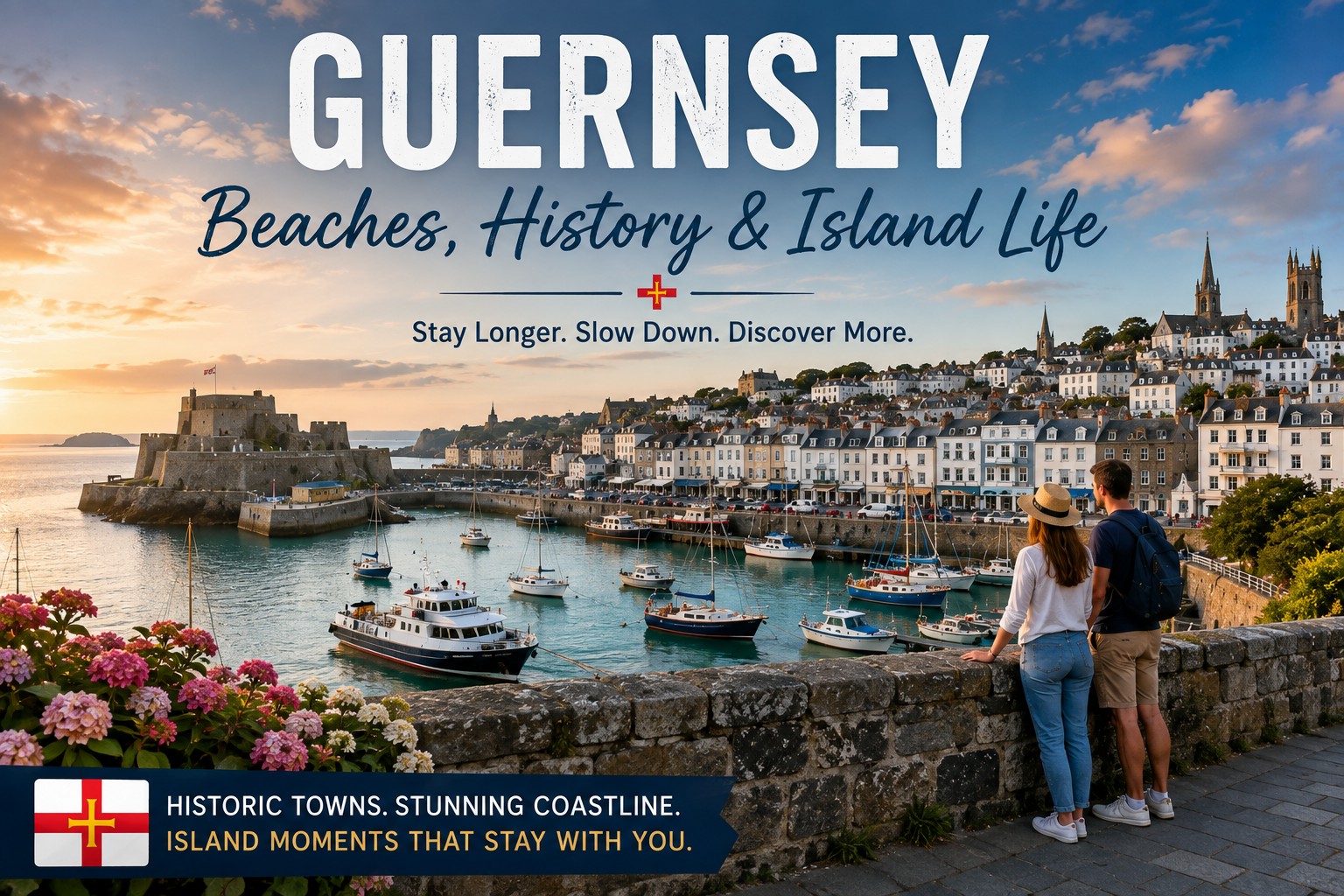
St Peter Port brings together many of Guernsey’s defining experiences, from its historic harbour and Castle Cornet to island life shaped by the surrounding sea
A first view of St Peter Port gives this Guernsey travel guide its natural starting point. Boats move across the harbour below a town that rises in tiers from the waterfront, while Castle Cornet guards the approaches and the open Channel stretches beyond. Within a relatively short distance, that urban harbour scene gives way to sandy bays, country lanes, cliff paths and stretches of coast where the sea repeatedly changes the view.
That variety is central to why you should visit Guernsey. This is not an island dependent on one headline attraction. A morning exploring centuries of history can lead naturally into an afternoon beside the sea, while another day might combine a coastal walk with lunch in a quiet bay before returning to St Peter Port for the evening.
History is equally difficult to separate from the landscape. Guernsey’s Norman inheritance reaches back centuries, German occupation during the Second World War left a remarkable physical legacy, and Victor Hugo’s years of exile created one of the Channel Islands’ most intriguing cultural connections with France. Yet beaches, seafood, harbour evenings and time deliberately left unplanned can be every bit as important to the holiday.
Guernsey also works at different scales. It can provide a complete short break or longer stay, serve as a base for discovering Herm and Sark, or become one stage of the wider Channel Islands route towards France introduced in our main Channel Islands guide.
The Channel Islands may open the door to Europe. Guernsey gives you a very good reason not to rush through it.
⚓ St Peter Port: A Harbour Town Worth Staying For
St Peter Port deserves more than the hours between arriving and heading elsewhere. Ferries, yachts and smaller boats bring constant movement to the waterfront, while narrow streets and lanes climb behind the harbour into a compact town of historic buildings, independent shops, cafés and restaurants.
Castle Cornet reinforces that sense of place. Standing immediately offshore from St Peter Port, the fortress gives the harbour a visible connection with centuries of maritime defence and helps explain why Guernsey’s position between Britain and France has repeatedly mattered far beyond the island’s modest size.
The town is also a practical base. Restaurants and cafés make evenings easy to enjoy without further travel, while bus connections provide access to beaches, countryside and other parts of Guernsey. The harbour also becomes important for travellers planning to explore neighbouring islands.
For many first-time visitors, that combination of atmosphere and convenience makes St Peter Port an appealing place to stay. You can begin a morning on foot, return easily after a day elsewhere and still have somewhere interesting to wander once sightseeing gives way to dinner.
It is not automatically the right choice for everyone. Travellers who picture waking beside a quieter bay, prioritising coastal walking or spending relatively little time in town may prefer accommodation elsewhere. Guernsey is compact enough for the decision to be based primarily on how you want the holiday to feel, rather than simply choosing the busiest or most convenient location.
🏖️ Beaches, Bays and a Coast That Keeps Changing
Guernsey beaches deserve more than a quick stop between attractions. The coast is one of the principal reasons to visit, but its character changes considerably according to where you go, what you want from the day and even when you arrive.
🏊 For Swimming and Relaxed Beach Days
Some bays encourage a deliberately uncomplicated plan: find a stretch of sand, swim when local conditions are suitable and allow several hours to pass without needing another attraction. Guernsey offers both broader beaches and more enclosed bays, creating choices between an expansive day beside the sea and somewhere that feels smaller and more sheltered.
👨👩👧 For Easy Family Days
Families may value a different combination: straightforward access, room on the sand, useful nearby facilities and enough flexibility for the beach itself to provide most of the entertainment. Rather than searching for one universally “best” family beach, it is more useful to match the coast to the children’s ages, current conditions and how much travelling you want to build around the day.
🌅 For Scenery and Quieter Coastal Time
Other parts of Guernsey’s coast reward visitors who are less interested in spending an entire day on the sand. Smaller bays, rocky shorelines and viewpoints above the sea can make travelling along the coast as memorable as reaching a particular destination, especially when beach time is combined with walking.
The tides add another dimension. As the sea advances and retreats, stretches of sand and rock can appear or disappear and a familiar-looking bay can take on a noticeably different character within the same day. That transformation is part of the pleasure of exploring Guernsey, but it also makes checking current tide and local swimming information sensible before planning a coastal day.
🥾 The Coast Is Better When You Slow Down
There are plenty of things to do in Guernsey, but trying to connect all of them as quickly as possible can mean missing one of the island’s greatest pleasures. Walking allows the coastline to unfold gradually.
Cliff paths and higher ground provide changing views across coves, bays and open water. Instead of driving to a viewpoint, taking a photograph and moving on, travelling on foot turns the landscape between places into part of the day. A beach first glimpsed from above may become the next stop; another path may lead towards a café, settlement or historical remnant that would have been easy to miss from the road.
You do not need to turn the holiday into a dedicated walking break. A carefully chosen coastal section can provide enough time on foot to change the rhythm of a day while still leaving room for swimming, lunch or an afternoon heritage visit.
Guernsey is small enough to make walking practical, but varied enough to make it rewarding.
Compact geography does not require a packed itinerary. Leaving the car behind for part of a day can actually make Guernsey feel larger, because attention shifts from covering distance to noticing what lies between destinations.
Walking also reveals how frequently the past remains embedded in the landscape. Fortifications, defensive positions and historic structures appear along a coastline whose strategic importance stretches back centuries.
On Guernsey, history is not always somewhere you deliberately go to find. Sometimes you encounter it simply by continuing along the coast.
🏰 Guernsey’s History Is Still in the Landscape
Guernsey history is unusually tangible. Castles, coastal defences and wartime structures remain part of the scenery, allowing visitors to encounter different periods of the past while exploring places they might already have chosen for their views.
🏯 Castle Cornet and a Strategic Island
Castle Cornet provides one of the clearest introductions. Standing at the entrance to St Peter Port harbour, the fortress occupied a position from which the approaches to the harbour and surrounding waters could be defended. Its setting helps explain something fundamental about Guernsey: this may be a small island, but its location between Britain and France has repeatedly given it significance beyond its size.
The castle works particularly well as a visitor experience because setting and history reinforce each other. Looking back towards St Peter Port or outward across the Channel makes Guernsey’s maritime story easier to understand than dates alone ever could.
⚔️ Norman Roots and a Distinct Island Identity
Guernsey’s connections with Normandy reach deep into its past. Norman inheritance, a long allegiance to the Crown and centuries of distinctive political development have helped shape a self-governing Crown Dependency with an identity that cannot be neatly described as simply British or French.
Traces of that inheritance survive in family and place names, traditions and the wider cultural landscape. For visitors arriving from Britain and perhaps continuing towards France, those layers make Guernsey feel like a genuine meeting point between different histories rather than merely a stepping stone across the Channel.
🎖️ Occupation and the Fortified Coast
The Second World War added a much darker layer. Guernsey, together with the other Channel Islands, experienced German occupation, leaving physical evidence that remains strikingly visible today.
Bunkers, fortifications and other defensive structures still punctuate parts of the landscape, while museums and preserved sites provide opportunities to understand what occupation meant for islanders themselves.
That story deserves sensitivity. The structures may be visually dramatic, but their deeper significance lies with the people who experienced occupation, evacuation, restrictions and eventual liberation.
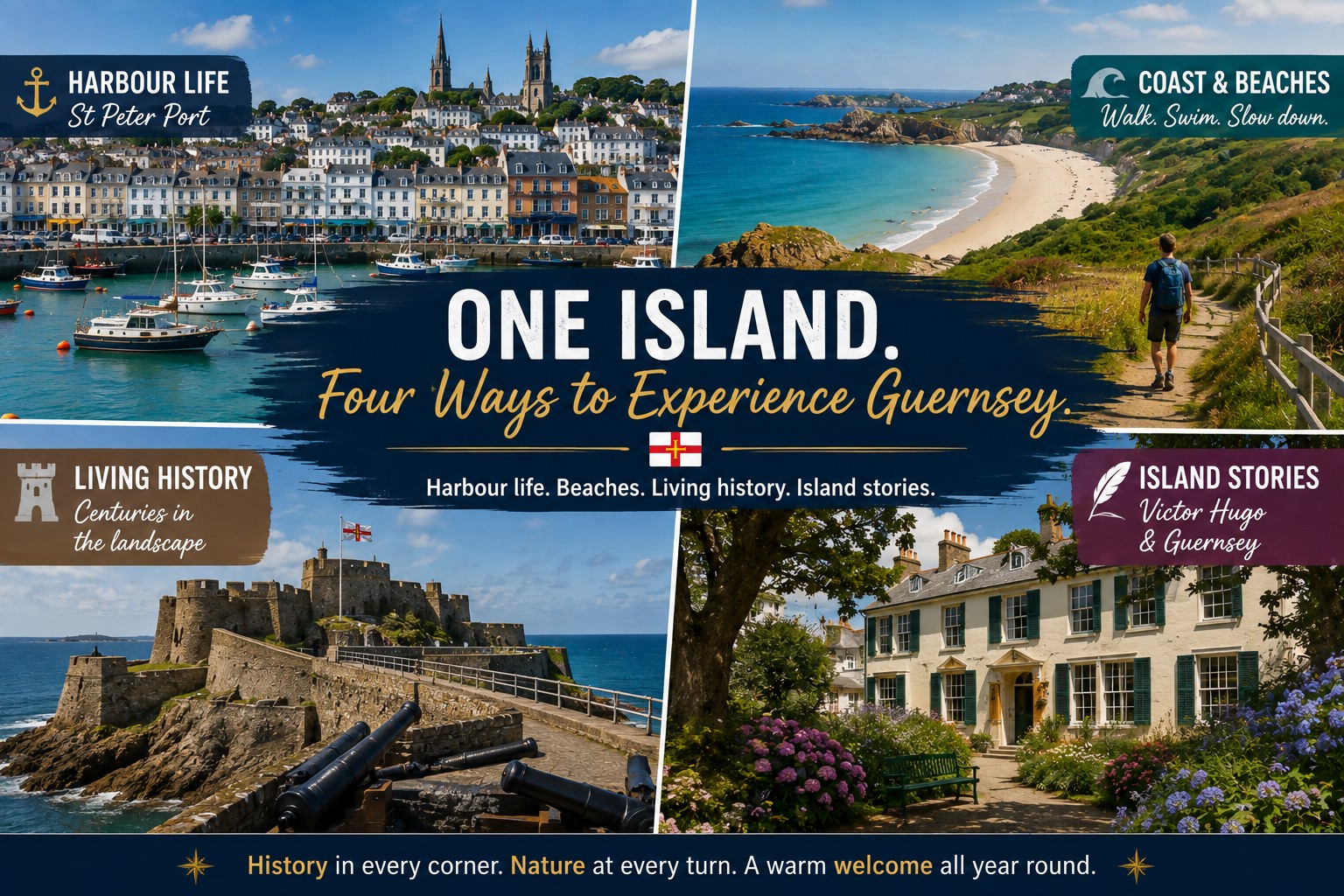
Guernsey brings together harbour life, beautiful coastline, centuries of visible history and distinctive cultural stories within one compact island
📚 Victor Hugo and the Guernsey Years
Victor Hugo’s connection with Guernsey gives the island a cultural story of international significance. The French writer arrived during political exile in the 19th century and made Hauteville House in St Peter Port his home, transforming it into an extraordinary residence that reflected his imagination almost as vividly as his writing did.
Guernsey became far more than somewhere Hugo waited for political circumstances to change. His years here formed one of the most productive periods of his career. He wrote significant parts of Les Misérables at Hauteville House and created Toilers of the Sea, the novel he dedicated to Guernsey and shaped around the maritime world he observed from the island.
For literary travellers, Hauteville House therefore offers more than the opportunity to visit a famous writer’s former home. Hugo’s story connects St Peter Port with European literature, political exile and the sea, while adding another dimension to the cultural relationship between Guernsey and France.
There is considerably more to discover about Hugo’s Guernsey years. For a first visit, however, the connection adds another layer to St Peter Port and another reason not to think of Guernsey solely as a beach destination.
🦞 Island Life: Food, Harbour Evenings and Leaving Space in the Day
Not every memorable part of Guernsey requires a historical explanation or a place on a sightseeing list. Part of the pleasure comes from allowing the rhythm of the destination to influence your own.
Food provides an easy introduction. Seafood belongs naturally on an island surrounded by productive waters, while local produce and Guernsey’s distinctive dairy heritage add flavour that genuinely belongs to the destination. A café can become a welcome pause during a coastal walk, while dinner around St Peter Port lets you enjoy the harbour after daytime visitors and excursions begin to wind down.
There is value, too, in exploring beyond the capital without treating every village or bay as another attraction to complete. Independent cafés, restaurants, shops and producers belong to the communities visitors have come to experience.
Some of Guernsey’s best moments may be the parts of the day you did not schedule.
That might mean lingering over lunch, returning to a bay that looked completely different at another stage of the tide, or leaving an evening free rather than filling it with another planned activity. On an island this compact, creating space in the itinerary is not wasting valuable time. It is one of the ways Guernsey begins to feel like somewhere you have experienced rather than somewhere you have merely toured.
⛴️ Guernsey as a Gateway to Herm and Sark
One of Guernsey’s greatest advantages is that staying longer does not necessarily mean repeating the same kind of day. Beyond its coastline lie smaller neighbours with markedly different rhythms, allowing Guernsey to remain the centre of the holiday while opening the door to genuine Channel Islands island hopping.
🥾 Herm: Beaches, Paths and Simplicity
Herm offers an immediate contrast to St Peter Port and Guernsey’s larger road network. Its tiny scale, walking paths and beaches encourage uncomplicated exploration, where moving around the island becomes part of the pleasure rather than a logistical exercise.
For visitors already enjoying Guernsey’s quieter side, Herm takes that simplicity another step. There is little reason to arrive with an ambitious sightseeing checklist. Walking, spending time beside the sea and experiencing a much smaller island on its own terms are central to its appeal.
🚲 Sark: Slow Travel Becomes the Experience
Sark changes the rhythm again. Its distinctive car-free character gives walking and cycling a much more prominent role in how visitors discover the island, making the movement between places part of what defines a day there.
That distinction matters. Sark is not merely another collection of coastal viewpoints reached by alternative transport; reducing speed changes how the landscape is encountered.
Herm and Sark therefore deserve to be treated as destinations rather than additions squeezed into spare hours. Sea connections should always be checked for your actual travel dates, especially when accommodation or other fixed plans depend on particular departures.
Alderney provides another possibility for travellers wanting to explore farther, although its location and connections make it better suited to deliberate planning than to automatic inclusion in every first Guernsey itinerary.
The question is not how many islands you can collect. It is whether changing islands will genuinely improve the holiday.
For travellers with only a couple of days, Guernsey itself deserves the available time. Once the stay becomes longer, however, Herm or Sark can introduce a striking contrast without requiring you to abandon Guernsey as the centre of the trip.
📆 How Long Should You Stay in Guernsey?
Guernsey can work as a short break, but the quality of the experience changes when you give yourself more time. Two days are enough for a focused introduction, perhaps combining St Peter Port with one carefully chosen stretch of coast and a major historical interest. It can be rewarding, but priorities will need to be clear.
Three or four days provide a more rounded first visit. There is room for St Peter Port, beaches, coastal walking and heritage without every morning beginning with a race through an itinerary. This is also when Guernsey’s unhurried character starts to influence the holiday rather than being something you briefly notice between attractions.
Five days or longer create genuine flexibility. You can revisit somewhere you particularly enjoyed, explore quieter corners and potentially devote meaningful time to Herm or Sark instead of treating another island as a hurried excursion.
| Time Available | Trip Style | Realistic Focus |
|---|---|---|
| 2 days | Focused introduction | St Peter Port plus selected coast and history |
| 3–4 days | Rounded first experience | Town, beaches, walking and heritage |
| 5+ days | Slower island holiday | Deeper Guernsey plus possible Herm or Sark |
Editorial Placeholder — Build Your Guernsey Stay Panel
Priority Feature Recommendation
Build Your Guernsey Stay Panel — Priority: High. Retain and build. The table establishes the time ranges; the panel should turn those ranges into practical itinerary choices rather than duplicate the table—for example, Short Break | Rounded First Visit | Guernsey + Smaller Island.
Allow additional usable time when adding neighbouring islands. Sea connections, weather and the simple process of getting to and from harbours mean a day on the calendar is not necessarily a full day of exploration.
🚌 Getting Around Guernsey: Do You Actually Need a Car?
Many visitors do not.
The better question is where you intend to stay and what you want to do. St Peter Port lends itself naturally to exploring on foot, while buses can make a car-free stay practical for travellers prepared to work with routes and timetables.
Cycling can combine transport with exploration for active visitors, although Guernsey’s terrain and changing weather should form part of that decision.
A car becomes more useful when maximum flexibility matters: perhaps you want to connect several less-central locations in one day, carry beach equipment or explore without arranging the day around public transport. Even then, Guernsey’s compact scale means hiring one should be a decision based on your plans rather than an automatic requirement.
| Transport Option | Best For | Main Advantage | Main Consideration |
|---|---|---|---|
| Walking | St Peter Port and selected coastal exploration | Immersive and naturally unhurried | Distance, hills and weather |
| Bus | Visitors travelling without a car | Practical access around the island | Routes and timetables require planning |
| Car | Travellers wanting maximum flexibility | Easier to combine several locations | Parking and whether you genuinely need one |
| Bike | Active travellers | Combines transport with exploration | Terrain, traffic and weather conditions |
The best solution may involve more than one mode. Walk around St Peter Port, use buses for another part of Guernsey and consider a car only when the freedom it provides will materially improve your plans.
That flexibility leads to another useful question: if distances are relatively short, do you actually need to travel quickly?
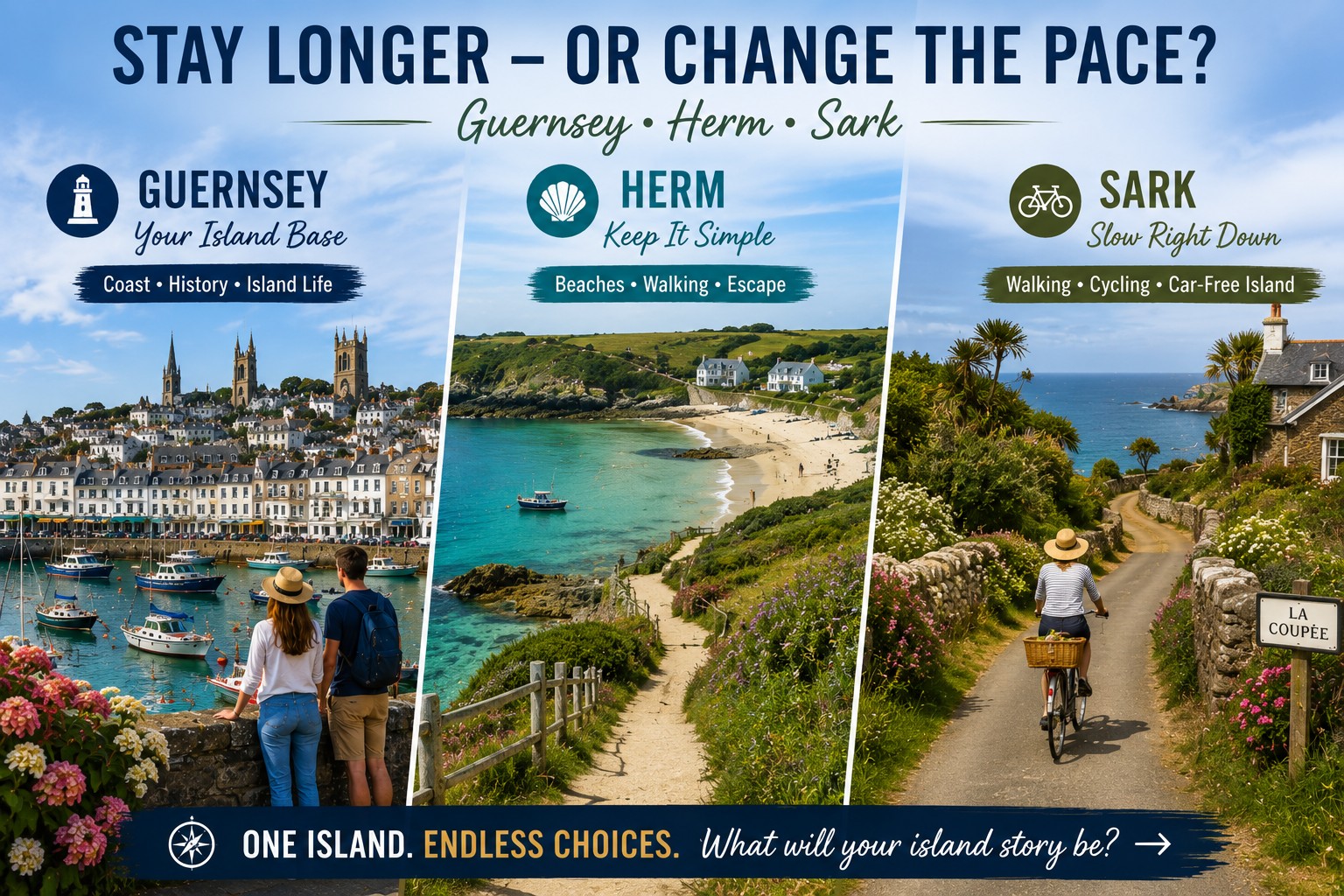
Guernsey makes an excellent island base, while nearby Herm offers beaches and simplicity and Sark provides a distinctive slower, car-free experience
🌿 Sustainable Guernsey: Make the Island Smaller, Not the Holiday Faster
Guernsey’s compact geography creates an opportunity to travel differently. Instead of using short distances as a reason to fit more into every day, they can make it easier to walk, use local transport and spend longer experiencing individual places.
That approach can improve the holiday as well as reduce unnecessary movement. Fewer accommodation changes and rushed transfers leave more time for beaches, coastal paths, cafés and heritage, while spending with independent businesses helps direct more visitor expenditure into the communities being explored.
The natural environment deserves particular care. Cliffs, beaches and wildlife habitats are fundamental to Guernsey’s appeal, so following marked routes, respecting local guidance and behaving responsibly around sensitive coastal areas all matter.
The aim is not to travel without impact. It is to make better-informed choices about how you move, where you spend and how much you try to fit into each day.
This philosophy applies equally when considering Herm, Sark or another extension. Adding a neighbouring island because it genuinely enriches the trip is very different from adding one simply to increase the destination count.
On Guernsey, travelling at a more considered pace can be both the more sustainable choice and the richer way to experience the destination.
Travel with purpose. Explore with care.
Keeping the holiday deliberately compact can therefore be deeply rewarding. Yet Guernsey’s position in the Channel creates another possibility: when you are ready to continue, the map opens remarkably quickly.
🇫🇷 When Guernsey Becomes Part of a Bigger Journey
Guernsey does not need another destination attached to it. A few days divided between St Peter Port, beaches, coastal paths, heritage and island life can create a complete holiday, while a longer stay can bring Herm or Sark into the itinerary without ever requiring you to leave the Channel Islands.
But geography naturally invites you to look farther.
The Norman inheritance encountered in Guernsey’s history, the French cultural connection represented by Victor Hugo and the island’s position close to the French coast all point towards northern France. What began as a Guernsey holiday can therefore become one stage of a wider route:
Britain → Channel Islands → Northern France → wider Europe.
How you arrange that progression is a separate decision. Independent travellers may enjoy choosing accommodation, checking connections and assembling every stage themselves. Others reach a point where coordinating islands, transport and an onward route into France begins to feel more like administration than anticipation.
BVT’s 12 Days to the Wonderful Channel Islands and Northern France provides an organised option for travellers attracted by this wider route but who would prefer its principal stages brought together within one coherent itinerary rather than assembling each element separately.
Neither approach is automatically better. Some travellers regard planning every connection as part of the adventure; others would rather devote that time to experiencing the places themselves.
Guernsey works naturally for both.
That flexibility is one reason Guernsey fits so naturally within the wider Touring Europe story. It can be the destination, a base for discovering neighbouring islands or the point at which a Channel Islands holiday begins to develop into a broader European itinerary.
Once northern France enters the picture, the possibilities expand again. Normandy provides a particularly coherent next chapter, with its coast, towns, countryside and extraordinary historical landscape offering substantial reasons to stay rather than simply travel through. From there, travellers can decide whether to explore France more deeply or continue farther into Europe.
📅 Use the BVT Europe Events Calendar 2026–2027 to Plan What Comes Next
When Guernsey forms part of a longer European trip, when you travel can begin to matter almost as much as where you go. The useful question is not simply what events are happening, but whether a major occasion could make your onward itinerary better — or considerably more difficult to organise.
A continuation through northern France and farther into Europe may coincide with festivals, cultural celebrations, sporting occasions or seasonal events worth deliberately incorporating. The same dates can also place additional pressure on accommodation and transport, making earlier planning particularly valuable.
The BVT Europe Events Calendar 2026–2027 provides a useful starting point for looking ahead. It can help identify experiences worth building into a wider trip while highlighting dates when demand elsewhere in Europe may influence your plans.
This does not mean every Guernsey holiday needs an event attached to it. The calendar becomes most useful when you are already considering what comes next and want the timing of the wider itinerary to work intelligently with the destinations ahead.
A special event might provide the perfect reason to continue towards another European destination. Equally, discovering that somewhere will be exceptionally busy could persuade you to change dates, remain longer in the Channel Islands or choose a quieter progression.
Good travel planning leaves room for both possibilities.
❓ Guernsey Travel FAQs
📆 How Many Days Do You Need in Guernsey?
Three or four days provide a useful framework for a rounded first visit, giving you time for St Peter Port, beaches, coastal walking and some of Guernsey’s history without making every day feel crowded.
A two-day stay can still work well if you choose priorities carefully. Five days or longer create more space for unhurried exploration and make adding Herm or Sark considerably easier.
🏖️ Does Guernsey Have Good Beaches?
Yes. Guernsey offers a varied coastline with sandy beaches, sheltered bays and more dramatic coastal settings that combine particularly well with walking.
The character of individual beaches can change significantly with the tides, so check current local tide, weather and swimming information when planning time beside the sea.
🚗 Do You Need a Car in Guernsey?
No. Many visitors can enjoy Guernsey without one, especially when staying in St Peter Port and combining walking with the island’s bus network.
A car becomes more useful if you value maximum flexibility, want to connect several locations efficiently or are staying somewhere less convenient for your particular plans. The best choice depends on the holiday you intend to have rather than Guernsey automatically requiring a hire car.
🇬🇬 Is Guernsey Better Than Jersey?
Neither island is universally better; they suit different travellers. Guernsey is particularly appealing when historic atmosphere, coastal walking, a relatively intimate scale and the possibility of continuing to Herm or Sark are high priorities.
Jersey is larger and offers its own substantial mixture of beaches, heritage, countryside and visitor experiences. Instead of asking which island wins, consider which one better matches the pace and character of holiday you want.
⛴️ Can You Visit Herm and Sark from Guernsey?
Yes. Guernsey provides a natural base for visiting both, and their contrast is part of the appeal.
Herm combines beaches, walking and remarkable small-island simplicity, while Sark offers a distinctive car-free environment where travelling by foot or bicycle changes the rhythm of exploration. Always check current sea services for your travel dates before making fixed plans around either visit.
🇫🇷 Can You Combine Guernsey with France?
Yes. Guernsey’s location and historical connections make northern France a particularly logical continuation for travellers who want a Channel Islands holiday to become part of a wider European itinerary.
The practical route will depend on transport services operating for your travel dates, so current connections should always be checked before committing to accommodation or onward arrangements. Where the itinerary works, however, the progression from Guernsey and the Channel Islands towards Normandy can feel far more coherent than treating the two as unrelated holidays.
It also changes the way you think about the trip. Instead of finishing one holiday and beginning another, you can follow a geographical and historical thread from the islands towards the nearby French coast and decide from there how much farther into Europe you want to travel.
🌍 A Small Island with a Much Bigger Journey Beyond It
Guernsey’s appeal ultimately comes from how comfortably different experiences coexist. St Peter Port provides harbour atmosphere and visible history; beaches and cliff paths bring the sea into almost every stage of the stay; occupation heritage reveals a more difficult past; and Victor Hugo adds an unexpected connection with European literary history.
Then come the quieter pleasures: seafood, a bay transformed by the tide, an afternoon spent walking without trying to reach another attraction, or an evening when there is nowhere else you particularly need to be.
Herm and Sark can change the pace again. Northern France can expand the route.
But Guernsey never needs to become merely somewhere passed through on the way to somewhere larger. Its greatest contribution to a wider European trip may be teaching you the value of doing precisely the opposite.
Stay long enough to understand the harbour. Walk some of the coast. Give the history the attention it deserves. Leave room for island life to interrupt the itinerary.
Sometimes the best way to begin a bigger European journey is to spend longer understanding the small island where it starts.