


Touring Europe from Britain: Where to Go First and How to Start Your Journey
6th September 2026
🌍 Touring Europe from Britain: Where to Go First and How to Start Your Journey
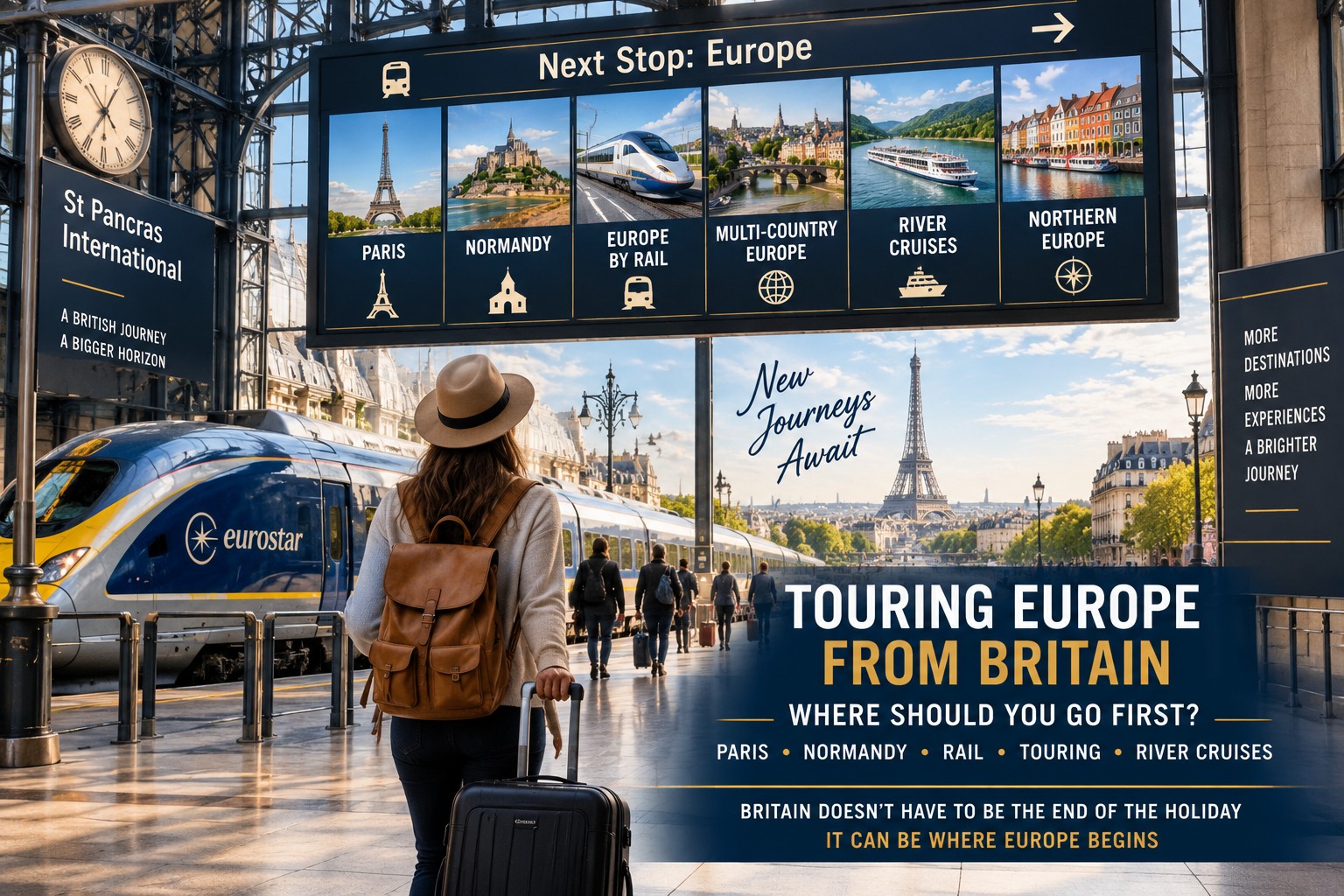
Britain can become the starting point for a wider European adventure, with Paris, Normandy, rail touring, multi-country journeys and river cruising offering very different ways to continue
Britain does not have to be the end of your holiday. For many travellers, it can become the beginning of a much larger European journey.
Perhaps you have spent several days exploring London, travelled through southern England, discovered Scotland or completed a wider tour through Britain and Ireland. You may even have travelled through the Channel Islands before continuing towards Normandy and begun to see how naturally a British holiday can expand into continental Europe.
If you are considering touring Europe from Britain, the first decision is not how many countries you can reach. It is what you want the next stage of the journey to feel like.
For many first-time visitors, France is the most natural first direction to consider, with Paris, Normandy and onward European rail journeys offering very different ways to begin. But France is not automatically the right answer. Some travellers want one great continental city before returning home. Others want to travel between European cities by rail, experience several countries on an organised journey or slow the pace aboard a river cruise.
The important question, therefore, is not: How many European countries can you fit into your holiday?
It is: What kind of European journey do you want to begin?
🧭 Where Should You Go First in Europe from Britain?
Europe offers so many possibilities that choosing a starting point can easily become more complicated than planning the journey itself. Rather than beginning with a list of famous countries and cities and attempting to connect them afterwards, start with the experience you want.
| If You Want…Consider Starting With…Why It Works | ||
|---|---|---|
| A first major continental city | Paris | Combines major sights and culture with strong possibilities for continuing farther into France and Europe |
| History and regional France | Normandy | Creates a more gradual transition from Britain into mainland Europe |
| Flexible city-to-city exploration | European rail | Allows the journey between destinations to become part of the experience |
| Several countries in one holiday | Multi-country touring | Provides a more structured way to combine destinations |
| A slower organised experience | River cruising | Reduces repeated hotel changes while making the route itself part of the holiday |
| Northern European cities and culture | Northern Europe | Opens a distinct European direction beyond France |
🇫🇷 Paris — For a First Major Continental City
Paris is an obvious candidate for travellers beginning their continental journey from Britain, but its strength is not simply that it is a famous city. It can perform two valuable roles within the same European holiday.
First, Paris deserves time as a destination in its own right. Its museums, architecture, neighbourhoods, food and cultural life can easily justify several days rather than being treated merely as somewhere to pass through.
Second, Paris can become a gateway. Once the city has been properly explored, travellers can consider continuing into other parts of France or building a broader European itinerary.
That combination makes Paris one of the strongest starting points for first-time visitors—but it does not automatically make it the right starting point for everyone.
⚜️ Normandy — For History and a Slower Transition
Not every traveller wants to leave Britain and immediately arrive in another major capital. If history, coastline, regional character and a gentler pace appeal more than the energy of a large city, Normandy can provide a particularly natural introduction to continental Europe.
This progression makes even greater sense for travellers who have already explored the Channel Islands. Their Norman connections create a fascinating historical bridge towards northern France, while Normandy itself opens several very different visitor experiences: medieval Bayeux, the D-Day beaches and memorial landscapes, Mont-Saint-Michel, historic towns, countryside and distinctive regional food.
Normandy should not be treated merely as somewhere to cross before reaching Paris. Giving the region several days allows the transition from Britain into France to develop at a more considered pace, with Paris remaining an attractive continuation rather than an automatic destination.
For travellers interested specifically in this progression, the wider Channel Islands to Normandy journey deserves its own planning consideration. Here, Normandy’s role is broader: it demonstrates that beginning a European journey does not necessarily mean beginning with a capital city.
🚆 European Rail — When the Journey Matters Too
Other travellers are less interested in choosing one region and more interested in connecting several European destinations logically.
Rail travel can work particularly well when the places you want to visit form a sensible geographical progression. Instead of selecting a collection of famous cities first and then discovering that the route between them is awkward, reverse the process: identify destinations that connect naturally and allow the journey itself to become part of the experience.
Paris can provide one starting point for this style of touring Europe, but the planning principle matters more than any individual route.
Choose destinations that form a logical journey before deciding how many cities to include.
This approach can reduce unnecessary backtracking while giving each stage of the trip a clearer relationship with the next.
🌍 Multi-Country Europe — When You Want Greater Variety
For some visitors, the attraction of touring Europe is precisely the opportunity to experience different countries, languages, cuisines, landscapes and cities within the same holiday.
Multi-country travel can be enormously rewarding, but it works best when variety does not come at the expense of experience. Four countries visited at a sensible pace can produce a far richer holiday than six or seven reduced largely to transfers, hotel check-ins and hurried sightseeing.
As the number of destinations increases, route design and logistics also become more important. This is where structured multi-country journeys can become attractive to travellers who want greater breadth without coordinating every stage themselves.
🚢 River Cruising — When You Want to Slow Down
A European journey does not have to become faster as it becomes larger. River cruising offers almost the opposite philosophy.
Instead of repeatedly changing accommodation as the itinerary progresses, travellers can use the ship as a moving base while experiencing destinations along the route. Organised sightseeing and a structured itinerary can reduce planning demands, while the river landscape becomes part of the journey itself.
For visitors who want to experience more of Europe but are wary of turning their holiday into a sequence of stations, airports and hotel changes, that slower rhythm can be particularly appealing.

Paris, Normandy, rail, multi-country touring, river cruising or Northern Europe — start with the European experience you want, then build the route around it
🗺️ Build Your European Journey from Britain
Once you have considered where you might want to go, the next step is to think about the shape of the journey rather than individual destinations in isolation.
A European itinerary can remain deliberately simple. Britain followed by several days in Paris may be exactly right for a traveller who wants two contrasting experiences without turning the holiday into a major logistical exercise. Add more time, however, and entirely different journeys become possible.
The strongest routes tend to have a sense of progression. Each destination earns its place because it adds something new while leading naturally towards what comes next.
| Journey Idea How the Trip Develops Best Suited To | ||
|---|---|---|
| Britain → Paris | Britain followed by one major continental city | Travellers wanting a simple first extension into Europe |
| Britain → Normandy → Paris | Regional France before continuing to the capital | History, culture and a more gradual transition |
| Britain → Paris → Europe by Rail | Paris becomes the gateway to a wider continental route | Independent travellers who enjoy city-to-city exploration |
| Britain → Multi-Country Europe | Several countries form one structured journey | Travellers wanting greater variety and geographical breadth |
| Britain → European River Cruise | A British holiday continues into a slower organised European experience | Travellers prioritising comfort and fewer accommodation changes |
| Britain → Channel Islands → Normandy → Paris | Islands, northern France and Paris form a progressive cross-Channel journey | Travellers wanting the Channel Islands within a larger European itinerary |
The important planning principle is straightforward:
Choose the shape of the journey before collecting destinations.
A coherent itinerary should feel as though one place leads naturally towards the next. If destinations are being added simply because they are famous or appear close on a map, the resulting holiday can quickly become more complicated than rewarding.
⏳ How Much Time Do You Have After Britain?
Time is one of the best filters for reducing the enormous number of European possibilities.
A traveller with four days remaining after London should approach Europe very differently from someone with another two weeks available. Trying to make both itineraries cover the same number of countries usually results in the shorter trip sacrificing the experiences that made continuing into Europe attractive in the first place.
| Time Available After Britain A Sensible Starting Approach | |
|---|---|
| 3–4 days | Concentrate on one major city or one focused region |
| 5–7 days | Consider one or two destinations or a shorter structured European journey |
| 8–12 days | Multi-country touring becomes considerably more practical |
| 2+ weeks | Britain can be combined with a substantial European itinerary |
Remember that travelling between destinations consumes real holiday time. Hotel changes, station or airport transfers, checking in and out, and simply getting oriented in a new place all reduce the hours available for exploration.
Arrival and departure days should therefore not automatically be counted as full sightseeing days. A less ambitious route can often create a more memorable European holiday because it gives you time for neighbourhoods, regional food, museums, landscapes and unplanned discoveries rather than constantly preparing for the next departure.
Let the time available determine the number of destinations—not the number of destinations determine the pace.
🚆 How Do You Want to Experience Europe?
Choosing where to go is only part of planning a European journey. How you want to travel can be just as important as the destinations themselves.
The same two-week itinerary can feel completely different depending on whether you plan every stage independently, connect cities by rail, join an organised multi-country tour or travel more slowly along a European river. The best choice depends on the balance you want between freedom, convenience, structure and pace.
🎒 Independent Touring — For Maximum Freedom
Independent travel offers the greatest control. You choose where to stay, how long to remain and how much structure you want around each day.
That flexibility particularly suits confident planners and travellers who enjoy researching accommodation, transport and experiences themselves. It also makes it easier to spend longer somewhere you unexpectedly love or build the journey around specialist interests.
The trade-off is responsibility. As the itinerary becomes more ambitious, you must coordinate more bookings, connections and transfers yourself.
🚆 Rail Travel — For Independent City-to-City Exploration
Rail can provide an excellent middle ground for travellers who value independence but want destinations to connect naturally.
It is particularly effective for city-to-city journeys where travelling between places contributes to the experience. Instead of treating every transfer as lost holiday time, the changing landscapes and progression between regions can become part of the day’s journey.
The key is still route discipline. Travelling by train does not automatically make an overambitious itinerary sensible.
🚌 Organised Multi-Country Touring — For Easier Logistics
Organised touring becomes increasingly attractive as logistical complexity grows. Accommodation, transport and much of the sightseeing structure can be coordinated within one journey, leaving the traveller with fewer separate arrangements to manage.
This can be particularly valuable for a first multi-country European holiday, or when available time is limited and you want several destinations to fit together efficiently.
The trade-off is reduced flexibility. A structured itinerary inevitably gives travellers less control over how long they spend in each place.
🚢 European River Cruising — For a Slower Structured Journey
River cruising offers a different balance again. The itinerary remains structured, but repeated hotel changes can largely disappear because your accommodation travels with you.
This can suit visitors who prefer a slower rhythm, appreciate organised sightseeing and want the landscape between destinations to become part of the holiday rather than simply something crossed on the way.
| Factor Independent Touring Rail Journey Organised Tour River Cruise | ||||
|---|---|---|---|---|
| Flexibility | Highest | High | More structured | Structured |
| Planning required | Highest | Moderate to high | Lower | Lower |
| Multi-destination practicality | Depends on itinerary | Strong on logical routes | Strong | Determined by cruise route |
| Accommodation changes | Variable | Usually several | Usually several | Minimal |
| Guided context | Optional | Optional | Often included | Often included |
| Best for | Confident planners | Independent explorers | Travellers seeking convenience | Travellers preferring a slower organised pace |
There is no universally superior way to tour Europe. The strongest choice is the one that matches how much freedom you want, how much planning you enjoy and how you want the journey itself to feel.
🧳 Independent or Organised — Which Is Better for Touring Europe?
For many travellers, the most important decision is not which country to visit first but how much of the journey they want to organise themselves.
Independent touring gives you control. You can choose your accommodation, decide how long to remain in each destination, spend longer somewhere you unexpectedly love and build the itinerary around your own interests. For travellers who enjoy planning and are comfortable coordinating transport, accommodation and activities, that freedom can become one of the pleasures of touring Europe.
The challenge grows as the journey expands. Adding countries means adding connections, hotel changes, individual bookings and more opportunities for logistical complications. A route that appears straightforward on a map can involve considerably more organisation once luggage, transfers, arrival times and sightseeing are considered.
Organised touring approaches the same challenge differently. Much of the logistical framework is already established, which can make it easier to experience several destinations within a limited period. Planned sightseeing and guiding can also provide valuable context, particularly when the journey crosses several regions or countries.
Neither approach is inherently better.
The real question is how much flexibility you want compared with how much logistical responsibility you want to carry.
| Choose Independent Touring If…Consider Organised Touring If… | |
|---|---|
| You enjoy researching and building itineraries | You would rather have the principal route organised |
| Flexibility is a major priority | Convenience is a major priority |
| You want control over accommodation | You prefer accommodation and transport to form part of one journey |
| You are comfortable managing connections | You want to reduce logistical complexity |
| You value changing plans as you travel | You value knowing the broad structure before departure |
⭐ Which European Journey Matches Your Time and Ambition?
Once you know approximately how much time you have and how much organisation you want to manage yourself, specific European journeys become much easier to evaluate.
The useful question is no longer simply “Which tour should I book?” It becomes: “Which journey actually fits the holiday I am trying to create?”
⭐ A Shorter Introduction to Multi-Country Europe
The 7 Day Europe Taster Tour – 4 Countries Budget Europe Trip is worth considering for travellers who want their first experience of multi-country touring to remain relatively compact.
Its purpose is not simply to maximise the number of countries visited. It provides an option for travellers who want the variety of a wider European journey but do not have the time—or desire—for a substantially longer itinerary.
⭐ Start in Britain and Continue Across Europe
The 8 Day – London to Rome journey is particularly relevant here because its fundamental idea mirrors the journey explored throughout this guide: Britain becomes the starting point rather than the finishing point.
For travellers who want to move beyond London and experience a structured progression into continental Europe, this is the kind of itinerary worth comparing directly with an independently planned route.
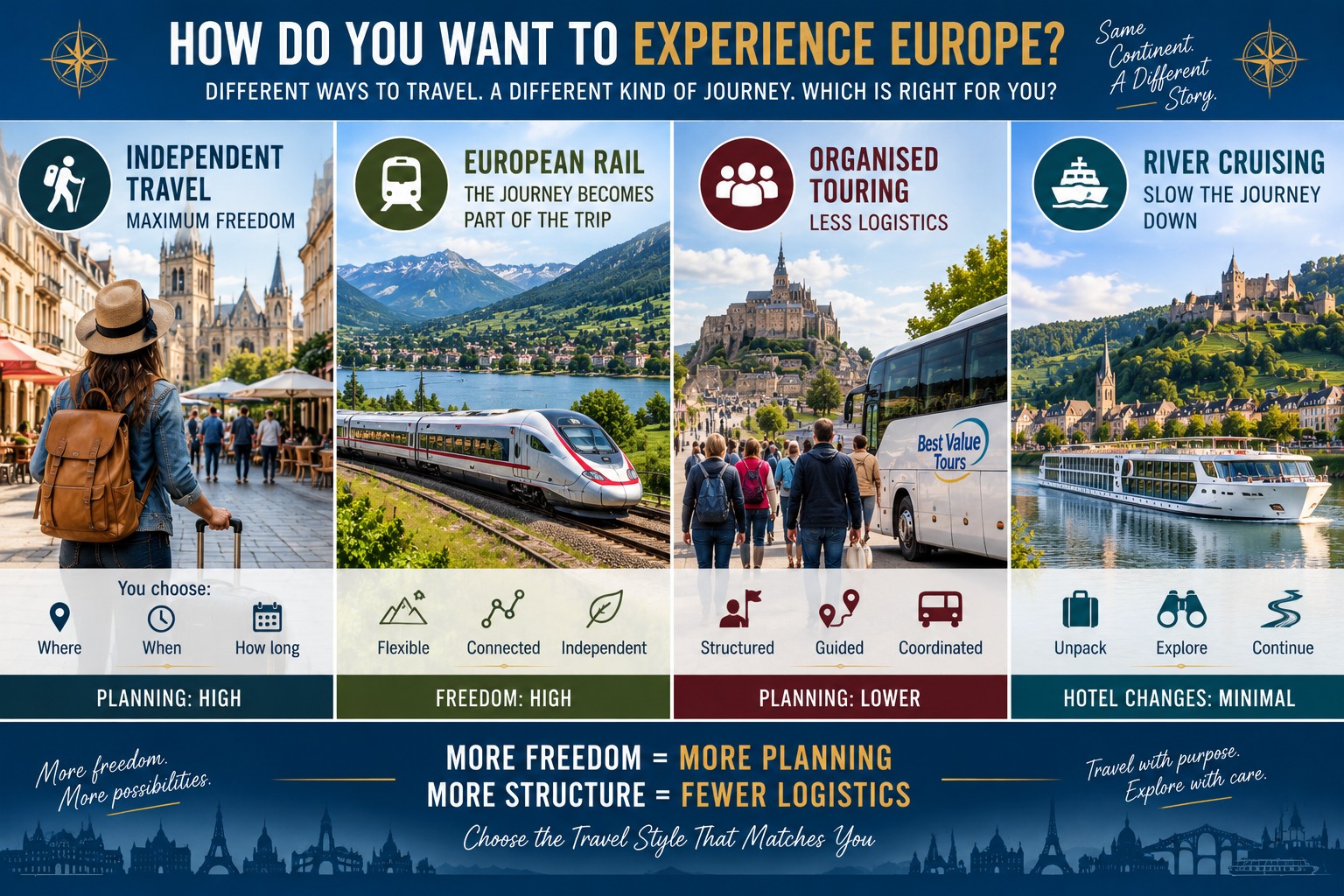
Independent travel, European rail, organised touring or river cruising — choose the travel style that matches the balance of freedom, convenience, planning and pace you want
⭐ Build a More Substantial European Experience
Travellers with more time can consider a journey such as the 12 Day – European Experience Tour, where the additional days create scope for a broader European experience.
The advantage of having longer is not simply that more destinations can be added. Extra time can make the overall progression feel less compressed and allow the contrasts between countries, cities and landscapes to become a more meaningful part of the holiday.
The same principle should be applied when comparing any longer European itinerary: greater duration should create greater depth and variety—not simply a longer list of destinations squeezed into the schedule.
| Your Time & Ambition Journey to Consider Why It May Fit | ||
|---|---|---|
| 7 days — A compact introduction | 7 Day Europe Taster Tour – 4 Countries Budget Europe Trip | For travellers wanting a relatively short introduction to multi-country Europe |
| 8 days — Britain into Europe | 8 Day – London to Rome | Particularly relevant when London is the starting point for a wider European journey |
| 12 days — A broader experience | 12 Day – European Experience Tour | For travellers with more time who want a more substantial European itinerary |
These examples are most useful as comparison points, not as a declaration that one itinerary is universally best. A traveller who values independence may still prefer to build a rail journey themselves, while someone prioritising coordinated logistics may find an organised route better suited to the holiday they want.
🚢 What If You Want to Slow the Journey Down?
Not every traveller who wants to see more of Europe wants to keep changing hotels, navigating stations or preparing for the next transfer. If the idea of a wider European journey appeals but the logistics do not, river cruising offers a distinctly different way to travel.
Instead of moving your luggage from destination to destination, your accommodation travels with you. Days can combine time ashore with the experience of moving through river landscapes, historic towns and regional countryside, while much of the wider itinerary is already structured.
This does not make river cruising automatically easier or better than rail or escorted touring. It simply answers a different traveller need. Visitors who value maximum independence may prefer building their own route, while those who want a more settled base, fewer accommodation changes and a slower rhythm may find cruising particularly attractive.
A river cruise can also form one stage of a larger Britain-and-Europe holiday rather than representing the entire trip. Time in Britain or Paris, for example, can sit before or after the cruise, allowing the overall journey to combine contrasting travel styles without forcing every destination into the same format.
🎭 Could an Event Decide Where You Go First?
Sometimes the best place to begin a European journey is determined not by geography, but by what is happening when you travel.
A major festival, sporting event, cultural celebration, exhibition, historical commemoration or Christmas market can transform a destination from somewhere you might visit into one of the principal reasons for making the journey. An event can influence not only where you go, but when you travel, how long you stay and which surrounding destinations make sense within the same itinerary.
This is worth considering before the route is fixed. Popular events can increase demand for accommodation and transport, while seasonal celebrations may take place within relatively short periods. Discovering something important after flights, hotels and an itinerary have already been arranged can make changing the journey considerably more difficult.
The BVT Europe Events Calendar 2026–2027 provides a useful starting point for discovering events that could help shape your plans. Rather than constructing an entire itinerary first and checking what happens to be taking place afterwards, consider whether an event you genuinely want to experience deserves to become one of the anchors around which the journey is built.
🌱 Build a Better European Journey — Not Just a Bigger One
Responsible European travel does not have to begin with complicated rules. Some of the most practical choices are also the ones that can make an itinerary more enjoyable.
Travel in a logical geographical direction where possible rather than repeatedly backtracking across Europe. Consider rail and public transport where they are practical for the journey you are making, and give individual destinations enough time to be experienced beyond their headline attractions.
Slowing the itinerary can also create space to look beyond major capitals. Regional towns, smaller cities and countryside destinations can reveal a very different side of a country, while longer stays provide more opportunities to eat locally, use independent businesses, meet local guides and understand the character of the places you have travelled to see.
Sustainability therefore does not have to sit separately from good itinerary planning. A route with fewer unnecessary transfers, sensible geographical progression and enough time in each destination can be better for the visitor experience as well as more considerate of the places through which you travel.
One of the best ways to make a European journey more responsible is also one of the best ways to make it more enjoyable: travel logically, stay longer and experience fewer places properly.
Travel with purpose. Explore with care.
❓ Touring Europe from Britain FAQs
🇪🇺 Where should I go first in Europe from Britain?
There is no single best starting point. For many first-time visitors, France is a natural first direction, with Paris offering a major continental city and Normandy providing a slower, more regional introduction. If the wider journey matters more than one destination, European rail, organised multi-country touring or a river cruise may provide a better framework.
🇫🇷 What is the easiest European country to visit from Britain?
France is one of the most natural countries to consider because it supports several very different types of journey, from Paris and Normandy to regional touring and onward travel into wider Europe. Convenience should not be the only deciding factor, however. Your available time, interests and intended route matter more than simply choosing the closest or most obvious destination.
🗼 Is Paris the best place to start a European trip?
Paris is an excellent starting point for many travellers, particularly first-time visitors who want to experience a major European city before travelling farther. It can also act as a gateway for onward journeys through France and continental Europe. Travellers prioritising regional history, slower travel or a different geographical direction may prefer to begin elsewhere.
🚆 Can you tour Europe by train from London?
Yes. Rail can form the backbone of a wider European journey from London, particularly when destinations are chosen in a logical geographical sequence. Rather than trying to include as many cities as possible, build the itinerary around places that connect sensibly and allow enough time for each destination.
⏳ How many days do you need for a European tour?
The answer depends on the scale of the journey. Three or four days can work well for one focused destination after Britain, while five to seven days provides more flexibility for one or two places. Around eight to twelve days makes a broader multi-destination journey more realistic, while two weeks or longer creates considerably greater scope without automatically forcing the pace.
🇬🇧 Can you combine Britain and Europe in one holiday?
Yes. Britain and continental Europe can form complementary stages of the same holiday when sufficient time is available. The strongest itineraries avoid treating Britain as somewhere to rush through before reaching Europe; instead, each stage receives enough time to justify its place within the overall journey.
🧳 Is it better to tour Europe independently or join an organised tour?
Neither approach is universally better. Independent touring provides greater flexibility and control, while organised touring can reduce the logistical burden of coordinating several destinations. The right choice depends largely on your preferred balance between freedom, convenience and planning responsibility.
Phase Two density note: I would stop at these four FAQ links. The FAQ block benefits from useful contextual routes, but linking every answer would add repetition rather than meaningful cluster strength. All four destinations above are verified against the current authoritative Touring Europe master.
🌍 What is the best way to visit several European countries?
Start with a geographically coherent route rather than a target number of countries. Then consider how much time you have, how long the transfers will take, how frequently you are prepared to change accommodation and whether you want to manage the logistics yourself.
Rail can work particularly well when cities connect naturally, while an organised multi-country tour can reduce the planning involved in combining several destinations. Whichever approach you choose, resist the temptation to judge the quality of the journey by the number of borders crossed. A smaller number of destinations experienced properly can produce a much richer European holiday.
🚢 Are European river cruises suitable for first-time visitors?
They can be. River cruising can particularly suit first-time visitors who prefer a structured itinerary, fewer accommodation changes and a slower travel rhythm while still experiencing several destinations.
They are less suited to travellers whose priorities are maximum independence, spontaneous itinerary changes or complete control over the amount of time spent in each place. As with rail and organised touring, the best choice depends on the experience you want rather than one travel style being universally superior.
🏝️ Can you visit the Channel Islands before touring mainland Europe?
Yes. The Channel Islands can be destinations in their own right while also forming part of a wider journey towards continental Europe.
One particularly coherent progression is Britain → Channel Islands → Normandy → France, after which the journey can continue towards Paris or farther into Europe. This route demonstrates an important planning principle: Europe does not have to begin with a flight into a famous capital. It can unfold gradually, with each destination creating a reason to consider the next.
🌅 Final Thoughts — Let Britain Become the Beginning
A journey through Britain deserves enough time to stand on its own. London, southern England, Scotland, the Channel Islands and the wider UK and Ireland all offer more than enough reason to resist treating Britain simply as a departure point for somewhere else.
But when the British stage of your holiday is complete, Europe can provide a remarkable next chapter.
That continuation does not have to follow one prescribed route. You might cross into Normandy and discover regional France before reaching Paris. You could make Paris your first continental destination and continue by rail. With more time, several countries can become part of one coherent journey, while travellers seeking greater structure might prefer an organised European tour or the slower rhythm of a river cruise.
The strongest itinerary is rarely the one with the longest list of countries. It is the one where the route makes sense, the pace remains enjoyable and every destination has enough time to become more than another photograph and hotel stop.
The best European journey is not necessarily the one that reaches the most countries. It is the one in which every destination earns its place.
Britain can therefore be much more than one part of a European holiday.
It can be where the journey begins.
🧭 Continue Your Touring Europe Journey
Once you have decided that Britain will become the starting point for a wider European adventure, the next step is to explore the route that best matches your interests, available time and preferred way of travelling.
There is no need to plan the whole of Europe at once. Start with the next sensible decision and allow the journey to develop from there.
🏝️ Channel Islands Travel Guide
Discover Guernsey, Jersey, Sark, Herm and Alderney as rewarding destinations in their own right, and understand how the islands can also become part of a wider journey between Britain and continental Europe.