


France Travel Guide: Where to Go, What to See and How to Explore
3rd October 2026
🇫🇷 France Travel Guide: Where to Go, What to See and How to Explore
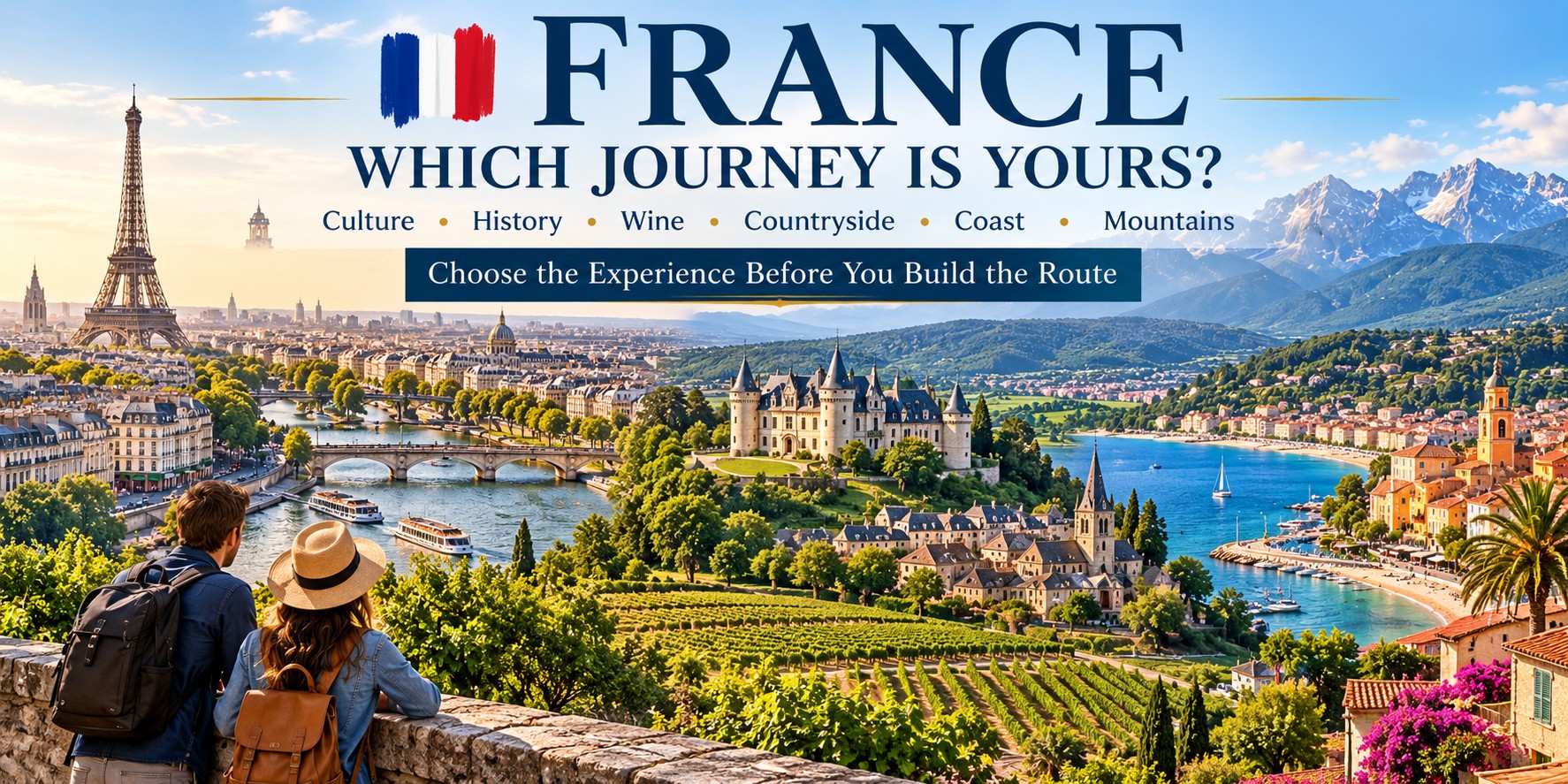
From Paris and historic heritage to vineyards, Mediterranean landscapes and the mountains, France offers very different journeys. Start with the experience you want, then build the route around it
France is easy to put on a travel wish list and surprisingly difficult to turn into a good itinerary. Paris alone could occupy several days, while beyond the capital lie historic Normandy, the vineyards of Burgundy and Bordeaux, the châteaux of the Loire Valley, the landscapes of Provence, Mediterranean towns and coastlines, and the mountains of eastern France.
The challenge is not finding somewhere worth visiting. It is deciding which version of France you actually want to experience.
For some travellers, the answer is an immersive few days in Paris. Others may value the historic landscapes of Normandy, a slower journey through wine country, the warmth and character of southern France or a route combining contrasting regions. Trying to include all of them can turn an exciting holiday into a succession of stations, roads and hotel check-ins.
A better starting point is to think about experience before geography. Decide whether culture, history, food and wine, countryside, coast, mountain scenery or simply slower French life matters most to you. Then consider how much time you genuinely have and choose the places that best deliver those experiences.
This guide is designed to help you do exactly that: understand the major choices, decide what deserves your time and build a journey in which every destination has a reason to be there.
🧭 Where Should You Go in France?
There is no single route that represents France properly. Its regions differ considerably in landscape, food, history and pace, so choosing where to go is less about identifying the country’s universally “best” destinations and more about finding the places that suit your trip.
🗼 Paris — Culture, Landmarks and the Classic First Encounter
Paris is an obvious starting point for many first-time visitors, and for good reason. Museums, architecture, historic streets, neighbourhood cafés, gardens, markets and some of Europe’s most recognisable landmarks are concentrated within one city.
Yet Paris works best when it is treated as somewhere to experience rather than a collection of monuments to complete. Leaving time for neighbourhoods, meals and unplanned exploration can be as important as visiting the headline sights.
For a short trip, Paris can comfortably be the entire destination. On a longer holiday, it can instead become the beginning or end of a wider journey through France.
⚜️ Normandy — History, Coast and Regional France
Normandy offers a markedly different experience. Its appeal combines countryside and coastline with medieval heritage and the powerful history of the D-Day landings.
Bayeux can provide a practical base for exploring some of that history, while Mont-Saint-Michel represents another side of the region’s extraordinary heritage. Elsewhere, coastal landscapes, towns and rural communities make Normandy much more than a battlefield destination.
It particularly suits travellers who want history embedded within a wider regional experience rather than concentrated entirely in museums and city landmarks.
🍷 Burgundy — Wine, Food and Slower France
Burgundy rewards a different pace again. Vineyards, historic settlements, regional cuisine and a strong sense of place make it particularly attractive to travellers who would rather explore one area properly than move rapidly between major cities.
Wine is central to Burgundy’s identity, but it need not be the traveller’s only reason for visiting. The combination of landscapes, heritage, food and smaller communities can make the region an appealing counterpoint to Paris.
This is the kind of France where slowing down can become part of the experience rather than a compromise.
🍇 Bordeaux and South-West France — City and Wine Country
Bordeaux combines the advantages of a substantial city with access to one of the world’s best-known wine-producing landscapes. That makes it useful for travellers who want urban culture and gastronomy without making their entire holiday city-based.
The surrounding region broadens the experience considerably, particularly for those interested in food, wine and the character of south-western France.
The important planning distinction is that Bordeaux can be more than a stop on a wine itinerary: it can serve as an anchor for a wider regional stay.
☀️ Provence and the Mediterranean South — Landscapes and Southern France
Southern France can feel dramatically different from the north. Provence brings together historic towns, markets, distinctive food and rural landscapes, with a rhythm that can encourage exploration beyond major attractions.
Continue towards the Mediterranean and another layer appears: coastal scenery, historic ports, beaches and cities shaped by centuries of movement around the Mediterranean.
For travellers attracted by landscape, food, outdoor life and a slower pace, southern France may deserve to become the centre of the journey rather than an addition to Paris.
🏰 The Loire Valley — Châteaux, Landscapes and French Heritage
The Loire Valley is especially appealing when architecture and heritage are priorities. Its famous châteaux sit within a broader landscape of rivers, towns, villages and countryside, allowing history to become part of a regional journey rather than a sequence of isolated monuments.
It can work particularly well for travellers who enjoy exploring at a measured pace and want a strong sense of historic France without relying entirely on major cities.
🏔️ The Alps and Eastern France — Mountains and a Different Landscape
Eastern France provides another reminder of the country’s geographical range. Alpine landscapes offer mountain scenery and outdoor experiences far removed from the boulevards of Paris or the vineyards of western France.
This part of the country is especially relevant to travellers whose idea of France includes mountains, lakes, scenery and active exploration. It can also fit naturally into journeys that eventually continue farther into continental Europe.
These regions are not competing for places on one enormous itinerary. They offer different answers to the same question: what do you want your time in France to be about?
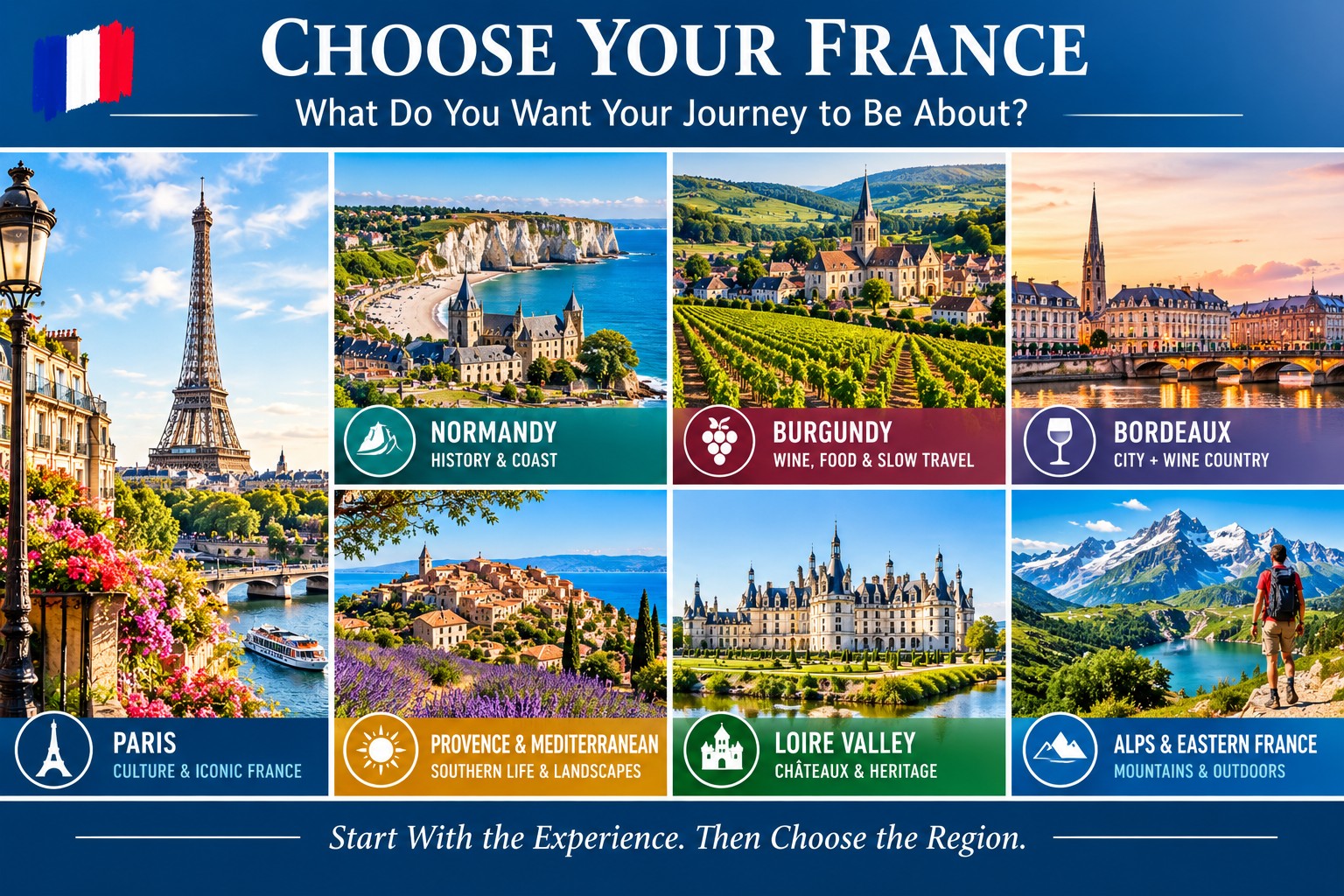
Paris, Normandy, Burgundy, Bordeaux, Provence, the Loire Valley or the Alps — start with the experience you want, then choose the part of France that delivers it
📊 Which Part of France Matches Your Travel Style?
A useful way to narrow the choice is to start with your strongest interest rather than the most famous destination.
| Traveller Priority | Strong Area to Consider | Principal Appeal | Particularly Suited To |
|---|---|---|---|
| Major culture and iconic sights | Paris | Museums, architecture, food and city life | First visits and city-focused breaks |
| History and coastline | Normandy | Historic landscapes, coast and countryside | History-led regional journeys |
| Wine, food and slower touring | Burgundy | Vineyards, gastronomy and smaller places | Travellers prioritising depth and pace |
| City plus wine country | Bordeaux and South-West France | Urban culture with regional exploration | Food-and-wine journeys with variety |
| Southern landscapes and lifestyle | Provence and Mediterranean France | Markets, historic towns, countryside and coast | Slower, landscape-led holidays |
| Châteaux and heritage | Loire Valley | Architecture, history and countryside | Heritage-focused regional exploration |
| Mountains and outdoor scenery | Alps and Eastern France | Mountain landscapes and active experiences | Scenery and outdoor-focused travellers |
The table is most useful as an elimination tool. If vineyards, regional food and slow travel are the main attraction, there is no reason to design the entire holiday around Paris simply because it is France’s most famous city. Equally, someone travelling primarily for museums, architecture and urban culture may gain more from staying longer in Paris than from adding distant regions simply for variety.🗼 Should You Visit Paris Only — or Explore Beyond the Capital?
For many first-time visitors, one of the hardest decisions is not whether to visit Paris, but how much of the holiday Paris should occupy. The answer depends less on what travellers feel they ought to see and more on the experience they actually want.
A Paris-focused trip makes excellent sense when time is limited or when museums, architecture, neighbourhoods, food and city culture are the main priorities. Staying in one place also removes repeated transfers and gives the city room to become more than a sequence of major sights. A shorter holiday does not automatically become better because another region has been squeezed into it.
With more time, Paris plus one contrasting region can provide a particularly satisfying introduction to France. The capital might be followed by Normandy for history and coast, the Loire Valley for heritage and countryside, or a wine-producing region for a slower experience. The important point is that the second destination should add something genuinely different.
Paris is not compulsory, either. Travellers who already know the capital—or whose priorities are vineyards, countryside, mountains, coast or regional life—may have a better holiday by concentrating entirely on another part of France.
Leaving somewhere famous out is not a planning failure. Often, it is what allows the places you do choose to be experienced properly.
⏳ How Much of France Can You Realistically See?
France’s size and variety can encourage ambitious itineraries. A route may look perfectly manageable when represented by dots on a map, yet feel very different once transfers, hotel changes, arrival days and onward travel are included.
The amount of France worth attempting should therefore be determined by usable time, not simply the number of destinations that appeal to you.
| Time Available | Sensible Scope | Typical Journey Shape | Main Risk |
|---|---|---|---|
| 3–4 days | One focused destination | Paris or a concentrated regional stay | Losing too much time by adding another base |
| 5–7 days | One principal area, or a carefully chosen second base | Paris in depth, one region, or a simple two-centre journey | Trying to create a national tour in one week |
| 8–10 days | Greater contrast becomes realistic | Paris plus one region, or deeper regional touring | Adding destinations faster than available time |
| 10–14 days | Meaningful multi-region travel | Two or more complementary areas connected logically | Underestimating transfer and settling-in time |
| 2+ weeks | Broader exploration | A more extensive route with time for regional depth | Assuming extra days must mean extra destinations These are planning frameworks rather than rigid rules. A well-connected two-centre journey may be comfortable within a week, while a geographically scattered itinerary can feel rushed even over ten days. The hidden cost is often transition time. Checking out, reaching a station or collecting a car, travelling, finding the next accommodation and settling in all consume part of a day. A two-hour journey is rarely only two hours in practical holiday terms. |
Arrival and departure days also deserve realistic treatment. If you arrive late or need to leave early for the journey home, those days cannot carry the same expectations as a full day based in one place.
A useful principle is therefore to let the time available determine the geographical scope, rather than allowing a long wish list to dictate the pace.
🗺️ One Region or a Multi-Region France Journey?
Once you know roughly how much time you have, the next question is whether to explore one part of France deeply or combine several.
A single-region journey offers obvious advantages. There are fewer transfers, more flexibility and more opportunities to explore beyond headline attractions. Staying longer can also make room for markets, smaller towns, countryside and spontaneous discoveries that are difficult to accommodate when every day has a fixed onward destination.
This approach can be particularly rewarding for travellers with a strong interest. Someone primarily interested in Burgundy’s food, wine and landscapes does not necessarily improve the holiday by adding an unrelated destination hundreds of kilometres away.
A multi-region journey, however, can reveal how varied France really is. Combining a major city with countryside, history with gastronomy, or northern France with the south can create valuable contrast. With sufficient time, moving between regions becomes part of a coherent journey rather than an interruption.
The crucial test is whether each additional region has a job to do.
Does it introduce an experience you genuinely want? Does it fit the geographical direction of travel? Is there enough time to experience it after getting there?
If the answer is yes, adding another region may enrich the itinerary. If its main qualification is that it appears on a list of famous places in France, leaving it for another journey may produce the better holiday.
🚆 How Should You Explore France?
Choosing the right destinations is only half the planning task. The way you move between them can determine whether an itinerary feels straightforward or unnecessarily complicated.
🚆 Travelling by Rail
Rail can work particularly well between major French cities and for relatively linear journeys. It allows travellers to avoid driving and can make city-centre-to-city-centre travel practical.
Its limitations become more apparent when the places you want to experience are dispersed through rural areas. A route built around vineyards, villages or countryside attractions may require a different solution for at least part of the journey.
The key is not to decide in advance that the whole holiday must be a rail trip. Instead, ask whether rail serves the particular places you have chosen.
🚗 Road-Based Exploration
A car becomes more useful when the journey moves away from major transport corridors and into rural France. Vineyards, small villages, countryside accommodation and dispersed heritage sites can be easier to combine when travellers control their own route and stopping points.
That does not mean a car is necessary for an entire French holiday. Driving can add little value while staying in a major city, and a more practical itinerary may combine rail between larger destinations with road-based exploration only where it genuinely improves regional access.
The decision should follow the itinerary rather than determine it.
🧳 Organised Touring
Organised touring can make sense when the places a traveller wants to combine create a substantial logistical task. Transport, accommodation and sightseeing can be coordinated within one journey, while guided interpretation may add valuable context at historical, cultural or regional destinations.
The trade-off is flexibility. A structured itinerary inevitably gives travellers less control over pace, stopping points and spontaneous changes than travelling independently.
Neither approach is inherently better. The useful question is whether you value independence and control more highly than convenience, structure and reduced planning responsibility.
🏨 Base-and-Explore Travel
Changing hotels is not the only way to see more of France. Choosing a well-positioned base and exploring the surrounding area can provide variety without requiring a suitcase to be repacked every second day.
This style can work particularly well where several worthwhile places lie within the same region. It also allows plans to remain flexible: a day intended for sightseeing can sometimes become a slower local day without disrupting the entire itinerary.
For travellers who dislike constant movement, the base-and-explore approach can offer an effective compromise between staying in one place and undertaking a continuous tour.
| Travel Style | Flexibility | Planning Effort | Regional Reach | Best Suited To |
|---|---|---|---|---|
| Rail | High once a suitable route is planned | Moderate | Strong between well-connected destinations | City-led and linear journeys |
| Road-based | Very high | Higher | Excellent for rural and dispersed places | Countryside, vineyards and smaller communities |
| Organised touring | Lower day-to-day flexibility | Lower individual logistical burden | Depends on the itinerary | Travellers valuing structure and guided context |
| Base-and-explore | High within the chosen area | Moderate | Strong locally | Slower travel with fewer accommodation changes |
A France itinerary does not have to use one method exclusively. In many cases, the most sensible approach changes with the geography.
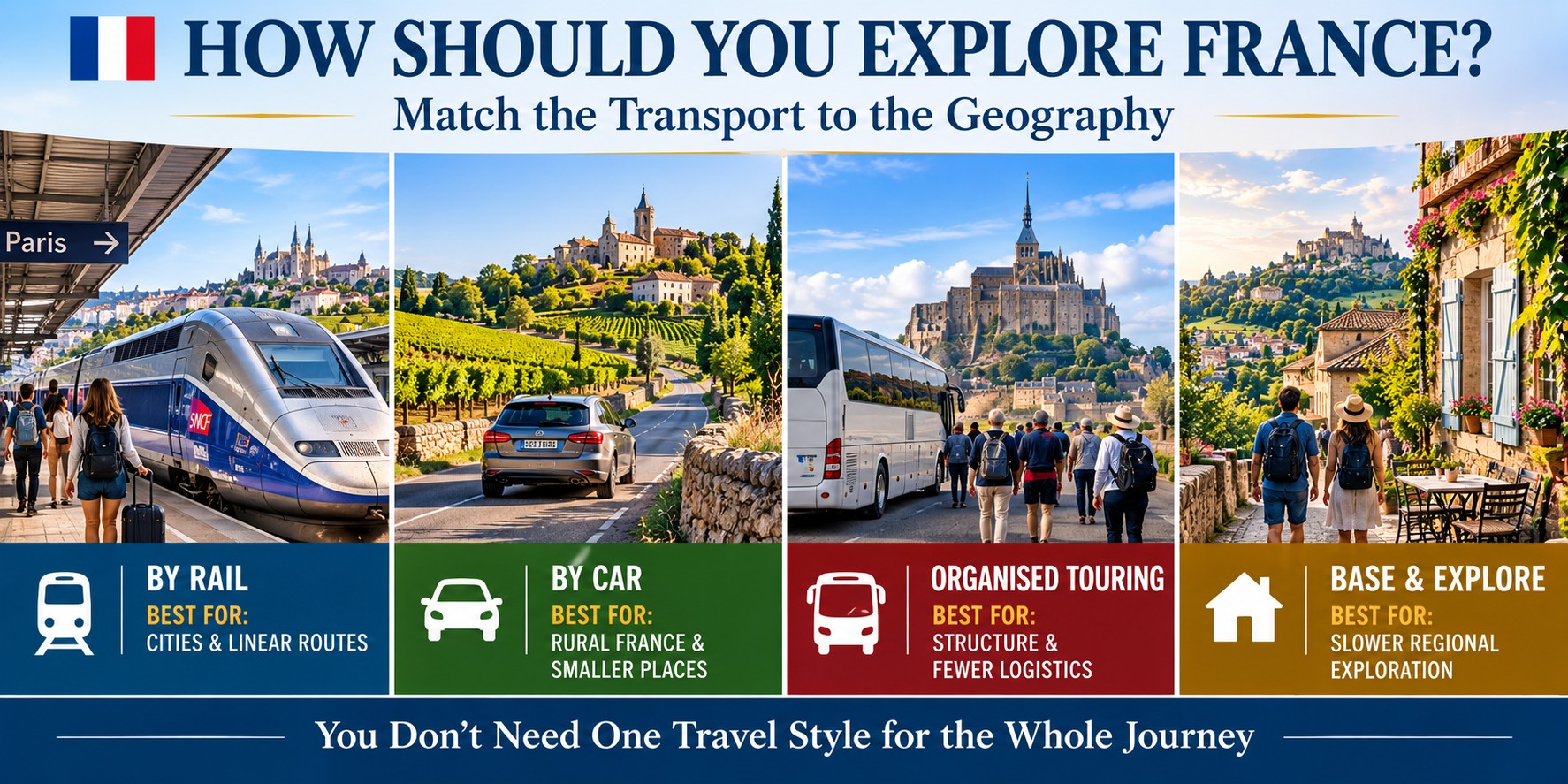
Rail, road, organised touring or a regional base — match the way you travel to the geography of the France journey you want to experience
🍷 What Do You Actually Want to Experience in France?
Destination planning becomes easier when you stop asking, “What should I see?” and instead ask, “What do I want to spend my days doing?”
That distinction matters because travellers with the same ten-day holiday can need completely different itineraries.
🎨 Art, Architecture and Culture
Travellers drawn to museums, architecture, historic streets and cultural institutions may naturally place greater emphasis on cities. Paris is the obvious example, but France’s cultural appeal extends well beyond the capital.
For this type of journey, allowing sufficient time within each city can be more valuable than constantly moving to the next destination.
⚔️ History and Heritage
France’s history can be experienced through medieval towns, châteaux, religious buildings, fortifications, battlefields and landscapes shaped by centuries of political and social change.
A history-led itinerary therefore does not need to mean spending every day inside a museum. Normandy, the Loire Valley and numerous historic cities demonstrate how heritage can become part of the landscape itself.
🍷 Wine and Gastronomy
Food and wine can provide an organising principle for an entire journey rather than simply an evening activity. Burgundy, Bordeaux, Provence and other French regions have distinctive culinary identities rooted in local landscapes and traditions.
The important decision is whether gastronomy is one element of the holiday or one of its central purposes. If it is central, spending longer within fewer regions can offer considerably more depth than collecting brief visits to several famous wine areas.
🌿 Countryside and Slow Travel
Rural France rewards travellers prepared to leave space in the itinerary. Smaller towns, villages, markets and landscapes rarely fit comfortably into a schedule built around rapid movement between major attractions.
Slow travel does not mean doing nothing. It means allowing enough time for the character of a place to become part of the experience.
🌊 Coast and Landscapes
France offers very different coastal and landscape experiences, from Normandy’s northern shores to Mediterranean France and the country’s mountain regions.
For travellers whose priorities are scenery, walking, outdoor time or the coast, these landscapes may deserve to shape the route rather than being treated as secondary excursions from cities.
🏙️ Cities and Local Life
French cities can also reward time beyond their headline monuments. Markets, neighbourhoods, cafés, public spaces and ordinary street life help distinguish one place from another.
This is another reason not to measure a successful itinerary by the number of destinations reached. Staying an additional day can sometimes reveal more about France than travelling another few hundred kilometres.
The strongest itinerary is therefore personal rather than universal. Choose destinations because they deliver the experiences you value, not simply because their names are familiar.
🌍 France Only or Part of a Wider European Journey?
France can comfortably occupy an entire holiday, even a long one. Concentrating on one country reduces international transfers and gives travellers more opportunity to appreciate the differences between its regions.
But France also occupies a useful position within a wider European journey.
Travellers arriving from Britain may use France as their first step into continental Europe, whether entering through Paris or approaching northern France by another route. For others, France may be one stage in a longer journey continuing towards neighbouring European countries.
The decision again comes back to depth versus breadth. Adding another country can provide greater contrast, but border crossings do not create extra holiday time. Every additional destination introduces another transfer and another set of practical arrangements.
A multi-country journey works best when the countries form a logical progression and each contributes something important to the overall experience. If France alone already provides the cities, history, food, countryside and landscapes you want, crossing another border simply to make the trip “multi-country” adds little.
France should therefore be treated as part of wider Europe when doing so improves the journey—not because a European holiday is expected to contain several countries.
📅 When Should You Visit France?
France can be visited throughout the year, but the season can change both the character of a destination and the type of journey that makes sense. Rather than searching for one universally “best” month, consider what you want to experience and how important factors such as outdoor time, seasonal atmosphere and visitor numbers are to you.
Spring can suit travellers who want to explore cities, countryside and heritage destinations before the busiest part of summer. Conditions vary considerably across the country, however, so a spring journey through northern France may feel very different from one in Provence or along the Mediterranean.
Summer brings long days and strong demand in many of France’s best-known destinations. It can be an excellent season for combining cities with countryside, mountains or coast, but popular locations may also be busier. Travellers tied to summer dates can often improve the experience by building a realistic itinerary rather than attempting to rush through numerous headline destinations.
Autumn can work particularly well for travellers interested in food, wine, cities and changing rural landscapes. In wine-producing areas, the season has particular significance, although working vineyards should not be treated as visitor attractions with guaranteed access. Local conditions and individual businesses vary.
Winter changes the balance again. Cities, museums, food and cultural experiences may become more prominent, while some countryside and coastal destinations take on a quieter, more seasonal character. Mountain areas can have entirely different reasons for attracting visitors during winter.
Events can influence the decision too. A festival, sporting event or major cultural occasion may be the reason for choosing particular dates, while major events can also affect demand and accommodation availability. Checking the Europe Events Calendar before fixing an itinerary can help identify whether something significant coincides with your proposed journey.
The important point is that France does not have one national travel season. Choose the time of year in relation to the places and experiences you actually want.
🌱 Explore France More Responsibly
Responsible travel does not need to sit separately from good itinerary planning. In many cases, decisions that reduce unnecessary impact can also produce a more enjoyable holiday.
Start with geography. A route that moves logically through France rather than repeatedly crossing the country can reduce unnecessary transport while giving you more usable time at each destination. Rail and public transport can be practical choices where they fit the route, while road travel may still have an important role in rural areas where it provides access that would otherwise be difficult.
Spending longer in fewer places can also change the character of a trip. More time in one region creates opportunities to use local businesses, eat locally, explore smaller communities and discover places beyond the busiest attractions. It can also reduce the constant cycle of checking out, travelling and checking in again.
Popular destinations deserve consideration too. Paris, major heritage sites and famous villages are popular for legitimate reasons; responsible travel does not require avoiding them. But where less pressured places genuinely match your interests, including them can distribute your time and spending more widely while often providing a different perspective on France.
Wherever you travel, respect historic sites, working landscapes, vineyards, natural environments and the communities that live there year-round. France is not simply a collection of visitor attractions: many of its most memorable travel experiences exist because local traditions, landscapes and communities remain active.
A thoughtfully designed journey can therefore be both more responsible and more rewarding.
Travel with purpose. Explore with care.
❓ France Travel Guide FAQs
🇫🇷 What Is the Best Part of France for a First-Time Visitor?
There is no single best region for every first visit. Paris is a natural choice for travellers prioritising major landmarks, museums and city culture, while Normandy may suit history enthusiasts and Burgundy or Bordeaux may appeal more strongly to food-and-wine travellers. Start with your strongest interests and available time rather than assuming every first trip needs the same route.
⏳ How Many Days Do You Need to Explore France?
A few days can provide a rewarding experience of one destination, but exploring several parts of France requires considerably longer. Around a week is better treated as a focused holiday than a national tour. With ten days to two weeks, combining contrasting regions becomes more realistic, provided the route is geographically sensible.
🗼 Should Your First Trip to France Include Paris?
Not necessarily. Paris offers an exceptional concentration of culture, history, architecture and food and is an obvious choice for many first-time travellers. But someone primarily interested in wine country, rural landscapes, mountains or the Mediterranean may prefer to spend limited holiday time elsewhere. Paris should earn its place in the itinerary like any other destination.
🚆 Can You Explore France Without Hiring a Car?
Yes. Rail and other public transport can support many journeys, particularly those connecting major cities and well-served destinations. A car becomes more useful when an itinerary depends on rural areas, smaller communities or dispersed attractions. Some travellers may find that combining rail travel with limited road-based exploration works better than choosing one method for the entire holiday.
🚗 When Is a Car Useful in France?
A car can be particularly valuable for countryside journeys, vineyard areas, smaller villages and places where public transport does not match the itinerary. It may be much less useful while staying in a major city. Consider using a car for the part of the journey where it solves a genuine access problem rather than automatically driving throughout France.
🍷 Which Part of France Is Best for Food and Wine?
Different regions offer different experiences, so there is no universal winner. Burgundy is closely associated with wine, regional cuisine and vineyard landscapes, while Bordeaux combines a major city with internationally recognised wine country. Provence and other regions offer their own strong food traditions. Choose according to the wider regional experience you want, not wine reputation alone.
⚜️ Can You Combine Paris and Normandy in One Trip?
Yes. Paris and Normandy can form a logical combination because they provide distinctly different experiences without requiring a wide-ranging tour of France. Paris supplies the concentrated city experience, while Normandy adds history, countryside and coast.
The important consideration is allowing enough time in each. Combining them works best when Normandy is treated as a meaningful part of the journey rather than another destination squeezed into an already crowded Paris itinerary.
🧳 Is It Better to Stay in One Region or Tour Several Parts of France?
That depends primarily on the length of the holiday and the variety you want. Staying within one region usually means fewer transfers, greater flexibility and more time for smaller places and unplanned discoveries.
Touring several regions can provide greater contrast, but it works best when the destinations connect logically and there is enough time to experience each one rather than simply arrive and leave. If adding another region makes the existing itinerary noticeably rushed, greater depth is usually the more useful choice.
🇬🇧 Can France Be Combined with a Holiday in Britain?
Yes. France can form a natural continuation of a Britain holiday, particularly for travellers who want to experience two different countries within one European journey.
The important planning question is whether the additional country adds enough value to justify another transfer and a reduction in the time available elsewhere. With a short holiday, exploring Britain or France more deeply may be preferable to dividing the trip simply to include both.
🌍 Is France a Good Starting Point for a Wider European Trip?
France can work very well as one stage of a wider European journey because it borders several countries and offers numerous possibilities for continuing farther across the continent. Paris can be particularly useful within journeys built around major European cities and rail travel.
However, the same principle applies internationally as it does within France: add another country because it contributes something you genuinely want to experience, not simply to increase the number of countries visited.
🌅 Final Thoughts — Choose Your France Before You Build Your Route
France does not require one definitive itinerary. A first visit could reasonably mean several days immersed in Paris, a journey through Normandy, time among the vineyards and historic communities of Burgundy, the landscapes of Provence or a route connecting several contrasting parts of the country.
What matters is that those choices reflect your interests, your available time and the way you prefer to travel.
Start with the experiences that matter most. Choose the destinations that deliver them. Then decide how much geography your available time can comfortably support and whether rail, road travel, organised touring or a fixed base provides the right structure.
Only after those decisions should you ask whether another region—or another European country—will genuinely improve the journey.
France rewards ambition, but it also rewards restraint. A holiday containing fewer destinations can reveal considerably more when there is time to explore beyond the headline sights, understand regional differences and enjoy the places between scheduled attractions.
The strongest France itinerary is therefore not necessarily the one that covers the greatest distance or contains the most famous names. It is the one in which every destination has a clear reason to be there.