


Britain & Europe Through the Seasons: The Complete Seasonal Travel Guide
23rd September 2026
🌍 Britain & Europe Through the Seasons: The Complete Seasonal Travel Guide
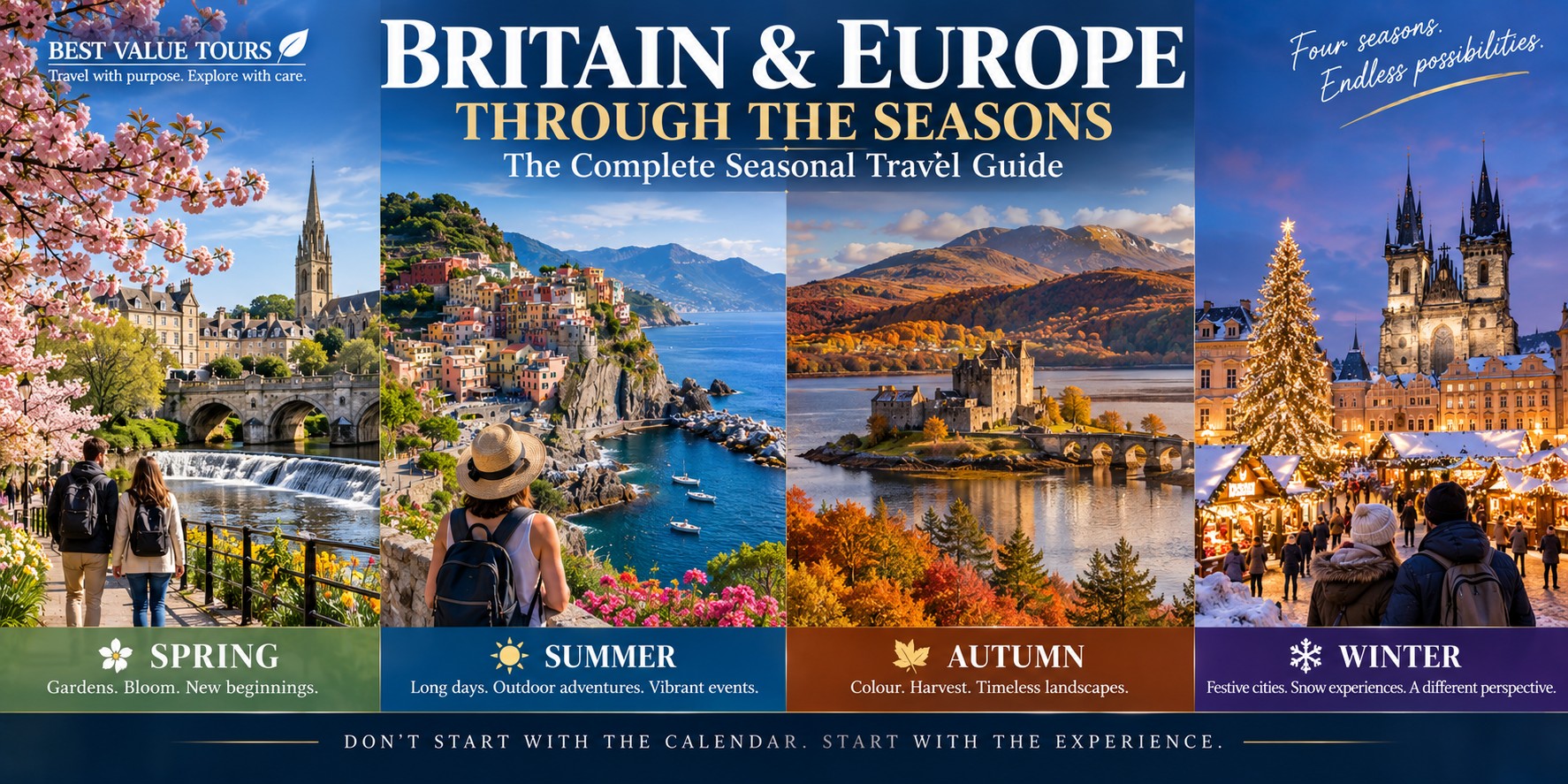
Spring blossom, long summer days, autumn landscapes and winter experiences can create very different journeys across Britain and Europe. Start with the experience you want, then choose the season and destination that best support it
When is the best time to visit Britain and Europe? It sounds like a simple question, but there is no single season—or even one part of a season—that suits every traveller equally well. The right choice depends on where you want to go, what you hope to experience, how you prefer to travel and how much flexibility you have over your dates.
If your dates are flexible, you can begin with the experience you want and choose the season that gives you the strongest opportunity to enjoy it. If your dates are fixed, the process works in reverse: understand the conditions and opportunities associated with that time of year, then choose destinations and experiences that make particularly good sense.
Spring can bring gardens into bloom, greener landscapes and rapidly increasing daylight. Summer offers long sightseeing days, outdoor events and greater scope for countryside and coastal exploration. Autumn changes the colours and rhythm of many destinations while bringing its own food, cultural and landscape experiences. Winter creates a completely different proposition, from Christmas markets and atmospheric cities to snow-based activities and experiences that benefit from long hours of darkness.
Geography matters just as much as the name of the season. Winter in London is very different from winter in the Scottish Highlands or the Alps, while summer conditions in Britain, northern Europe and the Mediterranean should never be treated as interchangeable.
The most useful question, therefore, is not simply “Which season is best?”
It is “What do I want this trip to give me?”
Once you know that, the calendar becomes much easier to navigate.
🧭 What Changes When You Travel at Different Times of Year?
Choosing when to travel affects much more than the weather. Season can change how much daylight you have for sightseeing, how landscapes look, which events are taking place, how busy a destination feels, what needs booking well ahead and which experiences are realistically possible.
Understanding those differences is the foundation of good seasonal planning.
🌦️ Weather Matters — But It Is Not the Whole Story
Weather naturally influences when and where people travel, but broad labels such as “summer” and “winter” tell only part of the story. Britain is strongly influenced by its maritime setting, yet conditions still vary according to latitude, elevation and exposure. Across continental Europe, the differences are greater still, ranging from northern and Atlantic environments to Alpine regions and Mediterranean climates.
Typical seasonal patterns are useful for planning, but they are not promises. A wet summer day, mild winter spell or unusually warm spring period can occur. Travellers are better served by understanding the broad conditions they may encounter and preparing for some variation than by expecting a particular week to conform perfectly to a seasonal average.
This becomes especially important on journeys crossing several regions. Comfortable conditions in one part of Europe can coincide with substantially different weather elsewhere.
☀️ Daylight Changes What You Can Do
Daylight is one of the most important—and easily underestimated—seasonal differences.
Long late-spring and summer days can create much more usable time for sightseeing, photography, scenic journeys and outdoor attractions, particularly farther north. That can materially change the pace of a trip: travellers may be able to spend longer at individual places or combine experiences without feeling that every hour of daylight has to be carefully rationed.
Winter requires a different rhythm. Shorter daylight hours do not make sightseeing impractical, but they can influence how an itinerary should be organised. Scenic drives, countryside visits and outdoor attractions may be best concentrated into the available daylight, leaving evenings for restaurants, performances, museums, festive illuminations and other after-dark experiences.
Good seasonal planning therefore works with the available daylight rather than treating longer days as automatically good and shorter days as automatically bad.
👥 Demand, Crowds and Availability Change Too
Visitor demand changes throughout the year, but not always according to a simple peak-season versus off-season pattern.
Summer holidays can create heavy demand in popular destinations, while major festivals, sporting occasions and school-holiday periods can produce concentrated pressure at other times. Accommodation, transport and limited-capacity experiences may need earlier planning when demand is high.
Spring and autumn can offer a different visitor environment, but “shoulder season” should not automatically be interpreted as cheap, quiet or uncrowded. Easter, local holidays, major events, conferences and exceptionally popular destinations can all affect demand.
Winter is equally varied. Some destinations become quieter, while ski resorts, Christmas-market cities and places hosting major New Year celebrations may be experiencing one of their busiest periods.
The useful question is therefore not simply whether you are travelling in peak or off-peak season, but what is happening at your destination while you are there.
🌿 The Experience Itself Can Change
Sometimes season does more than alter the conditions around an experience—it changes the experience itself.
A garden during spring blossom is not the same experience as that garden in late autumn. Woodland and rural landscapes can change dramatically as autumn progresses. Winter darkness can transform evening experiences, while suitable snow conditions create opportunities unavailable during warmer months.
Events add another dimension. A traveller interested in a major sporting occasion, a traditional seasonal gathering or an astronomical event is dealing with an experience tied to a particular point in the calendar. The recurring event or phenomenon may be well established, while exact annual dates, programmes, access arrangements and ticketing can still require separate confirmation for the year of travel.
This is where seasonal planning becomes particularly valuable. The objective is no longer simply to find acceptable weather. It is to recognise what becomes possible—or meaningfully different—because you travel at a particular time of year.
🌸 Spring: Fresh Landscapes, Longer Days & Seasonal Renewal
Spring is one of the most visibly transformative periods for travelling through Britain and Europe. Daylight increases quickly, gardens and parks begin to change, and destinations that experienced a quieter winter gradually return to a fuller seasonal rhythm.
The precise character of spring varies considerably by location. Southern areas may experience milder conditions and earlier flowering, while northern or higher-altitude regions can remain cooler for longer. Travellers moving across several countries—or even between different parts of Britain—should therefore avoid assuming that spring arrives everywhere at the same pace.
🌷 Gardens, Blossom & Changing Landscapes
For travellers interested in gardens, blossom and fresh seasonal landscapes, spring can provide some of the year’s most distinctive experiences.
Historic gardens, landscaped estates, city parks and rural areas can change rapidly as the season progresses. Early spring and late spring may therefore look very different even at the same destination.
This is an important example of why seasonal travel should be planned around the desired experience rather than around the season’s name alone. A traveller whose priority is a particular flowering display needs to think more precisely about timing than someone who simply wants greener countryside and longer days.
Natural timing also varies from year to year. Temperature, rainfall and other conditions can influence flowering and growth, so travellers should think in terms of a likely seasonal window rather than a guaranteed date.
🏛️ Sightseeing Before the Height of Summer
Spring can also work well for cultural and historical sightseeing.
Increasing daylight provides more usable time outdoors, while conditions may be comfortable for walking, heritage attractions and city exploration. The balance between indoor and outdoor experiences can be particularly useful for travellers building varied itineraries.
That does not mean every spring journey will be quiet. Easter, school holidays, major events and popular destinations can produce periods of significant demand. Attractions with limited capacity may still require advance planning.
The practical advantage is therefore not a promise of empty destinations. It is the combination of increasing daylight, changing landscapes and a travel rhythm that can differ substantially from midsummer.
🎉 Spring Events & Seasonal Occasions
Spring also brings cultural, religious, sporting and traditional events across Britain and Europe.
For travellers whose trip is built around a particular occasion, the event date may become the first fixed point in the itinerary. The surrounding journey can then be designed around it.
This is also a useful reminder that recurring annual events and confirmed annual arrangements are not the same thing. A celebration may traditionally occur during a familiar period while the detailed programme, ticketing, venue arrangements or public access for a future year remains subject to confirmation.
When an event matters enough to determine your travel dates, verify the official information for the year you intend to travel before committing non-refundable elements of the trip.
☀️ Summer: Long Days, Outdoor Events & Peak Travel
Summer creates some of the longest and most flexible sightseeing days of the year, particularly in northern Europe and Britain.
For travellers who want to spend substantial time outdoors, visit rural areas, explore coastlines or combine several sightseeing experiences within one day, the additional daylight can be extremely valuable.
Summer also supports a dense programme of festivals, sporting events, outdoor performances and traditional gatherings. Scotland’s warmer months also bring a wide range of Highland Games and other traditional events, while seasonal and astronomical occasions can give particular places additional significance.
🌞 Make Use of the Daylight
Long daylight is one of summer’s strongest practical advantages.
It can make scenic journeys easier to organise, create more flexibility around attraction visits and allow travellers to spend longer exploring without compressing every outdoor activity into a short window.
The effect becomes increasingly noticeable farther north. In Scotland and other northern European destinations, summer evenings can remain light for a considerable time, creating a very different daily rhythm from winter travel.
Long days should not automatically be interpreted as an instruction to fill every available hour. They are most useful when they create flexibility rather than simply encouraging a more exhausting itinerary.
🎪 Festivals, Culture & Outdoor Experiences
Summer is strongly associated with outdoor cultural life across much of Britain and Europe.
Music, theatre, festivals, sporting occasions, local celebrations and traditional events can all become important reasons to travel. Some destinations may feel fundamentally different while a major event is taking place.
This can be an advantage when the event is part of the purpose of the journey, but it can also affect accommodation, transport and visitor numbers. Travellers who are not attending the event may still experience its impact.
Where an event is central to the trip, establish its confirmed dates and practical arrangements before building the surrounding itinerary.
🌡️ Heat Is Not Uniform Across Europe
One of the most important mistakes to avoid is treating European summer weather as though it were geographically uniform.
Britain and northern Europe can experience warm or hot periods, but their summer conditions are not equivalent to those of southern and Mediterranean Europe. Travellers combining regions may encounter very different temperatures during the same journey.
In hotter destinations, the timing of sightseeing can become part of itinerary design. Earlier starts, shaded or indoor experiences during the hottest part of the day and more deliberate pacing may produce a better trip than trying to maintain the same sightseeing rhythm everywhere.
Seasonal planning therefore needs to consider both when you travel and where within that season you intend to go.
🍂 Autumn: Changing Landscapes, Harvest Traditions & Cultural Travel
Autumn changes both the appearance and the rhythm of many destinations.
As daylight gradually shortens and temperatures begin to fall, landscapes can become the focus of the journey. Woodland, parks, rural areas and mountain environments may develop striking seasonal colour, while harvest traditions and food-related experiences can give particular regions additional appeal.
Timing matters because autumn is a progression rather than a single visual moment. Conditions can look very different at the beginning and end of the season, and the timing of colour varies according to geography, altitude and weather.
🍁 Autumn Colour & Scenic Travel
Travellers hoping to experience autumn landscapes should think in terms of regional windows rather than expecting one universal peak.
Northern and higher-altitude areas may change earlier than southern or lower-lying destinations. Weather can also influence the development and duration of seasonal colour.
This makes flexibility particularly useful. A journey covering several landscapes or elevations may provide more opportunities than one built around a single precisely timed location.
The wider itinerary should still be worthwhile even if seasonal colour develops earlier or later than expected.
🍇 Harvest, Food & Seasonal Traditions
Autumn is closely associated with harvest traditions in many parts of Europe.
Food festivals, local produce, wine-related activities and regional celebrations can give travellers another reason to choose this period. As with other seasonal experiences, exact dates and programmes may vary from year to year.
These experiences can work particularly well when they complement the wider destination rather than becoming the only reason the trip succeeds. A region with strong cultural, historical or scenic interest remains rewarding even if a particular harvest-related activity changes or is unavailable.
⚖️ Autumn Equinox & Seasonal Turning Points
Certain seasonal and cultural occasions can add another reason to travel. The autumn equinox, for example, is an astronomical event that can acquire additional cultural or historical significance at particular places.
For travellers interested in such occasions, it is important to distinguish between the predictable astronomical event and any associated visitor arrangements. Access, transport, parking, organised experiences and site operations can change independently of the event itself.
That distinction becomes increasingly important when planning future years. The phenomenon may be predictable long in advance, while the practical arrangements around it may not yet be confirmed.
❄️ Winter: Festive Travel, Snow Experiences & Dark-Sky Opportunities
Winter creates some of the greatest contrasts in seasonal travel.
Cities can become centres of festive activity, mountain regions may enter their principal snow season, and longer hours of darkness can create opportunities that are impossible—or much less practical—during summer.
At the same time, shorter daylight, colder conditions and possible weather disruption mean that winter itineraries benefit from realistic pacing and greater attention to operational details.
🎄 Christmas & New Year
Christmas and New Year can transform the atmosphere and operating patterns of destinations across Britain and Europe.
Markets, illuminations, performances, seasonal food, religious services and public celebrations can all become part of the visitor experience. Exact programmes vary significantly between destinations and years.
Transport and attraction schedules also deserve particular attention. Christmas Day, Boxing Day and New Year’s Day can also involve unusual transport and attraction operations.
Travellers should therefore distinguish between the broad festive season and the operational reality of individual dates. A city may feel highly festive throughout December while particular services or attractions operate differently on specific days.
Planning around confirmed information is especially important when the trip depends on a particular attraction, transport connection or organised experience.
🏔️ Snow & Winter Sports
For travellers interested in skiing and other snow-based experiences, winter can be the obvious seasonal choice, but the precise timing still matters.
Snow conditions vary according to altitude, geography and weather. A destination’s normal winter season can provide a useful planning framework without guaranteeing conditions for a particular week.
The more important the snow-based activity is to the trip, the more carefully travellers should consider the underlying characteristics of the destination rather than relying only on the calendar.
🌌 Darkness Can Be an Advantage
Short winter days are often treated purely as a disadvantage, but some experiences depend on darkness.
Festive illuminations, evening events and dark-sky experiences can all benefit from longer nights. In suitable northern destinations, the darker part of the year also provides the essential conditions required for the possibility of seeing the Northern Lights.
That does not make the phenomenon predictable. Cloud cover, auroral activity, geographical position and local light pollution all affect visibility.
Travellers should therefore separate the season in which an experience becomes possible from the certainty that it will occur on a particular date.
🌧️ Build More Flexibility Into Winter Itineraries
Winter weather can affect transport and outdoor plans, so tightly constructed itineraries may be less resilient when conditions change.
Allowing realistic transfer times, avoiding unnecessary dependence on multiple fragile connections and maintaining alternatives for weather-sensitive days can make the journey more robust.
The objective is not to expect disruption. It is to avoid designing a trip that can succeed only if every element operates perfectly.
🎯 Which Season Best Matches the Trip You Want?
The four seasons are useful planning categories, but choosing between them becomes easier when you stop comparing them in the abstract.
Instead, identify the experience that matters most to you. A traveller whose priority is spring gardens is solving a different problem from someone who wants long sightseeing days, autumn landscapes, Christmas markets or the possibility of seeing the Northern Lights.
This experience-first approach turns season from a vague preference into a practical travel decision.
🧩 Start With the Experience, Not the Calendar
Begin by identifying the experiences you would be most disappointed to miss.
If gardens and blossom are central to the trip, spring deserves serious consideration. If you want long days for extensive sightseeing and outdoor exploration, late spring and summer become stronger possibilities. Autumn landscapes or harvest traditions point towards a different seasonal window, while Christmas markets, winter sports and dark-sky experiences depend much more directly on travelling at an appropriate time.
Some priorities offer considerable flexibility. Historic cities, museums, major heritage attractions and cultural sightseeing can often form part of a trip in several seasons, even though the surrounding experience changes.
Others are much less flexible. A seasonal event happens when it happens. Natural displays have recognisable windows but can vary from year to year. Experiences requiring darkness or snow depend on conditions that the traveller cannot control completely.
The less flexible the experience, the more influence it should have over your travel dates.

Each season creates different travel opportunities. Spring can bring gardens and blossom, summer long days and outdoor exploration, autumn changing landscapes and cultural experiences, and winter festive travel, snow-based activities and longer hours of darkness
📊 Seasonal Experience Matcher
| Your priority Season(s) to consider Why Important trade-off | |||
|---|---|---|---|
| Gardens and blossom | Spring | New growth and seasonal displays can become a major reason to visit | Exact flowering periods vary by location and weather |
| Long sightseeing days | Late spring and summer | More daylight can support longer outdoor and touring days | Popular periods can bring stronger demand |
| Outdoor events and festivals | Summer | Many major outdoor cultural and sporting occasions take place during warmer months | Event dates can create local crowding and booking pressure |
| Autumn landscapes | Autumn | Woodland and countryside can undergo striking seasonal change | Peak colour varies and cannot be guaranteed for a specific date |
| Food, wine and harvest traditions | Autumn | Some regions have experiences closely connected to harvest and seasonal produce | Timing and visitor access vary considerably by region |
| Christmas markets and festive atmosphere | Late autumn and winter | Festive events, illuminations and seasonal traditions become part of the destination experience | Exact annual dates and opening arrangements require checking |
| Snow and winter sports | Winter | Suitable mountain regions can support skiing and other snow-based activities | Snow conditions vary by altitude, location and year |
| Northern Lights | Darker months | Longer hours of darkness create the necessary viewing opportunity in suitable northern regions | Aurora activity and clear skies cannot be guaranteed |
| Substantial sightseeing outside midsummer | Spring or autumn | Both can provide strong sightseeing opportunities without making midsummer the default choice | Conditions, daylight and demand still vary greatly within each season |
The table is a starting point rather than a verdict. It identifies seasons naturally associated with particular priorities, but geography and the exact timing of the trip still matter.
⚖️ What If Your Priorities Conflict?
Many real trips involve competing priorities.
You may want long days but prefer not to travel during the busiest summer periods. You might want autumn colour while also needing enough daylight for extensive countryside touring. A Christmas-market journey may include rural sightseeing that becomes more difficult to fit into short winter days.
The solution is rarely to search for a mythical period when every condition is perfect. Instead, decide which parts of the trip are essential, which are desirable and which can be adapted.
A traveller prioritising gardens might accept more variable spring weather. Someone travelling principally for a major summer event may accept higher demand around the event dates. A winter visitor attracted by Christmas atmosphere may design shorter sightseeing days rather than wishing for summer daylight.
That trade-off is central to intelligent seasonal planning. The best season is the one whose advantages matter most to your trip and whose disadvantages you are comfortable managing.
🗺️ Geography Matters: Britain and Europe Do Not Share One Seasonal Pattern
Once you have identified a promising season, the next question is where within Britain or Europe that season best supports the experience you want.
Europe stretches across a vast geographical area. Latitude, altitude, distance from the sea and regional climate all affect how a particular season feels. Even within Britain, travelling from southern England into Scotland can produce meaningful differences in daylight, temperature and the timing of seasonal change.
A seasonal recommendation without geographical context is therefore incomplete.
🇬🇧 Britain Through the Seasons
Britain’s maritime setting moderates some temperature extremes, but that should not be mistaken for uniform conditions. Southern England, exposed coasts, upland Wales and the Scottish Highlands can offer very different experiences during the same period.
Seasonal development varies according to location and conditions, while northern areas experience especially pronounced changes in daylight across the year. Those differences can affect the practical shape of an itinerary as much as temperature itself.
Landscape and exposure matter too. A city itinerary can often absorb unsettled weather more easily than a walking-focused trip in an upland or coastal area. Likewise, conditions that are manageable for urban sightseeing may have greater implications for scenic roads, rural excursions or outdoor heritage sites.
Britain should therefore be planned not simply by asking “What is this season like?” but “What is this season like in the part of Britain I actually intend to explore?”
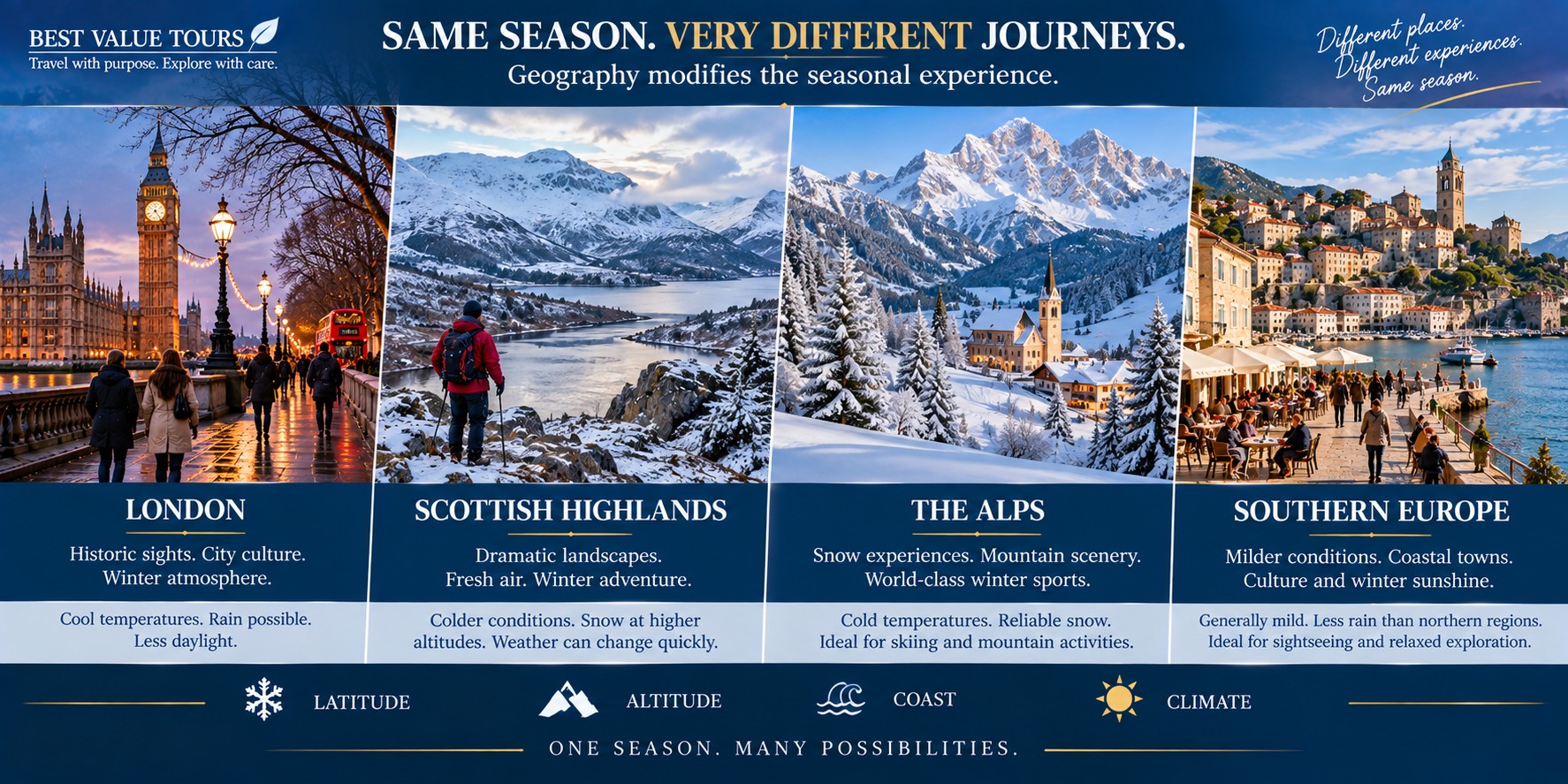
The same season can create very different journeys. Latitude, altitude, coastal influence and regional climate mean winter in London, the Scottish Highlands, the Alps and southern Europe should never be treated as one uniform experience
🇪🇺 Europe Through the Seasons
That principle becomes even more important across continental Europe.
Northern Europe, Atlantic-facing regions, central European cities, Alpine areas and Mediterranean destinations do not experience spring, summer, autumn and winter in the same way. Latitude can produce dramatic differences in daylight, altitude can transform winter conditions, and maritime or Mediterranean influences can create very different seasonal patterns.
Spring and autumn are equally diverse. The timing of blossom, foliage, harvest experiences and comfortable outdoor conditions can shift substantially across latitude and elevation.
This is why a season should never be treated as a weather forecast.
Geography modifies the seasonal experience.
The strongest travel decision combines both: choose the seasonal opportunity you want, then identify the destination where that opportunity makes the most sense.
🎭 Sometimes the Experience Chooses the Date
Not every trip begins with a choice between spring, summer, autumn and winter. Sometimes a particular event, tradition or natural phenomenon determines when you need to travel.
This changes the planning process. Instead of choosing convenient dates and then deciding what to do, you begin with the experience and build the journey around the period in which it occurs.
The more time-sensitive the experience, the more important it becomes to separate what is predictable from what still needs confirming.
🗓️ Events, Festivals & Sporting Occasions
Major events can completely alter the character of a destination. A festival may fill streets and performance venues, a sporting occasion can become the focus of an entire journey, and a traditional celebration can provide an experience that would simply not exist during an ordinary week.
For travellers, this creates both opportunity and pressure.
If an event is one of the principal reasons for travelling, its timing should be established before the wider itinerary is designed. Accommodation, transport and ticketed experiences may then need to be organised around it rather than added later.
The distinction between a recurring event and a confirmed future programme is important. An established festival or sporting occasion may traditionally take place during a particular part of the year, but exact dates, venues, schedules, ticketing arrangements and public access can change.
This is particularly relevant when planning far ahead. Use established seasonal patterns to identify the likely travel window, but treat the organiser’s confirmed information for the relevant year as authoritative when making date-dependent arrangements.
🌞 Solstices & Equinoxes
Some journeys are connected not to a conventional festival calendar but to the turning points of the year itself.
The solstices and equinoxes are astronomical events, and their relationship with ancient landscapes gives them particular cultural and historical resonance at certain places. Stonehenge is the most prominent British example, where the monument’s relationship with the solar cycle can make seasonal timing central to the experience.
It is important to separate the astronomical event from the visitor arrangements surrounding it. The occurrence of a solstice or equinox can be determined independently, but special access, parking, transport, opening arrangements or organised experiences at a heritage site are operational matters and can vary.
For travellers, the broader lesson is useful well beyond Stonehenge: a predictable date does not necessarily mean every practical arrangement around that date is equally predictable.
🌌 Natural Phenomena
Nature introduces a different type of timing problem because many phenomena have a recognisable season without having a guaranteed performance date.
Autumn colour, spring blossom, snowfall and auroral displays all illustrate this distinction. Travellers can identify periods in which the underlying conditions are more favourable, but weather and natural variation still influence what they actually experience.
This does not make planning pointless. It changes what good planning looks like.
Rather than seeking certainty where none exists, identify an appropriate seasonal window, choose a destination with sensible underlying conditions and build enough flexibility into the itinerary that the entire trip does not depend on one uncontrollable outcome.
For phenomena dependent on particular weather or viewing conditions, allowing several opportunities can be more useful than placing the success of the trip on one evening or one precisely timed visit. The wider journey should still be rewarding if nature does not cooperate.
📅 Use the Event Calendar to Refine the Trip
Once a broad season has been chosen, an events calendar can help turn a general travel window into a more specific opportunity.
Once a broad season has been chosen, an events calendar can help turn a general travel window into a more specific opportunity.
This is especially valuable for travellers who have some flexibility. A planned summer journey might be adjusted to coincide with a cultural or sporting occasion; an autumn trip might be refined around a festival or seasonal tradition; a winter itinerary may be built around Christmas or New Year experiences.
The process can also work in reverse. Discovering an event worth travelling for may determine the dates first, after which destinations and supporting experiences can be added around it.
The objective is not to fill every trip with events. It is to recognise when something genuinely time-sensitive can make travelling during a particular period more worthwhile.
🧳 Turn Your Seasonal Choice Into a Practical Trip
Choosing a season is only the beginning. The next step is to convert that seasonal preference into an itinerary that works under real conditions.
The best method depends on whether your dates are fixed or flexible.
📆 If Your Dates Are Fixed
Many travellers cannot choose freely between seasons. Existing commitments, holiday periods or transport bookings may determine when the journey must take place.
In that situation, do not spend time searching for the theoretical “best” season. Start with the dates you actually have.
A useful planning sequence is:
DATE → CONDITIONS → DESTINATION → EXPERIENCE
First, understand the likely daylight, broad weather pattern and seasonal context for your travel period. Then consider which destinations make particularly good sense under those conditions. Finally, select experiences that work with the season rather than against it.
A winter trip, for example, need not imitate a summer itinerary with fewer daylight hours. It can prioritise cities, seasonal experiences, indoor culture and carefully timed outdoor sightseeing. Likewise, a journey during a hot period may benefit from a different daily rhythm rather than an attempt to maintain intensive sightseeing throughout the middle of the day.
Fixed dates are therefore a constraint, but they are also a useful filter.

If your dates are fixed, start with the time you have and choose destinations and experiences that suit the conditions. If your dates are flexible, start with the experience you want and work towards the most appropriate seasonal window and destination
🧭 If Your Dates Are Flexible
Travellers with flexible dates can reverse the process:
EXPERIENCE → SEASONAL WINDOW → DESTINATION → DATES
Start with what matters most. That might be gardens, a festival, autumn landscapes, Christmas atmosphere, long sightseeing days, skiing or a dark-sky experience.
Identify the seasonal window associated with that priority, then compare destinations where the experience is particularly appropriate. Only after that should you narrow the journey to specific dates.
This approach prevents the calendar from driving the trip before you have decided what the trip is actually for.
🎟️ Book the Least Flexible Parts First
Once the broad shape of the trip is clear, identify the elements with the least flexibility.
A major event with fixed dates, a limited-capacity experience, a particular rail journey, a sought-after hotel or an attraction requiring timed admission can become the structural anchor around which the rest of the itinerary is organised. These elements may deserve attention before activities that can be moved easily between days.
Season affects this hierarchy. During periods of high demand, accommodation and transport may become important earlier in the planning process. Around major festivals or sporting occasions, availability can tighten locally even when the wider region is not experiencing its busiest travel period.
The same principle applies to festive travel. Christmas and New Year can bring altered operating patterns alongside concentrated demand for particular experiences. Travellers should therefore establish what is essential, what is date-sensitive and what remains flexible before committing the entire itinerary.
Booking early should not become an automatic rule applied to everything. The more useful principle is to secure the least flexible parts first and preserve flexibility where it still has value.
🧥 Prepare for Conditions, Not Stereotypes
Seasonal labels are useful for broad planning, but packing and daily preparation should respond to the conditions likely at the actual destination.
Layers can be particularly useful where temperatures vary during the day or where a journey crosses different environments. Waterproof protection may matter in any season in some destinations, while sun protection and access to water can become important during warmer periods.
Footwear deserves similar attention. Historic streets, rural paths, wet ground, snow or extensive walking can matter more than whether the calendar happens to say spring or autumn.
Preparation also includes understanding daylight. If a scenic excursion depends on natural light, its timing should reflect sunrise and sunset rather than an itinerary copied from another season.
The objective is not to prepare for every imaginable condition. It is to avoid allowing an oversimplified image of the season to dictate practical decisions.
🔄 Give Weather-Dependent Trips a Plan B
The more an itinerary depends on weather, the more valuable flexibility becomes.
A city break with museums, galleries and indoor attractions can usually absorb a wet day more easily than a journey built primarily around mountain views, walking or outdoor heritage sites. That does not mean weather-dependent trips should be avoided; it means they benefit from alternatives.
A useful Plan B might involve changing the order of two days, moving an indoor attraction into poor weather, allowing more than one opportunity for an important outdoor experience or avoiding a tightly packed schedule that leaves no room to adapt.
The same principle applies when natural conditions are part of the reason for travelling. A journey built around a hoped-for natural display should still provide a rewarding trip if conditions prevent it from appearing. Seasonal uncertainty is easier to manage when flexibility has been designed into the itinerary rather than added after plans begin to fail.
🌱 Travel Through the Seasons With Greater Care
Seasonal travel decisions affect more than the traveller. They can influence pressure on destinations, transport choices, landscapes, wildlife and local communities.
Travelling outside the most heavily demanded periods can sometimes help spread visitor pressure, but off-season travel should not automatically be described as more responsible. A destination may have reduced public transport, limited local services or environmentally sensitive conditions at quieter times of year. Responsible seasonal travel depends on understanding the place rather than assuming that fewer visitors always means lower impact.
Slower itineraries can help. Spending longer in an area rather than repeatedly making short stays across distant destinations can reduce avoidable backtracking and excessive movement while allowing a better understanding of local places. Rail, public transport and shared touring can also be useful choices where routes and seasonal operations make them practical.
Natural environments require particular care. Wet ground can make paths vulnerable to erosion, winter conditions can increase safety risks, and wildlife may be especially sensitive during breeding, nesting or other seasonal periods. Temporary restrictions and local guidance should be respected even when they affect a planned route.
Events require similar consideration. Festivals, solstice gatherings, Christmas celebrations and other seasonal occasions may have deep local, cultural or spiritual significance. Visitors should understand that they are entering a living event or community tradition, not simply consuming a spectacle.
Seasonal planning can also reduce unnecessary pressure on the trip itself. Realistic winter itineraries, appropriate clothing, sensible transport choices and enough flexibility for changing conditions can prevent travellers from forcing plans that no longer make sense.
Responsible travel is therefore not about finding one universally “green” season. It is about making better decisions within the season you choose.
Travel with purpose. Explore with care.
❓ Frequently Asked Questions About Seasonal Travel in Britain & Europe
❓ What is the best time of year to visit Britain and Europe?
There is no single best time. The strongest period depends on your destinations, preferred experiences and tolerance for factors such as heat, cold, shorter daylight or high demand. Choose according to what you most want the journey to provide, then consider where that experience works best.
❓ Is summer the best season for sightseeing?
Summer’s long daylight can make it excellent for sightseeing, particularly when a trip includes extensive outdoor exploration. It is not automatically best for every traveller or destination: high demand and, in parts of Europe, significant heat can make other seasons more suitable for particular itineraries.
❓ Is spring or autumn better for travelling?
They offer different advantages. Spring brings increasing daylight, fresh growth and garden experiences, while autumn can provide changing landscapes, harvest-related traditions and a different seasonal rhythm. The better choice depends on what you want to experience and where you are travelling.
❓ Is winter a good time to visit Britain and Europe?
Yes, when the trip is designed for winter rather than treated as a summer itinerary with shorter days. Festive travel, cultural city breaks, winter sports and dark-sky experiences can all provide compelling reasons to travel, while shorter daylight and possible weather disruption reward more deliberate planning.
❓ When is the best time to avoid the busiest periods?
There is no single quiet period across Britain and Europe. Spring and autumn can sometimes avoid midsummer demand, but school holidays, festivals, sporting events and local celebrations can create busy periods at other times. Check what is happening at your destination during your actual dates rather than relying solely on labels such as “shoulder season.”
❓ When should I travel for Christmas markets?
Christmas-market seasons vary by destination and year. Many operate during parts of late November and December, but exact opening dates, closing dates, hours and arrangements should always be checked for the specific market and year of travel.
If Christmas markets are one of the principal reasons for your journey, choose destinations only after confirming that the markets you want to experience are scheduled to operate during your dates. Do not assume that every market continues through Christmas itself or into the New Year.
The wider festive experience can also matter. Illuminations, seasonal performances, decorated historic centres and other Christmas traditions may make a destination attractive beyond the market alone, but each element can have its own operating period.
❓ When is the best time to see the Northern Lights?
The darker part of the year provides the essential darkness needed to see the Northern Lights in suitable northern destinations, making autumn, winter and parts of spring relevant depending on location.
There is no date that guarantees a display. Aurora activity, cloud cover, darkness, local light pollution and geographical position all affect visibility. Choose an appropriate destination and seasonal window, allow more than one opportunity where possible and treat any sighting as a possibility rather than a certainty.
❓ How far ahead should I book?
There is no universal booking period for seasonal travel. The appropriate lead time depends on destination, travel dates and how difficult the important parts of the trip would be to replace.
Major events, school holidays, Christmas and New Year periods, popular summer destinations and limited-capacity experiences can justify earlier planning. More flexible journeys may allow considerably more freedom.
Rather than applying one booking rule to an entire trip, identify the components that would be difficult to replace if they became unavailable. Secure those first and preserve flexibility elsewhere where it remains useful.
❓ Can I combine Britain and continental Europe in one trip?
Yes. Britain and continental Europe can work particularly well as part of the same journey, but the itinerary should account for geographical and seasonal differences rather than assuming identical conditions throughout.
A multi-country trip may cross different climates, daylight patterns and landscapes. Clothing, daily pacing and the balance between indoor and outdoor experiences may therefore need to work across several environments.
Transport should also be considered as part of the itinerary rather than as dead time between destinations. Rail and other practical connections can allow a journey to progress naturally from one region to another, provided the route remains realistic for the available time.
The same seasonal principle applies throughout: choose each destination for what it contributes to the journey at that time of year.
🌍 Choose the Season That Creates the Trip You Want
There is no universal best season for travelling through Britain and Europe because travellers are not all trying to create the same journey.
If your dates are fixed, begin with the conditions and opportunities those dates give you. Choose destinations and experiences that work naturally within them rather than trying to reproduce a trip designed for another time of year.
If your dates are flexible, start with the experience. Gardens and blossom, long sightseeing days, major events, autumn landscapes, Christmas atmosphere, winter sports and dark-sky opportunities all point towards different periods of the calendar.
Then add geography. Spring in southern England is not identical to spring in Scotland. Summer in Britain is not the same proposition as summer beside the Mediterranean. Winter in a European capital and winter in an Alpine resort may belong to the same season while creating completely different journeys.
Finally, allow for uncertainty where uncertainty genuinely exists. Weather changes. Natural displays vary. Event arrangements can be updated. Seasonal opening patterns differ between destinations. Good planning does not eliminate those variables; it creates an itinerary capable of working intelligently with them.
The strongest seasonal journey therefore begins not with a universal recommendation, but with the traveller’s own priorities.
Decide what you want the trip to give you. Understand when and where that experience is most likely to make sense. Then build the journey around those conditions.
That is how the calendar stops being a limitation and becomes one of the most useful travel-planning tools you have.