


Did Merlin Ever Visit Stonehenge? Myth, History & Britain’s Greatest Legends (2026 Guide)
29th July 2026
🧙 Did Merlin Ever Visit Stonehenge? Myth, History & Britain’s Greatest Legends (2026 Guide)
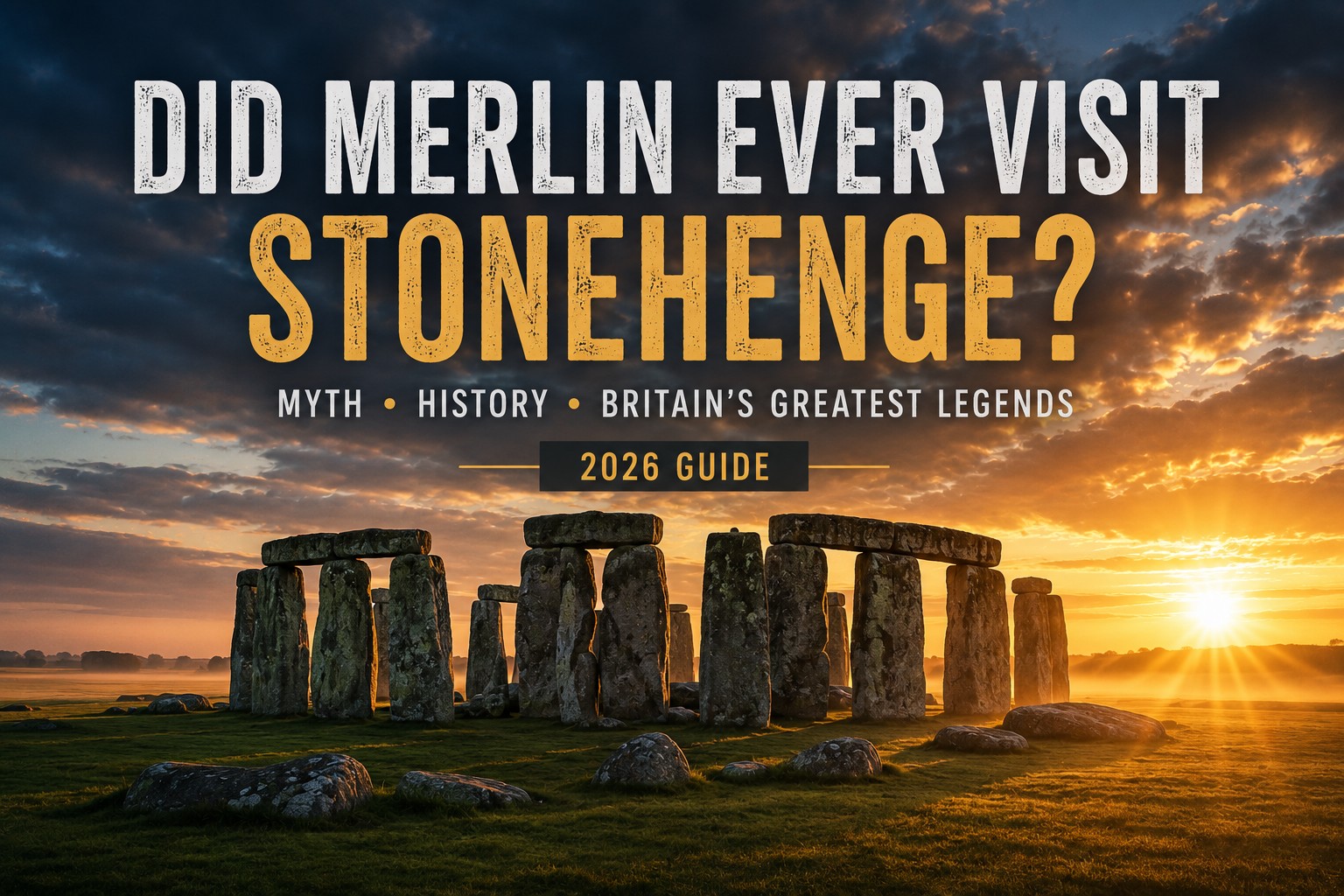
Stonehenge has inspired wonder for more than 4,500 years. Long before archaeology explained its origins, medieval writers connected the monument with Merlin, creating one of Britain’s most enduring legendary traditions
Stonehenge is Britain’s most famous prehistoric monument. Merlin is the defining wizard of Arthurian legend. It is therefore hardly surprising that, for centuries, people have imagined the two as belonging to the same ancient story.
But did Merlin ever visit Stonehenge?
According to the historical and archaeological evidence available today, there is no reliable evidence that he did. The famous connection comes instead from a remarkable medieval narrative written around 1136 by Geoffrey of Monmouth, who described Merlin transporting an existing stone monument from Ireland and re-erecting it on Salisbury Plain.
That distinction is more important than it might first appear. In Geoffrey’s account, Merlin did not discover Stonehenge, nor did he create it from nothing. His role was to move a sacred monument and give it a new purpose within Britain’s legendary history.
Modern archaeology tells a very different story, placing Stonehenge’s origins thousands of years before the Arthurian tradition emerged. Yet Geoffrey’s account remains one of the most influential stories ever told about the monument because it reveals how medieval Britain tried to explain a place that was already unimaginably ancient.
This guide explores both perspectives. It examines how Merlin became linked with Stonehenge, what Geoffrey’s famous Giants’ Dance story actually says, what archaeology has uncovered about the monument’s true origins and why the legend continues to enrich the experience of visiting Stonehenge today.
✨ Did Merlin Ever Visit Stonehenge? The Short Answer
No surviving historical source confirms that Merlin ever visited Stonehenge, and no archaeological evidence places him at the monument.
The enduring connection comes from Geoffrey of Monmouth’s Historia Regum Britanniae (The History of the Kings of Britain), where Merlin advises King Aurelius Ambrosius to transport a sacred stone circle from Ireland to Salisbury Plain as a memorial to British nobles who had been killed through treachery.
Understanding the legend becomes much easier when three commonly confused questions are separated.
| Question | Best Answer |
|---|---|
| Did Merlin visit Stonehenge? | There is no reliable evidence that he did. |
| Did Merlin build Stonehenge? | No. In Geoffrey’s story, the monument already existed elsewhere. |
| Did Merlin move Stonehenge? | Yes. According to the medieval legend, he transported and re-erected the stones on Salisbury Plain. |
Stonehenge had already stood for roughly four thousand years before Geoffrey connected it with Merlin. His story does not explain how the monument was really built, but it has shaped how generations of people have imagined Stonehenge ever since.
🏛️ Myth vs Archaeology: Understanding the Difference
Stonehenge is unique because it has two remarkable stories. One belongs to Britain’s legendary traditions, while the other is supported by modern archaeological research. Appreciating both perspectives helps visitors understand why the monument continues to fascinate millions of people today.
| 🧙 Medieval Legend | 🏛️ Archaeological Evidence |
|---|---|
| Merlin transported the stones from Ireland. | Stonehenge was built on Salisbury Plain over many centuries beginning around 3000 BC. |
| The monument was known as the Giants’ Dance. | Excavations reveal several prehistoric construction phases. |
| The story comes from Geoffrey of Monmouth’s Historia Regum Britanniae. | The evidence comes from archaeology, geology and scientific dating. |
| The legend forms part of Britain’s rich cultural heritage. | Research explains how the monument was actually created and evolved. |
💡 Why It Matters: The legend and the archaeology are not rivals—they tell two different parts of Stonehenge’s story. One explains how medieval Britain understood the monument, while the other reveals how prehistoric people really built one of the world’s greatest ancient landmarks.
🧙 Who Was Merlin in British Legend?
Merlin is one of the most recognisable figures in British folklore, yet he is also one of the most complex. Unlike many historical personalities, he cannot be traced to a single documented individual. Instead, the Merlin known today developed gradually through centuries of storytelling, with different traditions adding new qualities to his character over time.
Early Welsh traditions describe prophetic and mysterious figures associated with the wilderness, wisdom and visions of Britain’s future. Medieval writers later drew upon these earlier traditions, reshaping them into the Merlin who would become inseparable from King Arthur and Britain’s legendary past.
By the twelfth century, Merlin had evolved into far more than a magician.
He was portrayed as a prophet, royal adviser, strategist and interpreter of mysteries—someone capable of understanding events and places that lay beyond ordinary human knowledge. That reputation made him the ideal figure to explain ancient monuments whose true origins had long been forgotten.
Stonehenge was a perfect example.
Even in the Middle Ages, the monument was already astonishingly old. Its builders had left no written record explaining why it had been created, how its enormous stones had been transported or what ceremonies had once taken place there. Faced with such an extraordinary structure, medieval audiences naturally sought an explanation worthy of its scale.
Merlin provided exactly that.
His association with hidden knowledge allowed later writers to connect Britain’s most mysterious legendary figure with Britain’s most mysterious prehistoric monument. Whether or not anyone believed every detail literally, the pairing felt entirely believable within the cultural world of medieval Britain.
📖 How Geoffrey of Monmouth Linked Merlin with Stonehenge
The enduring relationship between Merlin and Stonehenge can be traced principally to the work of the twelfth-century cleric and chronicler Geoffrey of Monmouth.
Writing around 1136, Geoffrey completed Historia Regum Britanniae (The History of the Kings of Britain), a sweeping legendary history that followed Britain’s rulers from mythical beginnings through the age of King Arthur. Although modern historians do not regard the work as a factual account of early British history, its influence on British culture has been immense.
Geoffrey’s version of Merlin transformed the character into one of medieval Europe’s most memorable legendary figures. More importantly for Stonehenge, he provided the first widely known explanation for how such an extraordinary monument came to stand on Salisbury Plain.
To understand why Geoffrey’s story proved so influential, it helps to remember that medieval writers approached history very differently from modern historians.
📜 How Medieval History Was Written
Medieval chroniclers often combined inherited traditions, oral stories, genealogy, religious beliefs and political ideas into a single narrative. Their purpose was not always to distinguish clearly between verifiable history and cultural memory. Instead, they sought to explain how nations, kings and landscapes came to possess meaning.
For Geoffrey’s readers, Stonehenge represented an ancient mystery that deserved an equally remarkable explanation.
🪨 The Giants’ Dance: Merlin’s Most Famous Stonehenge Legend
At the heart of Geoffrey of Monmouth’s account lies one of medieval Britain’s greatest legends—a story of giants, kings, magic and remembrance.
The tale begins after the Night of the Long Knives, when many British nobles were treacherously murdered by Saxon leaders during what had been presented as a peace gathering. The massacre devastated the British kingdom, prompting King Aurelius Ambrosius to seek a memorial worthy of those who had died.
His advisers proposed magnificent monuments, but none seemed equal to the tragedy.
Merlin offered an extraordinary alternative.
Rather than building a new memorial, he told the king of an ancient stone circle standing on Mount Killaraus in Ireland, known as the Giants’ Dance. According to the legend, these were no ordinary stones. Giants had originally brought them from the farthest reaches of Africa before they were eventually transported to Ireland, where they became renowned for their remarkable healing properties.
Merlin explained that the stones possessed powers beyond human understanding and would provide a fitting memorial for Britain’s fallen leaders.
When Aurelius sent an army to retrieve them, Geoffrey describes the soldiers struggling in vain. Despite ropes, ladders and every practical method they could devise, the monument refused to yield.
Human strength alone was not enough.
Merlin then stepped forward and used his wisdom and magical knowledge to dismantle the great circle with ease before arranging for the stones to be carried across the sea and re-erected on Salisbury Plain.
In Geoffrey’s story, Merlin’s achievement is not simply an act of magic. It is an act of preservation. The monument’s sacred identity survives because the stones themselves—not copies or replacements—are transported to Britain and carefully rebuilt as a lasting memorial.
This is an important distinction that is often overlooked today. Geoffrey never claimed Merlin created Stonehenge from raw materials. Instead, he claimed Merlin relocated an already ancient and revered monument, giving it a new purpose while preserving its extraordinary character.
📋 Geoffrey’s Stonehenge Story at a Glance
| Element | Geoffrey’s Legend |
|---|---|
| Original monument | The Giants’ Dance on Mount Killaraus, Ireland |
| Earlier origin | Giants transported the stones from Africa |
| Special qualities | Famous for healing and sacred powers |
| Why move the stones? | To honour British nobles killed by Saxon treachery |
| Why soldiers failed | The monument could not be dismantled by ordinary human strength |
| Merlin’s role | Used wisdom and magical knowledge to move and rebuild the monument |
| Final location | Salisbury Plain, where it became Stonehenge |
Whether medieval readers accepted every detail literally or viewed it as symbolic, Geoffrey created a story powerful enough to become inseparable from Stonehenge itself. Nearly nine centuries later, it remains one of the monument’s best-known and most enduring legends.
🏛️ What Does Archaeology Say About Stonehenge?
Modern archaeology presents a very different story from Geoffrey of Monmouth’s medieval legend.
Today, Stonehenge is understood as the product of many centuries of prehistoric construction rather than a single dramatic event. Archaeological evidence shows that work began around 3000 BC, with the monument evolving through several major building phases before reaching the iconic form recognised today.
The enormous sarsen stones were transported from the Marlborough Downs, around 20 miles (32 kilometres) away, while the smaller bluestones originated in the Preseli Hills of south-west Wales, travelling more than 140 miles (225 kilometres). Exactly how prehistoric communities achieved these remarkable feats remains an active area of research, but the evidence points to careful planning, engineering and the collective effort of many generations.
Nothing discovered through archaeology suggests the monument was moved intact from Ireland during the historical period.
Instead, Stonehenge reflects thousands of years of gradual development by prehistoric societies whose beliefs, technologies and traditions evolved over time.
Recent discoveries continue to deepen that understanding. Scientific analysis has revealed more about where individual stones originated, while ongoing investigations have refined our knowledge of how the landscape surrounding Stonehenge developed. One notable example is the Altar Stone, whose geological source has been reassessed through modern research, demonstrating that archaeology continues to refine our understanding of the monument even today.
Each new discovery strengthens the picture of Stonehenge as one of prehistoric Europe’s most ambitious engineering and ceremonial achievements.
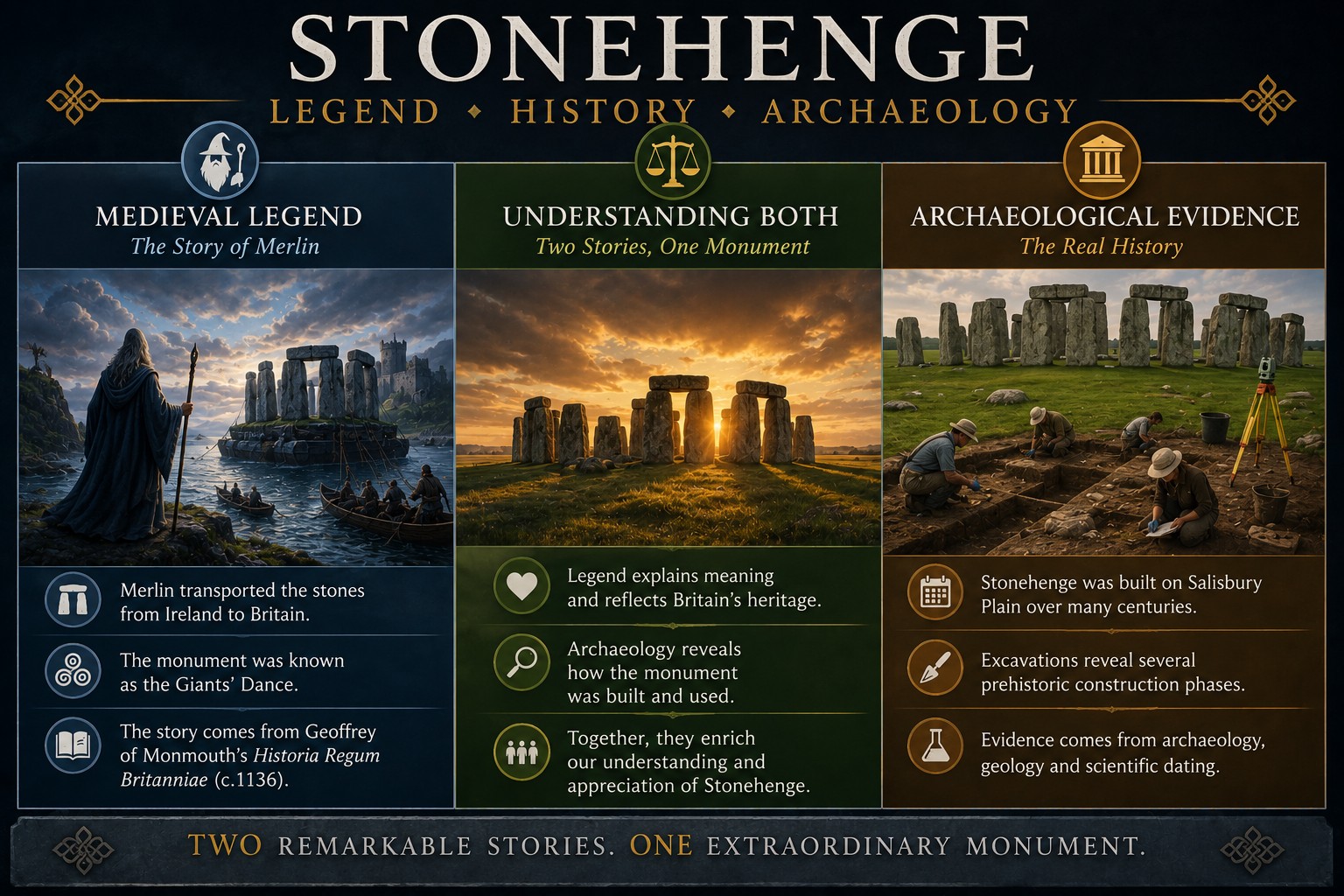
Stonehenge is best understood through two complementary perspectives. Medieval legend explains how later generations imagined the monument, while archaeology reveals how prehistoric communities actually created one of Britain’s greatest ancient landmarks
⚖️ Stonehenge Has Two Histories
Perhaps the most fascinating way to understand Stonehenge is to recognise that it possesses two equally important histories.
The first is its archaeological history—the evidence revealed through excavation, scientific dating, geology and decades of research. This history explains how prehistoric communities planned, built and continually transformed the monument over thousands of years.
The second is its cultural history—the stories later generations told when the monument’s true origins had long been forgotten. Geoffrey of Monmouth’s Merlin narrative belongs to this history. Although it is not accepted as factual archaeology, it became part of Britain’s cultural inheritance and profoundly shaped how people imagined Stonehenge for centuries.
These two histories do not compete with one another.
Instead, they answer different questions.
Archaeology explains how Stonehenge was built.
Legend explains what Stonehenge came to mean for the people who inherited it long after its original builders had disappeared from history.
Recognising both perspectives allows visitors to appreciate Stonehenge not only as an extraordinary prehistoric monument, but also as one of Britain’s richest sources of myth, imagination and national storytelling.
📅 Timeline: Legend and Historical Reality
Understanding when each story belongs helps explain why the Merlin legend became so enduring. Stonehenge and Merlin are separated not by centuries, but by millennia.
| Date | What Happened |
|---|---|
| c. 3000 BC | The first earthwork enclosure is created at Stonehenge. |
| c. 2500 BC | The great sarsen circle and trilithons are erected during the monument’s most famous building phase. |
| Following centuries | Stonehenge continues to evolve as prehistoric communities modify the site. |
| 5th–6th centuries AD (traditional setting) | The legendary age associated with King Arthur and Merlin is traditionally placed during post-Roman Britain. |
| c. 1136 AD | Geoffrey of Monmouth writes Historia Regum Britanniae, linking Merlin with Stonehenge through the Giants’ Dance story. |
| Modern era | Archaeology, geology and scientific research continue to reveal how Stonehenge was really constructed while the Merlin legend remains an enduring part of Britain’s cultural heritage. |
Seen this way, it becomes clear that Geoffrey was not recording eyewitness history. He was explaining one of Britain’s oldest monuments for a medieval audience that no longer knew who had built it.
🌄 Why the Merlin Story Still Matters Today
Visitors often arrive at Stonehenge expecting archaeology alone, yet many leave equally fascinated by the stories that have surrounded the monument for centuries.
The Merlin legend is one of the reasons.
Although it is not accepted as historical fact, the story adds another dimension to the visitor experience. It reminds us that every generation has tried to understand Stonehenge in its own way. Prehistoric builders gave the monument physical form, medieval writers gave it legendary meaning, and modern archaeologists continue to uncover new evidence about its remarkable past.
Rather than diminishing Stonehenge, these different perspectives enrich it.
Standing beside the stones, it is easy to understand why Geoffrey imagined a place worthy of giants, kings and Britain’s greatest wizard. The monument possesses a scale and atmosphere that naturally inspire imagination, even when viewed through the lens of modern science.
That combination of evidence and legend is part of what makes Stonehenge unique. Few places allow visitors to appreciate both one of the world’s most significant prehistoric monuments and one of Britain’s most influential medieval stories in the same landscape.
Whether you come to explore archaeology, Arthurian legend or simply one of Britain’s greatest landmarks, Stonehenge rewards curiosity from every direction.
📅 Planning a Visit to Stonehenge?
If Merlin’s legendary connection to Stonehenge has inspired you to experience this extraordinary monument for yourself, our Stonehenge Inner Circle Access Calendar is the perfect place to start. It lets you explore available sunrise and sunset access dates throughout the year, compare the best times to visit, and begin planning an unforgettable journey to one of Britain’s greatest ancient landmarks.
📅 View the Stonehenge Inner Circle Access Calendar
Discover the best dates, compare seasonal experiences and start planning your perfect Stonehenge visit.
Standing before Stonehenge is about more than seeing an ancient monument. Understanding both its prehistoric origins and the medieval legends that grew around it creates a richer and more memorable experience
🌿 Visiting Stonehenge with Both Perspectives
The most rewarding visit is often one that embraces both histories.
Explore the monument through the latest archaeological discoveries to understand how prehistoric communities shaped this extraordinary landscape. Then step back and imagine how medieval travellers, with no knowledge of radiocarbon dating or modern excavation, interpreted the same stones through stories of Merlin, giants and ancient magic.
Together, those two perspectives create a richer and more memorable experience than either could provide alone.
👣 Ready to Experience Stonehenge for Yourself?
Reading about Stonehenge’s extraordinary blend of archaeology, legend and history is only the beginning. Whether you’re interested in a classic visit, exclusive Inner Circle access, or combining Stonehenge with other iconic destinations, choosing the right tour can transform your experience.
Browse our carefully selected range of Stonehenge tours to find the option that best suits your interests, schedule and style of travel.
Discover unforgettable day tours, Inner Circle experiences, small-group adventures and more.
🌱 Visiting Stonehenge Responsibly
Stonehenge has survived for more than 4,500 years because generations have recognised its importance and worked to protect it. Every visitor plays a small part in ensuring that future generations can experience the monument in the same remarkable setting.
The best way to help preserve Stonehenge is to remain on the designated visitor paths, respect the protected areas around the stones and follow guidance provided by the site staff. These simple actions reduce wear on the fragile archaeological landscape while helping to safeguard buried remains that are still being studied today.
Choosing responsible transport, supporting local businesses and taking time to learn about the wider Stonehenge landscape also contributes to sustainable tourism. The monument is not an isolated circle of stones but part of a much larger UNESCO World Heritage Site containing ancient earthworks, burial mounds and ceremonial features that deserve equal care and respect.
By treating Stonehenge as both a world-famous attraction and an irreplaceable archaeological treasure, visitors help ensure that its history—both real and legendary—continues to inspire people for generations to come.
🧭 Expert Planning Tip
Many visitors arrive expecting Stonehenge to be simply a circle of ancient stones. In reality, it is the centrepiece of a vast UNESCO World Heritage landscape filled with prehistoric monuments, ancient burial mounds and ceremonial sites. Allow enough time to explore beyond the stones themselves—you’ll gain a much deeper appreciation of why Stonehenge is considered one of the world’s greatest archaeological treasures.
🌿 Travel with Purpose. Explore with Care.
Stonehenge is far more than a famous landmark—it is part of a protected UNESCO World Heritage Site that has survived for over 4,500 years. Every visitor has an opportunity to help preserve this remarkable landscape by respecting the monument, following designated paths and supporting responsible tourism.
Small actions make a lasting difference. By exploring thoughtfully today, you help ensure that future generations can continue to experience both the history and the wonder of one of Britain’s greatest ancient treasures.
❓ Frequently Asked Questions
❓Did Merlin really build Stonehenge?
No. Medieval legend says Merlin transported an existing stone circle from Ireland to Salisbury Plain. Modern archaeology shows Stonehenge was constructed over many centuries by prehistoric communities beginning around 3000 BC.
❓Did Merlin ever visit Stonehenge?
There is no reliable historical or archaeological evidence that he did. His association with Stonehenge comes primarily from Geoffrey of Monmouth’s Historia Regum Britanniae, written in the twelfth century.
❓Why is Merlin connected with Stonehenge?
Geoffrey used Merlin to explain how such an extraordinary monument could have come into existence. His Giants’ Dance story became one of the best-known legends associated with Stonehenge and influenced British culture for centuries.
❓Was Stonehenge really moved from Ireland?
No. Archaeological evidence demonstrates that the monument developed on Salisbury Plain over thousands of years. Geoffrey’s account is regarded as a medieval legend rather than a historical explanation.
❓Can you still enjoy the Merlin legend when visiting Stonehenge?
Absolutely. Understanding that Stonehenge has both an archaeological history and a rich cultural history allows visitors to appreciate the monument from multiple perspectives. The legend adds depth to the experience without replacing the evidence uncovered through modern research.
📚 Continue Exploring Stonehenge
Continue exploring the connections between Stonehenge, British legend and the experience of visiting one of the world’s greatest prehistoric monuments.
⚔️ Stonehenge & King Arthur Sites Tour: A Legendary South West England Journey
Discover a remarkable journey connecting Stonehenge with places associated with King Arthur, where ancient landscapes, history and legend come together.
Read the Guide →
🗿 Stonehenge Tours from London & UK: Complete Guide
Explore the principal ways to visit Stonehenge, compare tour options and find expert guidance for planning your journey from London or elsewhere in the UK.
Read the Guide →
🌅 Stonehenge Inner Circle Access: Complete Guide
Learn how Stonehenge Inner Circle access works, what makes the experience distinctive and how to prepare for a sunrise or sunset visit inside the stone circle.
Read the Guide →
🏁 Conclusion
So, did Merlin ever visit Stonehenge?
The honest answer is that we simply do not know, and there is no reliable evidence that he did. What we do know is that Geoffrey of Monmouth created one of Britain’s most enduring legends by linking Merlin with Stonehenge through the unforgettable story of the Giants’ Dance.
Archaeology and legend answer different questions. One reveals how Stonehenge was really built; the other explains how later generations found meaning in a monument whose true origins had long been forgotten.
That is why Stonehenge remains so compelling today. It is both a masterpiece of prehistoric engineering and a monument woven into Britain’s greatest legends. Whether you arrive fascinated by archaeology, captivated by Arthurian myth or simply curious about one of the world’s most famous ancient sites, you leave with an appreciation of both histories—and a deeper understanding of why Stonehenge continues to inspire wonder after more than four millennia.
🗺️ Continue Planning Your Stonehenge Visit
Your journey doesn’t have to end here. Whether you’re choosing the perfect Inner Circle date, comparing tour options or looking for comprehensive visitor advice, these expert resources will help you plan an unforgettable Stonehenge experience.
📅 View the Stonehenge Inner Circle Access Calendar
🗿 Read the Complete Stonehenge Guide
Expert planning resources, trusted travel advice and carefully selected tours—all designed to help you make the most of your Stonehenge visit.