


How Many Days Should You Spend in London? (2027 Visitor Guide)
21st August 2026
🕰️ How Many Days Should You Spend in London? (2027 Visitor Guide)
🎯 How Many Days in London Do You Really Need?

For most first-time visitors, four to five full sightseeing days offers the best balance of London’s major sights, neighbourhoods, culture and flexibility
For most first-time visitors, four to five full days in London is the sweet spot. That gives you enough time to experience many of the capital’s defining sights, explore different parts of the city, enjoy at least a little unscheduled London and avoid turning the entire visit into a race between attractions.
That does not mean shorter visits cannot work. Two full sightseeing days can deliver an excellent highlights-focused break, while three days provides a strong introduction to the city. At the other end of the scale, six or seven days is certainly not too long if you enjoy museums, history, neighbourhoods, markets, parks, food, theatre or simply travelling at a more relaxed pace.
The important word is full.
Four hotel nights do not necessarily equal four sightseeing days. Arrival and departure times, airport or rail transfers, luggage, pre-booked experiences and your own energy levels can substantially reduce the time you actually have available.
Nor should the right duration be calculated by counting famous attractions and dividing them between days. London rewards visitors who allow time for the spaces between the headline sights: walking beside the Thames, exploring a historic street, lingering in a museum, discovering a neighbourhood or changing plans because somewhere proves more interesting than expected.
This guide therefore takes a different approach. Rather than prescribing one itinerary for everyone, it will help you decide how long your London visit deserves according to your priorities, pace and wider journey.
The objective is not to “complete” London.
It is to give the London you most want to experience enough time to become memorable.
🎯 The Short Answer: Match Your London Stay to the Experience You Want
There is no single number of days that suits every visitor. The better question is what kind of London experience you want your available time to deliver.
⏱️ 1–2 Days: A Highlights-Focused Visit
One or two full days can still be memorable, particularly during a stopover or short city break. The key is selectivity. Choose the places that genuinely matter to you, group them geographically and accept that much of London will remain for another visit.
Two days is enough to experience London. It is not enough to experience everything London offers.
🧭 3 Days: A Strong Introduction
Three full days gives first-time visitors enough time to experience several different sides of the capital without reducing every landmark to a hurried photo stop. Major sights can sit alongside history, culture, the Thames or neighbourhood exploration when the days are organised intelligently.
⭐ 4–5 Days: The London Sweet Spot
For most first-time visitors, four to five full days remains our preferred range. The advantage is not simply fitting another attraction into the schedule. Extra time improves the quality and resilience of the entire visit.
Meals need not be rushed, longer museum visits can remain longer, transport delays are easier to absorb and unexpected discoveries do not automatically derail the day.
🌆 6–7 Days: London Starts to Breathe
With six or seven days, neighbourhoods, markets, parks, specialist museums and evening experiences can complement the major sights rather than compete with them. You can explore at a more relaxed pace and still have plenty of London left to discover.
A carefully chosen excursion beyond the capital may also fit naturally, although it should remain a choice rather than something every longer stay automatically requires.
🧳 More Than a Week: Absolutely Not Too Long
A week or longer can be ideal for repeat visitors, families, cultural travellers and anyone who prefers deeper exploration. It can also allow London gradually to become a base or gateway for discovering more of Britain.
📊 London Stay Length Compared: What Each Duration Really Gives You
It helps to think about London time in terms of what each additional day changes, rather than simply counting how many attractions can be added. The difference between three and five days is not merely two extra sightseeing slots; it can change the pace, geographical range and overall character of your visit.
| Time available | Realistic London experience | Particularly suitable for | Should you add a day trip? |
|---|---|---|---|
| 1 day | Carefully selected icons and orientation | Stopovers or very limited visits | Protect London |
| 2 days | Focused highlights | Short city breaks | Usually stay in London |
| 3 days | Strong first introduction | Time-conscious first visitors | Usually protect London |
| 4–5 days | Balanced first experience | Most first-time visitors | Possible if it is a priority |
| 6–7 days | Deeper, more relaxed London | Longer or repeat visits | One can fit naturally |
| 7+ days | Slow London plus wider possibilities | Extended trips | London can become a base |
Treat this as a planning framework rather than a rigid prescription. A history enthusiast could happily devote several days to historic London alone, while another visitor may prioritise famous sights, shopping, food, theatre and contemporary neighbourhoods.
The biggest improvement often occurs around the four-to-five-day mark. At that point, there is enough flexibility to stop organising every hour around a fixed sightseeing schedule. A rainy morning, an unexpectedly absorbing museum or a spontaneous detour through an interesting neighbourhood no longer threatens the entire itinerary.
Equally, more days do not automatically create a better holiday. Seven poorly organised days can involve unnecessary backtracking and sightseeing fatigue, while four intelligently planned days can feel remarkably complete.
The purpose is not to produce a mathematically perfect number. It is to prevent the common mistake of choosing the number of nights first and only afterwards discovering that your priorities do not fit comfortably inside them.
✈️ Don’t Confuse Nights in London with Sightseeing Days
One of the easiest London planning mistakes is counting every hotel night as though it represents a complete day of sightseeing. In practice, the number that matters is your usable London time.
Suppose you arrive on Monday afternoon and leave on Friday morning. On a booking calendar, that may appear to be a substantial London stay. In reality, it provides three full sightseeing days, plus whatever genuinely useful time remains after arriving on Monday. Friday may contribute little beyond breakfast, collecting luggage and beginning your onward journey.
Arrival days deserve particular realism. Airport or rail formalities, travelling into central London, reaching your accommodation, dealing with luggage and recovering from a long journey all consume time and energy. The amount of usable time will vary according to when and where you arrive, but a theoretically available afternoon should not automatically be trusted with one of your highest-priority experiences.
Departure days create similar problems. Even a late flight or train does not necessarily provide an unrestricted sightseeing day once checking out, storing or carrying luggage and allowing sufficient transfer time are considered.
Do not automatically count arrival and departure days as full days simply because both appear within your accommodation dates.
This distinction becomes particularly important when comparing a three-, four- or five-day visit. If your supposed four-day trip contains only two complete days and two heavily restricted travel days, the itinerary needs to resemble a shorter visit.
The reverse can also be true. An early arrival or late departure may create valuable additional time, particularly when convenient luggage arrangements allow you to explore comfortably.
The strongest approach is to build your plans around full sightseeing days first, then treat arrival and departure time as useful additional capacity rather than essential itinerary time.
That small adjustment makes a London visit considerably more resilient. Your genuine priorities remain protected, while partial days can accommodate a relaxed walk, nearby neighbourhood, riverside exploration, meal or another experience that does not depend on a tightly controlled schedule.
👣 Your Travel Style Changes How Many Days You Need
Two visitors can spend five days in London and experience completely different cities. Your interests, travelling companions, mobility, energy levels and preferred pace therefore matter almost as much as the number of days available.
👋 First-Time Visitors
First-time visitors understandably want to experience London’s defining sights. Westminster, Buckingham Palace, the Tower of London, the Thames and other major landmarks deserve proper time rather than being reduced to hurried photo stops. Four to five full days usually provides the strongest balance between famous London and the freedom to discover something unexpected.
🔁 Repeat Visitors
Returning visitors face a different calculation. Having already experienced many headline sights, they may need fewer days for a focused break—or considerably more because their interests have become deeper.
Neighbourhoods, markets, exhibitions, historic streets, specialist museums, food and seasonal events can reveal a London quite different from the first visit.
👨👩👧 Families
Families often benefit from adding time rather than adding activities. Transport, meals, breaks and changing energy levels can make an overfilled itinerary particularly tiring for children and adults alike.
Planning fewer major commitments each day leaves room to respond to how everyone actually feels.
🏛️ History, Museum and Culture Travellers
If London’s history and cultural collections are major reasons for visiting, a week can disappear surprisingly quickly. A substantial museum, gallery, palace or historic site may deserve several hours in its own right.
Trying to treat these places merely as boxes to tick usually defeats the reason for visiting them.
🌿 Travellers Who Prefer a Slower Pace
Five to seven days can transform London for travellers who enjoy walking, cafés, parks, neighbourhood life and spontaneous discoveries. Extra time also helps anyone who prefers fewer geographical moves, more frequent breaks or simply a less physically demanding sightseeing rhythm.
A relaxed five-day visit can ultimately deliver far more value than an exhausting three-day attempt to fit everything in.
⚓ Plan Experiences, Not an Attraction Checklist
One of the best ways to decide how many London days you need is to stop counting attractions and start thinking about anchor experiences. A schedule containing six famous names may look impressive on paper, but it can quickly become a succession of entrances, exits, queues and journeys across the city.
An anchor experience is simply one of the principal things around which you organise that day. It does not have to be a paid attraction, ticketed tour or advance booking. A major museum could be an anchor, but so could exploring Greenwich, walking through historic Westminster or spending meaningful time beside the Thames.
For most visitors, building a day around one or two genuine priorities creates a much better rhythm.
A historic attraction might become the morning anchor, with nearby streets, landmarks or riverside exploration developing naturally around it. The evening could then remain available for theatre, a meal, another carefully chosen experience or simply enjoying London without another deadline.
This matters because sightseeing takes longer than the admission time printed on a ticket. Security, walking between places, public transport, finding somewhere to eat and simply stopping to look at London are all part of the visitor day.
The principle also helps distinguish between a three-day and five-day stay. With three days, your anchors need to be highly selective. With four or five, those priorities can be distributed more comfortably. With a week, specialist interests and spontaneous discoveries no longer have to compete constantly with headline sights.
There is also a psychological advantage. If every hour has already been allocated before you arrive, one delay can make the entire day feel behind schedule.
London is particularly good at producing unplanned moments: an interesting street, an unexpected market, a riverside view or a historic building that makes you stop.
A strong London itinerary therefore has enough structure to protect what matters—and enough space for the city itself to interrupt it.

Build your London day around one or two priorities, explore nearby, allow realistic time for meals and travel, and leave space for spontaneous discoveries
🗺️ London’s Geography Can Add—or Remove—a Day
London’s size can make a perfectly reasonable sightseeing list surprisingly inefficient. Two attractions may both be described as being in “central London” yet still require a meaningful journey between them. Repeat that pattern several times and hours that could have been spent experiencing the city disappear into unnecessary backtracking.
A better approach is to think in areas rather than isolated attractions.
Westminster and Royal London naturally bring together major ceremonial, political and historic landmarks. The City and Tower area provides another concentration of history, while the South Bank and Thames form a natural sightseeing corridor. The West End and Covent Garden work particularly well for entertainment, dining and atmosphere, while Kensington contains some of London’s most important museums. Greenwich deserves more deliberate time because reaching and exploring it can form part of the experience itself.
Grouping experiences geographically does not mean every minute must be planned. In fact, it usually creates more freedom, because less of your day is lost repeatedly crossing the capital.
This can materially change how many days you think London requires. A poorly organised four-day itinerary may feel frustratingly short, while four intelligently grouped days can provide a remarkably rich first visit.
There will, of course, be occasions when crossing London is worthwhile for a particular attraction, event or reservation. The objective is not to minimise every journey. It is to make sure each significant journey is earning its place in your day.
This geographical approach also prepares the ground for deciding when guided sightseeing, public transport, walking or another organised experience could genuinely simplify your plans.
Sometimes you do not need to add another night to your London stay.
You simply need to use the days you already have more intelligently.
🎟️ Can Tours and Advance Planning Make a Short London Stay Work Better?
Once you begin grouping London geographically, another useful question emerges: would a little more structure make your limited time easier to use?
Independent exploration and organised sightseeing both have advantages. The right choice depends on the problem you are trying to solve rather than any assumption that one approach is automatically better.
For a first-time visitor with only two or three full days, an organised sightseeing experience can help with orientation, coordinate several locations and provide interpretation that would otherwise require additional research. Specialist guided experiences may also be worthwhile when understanding the history, people or stories behind a place matters as much as simply reaching it.
Visitors with four, five or more days may prefer a different balance—perhaps using structured sightseeing selectively while protecting substantial time for independent exploration.
Advance planning matters for priority attractions too. If a palace, historic site, exhibition or another experience is one of the principal reasons for your visit, check its visiting arrangements before constructing the rest of that day. Where a fixed entry time applies, it can become an anchor around which nearby sightseeing is organised.
The Thames fits naturally into this approach because the river connects rather than merely separates many parts of central London. Time beside—or, where appropriate, on—the Thames can provide orientation, sightseeing and a different perspective on the city rather than becoming another attraction squeezed into an already crowded schedule.
Above all, resist booking activities simply because an empty space exists in the itinerary.
Use organisation where organisation solves a real problem.
Efficiency is valuable only when the time it saves is returned to you as a better London experience.
🌙 Your London Evenings Count Too
When deciding how many days to spend in London, it is easy to concentrate entirely on daylight sightseeing. Yet a four-day visit may also contain three or four useful evenings, and using some of them thoughtfully can substantially change how much London fits comfortably into the trip.
London does not simply shut down when major daytime attractions close. Theatre, dining, riverside walks, entertainment and seasonal events allow the city to continue into the evening without requiring another major attraction to be forced into the afternoon.
This is particularly valuable when an experience naturally belongs later in the day. A West End performance does not need to compete with daytime sightseeing, while an evening beside the Thames can reveal a different atmosphere from the same area a few hours earlier.
That final option matters.
There is a danger in treating every evening as additional sightseeing capacity. A full day spent walking around London followed by a major evening commitment can be rewarding occasionally. Repeating that pattern throughout the visit can leave you exhausted precisely when you should be enjoying yourself.
Families, travellers adjusting after a long journey and anyone who prefers a slower pace should be particularly cautious about constructing morning-to-night schedules.
Instead, think of evenings as flexible additional capacity. Protect experiences that genuinely benefit from taking place after dark, while leaving other evenings deliberately light. Dinner followed by an unplanned walk through Covent Garden, Westminster or beside the river may be every bit as memorable as another ticketed activity.
This approach can make a shorter London stay work surprisingly well. Three full sightseeing days accompanied by one memorable evening experience and two relaxed evenings can feel richer than three days packed continuously from breakfast until bedtime.
The objective is not to extract the maximum possible activity from every available hour.
It is to recognise that London changes throughout the day—and to leave yourself enough energy to enjoy those different versions of the city.
📅 Check the BVT London Events Calendar Before Deciding Your Stay Length
Before fixing the length of your London visit, check what is happening in the city while you are there. A major event, exhibition, ceremony, festival or seasonal experience can be important enough to change both how many days you need and how those days should be arranged.
Imagine that four days initially seems ideal, but something you particularly want to experience takes place on the fifth. Staying an additional night may then provide considerably more value than trying to reorganise four already busy days around it.
The reverse is equally useful. Once fixed-date experiences are identified, flexible sightseeing can be arranged around them rather than competing for the same time.
A sensible planning sequence is:
1. Confirm your London dates and usable sightseeing time.
2. Check for events that genuinely matter to you.
3. Protect those fixed-date experiences first.
4. Add your priority London attractions and neighbourhoods.
5. Only then decide whether you have enough time for optional experiences or a day beyond London.
Use the BVT London Events Calendar 2026–2027 when planning your visit:
https://www.bestvaluetours.co.uk/london-events-calendar/
Before deciding how many days London deserves, find out what London is doing while you are there.
Events matter because the city changes throughout the year. The London available during your particular dates may be quite different from the generic version described in a standard itinerary. Important events can also affect how early you need to make certain arrangements or how much flexibility you should retain around a particular day.
That does not mean adding another night simply because something is happening. The event still needs to earn its place according to your interests.
Checking before finalising your stay does, however, prevent the frustrating discovery that an experience you would have prioritised occurred immediately before you arrived, after you departed or on a day already committed elsewhere.
Your ideal London duration is therefore not determined solely by landmarks.
Sometimes the calendar itself provides the best reason to stay another day.
🚆 When Is Your London Stay Long Enough for a Day Trip?
London’s connections make places such as Stonehenge, Windsor, Bath and Oxford tempting additions to a British holiday. But before deciding where to go, there is a more important question:
Do you actually have enough London time to justify giving one of those days away?
For most first-time visitors with only two or three full sightseeing days, the answer will usually be no. London itself still has too much competing for those limited hours. Unless somewhere beyond the capital is one of the principal reasons for your trip, protecting your London days normally creates the stronger overall experience.
With four full days, the decision becomes more personal. An excursion may make sense if Stonehenge, Windsor or another destination ranks above some of the London experiences you would otherwise choose.
At five days, one day beyond the capital becomes considerably easier to accommodate. With six or seven, an excursion can often fit naturally without making London feel unnecessarily compressed.
2–3 London days: Usually protect London
4 London days: Consider an excursion only if it is a major priority
5 London days: One day trip becomes easier to justify
6–7+ London days: London and wider exploration can work comfortably together
Repeat visitors may reasonably make a different choice. If you already know London’s headline sights, even a shorter return visit might provide an excellent opportunity to explore somewhere beyond the capital.
The key is remembering that a day trip is not free additional sightseeing. It consumes part of the same finite holiday.
Ask yourself:
Does this destination add something I value more than the London experiences I would sacrifice to make room for it?
If the answer is yes, travelling beyond London may become one of the highlights of your stay. If the answer is uncertain, another London day may provide greater value.
Once the capital has received enough time, however, the character of the journey begins to change. London can become more than a destination in isolation: it can become the starting point for discovering another part of England and, eventually, travelling farther through Britain.
The decision should begin with your priorities, not with the assumption that every London holiday needs a day trip.
🇬🇧 When London Stops Being the Whole Holiday
There comes a point in a longer trip when the planning question changes. Instead of asking how many days should I spend in London?, you begin asking how much of my time in Britain should London receive?
Those are not quite the same decision.
If you have ten days in Britain, spending all ten in London could be perfect if the capital is your principal interest. But it is not automatically the best use of those days simply because keeping one accommodation base is convenient. Once you have allowed enough time for the London experiences that genuinely matter to you, staying elsewhere can reveal a very different side of Britain.
A useful way to think about the progression is:
London → Day Trip → Overnight Stay → Wider Britain
A day trip allows you to experience somewhere beyond the capital while returning to the same London accommodation. An overnight stay gives another destination more breathing room. A longer journey changes London from your sole base into the gateway through which the wider holiday expands.
There is no prize for travelling the greatest distance. A week spent exploring London deeply can be every bit as worthwhile as a multi-destination itinerary.
Equally, London should not absorb days that would be more rewarding elsewhere simply because changing accommodation seems inconvenient.
The strongest itinerary gives each destination the time its importance to you deserves.
Once that principle is established, London becomes exceptionally flexible: somewhere you can explore deeply, somewhere you can use selectively as a base and, when your journey is ready to expand, the natural gateway to what comes next.
🌱 Spend Your London Days More Thoughtfully
A well-designed London itinerary is not only easier to enjoy; it can also reduce unnecessary travel and encourage a more thoughtful relationship with the city. Sustainability does not have to mean sacrificing the experiences you came to London to enjoy. Often, the decisions that make a visit more sustainable are the same ones that make it slower, richer and better organised.
Start with geography. Grouping attractions and experiences within the same part of London reduces repeated cross-city journeys while giving you more time to understand an area properly. Walking between nearby places can reveal historic streets, architecture, gardens, independent businesses and small details that disappear when every journey is treated simply as transport from one attraction to another.
London’s extensive public transport network also makes it possible to explore much of the capital without relying on private transport. The objective is not to avoid travelling, but to make each journey purposeful and avoid unnecessary backtracking.
Slowing the itinerary can help too. Spending meaningful time in a neighbourhood, stopping somewhere locally owned and exploring beyond the most congested visitor corridors can spread both your attention and visitor spending more widely across the city.
The same principle applies when travelling beyond the capital. If your wider journey eventually continues elsewhere in Britain, consider whether repeatedly returning to London still makes geographical sense or whether travelling onwards would use your time more effectively.
Sustainable travel should not become another checklist competing for attention. It works best when incorporated naturally into sensible visitor planning.
A slower, geographically coherent London itinerary can reduce unnecessary movement while simultaneously giving you more time where it actually matters.
That is one of the most useful principles to carry throughout London and into the wider journey beyond it:
Travel with purpose. Explore with care.
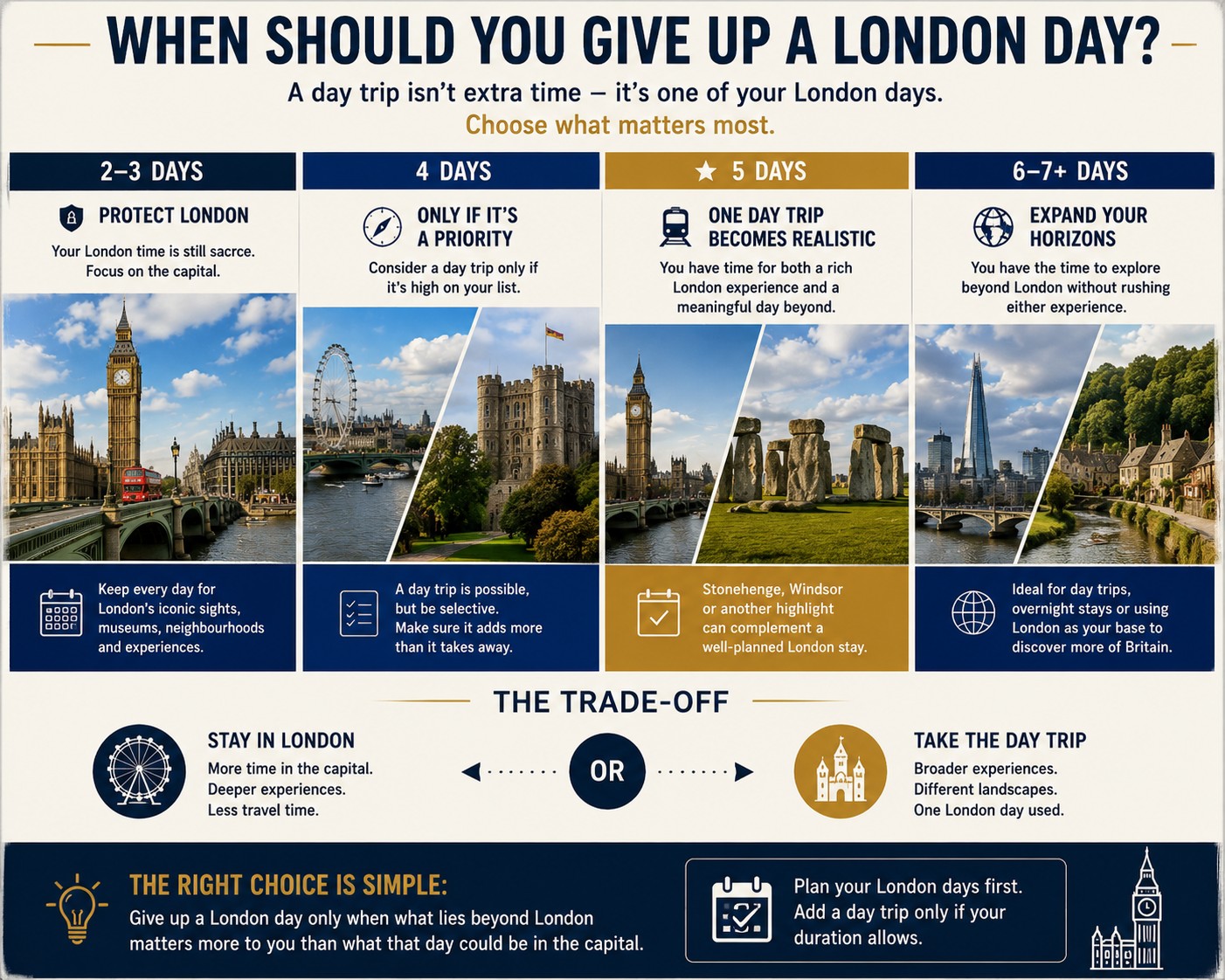
Protect London on shorter visits. As your stay gets longer, a carefully chosen trip to Windsor, Stonehenge or elsewhere in Britain becomes easier to justify
🧠 So, How Many Days in London Are Right for You?
After allowing for usable sightseeing time, travel style, geography, fixed events and your wider plans, the answer becomes much clearer. There is no perfect number for everyone, but there is a sensible range for the London experience you want to have.
⏱️ Choose 1–2 Days
Choose one or two full sightseeing days when London forms part of a larger journey or your available time is genuinely limited. Make this a highlights-focused visit: protect your highest priorities, group them intelligently and resist trying to recreate a five-day itinerary in 48 hours.
🧭 Choose 3 Days
Three full days provides a strong first introduction. With sensible geographical planning, you can experience several different sides of London while still giving your principal attractions meaningful time.
You will need to make choices, but the visit does not have to feel rushed.
⭐ Choose 4–5 Days
For most first-time visitors, four to five full days remains our recommended sweet spot. This duration provides the strongest balance between London’s defining sights, deeper experiences, different neighbourhoods and enough flexibility to prevent the holiday becoming a race against the clock.
It also gives the unexpected parts of London room to become part of the trip.
🌆 Choose 6–7 Days
Choose six or seven days if museums, history, culture, neighbourhoods and evening experiences matter to you, or if you simply prefer travelling at a more relaxed pace. This is also the point at which a carefully chosen excursion beyond London becomes considerably easier to accommodate without sacrificing the capital.
🧳 Choose Longer
Stay longer if London itself is one of the principal reasons for your journey, you have specialist interests, you are returning to explore more deeply or you want the capital eventually to function as a base or gateway for wider exploration.
Do not make the final decision according to how many famous places you can theoretically squeeze into each day.
Ask whether your itinerary leaves enough time to experience the London you came to see.
If the answer is yes, you have probably found the right number of days.
❓ Frequently Asked Questions About How Many Days to Spend in London
⏱️ Is 2 Days Enough in London?
Yes. Two full sightseeing days can provide a rewarding London visit if you accept that it will be selective rather than comprehensive. Choose the landmarks and experiences that matter most, group them geographically and avoid losing valuable time repeatedly crossing the city.
Two excellent London days are better than an unrealistic itinerary designed around seeing everything.
🧭 Is 3 Days Enough for a First Visit to London?
Three full days can provide a strong first introduction. You can experience several of London’s major sights while also including history, culture, the Thames or neighbourhood exploration.
The key is prioritisation. Decide what would genuinely disappoint you to miss and build the visit around those experiences first.
⭐ Is 4 or 5 Days Enough in London?
For most first-time visitors, four to five full days is the range we recommend most strongly. It provides enough time for London’s defining sights while allowing better pacing, geographical organisation, proper meals, spontaneous discoveries and experiences beyond a basic highlights checklist.
🌆 Is 7 Days in London Too Long?
Not at all. A week gives London room to reveal much more than its famous landmarks. Museums, markets, parks, neighbourhoods, evening experiences and specialist interests become easier to explore, while a day beyond the capital can potentially be included without sacrificing too much London time.
🚆 How Many London Days Do I Need If I Want a Day Trip?
Around five or more usable days generally makes one excursion easier to justify. With only two or three full days, most first-time visitors will gain more by protecting their London time unless the destination outside the city is a major personal priority.
Repeat visitors may reasonably make that decision sooner.
👨👩👧 Should Families Spend Longer in London?
Often, yes. Families can benefit from fewer major commitments each day and greater flexibility for meals, transport, breaks and changing energy levels. An additional day may improve the holiday more than adding extra attractions to an already crowded schedule.
✈️ Does My Arrival Day Count as a London Day?
Only if it provides genuinely usable sightseeing time. Consider when you arrive, your journey into London, luggage arrangements and likely energy levels before relying on arrival day for an important experience.
Treat useful arrival time as a bonus rather than allowing your entire itinerary to depend upon it.
✨ Give London Enough Time to Become More Than a Checklist
London is not a city you need to “complete”. Even after several visits, there will be another neighbourhood, museum, historic street, riverside walk, market, exhibition or unexpected corner capable of changing your understanding of it.
That is precisely why choosing the right number of days matters.
Three full days can introduce London remarkably well. Four or five allows the city to become more than a collection of headline landmarks. With six or seven, museums, neighbourhoods, events, evenings and slower discoveries can become part of the experience rather than things repeatedly sacrificed because the schedule is already full.
The best duration is therefore the one that matches your priorities, your pace and the wider journey you are planning.
Give your itinerary enough structure to protect the experiences that brought you to London, but enough flexibility to respond to the city once you arrive. Some of the moments you remember most may never have appeared on your original sightseeing list.
And when London has received the time it deserves, another question naturally emerges:
Should your next day remain in the capital—or take you somewhere new?
That might mean a carefully chosen day trip, an overnight stay elsewhere in England or the beginning of a longer journey through Britain. London works particularly well because it does not have to represent the entire holiday. It can be your destination, your base and eventually your gateway to whatever comes next.