


Planning the Perfect London Itinerary: 2, 3, 5 and 7 Day Visitor Plans (2027 Guide)
1st September 2026
🗺️ Planning the Perfect London Itinerary: 2, 3, 5 and 7 Day Visitor Plans (2027 Guide)
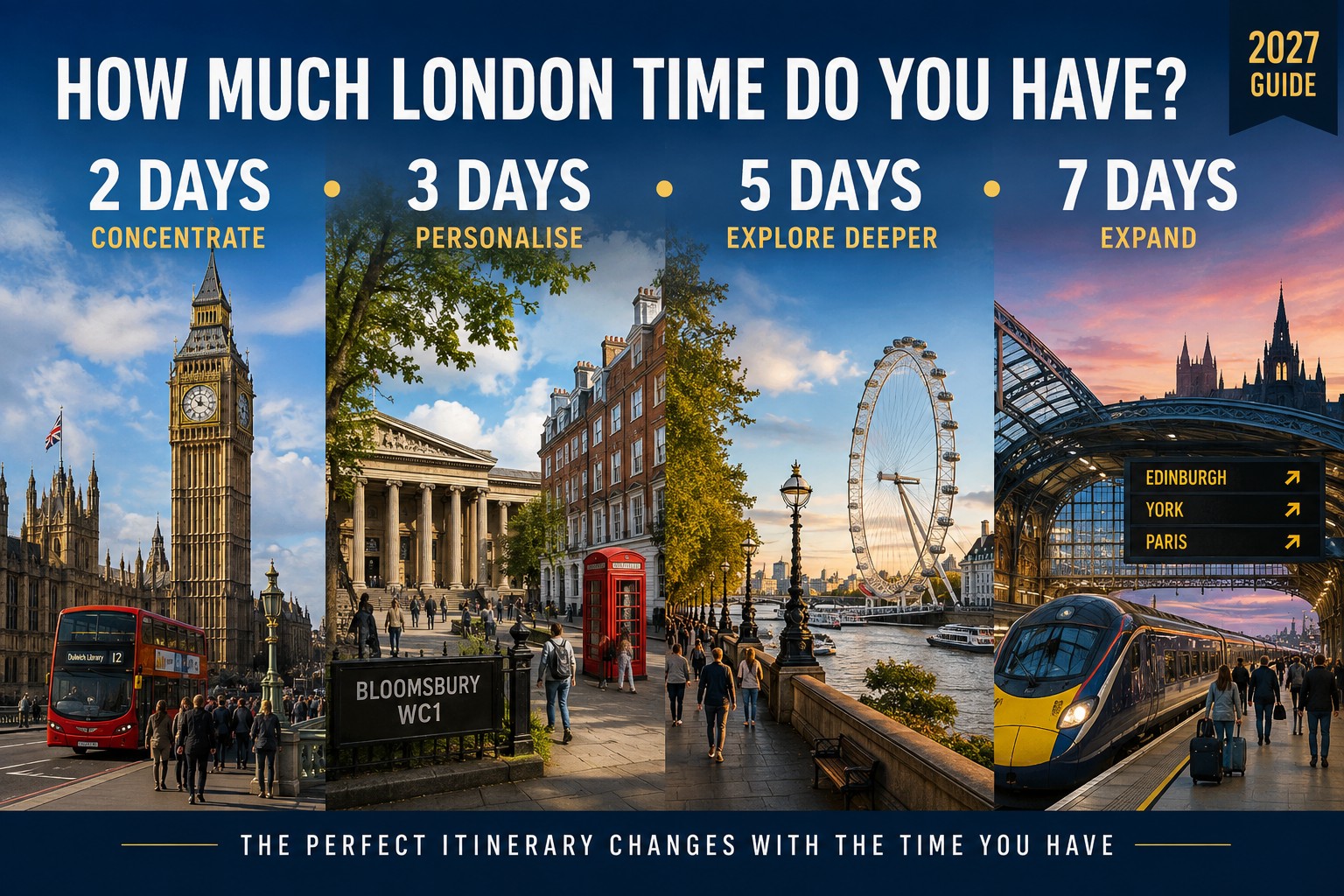
The best London itinerary changes with the time you have: concentrate with two days, personalise with three, explore deeper with five and expand your journey with seven
Planning a London itinerary can look deceptively simple. Choose a few famous attractions, divide them between your available days and start booking. In practice, London is too large, varied and full of possibilities for that approach to work particularly well.
Whether you have 2 days, 3 days, 5 days or a full week in London, the underlying challenge is much the same: deciding what genuinely deserves your time and what can realistically fit around it. The strongest itineraries are built around priorities, geography and sensible pacing rather than the number of attractions you can squeeze onto a schedule.
Travelling between sights takes time. Major attractions may involve queues, security or timed admission. Meals and breaks matter. Events can alter the character of an area, and some of London’s most memorable moments happen between the places you originally intended to visit.
That is why there is no single perfect London itinerary.
A traveller with two days needs disciplined choices. Three days creates room to make the visit more personal. Five days allows London to breathe and introduces the possibility of exploring beyond the capital. Seven days can transform a city break into something larger, with London becoming either the centre of the holiday or the gateway to a wider journey.
The plans below are therefore adaptable frameworks rather than rigid schedules. A useful itinerary should tell you not only what you could do, but also what you should probably leave out.
🧭 How Do You Build a London Itinerary That Actually Works?
Start with what matters enough to deserve protected time.
If visiting Westminster Abbey, seeing a particular exhibition, attending a West End performance or exploring the Tower of London is central to your trip, make that experience an anchor. An anchor is the experience around which the rest of that day is organised.
Once it is established, build around its location rather than adding unrelated attractions simply because they appear on the same wish list.
Allow for the parts of sightseeing that rarely appear on an itinerary: walking to stations, finding entrances, security checks, queues, lunch, coffee, changing transport and occasionally taking a wrong turn. A day that looks comfortable on a map can become exhausting when every hour depends on the previous one running perfectly.
Then preserve some flexibility. Not every attraction needs a timed reservation, and not every evening needs to be decided before you leave home.
A useful BVT planning formula is:
Anchor → surrounding area → break → flexible experience → evening
That structure gives each day direction without turning the holiday into a sequence of appointments.
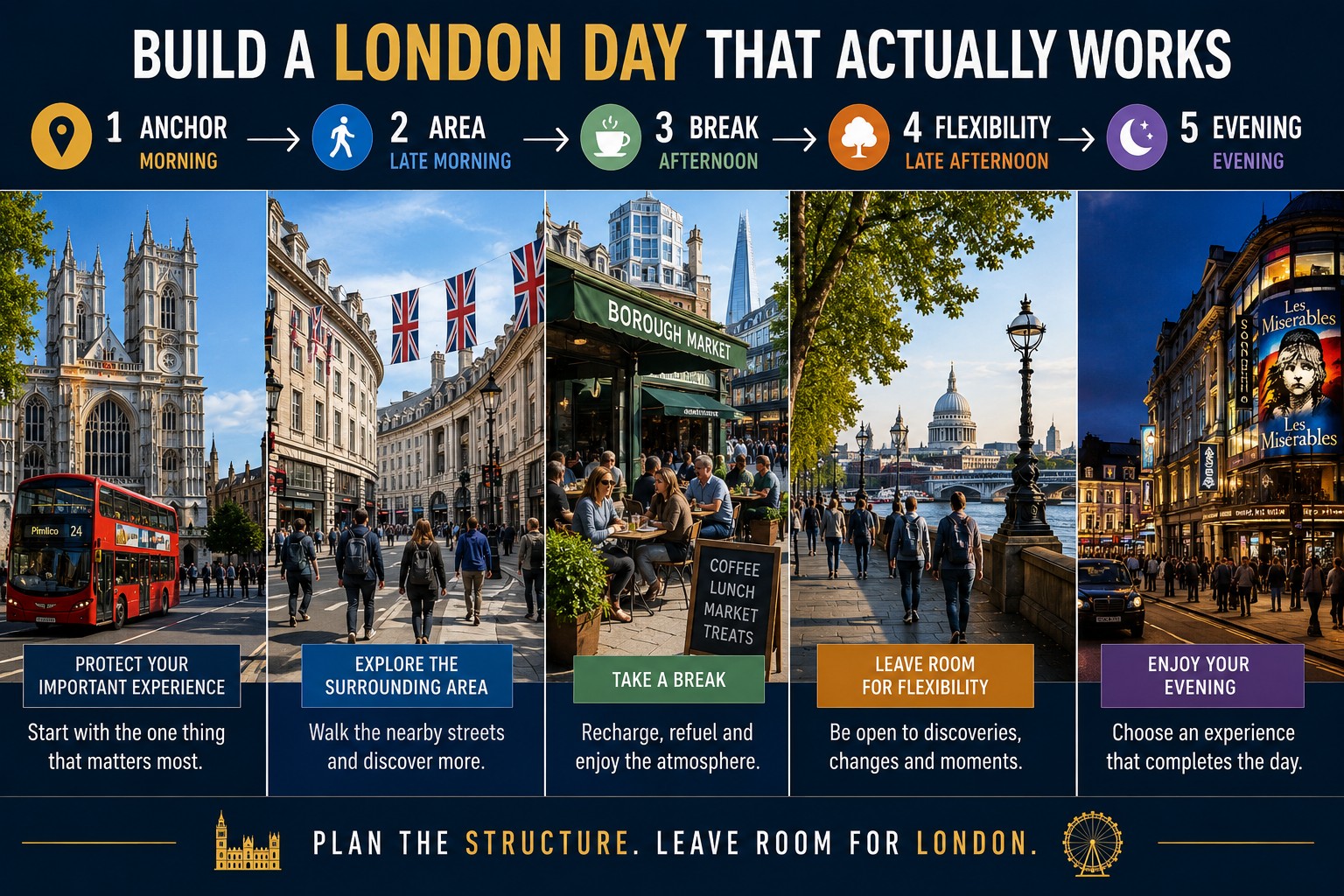
Build each London sightseeing day around a strong anchor, explore the surrounding area, take a proper break, preserve flexibility and finish with an evening experience
🎭 Check the BVT London Events Calendar Before You Fix Your Days
Before assigning particular areas to particular dates, check the BVT London Events Calendar 2026–2027.
A royal or ceremonial occasion, major sporting event, festival, exhibition, concert or seasonal celebration could become one of the experiences you most want to protect. Events can also influence transport, crowds and access around particular areas, making a small change to your itinerary worthwhile.
Use a simple sequence:
Travel dates → London events → personal priorities → fixed anchors → sightseeing days.
This means planning for the London that will actually exist during your visit rather than creating a theoretically perfect itinerary that ignores what is happening around you.
⏱️ Which London Itinerary Is Right for You?
The number of days you have should change more than the length of your sightseeing list. It should change the way you experience London.
Two days calls for concentration. Three days introduces personal choice. Five days creates genuine depth and enough breathing room to consider travelling beyond the capital. Seven days allows London to become a more relaxed experience and, if you wish, the starting point for a wider journey.
Use this comparison as a starting point:
| Time in London | What it gives you | Recommended pace | Day-trip potential | Flexibility |
|---|---|---|---|---|
| 2 days | Essential London | Focused | Usually protect London | Limited |
| 3 days | Highlights + personal choice | Balanced | Usually stay in London | Moderate |
| 5 days | Greater depth + wider options | Comfortable | Strong option | Good |
| 7 days | London + Gateway possibilities | Relaxed | Excellent | High |
These are not rules. A traveller who has dreamed for years of visiting Stonehenge may reasonably prioritise it during a shorter stay, while someone spending a full week in London may have no desire to leave the capital at all.
The London day-trip editorial destination and Stonehenge commercial destination are verified against the supplied protected master records.
The important progression is that more time should buy you greater depth and freedom—not just a longer attraction list.
🕑 The Perfect 2-Day London Itinerary
Two days in London demands choices. There is enough time for a memorable introduction, but not enough to treat every famous attraction as essential.
Think of this as the protect-the-essentials itinerary: two contrasting parts of London explored intelligently, with unnecessary cross-city travel kept to a minimum.
👑 Day 1 — Westminster, Royal London and the West End
Begin around Westminster, where several of London’s defining sights sit within a naturally connected area. The Houses of Parliament and Big Ben provide an immediate sense of place, while Westminster Abbey can become the day’s principal timed attraction if its history and interior are priorities for you.
From here, continue through Whitehall or towards St James’s Park and Buckingham Palace. The value of this route lies not only in the landmarks. Walking between them reveals ceremonial streets, historic buildings, green spaces and changing views of London that disappear when every movement becomes a separate transport journey.
Avoid trying to enter everything. If Westminster Abbey is your major interior visit, Parliament, Buckingham Palace and other landmarks can still contribute substantially to the day without each requiring another reservation.
Build in time for lunch or a proper break before continuing towards Covent Garden and the West End. Depending on your interests and energy, the evening might include theatre, dinner, Soho or simply exploring central London after dark.
The commercial destination is verified against the protected London Gateway master.
The objective is not to finish Day 1 having “completed” central London. It is to finish with a strong sense of how royal, political and contemporary London connect—and enough energy left to enjoy the evening.
🏰 Day 2 — Tower, City and the Thames
Use your second day to experience a very different side of London.
The Tower of London makes a strong morning anchor for visitors interested in royal, military and political history. Give it meaningful time rather than treating it as a quick stop before rushing elsewhere. Tower Bridge and the surrounding riverside then provide a natural transition into the historic City of London, where medieval churches and centuries-old streets sit alongside some of the capital’s most contemporary architecture.
Again, resist the temptation to turn every nearby landmark into another formal visit. Part of the value of this day comes from seeing how London’s layers fit together.
The Thames provides an especially effective way to continue the journey. Depending on your interests, you might walk part of the riverside, cross towards the South Bank or incorporate a river journey that serves as both transport and sightseeing.
Seeing London from the water also changes your perspective. Landmarks that can feel disconnected when travelling underground begin to reveal their relationship with the river and with one another.
By evening, the South Bank or another riverside area can provide an atmospheric conclusion to two concentrated days.
let historic eastern London flow naturally towards the Thames, then use the river to transition into a relaxed South Bank or riverside evening.
🚆 Should You Take a Day Trip During a 2-Day London Visit?
For most visitors, no.
Stonehenge, Windsor, Bath, Oxford and other destinations may be compelling, but using half of a two-day London stay—or an entire day—to leave the capital fundamentally changes what the trip becomes.
There is one important exception. If somewhere beyond London is one of the principal reasons you travelled to Britain, prioritising it can be entirely sensible. Someone who has always wanted to see Stonehenge should not abandon that ambition simply because a conventional itinerary says they should remain in London.
The London Gateway editorial record and both commercial destinations used in this block are supported by the supplied protected masters.
Your itinerary should reflect your priorities, not somebody else’s checklist.
Otherwise, protect these two days for the capital and save the wider journey for a longer visit. London rewards concentration, and trying to combine a very short city break with substantial travel beyond it can leave both experiences feeling compressed.
🕒 The Perfect 3-Day London Itinerary
Three days changes the character of the visit. You still need sensible priorities, but the additional day means the itinerary no longer has to concentrate almost entirely on London’s most famous landmarks.
The broad geographical foundations of the two-day plan remain strong: one day around Westminster, Royal London and the West End, followed by another around the Tower, City and Thames.
The third day should not simply collect whichever famous attractions remain unchecked.
Instead, use it to make the trip more personal.
This is the choose-your-London day—the point at which the itinerary begins to reflect not only that you came to London, but why you wanted to come in the first place.
🎨 Day 3 — Choose the London That Interests You Most
Your third day is where a London itinerary can become distinctly yours.
If museums and cultural history are priorities, Bloomsbury provides a natural focus. Give a major museum enough time to be meaningful, then explore the surrounding squares, historic streets and literary associations rather than immediately travelling across London to collect another headline attraction.
For a combination of culture and green space, Kensington and the Royal Parks create a very different day. Choose the museum or cultural experience that interests you most, allow several hours rather than rushing through it, and combine it with nearby streets, gardens or parkland. The change of pace after two landmark-heavy days can be part of the attraction.
Greenwich and the Thames works particularly well for visitors wanting another geographical perspective on London. Maritime heritage, distinctive architecture and riverside surroundings can form the core of the day, while travelling by river where practical makes the journey itself part of the experience.
Alternatively, dedicate Day 3 to markets and neighbourhood London. The objective is not to race between several famous markets. Choose an area that appeals to you and spend enough time there to experience its streets, food, shops and local character.
A specialist interest can shape the day just as effectively. History, architecture, food, music, literature or another subject may justify a guided experience where local knowledge and storytelling add something that independent sightseeing would struggle to provide.
The choice matters more than the category. Day 3 is the opportunity to stop following a universal London checklist and start building the trip around your own curiosity.
🌙 Let the Third Evening Stay Flexible
By the third evening, you understand London better than you did when you arrived. Use that knowledge.
You may want to book theatre, try a restaurant you noticed earlier, return to a neighbourhood that deserved more time or take an evening walk beside the Thames. You may equally decide that three substantial sightseeing days have been enough and enjoy a slower evening close to where you are staying.
There is no need to decide every evening months in advance unless a particular experience genuinely requires advance booking.
🚆 Should a 3-Day London Itinerary Include a Day Trip?
Usually, London still deserves all three days.
The answer changes if Windsor, Stonehenge, Bath, Oxford or another destination is among your highest priorities in Britain. In that case, replacing Day 3 with a journey beyond London can be entirely reasonable—but recognise the trade-off. You are exchanging greater London depth for a different British experience.
For most first visits, the stronger three-day itinerary keeps that final day in the capital and uses it to answer a more useful question than “What famous sight haven’t I seen yet?”
Ask instead:
“What part of London would make this trip feel like mine?”
That shift—from completing somebody else’s list to following your own interests—is what makes three days considerably more valuable than simply adding another 24 hours of sightseeing.
🕔 The Perfect 5-Day London Itinerary
Five days gives London room to breathe. You can protect the capital’s defining experiences without making every day a race, spend meaningful time on your own interests and still have enough flexibility to consider a journey beyond the city.
This is where itinerary planning should shift from seeing more to experiencing more deeply.
👑 Day 1 — Westminster and Royal London
Use the geographical logic of the two-day itinerary, but take advantage of having more time. Westminster can still provide the principal anchor, with Royal and ceremonial London forming the natural surrounding journey.
There is less reason to worry about fitting Covent Garden, the West End or another central area into the same afternoon if your energy or interests lead elsewhere. Five days gives you opportunities to return, and that freedom should improve the pace from the beginning rather than merely create spare time at the end.
🏰 Day 2 — Tower, City and Thames
Explore London’s eastern historic core around the Tower, City and river. A major attraction can anchor the day, while the Thames provides a natural route towards another part of central London.
If a river experience appeals to you, this is an especially logical place for it. Incorporated into the day’s geographical progression, the journey can provide transport, sightseeing and a different perspective on the capital without becoming another disconnected item on the schedule.
🎨 Day 3 — Make London Personal
Use the third-day choices from the shorter itinerary—museums, Kensington, Greenwich, neighbourhoods or a specialist interest—but allow yourself greater depth.
A museum that matters to you does not need to be “completed” in two hours simply because another attraction appears on your list. Equally, an interesting neighbourhood does not need to be abandoned because the original itinerary says you should already be somewhere else.
🌆 Day 4 — Slow Down and Explore More Deeply
Day 4 is where a five-day London itinerary should begin to feel fundamentally different from a short city break.
Return somewhere you wanted to understand better, explore a neighbourhood beyond the headline landmarks, spend longer in a major museum, visit a market, enjoy one of London’s parks or choose a specialist experience that benefits from more time and context.
You may also discover during your first three days that something you never considered before arriving now interests you more than something on the original plan.
Allow that discovery to change the itinerary.
A longer stay is valuable partly because it gives you permission to respond to the city you actually encounter. An unexpected exhibition, recommendation, neighbourhood or conversation can deserve more of your time than an attraction added to the itinerary months earlier simply because every guide seemed to include it.
By the end of Day 4, you should have experienced both the London you expected to see and at least some of the London you discovered after arriving.
That puts you in a much better position to make the most important decision in the five-day plan:
Should your final day remain in London—or is it time to explore beyond the capital?
🚆 Day 5 — Another London Day or Explore Beyond?
By Day 5, you have earned a genuine choice.
If important London experiences remain, stay in the capital. Perhaps weather disrupted an earlier plan, a museum deserves more time, you discovered a neighbourhood you want to revisit or you simply prefer a slower final day. There is no requirement to take a day trip merely because your itinerary is long enough to accommodate one.
If your principal London priorities feel comfortably covered, however, travelling beyond the capital can add something the previous four days could not: contrast.
Windsor is a natural choice for travellers drawn to royal heritage, combining one of Britain’s most important royal settings with the atmosphere of a historic town.
Stonehenge offers a much more dramatic change of scale. Moving from metropolitan London to an ancient prehistoric landscape can make it particularly rewarding for visitors interested in archaeology, early Britain and places whose significance reaches far beyond their physical size.
Bath combines Roman heritage with Georgian architecture and a distinctive cityscape, while Oxford offers university history, historic colleges and an urban character very different from London.
Do not choose simply according to which destination appears most frequently on other itineraries. Ask what your first four days have already given you—and what experience would add something genuinely different.
The London Gateway editorial records and Stonehenge commercial destination above are verified against the protected London Gateway master.
Five days therefore represents an important threshold. London remains the centre of the trip, but the question is no longer simply what else can you see?
It becomes:
What would make the fifth day add the greatest value to the journey as a whole?
🗓️ The Perfect 7-Day London Itinerary
Seven days changes the planning question again. You no longer need to choose between seeing London’s headline landmarks and experiencing the city at a more relaxed pace. There is room for both—and potentially for London to become the starting point of a wider journey.
Think of this as the London Gateway itinerary.
🏛️ Days 1–3 — Build Your London Foundations
Use the first three days to establish the geographical structure developed in the shorter itineraries: Westminster and Royal London, followed by the Tower, City and Thames, then a third day shaped around your strongest personal interests.
The difference is psychological as much as practical. With seven days available, there is little benefit in rushing through an attraction because you fear there will be no opportunity to return to that part of London.
🌿 Days 4–5 — Experience London More Deeply
These are the days to move beyond the obvious checklist.
Explore a neighbourhood that caught your attention earlier in the week. Give a major museum the time it deserves. Spend part of a day around Greenwich, a market or London’s parks. Choose a specialist guided experience where local expertise could deepen your understanding of a subject you care about.
One of these days can also absorb something displaced by weather, an event or a change of mind. That flexibility is one of the greatest advantages of a longer London itinerary.
Do not regard an unfilled afternoon as wasted space. London regularly rewards visitors for leaving enough room to follow an unexpected recommendation, linger over lunch or continue walking when an area proves more interesting than anticipated.
🚆 Day 6 — Explore Beyond London
After five substantial days in London, a journey beyond the capital can provide genuine contrast without making the city itself feel compressed.
Choose according to interest rather than reputation alone. Windsor extends the royal story beyond central London. Stonehenge takes you into a prehistoric landscape that could scarcely feel more different from the capital. Bath combines Roman heritage, Georgian architecture and a distinctive historic cityscape, while Oxford offers university heritage, centuries of scholarship and an atmosphere of its own.
A well-chosen day beyond London should expand the story of the holiday rather than simply add another famous name to it.
✨ Day 7 — Decide What Your Journey Has Become
Your final day does not need a universal itinerary. By this stage, you know what you enjoyed, what you missed and whether you want more London or something beyond it.
There are three strong ways to think about the week.
London Deep Dive — Remain in the capital, revisit favourite areas and use the final day for culture, neighbourhoods, food, parks or experiences that emerged during the trip.
London + England — Combine substantial London time with one or two carefully chosen journeys beyond the city, using contrast rather than quantity to shape the wider experience.
London Gateway — Treat London as the opening stage of a longer holiday, continuing afterwards into another part of Britain or potentially towards continental Europe.
For some travellers, that means travelling north towards Scotland. Others may continue through England or build London into a wider Britain, UK and Ireland itinerary. Visitors with additional time can also use London’s international connections to continue towards Paris and wider Europe.
The point is not that a seven-day visitor should leave London. It is that a week creates enough time and perspective to make the decision intelligently.
At seven days, London stops being simply a collection of attractions to organise. It becomes a place you can experience at different speeds—and, if the wider holiday allows, a gateway from which the next part of the journey can naturally begin.

More time in London creates greater freedom: stay and explore the capital more deeply, add contrasting experiences elsewhere in England, or let London become the starting point for a wider journey
🚆 Should You Add a Day Trip to Your London Itinerary?
A day trip can become one of the highlights of a London-based holiday, but it should earn its place. The question is not simply whether somewhere interesting can be reached from London. It is whether leaving the capital improves the overall journey enough to justify giving up a London day.
For most first-time visitors, the amount of time available provides a useful starting point.
| Time in London | Day-trip judgement | Why |
|---|---|---|
| 2 days | Usually protect London | Too little time to establish much depth in the capital |
| 3 days | Usually protect London | The third day adds valuable personalisation |
| 5 days | Strong option | Enough time for substantial London sightseeing plus contrast |
| 7 days | Easy to incorporate | London can remain unhurried while allowing wider exploration |
These are planning judgements, not rules. Someone who has dreamed of seeing Stonehenge should not exclude it merely because they have three days. Equally, a visitor with seven days does not need to leave London simply because the itinerary has room.
The decision should always return to the same principle:
Does this day trip add something sufficiently important or different to justify the London time it replaces?
🧭 Which Day Trip Best Fits Your London Itinerary?
If you decide to leave London for a day, choose the destination according to what it contributes to the holiday rather than how famous it is.
| Day-trip option | Best suited to travellers interested in | What it adds to a London stay |
|---|---|---|
| Windsor | Royal history, castles and monarchy | A royal town and castle setting beyond the capital |
| Stonehenge | Prehistory, archaeology and ancient Britain | A prehistoric landscape unlike anything in central London |
| Bath | Roman history, Georgian architecture and historic cities | A distinctive historic cityscape and different period of British history |
| Oxford | Universities, architecture and intellectual history | A collegiate city with its own identity and atmosphere |
This is a more useful way to choose than trying to determine which destination is objectively “best”. Each offers a different form of contrast.
Think about the journey you have already built. If several days of royal and political London have increased your interest in monarchy, Windsor may extend that story naturally. If the dense urban environment makes you want a dramatically different landscape and a much older chapter of Britain’s past, Stonehenge may be the stronger choice. Bath or Oxford can appeal when the experience of another historic city is more important than escaping urban surroundings entirely.
Avoid turning a day trip into a famous-name collection. Combining several destinations can work when the route, transport and experience have been designed coherently, but more stops do not automatically create a better day.
🚌 Where Do Sightseeing Tours Fit Into a London Itinerary?
A sightseeing tour should solve a planning problem or improve an experience—not simply occupy a vacant space on the itinerary.
For a first-time visitor, an orientation tour early in the stay can help establish London’s geography and make independent exploration easier afterwards. A specialist walking tour may work better later, once you have enough context to appreciate deeper storytelling about a particular neighbourhood, historical period or subject.
A Thames cruise can fit naturally into a river-focused day because the journey itself connects different parts of the city. An evening experience can add another dimension without consuming valuable daytime sightseeing hours.
Organised excursions beyond London can also make sense when transport, admission arrangements, access, specialist commentary or the convenience of combining compatible destinations materially improves the day.
The London sightseeing editorial destination and commercial destinations are verified against the protected London Gateway master.
The useful question is:
“Where would guidance, access, storytelling or convenience add enough value to improve my itinerary?”
If the answer is nowhere, independent sightseeing may be the better choice.
That distinction matters. A good itinerary does not automatically become better because more of it has been booked in advance. Equally, independent travel is not inherently superior when an organised experience removes unnecessary friction or provides expertise that would be difficult to reproduce alone.
Use tours selectively, where they genuinely strengthen the journey.
🔄 Adapt Your London Itinerary to Your Travel Style
The frameworks in this guide are starting points. The final itinerary should change according to who is travelling and what makes a successful day for them.
Two visitors can spend exactly five days in London and need completely different plans. The best itinerary is therefore not merely geographically efficient; it is realistic about energy, interests, attention and pace.
👨👩👧👦 Families — Protect Energy as Carefully as Time
A family itinerary usually benefits from fewer daily anchors, shorter periods of highly structured sightseeing and more deliberate breaks.
Children may be fascinated by the Tower of London or a major museum but have little enthusiasm for crossing the city immediately afterwards simply because another famous attraction fits on paper. Parks, river journeys, markets and flexible stops can provide useful changes of pace between more concentrated experiences.
Build around the family’s realistic energy rather than an adult sightseeing checklist. Finishing a day with everyone still enjoying London is usually more valuable than squeezing in one additional attraction.
❤️ Couples — Leave Room for Atmosphere
Couples may want more space for experiences that cannot be reduced to a list of landmarks: riverside walks, interesting restaurants, neighbourhoods, parks, markets or an evening that develops spontaneously.
The geographical principles still apply, but avoid scheduling every available hour. Some of London’s strongest shared experiences come from having enough time to linger somewhere unexpectedly appealing.
🏛️ History Lovers — Follow London’s Layers
Visitors primarily interested in history can give greater weight to Westminster, the Tower, the City, major museums and London’s royal and political heritage.
With five or seven days, the historical story can extend beyond the capital. Windsor can deepen the royal theme, while Stonehenge introduces a vastly earlier period of Britain’s past and a landscape completely different from metropolitan London.
🎨 Culture and Museum Lovers — Give Important Places Enough Time
Do not build a museum itinerary around the assumption that every major collection requires only a brief visit.
Choose the institutions that genuinely interest you, group them intelligently with nearby areas and allow enough time for the experience to remain enjoyable. A meaningful half-day in one museum can offer considerably more value than hurried visits to three.
🔁 Returning Visitors — Dismantle the Standard Checklist
If you already know London’s principal landmarks, use that freedom.
Build around neighbourhoods, temporary exhibitions, specialist interests, markets, food, architecture, performances or parts of the city you previously overlooked. Checking the BVT London Events Calendar becomes particularly useful because an event or exhibition can provide the anchor for an entirely different kind of visit.
🌦️ What If Weather or Events Change Your London Plans?
Do not rebuild the entire itinerary because one day changes.
Swap rather than abandon.
If poor weather affects an outdoor-heavy day, move an indoor-focused museum, gallery or attraction forward and return to the original plan when conditions improve. If an event changes access or transport around one part of London, use another geographically coherent day from your itinerary instead of forcing the original route to work.
Protect reservations that are genuinely difficult to change, but keep enough flexible experiences around them to absorb disruption.
This becomes easier on five- and seven-day visits because additional time provides natural recovery space. Shorter itineraries require more discipline: if you have only two days, identify at least one credible indoor alternative before travelling rather than trying to invent a completely new plan when the weather turns.
A good itinerary is not one that survives only when everything happens exactly as expected.
It is one that remains useful when London changes the plan.
A resilient London itinerary has enough structure to protect what matters and enough flexibility to survive a change of plan.
🌱 How Do You Build a More Sustainable London Itinerary?
A well-planned London itinerary can be better for the traveller and more considerate of the places being visited.
Start with geography. Grouping experiences within the same part of London reduces unnecessary journeys and creates more opportunities to walk between nearby sights. It also allows you to notice the streets, architecture, parks and smaller places that disappear when the day becomes a sequence of journeys between isolated attractions.
Use London’s extensive public transport network where walking is impractical. The Underground, buses, rail services and river transport can all form part of an efficient itinerary, and travelling this way often provides a better understanding of how different parts of the city connect.
Slower planning can also support London’s local economy. Independent cafés, restaurants, markets and shops become easier to discover when an itinerary leaves time to explore an area rather than arriving for one attraction and immediately departing for another.
The same principle applies when travelling beyond London. Where practical for the journey you are making, rail and public transport can provide alternatives to unnecessary private transfers, while organised transport may be appropriate when it makes a particular destination substantially easier to experience responsibly and efficiently.
The commercial destinations above are verified against the protected London Gateway master.
Most importantly, resist the idea that a successful visit requires you to “complete” London.
Choosing fewer places and experiencing them properly can reduce unnecessary movement while creating a richer trip. Sustainability and good itinerary planning often point in the same direction: travel more thoughtfully, stay longer where it matters and make each journey earn its place.
Travel with purpose. Explore with care.
❓ London Itinerary FAQs
Is 2 days enough for London?
Two days is enough for a strong introduction, but not a comprehensive visit. Concentrate on a small number of major priorities and geographically connected areas rather than trying to reproduce a five-day itinerary at twice the speed.
What should I see in London in 3 days?
For a first visit, use the first two days for major London foundations such as Westminster and Royal London, followed by the Tower, City and Thames. Use Day 3 for the part of London that most closely reflects your interests, whether that means museums, Greenwich, Kensington, neighbourhoods, markets or a specialist experience.
Is 5 days in London too long?
No. Five days allows substantially greater depth, a more comfortable pace and enough flexibility to consider a day trip without sacrificing the core London experience.
Is 7 days enough for London and day trips?
Yes. Seven days can provide an excellent balance between substantial time in London and one or more carefully chosen journeys beyond the capital. It can also work entirely as a London stay if you prefer deeper exploration.
Should I take a day trip if I only have 3 days in London?
Usually not. For most first-time visitors, the third day adds valuable depth and personalisation within London. Make an exception when a destination beyond the capital—such as Stonehenge or Windsor—is one of your highest priorities in Britain.
What London attractions should I book in advance?
Prioritise advance booking for experiences that are especially important to you and those operating with timed or limited admission. Major attractions, popular exhibitions, theatre performances and specialist experiences may all warrant early planning.
Avoid responding by pre-booking everything. Too many fixed times can make an otherwise sensible London itinerary unnecessarily fragile. Protect the experiences you would be genuinely disappointed to miss, then preserve flexibility around them.
How much should I plan for each day in London?
A strong day usually needs a clear geographical structure, one or two genuine priorities and enough space for transport, meals, queues, breaks and discoveries along the way.
The objective is not to fill every available hour. If your itinerary works only when every attraction finishes on time and every journey runs perfectly, it is probably too ambitious.
Is it better to walk or use the Tube when sightseeing in London?
Use both.
Walking is particularly valuable when attractions are geographically connected because the streets between them are part of the London experience. Use the Underground, buses and other public transport when the distance is substantial or when walking would consume time and energy better spent elsewhere.
Do not automatically take the Tube for every journey. A route that looks separate on a transport map may sometimes be an enjoyable and practical walk.
How should I plan a London itinerary with children?
Keep the same geographical principles but reduce the number of daily anchors and build in more breaks. Alternate experiences requiring concentration with parks, river journeys, food stops or other opportunities to change pace.
The best family itinerary is not necessarily the one that includes the most child-friendly attractions. It is the one that keeps the day enjoyable enough for everyone to appreciate them.
The commercial destinations above are verified against the protected London Gateway master.
✨ The Perfect London Itinerary Leaves Something Unplanned
The purpose of an itinerary is to give you confidence—not to decide every moment before you arrive.
Choose your priorities. Group experiences geographically. Check what is happening during your travel dates. Protect reservations that genuinely matter. Allow realistic time to travel, eat and rest. Then leave enough space for London to surprise you.
With 2 days, concentrate.
With 3 days, personalise.
With 5 days, add depth and decide whether somewhere beyond London would improve the journey.
With 7 days, give yourself freedom to experience the capital more slowly and consider whether London is the whole holiday or the gateway to something larger.
There is no prize for completing London. Even a week leaves countless neighbourhoods, museums, historic places, restaurants, performances and experiences unexplored. That is not a planning failure; it is one of the reasons London rewards returning visitors.
The strongest itinerary therefore accepts that selection is part of good travel.
The perfect London itinerary is the one that gives the time you have the greatest possible value—and still leaves enough room for London to change your plans.
For some visitors, that journey ends in London. For others, the capital creates the confidence and curiosity to continue towards Windsor, Stonehenge, Bath or Oxford, explore more of Britain, travel north towards Scotland or connect onwards to Paris and wider Europe.
That possibility is part of London’s strength as a gateway.
London can be the whole journey—or the place from which the next one begins.