


Normandy & D-Day Tours from the UK: History, Beaches & Battlefields (2026 Guide)
7th June 2026
🇫🇷 Normandy & D-Day Tours from the UK: History, Beaches & Battlefields (2026 Guide)
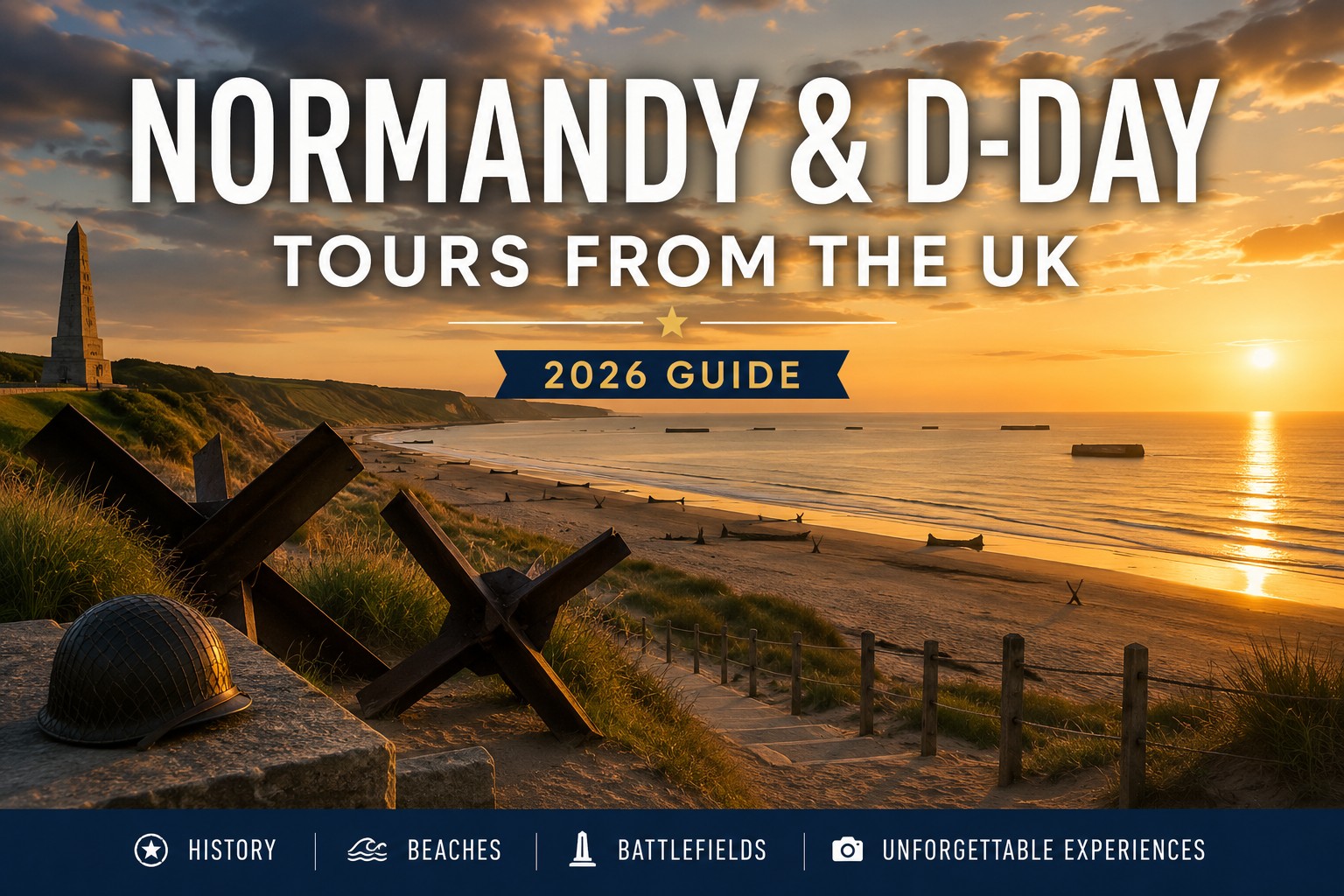
The D-Day beaches of Normandy remain among Europe’s most important historical destinations, combining remembrance, heritage and spectacular coastal scenery
Normandy is one of Europe’s most important and moving travel destinations.
For many visitors, a journey to Normandy is far more than a holiday. It is an opportunity to stand on the beaches where history changed, visit memorials that honour extraordinary sacrifice and gain a deeper understanding of the events that shaped modern Europe.
Yet Normandy offers much more than battlefields and museums. Beyond the famous D-Day landing beaches, visitors discover beautiful coastal scenery, charming French towns, excellent food, historic churches, picturesque countryside and some of the most significant heritage sites in Europe.
Whether you’re interested in military history, planning a meaningful family trip, exploring France beyond Paris or creating a wider European itinerary, Normandy provides an unforgettable travel experience that combines history, culture and reflection.
In this guide, we’ll explore the D-Day beaches, key historic sites, practical travel options from the UK, suggested itineraries and how Normandy can fit into a wider France or Europe adventure.
| Feature | Details |
|---|---|
| Best For | History, culture and educational travel |
| Recommended Stay | 2–3 Days |
| Top Sites | Omaha Beach, Bayeux, Pegasus Bridge, Pointe du Hoc |
| Best Base | Bayeux |
| Getting There | Ferry, Eurostar & Rail, Organised Tours |
🎖️ Who Is This Guide For?
This guide is designed for:
- First-time visitors to Normandy
- History enthusiasts
- UK travellers planning a France holiday
- Families interested in educational travel
- Travellers exploring France beyond Paris
- Visitors combining Normandy with wider European touring
Whether you’re planning a dedicated Normandy holiday or incorporating the region into a larger European journey, this guide will help you understand what to see, how to get there and how long to stay.
⚔️ Why Visit Normandy?
Few places in Europe combine historical significance and natural beauty quite like Normandy.
The region is forever associated with the events of 6 June 1944, when Allied forces landed on the beaches of northern France during Operation Overlord. These landings marked the beginning of the liberation of Western Europe and remain one of the most important military operations in modern history.
Today, visitors can walk the beaches, visit preserved battle sites, explore museums and stand in cemeteries that honour those who fought and died.
However, Normandy is not solely a destination for military history enthusiasts.
The region also offers:
- Spectacular coastline
- Historic market towns
- Traditional French villages
- Outstanding local cuisine
- Scenic countryside
- Cultural heritage attractions
Many visitors are surprised by how beautiful Normandy is beyond the battlefields.
Rolling farmland, dramatic cliffs, fishing harbours and medieval towns create a destination that appeals equally to history lovers and general travellers.
For those planning a wider France itinerary, Normandy also pairs naturally with Paris and many other regions of the country.
Normandy demonstrates how France offers far more than iconic cities, combining history, culture, countryside and unforgettable travel experiences. For many visitors, Normandy becomes the destination they remember most long after their trip has ended, thanks to its unique combination of historical significance and authentic French character.

Omaha Beach remains one of the most powerful and visited locations along the Normandy coastline, offering insight into the events of 6 June 1944
🏖️ Understanding the D-Day Landing Beaches
One of the first things visitors discover is that there wasn’t a single D-Day beach.
Instead, Allied forces landed across five separate sectors stretching along the Normandy coastline.
Each beach has its own story and visitor experience.
🇺🇸 Omaha Beach
Omaha Beach is perhaps the most famous of all the landing beaches.
Assigned primarily to American forces, Omaha witnessed some of the fiercest fighting on D-Day.
Today, visitors find a wide sandy beach backed by bluffs and memorials. Despite its peaceful appearance, Omaha remains one of the most powerful locations in Normandy.
Many travellers describe standing on Omaha Beach as one of the most emotional moments of their trip. Even visitors with limited prior knowledge of military history often find the scale and atmosphere unexpectedly moving.
The scale of the beach often surprises first-time visitors. Standing on the shoreline and looking back towards the bluffs helps visitors appreciate the enormous challenge facing Allied troops during the landings.
🇺🇸 Utah Beach
Located further west, Utah Beach was another American landing sector.
Although casualties were significantly lower than at Omaha, Utah played a crucial role in securing Allied objectives.
The excellent Utah Beach Museum helps bring the events of D-Day to life and provides valuable context for visitors.
🇬🇧 Gold Beach
Gold Beach was assigned to British forces.
Today, it forms part of a beautiful stretch of Normandy coastline where visitors can learn about British involvement in the landings while enjoying coastal scenery and nearby historic towns.
Gold Beach is often visited alongside Arromanches, one of Normandy’s most important historic locations.
🇨🇦 Juno Beach
Juno Beach was the Canadian sector.
Canada’s contribution to D-Day is commemorated through museums, memorials and preserved sites throughout the area.
The Juno Beach Centre provides a detailed and engaging visitor experience focused on the Canadian story.
🇬🇧 Sword Beach
Sword Beach marked the easternmost landing sector.
British and Allied forces landed here before pushing inland toward Caen.
Today, Sword Beach is often visited in combination with Pegasus Bridge and other nearby sites connected to airborne operations.
📊 D-Day Beaches Comparison
🌊 Quick Visitor Tip
Most first-time visitors attempt to see all five beaches in a single day.
While possible, many travellers find that focusing on fewer locations allows a more meaningful experience. Spending additional time at museums, memorials and cemeteries often provides greater insight than simply moving quickly between sites.
A well-planned two or three day itinerary usually offers the best balance between historical exploration and enjoying the wider Normandy region.
🎖️ Essential D-Day Sites to Visit
Beyond the beaches themselves, Normandy is home to numerous historic sites that help visitors understand the scale and significance of D-Day and the wider Battle of Normandy.
Many travellers find these locations provide some of the most memorable moments of their trip.
🇺🇸 Normandy American Cemetery
Overlooking Omaha Beach, the Normandy American Cemetery is one of the most visited and emotionally powerful sites in France.
More than 9,000 American servicemen are buried here, with rows of white crosses and Stars of David stretching across beautifully maintained grounds.
The visitor centre provides excellent historical context and helps explain the sacrifices made during the Normandy campaign.
Even visitors with little prior interest in military history often find the cemetery deeply moving.
The views across Omaha Beach also help visitors appreciate the scale of the operation and the importance of the Allied landings.
🧗 Pointe du Hoc
Situated between Omaha and Utah Beaches, Pointe du Hoc was a heavily fortified German position attacked by U.S. Army Rangers.
Visitors can still see bomb craters, bunkers and defensive positions that remain visible more than eighty years later.
The dramatic cliffs and preserved battlefield landscape provide a powerful insight into the challenges faced by Allied forces.
Few places in Normandy allow visitors to visualise the realities of combat as clearly as Pointe du Hoc.
🇫🇷 Sainte-Mère-Église
Sainte-Mère-Église became famous during the airborne landings of D-Day when American paratroopers descended into the town during the early hours of 6 June 1944.
Today the town remains one of Normandy’s most important D-Day destinations, featuring museums, memorials and preserved wartime sites.
The church, with its famous parachute display, has become one of the most recognisable symbols of the Normandy campaign.
⚓ Arromanches and the Mulberry Harbour
Arromanches played a crucial role in the success of the Normandy landings.
The town was the location of one of the remarkable Mulberry Harbours, temporary artificial ports that allowed Allied forces to unload vehicles, supplies and reinforcements after D-Day.
Remains of the harbour can still be seen offshore today.
Few places in Normandy explain the scale of Allied planning better than Arromanches, making it one of the most valuable stops for first-time visitors.
The excellent museum and panoramic viewpoints help visitors understand how innovative engineering contributed to Allied success.
🪂 Pegasus Bridge
Pegasus Bridge was captured during one of the first Allied operations of D-Day.
British airborne troops landed nearby during the early hours of 6 June 1944 and secured this strategically important crossing.
Today, visitors can explore the museum, see the original bridge and learn about one of the most daring operations of the entire campaign.
For British visitors in particular, Pegasus Bridge often becomes one of the highlights of a Normandy itinerary.
🔫 Longues-sur-Mer Battery
For travellers interested in preserved military sites, Longues-sur-Mer is one of the best examples in Normandy.
The original German gun emplacements remain in place and provide an excellent understanding of the coastal defences facing Allied forces.
The location also offers spectacular views of the coastline and demonstrates how strategically important Normandy’s cliffs and headlands were during the war.
🌺 Bayeux War Cemetery
The largest Commonwealth war cemetery in France is located in Bayeux.
Thousands of British, Canadian, Australian, New Zealand and other Commonwealth servicemen are buried here.
Many visitors combine the cemetery with time exploring Bayeux itself, creating one of the most rewarding days in Normandy.
The peaceful setting and carefully maintained grounds make this one of the most important remembrance sites in Europe. Its compact size also makes it one of the easiest places in Normandy to explore on foot.
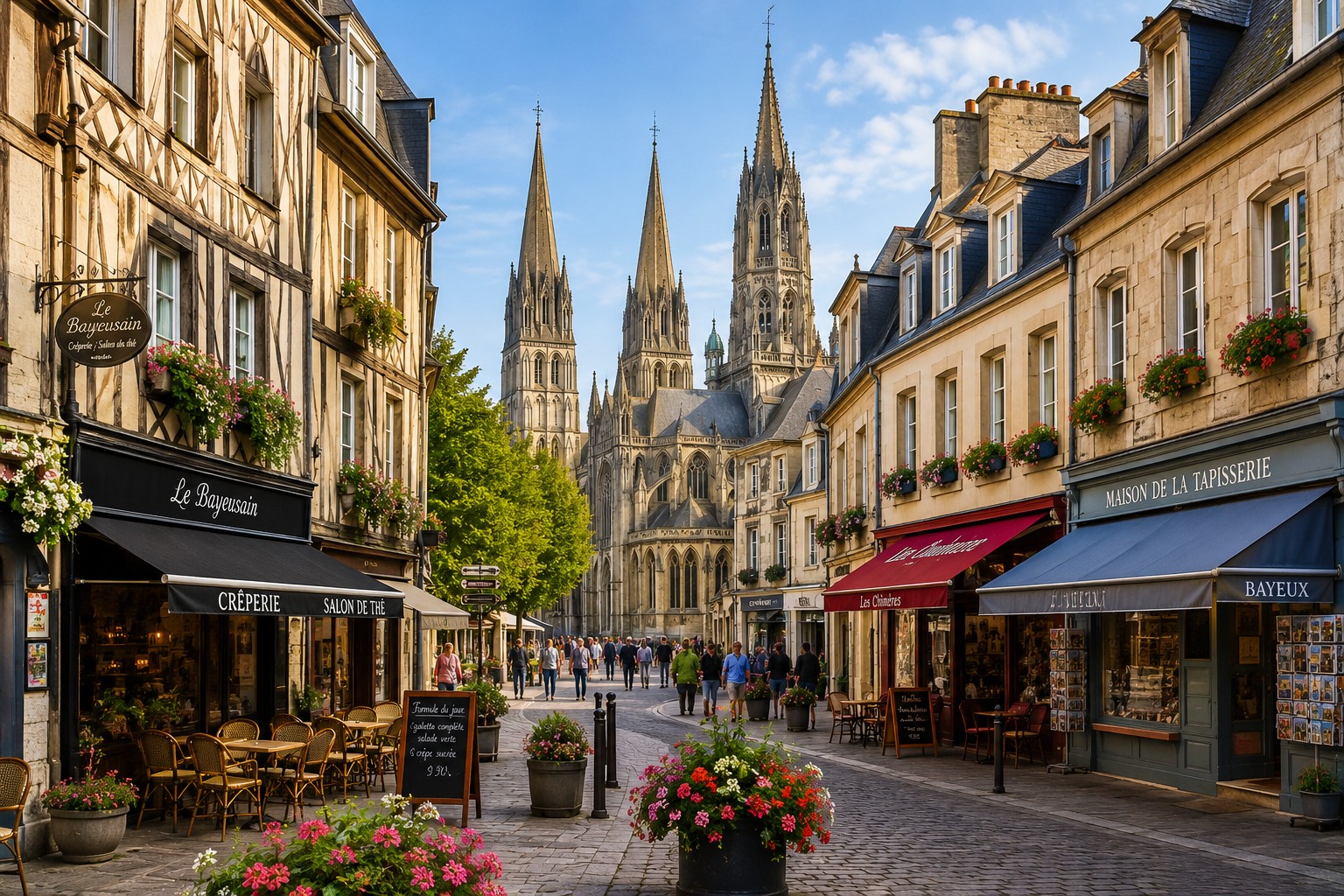
Bayeux combines medieval charm, impressive architecture and easy access to Normandy’s D-Day beaches, making it one of the region’s most popular visitor bases
🏰 Beyond the Battlefields: Other Reasons to Visit Normandy
While D-Day attracts many visitors to Normandy, the region offers much more than military history.
Travellers who allow extra time often discover that Normandy’s cultural and scenic attractions become some of the highlights of their trip.
The region rewards slower exploration and reveals a side of France that many international visitors never experience.
🏛️ Bayeux
Bayeux is frequently regarded as the ideal base for exploring Normandy.
Unlike many towns in the region, Bayeux escaped major wartime destruction and retains its historic character.
Visitors can stroll through charming streets, explore local markets, enjoy traditional French cafés and admire the magnificent Bayeux Cathedral.
The relaxed atmosphere makes Bayeux a favourite among travellers seeking a deeper connection with Normandy beyond the battlefields.
Many visitors find Bayeux strikes the perfect balance between history, culture and everyday French life.
🧵 The Bayeux Tapestry
One of Europe’s most famous historical artefacts, the Bayeux Tapestry tells the story of the Norman conquest of England in 1066.
Its connection to both French and British history makes it particularly fascinating for UK visitors.
The tapestry provides an excellent reminder that Normandy’s importance extends far beyond the events of the Second World War.
For history lovers, it adds another layer to the region’s already rich heritage.
⚓ Honfleur
Located near the mouth of the Seine, Honfleur is one of France’s most picturesque harbour towns. The harbour’s distinctive architecture has inspired generations of artists, including many associated with the Impressionist movement.
Its colourful waterfront, narrow streets and artistic heritage have attracted visitors for generations.
Many travellers choose to combine Honfleur with Normandy’s historic sites for a more varied itinerary.
Travellers who enjoy coastal France, historic ports and island landscapes may also find northern France itineraries a natural extension of a Normandy journey.
🏰 Mont-Saint-Michel
Although technically located beyond Normandy’s traditional D-Day touring area, Mont-Saint-Michel remains one of France’s most iconic attractions.
Rising dramatically from the surrounding tidal landscape, the medieval abbey attracts visitors from around the world.
For travellers spending several days in Normandy, Mont-Saint-Michel makes an excellent addition to the itinerary.
The combination of history, architecture and spectacular scenery creates one of the most memorable experiences in France. Many travellers consider Mont-Saint-Michel a highlight not only of Normandy but of their entire European trip.
🌳 Normandy Countryside and Local Culture
Away from the major attractions, Normandy rewards slower exploration.
Travellers who enjoy Normandy’s countryside, local food and rural culture may also enjoy exploring France’s wine regions as part of a wider trip.
Visitors discover:
- Traditional villages
- Coastal walks
- Local markets
- Apple orchards
- Cider producers
- Excellent seafood
- Historic churches
This combination of history, scenery and culture is one of the reasons Normandy remains such a rewarding destination.
🚄 How to Visit Normandy from the UK
Fortunately, reaching Normandy from the UK is relatively straightforward.
Depending on your travel style, there are several options available.
⛴️ By Ferry
Many travellers choose ferry routes from:
- Portsmouth
- Poole
- Plymouth
This option offers flexibility and is particularly useful for travellers wishing to explore Normandy independently by car.
Ferries remain one of the most popular choices for UK visitors who want the freedom to explore Normandy’s smaller towns and countryside.
🚆 By Eurostar and Rail
For visitors preferring public transport, travelling via Paris can be surprisingly easy.
Eurostar connects London with Paris in just a few hours, while onward rail services provide access to destinations throughout Normandy.
Many visitors begin their journey through France using Eurostar before continuing onward to Normandy’s beaches, museums and historic towns.
Paris is often the practical gateway for travellers continuing by train into Normandy and other French or European destinations.
🚌 Organised Tours
For many travellers, organised tours provide the easiest way to experience Normandy.
Benefits include:
- Expert historical guides
- Simplified transport
- Efficient itineraries
- Battlefield interpretation
- No driving required
Organised tours are particularly popular among first-time visitors and those with limited time.
If you are travelling from the UK, the best route depends on whether you want flexibility or simplicity. Ferry routes work well for self-drive holidays, while Eurostar and organised tours are often easier for travellers who prefer not to drive in France. Many travellers begin their European adventure by travelling from London into France before continuing onward to destinations such as Normandy.
🗺️ Thinking Beyond Normandy?
Normandy is an exceptional destination in its own right, but many travellers choose to combine its historic beaches and battlefields with Paris, Belgium, the Loire Valley or other parts of Europe. Careful planning helps create a journey that balances sightseeing, travel time and unforgettable experiences without feeling rushed.
Compare routes, destinations and travel styles before building your ideal European itinerary.
Normandy can be visited as a standalone destination or combined with Paris, Loire Valley, Belgium and other parts of Europe. Planning ahead helps create a more rewarding and relaxed itinerary.
🗺️ Suggested Normandy Itineraries
One of the most common mistakes visitors make is trying to see too much in too little time.
Normandy rewards slower exploration.
1 Day
Ideal for travellers with limited time.
Focus on:
- Omaha Beach
- Normandy American Cemetery
- Pointe du Hoc
- Arromanches
2 Days
Often considered the ideal first-time itinerary.
Day 1:
- D-Day beaches
- American Cemetery
- Arromanches
Day 2:
- Bayeux
- Bayeux Tapestry
- Pegasus Bridge
- Local countryside
3 Days
Allows a more relaxed pace, deeper historical understanding and time to experience Normandy beyond the main D-Day sites.
Visitors can add:
- Honfleur
- Mont-Saint-Michel
- Additional museums
- Coastal villages
5 Days or More
Perfect for travellers combining Normandy with wider France exploration.
📊 Normandy Itinerary Comparison
Quick Recommendation
⭐ 1 Day → Major D-Day highlights only
⭐⭐ 2 Days → Best balance for most visitors
⭐⭐⭐ 3 Days → History plus Bayeux, Honfleur & countryside
🏆 5+ Days → Normandy combined with wider France touring
| ⏳ Trip Length | 👤 Best For | 📍 What You’ll Experience |
|---|---|---|
| 1 Day | Time-Limited Visitors | Omaha Beach, American Cemetery, Pointe du Hoc and key D-Day highlights |
| 2 Days | First-Time Visitors | D-Day Beaches, Bayeux, Pegasus Bridge and memorial sites |
| 3 Days | ⭐ Most Balanced Choice | History, culture, countryside, Bayeux and coastal scenery |
| 5+ Days | France Touring Holidays | Normandy, Mont-Saint-Michel, Paris and wider France exploration |
Many visitors discover that spending additional time in fewer locations often creates a more memorable experience than trying to cover every attraction.
For those planning longer European adventures, Normandy works exceptionally well as part of a broader France itinerary.
Travellers who prefer a structured route may want to compare multi-country tours from London that combine transport, accommodation and sightseeing into one organised itinerary.
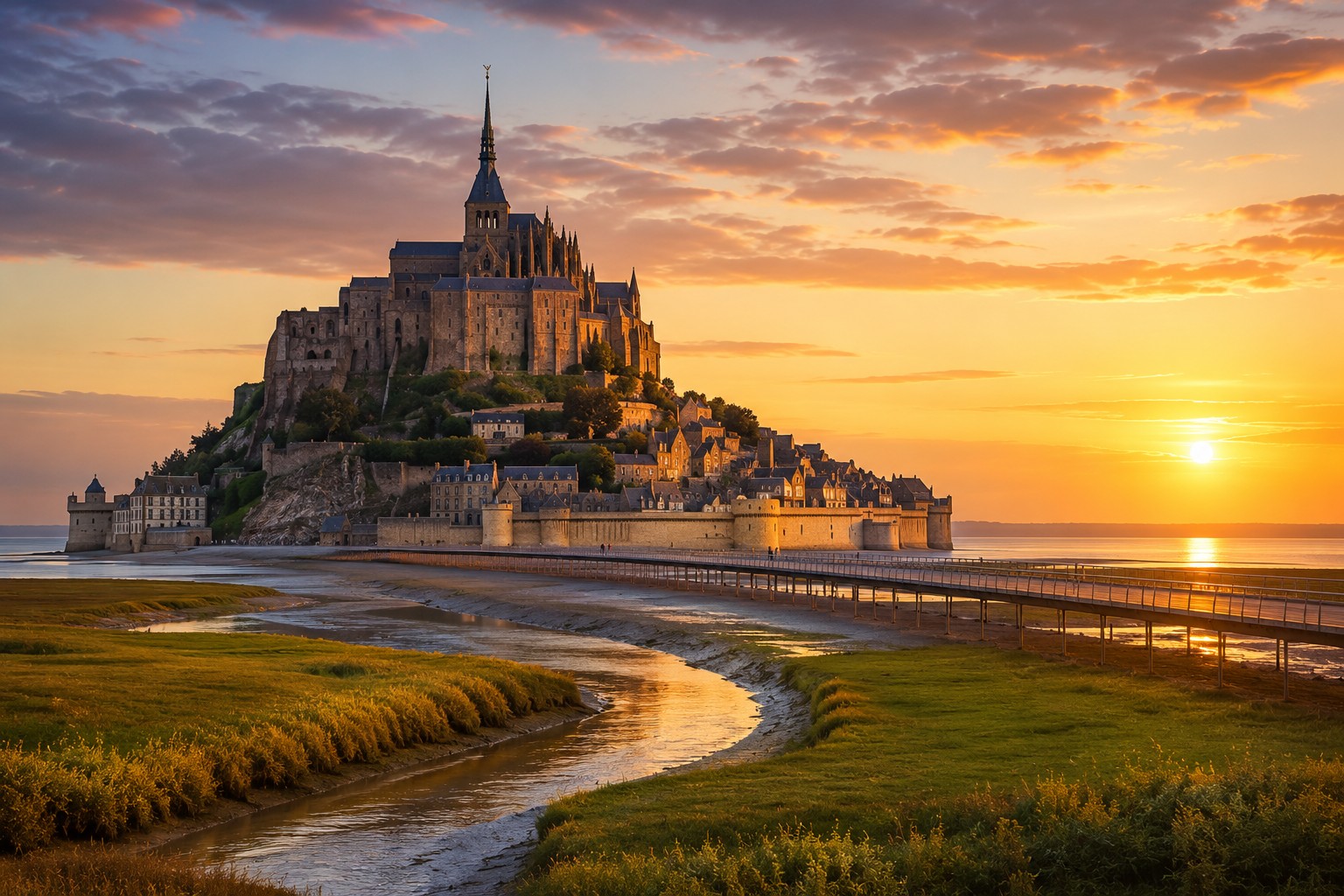
Rising dramatically from the tidal flats of Normandy, Mont-Saint-Michel combines history, architecture and spectacular scenery to create one of France’s most unforgettable visitor experiences
🌍 Combining Normandy with a Wider France or Europe Trip
One of Normandy’s greatest strengths is how easily it can be incorporated into a broader European itinerary.
Excellent transport links and proximity to Paris make the region a natural addition to many France and Europe journeys. Many travellers first create a broader Europe itinerary before deciding where destinations such as Normandy fit within their overall route.
For many travellers, Normandy becomes the historical centrepiece of a trip that also includes cultural cities, wine regions, scenic countryside and other iconic destinations.
🇫🇷 Normandy and Paris
This is by far the most popular combination.
Many visitors spend several days exploring Paris before travelling to Normandy’s beaches, museums and historic towns.
The contrast between France’s capital and Normandy’s countryside creates a particularly rewarding itinerary.
Travellers often begin by deciding whether Paris should be a short stop, an overnight stay or a longer city break before continuing deeper into France.
🍷 Normandy and France’s Wine Regions
Travellers looking to combine history, culture and gastronomy often continue south into France’s famous wine-producing regions.
The contrast between Normandy’s battlefields and destinations such as Bordeaux, Burgundy and the Loire Valley creates a fascinating journey through French history, culture and landscapes.
Many travellers continue beyond Normandy to discover some of France’s most celebrated wine regions, vineyard landscapes and culinary experiences.
🇨🇭 Normandy and Switzerland
Travellers seeking scenery often combine Normandy with Switzerland.
A journey that begins among Normandy’s beaches and memorials can continue into the Alps, creating one of Europe’s most varied travel experiences.
History, culture, mountains and spectacular rail journeys combine particularly well.
Travellers combining Normandy with Switzerland often discover that rail travel provides one of the most enjoyable ways to connect these very different regions.
🇮🇹 Normandy and Italy
For longer trips, Normandy can become the first chapter of a broader European adventure.
Many visitors travel onward through France before continuing into northern Italy, combining history, food, architecture and scenery within a single itinerary.
🇧🇪 Normandy, Belgium and The Netherlands
Travellers interested in military history frequently continue into Belgium.
The battlefields and memorials of Belgium complement Normandy’s wartime heritage while also providing opportunities to explore historic cities and cultural attractions.
Many travellers combine Normandy with neighbouring countries as part of a carefully planned multi-country Europe itinerary.
🌍 Looking Beyond Normandy?
Normandy is often just one chapter of a wider European adventure. Many travellers combine its historic beaches and battlefields with Paris, Belgium, Switzerland, the Netherlands or other iconic destinations across the continent.
Organised multi-country tours can simplify transport, accommodation and sightseeing, making it easier to experience more of Europe without the stress of planning every detail yourself.
🌱 Sustainable & Responsible Tourism in Normandy
Normandy is particularly well suited to slower and more sustainable forms of travel.
Unlike destinations dependent on large-scale tourism infrastructure, many of Normandy’s most rewarding experiences are found in smaller towns, local museums and rural communities.
Visitors who spend more time in fewer locations often contribute more directly to local economies while enjoying a richer travel experience.
Choosing local accommodation, family-run restaurants and independent attractions helps support the communities that preserve Normandy’s heritage.
Rail travel can also reduce the need for domestic flights and long-distance driving. Many travellers are increasingly choosing rail-based journeys that combine convenience, sustainability and memorable travel experiences across Europe.
Travelling by rail from London via Paris can significantly reduce transport emissions compared with short-haul flights while also creating a more relaxed and scenic journey into northern France. Choosing locally owned accommodation, restaurants and guides also helps preserve the character and heritage that make Normandy unique.
🌺 Respectful Remembrance
Normandy is not simply a tourist destination.
For many families around the world, it remains a place of remembrance and reflection.
Visitors should approach cemeteries, memorials and battlefield sites with respect and appreciation for the sacrifices commemorated there.
Responsible tourism helps ensure these important historic locations are preserved for future generations.
Taking time to understand the context of each site, rather than treating Normandy as a quick checklist, creates a more respectful and meaningful visit.
📅 Best Time to Visit Normandy
Normandy can be visited throughout the year, although each season offers a different experience.
🌸 Spring
Mild temperatures, fewer crowds and fresh countryside scenery make spring one of the most pleasant times to visit.
☀️ Summer
Long daylight hours provide excellent conditions for exploring beaches, museums and historic sites.
June is particularly significant because of D-Day anniversary commemorations.
Around the D-Day anniversary each June, Normandy hosts commemorative events, ceremonies and special exhibitions that attract visitors from around the world.
🍂 Autumn
Autumn brings quieter attractions, attractive countryside colours and comfortable temperatures.
Many travellers consider September and October ideal months for visiting.
❄️ Winter
Winter offers a quieter and more reflective atmosphere.
Although weather can be less predictable, visitors often appreciate the reduced crowds.
📊 Best Time to Visit Normandy
⭐ Is a Normandy Tour Worth It?
For most travellers, the answer is unquestionably yes.
Normandy offers a unique combination of:
- Historic significance
- Beautiful coastline
- Cultural heritage
- Scenic countryside
- Excellent food
- Meaningful visitor experiences
Whether you are fascinated by military history or simply interested in understanding one of Europe’s most important regions, Normandy delivers an experience that remains memorable long after the trip has ended.
Best For
✅ History enthusiasts
✅ Families
✅ Educational travel
✅ Couples
✅ Cultural travellers
✅ France touring holidays
Things to Consider
- Distances between sites can be greater than expected
- A rushed day trip may feel limited
- Some locations can be emotionally powerful
Most visitors find that two or three days provides the best balance between sightseeing and reflection.
Quick Decision Guide
🎖️ Interested primarily in D-Day history? → 2–3 days in Normandy
🏰 Want history plus French culture? → Stay in Bayeux and add Honfleur
🚄 Travelling without a car? → Use Eurostar and rail connections
🌍 Planning a wider Europe trip? → Combine Normandy with Paris and Belgium
📚 Looking for educational family travel? → Normandy is one of Europe’s best choices
❓ Frequently Asked Questions
Can you visit Normandy from London?
Yes. Visitors can travel via ferry, Eurostar and rail connections or organised tours.
Is one day enough for Normandy?
One day allows you to see major highlights, but two or three days is generally recommended.
Which D-Day beach is best to visit?
Omaha Beach is the most famous, although each beach offers a different perspective on D-Day.
Is Bayeux worth visiting?
Absolutely. Bayeux combines history, culture, excellent restaurants and easy access to major D-Day sites.
What is the best base for visiting the D-Day beaches?
Bayeux is often the best base for first-time visitors because it is historic, attractive and well positioned for reaching many major D-Day sites.
Can you visit Normandy without a car?
Yes. Rail services, organised tours and local transport make it possible to visit without driving.
What is the best month to visit Normandy?
May, June, September and October are often considered ideal.
Is Bayeux worth visiting?
Many visitors consider Bayeux the ideal base for exploring Normandy because it combines history, accommodation, restaurants and easy access to the major sites.
Is Normandy worth visiting if I’m not a military history enthusiast?
Definitely. Normandy offers beautiful scenery, historic towns, cultural attractions and excellent food alongside its wartime heritage.
Are Normandy tours suitable for children?
Many families visit Normandy successfully, particularly older children interested in history.
🔗 Continue Planning Your Europe Journey
If you’re planning a European adventure from London, these guides can help you compare destinations, routes and travel styles before booking. Normandy often acts as a gateway to wider European exploration, making it a natural starting point for longer journeys across France and beyond.
🌍 Europe Tours: Discover Multi-Country Travel, River Cruises and Cultural Journeys
🚄 London to Paris by Eurostar: The Best Way to Start a Europe Trip? (2026 Guide)
Learn how Eurostar connects London with continental Europe and why Paris remains one of the most popular starting points for a wider European journey.
🚆 Europe by Train from Paris: Best Rail Routes & Multi-Country Journeys (2026 Guide)
Discover some of the best onward rail routes from Paris into Switzerland, Germany, Italy, Spain and beyond.
🌍 Best Multi-Country Tours from London (2026 Guide)
Compare organised multi-country itineraries that combine transport, accommodation and sightseeing across Europe.
🧳 How to Plan a Multi-Country Europe Trip (2026 Guide)
Learn how to choose destinations, budget effectively and create a realistic Europe itinerary.
The best rail journey is not necessarily the one that covers the most countries. In many cases, travellers who focus on fewer destinations enjoy a richer and more memorable experience than those attempting to see everything in a single trip. Building time into your itinerary for unexpected discoveries often becomes one of the highlights of European rail travel.
🏁 Final Thoughts
Normandy is one of those rare destinations that leaves a lasting impression on almost everyone who visits.
Its beaches, memorials and battlefields tell stories that helped shape the modern world, while its towns, countryside and cultural attractions reveal a region rich in character and beauty.
Whether you’re standing on Omaha Beach, exploring Bayeux’s historic streets, visiting Mont-Saint-Michel or building a wider European itinerary, Normandy offers an experience that combines learning, reflection and discovery in equal measure.
For many travellers, Normandy becomes the most meaningful chapter of a wider European adventure, blending remembrance, culture, scenery and history in a way few destinations can match.
It also fits naturally within wider European journeys that combine history, culture, scenic landscapes and memorable travel experiences.
Whether you visit for a day, a long weekend or as part of a wider European journey, Normandy offers one of the most meaningful travel experiences available anywhere in Europe.
🌍 Continue Your Journey Across Europe
Normandy’s beaches, memorials and battlefields tell one chapter of Europe’s remarkable story. Beyond the coastline lies a continent filled with cultural cities, scenic rail journeys, historic regions, world-famous landmarks and unforgettable travel experiences waiting to be discovered.
Whether you’re planning a France holiday, a multi-country itinerary or a longer European adventure, exploring your options is the first step towards creating the perfect journey.