


Sark Travel Guide: Exploring the Channel Islands’ Car-Free Island
17th August 2026
🇬🇬 Sark Travel Guide: Exploring the Channel Islands’ Car-Free Island
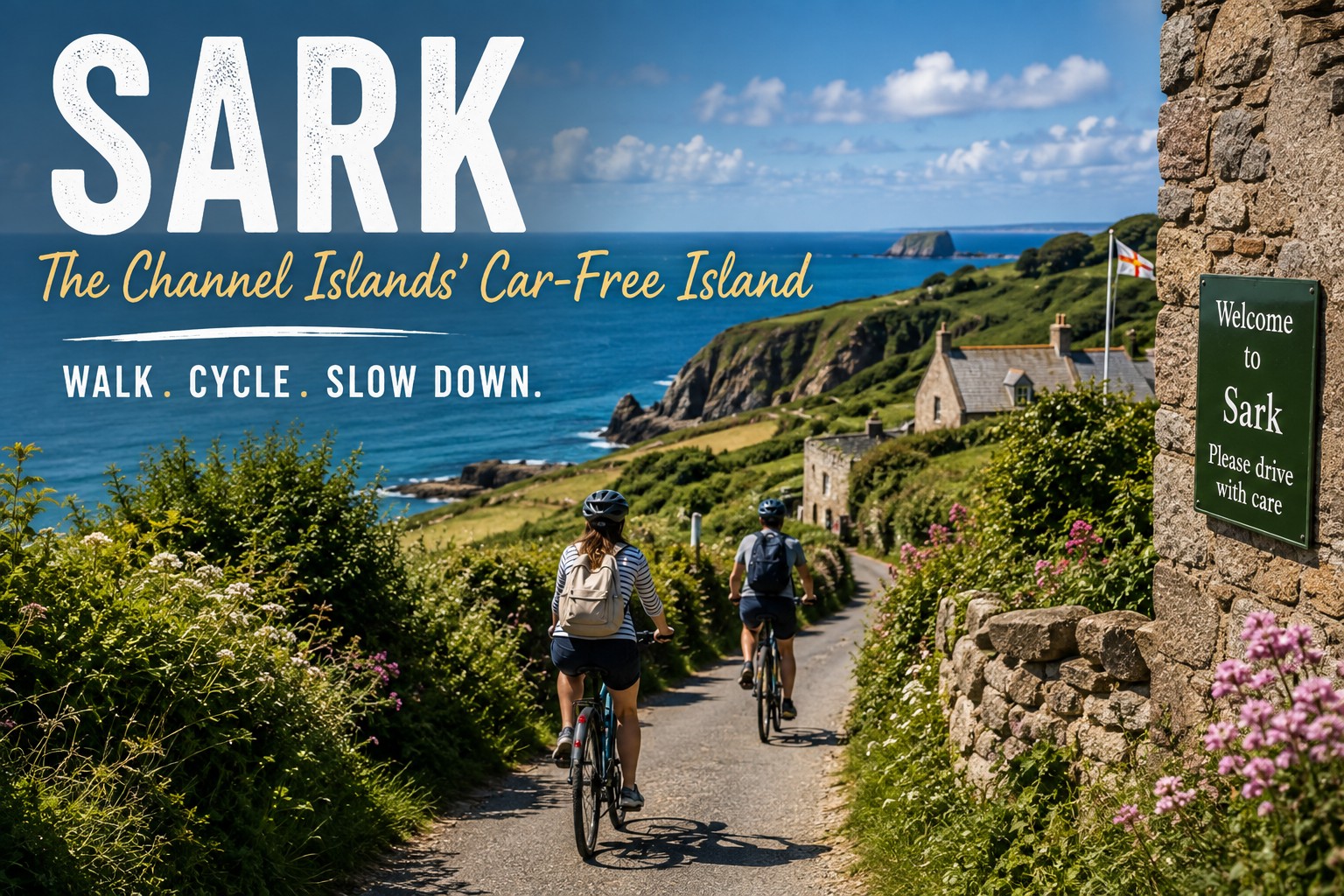
Sark’s quiet lanes, cycling and dramatic coastline create an island experience where slowing down and travelling through the landscape become part of the attraction
There is a moment when arriving on Sark when the Channel Islands begin to feel very different. The harbour is behind you, ordinary road traffic disappears from the experience, and quiet lanes, bicycles and open landscape begin to determine how the day unfolds.
This Sark travel guide explores what that difference means in practice. Sark is often introduced as the Channel Islands’ famous car-free island, but the description only begins to explain its appeal. Dramatic cliffs, secluded bays, walking routes, cycling, distinctive heritage and remarkably dark night skies combine with an unusual sense that travelling slowly is not an inconvenience to overcome, but part of the reason to come.
For travellers who discovered Sark while comparing Jersey, Guernsey and the smaller Channel Islands, its defining quality is not that there is less here. Time and distance work differently. A bicycle ride can become an afternoon of unexpected stops. A walk can matter as much as its destination. Staying after daytime visitors have departed can reveal another side of the island entirely.
Sark works well as a carefully planned day trip, particularly within a Guernsey holiday, but it can reward travellers willing to stay longer. Walking or cycling through its lanes, crossing La Coupée, exploring the coast and experiencing the island after dark all provide reasons not to treat its compact geography as an invitation to rush.
Best for: Walking, cycling, couples, landscapes, photography, slow travel and outdoor-minded families
Character: Peaceful, individual and strongly connected to nature
Getting around: Walking, cycling and horse-drawn carriage experiences
Ideal approach: Explore selectively rather than trying to cover everything
Signature experience: Discovering an island without conventional private-car traffic
Stay: Excellent as a day visit; considerably more immersive overnight
🌊 Why Sark Feels Different
Sark’s small size can be deceptive. This is not a destination whose value should be measured by counting major attractions.
Its appeal comes from the relationship between movement, landscape and time.
Quiet lanes replace conventional private-car traffic, making walkers and cyclists more aware of gradients, changing views, weather and the distance between places. Instead of travelling through the scenery behind a windscreen, you remain physically connected to your surroundings.
That difference becomes particularly noticeable when a planned journey is interrupted by something worth stopping for: a sudden view towards the sea, vegetation framing a quiet lane, an unexpected coastal perspective or simply somewhere that makes continuing immediately feel unnecessary. Sark rewards the willingness to stop.
This does not mean every visitor needs an exceptionally slow holiday. A bicycle provides considerable freedom, while a thoughtfully planned day visit can introduce several of the island’s defining experiences. The important distinction is that Sark works best when efficiency does not become the main objective.
Walkers, cyclists, photographers and couples looking for tranquillity may find its rhythm immediately appealing. Families who enjoy independent outdoor exploration can discover a destination where memorable days do not depend upon moving continuously between conventional attractions.
Others should consider terrain, mobility requirements, facilities and how much walking or cycling they genuinely want to undertake. Understanding those practicalities beforehand is part of choosing Sark well.
Sark is small, but experiencing it properly can still require time.
🚲 Is Sark Really Car-Free?
Yes — Sark has no conventional private-car traffic, and this is one of the defining characteristics of visiting the island. Walking and cycling are central to getting around, while horse-drawn carriage travel provides another memorable way to explore.
“Car-free” should not be interpreted as meaning that absolutely no motorised machinery or authorised service vehicle can ever be encountered. The important reality for travellers is that ordinary private cars do not dominate Sark’s lanes or determine how visitors move between places.
That changes more than transport. It alters the soundscape, pace and relationship between one destination and the next. Walking becomes more than a way to reach somewhere; cycling becomes part of the day’s experience rather than simply an efficient alternative to driving.
The practical question is therefore not just whether Sark has cars. It is how you want to explore an island where conventional private-car travel has largely disappeared from the visitor experience.
On Sark, getting around is not merely what happens between experiences. Getting around is one of the experiences.
That principle should influence what you pack, how much ground you expect to cover and whether walking, cycling or a carriage experience best matches your abilities and available time.
⚓ Arriving on Sark: Where the Change of Pace Begins
The transition begins before you reach Sark’s quiet lanes. Arriving by sea gives the island an immediate sense of separation, with the harbour sitting below the main plateau and the landscape rising beyond it. It is an arrival that makes you aware, almost immediately, that the familiar pattern of stepping from ferry to conventional road transport does not apply in quite the same way here.
Rather than rushing straight towards a checklist of things to do in Sark, take a little time to orientate yourself and understand how you intend to explore. This matters particularly on a day trip, when the return sailing creates a fixed boundary around the visit.
Luggage deserves consideration if you are staying overnight. Travelling relatively light can simplify the journey, while anyone carrying larger bags or travelling with particular mobility requirements should investigate the current assistance and transfer arrangements available between the harbour and their accommodation before arriving.
Ferry connections should also be treated as current travel arrangements rather than permanent facts. Sailing schedules, operating days and conditions can change, so verify services for your actual dates instead of constructing an itinerary around an old timetable.
Once those practicalities are settled, resist the temptation to compensate for Sark’s slower transport by planning the day more aggressively. The island is compact, but that does not mean every worthwhile place should be compressed into a few hours.
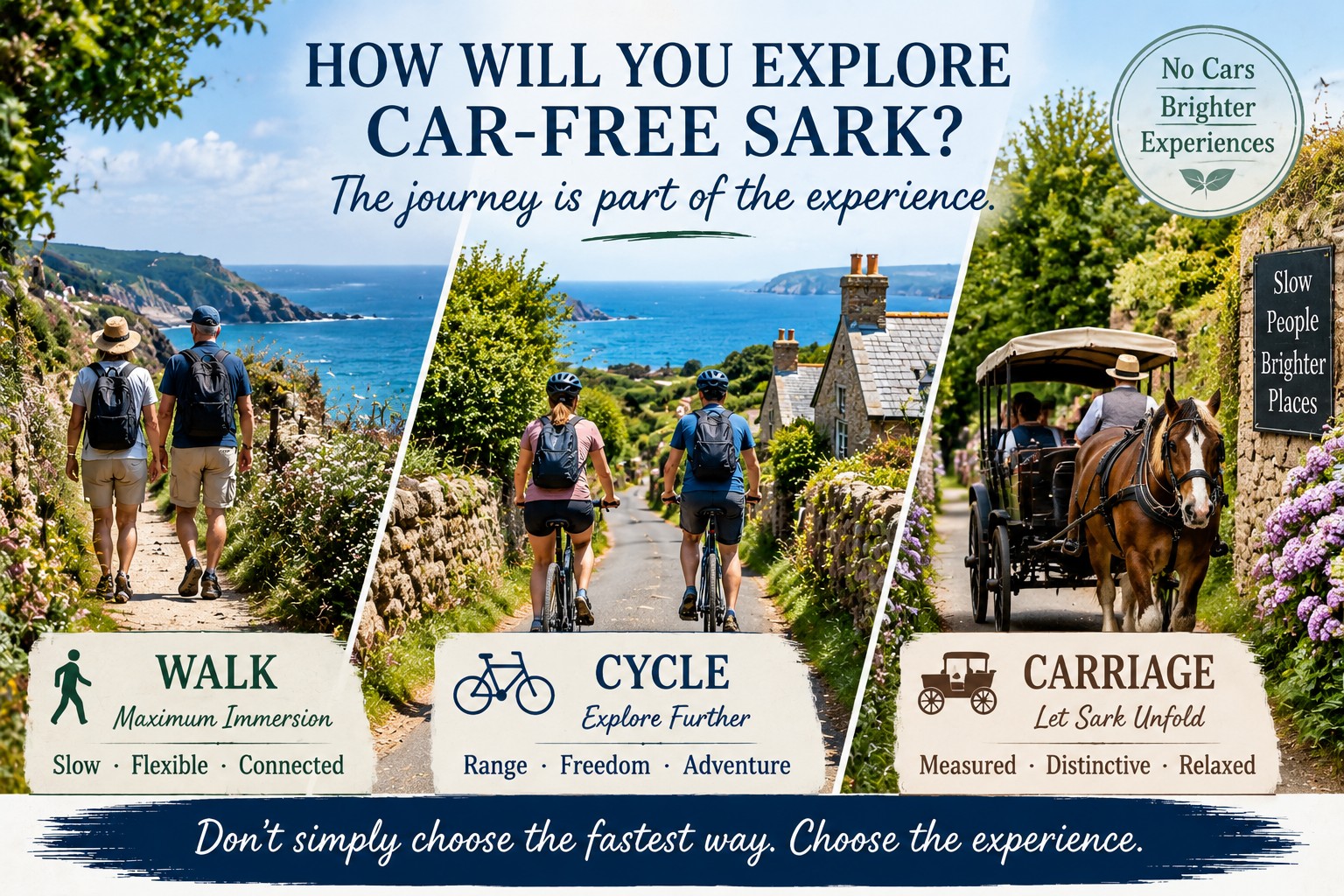
Walking, cycling and horse-drawn carriage travel each offer a different way to experience Sark, where moving through the landscape is an important part of the journey
🥾 Walking, Cycling or Carriage: How Should You Explore Sark?
There is no universally best choice. The right one depends on your available time, confidence, mobility and how much of Sark you hope to discover.
🚶 Exploring Sark on Foot
Walking creates perhaps the closest relationship with Sark. There is no bicycle to manage, and stopping for a photograph, following an interesting lane or lingering at a viewpoint requires almost no planning. The absence of ordinary private-car traffic also changes the character of the walk itself, allowing the lanes to feel more closely integrated with the surrounding countryside.
It particularly suits travellers comfortable allowing a relatively short distance to occupy a substantial part of the day. Sark’s gradients, terrain and coastal approaches can make distances feel different from their appearance on a map, so suitable footwear and realistic expectations matter.
Weather can alter exposed places quickly. Layers and appropriate protection are sensible even when conditions appear settled at the beginning of the day.
🚲 Exploring Sark by Bicycle
Cycling substantially increases the area you can explore while retaining the open-air character that makes getting around Sark distinctive. It can be especially useful for day visitors who want to reach several areas without sacrificing all their time to travelling between them.
A bicycle increases your range; it does not remove Sark’s gradients. Terrain still matters, and visitors should consider their cycling confidence rather than choosing two wheels simply because they appear to offer the fastest solution.
| Consideration | Walking | Cycling |
|---|---|---|
| Pace | Slow and highly immersive | Faster and flexible |
| Range | More selective | Greater |
| Stopping frequently | Extremely easy | Easy |
| Physical consideration | Walking distance and terrain | Gradients and cycling confidence |
| Particularly good for | Photography and unhurried exploration | Seeing more with limited time |
The two approaches need not be exclusive. Cycling can provide greater range, while leaving the bicycle and continuing on foot allows individual viewpoints and stretches of coastline to be explored more closely.
🐴 Exploring Sark by Horse-Drawn Carriage
Horse-drawn carriage travel offers a third interpretation of Sark’s unusual transport environment. Rather than treating it merely as a nostalgic novelty, consider it a distinctive sightseeing experience that allows the lanes and countryside to unfold at a naturally measured pace.
It can appeal to visitors who would rather not spend much of their day cycling, as well as those who simply want to experience Sark from another perspective.
A carriage experience should not automatically be regarded as a complete accessibility solution. Individual mobility requirements vary, and boarding arrangements, stops and onward walking may still matter. Anyone with specific needs should check current suitability and availability before travelling.
Walking, cycling and carriage travel therefore offer three different ways of engaging with the same defining Sark characteristic: the journey across the island matters.
🌉 La Coupée, Big Sark and Little Sark
Few places make Sark’s geography as immediately understandable as La Coupée, the narrow ridge linking Big Sark and Little Sark.
Crossing it is memorable not simply because of the views, but because the shape of the island suddenly becomes tangible. Sea and steep slopes frame the route, while Little Sark beyond feels like another stage of exploration rather than simply another attraction to reach.
La Coupée is the physical link between Big Sark and Little Sark, so travelling across it helps visitors understand how these two parts of the island relate to one another. It deserves more than a hurried photograph.
Weather also matters here. Wind and changing conditions can alter how exposed the crossing feels, and visitors should respond sensibly to the circumstances they encounter rather than treating La Coupée as something that must be completed regardless of conditions.
Beyond it, Little Sark rewards further exploration and reinforces an important lesson about the island: short map distances do not necessarily create short experiences. Gradients, viewpoints, stops and spontaneous diversions can easily transform a seemingly simple journey into a substantial part of the day.
🌊 Cliffs, Bays and Sark’s Wild Coast
La Coupée may be one of Sark’s defining landmarks, but the wider coastline gives that dramatic crossing its context.
Cliffs, headlands, rocky inlets and changing sea views create scenery that can feel surprisingly expansive for such a compact island. Here, coastal exploration is often as much about reaching the place as settling at it, with paths, gradients and unexpected viewpoints forming part of the reward.
A bay or coastal viewpoint may involve more walking, elevation or time than its apparent distance suggests. That is part of Sark’s character. Choosing a smaller number of coastal experiences and enjoying them properly is often more rewarding than attempting to connect every possible stop.
The coast also changes constantly with weather, light and tide. A viewpoint encountered beneath clear skies can feel entirely different when cloud moves across the sea, while photographers may find that Sark’s combination of cliffs, water and open horizons rewards patience more than hurried movement.
Swimming and access to individual bays require sensible judgement. Sea conditions, tides and local circumstances matter, and an attractive stretch of water should never automatically be assumed suitable for swimming. Current local guidance should take priority over generic travel advice.
For walkers, the coastline offers something equally valuable: perspective. Moving through Sark’s coastal terrain reveals how closely lanes, fields, cliffs and sea sit together, reinforcing the sense that the island is best understood through movement rather than as a collection of isolated attractions.
Editorial Placeholder — Sark Coastal Exploration Panel: Coastal Walks | Nature | Photography | Future Guided Experiences
🏰 Sark’s History, Heritage and Island Identity
Sark’s character is not created by geography alone. Its history has produced institutions, traditions and patterns of island life that differ from those visitors encounter elsewhere in the Channel Islands.
Its story reaches through Norman connections and centuries of seigneurial history. La Seigneurie remains one of the most visible reference points for that heritage, while Sark’s distinctive system of government forms an important part of understanding how the community developed.
That story deserves more care than simply presenting Sark as a surviving curiosity from “feudal Europe”. Its political institutions evolved, and modern Sark is a living community rather than a historical exhibit preserved for visitors.
Later history includes the German occupation during the Second World War, connecting Sark with one of the most consequential periods in the wider Channel Islands story.
Understanding these layers adds substance to a visit. Sark’s relative isolation, institutions, community and physical setting have influenced one another over centuries, helping create an identity that cannot be explained by its car-free lanes alone.
Visitors do not need a detailed political history lesson to appreciate that heritage. What matters is recognising that the quiet lanes and unusual rhythms encountered today belong to a real, evolving community whose history remains visible in its places, institutions and traditions.
That perspective becomes particularly useful when Sark is compared with Jersey and Guernsey. All three share wider Channel Islands connections, including Norman heritage and occupation history, yet each developed differently. Sark’s scale allows those historical layers to feel unusually close to everyday island life.
🌌 Sark After Dark: Why Staying Late Changes the Experience
For many day visitors, Sark is experienced between two journeys by sea. Arrival starts the clock; the return sailing ends it. Staying overnight removes that boundary and reveals one of the island’s most compelling differences.
Sark became the world’s first designated Dark Sky Island, recognition of the exceptional quality of its night environment and low levels of light pollution. Under favourable conditions, stars become far more prominent than most visitors accustomed to towns and cities will regularly experience, while familiar lanes and countryside take on another atmosphere after daylight disappears.
Dark-sky travel always depends on nature. Cloud, moonlight, season and weather influence what can be seen, so an overnight stay should never be presented as a guaranteed astronomical spectacle. The attraction is broader than that.
Simply experiencing Sark after daytime activity has subsided can deepen the sense of separation that began on arrival. For photographers and stargazers, favourable conditions may provide an additional reward. For everyone else, a quiet evening, an unhurried meal or the simple experience of walking beneath a much darker night sky can be equally memorable.
Some of Sark’s strongest experiences begin after the day visitors have left.
That distinction leads directly to one of the most important decisions in any Sark travel guide: whether to experience the island within a carefully planned day trip or give it enough time to continue beyond the return sailing.
⏳ Sark Day Trip or Overnight Stay?
Both can work exceptionally well. The better choice depends on what role you want Sark to play within your Channel Islands journey.
A Sark day trip from Guernsey can be extremely rewarding. Several hours can provide enough time for a carefully chosen combination of cycling, walking, La Coupée and coastal scenery while allowing Guernsey to remain the principal base for the holiday.
The key is not trying to experience the entire island simply because Sark looks small on a map. Day visitors should decide what matters most before setting out and preserve a comfortable margin for their return arrangements. Choosing a bicycle can increase the area explored, while walking may produce a more selective but deeply immersive introduction.
☀️ Visiting Sark for the Day
A day visit particularly suits travellers who want Sark to provide contrast within a broader Guernsey itinerary. It avoids another accommodation move and can still reveal the island’s lanes, scenery and distinctive transport culture.
Its principal constraint is time. Return connections inevitably shape the day, and every unexpected stop competes with something else you intended to see. That is why prioritisation matters more than trying to complete Sark.
🌙 Staying Overnight on Sark
Staying removes much of that pressure. Instead of continually calculating the time remaining before departure, you can allow a walk to run longer, explore more selectively and experience Sark after its daytime rhythm changes.
Dark skies provide an obvious incentive, but quieter evenings and mornings can be just as valuable.
| Sark Day Trip | Overnight Sark |
|---|---|
| Excellent introduction | Greater opportunity for immersion |
| Easy to combine with Guernsey | Experience Sark after dark |
| Requires prioritisation | More flexible exploration |
| Return connection shapes the day | Less clock-watching |
| Lower planning commitment | Accommodation planning required |
Neither approach is intrinsically better.
📆 How Long Should You Spend on Sark?
Sark’s compact geography can create the impression that a few hours must be enough. In practice, the right length of stay depends less on how quickly the island can be crossed and more on how you want to experience it.
One day can provide an excellent introduction to Sark. Choose priorities rather than attempting everything, and leave enough time for the return journey without allowing the final part of the visit to become a race back towards the harbour.
One night and two days changes the experience considerably. There is space for a longer walk or cycle ride, an evening without a departure deadline and the possibility of experiencing Sark’s dark skies. The following morning can reveal another side of island life before the daytime rhythm develops again.
Two or three nights can work particularly well for travellers who want walking, cycling, coastal exploration and unstructured time to coexist. Weather becomes less disruptive because the entire visit no longer depends upon a single day’s conditions.
Longer stays make most sense when tranquillity is itself one of the objectives. Sark is unlikely to reward someone who simply stretches a sightseeing checklist across additional days, but it can richly reward travellers happy to revisit a favourite viewpoint, follow an unplanned lane or let weather and mood influence what happens next.
Do not measure the right length of stay by how quickly Sark can be crossed. Measure it by how slowly you want to experience it.
🛏️ Staying and Eating on Sark
Choosing to stay overnight introduces practical decisions around accommodation and meals, but it also creates opportunities to participate more fully in Sark’s everyday rhythm and local economy.
As a small island, Sark naturally has a more limited accommodation and dining inventory than Jersey or Guernsey. Visitors travelling on fixed dates, particularly during popular periods, should therefore investigate current options early rather than assuming extensive last-minute choice.
Where you stay can influence the character of the visit. The most useful question is not simply which property has the longest facilities list, but what sort of Sark experience you want around it.
Eating deserves similar thought. Independent cafés, restaurants, accommodation providers and other island businesses help make Sark what it is, so spending locally can become part of experiencing the destination rather than something separate from it.
The smaller scale of Sark’s accommodation and dining scene is not a disadvantage when approached with the right expectations. It reinforces a principle that applies throughout the island: having fewer choices does not matter when the choices available suit the experience you came to find.
Visitors staying overnight should therefore secure the essentials without over-planning every hour. Understand where you will sleep, consider where and when you are likely to eat, then preserve enough freedom for the island itself to shape the rest of the stay.
❤️ Is Sark Right for You?
Sark has a strong identity, which means it can be an exceptional choice for one traveller and a less natural fit for another. Recognising that before booking is considerably more useful than pretending every Channel Island suits everyone equally.
🌿 Sark May Be Perfect If You…
Sark particularly rewards people who enjoy walking, cycling, scenery and being outdoors. Couples seeking a quieter escape may appreciate its unhurried rhythm, while photographers can find inspiration in the coastline, changing light and night sky.
Nature enthusiasts and slow travellers are equally well matched. Families can also enjoy Sark enormously when children are happiest exploring outdoors rather than relying upon a constant programme of conventional attractions.
Most importantly, Sark suits people comfortable leaving some time unstructured. If discovering an unexpected viewpoint or extending a walk sounds like a successful afternoon rather than a disruption to the itinerary, you are already approaching the island in the right spirit.
⚠️ Think Carefully If You…
Travellers seeking extensive nightlife, resort-style entertainment or effortless door-to-door transport may find another Channel Island better aligned with their priorities. Anyone who strongly dislikes walking or cycling should also consider carefully how they intend to explore before committing to a longer stay.
Visitors with mobility or accessibility requirements should investigate current arrangements in advance. Sark’s gradients, terrain, transport environment and access to individual places can create practical challenges that vary considerably according to personal circumstances.
That does not make Sark unsuitable by definition. It means individual requirements should be matched honestly against the realities of the destination.
👨👩👧 Visiting Sark with Children
For the right family, Sark can feel like an adventure precisely because so much of the day takes place outdoors. Cycling along quiet lanes, walking towards viewpoints, exploring the coastline and experiencing an island without conventional private-car traffic can provide a very different family day from one structured around organised attractions.
Children who enjoy bicycles, walking and discovering places independently may particularly appreciate that freedom. The journey somewhere can become as memorable as the destination itself, allowing families to build their time around simple shared experiences rather than continually moving between scheduled entertainment.
Age, stamina and confidence matter, however. Younger children may find longer distances or changing terrain tiring, while family cycling plans should reflect everyone’s ability rather than the confidence of the strongest rider. Weather can also transform what appears to be an easy outdoor day, making flexible plans and appropriate clothing important.
Sark’s cliffs and coastal environments require sensible parental judgement and close supervision. Families should also consider accommodation, meals and practical transport before travelling rather than assuming the island’s compact size makes every aspect straightforward.
For families who genuinely enjoy being outdoors together, those considerations need not diminish Sark’s appeal. They simply help ensure its independence and simplicity become strengths rather than surprises.
🇬🇬 Sark and Guernsey: Two Islands, One Excellent Journey
Sark and Guernsey work particularly well together because they offer contrast rather than repetition.
Guernsey provides St Peter Port, beaches, heritage, coastal walking, restaurants and broader visitor infrastructure. Sark changes the rhythm: conventional private-car traffic disappears, bicycles and walking become central, and the physical surroundings play a greater role in determining how the day unfolds.
For travellers based on Guernsey, Sark can therefore provide a compelling day of contrast. Those with more time can instead treat the two destinations as distinct parts of the same Channel Islands itinerary, staying on Sark rather than experiencing it entirely within the limits of a return sailing.
The choice between those approaches should come back to time and intent. If Guernsey is the principal holiday and Sark is one contrasting experience within it, a day visit can make excellent sense. If Sark’s walking, cycling, dark skies and slower rhythm are among the reasons you chose the Channel Islands in the first place, giving the island at least one night becomes considerably more compelling.
Either way, the two destinations complement one another. Guernsey does not need to become merely a gateway to Sark, and Sark should not be treated simply as an excursion attached to Guernsey. Each deserves its own identity within the journey.
🏝️ Sark, Herm and the Smaller Channel Islands
Travellers attracted to Sark may naturally become curious about the smaller Channel Islands more broadly. Herm is an obvious next possibility, but the two islands should not be regarded as interchangeable versions of the same quiet escape.
Sark offers an exploratory car-free island world of lanes, cycling, walking, dramatic coastline and distinct areas to discover. An overnight stay adds another dimension through quieter evenings and its celebrated night sky.
Herm offers simplicity in a different form, with beaches and walking central to its appeal. Someone who loves Sark may therefore enjoy Herm too, but for different reasons.
Alderney adds another possibility again, particularly for travellers interested in history, wildlife and exploring beyond the most familiar Channel Islands routes.
The important principle is contrast. Adding another island works best when it changes the character of the journey rather than merely increasing the number of destinations visited.
For some travellers, Sark will be enough. Others may discover that it changes how they think about the entire archipelago, encouraging a holiday that progresses naturally from one island to several.
That wider perspective also creates another possibility: instead of treating the Channel Islands as the end of the holiday, they can become its beginning.
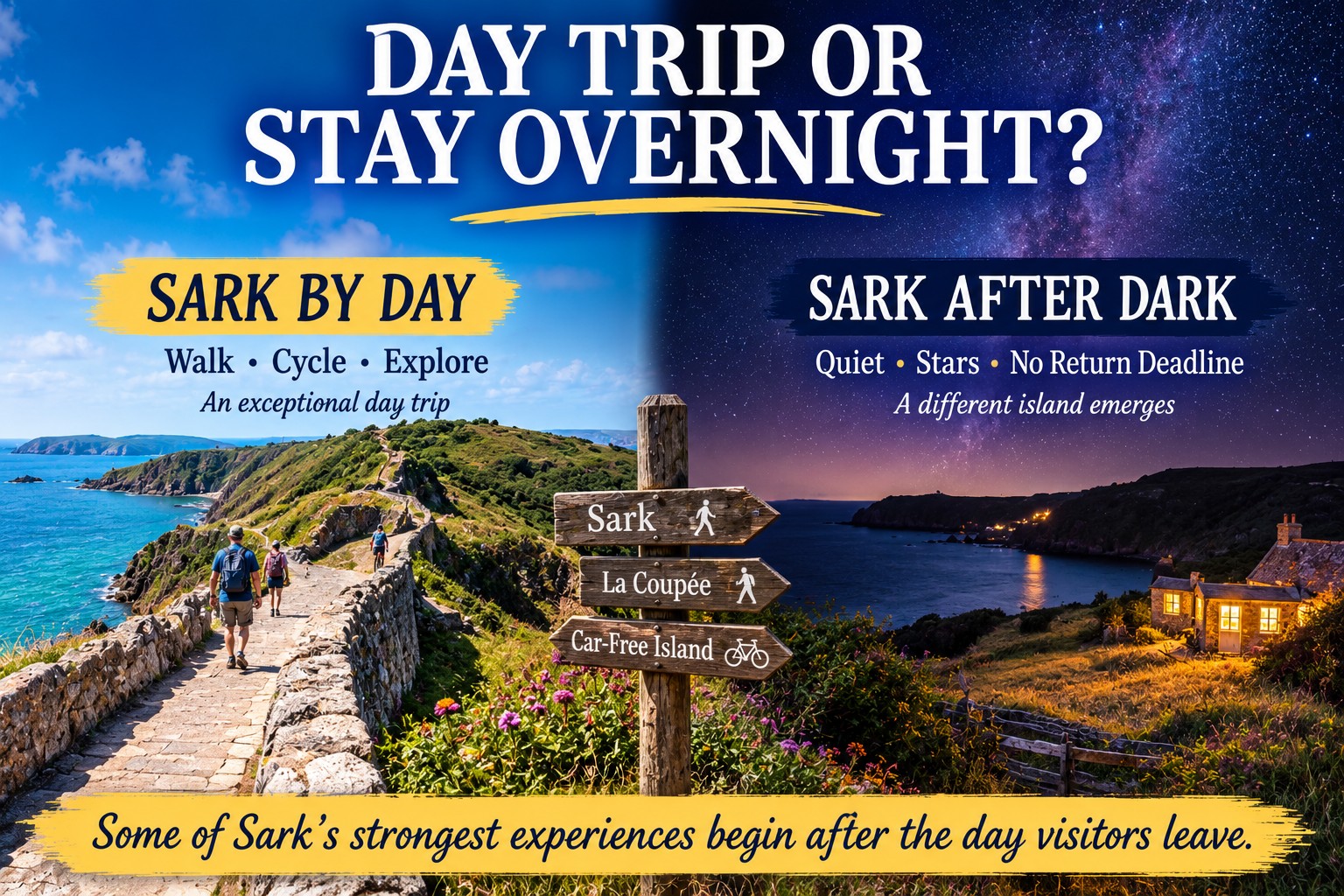
Sark offers a memorable day of walking, cycling and coastal exploration, but staying overnight reveals quieter evenings, darker skies and an island no longer shaped by the return ferry
🌍 From Sark to a Wider Channel Islands and European Journey
Sark can be the destination that changes the scale of a holiday. A traveller may begin with a few days on Guernsey, add Sark for its car-free character and then realise that the Channel Islands themselves could form the opening chapter of something larger.
There is no reason to force that progression. Sark deserves to be experienced as a destination rather than treated merely as a stepping stone. But for travellers already considering a longer itinerary, the geography and shared history of the Channel Islands make northern France a natural direction in which to continue.
The progression can develop gradually:
Sark → Guernsey → wider Channel Islands → Northern France → wider Europe
At that point, the planning challenge changes. Coordinating several islands, accommodation stays, sea connections and onward travel into France may appeal to independent travellers who enjoy constructing every stage themselves. Others may reach the point where having the principal elements organised becomes part of the holiday’s value.
That is where commercial choice can genuinely serve the reader.
The important distinction is that a wider itinerary should never encourage visitors to rush Sark. If anything, the island teaches a useful lesson for everything that follows: adding destinations creates value only when each receives enough time to feel meaningfully different.
Northern France can then become a continuation rather than an unrelated add-on, opening possibilities around Normandy and, eventually, a broader European journey.
The choice is not between slow travel and travelling further. The two can coexist.
A thoughtfully constructed European itinerary can cover considerable ground while still protecting enough time for individual places to matter. Sark simply makes that principle unusually difficult to ignore.
📅 Plan the Wider Journey with the BVT Europe Events Calendar 2026–2027
If Sark forms part of a longer Channel Islands and European trip, choosing where to travel is only part of the planning. When you travel can influence what the wider journey becomes.
Festivals, cultural celebrations, sporting occasions and seasonal events can provide worthwhile reasons to adjust an onward itinerary, particularly when the journey continues into France or deeper into Europe. An event that genuinely matches your interests might justify an additional night, a different route or another destination.
The reverse also matters. Major events can increase demand for accommodation and transport, so discovering what is happening before fixing the wider itinerary can prevent avoidable complications.
The BVT Europe Events Calendar 2026–2027 supports this stage of planning by helping travellers identify events that complement the dates and destinations already under consideration. The aim is not to rebuild an entire holiday around an event unless it deserves that importance, but to recognise opportunities and pressures before arrangements become difficult to change.
Before leaving Sark behind entirely, however, there is another question worth considering: how can the island be experienced responsibly?
🌿 Sustainable Travel on Sark: Slow Down, Stay Longer, Support Local
Sark provides an unusually natural setting in which to think about responsible travel, but describing it as sustainable simply because conventional private-car traffic is absent would be too simplistic.
The more useful lesson lies in the choices visitors make while they are there.
Walking and cycling can make movement part of the holiday rather than something to minimise. A less hurried itinerary can reduce unnecessary movement between experiences, while eating locally, choosing island accommodation and spending with independent businesses can help visitor expenditure remain within the community that makes the journey possible.
Sark’s small scale also makes the limits of an island environment easier to appreciate. Coastal habitats, wildlife, paths and community resources deserve the same consideration as the visitor experience itself.
Responsible travel here is therefore not about achieving perfection. It is about recognising that how you explore Sark matters almost as much as what you come to see.
Responsible behaviour matters particularly around Sark’s cliffs, paths, bays and wildlife habitats. Follow local guidance, respect access restrictions, keep an appropriate distance from wildlife and leave places as you found them. These are simple actions, but their cumulative effect matters on a small island.
There is also a valuable relationship between responsible travel and a better visitor experience. A slower itinerary can mean fewer rushed transfers, more time walking or cycling and greater opportunities to support local accommodation, food and services. Instead of extracting as many sights as possible from Sark, the traveller becomes more connected to the place supporting the holiday.
That does not mean everyone needs to stay for several nights. A thoughtfully planned day visit can be responsible too. The principle is to make the time available meaningful rather than treating the island as another destination to collect.
Sark reminds us that travelling more slowly does not necessarily mean experiencing less.
❓ Sark Travel FAQs
🚗 Is Sark Really Car-Free?
Yes. Sark has no conventional private-car traffic, which is one of the defining characteristics visitors notice. Walking and cycling are central to getting around, while horse-drawn carriage experiences provide another option. Essential or authorised motorised vehicles may still be encountered, so “car-free” should not be interpreted as meaning that no motorised machinery can ever operate on the island.
⛴️ Can You Visit Sark as a Day Trip from Guernsey?
Yes. Sark can work extremely well as a day trip from Guernsey when suitable ferry connections operate. Check current arrangements for your actual travel date and avoid overloading the itinerary. Choosing a few priorities generally produces a better visit than attempting to cover the entire island before the return sailing.
⏳ How Long Do You Need on Sark?
One day can provide an excellent introduction. Staying for one night or longer creates more time for relaxed walking and cycling, quieter evenings and, when conditions cooperate, Sark’s celebrated night sky. The right duration depends on whether you want a focused visit or deeper slow-island immersion.
🚲 Can You Cycle Around Sark?
Yes. Cycling is one of the most practical and enjoyable ways to explore Sark, particularly for visitors who want to cover more ground than would comfortably be possible on foot. The island’s car-free character makes cycling an integral part of the visitor experience rather than simply an alternative form of transport.
Sark’s compact size should not, however, be mistaken for effortless cycling. Gradients and terrain still matter, and visitors should consider their own confidence and fitness when deciding how much of the island to cover.
Walking and cycling also work particularly well together. A bicycle can provide the range, while individual stretches of coastline, viewpoints and other places can then be explored more closely on foot.
🌙 Is Sark Worth Staying Overnight?
For travellers attracted to Sark’s tranquillity, scenery and slower rhythm, an overnight stay can add considerably to the visit. It removes the pressure of a same-day return connection and creates opportunities to experience quieter evenings, mornings and the island’s internationally recognised dark-sky environment.
A day trip remains entirely worthwhile. Staying overnight simply reveals aspects of Sark that cannot be experienced within a daytime visit.
👨👩👧 Is Sark Suitable for Families?
Sark can be particularly rewarding for families who enjoy cycling, walking and outdoor exploration. Children may find the absence of conventional private-car traffic and the island’s unusual way of getting around part of the adventure.
Parents should consider children’s ages, cycling ability, stamina, terrain, weather and coastal safety. Families primarily seeking extensive organised attractions and entertainment may find another Channel Island better suited to their priorities.
♿ Is Sark Suitable for Visitors with Limited Mobility?
This depends heavily on individual requirements. Sark’s gradients, terrain and unconventional transport environment can create challenges, while some coastal locations require walking or more demanding access.
Visitors with specific accessibility needs should investigate current transport, accommodation and individual attraction access before travelling. Personal circumstances matter far more than a general claim that Sark is either accessible or inaccessible.
☀️ What Is the Best Time to Visit Sark?
The best time depends on what you want from the island. Longer daylight can favour walking, cycling and coastal exploration, while different seasons bring changes in weather, atmosphere, visitor numbers and operating arrangements.
Rather than choosing a month simply because it is traditionally considered “best”, think about what matters most to your visit. If long days and extensive outdoor exploration are priorities, daylight becomes important. If tranquillity matters more, travelling outside the busiest periods may appeal, provided the transport, accommodation and experiences you want are operating.
Whatever the season, check current ferry services, opening arrangements and weather close to departure rather than relying upon assumptions made months earlier.
⭐ Is Sark Worth Visiting?
Yes — if the qualities that distinguish Sark are qualities you genuinely value.
Travellers looking for walking, cycling, dramatic coastal scenery, dark skies and an escape from conventional private-car traffic can find an island experience markedly different from Jersey or Guernsey.
Its appeal may be less obvious to visitors who measure destinations primarily by the number of attractions, entertainment venues or organised activities available. Sark asks for a different measure of value: how memorable the experience of simply being somewhere can become.
For the right traveller, that is precisely why Sark is worth the journey.
🌊 Experience Sark at Its Own Pace
Perhaps the best way to understand Sark is to stop thinking about everything you could fit into a visit.
Walk instead of drive. Cycle along a quiet lane without treating every minute as travelling time. Cross La Coupée and allow the geography to explain why this small island can feel so dramatic. Stop at a viewpoint because the light has changed. Leave enough room in the day for something you had not planned.
And, if your itinerary allows it, discover what happens when you do not leave with the daytime visitors.
Sark can be a memorable excursion from Guernsey, a destination for several slower days, one stage of a wider Channel Islands holiday or the beginning of an itinerary eventually continuing towards northern France and Europe. None of those choices is automatically superior.
The best journey is the one that gives Sark enough time to remain Sark, rather than reducing it to another stop between connections.
Its car-free character may be what first attracts attention, but the deeper reward is what follows from it: greater awareness of distance, coastline, weather, quiet and time.
Sark does not ask you to fit more into your holiday. It invites you to experience more of the time you already have.