


Spring in Britain: The Complete Travel & Visitor Guide
6th October 2026
🌷 Spring in Britain: The Complete Travel & Visitor Guide

Spring in Britain is a season in motion. Timing, geography, daylight and individual priorities all influence whether March, April or May provides the spring journey that best suits you
Spring can be one of the most rewarding times to explore Britain, but it is better understood as a season in motion than as one predictable set of conditions. A journey in early March can feel very different from one in late May, while the stage of spring you encounter can also vary between regions, landscapes and individual years.
That matters because travellers often arrive with a particular image of British spring: flowering gardens, green countryside, longer days and milder weather. All can form part of the experience, but none should be treated as a promise attached to a particular date.
The more useful question is therefore not simply “Is spring a good time to visit Britain?” It is “What do I want from spring, when should I travel, and where in Britain is most likely to suit the experience I want?”
For some travellers, spring is primarily about gardens and changing landscapes. Others want historic cities, countryside, wildlife, cultural occasions or a journey combining several parts of Britain. The importance of timing changes according to those priorities.
Think of spring as a progression. Decide first what you want the season to contribute, then choose the timing and geography that best support that journey.
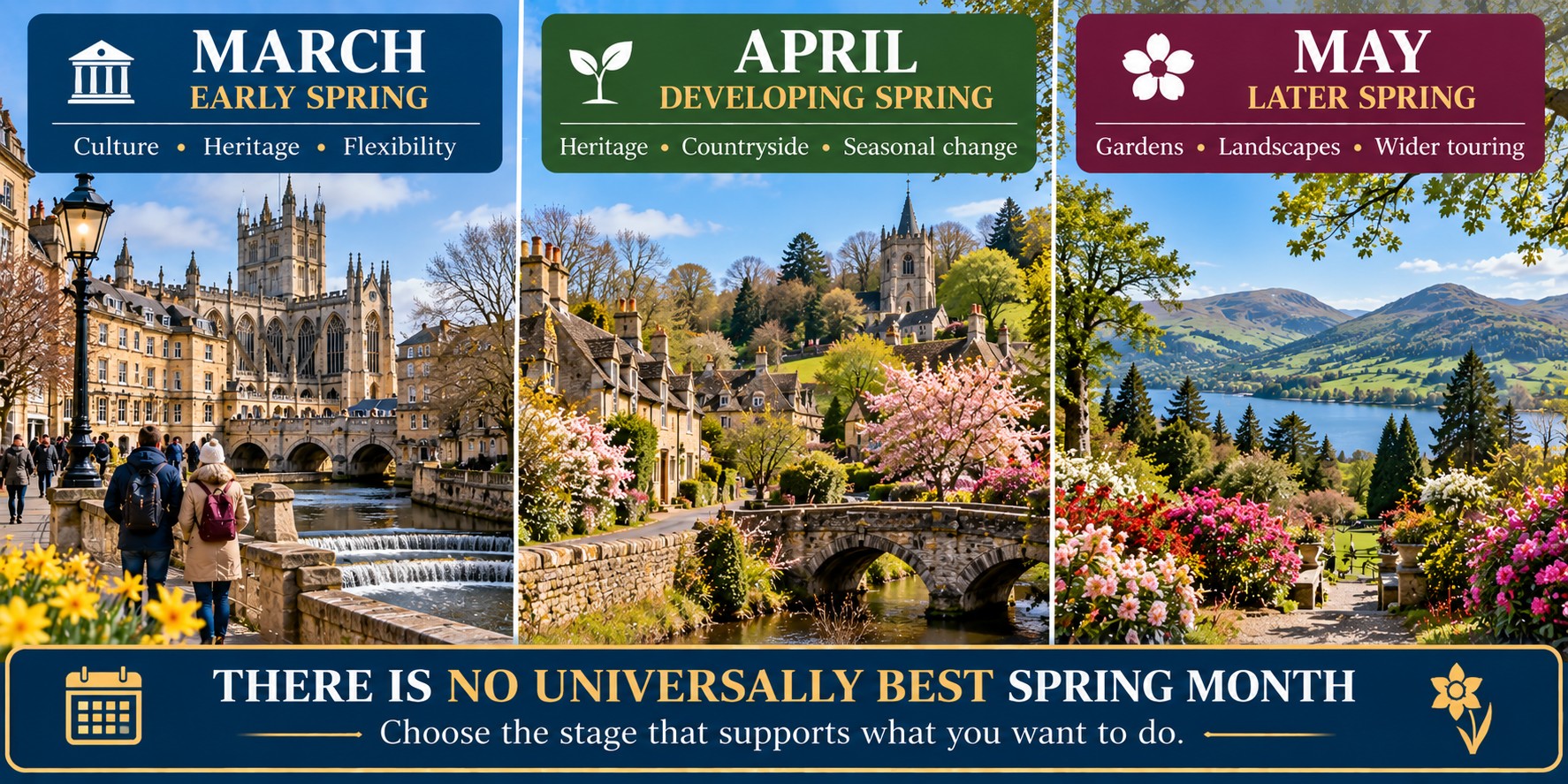
There is no universally best spring month in Britain. March, April and May represent different stages of the season, so the strongest choice depends on whether your priorities are culture and heritage, developing countryside, gardens, landscapes or wider touring
🌱 What Actually Changes When You Visit Britain in Spring?
Spring changes more than the appearance of the countryside. As the season develops, increasing daylight can expand the possibilities for sightseeing and touring, landscapes change, natural experiences become more prominent and particular cultural occasions can influence when people choose to travel.
At the same time, spring remains variable. Understanding both sides of the season—greater opportunity and continuing uncertainty—is the foundation of good planning.
🌅 Increasing Daylight Changes What You Can Do
One of spring’s most dependable changes is the progression towards longer days.
For travellers, the value of that extra daylight is practical. Countryside walks, outdoor heritage, gardens, viewpoints and scenic journeys can become easier to combine as the season advances. On a touring itinerary, additional usable daylight can also make the difference between a day dominated by transfers and one that still allows meaningful exploration after reaching the next destination.
This does not automatically make later spring better. A city-based journey built around museums, historic interiors, food and culture may depend much less heavily on long outdoor days than a countryside-focused itinerary.
The useful question is:
How much of my planned journey genuinely benefits from daylight?
The more outdoor and landscape-led the trip, the more important that question becomes when choosing between early and later spring.
🌦️ Spring Weather Is a Variable, Not a Promise
The calendar tells you when you are travelling. It cannot tell you exactly what weather you will experience.
Spring conditions in Britain vary between regions and from one year to another, and the weather can change during an individual journey. Travelling later in spring should therefore not be treated as a guarantee of warm, dry or settled conditions.
That uncertainty need not make spring difficult to plan.
A city and heritage itinerary may naturally provide indoor alternatives when conditions are less favourable. A countryside journey can include activities suited to different conditions. A longer touring itinerary can avoid making every important outdoor experience dependent on one particular day.
The strongest spring plans do not attempt to predict the weather months in advance. They are designed to remain worthwhile across a realistic range of conditions. 🌼 Britain’s Landscapes Begin to Change
Landscape change is one of spring’s defining attractions, but nature does not work to a fixed tourism calendar.
Plants flower according to species, location and conditions. Elevation and geography can influence how advanced the season appears, while the character of the countryside can change noticeably as spring progresses.
For travellers, this creates an important distinction.
If spring colour would simply enhance an already appealing journey, there is little reason to make the entire itinerary dependent upon precise natural timing. If seeing particular gardens or seasonal landscapes is one of the main reasons for travelling, timing deserves more attention—but still without assuming that a particular week will produce an exact result.
Spring creates windows of opportunity, not guaranteed appointments with nature.
🐦 Nature & Wildlife Create Seasonal Opportunities
Spring can also make nature and wildlife a more significant part of a British journey.
The season brings changing habitats and patterns of wildlife activity, but the same principle applies: choosing an appropriate season can improve the opportunity to experience nature without guaranteeing a particular sighting.
This is especially important when wildlife is central to the trip. A worthwhile itinerary should not become unsuccessful simply because one hoped-for encounter does not occur.
Seasonal knowledge helps travellers choose when and where opportunities may be stronger. Flexibility and realistic expectations do the rest.📅 March, April or May: When Should You Visit Britain?
There is no universally best spring month for visiting Britain.
March, April and May represent different stages of the season, and their relative value depends on what you want to do. A traveller primarily interested in cities and heritage may make a different choice from someone whose priorities are gardens, countryside and long days of scenic touring.
🌱 March — Early Spring & Seasonal Transition
March is best understood as a transition month. Winter is receding and daylight is increasing, but travellers should not expect Britain to have reached the fuller spring character associated with later in the season.
That can work extremely well for the right journey.
Travellers interested primarily in historic cities, museums, architecture, heritage and cultural experiences do not need their trip to depend on advanced flowering or consistently favourable outdoor conditions. Countryside and landscape experiences can still form part of the itinerary, but they are better treated as part of an adaptable journey than planned around assumptions about exactly how spring will look.
March therefore suits travellers comfortable with early spring as it actually is, rather than those trying to recreate an image of late-spring Britain several weeks early.
🌷 April — Spring Becomes More Visible
By April, the seasonal transition is generally further advanced, making spring itself more prominent within the travel experience.
That can make the month particularly appealing for itineraries combining cities and heritage with countryside, gardens and outdoor exploration. Increasing daylight gives travellers greater scope to combine different types of experience within the same journey, while developing landscapes can make the season feel more evident.
April also demonstrates why calendar planning and seasonal planning are not quite the same thing. Easter can fall at different points in the spring calendar, and journeys overlapping Easter may need additional attention to opening arrangements, transport, events or visitor demand.
Natural timing remains variable too. April may provide excellent spring experiences, but it should never be treated as a guarantee of particular flowers, temperatures or weather.
🌼 May — Later Spring & Longer Touring Days
May offers a later-stage spring experience and can be especially attractive when gardens, countryside, landscapes and wider touring feature strongly in the itinerary.
Longer daylight becomes increasingly valuable for travellers moving between destinations or spending substantial time outdoors. A scenic journey does not necessarily need to end when a conventional attraction closes, while an itinerary combining heritage visits with countryside can have more usable time around its fixed elements.
May can therefore be a strong choice for travellers wanting spring to play a substantial role in the journey rather than simply form its backdrop.
But later does not automatically mean better. Travellers should still allow for variable weather, and particular dates can create their own patterns of demand or activity. Nor should the approach of summer be mistaken for a guarantee of summer conditions.
The best month remains the one that fits the experience you actually want.
| Timing | Broad spring character | Particularly suited to | Main planning consideration |
|---|---|---|---|
| March | Early spring and seasonal transition | Cities, heritage, culture and flexible mixed itineraries | Do not depend on advanced spring conditions |
| April | Developing and increasingly visible spring | City-and-countryside combinations, heritage and seasonal landscapes | Easter timing and natural variation may matter |
| May | Later spring with longer usable days | Gardens, landscapes, countryside and broader touring | Particular dates may affect demand; weather remains variable |
🧭 What Do You Want From Spring in Britain?
Choosing a month becomes much easier once you identify what you want spring to contribute to the journey.
If the trip would be rewarding regardless of flowering, wildlife or weather, exact seasonal timing may be relatively unimportant. If the principal reason for travelling is a spring-dependent experience, timing deserves much greater weight.
🏙️ Cities, Heritage & Culture
Cities and heritage can provide one of the most resilient ways to experience Britain in spring.
Historic buildings, museums, galleries, cultural attractions and indoor experiences can be combined with walking, parks, outdoor heritage and neighbourhood exploration as conditions allow. As daylight increases, the outdoor part of that balance becomes easier to extend.
This flexibility is particularly useful in early spring. Rather than asking the weather to cooperate with an entirely outdoor itinerary, travellers can move between experiences according to conditions without sacrificing the purpose of the journey.
The seasonal value lies in understanding how spring’s changing daylight and outdoor possibilities can alter the rhythm of a city or heritage trip—not simply in attaching a spring label to experiences that could be enjoyed at any time of year.
🌷 Gardens, Flowers & Seasonal Landscapes
For some travellers, gardens and seasonal landscapes are pleasant additions. For others, they are the reason for visiting Britain.
That distinction should influence planning.
If gardens are supplementary, a flexible itinerary can incorporate them when conditions and seasonal development are favourable. If they are central, travellers should research the types of gardens and seasonal displays they most want to experience and plan around realistic flowering periods rather than a generic idea of “spring flowers.”
Even then, precision has limits. A typical flowering period describes an expectation, not a reservation with nature.
The same applies beyond formal gardens. Woodland, parkland and countryside can all change through spring, but local conditions and the progress of the particular year matter.
🌳 Countryside & Scenic Touring
Spring countryside travel benefits particularly from the relationship between landscape, daylight and flexibility.
As the days lengthen, scenic routes and outdoor stops become easier to combine with heritage attractions and overnight destinations. Travellers can build days around several complementary experiences rather than treating the journey between them merely as transport.
Conditions still matter. Walking routes, rural ground and exposed landscapes may respond very differently to recent weather. A strong itinerary therefore combines ambition with alternatives rather than assuming every outdoor plan will work exactly as imagined.
🐑 Wildlife & Nature
Travellers motivated by wildlife should think in terms of probability rather than certainty.
Choosing the right broad season can improve the opportunity for particular kinds of nature experience, but wildlife remains wild. Location, conditions, timing and chance all play a part.
A better planning question is therefore not simply, “Will I see it?” but:
“Would this still be a worthwhile day if I don’t?”
That small change in thinking produces much stronger spring itineraries. It encourages travellers to choose landscapes and destinations they would value regardless of a particular sighting, while still allowing wildlife to become one of the memorable rewards of travelling at the right time of year.
🎭 Traditions, Events & Cultural Occasions
Spring travel can also be shaped by occasions tied to particular points in the calendar. Easter and May Day are obvious examples, while local festivals, celebrations and seasonal programmes can create additional reasons to choose one date over another.
The important distinction is between visiting Britain during spring and travelling specifically for a spring occasion.
If an event is simply an added possibility, it can remain one element within a flexible itinerary. If attending it is one of the principal reasons for travelling, its current year’s dates, programme, ticketing and visitor arrangements become essential planning information.
Annual tradition should never be mistaken for confirmed future operation. An occasion may recur each year while its programme, access arrangements or exact visitor experience changes.
🗺️ Where in Britain Best Matches Your Spring Journey?
Choosing when to travel is only part of the decision. Geography matters too.
Britain does not move through spring as one uniform landscape. Latitude, elevation, local conditions and the character of individual destinations can all influence what travellers experience. The same dates can therefore support quite different journeys in different parts of the country.
Rather than trying to find the single “best place in Britain in spring,” decide which combination of season and place best supports your priorities.🏴 England — Cities, Heritage, Countryside & Gardens
England gives spring travellers considerable scope to combine different types of experience within one journey.
A city-and-heritage itinerary can use museums, historic interiors and cultural attractions as reliable anchors while taking advantage of parks, gardens, walking and outdoor heritage when conditions suit. A countryside-focused journey can give much greater importance to landscapes and seasonal change, while a garden-led trip makes natural timing more central still.
The strength lies in those combinations.
A traveller does not necessarily need to choose between culture and countryside or between heritage and spring landscapes. The better question is how heavily each should feature and how dependent the journey should become on outdoor conditions.
That makes England particularly adaptable to mixed spring itineraries—but the itinerary should still be designed around genuine priorities rather than trying to include every possible type of experience.
🏴 Scotland — A Different Spring Progression
Scotland should not simply be treated as England with the same seasonal timetable.
Its northerly geography, varied elevations and landscapes mean that the progress and character of spring can differ substantially between places. For travellers combining different parts of Britain, that variation can be part of the attraction rather than an inconvenience.
Scotland can work especially well when landscapes, wildlife, castles, scenic journeys and outdoor experiences are important, but expectations should remain geographically realistic. Conditions in a city, coastal area, island or Highland landscape need not be the same simply because they share the same date on the calendar.
Daylight also becomes increasingly valuable as spring advances, particularly for journeys in which the landscape between destinations is part of the experience.
The practical lesson is straightforward: do not assume that a spring expectation formed elsewhere in Britain automatically transfers to Scotland.
Wales can bring a different balance of landscapes, heritage, communities and cultural identity to a British spring journey.
Here too, seasonal value comes from more than scenery. Outdoor exploration can become increasingly attractive as daylight develops, while particular cultural occasions may provide an additional reason to travel at a specific point in the season.
For landscape-focused journeys, flexibility remains important. Conditions in upland or exposed areas can differ markedly from those encountered in towns, valleys or lower ground, so an itinerary that includes worthwhile alternatives is stronger than one dependent on a single outdoor plan.
Wales is therefore most useful here not as another list of destinations, but as another example of why where you travel affects the kind of spring you experience.
🧭 One Region or Several?
A multi-region journey can reveal more of Britain’s spring variety, but greater geographical coverage does not automatically produce a better trip.
Every transfer consumes time. The useful question is whether moving to another region adds something meaningfully different: a contrasting landscape, cultural experience, particular seasonal opportunity or another important part of the traveller’s overall journey.
If it does, the movement may be entirely worthwhile. If it simply adds another name to the itinerary, spending longer in fewer places may create a richer experience.
Spring adds another consideration: flexibility. A tightly packed itinerary with frequent transfers leaves less room to respond to weather or make better use of an unexpectedly favourable day.
The objective is not necessarily to travel slowly. It is to make each movement earn its place.
🌦️ How Certain Is a Spring Experience?
Good seasonal planning depends on knowing the difference between something that can be anticipated with reasonable confidence and something that can only be treated as an opportunity.
That distinction is particularly important in spring, when travellers may be making decisions around weather, flowers, wildlife, events or seasonal opening arrangements.
🌼 Flowering, Wildlife & Weather
Spring creates opportunities, not guarantees.
A garden may typically reach a particular stage during part of the season, a landscape may usually develop its spring character within a broad period, and certain wildlife may be associated with particular times of year. None of those patterns can determine exactly what an individual traveller will encounter.
Weather deserves the same discipline. Seasonal averages and established patterns can help with broad expectations, but they cannot provide a forecast for a trip planned months ahead.
This is not a reason to avoid nature-led spring travel. It is a reason to plan it intelligently.
Choose a period when the desired experience is realistically possible, select places capable of delivering a rewarding visit in their own right, and avoid making the success of an entire journey dependent upon one condition-sensitive moment.
📅 Recurring Events Are Not Confirmed Programmes
Events require a different type of caution.
An established celebration or festival may recur annually, but recurrence alone does not confirm the next edition’s exact dates, programme, ticket arrangements, opening hours or visitor access.
This becomes important when the event influences the reason for travelling.
Someone who would enjoy encountering a celebration as part of a wider spring journey has considerable flexibility. Someone travelling specifically to attend it needs current information before making firm plans.
The same principle applies to seasonal attractions and special programmes. Historical arrangements can provide useful context, but they should not silently become promises about a future visit.
| Information type | How to use it when planning |
|---|---|
| Evergreen seasonal fact | Use it confidently as broad planning context |
| Typical spring pattern | Treat it as a useful expectation, not a guarantee |
| Natural or condition-dependent experience | Plan for the opportunity rather than a certain outcome |
| Annually recurring occasion | Check the relevant year’s dates and arrangements |
| Historical arrangement | Use for context, not as evidence of current operation |
| Provisional information | Treat it as subject to change until confirmed |
| Confirmed future information | Use for firm planning when it comes from a reliable current source |
Thinking this way makes seasonal information more useful, not less. It allows travellers to rely confidently on what is genuinely dependable while recognising where flexibility or current verification provides better protection against disappointment.

The same date does not produce the same spring everywhere in Britain. England, Scotland and Wales can offer different landscapes and stages of seasonal development, making geography as important as timing when planning a spring journey
🎯 How to Build a Spring Itinerary That Works
Once you understand the season, itinerary planning becomes less about predicting conditions and more about deciding what deserves priority and where flexibility has value.
🧭 Start With the Spring Experience That Matters Most
Begin with one question:
What would I most regret missing from this journey?
For one traveller, the answer may be historic places and culture. For another, gardens, countryside, wildlife or a particular event may define the trip. Others may simply want to tour Britain at a time when spring adds another dimension to places they already want to visit.
That priority should influence both timing and geography.
If the journey is fundamentally about heritage and culture, it may tolerate a wider range of spring dates. If it depends heavily on gardens or another natural experience, seasonal timing becomes more influential. If attendance at a particular event is essential, confirmed dates may determine the itinerary before almost anything else.
This is more useful than choosing a month first and then trying to make every desired experience fit it.
🌅 Use Increasing Daylight Deliberately
Longer spring days are most valuable when the itinerary makes use of them.
Experiences dependent on outdoor light—landscapes, walking, scenic journeys and outdoor heritage—can be given the parts of the day that suit them best. Museums, historic interiors and other less daylight-dependent experiences can provide useful anchors around them.
On a touring journey, think about the journey itself as well as the destination. Travelling through attractive countryside in daylight can be part of the experience rather than lost time between stops.
The objective is not to fill every available hour. It is to use spring’s expanding daylight where it contributes most.
🔄 Keep Nature-Dependent Experiences Flexible
Flexibility is especially valuable when an experience depends upon weather, flowering, ground conditions or wildlife.
A good alternative should not feel like consolation.
If a countryside day becomes unsuitable, a nearby heritage or cultural experience may provide an equally worthwhile use of the day. If a hoped-for natural display is less advanced than expected, the surrounding destination should still justify the visit.
That is a stronger approach than building an itinerary around several fragile assumptions and hoping they all prove correct.
🚆 Balance Regional Variety Against Travel Time
Britain can tempt travellers into adding destinations simply because the distances appear manageable on a map.
But every move involves more than the nominal journey time. Packing, reaching stations or departure points, checking in and reorganising the day all consume time and attention. In spring, frequent transfers can also reduce the flexibility that makes it easier to respond to changing conditions.
Ask what each additional region contributes.
If moving north, west or elsewhere produces a substantially different landscape, experience or cultural dimension that matters to you, the transfer may be an excellent investment. If it merely adds another overnight stop, greater depth elsewhere may be more rewarding.
🎟️ Secure Fixed Elements; Keep Variable Ones Adaptable
Some parts of a spring journey may need commitment in advance. Others become stronger when they retain flexibility.
The useful planning principle is:
Fix what genuinely requires commitment. Preserve flexibility where spring conditions influence the outcome.
That does not mean leaving an entire holiday unplanned. It means distinguishing between elements that depend on availability or confirmed arrangements and those where keeping options open can improve the experience.
Accommodation, essential transport or an important ticketed experience may belong to the first category. A weather-sensitive walk, garden visit or countryside day may benefit from greater adaptability where the itinerary allows it.
Spring rewards travellers who know the difference.
⚠️ What Should You Check Before a Spring Trip?
Good spring planning combines evergreen seasonal knowledge with current information where current information actually matters.
Not every part of a journey needs repeated checking. But when an attraction, journey, event or natural experience is essential to the success of the trip, assumptions become more costly.
🏛️ Seasonal Opening & Visitor Access
Do not assume that every attraction follows identical opening arrangements throughout the year.
Historic properties, gardens, heritage sites and other visitor attractions can have seasonal operating patterns, while individual facilities or areas may occasionally have different access arrangements.
If a particular place is fundamental to your itinerary, check its current official visitor information before relying on it.
The distinction matters: knowing that somewhere normally welcomes visitors in spring is useful background information. Knowing that it will be accessible in the way you require on the date of your visit is an operational question that deserves current confirmation.🚆 Transport & Date-Specific Changes
The same principle applies to transport.
A normal rail, ferry, bus or other transport pattern should not automatically be assumed to apply to every future date. Planned works, public holidays and other temporary changes can affect individual journeys.
There is little value in overloading an itinerary with transport checks months before they become relevant. Instead, identify the connections upon which the journey genuinely depends and confirm them at an appropriate point before travel.
This becomes particularly important when a missed or altered connection would disrupt several later parts of the itinerary.
🎭 Events, Festivals & Programmes
If attending an event is central to your trip, verify the relevant year’s details rather than relying on what happened previously.
Check the things that actually determine whether the experience will work for you: the date, programme, access and any ticketing requirements.
An annually recurring celebration may be an established tradition while its practical visitor arrangements still change from year to year.
🌼 Gardens, Landscapes & Natural Timing
Current information can also help when a particular natural experience is one of the main reasons for travelling.
Gardens may provide seasonal updates, and local information can sometimes indicate how landscapes or natural conditions are developing. Such information can improve decisions, particularly close to the visit.
It still cannot guarantee what nature will do next.
A useful rule across all these situations is:
The more important an experience is to the success of your journey, the stronger the reason to verify its current conditions or arrangements.

Good spring planning separates what can be planned confidently from what needs current verification and what nature ultimately controls. Use dependable seasonal knowledge, check important arrangements when they matter, and preserve flexibility for weather, wildlife and natural conditions
🌱 Responsible Spring Travel in Britain
Spring landscapes can appear robust while actually being particularly vulnerable to pressure. Wet ground, emerging vegetation, wildlife activity and increasing numbers of people enjoying the outdoors all make responsible decisions part of good seasonal travel.
Responsible travel need not make a journey more restrictive. Often, it produces a better one.
🥾 Protect Paths & Changing Landscapes
Recent weather can leave paths and surrounding ground wet, soft or vulnerable to erosion.
Follow established routes and local guidance rather than creating alternative tracks around difficult sections. If conditions make a planned route inappropriate, changing the plan is generally better than forcing the original itinerary.
Appropriate footwear and realistic expectations also matter. A countryside experience designed around actual ground conditions is likely to be more enjoyable as well as less damaging.
🌼 Enjoy Spring Nature Without Damaging It
Spring flowers and changing landscapes naturally attract photographers and visitors, but the best viewpoint is not always one that should be reached.
Avoid trampling vegetation or leaving established paths simply to obtain a photograph. In gardens and managed landscapes, respect local restrictions even when an apparently accessible area looks harmless.
Seasonal beauty is part of the reason people travel in spring. Protecting it is therefore part of experiencing it well.
🐦 Give Wildlife Appropriate Space
Spring can be an important period for wildlife, making distance and restraint particularly valuable.
Follow local guidance, respect temporary restrictions and avoid disturbing animals or habitats in pursuit of a closer view or photograph. Where access advice changes because an area has become sensitive, that current guidance should take precedence over an itinerary made earlier.
A wildlife encounter does not become better because the traveller gets closer.
🚆 Consider Slower, Better-Connected Itineraries
Responsible travel can also begin with itinerary design.
A journey with fewer unnecessary transfers may reduce travel demand while giving visitors more time to understand individual places. It can also create useful flexibility: an extra night in one location provides more opportunity to adapt plans when spring conditions change.
That does not mean every multi-region itinerary is excessive. Moving between regions can be an important part of understanding Britain’s diversity.
The question is whether each movement contributes enough to justify the time and resources it requires.
Travel with purpose. Explore with care.
❓ Frequently Asked Questions About Visiting Britain in Spring
Is spring a good time to visit Britain?
Yes, particularly for travellers who value changing landscapes, increasing daylight and the ability to combine cities, heritage and countryside. The key is to treat spring as a variable season rather than expect guaranteed weather or natural conditions.
Is March, April or May best for visiting Britain?
There is no universal best month. March suits travellers comfortable with early spring and seasonal transition; April can provide a broader mixture of spring experiences; and May’s longer days can be particularly useful for gardens, countryside and wider touring. Your priorities should determine the choice.
What is the weather like in Britain during spring?
Spring weather is variable, both between different parts of Britain and from one year to another. Broad seasonal patterns can help with planning, but they should not be treated as a forecast for an individual trip.
Does it rain a lot in Britain in spring?
Rain is possible, but a useful itinerary should not depend on assumptions about either persistent rain or reliably dry conditions. Prepare for changeable weather and build in experiences that work under different conditions.
When do spring flowers appear in Britain?
There is no single date. Different plants flower at different stages of the season, while geography, elevation and annual conditions can influence timing. If a particular display is central to your journey, use current local or garden information close enough to the visit for it to be meaningful.
Is April a good month to visit Britain?
April can work particularly well for travellers wanting a mixture of culture, heritage, countryside and developing spring landscapes. Easter timing and variable natural conditions should be considered when choosing exact dates.
Is May a good month to tour Britain?
May can be particularly well suited to touring because later spring brings longer usable days, which can make countryside, outdoor heritage and scenic journeys easier to combine. Weather remains variable, however, so later spring should not be mistaken for guaranteed summer conditions.
Are British gardens worth visiting in spring?
They can be one of the highlights of a spring journey, especially for travellers interested in seasonal planting, flowering displays and changing landscapes. Different gardens and plants reach their seasonal highlights at different times, so travellers with a particular horticultural interest should research current conditions rather than assume that all gardens peak together.
Is Scotland worth visiting in spring?
Yes. Scotland can offer a distinctive spring journey combining cities, castles, landscapes, wildlife and scenic travel. Its seasonal progression can differ considerably according to latitude, elevation and location, so expectations formed elsewhere in Britain should not automatically be applied to Scotland.
Many attractions operate during spring, but opening patterns vary. Some properties, gardens and visitor sites may have seasonal hours, restricted access or changing arrangements. If an attraction is essential to your itinerary, check its current official information before travelling.
Is Britain busy during Easter?
Easter can influence visitor demand, events, transport and opening arrangements, but the effect is not identical everywhere or every year. Because Easter moves within the spring calendar, travellers whose dates overlap the period should check the current year’s arrangements rather than rely on assumptions from previous years.
What should I pack for Britain in spring?
Think in terms of adaptability rather than trying to pack for one predicted type of weather. Layers, suitable protection against rain and footwear appropriate to your planned activities are generally more useful than preparing for a single temperature range. A city break and a countryside walking itinerary will naturally require different choices.
🌍 Choose the British Spring That Suits Your Journey
The best British spring journey begins not with a month, but with a priority.
Decide what you most want from the season. If cities, heritage and culture dominate, your itinerary may work across a broad part of spring. If gardens, wildlife or changing landscapes are central, timing and geography become more important. If a particular festival or cultural occasion is the reason for travelling, confirmed dates and current visitor arrangements may determine the journey.
Then decide how much of Britain you genuinely need to cover. Moving between regions can reveal striking differences in landscape and seasonal character, but additional destinations are valuable only when they contribute something worthwhile. A well-designed journey does not measure success by the number of places visited.
Finally, separate what you can reasonably plan from what spring must be allowed to determine for itself.
You can choose a suitable stage of the season. You can select destinations where the experiences you value are realistically possible. You can secure the elements that require advance commitment and verify current arrangements where they matter.
What you cannot do is guarantee the weather, dictate when a flower will bloom or arrange for wildlife to appear on schedule.
That uncertainty is not a weakness of travelling in spring. It is part of experiencing a season that is visibly changing.
There is no universally best choice between March, April and May. There is instead a better match between particular travellers and particular stages of spring.
The strongest spring journey is therefore not one built around a promise of perfect weather or exact natural timing. It is one designed around the experiences that matter most to you, during a period and in a part of Britain where those experiences are realistically possible, with enough flexibility to work with the season as it develops.
Spring in Britain is at its most rewarding when timing, place and expectation work together. Choose the spring that suits your journey, rather than asking your journey to conform to an imagined version of spring.