


Stonehenge and the Cotswolds Multi-Day Tours (2026 Guide)
26th August 2026
🗿 Stonehenge and the Cotswolds Multi-Day Tours (2026 Guide)
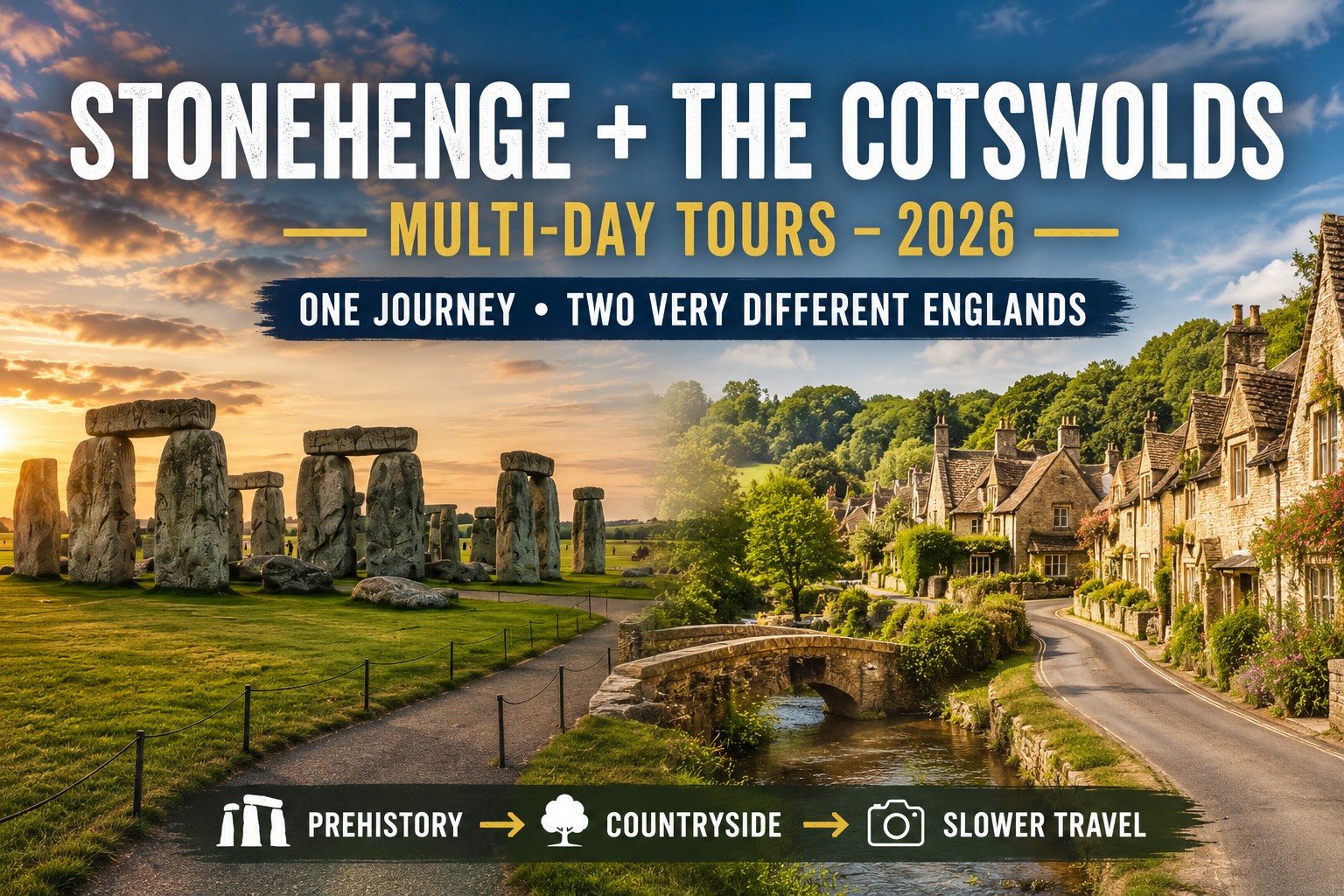
Stonehenge and the Cotswolds create a contrasting multi-day England journey, combining one of Britain’s greatest prehistoric monuments with villages, countryside and a slower style of travel
🌄 Do Stonehenge and the Cotswolds Work Well Together?
Stonehenge and the Cotswolds can make an excellent multi-day England journey, but the combination works best when you give each destination enough time to feel completely different.
Stonehenge offers a concentrated encounter with prehistoric Britain: monumental stones, an archaeological landscape and questions that have fascinated visitors for generations. The Cotswolds changes the pace. Here, much of the pleasure comes from countryside, honey-coloured villages, historic market towns, local food and the freedom to slow down.
That contrast is exactly why the pairing works.
The mistake is assuming that because both places fit naturally into the same wider England itinerary, you should also add every famous destination nearby. Stonehenge, Bath, Oxford, Salisbury and several Cotswolds villages may all look tempting on a map, but a multi-day trip can quickly become a checklist rather than a holiday.
For many first-time visitors, three days provides a particularly useful balance. Two days can work if you remain selective, while four or five days allows a more relaxed countryside experience and greater freedom to add one carefully chosen extension.
Your second major decision is how to travel. An organised multi-day tour can remove much of the logistical work. Small-group and private touring offer different levels of personalisation, while confident drivers may find self-drive gives them exactly the freedom the Cotswolds rewards.
Before comparing individual itineraries, it is worth deciding whether your priority is maximum sightseeing, minimum logistical work or a slower countryside experience. That distinction can quickly eliminate options that look attractive on paper but do not suit the journey you actually want.
The strongest Stonehenge and Cotswolds itinerary is not the one containing the most famous names. It is the one that gives both destinations enough space to feel memorable.
👤 Who Is This Multi-Day Journey Best For?
Stonehenge and the Cotswolds can suit very different travellers, but understanding your priorities early will make the rest of the itinerary much easier to design.
🌍 First-Time Overseas Visitors
For a first visit to England, this combination offers a useful contrast to London.
Stonehenge introduces one of Britain’s most recognisable ancient sites, while the Cotswolds provides a slower experience of countryside, villages and small-town England. Travellers with limited holiday time can therefore experience several distinct sides of the country without attempting an exhausting cross-Britain itinerary.
💑 Couples
The Cotswolds is particularly well suited to couples who enjoy scenic travel, relaxed meals, characterful accommodation and unhurried exploration.
Combining it with Stonehenge can produce a journey with both a major bucket-list landmark and time to slow down afterwards.
That does not mean couples automatically need a luxury or private tour. A well-paced small-group journey, organised tour or self-drive itinerary can be equally rewarding. The better question is how much independence, privacy and schedule control you actually want across several days.
🚗 Independent Drivers
Confident motorists are particularly well placed to enjoy this combination because the Cotswolds rewards flexibility.
Having a car gives you the freedom to choose villages according to your interests rather than a fixed timetable, stop when somewhere catches your attention and select accommodation away from the most obvious transport hubs. It can also make it easier to link Stonehenge with quieter countryside locations that are less convenient to reach independently without a vehicle.
For self-drivers, the bigger challenge is often not transport but restraint. The freedom to visit almost anywhere can make it tempting to add too many stops.
🚌 Travellers Without a Car
You do not need to drive to combine Stonehenge and the Cotswolds, but transport integration becomes more important.
An organised multi-day experience can be particularly attractive because it joins destinations that are individually straightforward to understand but more complicated to connect efficiently without your own vehicle. The practical value lies in reducing the number of transfers, timetable decisions and luggage arrangements you need to manage yourself.
For travellers who would rather spend their evenings enjoying the destination than planning the next stage, that simplicity can be a meaningful part of the holiday.
When comparing organised options, look beyond the list of destinations and consider how much usable time the itinerary actually creates. A joined-up journey can provide greater practical value when it reduces hotel changes, awkward transfers and repeated luggage handling rather than merely transporting you between more places.
👨👩👧 Families and Small Groups
Families and small parties may value predictable transport, suitable accommodation, luggage handling and an itinerary that does not require constant repacking.
Private touring can become more attractive when several people share the cost and want control over stops, meal breaks or daily pace. However, it is worth comparing the total practical benefit rather than assuming that private travel is automatically the superior option.
A well-designed shared or small-group journey may provide everything a family needs at considerably lower cost.
🗿 Stonehenge-Priority Travellers
If Stonehenge is the principal reason for the trip, protect it accordingly.
Do not allow a multi-day itinerary to reduce your most important destination to a rushed photograph simply because more attractions have been added around it. The Cotswolds should enrich the journey, not compete with the experience that motivated you to travel in the first place.
This distinction matters because travellers approach the same itinerary with different priorities. For one visitor, Stonehenge may be the headline event followed by countryside touring. For another, it may be one exceptional stop within a broader England journey.
Knowing which traveller you are will make the next decision—how many days to allow—considerably easier.
📊 How Many Days Do You Need for Stonehenge and the Cotswolds?
The best trip length depends less on how many places you could technically reach and more on how much of each place you want to experience.
| Journey Length | Best For | Strength | Main Risk |
|---|---|---|---|
| 2 Days | Time-limited visitors | Efficient contrast | Can feel rushed |
| 3 Days | Most first-time visitors | Strong balance | Requires selective planning |
| 4 Days | Slower travellers | More countryside depth | Greater cost |
| 5 Days | Extended England touring | Strong flexibility | Easy to over-expand |
⏱️ Two Days: Possible, but Selective
Two days can work when you accept from the beginning that you are not going to see everything.
A sensible version gives Stonehenge proper attention before moving into one carefully chosen part of the Cotswolds rather than attempting to cover the whole region. The objective should be to experience the contrast between the prehistoric landscape and rural England, not to maximise the number of stops.
The danger is turning two days into Stonehenge, Bath and several famous villages simply because each sounds appealing. If every destination receives only a short visit, the itinerary may look impressive on paper while feeling rushed in practice.
If two days is your absolute limit, decide which element is non-negotiable before booking. Protect that experience first, then use the remaining time to create a realistic second chapter rather than repeatedly shortening every stop to make the itinerary fit.
🧭 Three Days: The Best Balance for Many Visitors
Three days creates considerably more breathing room.
Stonehenge can receive meaningful time, the Cotswolds can become an experience rather than a brief scenic drive, and an overnight stay allows you to appreciate how different the area can feel outside the busiest part of the sightseeing day.
For many first-time travellers, this is the most useful starting point. It is long enough to feel like a genuine journey but short enough to fit comfortably within a broader Britain holiday.
Three days still requires choices. It should not be interpreted as permission to include every famous village plus Bath, Oxford and Salisbury.
If you are comparing organised three-day itineraries, examine how those days are actually used. The strongest option is usually the one that protects meaningful time at Stonehenge and within the Cotswolds rather than using the extra day simply to increase the number of advertised destinations.
🌳 Four to Five Days: Better for Slower Travel
Extra time becomes valuable when it buys depth.
Four or five days can allow longer village stays, countryside walks, market-town time, relaxed meals and perhaps one carefully selected additional destination such as Bath or Oxford. It also gives you greater resilience when weather, traffic or simple preference changes the day’s plans.
What those additional days should not automatically buy is a longer checklist.
Extra days should buy deeper experience before they buy additional destinations.
That principle is useful throughout the journey. A fourth day spent experiencing the Cotswolds at a gentler pace may contribute more to the holiday than a fourth day spent racing between several additional headline attractions.
Longer journeys can also make it easier to continue naturally into another part of Britain rather than returning immediately to the original starting point. If the Cotswolds forms one stage of a wider UK itinerary, consider where you genuinely need to finish the multi-day journey before choosing the route and accommodation pattern.

Two days can work for a selective Stonehenge and Cotswolds trip, three days offers a strong balance for many first-time visitors, while four or five days allows a slower and deeper countryside experience
🗺️ What Should a Good Stonehenge–Cotswolds Route Actually Look Like?
A good Stonehenge and Cotswolds route should feel like a journey rather than a sequence of disconnected attractions. The objective is to minimise unnecessary backtracking while allowing the character of the trip to change naturally as you move between prehistoric landscape, countryside and historic settlements.
There is no universally correct direction. Where you are travelling from before Stonehenge—and where you intend to go afterwards—should influence the route far more than an arbitrary idea of which destination must come first.
🗿 Stonehenge First, Cotswolds Second
For visitors leaving London or travelling through southern England, Stonehenge first can create an especially satisfying progression.
You begin with a concentrated landmark experience, where the stones and surrounding archaeological landscape provide a clear focal point. Moving onwards into the Cotswolds then changes the rhythm: sightseeing becomes less about one headline monument and more about villages, countryside, meals, walks and the pleasure of travelling between places.
This sequence can work particularly well when you want the journey to become progressively less scheduled.
It can also make practical sense when Stonehenge forms part of a wider journey away from London. Rather than treating every destination as a separate return excursion, a multi-day route can use Stonehenge as the first major stage before continuing naturally into rural England.
🌄 Cotswolds First, Stonehenge Later
The reverse route can be equally sensible when it fits your wider England itinerary.
Travellers approaching through Oxford, the Midlands or another part of central England may find it more logical to experience the Cotswolds first and continue south towards Stonehenge. Stonehenge can then become a major concluding experience before travelling towards Salisbury, the South Coast, London or another destination.
Do not add unnecessary mileage merely to follow somebody else’s preferred itinerary order.
🏨 One Base or Multiple Bases?
Changing hotels can look efficient on a map but carries hidden costs. Every move involves packing, checking out, handling luggage, travelling, finding the next property and checking in again.
On a short multi-day journey, those transitions can consume a surprising amount of usable holiday time.
One well-positioned Cotswolds base may therefore be better than changing accommodation every night. A second base becomes worthwhile when it genuinely reduces travel or allows you to experience another destination properly—not simply because moving hotels makes the itinerary appear more extensive.
Before choosing individual sightseeing stops, sketch the journey around your overnight locations and realistic travel direction.
Plan sensible movement first. Add attractions second.
🏘️ Which Parts of the Cotswolds Should You Prioritise?
One of the easiest itinerary mistakes is treating “the Cotswolds” as if it were a single attraction that can simply be added after Stonehenge.
In reality, the Cotswolds covers a substantial rural landscape of villages, market towns, farmland, walking country and historic places. Trying to sample too many of them in one short visit can mean spending more time arriving and departing than actually experiencing the area.
For a first multi-day journey, choose a small number of places that provide different experiences rather than several villages that fulfil essentially the same role.
A well-balanced day might include a particularly attractive village you have genuinely wanted to see, a market town where you can spend longer over lunch or explore independently, and some less structured countryside time. That often produces a stronger sense of the Cotswolds than repeatedly stopping for twenty or thirty minutes simply to photograph another famous location.
Popular villages can absolutely deserve a place in the itinerary, but fame should not become the only selection criterion. The most heavily visited places may be at their best earlier or later in the day, while quieter locations can provide a very different sense of rural life.
Allow some flexibility as well.
If the weather is beautiful, you may prefer a walk or longer countryside stop. If conditions deteriorate, a historic market town, pub lunch or indoor attraction may suddenly become more appealing. A rigid village-by-village schedule removes much of the freedom that makes multi-day Cotswolds travel worthwhile.
Think in terms of experiences rather than numbers:
- one or two places you particularly want to see;
- a contrasting market town or village;
- meaningful countryside time;
- a relaxed meal or local stop;
- enough unscheduled space to respond to the day.
This is also where a well-designed guided, small-group or private journey can add practical value. Local knowledge can help turn the Cotswolds from a list of famous village names into a more coherent countryside experience, particularly for visitors who have limited time or do not want to research every stop themselves.
Do not judge the success of the journey by the number of village signs photographed.
The best Cotswolds itinerary is selective, not exhaustive.
That principle matters even more when Stonehenge already occupies an important part of the same trip. The objective is not to “complete” the Cotswolds—it is to experience enough of its character that the countryside becomes a genuine second chapter of your journey.
🏛️ Should You Add Bath, Oxford or Salisbury?
Once Stonehenge and the Cotswolds are fixed, the temptation is to keep expanding the route. Bath, Oxford and Salisbury can all strengthen a multi-day itinerary, but only when the additional destination contributes something you genuinely want to experience.
The question is not simply whether another place is geographically possible. It is whether adding it improves the holiday enough to justify the time it takes from somewhere else.
🛁 Add Bath If…
Bath is a strong addition for travellers interested in Roman history, Georgian architecture and a substantial historic city experience.
It can provide an excellent contrast with both prehistoric Stonehenge and the rural Cotswolds. However, Bath deserves enough time to function as a destination in its own right. Compressing it into a hurried stop between other places can deliver the name without much of the experience.
Add Bath because you want Bath—not merely because the route makes it possible.
For travellers continuing through South West England, Bath can also work as a genuine stage of the wider journey rather than an additional excursion squeezed into the Stonehenge–Cotswolds itinerary.
🎓 Add Oxford If…
Oxford can work particularly well when your wider journey already connects London, Oxford and the Cotswolds.
Its university heritage, architecture and city atmosphere provide another distinctive dimension without duplicating the countryside experience. It becomes less convincing when reaching it requires substantial backtracking or forces several Cotswolds stops to be shortened.
Oxford therefore works best when it strengthens the direction of travel as well as the sightseeing programme.
⛪ Add Salisbury If…
Salisbury can be particularly useful when Stonehenge is a major priority.
Staying in or visiting the city can place you relatively close to Stonehenge while adding cathedral heritage and an attractive historic centre. It can also suit travellers whose wider journey involves rail travel rather than driving throughout.
For some itineraries, Salisbury works better as an overnight gateway than another brief sightseeing stop.
Before adding Bath, Oxford, Salisbury—or anywhere else—apply one simple test:
Would I still want to visit this destination if it were not conveniently close to my route?
If the answer is yes, investigate whether the itinerary can give it sufficient time.
If the answer is no, leaving it out may produce the better journey.
🚐 Organised Multi-Day Tour: Who Is It Best For?
An organised multi-day tour becomes particularly attractive when the logistics of connecting several destinations begin to feel more like work than part of the holiday.
You are potentially paying for much more than transport. Depending on the individual tour, the value may include route planning, accommodation coordination, luggage arrangements, guiding, admissions and the reassurance that each stage of the journey has already been joined together.
That can be especially useful for overseas visitors who do not want to drive in Britain, as well as travellers who would rather spend their evenings enjoying the destination than researching roads, parking, transfers and the following day’s schedule.
For visitors already considering a wider Britain journey, an organised multi-day format can also remove the need to construct Stonehenge and the Cotswolds as separate excursions. The practical advantage is strongest when the itinerary connects naturally with where you are travelling from and where you want to continue afterwards.
However, convenience alone does not make every organised tour a good choice.
Before booking, compare the details that will actually shape your experience:
- maximum group size;
- hotel arrangements and location;
- luggage policy;
- included and excluded admissions;
- whether guiding is provided throughout or only at selected stops;
- how much time is allocated to Stonehenge;
- which parts of the Cotswolds are actually visited;
- how much independent time you receive;
- how frequently accommodation changes.
Pay particular attention to time on the ground.
A tour may advertise Stonehenge, Bath, Oxford and numerous Cotswolds villages, but the destination list tells you little about how satisfying the journey will be. Ask how long you will actually spend experiencing the places that matter most to you and how much of each day is devoted to travelling between them.
A four-day tour is therefore not automatically better than a three-day alternative. If the additional day has simply been filled with more destinations, the longer itinerary may provide less meaningful time at each place.
The strongest organised multi-day tours solve logistical problems while still allowing destinations to breathe.
For the right traveller, that can be enormously valuable: someone else handles the connections while you concentrate on the journey itself.
Organised touring is at its best when it removes complexity without removing too much choice.
👥 Small-Group Multi-Day Touring: When Does It Add Value?
Small-group touring can become more valuable on a multi-day journey than on a simple day trip because group size influences much more than the journey between attractions.
A smaller group can make it easier to ask questions, interact with the guide and move between stops without every arrival and departure becoming a lengthy process. It may also allow the journey to feel more personal, particularly when the itinerary includes Cotswolds villages and rural locations where very large groups can change the character of a visit.
For couples and solo travellers, there can be a useful social dimension too. You retain the convenience and companionship of shared travel while potentially avoiding the more regimented feel associated with a much larger touring group.
However, the words “small group” should never be accepted as a complete description.
There is no single group size that every operator uses for the term. Check the stated maximum passenger number, vehicle type and itinerary before deciding whether the experience genuinely matches what you imagine small-group touring to mean.
The itinerary itself remains more important than the label.
A smaller vehicle does not compensate for insufficient time at Stonehenge, excessive village-hopping or a schedule that attempts to cover too much ground. Equally, a slightly larger group on a thoughtfully paced itinerary may produce a better holiday than a smaller group racing between destinations.
Consider how much guide interaction matters to you as well. Travellers who enjoy asking questions, hearing stories and developing a rapport with their guide may gain considerably more from a smaller group across three or four days than visitors who mainly want efficient transport.
When comparing small-group journeys, also consider whether the route forms part of a wider Britain itinerary. A well-connected tour that begins and ends where you genuinely need it to can provide more practical value than one requiring additional transfers simply because its advertised group size is smaller.
That is the distinctive advantage of this format:
Group dynamics compound over time.
A group size that seems relatively unimportant during one short transfer can materially influence the atmosphere of an entire multi-day journey.
🚘 Private Multi-Day Touring: When Is It Worth the Premium?
Private touring offers its greatest value when personal control materially changes the journey.
On a Stonehenge and Cotswolds itinerary, that flexibility can extend well beyond having a vehicle to yourselves. Depending on the experience booked, it may allow greater control over departure times, the pace of each day, village choices, meal breaks, accommodation and the amount of time devoted to particular destinations.
That can be especially valuable for families, couples and small parties with clearly defined priorities. Travellers with mobility considerations may appreciate additional control over walking distances and breaks, while photographers may value the ability to spend longer somewhere when conditions are particularly good.
Private touring can also become more useful when the itinerary contains a fixed commitment, such as a particular Stonehenge access time. The surrounding journey can potentially be arranged around that priority rather than requiring the priority to fit a predetermined schedule.
It may also solve a wider journey problem. If you want to begin in one city, travel through Stonehenge and the Cotswolds and finish somewhere different, a suitably structured private itinerary can sometimes combine sightseeing and onward travel rather than forcing you to return unnecessarily to your original starting point.
When comparing prices, consider the total cost for your travelling party, not simply the apparent cost per person of another option. For several travellers, the difference between private and shared touring may become smaller once the overall price is assessed properly.
But exclusivity should not be confused with value.
If you are likely to follow a standard route, visit the same mainstream locations and keep conventional timings anyway, paying substantially more for flexibility you never use may achieve very little.
It is also important to understand exactly what you are booking. A private vehicle, a private transfer and a fully guided private multi-day tour are not necessarily equivalent experiences. Check whether guiding, admissions, accommodation and itinerary planning are included rather than assuming that “private” describes the complete service.
The most useful question is therefore not:
“Is private touring better?”
It is:
“What would I actually change if this journey were private?”
If you can identify meaningful changes that would improve the holiday, the premium may be worthwhile.
Private touring is most valuable when personal control is something you will genuinely use.
🚗 Self-Drive Stonehenge and Cotswolds: Is It the Best Option?
For confident independent travellers, self-drive may genuinely be the strongest way to combine Stonehenge and the Cotswolds.
The Cotswolds particularly rewards flexibility. Having a car allows you to choose villages according to your interests, stay outside the most obvious transport hubs and change plans when weather, traffic or simple curiosity suggests somewhere different.
There is also considerable value in spontaneity. A viewpoint, village or country pub that was never part of the original itinerary can become one of the highlights precisely because you have the freedom to stop.
The disadvantages should not be underestimated, particularly if you are unfamiliar with driving in Britain.
Overseas visitors may need to adjust to driving on the left, while some rural roads can feel surprisingly narrow. Parking requires planning in popular Cotswolds locations, and the driver carries responsibility for navigation, traffic and the practicalities of each day’s journey.
Driving can also influence seemingly minor pleasures. If a leisurely pub lunch forms part of your idea of the Cotswolds, the designated driver needs to remain mindful of alcohol limits and safe driving.
Your wider Britain itinerary should influence the decision too.
If you already have a hire car for several days elsewhere in England, using it for Stonehenge and the Cotswolds may be an obvious continuation. If you would be hiring a vehicle solely for this short journey, compare the entire process—collection, insurance, fuel, parking, navigation and return—with the simplicity and cost of an organised alternative.
Also consider where the car fits into the journey afterwards. A vehicle that is useful through the Cotswolds may become unnecessary when you continue to a city where rail travel and local transport are more practical. Thinking about collection and return as part of the complete itinerary can prevent the convenience of self-drive in one region from creating inconvenience elsewhere.
Self-drive also works best when you resist changing accommodation unnecessarily. Freedom on the road does not mean you need to sleep somewhere different every night.
For travellers comfortable behind the wheel, the reward can be substantial: greater independence, access to quieter places and the ability to let the countryside dictate part of the day.
Self-drive is not merely an alternative to organised touring. For the right traveller, it may provide the most satisfying Cotswolds experience of all.
🛏️ Where Should You Stay on a Multi-Day Trip?
Accommodation should support the journey rather than become another attraction to collect.
For a short Stonehenge and Cotswolds trip, repeatedly changing hotels can consume more time than expected. Packing, checking out, managing luggage, travelling to the next property and checking in again all reduce the hours available for the places you actually came to experience.
One well-chosen Cotswolds base can therefore be particularly effective. It allows you to unpack once, explore different parts of the area and return somewhere familiar in the evening rather than continually moving your belongings with you.
The type of base matters as much as its location.
A market town may offer greater choice of restaurants, shops and evening amenities, while a rural inn or country-house stay can provide the atmosphere many travellers associate with a Cotswolds escape. The more secluded option may, however, require additional driving or more carefully arranged transport.
Neither approach is inherently better.
If Stonehenge is scheduled early in the journey, spending the previous night closer to Salisbury or the Stonehenge area may make practical sense before continuing towards the Cotswolds. Bath can also work as an overnight point when it is genuinely part of the itinerary rather than being used simply because it appears conveniently positioned.
For travellers using an organised or private multi-day experience, accommodation deserves the same scrutiny as the sightseeing programme. Check where you will actually stay, whether the location gives you useful independent evening time and how frequently the itinerary requires you to move your luggage.
Before booking accommodation, ask three questions:
- Does this location reduce unnecessary travel?
- Will I enjoy being here after the sightseeing day ends?
- Is changing hotels genuinely improving the route?
The second question is particularly important on a multi-day journey. Accommodation is not merely somewhere to sleep between attractions. An evening meal, a walk through a market town or a quiet night in the countryside can become part of the experience you remember.
The strongest accommodation strategy usually balances geography, atmosphere and convenience.
A beautiful hotel in the wrong location can create unnecessary travel. A perfectly positioned hotel that adds nothing to the experience may also be a missed opportunity.
Where you sleep affects how much usable holiday time you have—and how the journey feels once the formal sightseeing day is over.
🗿 How Much Time Should Stonehenge Get Within a Multi-Day Itinerary?
One of the unexpected risks of a multi-day Stonehenge itinerary is that Stonehenge itself can receive less attention than it deserves.
As more destinations are added, each one competes for the same finite amount of time. A visit that originally formed the centrepiece of the journey can gradually become a tightly scheduled stop between breakfast, another attraction and the onward drive to the Cotswolds.
If Stonehenge is one of the reasons you chose the trip, protect sufficient time for it.
A worthwhile visit is about more than reaching a viewpoint, taking photographs and leaving. Depending on your interests, you may want time for the visitor facilities and interpretation, the monument experience itself and a broader appreciation of the surrounding archaeological landscape.
Different travellers will naturally spend different amounts of time here. Someone fascinated by prehistory may want considerably longer than a visitor primarily interested in seeing the famous stone circle for the first time.
That variation is entirely reasonable.
What matters is avoiding an itinerary designed around the shortest possible Stonehenge visit simply so another village or attraction can be added later in the day.
When comparing organised, small-group or private itineraries, check how much time is genuinely allocated to Stonehenge rather than assuming that its appearance in the itinerary guarantees a substantial visit. This is especially important when the same day also includes several other headline destinations.
Remember that multi-day travel should give you an advantage over a tightly compressed day trip: time.
Use some of it.
If your itinerary starts to feel crowded, removing one secondary stop can be far more valuable than shortening the destination you most wanted to experience. The Cotswolds will still provide plenty of opportunities for variety without requiring every famous village to appear on the route.
Weather, traffic and normal travel delays also deserve breathing room. A schedule with no flexibility can turn a minor disruption into pressure throughout the rest of the day.
Stonehenge does not need to dominate the entire multi-day journey, but neither should it become merely a box to tick before moving on.
A multi-day itinerary should create breathing room around its headline destinations.
That principle protects both halves of this journey: enough time for Stonehenge to feel monumental, and enough time afterwards for the Cotswolds to feel genuinely slow.

A well-designed Stonehenge and Cotswolds itinerary should progress naturally from the monument into countryside exploration, an enjoyable overnight stay and the next stage of the journey rather than becoming a checklist of rushed attractions
📅 Should You Build the Journey Around Inner Circle Access?
For many visitors, a standard Stonehenge visit provides exactly the experience they want. For others, however, getting closer to the stones through a suitable special-access experience may be one of the most important ambitions of their entire Britain trip.
If Inner Circle access matters strongly to you, reverse the normal planning process.
Instead of constructing a Stonehenge and Cotswolds itinerary first and then trying to fit special access into it, establish the potential Stonehenge access opportunity and build the surrounding journey around that fixed point.
The BVT Stonehenge Inner Circle Access Calendar 2026–2027 can help you identify potential dates and timings before deciding where to stay, how to travel and whether the Cotswolds should come before or after Stonehenge.
This can influence several practical decisions. An early access time may make staying closer to Stonehenge the previous night particularly valuable. A later experience may change how much travelling you want to undertake afterwards. Private or organised transport may also become more attractive when a specific arrival time matters.
For travellers incorporating Stonehenge into a wider Britain journey, establishing the special-access opportunity early can prevent accommodation and onward transport from being booked in a sequence that later proves awkward. Once the Stonehenge commitment is understood, the Cotswolds and any wider journey can be arranged around it more logically.
Treat the calendar as a planning resource rather than a guarantee of availability. Potential access dates, current bookable experiences and remaining spaces are separate considerations, so confirm the actual experience before committing non-refundable accommodation or wider travel arrangements around it.
Special access should not automatically be regarded as an upgrade every Stonehenge visitor needs. If your main ambition is to see Stonehenge, understand the monument and continue into the Cotswolds, a standard visit may fit the overall journey perfectly.
But when being closer to the stones is a genuine priority, the logic changes.
Stonehenge becomes the fixed point. Your accommodation, transport and Cotswolds route can then be arranged around it rather than forcing an important experience into an already crowded itinerary.
That is precisely where a multi-day journey can become an advantage: you have enough time to let one exceptional experience shape the route without sacrificing everything around it.
🧩 Which Multi-Day Touring Style Should You Choose?
By this stage, the decision should be much clearer. There is no universally best way to combine Stonehenge and the Cotswolds; the strongest choice is the one that solves the practical problems that matter to you without sacrificing the character of the journey.
🚌 Choose Organised Multi-Day If…
Choose an organised multi-day tour when logistical simplicity is one of your highest priorities.
Having transport, route structure and accommodation arrangements joined together can be particularly valuable if you do not want to drive or spend part of each day coordinating the next stage of the trip.
It becomes even more useful when the tour connects naturally with the wider Britain journey you are already making rather than requiring additional transfers before or afterwards.
👥 Choose Small Group If…
Choose small-group touring when guide interaction and the atmosphere of the travelling group will materially affect your enjoyment.
Because you may spend several days together, the benefits of easier interaction can become more significant than they would be on a short excursion.
🚘 Choose Private If…
Choose private touring when you have clear reasons for wanting control over timing, stops, pace or accommodation.
It becomes particularly compelling when family requirements, mobility considerations, specialist interests or a fixed Stonehenge access time make a standard itinerary less suitable.
🚗 Choose Self-Drive If…
Choose self-drive when independence and countryside freedom matter most and you are comfortable driving in Britain.
For confident motorists, the ability to change plans and explore beyond a fixed route can be one of the greatest advantages of travelling through the Cotswolds.
⏱️ Choose Two Days If…
Choose two days when your available time is genuinely limited and you are prepared to remain selective.
🧭 Choose Three Days If…
Choose three days when you want a strong general balance between Stonehenge, countryside touring and an enjoyable overnight experience. For many first-time visitors, this is the most useful starting point.
🌳 Choose Four to Five Days If…
Choose four or five days when the additional time will create slower travel, deeper countryside exploration or room for one carefully chosen extension.
Use those extra days to improve the experience rather than simply lengthen the destination list.
The final decision rule is straightforward:
Choose the journey that gives each destination enough space to feel distinct.
⚖️ More Destinations or More Experience?
Consider two hypothetical three-day journeys.
The first gives Stonehenge enough time to be experienced properly before continuing into a carefully selected part of the Cotswolds. Rather than attempting to visit every famous village, the itinerary combines a few worthwhile stops with countryside, an unhurried meal, time to explore independently and an evening in the region.
The second journey includes Stonehenge, Salisbury, Bath, Oxford and several well-known Cotswolds villages within a similar timeframe.
On paper, the second itinerary appears more impressive. It contains more recognisable names, more photographs to take and more places to say you have visited.
It may not produce the better holiday.
Every additional destination has a cost that is easy to overlook while planning. It requires travel time, parking or transfers, arrival and departure, orientation and enough energy to engage with another place. That time has to come from somewhere—usually from destinations already on the itinerary or from the unscheduled breathing room that makes a multi-day journey enjoyable.
This does not mean a busy itinerary is inherently wrong.
Some travellers genuinely enjoy energetic sightseeing and would rather experience the highlights of several destinations than spend longer in fewer places. If that describes you, a faster itinerary can be entirely appropriate.
The important distinction is conscious choice.
Do not add destinations simply because they are famous, nearby or routinely included by other itineraries. Ask whether each place contributes something sufficiently different to justify the time it requires.
Stonehenge and the Cotswolds already provide a powerful contrast: one extraordinary prehistoric landscape followed by a much slower experience of rural England. You do not necessarily need several additional headline destinations to make that journey feel substantial.
This is also a useful way to compare commercially available itineraries. A longer destination list should not automatically be interpreted as greater value. Compare how much meaningful time the journey gives you at the places you actually care about and whether its route reduces unnecessary travel.
A multi-day holiday should create opportunities to experience places more deeply than a collection of compressed day trips.
Do not judge a multi-day itinerary by how impressive the destination list looks before you travel. Judge it by how much of each destination you will actually experience once you arrive.
That is the difference between travelling through somewhere and genuinely visiting it.
🌱 A More Responsible Stonehenge–Cotswolds Journey
Good multi-day itinerary design and more responsible travel often point in the same direction.
Staying longer in fewer places can reduce unnecessary journeys while giving you more time to support local cafés, pubs, shops, attractions and accommodation providers. Rather than repeatedly arriving, photographing and leaving, slower travel allows more of your spending—and your attention—to remain within the communities you have travelled to experience.
This matters particularly in the Cotswolds, where picturesque villages are also living communities. Park responsibly, respect private property and residents, use shared or public transport where it works for your itinerary, and consider spending time beyond the most photographed locations.
Walking within villages and market towns can also improve the experience. Once the vehicle is parked, exploring on foot allows you to notice details easily missed when travelling from one scheduled stop to another.
At Stonehenge, respect visitor guidance and remember that the famous stone circle forms part of a much larger and highly significant archaeological landscape. Remaining on permitted routes and treating the surrounding environment carefully helps protect a place that has survived for thousands of years.
Responsible travel does not require turning your holiday into a restriction exercise.
Often, it simply means making better choices: fewer unnecessary transfers, realistic daily distances, greater respect for local communities and enough time to appreciate the places you visit.
The same approach can improve the holiday itself. A slower itinerary provides more resilience when traffic, weather or personal preference changes the day, while reducing the pressure to keep moving simply because another destination appears on the schedule.
Choosing locally based accommodation, food, guiding or experiences where they genuinely suit your itinerary can also allow more of the value created by tourism to remain within the destinations you are visiting.
In that sense, sustainability and visitor experience are not competing objectives.
For a Stonehenge and Cotswolds journey, they can reinforce each other.
More meaningful time and less unnecessary movement is often better for the destination and better for the traveller.
Travel with purpose. Explore with care.
❓ Frequently Asked Questions
❓ Can You Combine Stonehenge and the Cotswolds in One Trip?
Yes. Stonehenge and the Cotswolds can make an excellent multi-day combination because they provide distinctly different experiences within one wider England journey.
Stonehenge offers prehistoric heritage and an extraordinary archaeological landscape, while the Cotswolds introduces countryside, villages, market towns and a slower style of exploration.
❓ How Many Days Do You Need?
Two days is possible, but it requires discipline. You will need to prioritise Stonehenge and a carefully selected part of the Cotswolds rather than trying to cover the region comprehensively.
For many first-time visitors, three days provides a stronger balance. Four or five days becomes worthwhile when you want slower countryside exploration, longer stays or one carefully chosen additional destination.
The most useful way to choose is to decide what the extra time will actually buy. If another day creates more meaningful time in the Cotswolds, a better overnight experience or a worthwhile extension within your wider Britain journey, it may add considerable value. If it merely adds more brief stops, a shorter and better-paced itinerary may be stronger.
❓ Is Two Days Enough?
Yes, provided you accept that a two-day trip should be selective.
Stonehenge plus a focused Cotswolds experience can work well. Problems usually begin when Bath, Oxford, Salisbury and several villages are added to the same short itinerary.
If two days is all you have, protect the experiences that matter most rather than trying to maximise the destination count.
❓ Should You Add Bath?
Bath can be an excellent addition when Roman history, Georgian architecture and the experience of a substantial historic city genuinely interest you.
However, Bath deserves proper time. If including it means significantly shortening Stonehenge or reducing the Cotswolds to a rapid drive between villages, consider saving Bath for another journey.
If Bath also lies naturally on your onward route, the case for including it becomes stronger because it can function as the next stage of the journey rather than simply another excursion.
❓ Should You Add Oxford?
Oxford can fit particularly well when your wider route already passes between London, Oxford and the Cotswolds.
Its university heritage and city atmosphere provide a strong contrast with the countryside. The case becomes weaker when reaching Oxford creates substantial backtracking or forces you to sacrifice experiences that rank higher on your personal itinerary.
❓ Do You Need a Car for Stonehenge and the Cotswolds?
No. Organised multi-day tours, small-group experiences and private touring can connect Stonehenge and the Cotswolds without requiring you to drive.
A car does, however, provide considerably greater independence within the Cotswolds. It can make quieter locations, rural accommodation and spontaneous stops easier to incorporate.
Whether that freedom outweighs the responsibilities of driving depends on your confidence, wider travel plans and preferred holiday style.
❓ Is an Organised Multi-Day Tour Worth It?
It can be, particularly when you value joined-up transport, accommodation planning and reduced logistical responsibility.
For travellers unfamiliar with driving in Britain, an organised journey can remove several practical decisions at once. The important question is whether the itinerary uses that convenience to create a better experience rather than simply fitting more destinations into the schedule.
Compare the actual time provided at Stonehenge and in the Cotswolds, the number of overnight moves, group size, guiding and how much independent time you receive before deciding.
Also consider where the tour begins and ends. An itinerary that connects naturally with the wider Britain journey you are already making may provide considerably more practical value than one requiring additional transfers or unnecessary backtracking before or afterwards.
❓ Is Private Touring Better?
Not automatically.
Private touring becomes particularly valuable when personalised timing, route flexibility, accommodation preferences, mobility considerations or specific interests would materially change your journey.
If you would choose essentially the same route and timings offered by a good shared tour, paying substantially more for exclusivity may provide limited additional value. For couples, families and small groups, compare the total party cost as well as the practical benefits before deciding.
❓ Can Inner Circle Access Be Included?
Potentially, yes, but it should be treated as a fixed planning consideration rather than an attraction casually added to an already busy itinerary.
Use the BVT Stonehenge Inner Circle Access Calendar 2026–2027 to identify potential opportunities, then verify current bookable availability before arranging important accommodation or transport around a particular date.
If Inner Circle access is a major priority, build the surrounding Stonehenge and Cotswolds journey around it.
❓ Is This a Good Multi-Day Trip for Couples?
Yes. Stonehenge and the Cotswolds can be particularly rewarding for couples who want to combine a major heritage experience with countryside, characterful places to stay, relaxed meals and a slower pace.
Private touring can suit couples who value maximum flexibility, while small-group and organised tours reduce logistical work. Confident drivers may prefer self-drive because it provides greater freedom to explore the Cotswolds independently.
The best option depends less on travelling as a couple than on how you want the journey itself to feel.
🎯 Final Verdict: Stonehenge and the Cotswolds Work Best as a Journey, Not a Checklist
Stonehenge and the Cotswolds can form one of the most rewarding short multi-day combinations in England when the itinerary respects the character of both destinations.
Their strength lies in contrast. Stonehenge provides a concentrated encounter with prehistoric Britain and a landscape shaped by thousands of years of human activity. The Cotswolds changes the rhythm completely, replacing the focus on one extraordinary monument with villages, market towns, countryside and the freedom to explore more slowly.
Two days can work for travellers willing to remain selective. Three days provides many first-time visitors with a particularly useful balance between Stonehenge and meaningful Cotswolds time, while four or five days becomes worthwhile when the additional time creates deeper exploration rather than simply a longer list of stops.
How you travel should reflect the experience you want.
Organised multi-day touring suits visitors who want transport and logistics simplified. Small-group travel can improve guide interaction and the atmosphere of a journey shared over several days. Private touring is strongest when flexibility will genuinely be used, while self-drive can be the best choice for confident independent travellers who value countryside freedom and spontaneous stops.
There is no need for one format to win every comparison.
The better question is whether your chosen itinerary solves the practical problems that matter to you while protecting enough time for the places you most want to experience.
The same principle applies when considering Bath, Oxford, Salisbury or additional Cotswolds villages. Each can strengthen the journey, but none should be included merely to make the itinerary appear more impressive.
Think beyond the individual tour as well. The strongest itinerary should fit naturally between where your wider Britain journey begins and where you genuinely want to continue afterwards. Stonehenge and the Cotswolds can therefore work not only as a self-contained break, but as a coherent stage within a longer exploration of England and Britain.
Stonehenge deserves time to feel monumental.
The Cotswolds deserves time to feel slow.
Allow both to do what they do best, and the result can feel far richer than a sequence of hurried day trips.
The best Stonehenge and Cotswolds multi-day journey is not the one that covers the most ground. It is the one that gives prehistoric Stonehenge and rural England enough space to feel completely different.