


Stonehenge Half-Day vs Full-Day Tours: Which Experience Is Right for You? (2027 Guide)
2nd October 2026
🕰️ Stonehenge Half-Day vs Full-Day Tours: Which Experience Is Right for You? (2027 Guide)
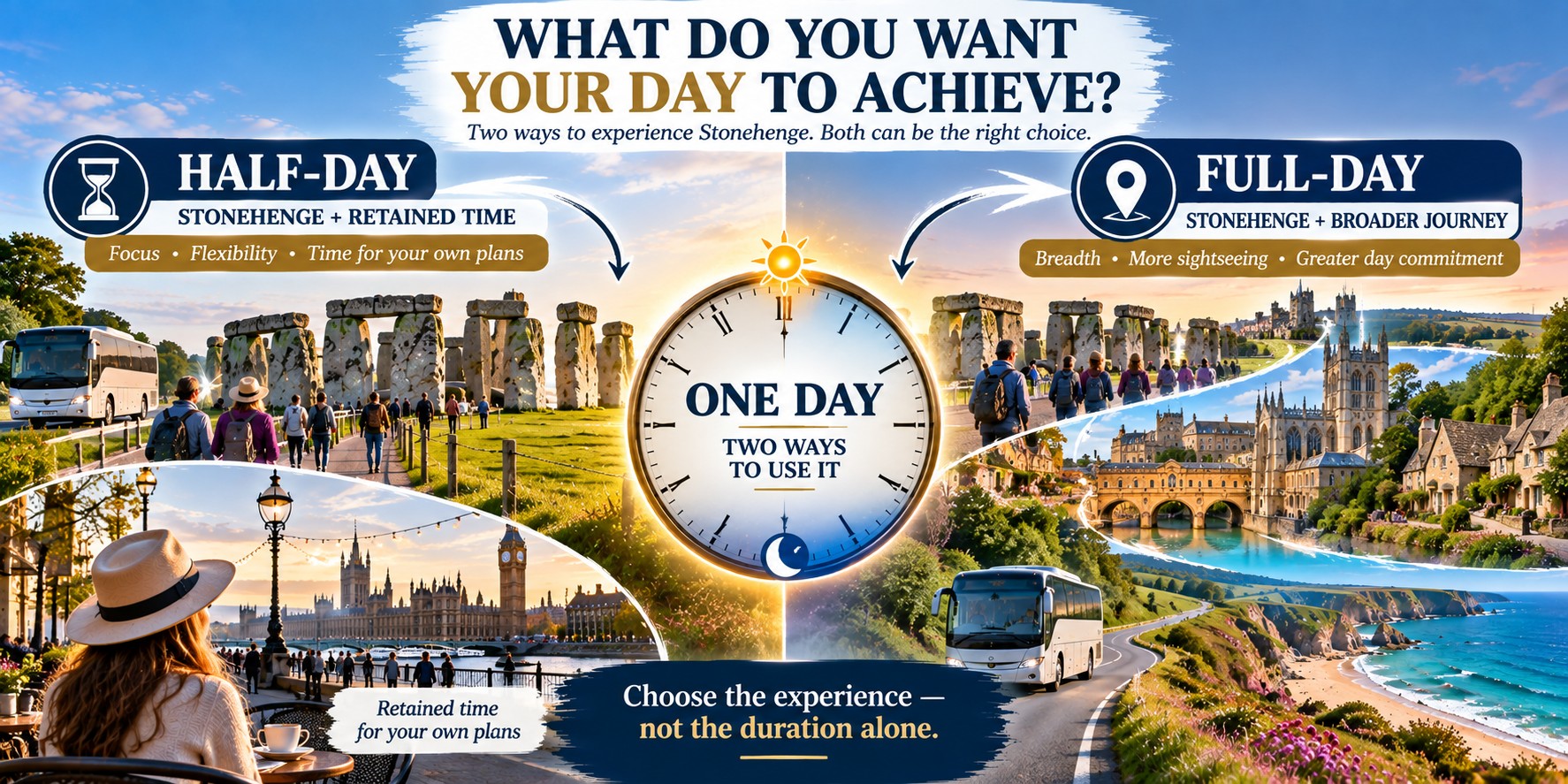
One day can be used in very different ways. A half-day Stonehenge experience can preserve time for your own plans, while a full-day tour can use more of the day for a broader sightseeing journey. The important question is what you want your day to achieve
Choosing between a half-day and full-day Stonehenge tour can look like a simple question of time. One takes up less of your day; the other takes up more. For most travellers, however, that is not the comparison that really matters.
The more useful question is what you want your day to achieve.
A focused Stonehenge experience can leave valuable time for other plans before or afterwards. A full-day tour can make Stonehenge part of a broader sightseeing journey, potentially adding other places and experiences. Neither approach is automatically better, and a longer tour does not necessarily mean a better or more substantial experience at Stonehenge itself.
That distinction matters when holiday time is limited. Every additional hour committed to organised touring is an hour you cannot use elsewhere — but those extra hours may be extremely worthwhile when they contain experiences you genuinely want.
So, rather than asking only “How long is the tour?”, ask:
“What am I getting in return for giving this experience more of my day?”
That is the question that makes the half-day versus full-day decision much easier.
By the time you choose a particular tour, you should ideally know whether you are looking for a focused Stonehenge experience or a broader sightseeing day that includes Stonehenge. Duration then becomes one part of the decision rather than a substitute for examining the actual itinerary.
⏱️ What Does Half-Day vs Full-Day Really Change?
The terms half-day and full-day are useful starting points, but they do not tell you everything about the experience.
Two tours described in similar terms can use their available time very differently. One may concentrate primarily on getting you to Stonehenge, experiencing the monument and returning efficiently. Another may build Stonehenge into a much broader itinerary involving additional sightseeing.
The important distinction is therefore not simply short tour versus long tour. It is how each experience uses the time you are committing.
🪨 Stonehenge Time and Tour Time Are Not the Same Thing
One of the easiest mistakes when comparing tours is to assume that a longer overall tour automatically gives you proportionately more time experiencing Stonehenge.
It may not.
An organised touring day can contain several different uses of time:
TRAVEL → COLLECTION AND LOGISTICS → STONEHENGE → INTERPRETATION → ADDITIONAL SIGHTSEEING → BREAKS AND TRANSITIONS
The precise balance varies between itineraries, and not every tour will contain all of these elements. But the distinction is important.
If a full-day experience is significantly longer than a half-day alternative, those additional hours might create space for another destination or a broader journey rather than substantially extending the Stonehenge portion itself.
That does not make the extra time less valuable. If you genuinely want the additional sightseeing, it may be exactly why the full-day experience appeals to you. But it does mean you should avoid treating total tour duration as a measure of Stonehenge experience quality.
Look instead at the composition of the day.
What happens between departure and return? How much of the itinerary serves your main reason for travelling? Which additional experiences are included, and would you choose to spend your time on them anyway?
Those questions tell you far more than the headline duration.
a half-day can protect time for the rest of your plans; a full-day can use more of your day to create a wider experience. Neither is automatically the better choice.
🧭 The Real Choice: Focus or Breadth?
For many travellers, the half-day versus full-day decision can be reduced to one useful distinction:
HALF-DAY → FOCUS + RETAINED TIME
FULL-DAY → BREADTH + GREATER DAY COMMITMENT
These are tendencies rather than guarantees. Individual itineraries vary, and a duration label alone cannot tell you how focused, relaxed, comprehensive or worthwhile a particular tour will be.
A half-day experience may suit you because you want Stonehenge to be the clear purpose of that part of your day while preserving substantial time for something else.
A full-day experience may appeal because Stonehenge is one important part of a larger sightseeing day. You are willing to commit more time because the wider journey itself has value.
Neither traveller is necessarily compromising.
One is choosing concentration. The other is choosing range.
The key is knowing which matters more to you before comparing individual itineraries.⚖️ Half-Day vs Full-Day Stonehenge Tours: The Essential Comparison
The most useful comparison is not which format contains the greatest number of hours, but how each may affect the way you use your day.
| Decision factor | Half-day tendency | Full-day tendency | Ask yourself |
|---|---|---|---|
| Primary emphasis | More focused | Potentially broader | Is Stonehenge itself my main objective? |
| Day commitment | Lower | Higher | How much of the day can I dedicate? |
| Additional sightseeing | Usually more limited | Greater potential | Do I genuinely want other places included? |
| Flexibility elsewhere | Greater potential | Usually lower once committed | Do I need usable time before or after? |
| Touring intensity | Shorter structured period | Longer structured day | How much organised touring suits me? |
| Breadth | More concentrated | Potentially wider | Do I value focus or variety? |
| Value | Depends on itinerary quality | Depends on itinerary quality | What are the extra hours actually giving me? |
The final question is the most important. A longer tour may offer considerably more than a shorter alternative, but those additions create meaningful value only when they match what you actually want from the day.
🔎 Why Longer Does Not Automatically Mean Better
It is tempting to assume that if you are travelling all the way to Stonehenge, you should choose the longest experience available. More time sounds like more depth, more sightseeing and better value.
That logic only works if the additional time is being spent on things you value.
There are several different ideas that can easily become blurred together:
- more hours on a tour;
- more attractions included in the itinerary;
- more time actually experiencing Stonehenge;
- more personal value from the day.
They are not the same thing.
A full-day tour can be an excellent use of time when its wider itinerary contains places you genuinely want to experience. In that situation, Stonehenge becomes part of a larger journey rather than the sole objective.
Equally, a shorter experience can be the stronger choice when Stonehenge is what you came to see and the alternatives would add sightseeing you do not particularly want. The time you preserve has value too.
There is therefore no automatic winner. The better question is whether the additional commitment produces additional value for you.
🌓 When a Half-Day Stonehenge Tour Makes Sense
A half-day Stonehenge experience is sometimes treated as the compromise option — something you choose because you cannot spare enough time for a full day.
That is too simplistic.
For many travellers, keeping the experience focused is exactly what makes sense.
If Stonehenge is your principal objective, you may have little interest in extending the day simply to include more attractions. You might prefer to concentrate on the monument and then use the remaining part of your day independently.
That can be particularly useful when Stonehenge forms one part of a busy trip. Preserving time can create room for an evening activity, independent sightseeing, a meal you particularly want to enjoy, or simply some breathing space in an itinerary that would otherwise become relentlessly scheduled.
A shorter organised experience may also suit travellers who enjoy guided or structured touring in moderation but do not necessarily want most of their day predetermined.
The important point is that choosing less organised touring is not the same as choosing less travel experience. What matters is what you do with the time you retain.
A half-day tour should therefore be chosen because its focus suits you, not merely because it is the shortest option. If what you actually want is an organised journey centred principally on Stonehenge, retaining the rest of your day can be part of the value rather than evidence that you have chosen a lesser experience.
🎯 What You Gain by Keeping the Experience Focused
The most obvious advantage is a lower commitment of your day, but the practical benefit goes further.
A focused itinerary can make the purpose of the experience very clear: you are going to Stonehenge because Stonehenge is what you want to see.
It can also provide greater potential flexibility around the rest of the day. Instead of combining several attractions because they happen to fit into one organised itinerary, you can decide independently what deserves your remaining time. That can be especially valuable if your wider trip already contains plenty of sightseeing.
There is also a useful distinction between wanting to see more and feeling that you ought to see more because you are travelling. Holiday itineraries can become crowded surprisingly quickly. Adding another destination does not automatically improve them.
A focused Stonehenge experience can therefore be a deliberate choice rather than a reduced version of a bigger day.🔄 What You May Give Up
The trade-off is breadth.
By choosing a more focused experience, you may have less opportunity to incorporate additional organised sightseeing into the same journey. You may also lose some of the wider geographical or historical context that can emerge when Stonehenge forms part of a broader itinerary.
For travellers with limited days in Britain, that opportunity cost can matter. Combining meaningful destinations into one well-designed touring day may be an efficient way to experience places that would otherwise require separate journeys.
The important question is whether you actually want those additional experiences.
If you do, the narrower itinerary can begin to feel restrictive. If you do not, their absence is not really a sacrifice.

A longer Stonehenge tour does not necessarily mean proportionately more time at the monument. Compare how the complete day is used—including travel, interpretation, additional sightseeing and transitions—rather than judging an experience by its headline duration alone
Do not ask whether the longer tour gives you more hours. Ask whether those extra hours give you experiences you would genuinely choose.
🌞 When a Full-Day Stonehenge Tour Makes Sense
A full-day experience becomes particularly compelling when Stonehenge is important, but Stonehenge alone is not the whole purpose of your day.
You may want to use one organised journey to experience several places, gain a broader sense of the region or simply make fuller use of limited holiday time.
For some travellers, committing the day also makes planning easier. Instead of constructing several separate activities, transport arrangements and timings, they prefer a day with a defined structure.
That structure can be an advantage when it matches the way you like to travel. The value may lie not only in seeing additional places, but in having the transport, sequencing and practical coordination of a broader sightseeing day organised within one experience.
The crucial distinction is that you should choose a full-day experience because you value what fills the day, not merely because a longer itinerary sounds more comprehensive.
🗺️ What the Extra Hours Can Add
Additional time can create room for a broader journey.
Depending on the individual itinerary, that may mean other destinations, different types of sightseeing, more varied experiences or a wider context around the day as a whole.
For the right traveller, that breadth is precisely the attraction.
A full-day experience can allow you to return having done more than visit Stonehenge. If the additional places were already on your travel wish list, combining them into one coherent day may make excellent sense.
A useful quality test is whether the combination feels like a day you would deliberately choose rather than a collection of attractions accumulated because there was space to include them. Additional destinations earn their place when they provide experiences you genuinely value, make practical sense within the journey and justify the extra time you are giving them.
But always return to the same test: where are the additional hours going?
If most of what distinguishes the longer option is genuinely interesting to you, the extra commitment may be easy to justify. If those additions are merely things you would accept because they are included, the calculation changes.
🥱 The Hidden Cost of a Bigger Itinerary
More ambitious touring days also carry costs that are easy to overlook when comparing attraction lists.
Additional destinations can mean more travel, more transitions between places, more time operating to a fixed schedule and less independent time. A longer sequence of experiences can also become tiring, particularly when it sits inside an already intensive holiday.
None of those factors makes a full-day tour undesirable. Many travellers enjoy exactly this style of sightseeing and would rather make maximum use of the day.
But more included is not automatically more enjoyable.
A good full-day choice is one where the breadth justifies the intensity.🧩 Which Experience Fits the Way You Travel?
Once you understand the trade-off between focus and breadth, the decision becomes much more personal.
Two travellers with exactly the same amount of available time can reasonably make opposite choices. One may regard an unstructured afternoon as valuable holiday time; another may see that same time as an opportunity to fit in another major experience.
The following situations help identify which factors deserve the greatest weight in your own decision.
🏙️ You Have Limited Time and Other Plans That Day
If you already have something important planned before or after Stonehenge, the amount of usable time you preserve becomes a major consideration.
A more focused experience may fit naturally into the day without forcing you to abandon other priorities. But do not choose purely by the half-day label. Check whether the actual itinerary gives you the Stonehenge experience you want and whether the overall timing works comfortably with your other plans.
Trying to squeeze incompatible activities into the same day can defeat the purpose of choosing the shorter option.
the useful distinction is whether you want Stonehenge to remain the focus or become part of a broader sightseeing day.
🪨 Stonehenge Is the Main Reason You Are Touring
If Stonehenge is your priority, it might seem logical to choose the longest available tour.
Instead, look at which parts of the itinerary actually serve that priority.
A longer tour whose additional hours are devoted primarily to other places may offer greater breadth without necessarily providing a substantially greater Stonehenge experience. If those places also interest you, that can be excellent. If they do not, a more focused itinerary may align more closely with why you are travelling.
🌍 You Want to See More Than Stonehenge
The calculation changes when additional sightseeing is part of your objective from the outset.
A broader full-day experience can then make effective use of a day, particularly when the included places are destinations you genuinely wanted to experience anyway.
The important distinction is between choosing a combination because it suits your plans and accepting extra stops simply because they increase the number of attractions listed.
The strongest combinations should therefore pass a simple test: would you still want to visit the additional places if they were not bundled with Stonehenge? If the answer is yes, bringing them together within one organised journey can create genuine value. If the answer is no, their presence should not automatically persuade you that the broader itinerary is better.
🧳 You Want to Maximise a Short Britain Itinerary
Travellers with only a few days available often face the hardest choice.
Combining several worthwhile experiences into one organised day can be an efficient way to broaden a short trip. But efficiency should not be measured solely by the number of places visited.
A tightly packed itinerary that leaves you feeling as though you have spent the day moving between attractions rather than experiencing them may not represent good use of limited time.
Ask what you want to remember from the day, not simply how many places you can say you visited.
🌿 You Prefer a Slower or Less Structured Travel Day
Not everyone wants every available hour organised.
If you enjoy lingering over meals, exploring independently, changing plans spontaneously or simply allowing some unscheduled time between major experiences, that preference deserves to influence your decision.
Conversely, if you enjoy the momentum of a structured sightseeing day and prefer knowing that the practical sequence has already been organised, committing to a full day may feel liberating rather than restrictive.
Travel style is not a minor consideration here. It is one reason there can never be a universally correct answer.
🔍 Before You Book: Compare the Itinerary, Not the Label
By this stage, the most important principle should be clear: “half-day” and “full-day” are categories, not guarantees of what your experience will contain.
Before making a choice, break the itinerary down:
TOTAL DAY → STONEHENGE EXPERIENCE → TRAVEL → ADDITIONAL STOPS → PACE → FLEXIBILITY → PERSONAL VALUE
This prevents a common comparison mistake: looking at two headline durations without examining what happens inside them.
→
ITINERARY
→
TOUR FORMAT
→
ACCESS
→
SPECIFIC EXPERIENCE
choose the kind of day and itinerary first. Group format and access should refine a suitable experience, not determine the whole day before you know what you want from it.
📋 Seven Questions to Ask Before Choosing
1. How much of my day am I committing?
Consider the whole commitment rather than Stonehenge in isolation. Think about what the tour prevents or enables you to do elsewhere that day.
2. What is the main purpose of this experience?
If the answer is simply “I really want to experience Stonehenge”, focus may carry considerable value. If it is “I want a substantial sightseeing day that includes Stonehenge”, breadth becomes more important.
3. What does the itinerary actually include?
Look beyond the duration label. Understand what the day contains and why it takes the time it does.
4. Are the additional stops genuinely important to me?
Do not assign value to an attraction simply because it appears on an itinerary. Ask whether you would have wanted to experience it anyway.
5. How much travel and transition does the day involve?
A broader itinerary needs to connect its different elements. Consider whether that movement feels worthwhile in return for what the day provides.
6. Does the overall pace suit the way I like to travel?
Some travellers thrive on full sightseeing days. Others enjoy fewer experiences with more space around them. Neither approach is inherently superior.
7. Would I value the extra touring more than the time I retain with the shorter option?
This is the final opportunity-cost test. The hours you do not commit to a tour have value too. Compare the two uses of your time rather than treating only the organised portion as part of the decision.
if one profile sounds noticeably more like you, use that preference when judging whether a focused half-day or broader full-day itinerary is the better fit for the day you want.
🚌 Where Tour Format and Access Type Fit
Duration is only one characteristic of a Stonehenge experience.
Group format and the type of access offered can also influence what a particular tour feels like. They should not, however, obscure the question this decision requires you to answer first.
Decide what you want from the day. Then consider whether the particular experience’s other characteristics support that objective.
A longer tour in the wrong format for you does not become the right choice merely because it includes more. Equally, a shorter tour should not win purely because it preserves time.
The complete experience needs to fit.
Once you have decided between focus and breadth, the next step is therefore more precise:
DAY TYPE → ITINERARY → TOUR FORMAT → ACCESS → SPECIFIC EXPERIENCE
This keeps the decision in the right order. First establish the kind of day you want; then compare tours capable of delivering it rather than allowing an attractive individual feature to determine the whole itinerary.🧠 Half-Day or Full-Day? A Quick Decision Framework
After considering the itinerary in detail, the final choice can be simplified. You are not trying to identify which format is objectively best. You are trying to establish which use of the day better matches your priorities.
🌗 A Half-Day May Suit You If…
A half-day experience may be the stronger fit when:
- Stonehenge itself is your main objective;
- preserving usable time elsewhere in the day matters;
- additional destinations have limited appeal;
- you prefer a shorter period of organised touring;
- your wider itinerary is already busy;
- you value a focused experience more than increasing the number of places visited.
The important point is that you are choosing focus deliberately, rather than regarding it as a second-best option.
☀️ A Full-Day May Suit You If…
A full-day experience may be the stronger fit when:
- you genuinely want additional sightseeing alongside Stonehenge;
- you prefer a broader organised journey;
- committing most of the day does not prevent something else you value;
- itinerary variety adds to your enjoyment;
- you are comfortable with a longer, potentially more intensive touring day;
- having a substantial part of the day’s planning organised for you is itself useful.
Again, the additional hours need to earn their place.
If you remain undecided, use one final test:
Look at what the additional hours actually contain and ask whether you would willingly exchange the time retained by the shorter option for those experiences.
If the answer is yes, the broader day may make sense. If the answer is no, additional duration alone is not a compelling reason to choose it.
At this point, you should be able to identify the type of Stonehenge experience worth comparing. You may want a focused tour that leaves substantial time available elsewhere, or a broader full-day combination in which the additional destinations are part of the reason for travelling. Only after making that distinction do the individual tour options become meaningfully comparable.
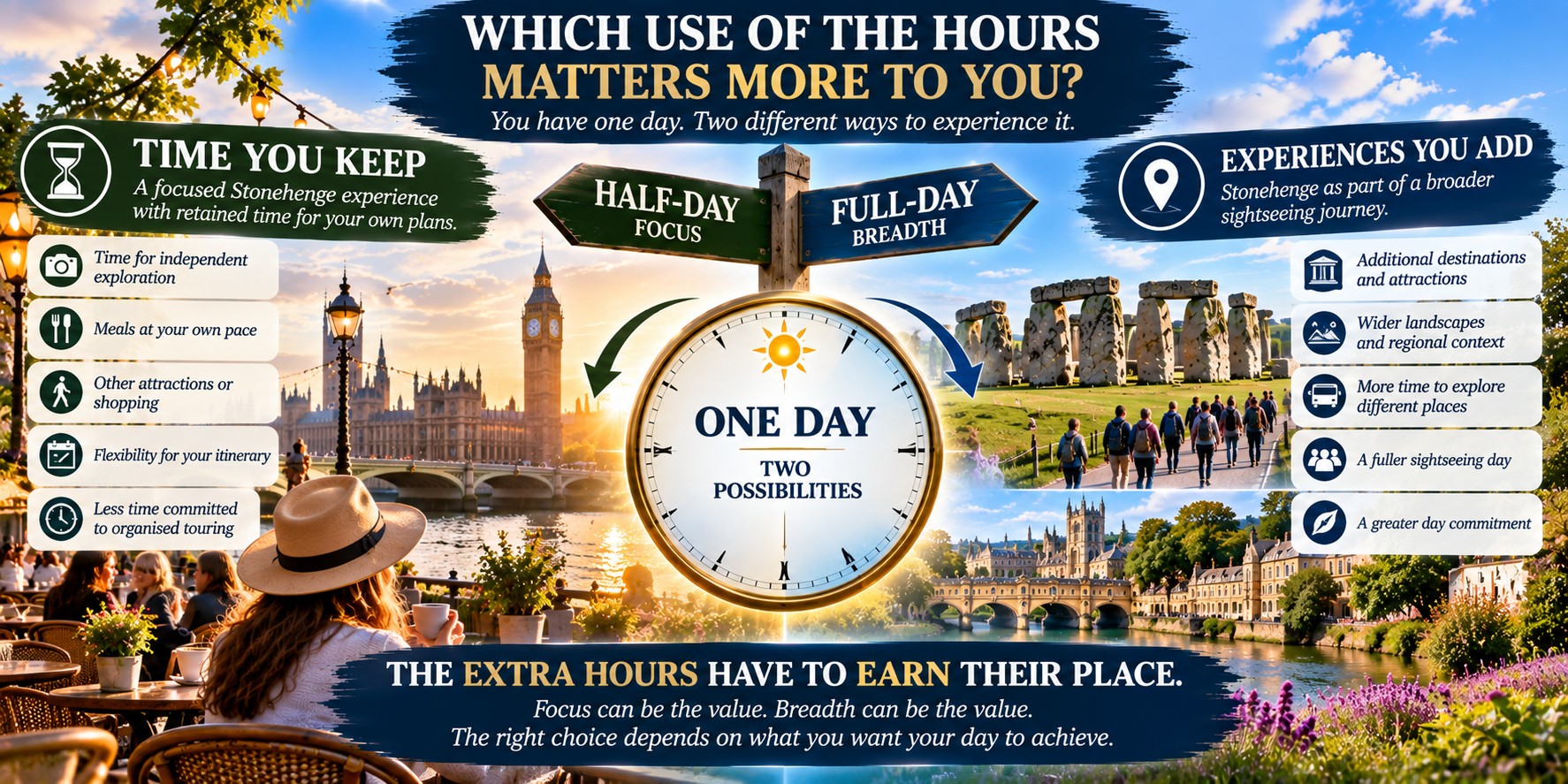
A focused Stonehenge experience can preserve valuable time for your own plans, while a broader touring day can add sightseeing, regional context and an organised journey. The extra hours earn their place when those additional experiences genuinely matter to you
→
PURPOSE
→
ACTUAL ITINERARY
→
EXTRA STOPS
→
TRAVEL & TRANSITIONS
→
PACE
→
OPPORTUNITY COST
🌱 Responsible Touring: Make the Day Count, Not Just the Stops
Responsible travel is not simply about choosing the shortest journey or visiting the fewest places. It is also about making thoughtful choices about how you travel and how you experience the places you visit.
Stonehenge is an internationally significant heritage landscape, and visiting responsibly begins with respecting the site, following current visitor guidance and treating shared spaces considerately.
It can also influence how you think about your itinerary.
There is little value in accumulating attractions simply to increase the number of places visited. A coherent day built around experiences you genuinely care about can be more rewarding than an itinerary filled with stops that receive little meaningful attention.
That does not mean a broader full-day journey is inherently less responsible. A well-designed touring day may bring together several experiences efficiently and reduce the need to organise separate journeys. Equally, a focused visit may avoid unnecessary movement when Stonehenge is the only place you really want to experience.
The useful principle is the same one that applies throughout this comparison:
Make the day count rather than simply counting the stops.
❓FAQs: Stonehenge Half-Day vs Full-Day Tours
❓ Is a Half-Day Enough for Stonehenge?
It can be. The important question is not whether a tour carries a half-day label but whether its actual itinerary provides the Stonehenge experience you want.
A shorter overall tour should not automatically be treated as an incomplete visit. Compare what the experience contains rather than judging it by total duration alone.
❓ Does a Full-Day Tour Give You More Time at Stonehenge?
Not necessarily. A full-day tour is longer overall, but the additional time may be used for travel, other destinations or other elements of the itinerary.
If time at Stonehenge is particularly important to you, examine how the individual tour is structured rather than assuming that the longest overall itinerary provides the longest Stonehenge experience.
❓ Are Half-Day Stonehenge Tours Only for Travellers Short on Time?
No. A traveller with an entirely free day may still prefer a focused Stonehenge experience and use the remaining time independently.
Flexibility can be a positive choice rather than a consequence of having insufficient time.
❓ Is a Full-Day Tour Better for First-Time Visitors?
Not automatically. Being a first-time visitor does not determine whether focus or breadth will suit you better.
A first-time visitor primarily interested in Stonehenge may prefer a focused experience. Another may want Stonehenge to form part of a broader sightseeing day. The itinerary and the traveller’s priorities matter more than first-time status alone.
❓ Should I Choose the Tour with the Most Attractions Included?
Only if those attractions are places you genuinely want to experience.
A longer list of stops can look attractive when comparing itineraries, but every additional destination uses time and usually adds movement or structure to the day. Judge an itinerary by the relevance and quality of the experiences it contains, not simply their number.
A useful final check is to ask whether you would still want to visit those additional places if they were not packaged with Stonehenge. If you would, the combination may genuinely improve your day. If you would not, the number of included attractions is a weak reason to commit additional time.
❓ What If Two Stonehenge Tours Are Both Described as Full-Day?
Compare what happens within the day.
Look at the overall itinerary, how travel fits into it, the additional stops, the likely pace, the type of Stonehenge experience offered and how closely the complete journey matches your priorities.
The shared “full-day” description does not make two experiences equivalent.
🌅 Choose the Experience That Makes the Best Use of Your Day
The half-day versus full-day decision becomes much easier once you stop treating duration as a measure of quality.
A half-day experience is not automatically rushed, inadequate or inferior because it occupies less of your day. A full-day experience is not automatically deeper or better value because it occupies more.
Instead, work through the decision in order:
TIME → PRIORITY → FOCUS OR BREADTH → PACE → ITINERARY CONTENT → PERSONAL VALUE → DECISION
Start with the time you genuinely want to commit. Decide whether Stonehenge itself is the objective or part of a wider sightseeing ambition. Consider the pace you enjoy, examine what the itinerary actually contains and give proper value to the time you would retain by choosing the shorter alternative.
Then ask the question that matters most: Which option creates the day I would actually prefer to have?
For one traveller, that may mean experiencing Stonehenge and keeping substantial time free for independent plans. For another, it may mean committing the whole day because the additional experiences are an important part of the journey.
Both can be excellent choices.
Once you know which of those days you want, compare tours within that category on their actual itinerary, format and access rather than returning to duration alone. That turns a vague choice between “shorter” and “longer” into a much more useful decision about the experience you genuinely want to book.