


Stonehenge with Kids During the Summer Holidays: Top Tips for Families (2026 Guide)
5th August 2026
🏛️ Stonehenge with Kids During the Summer Holidays: Top Tips for Families (2026 Guide)

Stonehenge is a place where children naturally begin asking questions. With a little preparation and a relaxed pace, a summer family visit can become one of the most memorable days of your holiday
Planning Stonehenge with kids during the Summer Holidays often begins with one very practical question: will everyone genuinely enjoy the day?
Stonehenge may appear, at first glance, to be a historic attraction designed mainly for adults. Parents sometimes worry that younger visitors will lose interest quickly, struggle with the summer heat or find the experience too abstract. In reality, children often respond to Stonehenge in a completely different way from adults—and that difference can make a family visit especially rewarding.
Adults may arrive thinking about archaeology, chronology and UNESCO World Heritage status. Children are more likely to notice the enormous scale of the stones, the wide-open landscape and the mystery of how people moved and raised such heavy blocks without modern lifting machinery. They ask direct questions, invent their own explanations and notice details that adults may overlook.
Stonehenge rewards curiosity far more than prior knowledge.
The best family visits do not expect children to experience the monument like adults. They give younger visitors space to explore it in their own way, whether that means asking how the stones were moved, imagining prehistoric life, spotting different shapes or simply enjoying the sense of being outdoors together.
The Summer Holidays are also one of the most practical periods for many families to plan a visit. Schools are closed, daylight hours are longer and Stonehenge can be combined with Salisbury, Bath, Windsor or another destination within a wider southern England itinerary. Higher seasonal demand, limited natural shade and changing attention levels still require preparation, but none of these challenges is difficult to manage when the day is planned around the needs of the family.
This guide explains how to prepare, what different age groups may enjoy, how to keep children engaged, when to pause for breaks and whether a guided tour or independent visit is likely to suit you best.
It also covers summer comfort, family facilities, typical visit length and the practical decisions that can turn an ambitious itinerary into a genuinely enjoyable day out.
The central principle is simple:
👨👩👧👦 Stonehenge Family Visitor Snapshot
Stonehenge is one of Britain’s most rewarding family attractions. During the Summer Holidays, longer daylight hours, open landscapes and plenty of opportunities for curiosity and discovery make it an enjoyable experience for children of all ages. A little preparation helps everyone relax and enjoy the day together.
| Family Question | Quick Answer |
|---|---|
| 👧 Is it suitable for children? | Yes. Children are often fascinated by the enormous stones, the mystery of their construction and the wide-open prehistoric landscape. |
| ⏱️ How long should we allow? | Around two to three hours usually provides enough time to explore comfortably without feeling rushed. |
| ☀️ Is summer a good time to visit? | Absolutely. Longer days make family visits easier, although sensible planning for warm weather is recommended. |
| 🎒 What helps most? | Comfortable shoes, drinks, snacks, flexible planning and allowing children time to explore at their own pace. |
| 😊 What do children enjoy most? | Asking questions, imagining prehistoric life, discovering the visitor centre and experiencing the monument together as a family. |
💡 Family Visits Work Best at a Child’s Pace
Children rarely remember a day because they learned every historical fact. They remember the excitement of seeing the stones for the first time, asking unexpected questions and sharing discoveries together. Allowing curiosity to lead the visit often creates the happiest family memories.
🧠 Why Children Often Experience Stonehenge Differently
Adults often arrive at Stonehenge looking for historical answers. Children usually arrive with endless questions. That natural curiosity is one of the reasons families so often discover that younger visitors become fascinated by the monument in ways they never expected.
| Adults Often Notice… | Children Often Notice… |
|---|---|
| 🏛️ Archaeology and history | 🪨 The enormous size of the stones |
| 📖 Historical facts and dates | ❓ Questions about how the stones were moved |
| 🌍 UNESCO World Heritage status | 🌿 The wide-open prehistoric landscape |
| 🧭 Ancient civilisation | 🏠 How prehistoric families may have lived |
| 🔬 Accepted archaeological theories | 💭 Their own imaginative explanations |
💡 Curiosity Is More Important Than Knowing the Answers
Families do not need to explain every archaeological theory during their visit. Some of the best conversations begin with simple questions like “How do you think they moved those stones?” or “Why do you think they built it here?” Encouraging children to wonder first and discover together often creates far more memorable experiences than trying to teach every historical detail.
👨👩👧👦 Why Stonehenge Captures Children’s Imaginations
Adults often arrive at Stonehenge looking for answers. Children usually arrive with questions.
That contrast shapes the whole family experience. Younger visitors may not understand every archaeological theory, but they instinctively recognise that the stones are extraordinary. Their size, age and unexplained purpose create an immediate sense of wonder that no lengthy history lesson is required to produce.
Stonehenge also rewards curiosity because so many questions remain unanswered. Instead of presenting children with a finished story, it invites them to imagine how prehistoric people moved enormous stones, why the monument was built and what life on Salisbury Plain may have been like thousands of years ago.
Stonehenge becomes far more engaging when children are encouraged to form ideas first, then compare them with the archaeological interpretation presented at the visitor centre. This turns the visit into a shared investigation rather than a one-way explanation, giving younger visitors an active role in discovering the monument.
Different ages often connect with different parts of the experience. Very young children may respond to the size of the stones and the open landscape. Primary-age children often enjoy the reconstructed Neolithic houses, building questions and prehistoric stories. Older children may become interested in archaeology, engineering and the movement of heavy materials, while teenagers frequently appreciate photography, cultural significance and the wider World Heritage landscape.
📊 What Different Age Groups Often Enjoy
| Age Group | Typical Points of Interest |
|---|---|
| Under 5 | Enormous stones, open space, movement and simple stories |
| Ages 5–8 | Mystery, reconstructed Neolithic houses and imaginative questions |
| Ages 9–12 | Construction methods, archaeology and prehistoric engineering |
| Teenagers | Photography, heritage, landscape and competing historical theories |
These are broad patterns rather than fixed rules. A younger child may become fascinated by engineering, while a teenager may simply enjoy the atmosphere and photography. The aim is not to decide in advance what children should find interesting, but to notice what captures their attention once the visit begins.
Stonehenge also creates a rare opportunity for the whole family to experience the same place together. Adults and children follow the same route, see the same monument and contribute their own questions to the conversation. That shared perspective is one reason the visit often feels more memorable than an attraction divided into separate adult and children’s activities.

Children don’t need to understand every archaeological theory to enjoy Stonehenge. Its enormous stones, fascinating mysteries and open landscape naturally inspire curiosity, imagination and shared family conversations
🎒 How to Prepare for Stonehenge with Kids
A successful family visit usually begins before the journey starts.
The practical details may seem small, but confirming tickets, checking the weather, downloading booking information and keeping the day realistic can remove much of the pressure that parents otherwise feel during busy summer travel.
One of the most common mistakes families make during the Summer Holidays is trying to fit too much into a single day. Stonehenge deserves more than being treated as a brief stop between several major attractions. While it can certainly form part of a wider itinerary, allowing enough time for children to explore naturally usually creates a far more enjoyable experience than constantly watching the clock.
Packing thoughtfully also helps the day run more smoothly.
Comfortable walking shoes are essential, as families will spend time both at the visitor centre and around the monument itself. Lightweight clothing works well during warmer weather, but layers remain the most practical choice because conditions on Salisbury Plain can change quickly. A light waterproof jacket takes up very little room and is often appreciated if a summer shower appears unexpectedly.
Because there is very little natural shade around the monument, carrying sufficient drinking water should be one of the day’s priorities. Hats, sunscreen and sunglasses all help children remain comfortable during warmer periods, while a few familiar snacks can be useful during planned refreshment breaks.
Technology can also help reduce stress.
Keeping booking confirmations available on your phone, carrying a portable charger and checking your planned route before leaving all make the journey considerably easier, particularly if you are visiting during one of the busier periods of the Summer Holidays.
Perhaps the most important preparation, however, is setting realistic expectations.
Children rarely judge a day by how many attractions they visited or whether everything happened exactly on schedule. They are much more likely to remember asking an unexpected question, discovering something fascinating or simply spending relaxed time outdoors with their family. Allowing room for those moments often produces the happiest memories.
🎒 Family Essentials Before You Leave
A little preparation before setting off can make your Stonehenge family day far more relaxed. Most of these essentials take only a few minutes to organise but help avoid unnecessary stress during the busy Summer Holidays.
| ✔️ Essential | Why It Matters |
|---|---|
| 🎟️ Confirm Your Booking | Have tickets or tour confirmations ready before you travel to avoid delays on arrival. |
| 🌤️ Check the Weather | Summer conditions can change quickly on Salisbury Plain, so dress in lightweight layers and pack a waterproof if needed. |
| 💧 Pack Water & Snacks | Keeping children hydrated and refreshed helps everyone stay comfortable throughout the visit. |
| 🧢 Bring Sun Protection | Hats, sunscreen and sunglasses are recommended as there is very little natural shade around the monument. |
| 👟 Wear Comfortable Shoes | Families spend more time walking than many first-time visitors expect. |
| 📱 Keep Your Phone Charged | Booking confirmations, maps and photographs all become much easier with a fully charged phone or portable charger. |
| ⏰ Keep the Day Flexible | Allow extra time for breaks, questions and unexpected discoveries instead of rushing between attractions. |
💡 Preparation Creates Better Family Memories
Children rarely remember whether everything ran exactly to schedule. They remember exploring together, asking fascinating questions and enjoying the adventure as a family. A little preparation before you leave home allows everyone to focus on discovering Stonehenge rather than worrying about the practical details.
🚗 Arriving at Stonehenge
The first few minutes after arriving often determine the pace of the entire visit.
Rather than heading immediately towards the stones, give everyone an opportunity to settle in. Children who have spent time travelling often appreciate stretching their legs, visiting the facilities and taking in their surroundings before beginning to explore the monument itself.
The visitor centre plays an important role in that introduction.
Its exhibitions, displays and reconstructed Neolithic houses help place Stonehenge within the wider story of prehistoric Britain. For many children, seeing how people may have lived thousands of years ago provides an immediate connection with the landscape long before the stones themselves come into view. It changes Stonehenge from an isolated monument into part of a much bigger story.
Families can normally choose to use the visitor transport provided or walk through the surrounding landscape towards the monument, depending on current site arrangements, weather conditions and the ages of the children in their group. Neither option is automatically better. Some younger visitors enjoy watching the stones gradually appear across Salisbury Plain, while others prefer to conserve their energy until they reach the monument itself.
Whatever approach you choose, resist the temptation to hurry.
A calm start almost always leads to a calmer day.
🔍 Five Ways to Keep Children Curious at Stonehenge
Children usually engage most deeply when they are encouraged to investigate Stonehenge rather than simply listen to explanations. These simple prompts turn the visit into a shared family discovery.
① Ask Questions Before Giving Answers
Invite children to share their own ideas first. Questions such as “How do you think the stones were moved?” or “Why might people have built Stonehenge here?” encourage imagination and active thinking.
② Compare the Stones
Look for differences in height, shape, colour and texture. Ask which stone appears tallest, widest or most unusual and encourage children to explain what they notice.
③ Imagine Prehistoric Family Life
Use the reconstructed Neolithic houses to discuss where families may have slept, how meals were prepared and what work children might have helped with thousands of years ago.
④ Explore the Wider Landscape
Encourage children to notice the grassland, earthworks, weather, birds and changing views around the monument. This helps them understand that Stonehenge belongs to a much larger prehistoric landscape.
⑤ Follow Their Interests
Some children will focus on engineering, others on stories, photography, wildlife or the open space. Let their curiosity shape part of the visit instead of expecting every family member to enjoy Stonehenge in the same way.
💡 Curiosity Is the Activity
Families do not need elaborate games or worksheets to make Stonehenge engaging. The monument already provides the mystery. By asking open questions, noticing details and allowing children to form their own ideas, parents can turn the visit into a memorable shared investigation.
🏡 Keeping Children Curious Throughout the Visit
One of the biggest advantages of Stonehenge is that it naturally encourages conversation.
Parents do not need to become tour guides or history teachers for children to enjoy the experience. In fact, younger visitors often become far more engaged when they are encouraged to notice details, ask questions and develop their own ideas before learning what archaeologists believe today.
Simple observations can lead to memorable discussions.
Ask children which stone they think is the tallest. Can they spot stones that look different from the others? Why do they think people chose this particular landscape? How long might it have taken to move one enormous stone across the countryside without modern machinery?
There are no perfect answers.
That uncertainty is part of what has fascinated visitors for centuries.
The reconstructed Neolithic houses provide another excellent opportunity to bring prehistoric Britain to life. Rather than asking children to memorise facts, encourage them to imagine daily life thousands of years ago. Where would families have slept? How might meals have been prepared? What jobs would children have helped with? Those conversations often help younger visitors understand that Stonehenge was created by real communities rather than existing as an isolated monument.
As you continue around the public viewing route, encourage children to look beyond the stones themselves.
Notice the rolling landscape, changing skies and surrounding earthworks. Listen for birdsong or the wind across Salisbury Plain. These details help children understand that Stonehenge forms part of a much larger prehistoric landscape, not simply a single monument standing alone.
Children also have different attention spans.
Some may spend a long time studying every stone, while others become interested for a shorter period before their attention moves elsewhere. Both responses are perfectly natural. A successful family visit adapts to children’s curiosity rather than trying to force it into a timetable.
🚗 A Relaxed Arrival Sets the Tone for the Whole Day
The first few minutes after arriving at Stonehenge often shape the entire family experience. Rather than rushing towards the monument, take time to settle in, allowing everyone to begin the day feeling relaxed and ready to explore.
| Arrival Step | Why It Helps Families |
|---|---|
| 🚻 Start at the Visitor Centre | Use the facilities, stretch your legs and allow children to adjust after the journey before heading to the monument. |
| 🏡 Explore the Exhibitions | The visitor centre and reconstructed Neolithic houses introduce children to prehistoric life before they see the stones. |
| 🚶 Choose Your Route Calmly | Whether walking or using the visitor transport, there’s no need to hurry. Let the excitement build naturally. |
| 💧 Check Everyone Is Comfortable | A quick drink, hats on and sunscreen applied before leaving the visitor centre can make the rest of the visit much more enjoyable. |
| 😊 Let Curiosity Lead | Encourage children to look around, ask questions and notice the landscape before focusing on historical facts. |
💡 Don’t Rush to the Stones
Many families naturally head straight towards the monument, but taking a few extra minutes at the visitor centre often creates a much more relaxed day. Children arrive at the stone circle feeling refreshed, engaged and ready to explore, making the experience more enjoyable for everyone.
🔍 Five Simple Ways to Spark Curiosity
- Ask questions instead of giving all the answers.
- Compare the size and shape of different stones.
- Imagine how prehistoric families lived.
- Look beyond the monument to the wider landscape.
- Celebrate curiosity rather than trying to remember every fact.
☀️ Summer Comfort Tips for Families
Summer brings some of the year’s longest and brightest days, making the school holiday period an excellent time to explore Stonehenge as a family.
It also brings a few practical considerations.
Because the monument stands within the open landscape of Salisbury Plain, natural shade is limited once you leave the visitor centre. On warmer days, children may spend longer outdoors than they realise, making sensible preparation an important part of a successful visit.
Before heading towards the monument, make sure everyone has sufficient drinking water and appropriate sun protection. Lightweight clothing, hats and sunscreen will usually provide the greatest comfort, while a light waterproof layer remains worthwhile because British summer weather can change surprisingly quickly.
Just as importantly, allow the day to follow a comfortable rhythm.
Children often enjoy Stonehenge much more when there is time to pause for a drink, enjoy the surroundings or simply sit quietly for a few minutes before continuing. Short breaks help maintain enthusiasm throughout the visit and reduce the likelihood of tiredness overshadowing the experience.

A little preparation goes a long way. Packing a few family essentials helps everyone stay comfortable, relaxed and ready to enjoy an unforgettable day exploring Stonehenge together
☀️ Keep the Whole Family Comfortable This Summer
Warm summer days make Stonehenge a wonderful place to explore, but a little forward planning helps everyone stay comfortable from arrival to departure. Small adjustments throughout the day often make the biggest difference, especially for younger children.
| ☀️ Comfort Tip | Why It Helps |
|---|---|
| 💧 Stay Hydrated | Carry water for every family member and encourage children to drink regularly throughout the visit. |
| 🧢 Protect Against the Sun | Wide-brimmed hats, sunscreen and sunglasses are particularly useful, as the landscape around the stone circle offers very little natural shade. |
| 👕 Dress in Layers | Even during summer, conditions on Salisbury Plain can change quickly. Lightweight layers help everyone stay comfortable. |
| 🍎 Take Regular Breaks | Short pauses for snacks, drinks or simply sitting down help children maintain their energy and enthusiasm. |
| 😊 Keep a Relaxed Pace | Allow plenty of time for questions, photographs and unexpected discoveries instead of trying to fit everything into a strict timetable. |
💡 Comfortable Children Stay Curious
The best family visits aren’t measured by how much ground you cover—they’re remembered because everyone enjoyed the experience together. Keeping children comfortable, well rested and unhurried allows curiosity to flourish and makes exploring Stonehenge a far more rewarding adventure for the whole family.
🍽️ Refreshments, Breaks and Enjoying the Day at Your Family’s Pace
One of the simplest ways to improve a family visit to Stonehenge is to remember that there is no need to rush.
Children rarely measure a successful day by how many places they visited. They are much more likely to remember spotting something unexpected, asking an interesting question or enjoying time together outdoors. Building a little flexibility into your plans allows those moments to happen naturally.
The visitor centre provides an ideal opportunity to pause.
Whether you stop for refreshments, take advantage of the facilities or simply spend a few quiet minutes together before continuing, these short breaks often help younger visitors recharge. Families sometimes feel pressure to keep moving throughout the day, but a relaxed pace usually creates a far more enjoyable experience than constantly watching the time.
It is also worth remembering that every child is different.
Some children will happily spend a long time examining the stones from different viewpoints, while others may be more interested in the reconstructed Neolithic houses, the exhibition or simply watching the landscape around them. Rather than encouraging everyone to enjoy Stonehenge in exactly the same way, allow each child to discover the parts that interest them most.
If you are combining Stonehenge with other attractions, try not to overload the day.
A carefully planned itinerary with one or two memorable destinations is often more enjoyable than trying to fit in several major attractions before everyone becomes tired. Leaving space for unexpected discoveries, longer conversations and spontaneous breaks usually creates the strongest family memories.
⏱️ A Comfortable Family Rhythm
A typical family visit might naturally flow like this:
- Arrive and settle in at the visitor centre.
- Explore the exhibition and reconstructed Neolithic houses.
- Travel or walk to the monument.
- Take time to enjoy the stones and surrounding landscape.
- Pause for refreshments before continuing your journey.
There is no single “correct” timetable.
The best family day is the one that feels relaxed from beginning to end.
😊 A Relaxed Family Visit Works Best
One of the biggest advantages of visiting Stonehenge as a family is that there is no need to rush. Building in time for breaks, refreshments and spontaneous discoveries creates a far more enjoyable experience than trying to follow a strict timetable.
| Stage of Your Visit | Family-Friendly Approach |
|---|---|
| 🚗 Arrival | Take a few minutes to settle in, visit the facilities and let everyone prepare for the adventure ahead. |
| 🏡 Visitor Centre | Explore the exhibitions and reconstructed Neolithic houses before heading to the stone circle. |
| 🪨 Stone Circle | Allow children to ask questions, take photographs and enjoy the atmosphere without feeling hurried. |
| 🍽️ Refreshment Break | Pause for drinks or snacks before energy levels begin to drop, helping everyone stay happy and engaged. |
| 🌿 Journey Home | Talk about favourite discoveries and memorable moments while the day’s experiences are still fresh in everyone’s mind. |
💡 Slow Down and Let the Day Unfold Naturally
Families often discover that the most memorable moments happen between the planned activities—a child’s unexpected question, a favourite view of the stones or a shared laugh over lunch. By keeping the day flexible rather than tightly scheduled, you give everyone the freedom to enjoy Stonehenge in their own way and create lasting family memories.
🚌 Should Families Choose a Tour or Visit Independently?
Another decision many parents face during the Summer Holidays is whether to book an organised tour or visit Stonehenge independently.
Both approaches can provide an excellent family day out, and the right choice depends largely on your children’s ages, your wider holiday plans and the style of travel you enjoy most.
For many families, guided tours remove much of the practical pressure. Transport, navigation and parking are all taken care of, allowing parents to focus on enjoying the day rather than driving through unfamiliar roads or managing busy holiday traffic. Many tours also combine Stonehenge with destinations such as Bath, Windsor or Oxford, making good use of the longer summer days while providing guided commentary and historical context throughout the journey.
These combination tours can work particularly well for families with older children who enjoy a full day of sightseeing.
Families with younger children, however, may sometimes find that a simpler itinerary with fewer destinations provides a more relaxed experience. A shorter day often allows more flexibility for breaks, refreshments and changing energy levels.
Independent visits offer a different type of freedom.
Parents can choose from available entry times, adjust the pace throughout the day and respond naturally if children want to spend longer exploring one area or need an unexpected break. The trade-off is that journey planning, parking and seasonal traffic all become part of your own responsibilities.
Neither approach is universally better.
Choose the one that allows your family to enjoy Stonehenge comfortably, confidently and without unnecessary pressure.
⚖️ Tour or Independent Visit — Which Is Best for Your Family?
There is no single “right” way to visit Stonehenge with children. The best choice depends on your family’s travel style, the ages of your children and how much planning you want to do yourself. Both options can provide a memorable family day out.
| 🚌 Guided Tour | 🚗 Independent Visit |
|---|---|
| Ideal For Families who prefer someone else to organise transport, timings and logistics. |
Ideal For Families who enjoy complete flexibility and travelling entirely at their own pace. |
| Benefits Less planning, professional guidance and a straightforward, stress-free day. |
Benefits Freedom to spend as much time as you wish at each part of the site and visitor centre. |
| Works Well If… You’re visiting from London, have limited time or simply want to relax and enjoy the experience. |
Works Well If… You’re already touring southern England or travelling with your own vehicle. |
| Family Experience Parents can spend more time sharing the experience with their children instead of managing the day’s logistics. |
Family Experience Children can explore at their own rhythm with complete flexibility for breaks, snacks and spontaneous discoveries. |
| Planning Required Minimal—most arrangements are taken care of in advance. |
Planning Required A little more preparation, but maximum flexibility throughout the day. |
💡 Choose the Option That Lets Your Family Relax
The most successful family visit is rarely about seeing everything as quickly as possible. Whether you choose a guided tour or travel independently, the goal is the same: giving everyone enough time to explore, ask questions and enjoy Stonehenge together. A relaxed family is far more likely to leave with lasting memories than one following a packed timetable.
✅ Practical Tips for a Successful Family Day
The most memorable family visits to Stonehenge rarely happen because every minute followed a carefully planned schedule.
They succeed because everyone has the opportunity to enjoy the day without feeling rushed.
Allow children to ask questions as they arise rather than trying to explain everything at once. Encourage them to notice the landscape as well as the monument, to imagine how people lived thousands of years ago and to discover the site at a pace that suits them. Stonehenge is a place where curiosity develops naturally, and allowing children to lead some of those conversations often creates the most rewarding moments.
It also helps to keep the wider itinerary realistic.
If you are planning to combine Stonehenge with other destinations, leave enough time between attractions for unexpected discoveries, refreshment breaks and changes of plan. Families who try to fit too much into one day often spend more time watching the clock than enjoying the places they have travelled to see.
A little preparation before leaving home also makes a noticeable difference.
Downloading booking confirmations, checking weather forecasts, allowing extra travel time during the Summer Holidays and carrying a portable phone charger all help remove unnecessary stress before the visit even begins.
📊 Family Planning Checklist
| Before You Leave | During Your Visit |
|---|---|
| Confirm tickets or tour booking | Encourage children to ask questions |
| Check weather and seasonal traffic | Explore at your family’s own pace |
| Pack water, planned snacks and sun protection | Visit the exhibition and Neolithic houses |
| Wear comfortable walking shoes | Take regular refreshment breaks |
| Keep booking confirmation accessible | Enjoy the wider landscape as well as the stones |
| Carry a portable phone charger | Leave time for unexpected discoveries |
Stonehenge has inspired families for generations.
Giving yourselves enough time to experience it properly is one of the simplest ways to ensure your visit becomes a lasting memory.
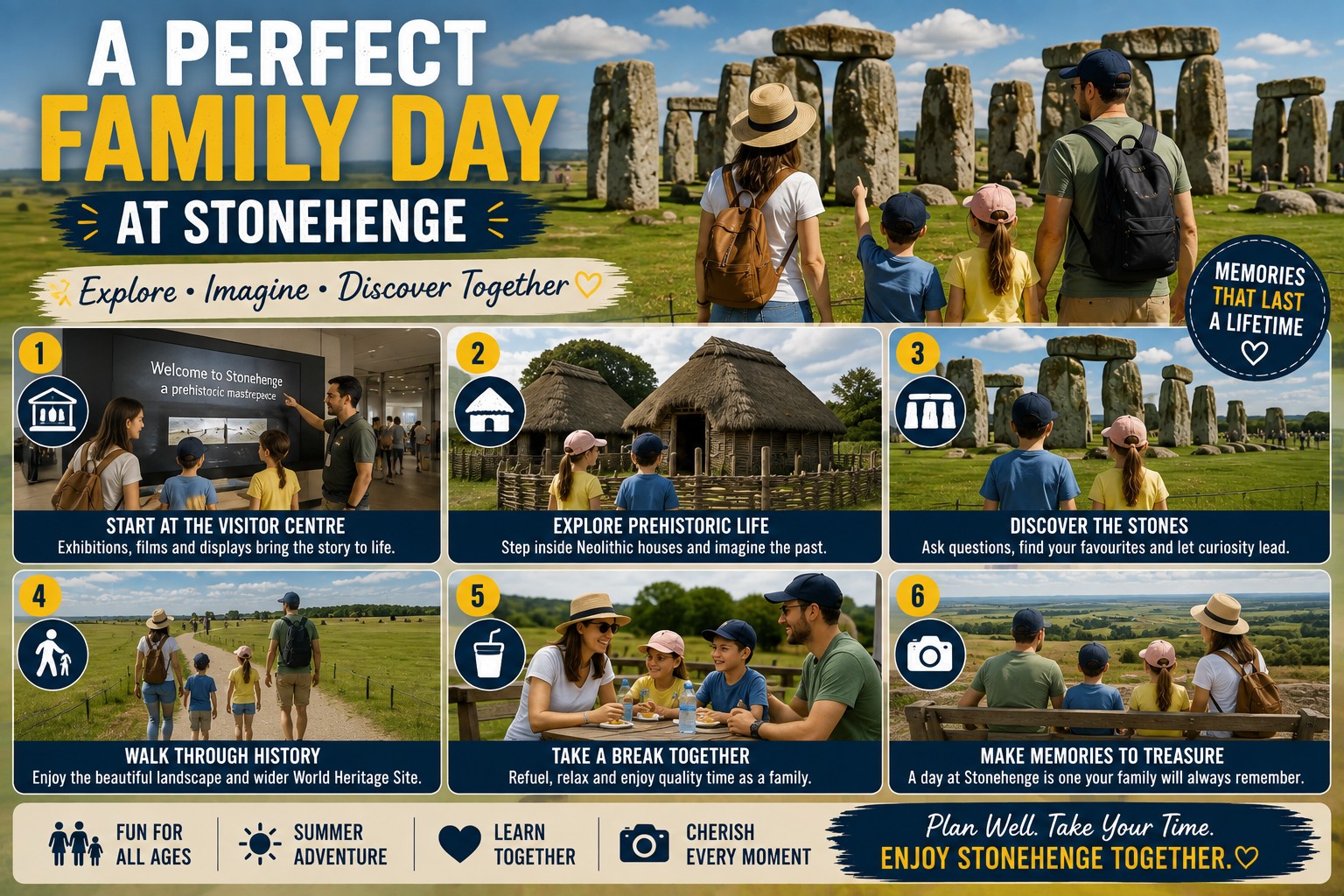
The best family visits to Stonehenge combine discovery, imagination and time together. From the visitor centre to the wider prehistoric landscape, every part of the experience helps create lasting memories
✅ Family Planning Checklist for a Great Stonehenge Day
Before your family heads to Stonehenge, take a moment to run through this simple checklist. A few minutes of preparation can make the day feel much more relaxed, allowing everyone to focus on exploring, learning and making memories together.
| ✔️ Final Check | Why It’s Worth Doing |
|---|---|
| 📅 Confirm Your Visit | Double-check tickets, opening times or tour arrangements before leaving home. |
| 🎒 Pack the Essentials | Water, snacks, sun protection, lightweight layers and comfortable footwear will help everyone stay happy throughout the day. |
| ⏰ Allow Plenty of Time | Avoid a rushed schedule so children have time to ask questions, explore and simply enjoy being there. |
| 📷 Capture the Memories | Take photographs, but also remember to pause and enjoy the experience together without constantly looking through a screen. |
| 😊 Follow Your Children’s Curiosity | The best conversations often begin with their questions, not the guidebook. Let their imagination shape part of the visit. |
| 🌿 Leave with Respect | Help children understand why this remarkable prehistoric landscape is protected so future generations can enjoy it too. |
💡 The Best Family Visits Aren’t the Fastest
A successful day at Stonehenge isn’t about seeing everything in the shortest possible time. It’s about creating shared experiences, encouraging curiosity and giving your family the freedom to explore together. When everyone leaves smiling and talking about what they’ve discovered, you’ve planned the day perfectly.
📅 Planning Around the BVT Stonehenge Inner Circle Access Calendar (2026–2027)
Most families visiting during the Summer Holidays will enjoy the standard daytime visitor experience.
However, some families—particularly those with older children, teenagers or a growing interest in archaeology, photography or Britain’s prehistoric heritage—may also wish to consider a different type of visit in the future.
Stonehenge Inner Circle Access offers authorised sunrise or sunset sessions that allow participants to enter the stone circle itself outside normal public opening hours. Instead of viewing the monument from the public pathway, visitors have the rare opportunity to stand among the ancient stones during carefully managed special-access visits.
This experience is not intended to replace a traditional daytime visit.
Instead, many families choose to see it as something to look forward to on a future holiday or return trip, when children are older or particularly interested in experiencing Stonehenge from a completely different perspective.
Because these special-access sessions take place only on selected dates, planning ahead is essential.
The easiest way to explore scheduled opportunities is by using the BVT Stonehenge Inner Circle Access Calendar (2026–2027), which brings together sunrise and sunset access dates in one convenient planning resource, helping families decide whether a future special-access visit could become part of a later holiday.
📅 Planning Around the BVT Stonehenge Inner Circle Access Calendar (2026–2027)
Many families enjoy their first visit to Stonehenge during the Summer Holidays and later decide they’d love to experience the monument from even closer. A special-access Stonehenge Inner Circle visit allows you to enter the stone circle itself outside normal opening hours, creating an unforgettable experience for older children, teenagers and adults with a deeper interest in Britain’s prehistoric past.
The BVT Stonehenge Inner Circle Access Calendar makes it easy to see available access dates throughout 2026 and 2027, helping you plan ahead for one of the UK’s most exclusive heritage experiences.
📅 View the Stonehenge Inner Circle Access Calendar
💡 A Wonderful Reason to Return
A family visit during the Summer Holidays often sparks a lifelong interest in Stonehenge. If your children leave asking more questions than they arrived with, an Inner Circle experience could become the perfect future adventure—offering the rare opportunity to stand among the ancient stones and see this extraordinary monument from a completely different perspective.
🗓️ Discover More Family Adventures with the Scotland Events Calendar
For many families, a memorable visit to Stonehenge is just the beginning of a much bigger journey discovering Britain’s history, landscapes and traditions.
If your children enjoy exploring ancient places, castles, historic cities and spectacular scenery, Scotland offers countless opportunities for future family holidays. Throughout the year, the country hosts Highland Games, family festivals, seasonal celebrations, cultural events and outdoor activities that appeal to visitors of every age.
The BVT Scotland Events Calendar provides a simple way to explore what’s happening across Scotland during every season, making it easier to plan another family adventure when the time is right.
Whether you are considering a weekend break or a longer touring holiday, it offers inspiration for future journeys while continuing the theme of discovering Britain’s remarkable heritage together.
🏴 Discover More Family Adventures with the Scotland Events Calendar
Has your family enjoyed discovering Stonehenge together? Scotland offers even more opportunities to inspire young explorers, from colourful Highland Games and world-famous festivals to wildlife encounters, historic castles, family-friendly events and spectacular landscapes throughout the year.
The BVT Scotland Events Calendar helps you plan your next UK family adventure by highlighting the best seasonal events and experiences across Scotland, making it easy to choose the perfect time to visit.
🏴 Explore the BVT Scotland Events Calendar
💡 Keep Your Family Adventure Growing
Many families discover that a visit to Stonehenge is only the beginning of a wider journey through Britain’s history and landscapes. Scotland provides countless opportunities for children to continue exploring ancient castles, Highland traditions, spectacular scenery and seasonal celebrations, turning one memorable day out into a lifetime of family adventures.
🌿 Teaching Children to Travel Responsibly
One of the greatest lessons children can take home from Stonehenge has nothing to do with archaeology.
It is learning how to care for places that have been treasured for thousands of years.
Stonehenge forms part of a remarkable UNESCO World Heritage Site, and every visitor plays a small role in helping protect it for future generations. Explaining this to children turns the visit into something more than sightseeing—it becomes an opportunity to understand why historic places deserve respect and careful stewardship.
Simple actions make a meaningful difference.
Encourage children to remain within designated visitor areas, follow site guidance, dispose of litter responsibly and treat the surrounding landscape with the same respect they would show in any important natural environment. Carrying reusable water bottles instead of relying on single-use plastics is another easy habit that benefits both the environment and future visitors.
Respect also extends to other people sharing the experience.
Waiting patiently for photographs, keeping noise to a considerate level and allowing everyone the opportunity to appreciate the monument helps create a welcoming atmosphere for visitors from around the world.
These lessons reach well beyond Stonehenge.
They encourage children to become thoughtful travellers who understand that preserving special places is a shared responsibility.
🌿 Teaching Children to Travel Responsibly
A visit to Stonehenge is more than a family day out—it’s an opportunity to help children understand why historic places are protected and how small actions today help preserve them for future generations.
| 🌱 Responsible Habit | Why It Matters |
|---|---|
| 🚶 Stay on Designated Paths | Protects the fragile prehistoric landscape and helps preserve important archaeological features beneath the ground. |
| 🗑️ Leave No Litter | Keeping the site clean ensures every visitor can enjoy the landscape exactly as it should be experienced. |
| 🤝 Respect Other Visitors | Sharing viewpoints, keeping noise to a reasonable level and being considerate helps everyone enjoy their visit. |
| 📖 Respect History | Encourage children to appreciate that Stonehenge has survived for thousands of years because generations have valued and protected it. |
| 💚 Be a Heritage Guardian | Simple actions today help ensure that future families can experience the same sense of wonder tomorrow. |
🌍 Travel with Purpose. Explore with Care.
The greatest souvenir children can take home from Stonehenge isn’t a photograph or a gift—it’s an appreciation of why places like this deserve care and respect. By travelling thoughtfully and setting a positive example, families help preserve one of Britain’s greatest prehistoric treasures for generations still to come.
❓ Frequently Asked Questions
❓ Is Stonehenge suitable for toddlers and young children?
Yes. Many families visit with younger children throughout the Summer Holidays. While toddlers may not understand the history, they are often fascinated by the size of the stones, the open landscape and the opportunity to explore outdoors at their own pace.
❓ Can I use a pushchair during my visit?
Many families visit with pushchairs. As this is an outdoor heritage site, suitability can vary depending on current routes, ground conditions and the weather. Before travelling, it is worth checking the latest accessibility information so you can plan the most comfortable visit for your family.
❓ How long should families allow?
Many families find that allowing around two to three hours provides enough time to enjoy the visitor centre, exhibitions, reconstructed Neolithic houses, the journey to the monument and the stones themselves without feeling rushed. Some families choose to stay longer, particularly if they are exploring the wider World Heritage landscape.
❓ Are toilets and baby-changing facilities available?
Yes. The visitor centre provides family facilities before you continue towards the monument. Taking advantage of these at the start of your visit often makes the rest of the day more comfortable, particularly for younger children.
❓ Is there somewhere to eat?
Yes. Refreshments are available at the visitor centre, making it easy for families to pause before or after exploring the monument. If you are planning a longer day out, nearby towns and villages also offer additional cafés, pubs and restaurants.
❓ Is there much shade during the Summer Holidays?
Natural shade around the monument itself is limited because Stonehenge stands within the open landscape of Salisbury Plain. During warmer weather, hats, sunscreen, lightweight clothing and plenty of drinking water are strongly recommended, particularly for younger children.
❓ Should we choose a guided tour or visit independently?
Both can provide an excellent family experience.
Guided tours remove much of the stress associated with driving, navigation and parking, while independent visits offer greater flexibility to adjust the day around your children’s pace and interests. The best choice depends on your family’s travel style, holiday plans and the type of day you want to enjoy.
❓ What should children wear?
Comfortable walking shoes, lightweight layered clothing, a hat, sunscreen and a light waterproof jacket are sensible choices for most summer visits. Dressing in layers makes it easier to adapt to Britain’s changeable summer weather.
❓ Is Stonehenge too busy during the Summer Holidays for families?
The Summer Holidays are naturally one of the busiest periods of the year, but that does not prevent families from having an excellent visit. Arriving with realistic expectations, allowing enough time and keeping the day flexible usually has a much greater influence on the experience than the number of other visitors.
📚 Continue Exploring Stonehenge with Your Family
Planning a family visit often leads to even more questions. Whether you’re deciding the best time of day to visit, wondering how busy Stonehenge becomes during the Summer Holidays or comparing it with other great family days out, these guides will help you continue planning with confidence.
🌅 Best Time of Day to Visit Stonehenge During the Summer Holidays
Discover when families can enjoy a more relaxed atmosphere, cooler temperatures and the best opportunities for sightseeing and photography during the busy summer season.
📖 Continue Reading
🚌 Are Stonehenge Tours Busier During the Summer Holidays?
Find out how the summer season affects visitor numbers, tour availability and planning, together with practical advice for choosing the right experience for your family.
📖 Continue Reading
🏰 Stonehenge or Windsor? Choosing the Best Day Out During the Summer Holidays
Compare two of southern England’s most popular attractions and discover which destination best suits your family’s interests, available time and style of holiday.
📖 Continue Reading
💡 Every Family Adventure Starts with the Next Question
The best trips rarely end with a single attraction. Each visit inspires new ideas, new destinations and fresh discoveries. Exploring these related guides will help you build an even richer Stonehenge itinerary while making the most of your family’s Summer Holiday adventure.
🏁 Final Thoughts
Visiting Stonehenge with kids during the Summer Holidays is not about keeping children entertained every minute of the day.
It is about giving them the opportunity to discover one of Britain’s most remarkable places in their own way.
Some children will be fascinated by the sheer size of the stones. Others will imagine prehistoric builders working together thousands of years ago. Some will ask endless questions, while others will simply enjoy walking across the ancient landscape with their family. Every child experiences Stonehenge differently, and that individuality is one of the monument’s greatest strengths.
Parents often arrive wondering whether Stonehenge will hold their children’s attention.
They usually leave remembering something quite different.
A thoughtful question asked by a young explorer.
A moment of quiet wonder as the stones first appear on the horizon.
A family conversation about how people achieved something extraordinary five thousand years ago.
Those shared discoveries often become the memories that last longest.
With a little preparation, realistic expectations and the confidence to let curiosity lead the way, Stonehenge can become one of the highlights of a family Summer Holiday. It offers history, imagination, outdoor exploration and genuine shared discovery in a setting unlike anywhere else in Britain.
The best Stonehenge family visits do not ask children to experience the monument like adults.
They give children the freedom to experience it as children.
For many parents, the next planning question naturally follows: When is the best time of day to visit Stonehenge during the Summer Holidays?
🧭 Continue Planning Your Family Stonehenge Adventure
Every family experiences Stonehenge differently. Some children are captivated by the mystery of how the stones were built, others love the open landscape or the reconstructed Neolithic homes, while parents often enjoy watching curiosity and imagination come alive. With a little planning, your visit can become one of those family days out that everyone remembers long after the journey home.
✨ Great Family Adventures Begin with Curiosity
The most memorable family visits are rarely measured by how much you manage to see—they’re remembered because of the questions asked, the discoveries shared and the moments experienced together. Stonehenge has inspired wonder for thousands of years, and with thoughtful planning, your family’s visit can become the beginning of a lifelong fascination with Britain’s remarkable history and landscapes.