


How to Choose the Best Month for Stonehenge Inner Circle Access (2026 Guide)
18th July 2026
🗓️ How to Choose the Best Month for Stonehenge Inner Circle Access (2026 Guide)
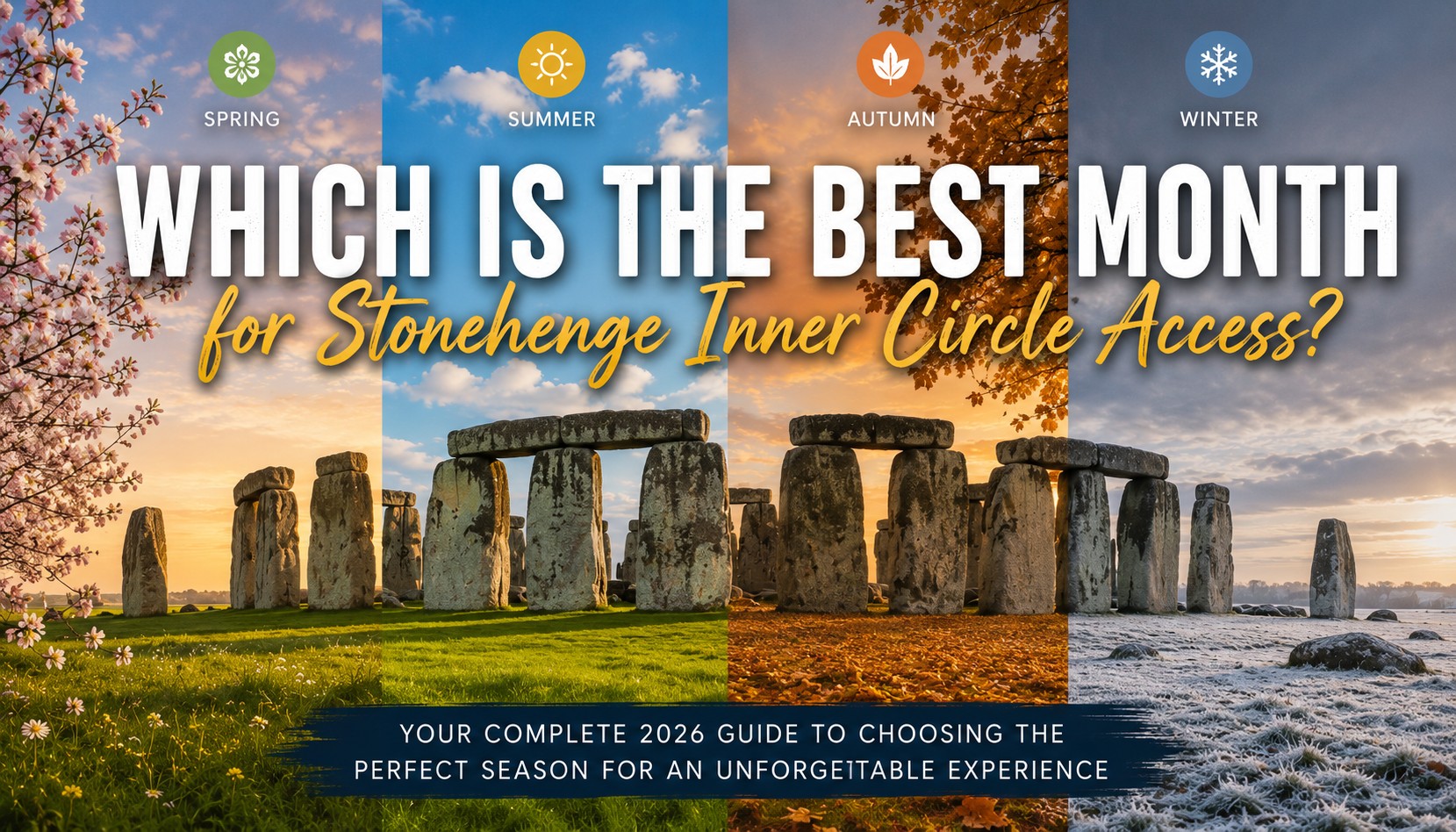
Every season offers a different Stonehenge experience. From the fresh colours of spring and the long days of summer to the rich tones of autumn and the dramatic atmosphere of winter, choosing the right month depends on the type of visit you want to enjoy
Planning a visit inside the ancient Stone Circle is unlike planning an ordinary sightseeing trip.
One of the biggest questions visitors ask is:
“What is the best month to experience Stonehenge Inner Circle Access?”
The answer is more nuanced than simply choosing the warmest weather or the busiest season.
Every month offers a different balance of daylight, atmosphere, photography opportunities, travel logistics and overall visitor experience. A sunrise visit in June feels completely different from a winter morning in January, while a peaceful September evening creates a very different atmosphere from a midsummer sunset.
Choosing the right month before choosing your specific access date is one of the smartest decisions you can make. It helps narrow your options, creates a smoother itinerary and often leads to a much more rewarding experience overall.
Whether you’re travelling from overseas, planning a once-in-a-lifetime holiday, celebrating a special occasion or simply hoping to experience Stonehenge at its most atmospheric, understanding how the year unfolds can make all the difference.
⚡ Quick Answer: What Is the Best Month for Stonehenge Inner Circle Access?
There is no single “best” month for every visitor, but there are months that often suit different travel priorities.
For many people, April, May and September provide one of the best overall balances of pleasant touring conditions, attractive seasonal scenery and practical travel planning. June and July offer the year’s longest daylight hours, making them appealing for visitors who want to maximise their time in southern England, while autumn and winter can provide quieter surroundings, distinctive seasonal light and a very different atmosphere inside the ancient stone circle.
The most important point is this:
Choose the month that best fits the experience you want first, then compare the available Inner Circle access dates within that month.
That simple change in planning approach often leads to a better overall trip.
❓ Why Does the Month Matter So Much?
To many first-time visitors, Stonehenge appears to be a destination that looks much the same throughout the year.
The monument itself may remain unchanged, but the experience around it certainly does not.
As the seasons progress, almost every aspect of a visit evolves.
Daylight hours increase and decrease dramatically.
Sunrise and sunset occur at very different times.
The colours across Salisbury Plain shift from the fresh greens of spring to the rich tones of autumn before giving way to the stark beauty of winter.
Weather conditions can feel entirely different from one month to the next, particularly across the exposed landscape surrounding the stones.
Even the rhythm of your day changes.
A midsummer sunrise experience may require an exceptionally early departure, while a winter sunrise can begin much later in the morning. Conversely, summer sunset sessions often lead to much later returns than visitors initially expect.
These practical differences matter just as much as the scenery.
Experienced travellers rarely begin by asking which date they should book.
Instead, they usually work through a simple planning sequence:
- Decide which months fit their wider holiday.
- Compare the advantages of those months.
- Choose whether a sunrise or sunset experience appeals most.
- Review the available Inner Circle sessions within their preferred month.
- Keep a realistic backup option if their first choice is unavailable.
Approaching the planning process this way is often far easier than searching through individual dates without any seasonal context.
Once you’ve selected the right month, our guide explains why beginning your planning with the Stonehenge Inner Circle Access Calendar makes every later decision easier.
🌅 How the Month Changes Your Experience
One of the biggest advantages of visiting Stonehenge through the year is that no two months feel exactly alike.
The changing seasons influence not only the appearance of the landscape but also the pace of the visit, the timing of your day and the overall atmosphere inside the stone circle.
Several factors are worth considering before choosing your preferred month.
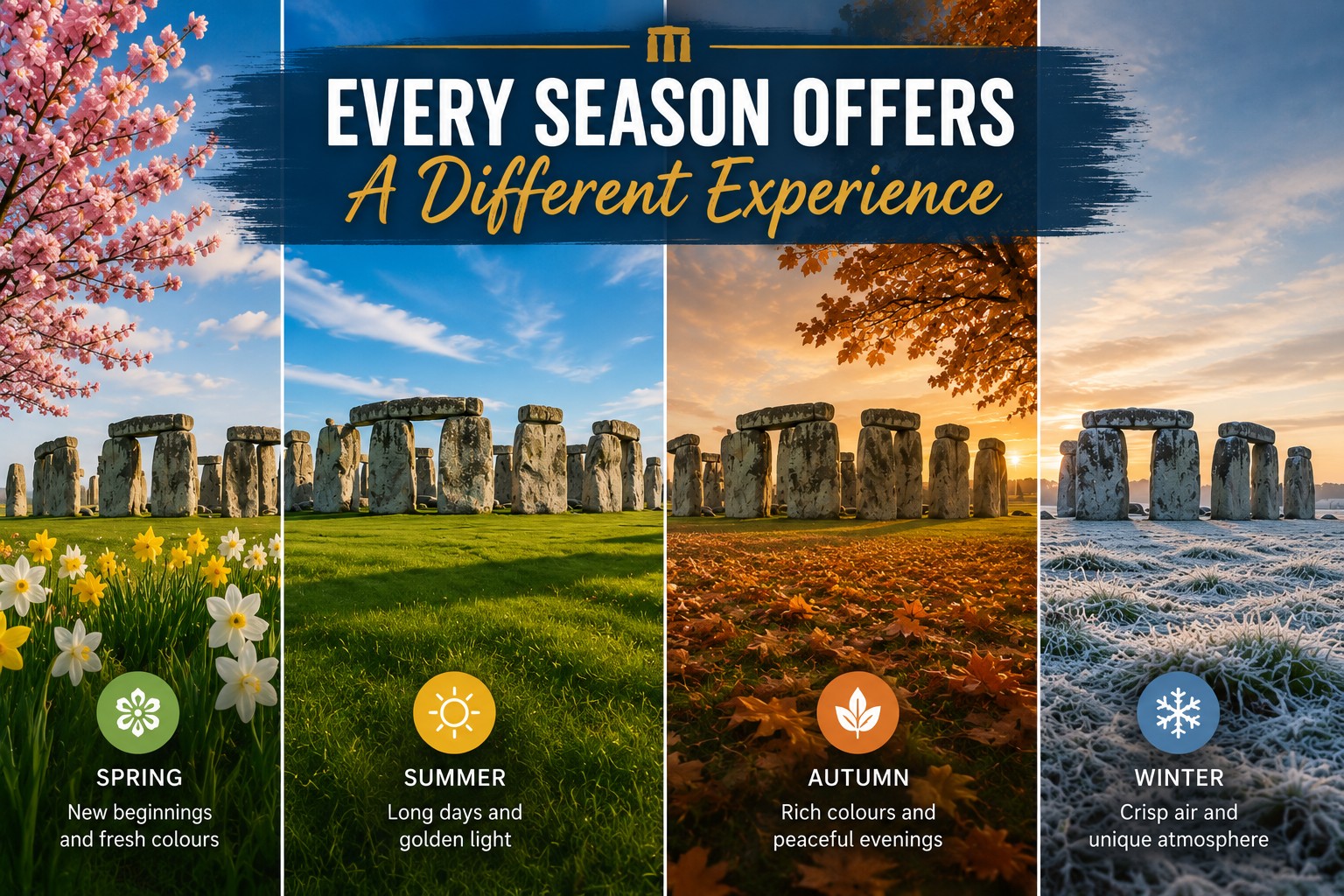
Stonehenge changes with every season. Spring brings fresh colour, summer offers long daylight hours, autumn creates rich golden scenery and winter provides dramatic light and a peaceful atmosphere. Each season offers its own unique Inner Circle experience
🌞 Daylight Hours
Long summer days create more opportunities to combine Stonehenge with other destinations such as Bath, Windsor or Oxford.
Spring and early autumn often provide a comfortable middle ground, with generous daylight that still allows for a relaxed touring schedule.
Winter, by contrast, offers much shorter days. While this can reduce the amount of daylight available for wider sightseeing, some visitors appreciate the simpler rhythm and the distinctive atmosphere created by lower seasonal light.
📸 Photography
The quality of light changes significantly throughout the year.
Spring introduces fresh colours and increasingly bright mornings.
Summer provides long periods of daylight and expansive evening skies.
Autumn often produces softer golden light and richer natural colours across the surrounding landscape.
Winter can create dramatic contrasts, with low-angle sunlight, crisp air and an altogether different mood around the monument.
No season guarantees perfect photography, but each offers its own distinctive character.
🚐 Travel Logistics
The month you choose also influences the practical shape of your day.
Long summer evenings may allow more flexibility for sightseeing, yet they can also mean very early departures for sunrise visits or late returns following sunset experiences.
During winter, sunrise occurs later, making early-morning access easier for some travellers, although the shorter days naturally reduce the amount of time available for additional touring afterwards.
These are practical considerations that are often overlooked when visitors focus only on the weather.
🌬️ Seasonal Conditions
Stonehenge stands on the open landscape of Salisbury Plain, where conditions can feel more exposed than many visitors anticipate.
Regardless of the month, it is sensible to prepare for changing weather, particularly if your visit involves an early morning or evening session.
Layered clothing, comfortable footwear and a degree of flexibility will usually contribute more to an enjoyable experience than trying to identify a supposedly “perfect” month.
Once you’ve narrowed your preferred season, explore how the Stonehenge Inner Circle sunrise changes throughout the year, revealing how the quality of light, atmosphere and landscape evolve from month to month.
🌸 March: A Season of Renewal and Changing Light
For visitors who enjoy watching the countryside emerge from winter, March offers a fascinating starting point to the Stonehenge year.
The landscape begins its gradual transformation as daylight steadily increases and the first signs of spring become more visible across Salisbury Plain. Conditions remain unpredictable, but that changing character is part of the month’s appeal.
March often suits travellers who appreciate quieter periods of the year and don’t mind preparing for cooler mornings.
It can also be an attractive choice for photographers looking to capture the monument beneath dramatic skies and lower seasonal light, where the changing weather frequently produces striking contrasts.
Although temperatures are generally cooler than later in spring, the increasing daylight begins to make broader touring across southern England more comfortable than during the depths of winter.
For many visitors, March represents the beginning of the year’s transition rather than the end of winter—a month that rewards flexibility with a distinctive atmosphere.
🌼 April: One of the Best All-Round Months
If many experienced travellers were asked to shortlist just a handful of months for Stonehenge Inner Circle Access, April would often appear near the top.
By this point, the countryside has become noticeably greener, daylight continues to lengthen and outdoor touring generally feels more comfortable than earlier in the year.
April offers an appealing balance.
The days are becoming longer without reaching the exceptionally early sunrise times associated with midsummer. Conditions are often well suited to visitors combining Stonehenge with other destinations, while the fresh colours of spring create an attractive backdrop for both sightseeing and photography.
Like every month, April can still bring variable weather, and visitors should be prepared for changing conditions on the exposed plain.
However, for travellers seeking a blend of practicality, seasonal beauty and itinerary flexibility, April is frequently one of the strongest all-round options.
🌿 May: Longer Days Without the Height of Summer
For many visitors, May represents one of the finest months of the entire year to experience Stonehenge Inner Circle Access.
It combines many of spring’s advantages with some of the longer daylight hours that make summer so attractive, yet without reaching the busiest part of the main holiday season.
The countryside surrounding Stonehenge is typically at its most vibrant, with Salisbury Plain displaying rich greens and abundant wildflowers. Longer evenings also create greater flexibility when planning wider itineraries that include destinations such as Bath, Windsor or Oxford.
One of May’s greatest strengths is balance.
The days are long enough to make touring comfortable, yet sunrise and sunset timings have not reached the extremes experienced closer to the Summer Solstice. For many visitors, this creates a more manageable schedule while still providing excellent opportunities for photography and sightseeing.
For first-time visitors travelling from overseas, May often provides an excellent compromise between practicality and atmosphere.
It is important to remember, however, that no month guarantees ideal weather. Salisbury Plain remains an exposed landscape where conditions can change quickly, so layered clothing and sensible preparation remain advisable regardless of the forecast.
If your priorities include comfortable touring, attractive seasonal scenery and a well-balanced itinerary, May is frequently one of the strongest months worth considering.
☀️ June: Maximum Daylight and Summer Solstice Considerations
June is unlike any other month at Stonehenge.
It brings the year’s longest daylight hours and an unmistakable sense of anticipation as the Summer Solstice approaches.
For many visitors, those exceptionally long days are one of June’s greatest attractions. They create opportunities to combine Stonehenge with several other destinations across southern England while still enjoying extended daylight well into the evening.
However, June also requires more careful planning than many people initially realise.
The period around the Summer Solstice is unique within the Stonehenge calendar. Public interest increases significantly, travel demand rises and access arrangements during this period may differ from the normal pattern of authorised Inner Circle sessions.
Rather than assuming that every June date operates in exactly the same way, visitors should always review the available access sessions for their preferred travel period before making wider holiday arrangements.
June also introduces another practical consideration that many first-time visitors overlook.
🌅 Exceptionally Early Sunrise Sessions
While the idea of watching the sun rise among the ancient stones is understandably appealing, midsummer sunrise experiences can involve very early departures.
Visitors should think beyond the moment inside the stone circle itself and consider the complete day.
Questions worth asking include:
- Are you comfortable with an exceptionally early start?
- Will you still want to continue touring afterwards?
- Would a sunset session better suit your travel style?
- Would another month provide a similar experience with a more relaxed schedule?
These practical considerations often become more important than the weather itself.
For travellers who value maximum daylight and enjoy the excitement surrounding one of Britain’s most celebrated prehistoric monuments, June remains a superb choice—but it rewards thoughtful planning.
🌞 July: Long Summer Days and Peak Holiday Travel
By July, summer is firmly established.
Long daylight hours continue to create excellent opportunities for touring, making it one of the most convenient months for visitors combining Stonehenge with other destinations across southern England.
For overseas travellers, July often fits naturally within longer UK holidays.
Families also frequently choose July because it aligns with school holiday periods in many countries, allowing Stonehenge to form part of a broader sightseeing itinerary.
The atmosphere during July is energetic.
Long evenings encourage extended exploration, while the surrounding countryside remains rich in colour.
From a planning perspective, however, July also demonstrates why choosing the right month involves more than simply selecting the warmest season.
Long summer evenings can also mean later finishes, particularly for visitors choosing sunset experiences.
Likewise, sunrise sessions continue to involve very early departures.
Neither is necessarily a disadvantage, but both should form part of your planning before selecting a specific date.
For visitors who prioritise long daylight, flexibility within their itinerary and a classic summer touring experience, July is often an excellent option.
👨👩👧 August: Ideal for Family Holidays
August continues many of the advantages offered by July while bringing its own distinctive travel patterns.
For families travelling during school holidays, August may simply be the most practical month available.
Long days still allow visitors to combine Stonehenge with nearby destinations, while the warmer season makes outdoor sightseeing particularly enjoyable for many travellers.
Families visiting England for the first time often appreciate how easily Stonehenge can be incorporated into a wider touring itinerary during August.
That said, practical planning remains important.
Accommodation, transport and popular attractions across southern England can all experience greater seasonal demand during the height of summer.
Rather than viewing this as a reason to avoid August, it is better understood as a reminder to organise travel arrangements well in advance.
Visitors should also remember that the longest daylight does not automatically create the easiest schedule.
Late-evening returns following sunset experiences and very early starts for sunrise visits may still influence which type of Inner Circle session best suits their holiday.
For many family groups, however, August remains one of the most convenient months in which to experience one of Britain’s most remarkable prehistoric monuments.
🔄 From Summer Into Autumn
If summer offers maximum daylight and extended touring opportunities, autumn introduces a different kind of appeal.
The pace begins to soften.
The colours across the landscape gradually change.
Many visitors discover that the balance between atmosphere, photography and practical travel becomes particularly attractive during the early autumn months.
For travellers who enjoy a calmer rhythm without losing many of the practical advantages of summer, the next stage of the year deserves especially careful consideration.
🍂 September: One of the Year’s Best All-Round Choices
If one month consistently appears on experienced travellers’ shortlists, September is often among the strongest contenders.
It successfully combines many of summer’s advantages with the gentler pace that arrives as autumn begins.
Long daylight hours still provide excellent opportunities for touring, yet the changing season introduces a noticeably different atmosphere across Salisbury Plain. The surrounding countryside begins its gradual transition towards autumn colours, while the lower angle of the sun often creates beautifully balanced natural light throughout the day.
For many visitors, September represents a sweet spot between practicality and atmosphere.
The longest summer evenings have begun to shorten, making both sunrise and sunset sessions feel more manageable within a day’s itinerary. At the same time, there is still ample daylight to combine Stonehenge with nearby destinations or enjoy a fuller day exploring southern England.
Photographers are particularly drawn to September because of the softer quality of the seasonal light. Rather than the bright intensity often associated with midsummer, September frequently offers warmer tones that complement the ancient stones beautifully.
For overseas visitors planning a once-in-a-lifetime trip, September can provide an excellent combination of comfortable touring conditions, attractive scenery and a slightly more relaxed pace than the height of summer.
It is one of the clearest examples of why the best month is not necessarily the warmest month, but the month that best supports the overall journey.
🍁 October: Rich Autumn Colour and Timeless Atmosphere
By October, the character of Stonehenge begins to change once again.
The countryside surrounding the monument takes on deeper autumn colours, daylight continues to shorten and the atmosphere becomes noticeably more reflective.
For many visitors, this quieter rhythm is precisely what makes October so appealing.
Rather than competing with the long, energetic days of midsummer, October offers something entirely different.
The lower position of the sun throughout the day often creates beautifully textured light across the stones, while the surrounding landscape develops the warm tones that many photographers associate with autumn travel.
October also encourages a slower pace.
Visitors frequently spend more time appreciating the monument itself rather than rushing between multiple attractions. That more measured approach often suits couples, photographers and travellers whose priority is the experience itself rather than fitting as many destinations as possible into a single day.
As with every month, preparation remains important.
Conditions across Salisbury Plain can change quickly, particularly during the morning and evening, so dressing in layers remains advisable.
For travellers seeking atmosphere, beautiful seasonal colour and a memorable sense of place, October is frequently one of the year’s most rewarding months.
🌫️ November: Quiet, Reflective and Distinctive
November is sometimes overlooked when people begin planning a Stonehenge visit.
That is a mistake.
Although daylight becomes noticeably shorter and temperatures continue to fall, November offers a calmness that many experienced travellers value highly.
The landscape becomes simpler.
The skies often appear broader.
The monument itself seems even more dominant within the open landscape of Salisbury Plain.
For visitors who appreciate history, archaeology and atmosphere, November can feel remarkably authentic.
Rather than expecting long days filled with multiple attractions, visitors often approach November with a different mindset.
The focus shifts from quantity to quality.
The experience becomes less about how many places can be visited and more about spending meaningful time at one of Britain’s most important prehistoric sites.
Practical planning is naturally important.
The shorter days mean that sunrise and sunset sessions influence the overall itinerary differently from summer, while weather conditions become increasingly changeable.
Visitors who prepare for these realities often discover that November provides an unexpectedly memorable experience.
❄️ December: Winter Solstice Season and Shortest Days
December introduces one of the year’s most distinctive atmospheres.
The days are at their shortest, temperatures are typically lower and the monument often feels dramatically different from its appearance during spring or summer.
The period around the Winter Solstice also holds particular significance in the annual Stonehenge calendar.
As with the Summer Solstice, visitors should recognise that this period has its own operational considerations and should always check authorised access arrangements before finalising travel plans.
Away from the Solstice itself, December can appeal to visitors seeking a quieter and more contemplative experience.
The lower winter light often creates striking visual contrasts across the ancient stones, while later sunrise times may be more manageable for travellers who prefer avoiding extremely early starts.
Although outdoor conditions require sensible preparation, December demonstrates that Stonehenge is not simply a summer destination.
Its character changes with the season, rewarding visitors who appreciate history, atmosphere and the changing rhythm of the landscape.
🧣 January: Peaceful and Undeniably Atmospheric
January is rarely the first month people consider.
Yet for some travellers, it becomes one of the most rewarding.
The festive period has passed, the countryside feels wonderfully open and Stonehenge often appears at its most stark against the winter landscape.
Visitors who choose January generally do so for very different reasons than those travelling during midsummer.
They are often seeking atmosphere rather than long daylight.
Reflection rather than busy sightseeing.
A deeper appreciation of one of the world’s best-known prehistoric monuments.
The shorter days naturally influence planning, but later sunrise timings can make early-morning visits considerably easier than during June or July.
For photographers, the low angle of the winter sun may also produce beautifully textured light that is rarely seen during the height of summer.
January reminds us that some of the year’s most memorable travel experiences come not from perfect weather, but from experiencing remarkable places in a completely different way.
🌤️ February: Winter Begins to Give Way to Spring
February sits quietly between winter and spring.
The days gradually begin to lengthen, the first hints of seasonal change appear across the countryside and visitors start to sense the transition towards another Stonehenge year.
Although winter conditions remain entirely possible, February often feels subtly more optimistic than the months immediately before it.
For travellers planning ahead, it can represent an appealing balance.
Later winter atmosphere remains, yet increasing daylight begins to make wider touring across southern England slightly easier once again.
As always, weather conditions remain variable and visitors should continue preparing for exposed conditions across Salisbury Plain.
However, February demonstrates once again that choosing the best month is rarely about finding perfect weather.
It is about selecting the period that best matches your own priorities, itinerary and preferred travel style.
Once you’ve decided on the best month, our Stonehenge Inner Circle Access Calendar 2026–2027 guide explains how to turn that decision into a complete travel plan.
📊 Stonehenge Inner Circle Access: Month-by-Month Comparison
| Month | General Character | Daylight | Planning Advantages | Main Considerations | Often Suits |
|---|---|---|---|---|---|
| March | Early spring transition | Increasing | Fresh seasonal atmosphere | Variable weather | Photographers, quieter travel |
| April | Balanced and vibrant | Longer | Excellent all-round choice | Changeable conditions | First-time visitors, couples |
| May | Long spring days | Long | Strong balance before peak summer | Growing travel demand | Overseas visitors, touring holidays |
| June | Peak daylight | Very long | Maximum sightseeing time | Summer Solstice planning and very early sunrise | Long-day itineraries |
| July | Classic summer | Very long | Extended touring opportunities | Very early sunrise and late sunset schedules | Families, overseas visitors |
| August | High summer | Very long | Practical for school holidays | Seasonal demand across southern England | Family holidays |
| September | Early autumn balance | Moderate to long | Excellent blend of atmosphere and practicality | Daylight begins reducing | Almost all visitor types |
| October | Rich autumn scenery | Moderate | Beautiful seasonal light | Cooler conditions | Couples, photographers |
| November | Calm and reflective | Short | Atmospheric experience | Shorter days | History enthusiasts |
| December | Winter character | Very short | Distinctive seasonal atmosphere | Winter weather and Solstice period | Winter travellers |
| January | Peaceful winter | Short | Later sunrise and dramatic landscape | Cold, exposed conditions | Repeat visitors |
| February | Winter to spring transition | Increasing | Early seasonal change | Variable weather | Flexible travellers |
🔄 Before Choosing Your Month…
Looking at the year month by month often reveals something surprising.
Very few months are simply better than the others.
Instead, every month presents a different combination of advantages and compromises.
The next step is therefore not to ask “Which month is best?”
It is to ask:
“Which month best supports the kind of Stonehenge experience I want to have?”
That question leads to far better planning—and ultimately to a far better visit.
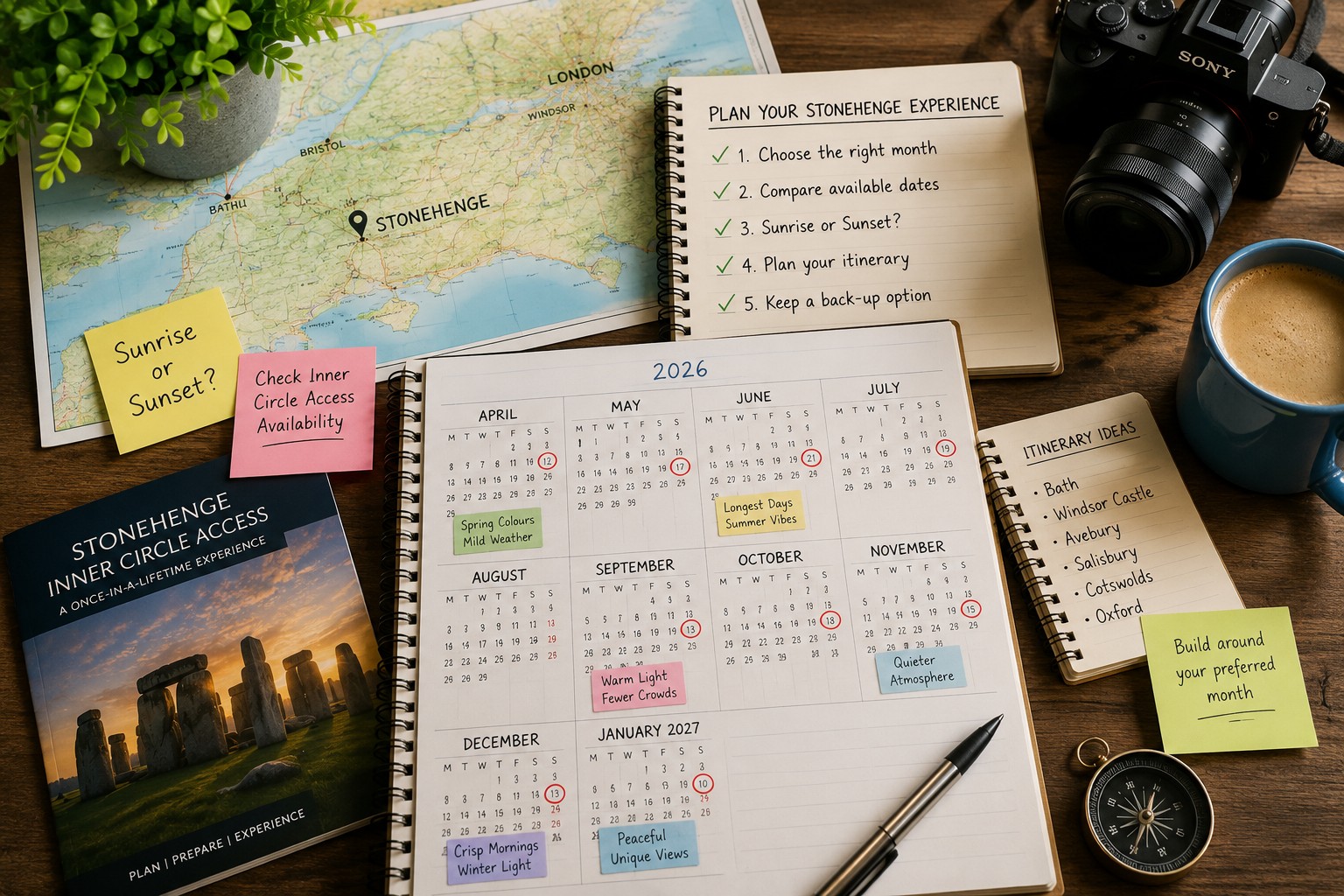
The most effective way to plan a Stonehenge Inner Circle visit is to choose the month that best matches your travel priorities before comparing individual access dates. This simple approach creates a smoother, more confident itinerary
🎯 Which Month Should You Choose? It Depends on Your Priorities
One of the biggest misconceptions about planning a Stonehenge Inner Circle visit is that there must be one month that is clearly better than every other.
In reality, choosing the right month is much like choosing the right route for a journey.
The best choice depends on what matters most to you.
Some visitors want the longest possible daylight.
Others are searching for peaceful surroundings or beautiful seasonal colours. Some are planning a family holiday, while others are travelling across Britain on a once-in-a-lifetime itinerary and need every day to fit together perfectly.
Instead of searching for a single “best” month, it is far more helpful to identify your own priorities first.
The table below provides a useful starting point.
📋 Best Months by Travel Priority
| Your Priority | Months Worth Considering | Why They Often Work Well |
|---|---|---|
| Overall balance | April, May, September | Good combination of daylight, seasonal scenery and practical touring. |
| Longest daylight | June, July | Maximum daylight allows greater flexibility for wider sightseeing. |
| Family holidays | July, August | Often align with school holiday periods and extended touring. |
| Autumn scenery | September, October | Softer light and beautiful seasonal colour. |
| Winter atmosphere | December, January | Dramatic landscape and distinctive seasonal character. |
| Photography | March, April, September, October | Lower seasonal light and changing landscapes often create rewarding photographic conditions. |
| Flexible southern England touring | April, May, June, September | Comfortable balance between sightseeing and travel logistics. |
These are planning suggestions rather than fixed rules.
Every visitor’s itinerary is different, and authorised Inner Circle sessions vary throughout the year.
👥 Best Months for Different Types of Visitors
Choosing a month becomes even easier when you think about the type of trip you’re planning.
🌍 Overseas Visitors
For travellers making a once-in-a-lifetime journey to Britain, April, May and September often provide one of the strongest overall combinations of practical touring conditions and itinerary flexibility.
These months generally make it easier to combine Stonehenge with destinations such as Bath, Windsor, Oxford or the Cotswolds without the exceptionally early sunrise departures of midsummer or the shorter daylight associated with winter.
For many international visitors, these shoulder-season months offer an excellent balance between sightseeing opportunities and a more relaxed pace of travel.
👨👩👧 Families
Families frequently work around school holiday calendars rather than ideal travel conditions.
For that reason, July and August often become the most practical months.
Long daylight hours allow more flexibility when combining several attractions into the same day, while warmer seasonal conditions generally encourage outdoor sightseeing.
Planning ahead becomes especially important during this period so that transport, accommodation and preferred touring arrangements fit comfortably within the wider holiday.
❤️ Couples and Special Occasions
Visitors celebrating anniversaries, birthdays or simply looking for a memorable experience often prioritise atmosphere over convenience.
For many couples, April, May, September and October provide an appealing blend of beautiful seasonal scenery, comfortable touring conditions and a calmer rhythm than the height of summer.
The changing light during these months frequently creates a particularly memorable setting for experiencing the monument.
📸 Photographers
Stonehenge is one of Britain’s most photographed prehistoric monuments, yet experienced photographers rarely chase one “perfect” month.
Instead, they choose the type of light they want.
Spring introduces fresh colour and increasing daylight.
Autumn often produces warmer tones and softer evening light.
Winter creates low-angle sunlight, dramatic skies and a striking sense of scale across Salisbury Plain.
Each season rewards a different photographic style, and no month guarantees ideal conditions.
Patience and flexibility usually matter more than the calendar alone.
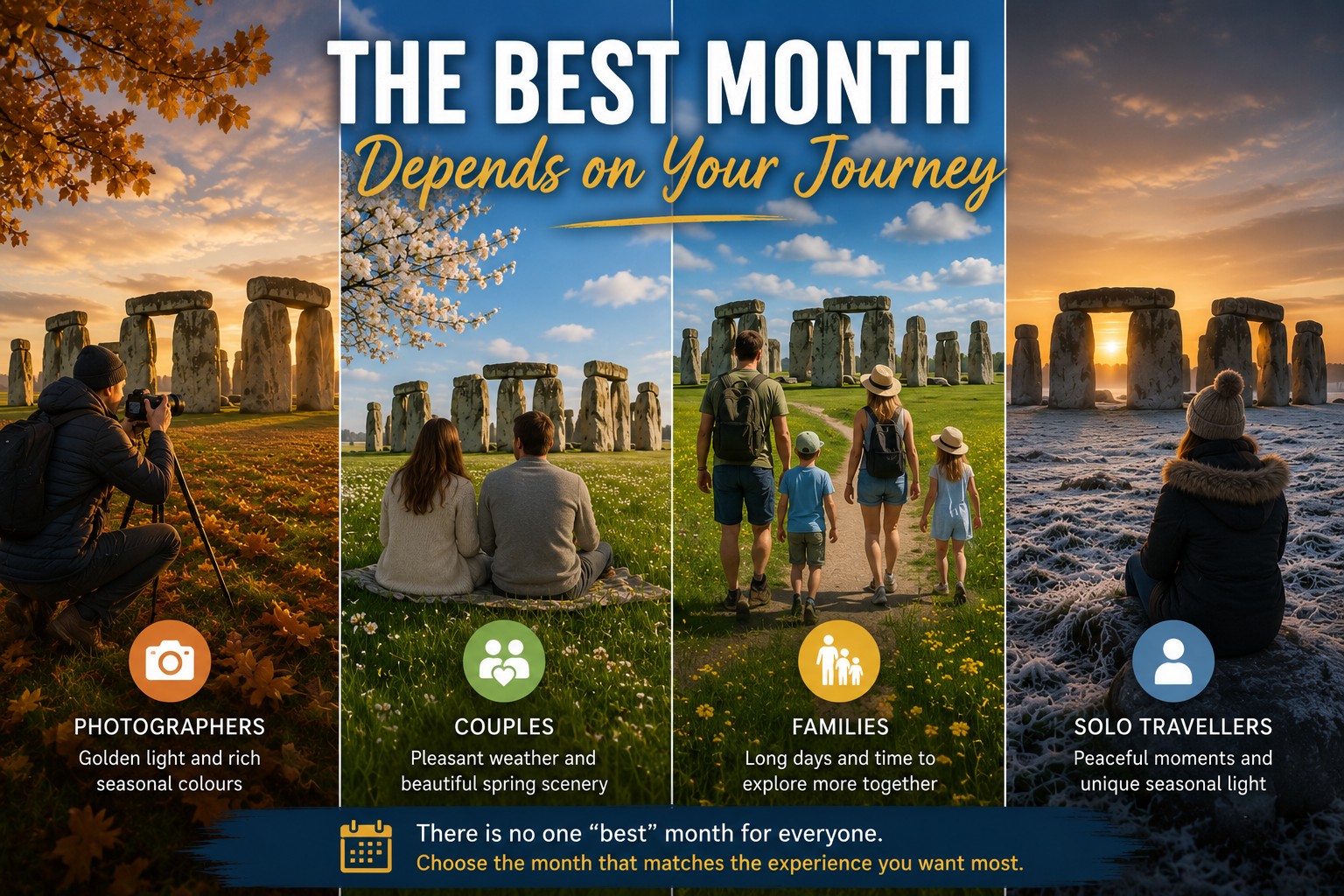
There is no single “best” month for everyone. Whether you’re travelling as a couple, with family, as a photographer or on a solo adventure, the ideal time to experience Stonehenge Inner Circle Access depends on the journey you want to create
🧳 Travellers Exploring Southern England
If Stonehenge is only one stop on a wider journey, practical scheduling becomes especially important.
Visitors planning to include destinations such as Bath, Windsor, Salisbury or Oxford often appreciate the balance offered by April, May, June and September, when daylight remains generous enough to support a fuller itinerary without necessarily requiring the exceptionally long days of midsummer.
🌅 Visitors Hoping for Sunrise Access
Many people imagine that midsummer automatically provides the best sunrise experience.
While June and July certainly deliver spectacularly early dawns, those early starts also require exceptionally early departures.
Some travellers discover that a spring or autumn sunrise provides a far more comfortable balance between atmosphere and practicality.
The right choice depends on whether your priority is witnessing the earliest sunrise possible or enjoying a more relaxed overall schedule.
🌇 Visitors Considering Sunset Access
Sunset experiences change just as dramatically throughout the year.
Summer offers long evenings and extended daylight, often resulting in later finishes.
Autumn and winter provide much earlier sunset timings, which some visitors find easier to incorporate into a wider day’s sightseeing.
Once again, there is no universal answer.
The most suitable month is the one that best complements your complete itinerary.
🧭 A Seven-Step Framework for Choosing the Right Month
Experienced Stonehenge travellers rarely begin by searching individual dates.
Instead, they work through a simple decision process that steadily narrows the options.
Following the same approach can make planning considerably easier.
1️⃣ Identify Your Available Travel Window
Start with the months that genuinely fit your holiday, annual leave or wider travel plans.
There is little value comparing months that are not realistic options.
2️⃣ Decide What Matters Most
Ask yourself:
- Do you want the longest daylight?
- Is photography a priority?
- Would you prefer quieter surroundings?
- Are you travelling with children?
- Is atmosphere more important than convenience?
Knowing your priorities immediately narrows the shortlist.
3️⃣ Think Beyond Stonehenge
Stonehenge is rarely the only destination.
Consider how your chosen month fits the rest of your itinerary.
Will you be visiting Bath?
Oxford?
Windsor?
The Cotswolds?
A month that works well across your entire journey is often a better choice than one selected purely for Stonehenge itself.
4️⃣ Consider Sunrise or Sunset
Your preferred session influences the whole day.
Early summer sunrise experiences can require exceptionally early starts.
Winter sunrise begins much later.
Summer sunsets create wonderfully long evenings but may also result in late returns.
Choose the session that genuinely suits your travel style.
5️⃣ Prepare for Seasonal Conditions
Regardless of the month, remember that Stonehenge stands on the exposed landscape of Salisbury Plain.
Weather conditions can change quickly.
Comfortable footwear, suitable clothing and a flexible attitude are often more valuable than searching endlessly for supposedly perfect weather.
6️⃣ Compare the Available Inner Circle Sessions
Only after deciding on your preferred month should you compare the actual authorised Inner Circle sessions.
This is where planning becomes far simpler.
Instead of reviewing an entire year’s schedule, you’ll already know which months best fit your priorities.
7️⃣ Keep One Backup Month
Finally, choose a realistic second option.
Having a backup month gives you far greater flexibility if your preferred dates do not fit your itinerary or if another nearby month offers a better overall balance.
It is one of the simplest ways to reduce planning stress.
🔄 Why Choosing a Backup Month Is One of the Smartest Planning Decisions
Many visitors spend considerable time deciding on their ideal month, only to become disappointed if their preferred Inner Circle session doesn’t fit the rest of their itinerary.
Experienced travellers usually avoid this problem.
Rather than planning around a single month or one specific date, they prepare a primary choice and a realistic alternative.
This simple approach creates far greater flexibility while keeping the overall experience almost identical.
For example, if your first choice is May, you may find that late April or early June offers many of the same advantages—longer daylight, attractive spring scenery and comfortable touring conditions—while fitting your holiday more naturally.
Likewise, visitors drawn to September may discover that early October delivers much of the same seasonal atmosphere with only modest differences in daylight.
The important point is this:
Your goal is not to chase one “perfect” date.
It is to create the best overall journey.
Choosing a backup month gives you far greater freedom when comparing available sessions, accommodation, transport and the rest of your holiday.
In many cases, it leads to an even better itinerary than your original plan.
⚠️ Common Mistakes When Choosing a Month
Choosing the right month is often easier when you understand the mistakes many first-time visitors make.
Avoiding these common assumptions can help you build a more enjoyable and less stressful trip.
❌ Assuming Summer Is Automatically the Best
Long daylight hours are undeniably attractive, but they are only one part of the decision.
Earlier sunrise departures, later evening finishes and the practical demands of peak-season travel may not suit every visitor.
For many travellers, spring or early autumn provides a more balanced experience.
❌ Focusing Only on the Weather
Good weather is never guaranteed at Stonehenge.
The monument stands on the exposed landscape of Salisbury Plain, where conditions can change quickly regardless of the season.
Planning around likely seasonal characteristics is far more reliable than hoping for a perfect forecast months in advance.
❌ Choosing a Date Before Choosing a Month
Many visitors immediately begin searching through available sessions without first deciding what kind of experience they actually want.
Working the other way around is usually far easier.
Select the month first.
Then compare the available dates within that month.
This approach makes the planning process far more focused and avoids becoming overwhelmed by too many options.
❌ Forgetting the Rest of the Holiday
Stonehenge is rarely the only destination on a UK itinerary.
A month that works well for Stonehenge but creates unnecessary pressure elsewhere may not be the best overall choice.
The strongest itineraries are those where every destination fits comfortably together.
❌ Having No Alternative Plan
Visitors sometimes become attached to one specific month or one individual date.
Keeping a realistic backup month provides flexibility and often leads to smoother travel arrangements if your original preference proves less practical.
📅 After Choosing Your Month, Compare the Available Dates
Once you’ve decided which month best suits your travel plans, the next stage becomes much simpler.
Instead of reviewing every available session throughout the year, you can concentrate on the dates that fall within your preferred travel window.
At this point, compare practical considerations such as:
- your preferred sunrise or sunset session
- how the access time fits the rest of your itinerary
- accommodation and transport arrangements
- any nearby alternative dates within the same month
- whether your backup month offers additional flexibility
Planning in this order—month first, date second—creates a far more organised and confident decision-making process.
It also reflects the way experienced Stonehenge travellers typically approach their own planning.
You’ve Chosen Your Month—Now Compare the Available Access Dates
Now that you’ve narrowed down the month that best matches your travel plans, the next step is to compare the authorised Stonehenge Inner Circle Access sessions available during that period. Viewing the calendar allows you to identify suitable sunrise and sunset experiences before finalising the rest of your itinerary.
Checking availability after choosing your preferred month is one of the simplest ways to create a smoother, more flexible and better organised Stonehenge visit.
📅 View the Stonehenge Inner Circle Access Calendar
Free to use • View available dates • Plan with confidence
🌿 Travel with Purpose. Explore with Care.
Thoughtful travel begins long before you arrive at Stonehenge.
Choosing the right month isn’t simply about finding pleasant conditions—it is also about creating a journey that is well planned, enjoyable and considerate of the places you visit.
Where practical, consider building a slower itinerary that groups nearby destinations together rather than making unnecessary additional journeys.
Preparing appropriately for seasonal conditions, respecting the protected landscape and allowing enough time to appreciate each destination all contribute to a more rewarding travel experience.
Stonehenge has stood on Salisbury Plain for thousands of years.
Experiencing it thoughtfully, respectfully and at the right pace allows visitors to appreciate not only the monument itself, but also the remarkable landscape that surrounds it.
At Best Value Tours, we believe the finest journeys are those that balance careful planning with genuine curiosity—helping visitors explore extraordinary places while travelling with purpose and care.
✅ Conclusion
Choosing the best month for Stonehenge Inner Circle Access is not about discovering a single perfect answer.
It is about finding the month that best matches the experience you want, the way you like to travel and the wider journey you are planning.
For some visitors, that may be the fresh balance of April or May.
Others will appreciate the long daylight of June and July, the rich colours of September and October, or the peaceful atmosphere that winter can bring.
Every month offers something different.
The key is understanding those differences before you begin comparing individual access dates.
By identifying your priorities, narrowing your shortlist to one or two suitable months and keeping a realistic backup option, you place yourself in the strongest possible position to plan a memorable visit.
Stonehenge has inspired travellers for generations.
Choosing the right month won’t simply help you visit the monument—it will help you experience it in the way that matters most to you.
❔ Frequently Asked Questions
🗓️ What is the best month for Stonehenge Inner Circle Access?
There is no single best month for everyone. April, May and September are often excellent all-round choices because they combine attractive seasonal scenery, practical touring conditions and balanced daylight. However, the right month depends on your travel priorities, itinerary and the available authorised Inner Circle sessions.
🌼 Is April or May better for Stonehenge Inner Circle Access?
Both are excellent choices. April offers fresh spring landscapes and steadily increasing daylight, while May provides longer days and greater flexibility for wider touring. Many visitors find that either month delivers an outstanding balance of atmosphere and practicality.
☀️ Is June a good month despite the Summer Solstice?
Yes. June offers the longest daylight hours of the year and can be an excellent month to visit. However, the period around the Summer Solstice has its own operational considerations, so visitors should always check authorised access arrangements and available sessions before finalising travel plans.
🌅 What is the best month for a sunrise visit?
That depends on your priorities. Summer delivers spectacularly early sunrises but also requires exceptionally early departures. Spring and autumn often provide a more relaxed balance, while winter offers considerably later sunrise times that some visitors find easier to incorporate into their itinerary.
🌇 What is the best month for a sunset visit?
Long summer evenings create memorable sunset experiences but often lead to later finishes. Autumn and winter provide earlier sunset timings that may suit visitors who prefer a more manageable schedule.
🍂 Is September better than July?
Neither month is universally better. July offers maximum daylight and classic summer touring, while September often provides a slightly calmer atmosphere with softer seasonal light. The better choice depends on the type of experience you are looking for.
❄️ Is Stonehenge Inner Circle worth visiting during winter?
Absolutely. Winter offers a completely different experience, with dramatic seasonal light, quieter surroundings and a distinctive atmosphere that many visitors find especially memorable. Preparing for colder and more changeable conditions is the key to enjoying the visit.
👥 Which months usually feel more relaxed?
Many travellers find that spring and early autumn provide an appealing balance between favourable touring conditions and a gentler pace. The overall atmosphere can vary from year to year, but these periods are often appreciated by visitors seeking a more measured travel experience.
📅 Does Stonehenge Inner Circle Access operate throughout the year?
Authorised Inner Circle sessions are offered at different times during the year, but availability varies. Always check the current access schedule for your preferred month before confirming your travel arrangements.
🔄 Should I choose a backup month?
Yes. Having a second-choice month gives you much greater flexibility if your preferred session does not fit your itinerary or if another nearby period offers a better overall balance. It is one of the simplest ways to create a smoother planning process.
🧭 What should I do after choosing my month?
Once you’ve selected the month that best matches your priorities, compare the available Inner Circle sessions within that period. Review sunrise and sunset options, consider how each fits your wider itinerary and keep a realistic alternative available before making your final booking.