


Channel Islands Travel Guide: Start Your European Journey Here
10th August 2026
🏝️ Channel Islands Travel Guide: Start Your European Journey Here
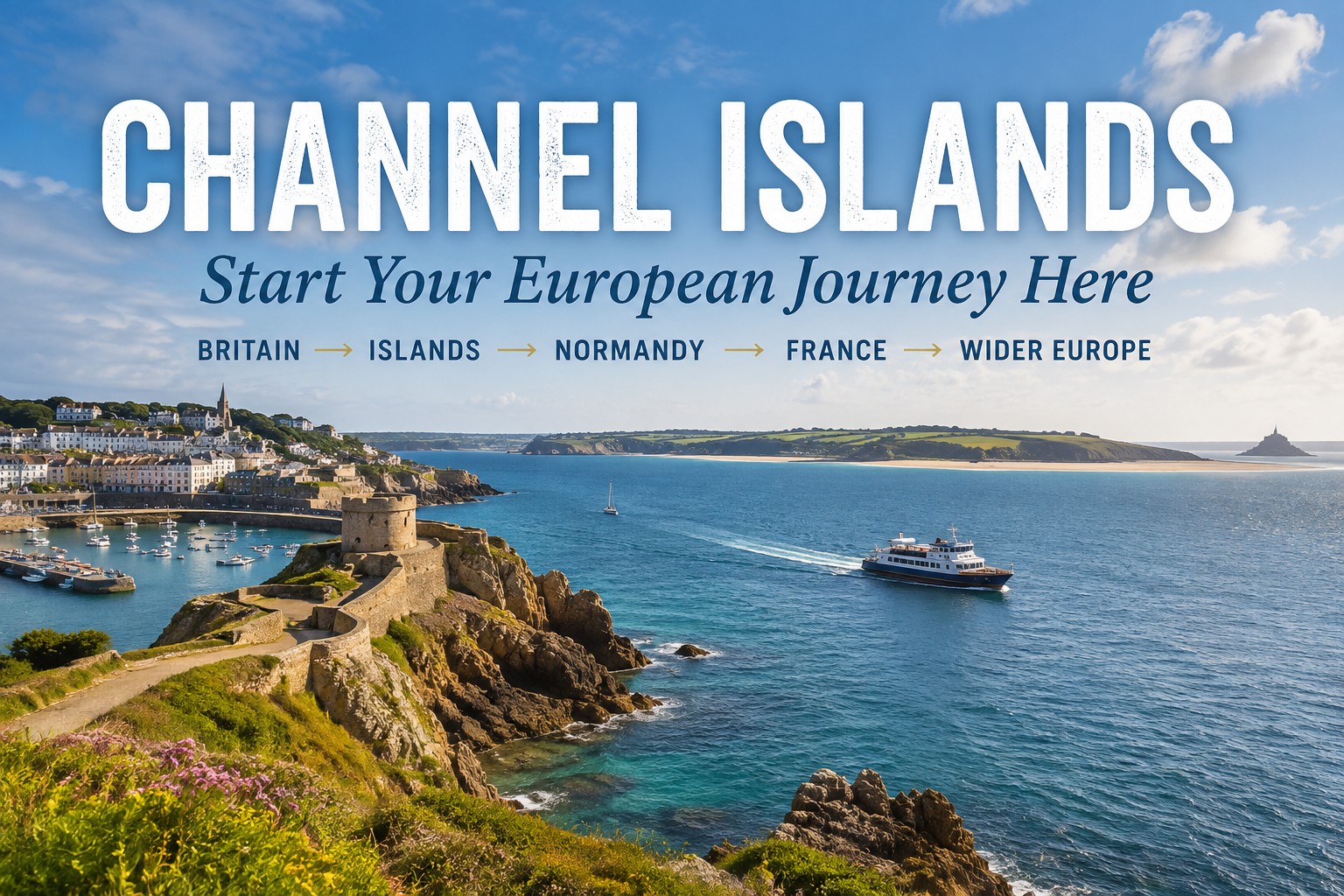
The Channel Islands offer much more than an island escape. Their position between Britain and France creates a natural starting point for a journey through Normandy and into wider Europe
A Channel Islands travel guide could easily begin with beaches, castles and places to stay. But these islands deserve a wider introduction. Set close to the coast of Normandy yet connected for centuries with the British Crown, they occupy one of Europe’s most intriguing geographical and cultural crossroads — a place where a familiar island break can gradually become something much bigger.
Jersey and Guernsey are the largest and best-known destinations, but they are only the beginning. Sark invites you to exchange traffic for walking, cycling and a dramatically slower rhythm. Herm compresses beaches and coastal paths into a tiny escape, while Alderney rewards travellers willing to venture farther for wildlife, history and a more independent island experience.
You can visit the Channel Islands for an entire holiday and never feel the need to go anywhere else. Alternatively, you can combine several islands, spend longer discovering their Norman heritage, or look east towards France and realise that Normandy offers a remarkably logical next chapter.
That possibility gives the Channel Islands a special role for travellers beginning in Britain. Rather than making one large leap into continental Europe, you can let the landscape, history and culture change around you in stages:
Britain → Channel Islands → Normandy → France → wider Europe.
This guide will help you decide which island best suits you, whether island hopping will improve your trip, how much time to allow and what to consider when planning transport. Just as importantly, it will show why visiting the Channel Islands can be much more rewarding when you resist the temptation to collect destinations and instead give each place time to reveal its character.
🧭 Where Are the Channel Islands — and Why Are They Different?
The Channel Islands lie in the English Channel, much closer geographically to Normandy than many first-time visitors expect. Jersey and the Bailiwick of Guernsey are self-governing Crown Dependencies rather than parts of the United Kingdom, each with its own institutions, traditions and distinctive identity.
That unusual position is fundamental to their appeal. Their history reaches deeply into Normandy, French and Norman influences remain visible in names and heritage, and centuries of connection with the British Crown have added further layers. What emerges is neither a miniature England nor a fragment of France, but an island world with a character of its own.
For travellers, those distinctions are more than historical curiosities. They influence architecture, food, language, traditions and the stories encountered while exploring. They also help explain why a relatively short journey from Britain can feel like the beginning of a transition towards continental Europe.
Before looking towards France, however, there are five very different islands worth understanding on their own terms.
🏖️ Five Islands, Five Different Travel Experiences
Choosing where to begin becomes easier once you stop asking which Channel Island is simply “best”. Each offers a different balance of coastline, heritage, activity and pace, so the better question is which island most closely matches the holiday you want.
🇬🇬 Guernsey: Heritage, Coast and Island Character
Guernsey combines the historic waterfront and steep streets of St Peter Port with an extensive coastline of cliffs, bays and walking routes. History remains unusually visible, from fortifications and occupation heritage to the story of Victor Hugo, whose years of exile at Hauteville House created an enduring connection between this small island and French literary history.
It is also particularly well placed for travellers who want their holiday to expand without becoming complicated. Nearby Herm and Sark provide contrasting experiences, making Guernsey a strong base for combining heritage and coastal exploration with carefully chosen island excursions.
🇯🇪 Jersey: Beaches, Castles and the Widest Choice
Jersey is the largest Channel Island and offers perhaps the broadest variety within a single stay. St Helier provides the archipelago’s busiest urban base, while beyond it the landscape opens into broad beaches, coastal scenery, countryside, historic fortifications and communities with very different atmospheres.
That range makes Jersey especially attractive to first-time visitors who want plenty of choice without repeatedly changing accommodation. Beach time, active exploration, food and history can all fit comfortably into the same holiday.
🚲 Sark: Slow Down Completely
Sark changes the rhythm again. Conventional private cars are absent, so walking, cycling and other traditional forms of transport become part of how you experience the island rather than simply a means of getting between attractions.
Its compact scale encourages something increasingly rare in European travel: having fewer places you need to reach and more time to notice where you already are.
🥾 Herm: Small, Walkable and Wonderfully Simple
Herm takes the idea of slowing down even further. Beaches, coastal paths and short walking distances give the island an appealing simplicity, particularly for travellers who want a day or short stay centred on scenery rather than an itinerary crowded with attractions.
It combines especially well with Guernsey. Instead of feeling like another destination to tick off, Herm can provide a complete change of pace within a longer Channel Islands holiday.
🌊 Alderney: The More Independent Island Choice
Alderney sits farther from the main visitor circuit and feels correspondingly independent. Its coastline, wildlife and substantial wartime heritage give it a strong identity, while its relative remoteness appeals to travellers who actively enjoy going beyond the most obvious route.
That does not mean every first-time visitor needs to include Alderney. Reaching and exploring it requires more deliberate planning, and on a short holiday those extra logistics may be better exchanged for additional time elsewhere. For the right traveller, however, that independence is precisely the attraction.
| Island | Character | Best for | Natural trip role | Main consideration |
|---|---|---|---|---|
| Guernsey | Historic, coastal and characterful | Heritage, walking and smaller-island excursions | Main base or longer stay | Less overall variety than Jersey |
| Jersey | Largest and most varied | First visits, beaches, attractions and choice | Main destination or base | Can feel busier in popular areas |
| Sark | Slow, intimate and car-free | Walking, cycling and switching off | Short stay or distinctive extension | Fewer conventional facilities |
| Herm | Tiny, relaxed and highly walkable | Beaches, walking and uncomplicated escapes | Day visit or short extension | Limited scale |
| Alderney | Independent and quieter | Wildlife, history and less conventional exploration | Specialist extension | Requires more deliberate planning |
⚖️ Which Channel Island Should You Choose?
For many first-time visitors, the decision begins with Jersey or Guernsey. Choose Jersey when breadth matters most: more variety, larger beaches and plenty to occupy a longer stay without changing islands. Choose Guernsey when historic atmosphere, coastal walking and easy access to contrasting smaller islands are higher priorities.
Sark is compelling when slowing down is part of the purpose of travelling. Herm suits an uncomplicated escape built around beaches and walking, while Alderney rewards those prepared to put a little more effort into reaching somewhere quieter and less conventional.
The real question is therefore not “Which is the best Channel Island?”
It is “Which island is best for the trip I actually want?”
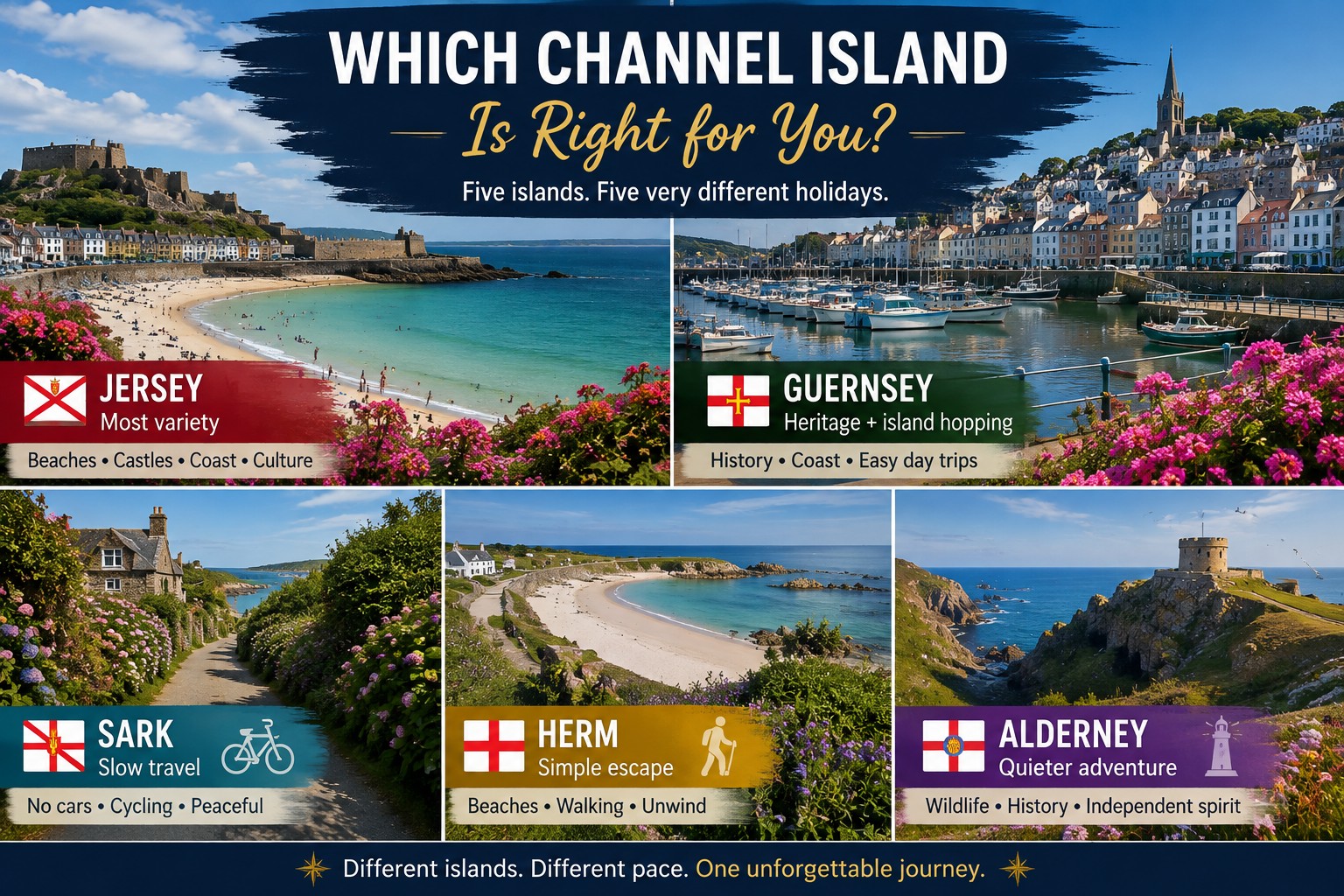
Five islands offer five very different holidays, from Jersey’s variety and Guernsey’s heritage to the slower pace of Sark, simplicity of Herm and independent character of Alderney
⛴️ One Island or Several? Planning an Island-Hopping Journey
Once you realise how different the islands are, Channel Islands island hopping becomes tempting. Done well, it can be one of the highlights of a holiday. Done too aggressively, it can turn precious days into a sequence of check-outs, luggage transfers and transport connections.
On a short break, one well-chosen island will usually be more rewarding than an ambitious itinerary built around seeing as many as possible. With additional time, combinations become much more appealing. Guernsey works especially well as a base for adding smaller-island experiences, while a longer holiday can potentially bring Jersey and Guernsey together and still leave enough time to explore rather than simply arrive and depart.
Alderney deserves more deliberate consideration. Its distinctive character can justify the additional logistics, but include it because its wildlife, landscapes and history genuinely interest you — not because five islands sounds more complete than four.
Transport also introduces an element that no perfect itinerary can entirely control. Inter-island routes and frequencies can vary seasonally, while weather can affect sea travel. Building some breathing room into the schedule therefore makes practical sense, particularly when accommodation changes or onward connections depend upon arriving at a specific time.
The most useful question is not “How many islands can I visit?”
It is “How many islands can I experience properly?”
For some travellers, the answer will be one. For others, moving between islands becomes a defining part of the holiday. If you have more time, there is another possibility worth considering: instead of adding one more island simply because you can, continue east and allow France to change the scale of the trip.
🏰 Why the Channel Islands Feel Like a Bridge Between Britain and Europe
The Channel Islands’ position between Britain and France is more than geographical. Their identities have been shaped by centuries of political allegiance, maritime movement and cultural exchange across the Channel, leaving traces that become increasingly visible once you look beyond the beaches.
Their Norman inheritance is central to that story. The islands’ historic relationship with the Duchy of Normandy and their subsequent allegiance to the English Crown helped create the unusual constitutional path that distinguishes them today.
Priority Feature Recommendation
Channel Island Quick Decision Panel — Priority: High. Retain and build. This is an excellent decision-support location immediately after the five-island comparison. The panel should convert the preceding detail into rapid traveller choices such as Best for first visit → Jersey; heritage + island extensions → Guernsey; slow travel → Sark; simple beach escape → Herm; quieter independent exploration → Alderney.
French and Norman influences endured in place names, traditions and historic languages, while centuries of connection with Britain added further layers. This is why the Channel Islands can feel familiar and European at the same time without being completely defined by either identity.
Later history is equally tangible. During the Second World War, the Channel Islands became the only part of the British Isles occupied by German forces. Fortifications, bunkers, tunnels, museums and other surviving structures make the occupation something visitors can encounter directly across the archipelago rather than simply read about as a distant historical episode.
Guernsey adds another remarkable European connection through Victor Hugo. The French writer spent years in exile at Hauteville House, where his life and work became entwined with the island. His Guernsey years included work on Les Misérables and the writing of Toilers of the Sea, creating a cultural connection that reaches far beyond the Channel itself.
Understanding these layers changes how you read the map. Normandy no longer appears to be an unrelated destination conveniently sitting across the water. It becomes another part of a much older story linking these islands with both Britain and continental Europe.
🧳 How Long Do You Need in the Channel Islands?
A focused two- or three-day break can provide a rewarding introduction to one principal island, especially if you resist trying to cover everything. Four or five days create more breathing room for coastal exploration, historical sites and perhaps one carefully chosen neighbouring-island experience.
Around a week opens considerably more possibilities. You could explore a single island in greater depth, combine complementary islands at a comfortable pace or build in the flexibility that sea travel sometimes requires. With longer still, the question changes from how many islands to include to whether the trip should continue towards northern France.
The crucial measure is usable holiday time, not distance on a map. Ferries, flights, check-ins, accommodation changes and transfers consume parts of days even when two destinations appear remarkably close together.
Don’t measure the success of your Channel Islands holiday by the number of islands collected. A smaller itinerary experienced properly will usually tell you far more about this extraordinary archipelago than a hurried attempt to tick off all five.
✈️ Getting There and Travelling Between the Islands
How you reach the Channel Islands can shape the character of the holiday almost as much as the island you choose. Flying can make a shorter break practical, while arriving by ferry allows the transition from mainland to island to unfold more gradually, with the sea crossing becoming part of the travel day rather than simply a transfer.
Moving between the islands requires a little more thought. Distances can look deceptively small on a map, but inter-island connections do not operate like an urban transport network. Routes and frequencies can vary according to season, and weather can disrupt sea services, so check current schedules before committing accommodation or important onward connections to a tightly timed itinerary.
Travelling without a car can work extremely well. Walking, buses, cycling and other local options allow you to experience individual islands at a more appropriate pace rather than trying to recreate a mainland road trip within a much smaller landscape.
| Travel option | Best suited to | Advantages | Main consideration |
|---|---|---|---|
| Flight | Shorter breaks and time-conscious travellers | Makes limited holiday time easier to use | Available routes and schedules vary |
| Ferry | Longer stays and travellers who enjoy sea journeys | Makes arrival part of the experience | Crossing time and weather |
| Inter-island services | Multi-island holidays | Adds genuinely contrasting destinations | Current connections require checking |
| Local transport | Exploring without a car | Less driving and greater engagement with each island | Networks differ between islands |
Exact operators, routes and timetables can change. Verify them close to booking rather than building a holiday around transport information found in an older itinerary or travel guide.
🌿 Slow Down: The Channel Islands Reward a Different Pace
The compact scale of the Channel Islands makes them particularly well suited to slower travel. Coastal paths invite walking, cycling can become part of the day’s exploration, and local transport can reduce the need to drive everywhere. Sark takes that principle further: its car-free character makes a slower rhythm fundamental to the visit.
Travelling more slowly can also make an itinerary more resilient. Fewer accommodation changes and unnecessary transfers mean fewer connections vulnerable to weather disruption, while longer stays create more opportunities to support local cafés, restaurants, shops, guides and other island businesses.
Small communities should never feel like stops to be consumed quickly. Give them time, respect their landscapes and let the holiday breathe.
Travel with purpose. Explore with care.
🇫🇷 Continue Your European Journey: From the Channel Islands to Normandy
The Channel Islands can provide a complete holiday without going anywhere else. Yet after spending time among Norman place names, centuries-old fortifications and landscapes sitting remarkably close to France, returning directly to Britain is no longer the only obvious way to finish the trip.
Travelling from the Channel Islands to Normandy can turn an island holiday into the first stage of a broader European adventure. The connection is not simply geographical. Normandy provides historical context for much of the heritage encountered across the islands, allowing two destinations on opposite sides of the water to become parts of the same story.
Northern France also changes the scale of what comes next. Normandy offers historic towns, countryside and coastal communities alongside some of Europe’s most significant Second World War sites, including the D-Day beaches and battlefields. Spend time here and the transition from island life to continental Europe can feel gradual rather than abrupt.
The route begins to make sense as a progression:
Independent travellers may relish assembling the individual ferries, accommodation and onward arrangements themselves. Others will prefer the simplicity of bringing the principal stages together within one organised itinerary. BVT’s Channel Islands and Northern France touring experience offers that alternative, following the same broad geographical progression while removing some of the work involved in coordinating separate elements.
Neither style of travel is inherently better. The important consideration is how independently you want to travel, how much logistical planning you enjoy and whether arranging every stage yourself adds to the anticipation or simply creates another job before the holiday begins.
That choice-first approach matters. A tour should solve a travel need rather than manufacture one.
The Channel Islands therefore perform an unusual role within Touring Europe. They are sufficiently distinctive to reward a dedicated holiday, yet geographically and historically connected enough to make onward travel feel coherent.
Once Normandy becomes the next chapter rather than the finishing point, Europe begins to open considerably farther.
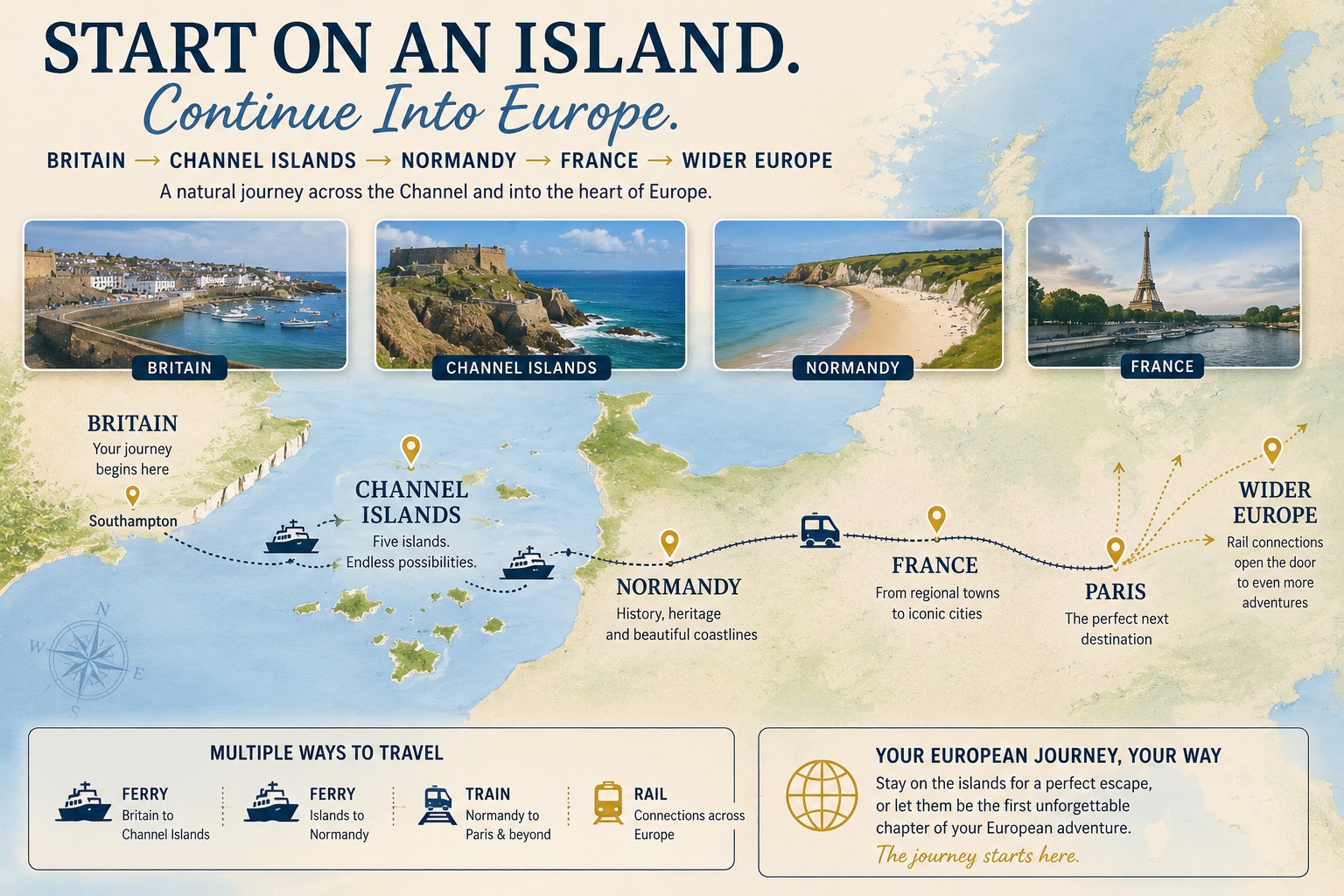
The Channel Islands can be a complete holiday or the beginning of a wider European journey, connecting Britain with Normandy, France, Paris and destinations farther across Europe
🚆 Where Could Your European Journey Go Next?
Reaching Normandy does not mean turning a Channel Islands holiday into an enormous race across the continent. One of the strengths of beginning Europe this way is that the itinerary can expand gradually, with each additional destination earning its place.
Paris is an obvious continuation from northern France, opening the door to a very different combination of culture, food, neighbourhood exploration and major landmarks. From the French capital, travellers can continue by rail towards Brussels and Bruges for a compact northern European progression, or spend longer discovering France before considering routes towards Switzerland, Italy and other parts of the continent.
The important shift is from seeing Europe as a collection of disconnected holidays to recognising a network of journeys that can be combined intelligently. The Channel Islands can remain the entire trip, Normandy can become one carefully chosen extension, or both can form the opening stages of a longer itinerary.
Editorial Placeholder — Continue Your European Journey Panel: Explore Normandy | Continue to Paris | Discover France | Travel Europe by Rail | Plan a Multi-Country Europe Trip
Priority Feature Recommendation
Continue Your European Journey Panel — Priority: Highest. Retain and build. This is a major cluster-navigation feature and should provide the reader with distinct onward paths rather than repeating the two contextual links above.
For travellers who prefer more structure, this expanding route also creates logical opportunities to consider European rail journeys, multi-country touring and other organised experiences. The principle remains the same: choose the journey first, then decide which form of travel best helps you experience it.
This is a commercial/category destination; no blog publication date applies. The URL is verified in the protected Touring Europe master.
📅 Plan Around the BVT Europe Events Calendar 2026–2027
Dates can become almost as important as destinations once a Channel Islands holiday develops into a wider European trip. Festivals, sporting occasions, seasonal celebrations and major cultural events can provide compelling reasons to extend an itinerary, but popular dates can also place additional pressure on accommodation and transport.
The BVT Europe Events Calendar 2026–2027 can help you identify those opportunities while plans are still flexible. It is particularly useful when considering whether to continue from the Channel Islands and Normandy towards Paris, another French region or elsewhere in Europe.
Checking events early allows them to inform the itinerary rather than disrupt it later. A festival or major sporting occasion may justify another night in a destination; an exceptionally busy period may make a quieter alternative more appealing.
The objective is not to squeeze another event into an already full holiday. It is to recognise when where you travel and when you travel can work together to create a better European experience.
❓ Channel Islands Travel FAQs
🇬🇧 Are the Channel Islands Part of the UK?
No. Jersey and the Bailiwick of Guernsey are self-governing Crown Dependencies rather than parts of the United Kingdom. They have their own governments and constitutional arrangements while maintaining a long-standing relationship with the British Crown. That unusual status helps explain why the islands can feel familiar to British visitors while retaining identities distinctly their own.
🏝️ Which Channel Island Is Best for a First Visit?
Jersey and Guernsey are the most natural starting points for many first-time visitors, but neither is universally better. Jersey generally offers the widest variety within one island, including beaches, heritage, attractions and a larger urban centre. Guernsey combines historic atmosphere and coastal exploration with particularly appealing opportunities to add Herm or Sark.
Choose according to the holiday you want rather than the island somebody else ranks first.
📆 How Many Days Do You Need in the Channel Islands?
Two or three days can provide a focused introduction to one principal island, while four or five allow more relaxed exploration and perhaps a carefully chosen neighbouring-island excursion. Around a week gives greater freedom for island hopping or deeper exploration. If Normandy is also part of the plan, allow additional days rather than compressing France into an already crowded itinerary.
⛴️ Can You Visit Several Channel Islands on One Trip?
Yes. Combining islands can be extremely rewarding because their landscapes, scale and atmosphere differ considerably. The key is allowing sufficient time between movements and checking current inter-island services before booking. On a shorter break, exploring one island properly may deliver a better holiday than repeatedly packing and transferring.
🛂 Do You Need a Passport to Visit the Channel Islands?
Not necessarily when travelling from within the Common Travel Area, which includes the UK, Ireland, Jersey, Guernsey and the Isle of Man. However, identification requirements can depend on your nationality, route and airline or ferry operator, while travellers arriving from outside the Common Travel Area are subject to different entry requirements.
Always check current official entry guidance and your carrier’s identification requirements before departure.
🇫🇷 Can You Travel from the Channel Islands to France?
Yes, direct sea connections can make France a practical onward destination from the Channel Islands. Routes and schedules vary according to island, season and travel date, so verify the current service before committing other parts of the itinerary.
When the connection works for your dates, France offers much more than convenient onward transport. It provides the opportunity to turn an island holiday into a genuinely connected European journey.
🌍 Start on an Island. Continue Into Europe.
The Channel Islands do not need an onward destination to justify the journey. Jersey can fill a holiday with coast, history and variety, while Guernsey combines St Peter Port, walking and heritage with easy opportunities to experience smaller neighbours. Sark, Herm and Alderney then demonstrate just how much character can be concentrated within a relatively small archipelago.
But look east towards Normandy and the geography begins to tell a second story.
The Norman heritage encountered in place names, historic buildings and island traditions connects naturally with mainland Europe. France stops feeling like an unrelated destination across the water and becomes a logical continuation of a route that has been developing throughout the trip.
For some travellers, Normandy will be enough. Others may continue towards Paris, explore France more deeply or eventually connect several countries by rail or organised tour. There is no requirement to keep going. The strength of this approach is that every stage can provide a rewarding holiday in its own right while leaving another worthwhile possibility ahead.
The same philosophy applies within the Channel Islands. You do not need to visit all five to understand what makes this archipelago special. Start with the place that most closely matches your interests, stay long enough to experience more than its headline attractions and allow curiosity rather than a checklist to determine what happens next.
For many travellers, Guernsey is an excellent place to continue exploring. St Peter Port, coastal landscapes, Norman connections, occupation history and Victor Hugo provide several different ways into its story, while nearby Herm and Sark reveal how dramatically the character of a Channel Islands holiday can change over a short distance.
The Channel Islands occupy a small area on the map, but the possibilities they create are considerably larger.
You don’t have to cross Europe quickly to begin exploring it well. Sometimes the journey starts on a small island just off the coast of France.