


Ancient Scotland and Standing Stones: Callanish, Orkney and Scotland’s Prehistoric Landscapes
10th August 2026
🪨 Ancient Scotland and Standing Stones: Callanish, Orkney and Scotland’s Prehistoric Landscapes

The Callanish standing stones rise from the Hebridean landscape of Lewis, representing one remarkable surviving chapter in Scotland’s much wider prehistoric story
On the Isle of Lewis, great stones rise from an open Hebridean landscape beneath a sky that can shift from clear light to Atlantic drama within minutes. At Callanish, also commonly known as Calanais, their arrangement immediately suggests intention: a towering central monolith, a stone circle and lines of standing stones extending across ground where people were gathering and building thousands of years before Scotland existed as a kingdom.
Yet Callanish is only one surviving fragment of a far larger prehistoric story.
Across ancient Scotland, communities created stone circles, chambered tombs, burial cairns and other monumental places, carved rock, established settlements and repeatedly returned to landscapes that clearly mattered to them. In Orkney, some of the most extraordinary evidence survives within a concentrated Neolithic world where places associated with living, burial and monumental gathering can still be experienced within the same wider archaeological setting.
These sites are compelling partly because archaeology can tell us so much—and partly because important questions remain unanswered. We can investigate when monuments were built, how settlements developed, what people ate, the materials they used and how particular places changed across generations. What we cannot always recover is precisely what every ceremony meant, why one location was chosen over another or what beliefs accompanied the raising of the stones.
To understand ancient Scotland and its standing stones, we need to see these places not simply as isolated monuments, but as surviving fragments of entire prehistoric landscapes.
That perspective also changes Scotland’s place within prehistoric Britain. The islands and northern regions that can appear remote on a modern road map were not necessarily disconnected margins. People, materials, technologies and ideas moved through networks spanning considerable distances, while coastlines and sea routes could connect communities as readily as separate them.
This wider prehistoric world provides a fascinating context for another extraordinary British landscape: Stonehenge.
Callanish is not simply a Scottish Stonehenge, nor should every stone circle be assumed to have shared the same purpose. Exploring Scotland’s monuments alongside Stonehenge reveals something considerably richer: the diversity, ambition and interconnectedness of prehistoric communities transforming Britain thousands of years ago.
🪨 Ancient Scotland: Look Beyond the Stones
Don’t think of Scotland’s standing stones as isolated monuments. Think in terms of prehistoric landscapes.
The stones we see today are surviving parts of a much bigger human story. To understand ancient Scotland, look at how different forms of archaeological evidence belong together:
| 🗿 Calanais | Monumental stones within an extraordinary Hebridean landscape |
| 🏝️ Orkney | Settlement, tombs and ceremonial monuments experienced together |
| 🌀 Kilmartin | Cairns, standing stones and rock art across one remarkable landscape |
| ⚱️ Clava | A distinctive Bronze Age funerary and ceremonial landscape |
| 🪨 Machrie Moor | Island stone circles and wider prehistoric remains beneath the Arran hills |
⏳ Before Castles and Clans: Discovering Prehistoric Scotland
The story of prehistoric Scotland begins long before castles dominated strategic hills, clans became associated with Highland history or Scotland emerged as a kingdom. Thousands of years earlier, communities were already farming land, building homes, raising monuments and creating places for their dead that would remain visible across the landscape for generations.
During the Neolithic, farming and more settled ways of life increasingly transformed communities across Scotland, although this change did not happen everywhere at precisely the same time. Settlements became established within landscapes that could also contain tombs, standing stones and other substantial structures. Building monuments required planning, labour, knowledge and cooperation, demonstrating communities capable of organising projects far beyond the immediate demands of everyday survival.
Later prehistoric societies continued creating monuments and sometimes returned to places that had already carried significance for generations. Some archaeological landscapes therefore represent centuries of building, modification and reuse rather than a single moment frozen in time. This distinction is important: a stone circle, burial cairn or individual standing stone may belong to a much longer sequence of human activity.
Archaeologists reconstruct that world without the benefit of contemporary written histories. Houses, hearths, pottery, tools, human and animal remains, burial practices and patterns across the landscape can reveal how people lived and interacted. Scientific dating can help establish chronology, while the movement of materials provides evidence for wider networks of travel and exchange.
What archaeology rarely provides is a simple explanation of precisely what prehistoric people believed.
Ancient Scotland begins thousands of years before the Scotland of castles and clans, and its archaeological record allows us to glimpse a human world that would otherwise be almost entirely lost.
Understanding that chronology also prevents very different remains from being grouped together. Scotland’s prehistoric heritage includes Neolithic settlements and ceremonial monuments alongside later Bronze Age cairns, standing stones and landscapes that could continue to be revisited long after their first construction.
The stones survive, but they are only part of the evidence.
🧭 Scotland’s Great Prehistoric Landscapes at a Glance
There is no single monument that represents prehistoric Scotland. The archaeological record ranges from individual standing stones and great stone circles to burial cairns, chambered tombs, rock art and remarkably preserved settlements. Several of the landscapes below also developed across long periods, so their broad dates should be understood as useful orientation rather than evidence that everything visible today was created at the same moment.
| Prehistoric Landscape | Region | Principal Remains | Broad Period | Why Visit? |
|---|---|---|---|---|
| Callanish / Calanais | Isle of Lewis | Standing stones, circle and avenues | Neolithic with later prehistoric use | Iconic stones within an extraordinary Hebridean landscape |
| Heart of Neolithic Orkney | Orkney | Stone circles, chambered tomb and settlement | Neolithic | Exceptional concentration of prehistoric archaeology |
| Kilmartin Glen | Argyll | Cairns, standing stones and rock art | Neolithic and Bronze Age | Diverse archaeology concentrated within one remarkable landscape |
| Clava Cairns | Highlands | Burial cairns and standing stones | Bronze Age | Impressive Highland funerary and ceremonial landscape |
| Machrie Moor | Arran | Stone circles and other prehistoric remains | Neolithic and Bronze Age | Atmospheric island archaeology beneath surrounding hills |
These places should not be approached as a ranking of Scotland’s “best” standing stones. They offer fundamentally different encounters with the past.
Callanish provides the drama of a monumental stone setting on Lewis. Orkney allows settlements, tombs and ceremonial architecture to be considered together. Kilmartin reveals an extraordinary density and diversity of prehistoric remains, while Clava and Machrie Moor demonstrate how later communities continued creating distinctive monumental landscapes.
For travellers deciding where to begin, geography may ultimately matter as much as fame. The strongest prehistoric experience is often the one that fits naturally into a wider journey and leaves enough time to understand the setting around the archaeology.
🧭 Which Prehistoric Scotland Experience Suits You?
Start with the type of archaeological experience you want, then choose the landscape that fits your wider Scotland journey.
Scotland’s prehistoric sites are too varied to rank meaningfully from best to worst. A dramatic stone circle, a connected Neolithic landscape, a concentration of cairns and rock art, or a Highland funerary site can each offer a completely different encounter with the past.
🗿 Want Scotland’s Most Iconic Monumental Stone Landscape?
→ Calanais
Choose Calanais for monumental standing stones, a powerful Hebridean setting and one of Scotland’s most immediately recognisable prehistoric landscapes.
🏝️ Want Settlements, Tombs and Stone Monuments Together?
→ Orkney
Choose Orkney for an exceptional concentration of Neolithic archaeology where domestic life, burial and monumental construction can be understood within the same wider landscape.
🌀 Want Several Forms of Archaeology Concentrated Geographically?
→ Kilmartin Glen
Choose Kilmartin for cairns, standing stones, rock art and evidence of repeated prehistoric activity across one remarkably rich landscape.
🏔️ Already Exploring the Highlands?
→ Clava Cairns
Choose Clava when you want to add a distinctive Bronze Age funerary and ceremonial landscape naturally into a wider Highland itinerary.
🌄 Want Atmospheric Archaeology Within an Island Journey?
→ Machrie Moor
Choose Machrie Moor for stone circles and other prehistoric remains set within the open landscapes of Arran beneath surrounding hills.
🧭 Quick Prehistoric Scotland Selector
Iconic standing stones → Calanais
Connected Neolithic world → Orkney
Dense mixed archaeology → Kilmartin Glen
Highland prehistoric stop → Clava Cairns
Island stone-circle landscape → Machrie Moor
Choose the Archaeological Experience → Match It to Your Route → Allow Enough Time for the Landscape
🧭 BVT Prehistoric Scotland Planning Principle: The strongest choice is not automatically the most famous monument. Choose the site that fits your interests and wider Scotland journey, then leave enough time to understand the landscape around the archaeology.
🗿 Callanish Standing Stones: Ancient Scotland on Lewis
🌊 Stones in the Hebridean Landscape
Callanish—or Calanais, the name increasingly encountered locally and in modern references—is compelling not simply because its stones are ancient, but because monument and landscape remain so powerfully connected. On the western side of Lewis, the stones occupy an expansive setting of moorland, water, distant hills and enormous skies. Atlantic weather and changing light can transform the character of the site remarkably quickly.
At its heart stands a tall central monolith surrounded by a stone circle, with lines of stones extending outward to create a distinctive arrangement. Seen in a photograph or plan, that geometry can appear almost abstract. Walking around the monument is different: distances, horizons and the changing relationships between individual stones become much easier to appreciate.
That is an important part of experiencing Scotland’s prehistoric sites. These structures were not created as objects destined for museums or isolated viewpoints. Their builders selected particular places within lived environments, and modern archaeology therefore examines the relationship between monuments and their surroundings as carefully as the stones themselves.
For visitors, it is worth doing the same.
Rather than arriving only for the familiar photograph, allow time to move around Calanais and notice how the monument changes from different positions. Look beyond the central stones towards the horizon, surrounding terrain and shifting sky. The archaeological setting is part of the experience.
🌌 Why Was Calanais Built?
The monument developed thousands of years ago, with its story extending across different phases of prehistoric activity. Archaeologists can investigate its arrangement, construction sequence, dating evidence and relationship with other remains nearby, but the intentions of its builders cannot simply be read from the stones.
Calanais may have provided a setting for gatherings, ceremonies or activities connected with community identity and the surrounding world. Relationships between the monument, horizon and sky have also encouraged serious investigation of possible astronomical significance.
Such interpretations are fascinating—but they should not be converted into certainty where the archaeological evidence cannot support it.
There is no surviving prehistoric account explaining precisely what happened at Calanais or what the monument meant to the people who created and used it.
That uncertainty does not make the stones less interesting. It reminds us that archaeology reconstructs human lives from surviving evidence and that responsible interpretation includes recognising where the evidence ends.
Calanais is therefore better understood not as a puzzle requiring a convenient modern explanation, but as a remarkable archaeological landscape where human achievement, evidence and unanswered questions still coexist.
🔍 What Can Archaeology Actually Tell Us?
Archaeology can reveal an extraordinary amount about prehistoric Scotland—but good archaeology also recognises the limits of the surviving evidence.
The most useful approach is to separate what can be investigated directly from what the evidence may reasonably suggest, and from what remains uncertain.
🔎 Archaeology Can Investigate
✓ Chronology — when sites were built, altered or used
✓ Construction — materials, techniques and monument design
✓ Settlements — where and how communities lived
✓ Diet — evidence for food, farming and subsistence
✓ Tools and materials — objects people made, used and exchanged
✓ Burial practices — treatment of the dead and funerary activity
✓ Movement and exchange — connections involving people, materials and ideas
✓ Relationships with landscape — how monuments, settlements and natural features were positioned in relation to one another
🧭 Archaeology Can Support Interpretation
Evidence can also support carefully argued interpretations of how prehistoric places may have functioned or what they may have meant to the communities that created them.
Gathering • Ceremony • Ancestors • Identity • Landscape • Astronomical Relationships
The important qualification: these interpretations must remain proportionate to the evidence. Some are better supported than others, and new discoveries can change how archaeologists understand a site.
❓ Archaeology Cannot Automatically Recover
✗ The exact beliefs of prehistoric communities
✗ Every ceremony that may have taken place
✗ A single definitive purpose for every monument
✗ The precise intentions of every person who designed, built or used a site
🔍 Evidence → Interpretation → Uncertainty
Strong interpretation begins with evidence—and remains honest about what the evidence cannot prove.
🪨 BVT Archaeology Principle: Never turn uncertainty into certainty simply because a theory is attractive. The unanswered questions are part of what makes prehistoric landscapes so compelling.
🏝️ Orkney Standing Stones and Neolithic Landscapes
If Calanais demonstrates the power of a monumental stone setting, Orkney reveals something different: an extraordinary concentration of settlements, tombs and ceremonial monuments that allows visitors to encounter multiple dimensions of a prehistoric world.
The internationally recognised Heart of Neolithic Orkney brings several outstanding surviving monuments into focus, while the wider islands contain an even richer archaeological record. The importance of Orkney lies not simply in the number of ancient sites, but in the relationships between people, monuments and landscape that archaeology can investigate.
🪨 Ring of Brodgar
The Ring of Brodgar is among Scotland’s most impressive stone circles. Its surviving stones occupy a dramatic position between lochs, with surrounding hills and open sky reinforcing the sense that location formed an important part of the monument’s character.
Its precise original purposes remain uncertain. What is unmistakable is the scale of communal effort represented by monumental construction and the significance attached to this wider landscape across generations.
🗿 Stones of Stenness
Nearby, the Stones of Stenness create a different impression. Fewer stones remain standing, but their exceptional height gives the surviving monument an imposing presence.
Experiencing Stenness and Brodgar within the same broader archaeological landscape helps move the visitor beyond the idea of collecting isolated attractions. These monuments existed within a much richer Neolithic environment whose different elements were experienced in relation to one another.
That context is crucial to understanding why Orkney occupies such an important place in the archaeology of prehistoric Britain.
⚰️ Maeshowe: Architecture, the Dead and Midwinter Light
Maeshowe introduces another dimension to Orkney’s prehistoric world. Rather than a stone circle, it is a monumental chambered tomb whose construction demonstrates sophisticated planning, engineering and stoneworking.
Its entrance passage is famously aligned so that around the winter solstice period the setting sun can shine along the passage towards the interior chamber when conditions allow. This provides compelling evidence that the relationship between architecture, landscape and seasonal light could be deliberately incorporated into a monument.
What that phenomenon meant to the people who built and used Maeshowe is harder to establish. Recognising an intentional relationship with the sun is not the same as knowing the beliefs, ceremonies or stories associated with it.
That distinction—between observable archaeological evidence and interpretation—will recur throughout ancient Scotland.
🏠 Skara Brae: Meeting the People Behind the Monuments
Standing stones and chambered tombs demonstrate what prehistoric communities were capable of building together. Skara Brae provides something equally valuable: an opportunity to think about the people themselves.
This remarkably preserved Neolithic settlement reveals stone-built houses with surviving interiors that make domestic life unusually tangible. Hearths, storage spaces and stone furnishings allow visitors to look beyond Orkney’s monumental archaeology and consider people cooking, working, gathering and sheltering here thousands of years ago.
Domestic archaeology provides a different category of evidence from ceremonial monuments. Without settlements such as Skara Brae, prehistoric Scotland can too easily become a landscape populated only by mysterious monument builders. The people associated with these places had homes, technologies, food, possessions and relationships. They lived everyday lives alongside whatever ceremonies, traditions and communal activities accompanied the creation and use of monumental sites.
Orkney is particularly powerful because these different categories of evidence survive within the same wider prehistoric world.
Skara Brae introduces domestic life. Maeshowe brings us into monumental architecture associated with the dead. Stenness and Brodgar reveal communities investing enormous collective effort in places whose precise meanings remain debated.
Standing stones show us what communities could build together. Skara Brae helps us imagine where people actually lived.
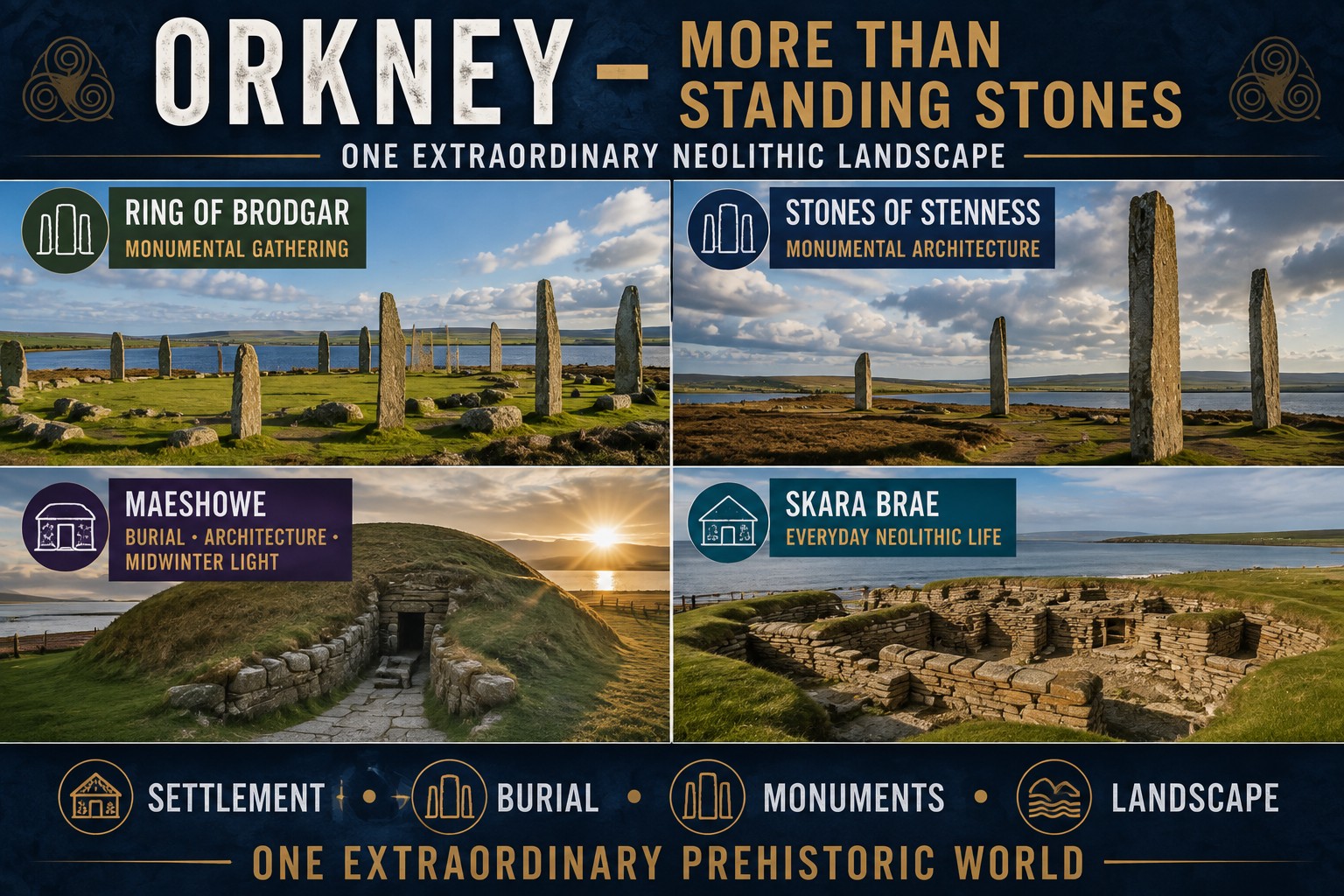
Orkney preserves far more than standing stones, with monumental circles, chambered tombs and remarkably preserved settlements revealing different dimensions of Neolithic life
🏝️ Orkney: A Complete Neolithic Landscape
Orkney’s archaeological importance lies not simply in the number of prehistoric sites, but in the different dimensions of Neolithic life that survive within the same wider landscape.
Rather than treating each monument as an isolated attraction, consider what each place adds to our understanding of the people who lived, gathered, built and buried their dead here thousands of years ago.
🏠 Skara Brae
Everyday Life and Settlement
Stone-built houses and surviving domestic features provide an extraordinary window into how Neolithic communities lived.
⚰️ Maeshowe
Burial, Architecture and Seasonal Light
A monumental chambered tomb demonstrating sophisticated construction and a striking relationship between architecture and the midwinter setting sun.
🗿 Stones of Stenness
Monumental Gathering
Enormous surviving stones demonstrate the scale and ambition of monument building within Orkney’s Neolithic ceremonial landscape.
🪨 Ring of Brodgar
Landscape-Scale Monumental Construction
A vast stone circle whose scale and setting reinforce the importance of understanding monuments as parts of a much larger prehistoric landscape.
🌍 The Wider Orkney Landscape
Understand the Relationships
Settlements, tombs and monumental places become more revealing when considered together. The objective is not simply to collect individual archaeological sites, but to understand how different places may have related to communities and the landscape around them.
🏠 Settlement + ⚰️ Burial + 🪨 Monument + 🌍 Landscape
= The Exceptional Power of Neolithic Orkney
🏝️ BVT Orkney Planning Principle: Don’t visit Orkney’s prehistoric sites simply as separate stops on a checklist. Their greatest value comes from seeing settlement, burial, monumental construction and landscape as parts of a much richer archaeological story.
The questions raised by Orkney extend well beyond individual monuments. Who were the people who created these places? How did their communities function? Why did particular locations matter enough to be transformed so dramatically?
Those questions become increasingly important when we later consider Scotland within the wider prehistoric world that also produced Stonehenge.
For travellers, however, Orkney’s immediate appeal lies in experiencing several dimensions of ancient life within one remarkable island setting. It is not simply somewhere to collect famous archaeological sites. It is a place where relationships between settlement, burial, monumental construction and landscape become unusually visible.
🌄 Beyond the Famous Islands: Scotland’s Other Ancient Landscapes
Calanais and Orkney may command international attention, but Scotland’s prehistoric archaeology extends far beyond its northern and western islands. Across the mainland and other islands, monuments survive within settings that reveal different traditions of burial, gathering and commemoration.
🌀 Kilmartin Glen
In Argyll, Kilmartin Glen offers one of Scotland’s richest concentrations of prehistoric remains. Burial cairns, standing stones and rock art occur across a relatively concentrated landscape where generations repeatedly created, used and encountered monuments.
Its strength for visitors lies in both density and diversity. Rather than seeing one prehistoric structure in isolation, it becomes possible to appreciate how different forms of archaeology occupied the same broader environment and how human significance accumulated across the landscape over long periods.
⚱️ Clava Cairns
Near Inverness, the Clava Cairns provide a distinctly different encounter. The surviving complex is principally a Bronze Age funerary landscape, with carefully constructed burial cairns, surrounding stones and other architectural features demonstrating that monumental traditions continued to develop long after the beginnings of Scotland’s Neolithic story.
Its Highland location also makes Clava particularly valuable for travellers already exploring northern Scotland. Here, archaeology need not feel separate from the scenic journey: the monument, surrounding terrain and wider Highland setting belong to the same experience.
Clava also reinforces an essential point. Not every dramatic arrangement of ancient stones in Scotland belongs to the same period, monument type or cultural tradition.
🪨 Machrie Moor
On Arran, Machrie Moor presents another variation on prehistoric Scotland. Stone circles and other ancient remains occupy an open island landscape beneath surrounding hills, creating a setting quite unlike either Calanais or Orkney.
Different monument forms survive here, reinforcing the importance of looking beyond the convenient label of “standing stones”. What visitors encounter is an archaeological landscape shaped at different times and for purposes that cannot always be reconstructed with certainty.
Together, Kilmartin, Clava and Machrie Moor expose one of the weaknesses in treating every ancient Scottish monument as essentially the same phenomenon.
Prehistoric Scotland did not follow one architectural blueprint. Communities created different forms of monuments, selected different settings and sometimes returned to significant places over many generations. The surviving remains are evidence of something considerably richer than one universal stone-building tradition: a long and varied prehistoric world whose regional and chronological differences are fundamental to its story.
🔍 What Do We Know—and What Remains a Mystery?
Ancient monuments naturally invite questions, and the absence of contemporary written explanations makes speculation almost inevitable. The challenge is to preserve the fascination of what remains unknown without allowing an attractive theory to become established fact.
🧑🌾 What Archaeology Can Tell Us
Archaeology provides considerably more evidence than the stones alone might suggest. Excavated settlements, pottery, tools, human and animal remains, burial practices and traces of farming can help reconstruct aspects of everyday life. Scientific dating can establish chronological frameworks, while materials discovered far from their geological or manufacturing sources can reveal wider networks of movement and exchange.
The location of archaeological remains also matters. Relationships between tombs, settlements, waterways, horizons and earlier monuments can help researchers investigate how particular places developed and were experienced across generations.
The result is not a complete biography of prehistoric people, but neither is it an empty canvas onto which any modern explanation can be projected.
Archaeology gives us evidence.
The next challenge is deciding what that evidence allows us reasonably to interpret.
🌌 What Archaeologists Can Interpret
Evidence can support interpretations involving communal gathering, ceremony, ancestors, identity and relationships between people and the natural world. At some monuments, orientation towards particular solar or celestial events provides important evidence that the sky and changing seasons influenced architectural choices.
The difficulty begins when possibility is presented as certainty.
Interpretation is not the same as invention—but neither is it the same as certainty.
A monument may also have accumulated different meanings during a long history. Places created by one generation could be altered, revisited or understood differently by people living centuries later. Searching for one permanent explanation can therefore oversimplify the archaeological record.
🔮 Druids, Merlin and Later Stories
Scotland’s ancient stones accumulated legends long after their original builders had disappeared from memory. Druids, giants, supernatural powers and figures such as Merlin became associated with prehistoric places as later generations attempted to explain monuments whose original meanings had already been lost.
These traditions are culturally fascinating, but chronology matters.
Scotland’s great Neolithic stone monuments were already ancient long before Druids appeared in surviving historical accounts. Merlin belongs to a much later legendary and literary world rather than the archaeological world of the people who originally raised Scotland’s prehistoric stones.
Separating those stories does not require dismissing either of them.
Archaeology asks what surviving material evidence can reveal about the original construction and use of a monument. Folklore reveals something different: how later communities interpreted, reimagined and continued to give meaning to ancient places.
That distinction allows both stories to become more interesting.
The stones can be appreciated as evidence of prehistoric communities without assigning their construction to Druids or legendary figures. Their later mythology can then be explored as part of the remarkable cultural afterlife of monuments that remained visible for thousands of years after knowledge of their original purposes had faded.
Ancient stones therefore possess more than one history: the prehistoric history of their creation and use, and the long human history of trying to explain them.
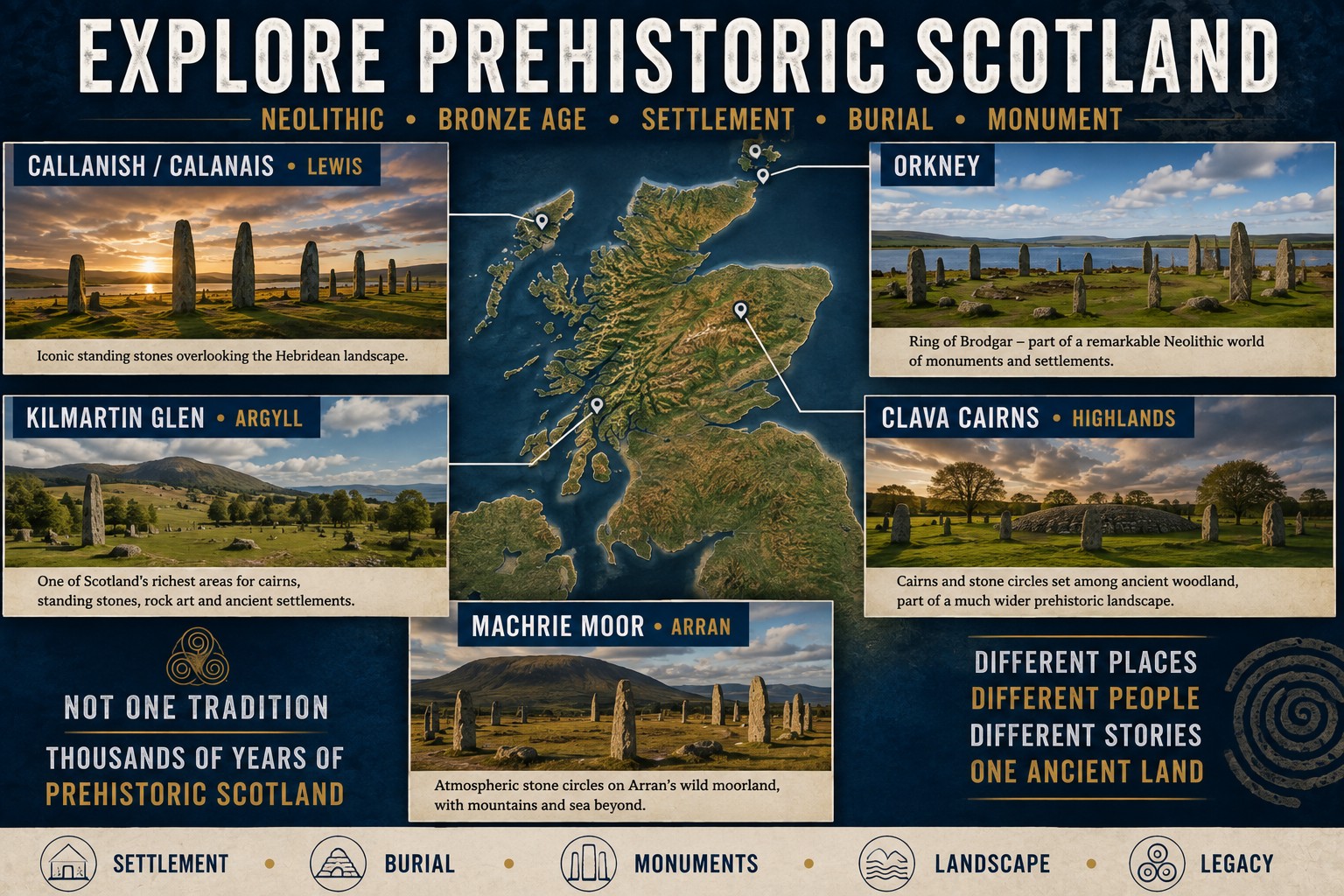
From Callanish and Orkney to Kilmartin Glen, Clava Cairns and Machrie Moor, Scotland’s prehistoric landscapes reveal thousands of years of different monuments, communities and traditions
🔮 Myth vs Archaeology: Two Different Stories
Scotland’s ancient stones belong to more than one story. Archaeology investigates the prehistoric communities that created and used these places. Myth and folklore reveal how people living centuries or millennia later interpreted, remembered and reimagined monuments whose original meanings had long been lost.
Both matter—but they answer different questions.
|
🪨 Prehistoric Archaeology ✓ Physical evidence ✓ Scientific dating ✓ Settlements ✓ Burials ✓ Construction ✓ Material culture ✓ Landscape relationships |
🔮 Later Myth & Folklore ◆ Druids ◆ Giants ◆ Merlin ◆ Supernatural traditions ◆ Later explanations of ancient places |
🧭 Ask the Right Question
🪨 Archaeology asks:
What can surviving evidence tell us about the people who built, used and experienced the original monument?
🔮 Folklore asks:
How did later generations understand, explain and reimagine an ancient place whose original meaning was no longer known?
Why the distinction matters
A prehistoric monument can acquire stories about druids, giants, Merlin or supernatural events many centuries after it was constructed. Those traditions can be culturally important without becoming evidence for who originally built the monument or why.
🪨 Prehistoric History + 🔮 Later Legendary History
Both can belong to the same ancient place—but they should not be confused with one another.
🔮 BVT Myth & Archaeology Principle: Ancient stones can have a prehistoric history and a later legendary history. Understanding when those different stories developed allows us to appreciate both without turning later folklore into prehistoric fact.
🌍 Ancient Scotland Was Not Isolated
Looking at Orkney or the Outer Hebrides on a modern map can encourage us to imagine prehistoric communities living at Britain’s distant northern edges. That perspective is heavily influenced by modern roads, driving times and our tendency to think of islands primarily in terms of remoteness.
For communities accustomed to travelling by water, the geography could look very different.
The sea could connect as well as separate.
Archaeological evidence demonstrates that prehistoric communities were not confined to tiny, self-contained worlds. People moved, technologies and practices could spread, and materials passed through networks of exchange over considerable distances. Objects made from stone and other resources originating far from where they were eventually used or deposited provide tangible evidence that connections extended beyond individual settlements.
That does not mean every distant community traded directly with every other one, nor that prehistoric Britain formed a single uniform culture. Materials and ideas could move through multiple communities and networks, while regional identities and distinctive traditions remained important.
Connectivity and diversity could exist at the same time.
Orkney is particularly important in challenging simplistic assumptions about prehistoric centres and margins. Its extraordinary settlements, monumental tombs and ceremonial architecture demonstrate that sophisticated communities were flourishing far to the north. The archaeological record encourages us to think of Neolithic Britain as dynamic and interconnected, with several important centres of activity rather than a world in which every significant development necessarily travelled north from southern Britain.
That wider perspective changes how Scotland’s standing stones should be understood.
Calanais, Brodgar and Stenness do not need to be treated as northern versions of monuments elsewhere to establish their importance. Each belongs to its own archaeological setting and history. Yet they also emerged within a prehistoric world in which people, materials, technologies and ideas were capable of travelling.
And that leads naturally to one of the most fascinating relationships in the story.
What happens when we place Scotland’s extraordinary prehistoric landscapes alongside Stonehenge—not to claim they are the same, but to understand the larger world in which monumental places were being created?
🪨 What Connects Scotland’s Ancient Stones with Stonehenge?
The relationship between Scotland’s prehistoric monuments and Stonehenge becomes most interesting when we resist trying to make them identical.
Calanais, the Ring of Brodgar, the Stones of Stenness and Stonehenge have different architectures, chronologies and individual histories. Stonehenge itself developed through multiple phases rather than appearing as the completed stone monument familiar today in a single act of construction.
There is therefore no sound basis for assuming that every monumental stone setting across Britain performed the same function or represented one universal system of belief.
What these places do reveal is something broader: communities across prehistoric Britain were capable of organising labour, moving substantial materials and transforming selected landscapes on an extraordinary scale.
🏛️ Part of the Wider Story of Neolithic Britain
Monument building required cooperation. Stones had to be selected, transported and erected; earthworks were constructed; tombs were engineered; and significant places could be maintained, altered or revisited across generations.
These were not casual additions to the landscape.
Their creation demonstrates that prehistoric communities could mobilise people, knowledge and resources around projects whose importance extended beyond ordinary domestic requirements. Across different regions, monumental structures could become components of wider archaeological landscapes containing settlements, burials and evidence of repeated human activity.
Similarities between distant monuments do not automatically reveal how those similarities arose. Shared traditions, movement of ideas, networks of contact and parallel developments may all form part of the archaeological discussion, and the surviving evidence does not always allow simple answers.
Nor does connection demonstrate identical ritual practice or a single religion extending across Britain.
Stonehenge belongs within this wider prehistoric story—but it does not provide a template against which every Scottish monument should be measured.
Understanding the relationship requires us to look in both directions: not simply asking what Stonehenge can tell us about Scotland, but what Scotland’s exceptional archaeology can contribute to our understanding of prehistoric Britain itself.
🧭 Orkney, Stonehenge and a Connected Prehistoric Britain
Orkney makes the wider picture particularly compelling. The sophistication and concentration of its Neolithic archaeology challenge any simplistic model in which innovation flowed in only one direction from southern Britain towards a passive northern periphery.
Researchers continue to investigate how people, materials, practices and ideas moved across Britain during the Neolithic. The evidence supports substantial interaction between regions, while the precise nature, direction and significance of many connections remain subjects of archaeological investigation and debate.
That distinction matters.
We do not need to claim that Orkney directly caused Stonehenge to develop, or that the builders of Scotland’s monuments travelled south to construct it, to recognise something more significant:
Neolithic Britain was interconnected, dynamic and capable of supporting several remarkable centres of settlement, innovation and monument building.
⚠️ What the Evidence Does Not Allow Us to Say
Connections across prehistoric Britain become less informative when uncertainty is replaced by convenient conclusions.
There is no justification for assuming that the people who erected Calanais also built Stonehenge. Similarities between monuments do not prove that every stone circle served one purpose, followed identical beliefs or belonged to a single organised religion.
Chronology also rules out one persistent misconception. Britain’s great Neolithic monuments were constructed thousands of years before Druids appeared in surviving historical accounts. Later traditions associated Druids with ancient stones, but that cultural association is not archaeological evidence identifying them as the original builders.
Astronomical relationships require similar care. Some monuments provide strong evidence that architecture was deliberately related to particular movements of the sun or other features of the sky. That does not make every apparent alignment intentional or every stone circle an astronomical observatory.
Perhaps most importantly, Scotland should not be treated as a prehistoric backwater merely copying ideas generated elsewhere.
The stronger archaeological picture is one of connection without uniformity: communities exchanging materials, practices and ideas while continuing to create distinctive monuments within their own regional landscapes.
🌍 Scotland and Stonehenge: Connection Without Uniformity
Prehistoric Britain was connected—but connection does not mean that every region shared the same monuments, beliefs or practices.
Scotland’s prehistoric landscapes and Stonehenge belong within a wider world in which people, materials, technologies and ideas could move over considerable distances. The important story is therefore one of connection alongside strong regional difference.
🏴 Scotland’s Prehistoric Landscapes
Distinctive regional monuments, communities and traditions
🚶 Movement Across Prehistoric Britain
People • Materials • Technologies • Ideas
🪨 Stonehenge and Southern Britain
Different monuments and communities within the wider prehistoric world
|
✓ What Connection DOES Suggest ✓ Britain was interconnected ✓ Substantial movement of people occurred ✓ Materials, technologies and ideas could travel considerable distances ✓ Multiple regions could become important prehistoric centres |
✗ What Connection DOES NOT Prove ✗ Identical religions across Britain ✗ Identical purposes for different monuments ✗ The same communities built every monument ✗ Scotland simply copied Stonehenge ✗ Orkney directly created Stonehenge |
🧭 A Better Way to Understand Prehistoric Britain
Think network rather than blueprint.
Communities could interact, exchange knowledge and participate in wider prehistoric developments while continuing to create monuments and traditions with distinctive regional identities.
🌍 Connected Does Not Mean Identical
The significance of prehistoric Britain’s connections becomes more interesting—not less—when its regional differences are preserved.
🪨 BVT Prehistoric Britain Principle: Scotland, Orkney and Stonehenge should not be forced into a single uniform story. The stronger interpretation recognises both the evidence for long-distance connections and the distinctive archaeological character of different prehistoric landscapes.
🌅 From Callanish to Stonehenge: Two Extraordinary Prehistoric Experiences
For modern visitors, one of the most revealing ways to understand prehistoric Britain is not to ask which monument is “better”, but to experience how differently ancient communities transformed particular places.
At Calanais, the journey is inseparable from Lewis itself. The stones rise within an expansive Hebridean setting of moorland, water, distant hills and Atlantic sky. Weather and light continually reshape the scene, while walking around the monument reveals relationships between stones, horizons and surrounding terrain that photographs can only partially capture.
The relative remoteness of Lewis also influences the experience. Reaching Calanais usually forms part of a wider island journey rather than a brief diversion from another major visitor destination. That encourages travellers to encounter the stones within the geography and character of the Outer Hebrides.
Stonehenge creates a very different experience.
Its monumental architecture occupies Salisbury Plain within an extensive prehistoric landscape containing burial monuments, earthworks and other archaeological remains. The famous stone setting is therefore only the most immediately recognisable element of a landscape shaped, used and revisited across many generations.
Callanish is not Scotland’s version of Stonehenge, and Stonehenge is not the template against which Scotland’s monuments should be judged.
Their differences are precisely what make experiencing both so valuable.
Travelling between these prehistoric worlds allows visitors to appreciate how communities separated by geography created monumental places with distinctive architectures and histories while participating in the broader transformations occurring across prehistoric Britain.
The connection is therefore not a claim that one monument explains the other. It is an invitation to look beyond individual stones.
From Lewis and Orkney to Salisbury Plain, archaeology reveals communities investing extraordinary effort in particular places and creating structures capable of surviving long after their original meanings became uncertain.
Seen together, Scotland and Stonehenge do not give us one simple prehistoric story.
They reveal just how varied—and how remarkable—that story was.
🪨 Continue the Prehistoric Journey at Stonehenge
Calanais and Orkney reveal extraordinary prehistoric Scotland. Stonehenge provides another remarkable chapter in the wider story of prehistoric Britain.
These landscapes should not be treated as identical or forced into a single story. Instead, visiting them reveals both the remarkable regional diversity of prehistoric Britain and the evidence that people, materials, technologies and ideas could move across considerable distances.
🏴 Scotland
→ Distinctive regional prehistoric landscapes
Standing stones, settlements, chambered tombs, cairns and other archaeological remains reveal different expressions of prehistoric life across Scotland and its islands.
🪨 Stonehenge
→ A monumental landscape on Salisbury Plain
Stonehenge belongs to a wider archaeological landscape of monuments and activity that developed over many generations in southern Britain.
🌍 Experience Both
→ Discover diversity and connectivity across prehistoric Britain
Comparing Scotland’s ancient landscapes with Stonehenge makes the wider prehistoric story richer: different monuments and regional traditions existed within a Britain where communities were not necessarily isolated from one another.
🧭 One Prehistoric Britain — Many Remarkable Landscapes
Explore Scotland for its distinctive ancient places, then continue the archaeological journey south to one of the world’s most famous prehistoric monuments.

Scotland’s prehistoric monuments and Stonehenge belonged to a wider interconnected British world, but different places developed their own monuments, landscapes and traditions
🚗 Planning a Prehistoric Scotland Journey
Scotland’s great prehistoric landscapes are spread across islands, Highlands and western regions, so the strongest itinerary rarely involves trying to collect as many monuments as possible. Calanais, Orkney, Kilmartin, Clava and Machrie Moor are not neighbouring attractions. Reaching them can involve substantial road journeys, ferries and weather-sensitive connections that deserve to be treated as part of the experience.
Regional depth usually produces the better trip.
A journey through the Outer Hebrides can place Calanais within the wider landscapes and communities of Lewis rather than reducing the island to one archaeological stop. Orkney deserves similar consideration because its prehistoric sites become substantially more meaningful when experienced together.
Travellers exploring the Inverness area can incorporate Clava into a wider Highland journey, while Kilmartin fits naturally within an exploration of Argyll. Machrie Moor provides Arran with its own distinctive prehistoric dimension.
Allowing sufficient time also gives changing weather, transport disruption and unexpected discoveries less power to derail an itinerary. Ferry arrangements for Lewis and Orkney should be checked carefully, particularly when accommodation or onward connections depend upon them. Current site access should also be confirmed before travelling, as conservation work, ground conditions or local circumstances can affect individual monuments.
Comfortable footwear is worthwhile. Many of the most memorable encounters with prehistoric Scotland involve spending time outdoors and appreciating the surrounding terrain rather than simply walking from a car park to a stone circle.
⛴️ Remote Archaeology Journey Checklist
Some of Scotland’s most rewarding prehistoric landscapes require more planning than the monument itself. For Lewis, Orkney and other remote archaeological journeys, transport, weather, accommodation and local access should be treated as part of the experience from the beginning.
✓ Check current monument access
Confirm opening arrangements, access conditions and any visitor restrictions before travelling.
✓ Confirm ferry arrangements
Treat important crossings as part of the itinerary rather than something to solve after accommodation and sightseeing are fixed.
✓ Secure critical accommodation
Remote destinations can have limited availability, particularly during popular travel periods.
✓ Allow weather contingency
Build enough flexibility into the journey to accommodate changing conditions and possible transport disruption.
✓ Allow realistic road time
Rural and island journeys can take considerably longer than distance alone suggests.
✓ Wear suitable footwear
Archaeological landscapes may involve uneven paths, open ground and exposed conditions.
✓ Expect variable ground conditions
Rain, drainage and seasonal conditions can substantially change the experience underfoot.
✓ Respect rural parking and access
Keep gates, entrances, passing places and essential local access clear.
✓ Leave time to explore beyond the monument
The surrounding landscape can be essential to understanding why a prehistoric place is significant.
✓ Check conservation restrictions before visiting
Follow current site guidance and respect temporary measures designed to protect vulnerable archaeology.
🏝️ Particularly Important for Lewis and Orkney
Remote archaeology is often inseparable from island geography. Ferry connections, weather, road time and accommodation availability can determine how much time you actually have to experience the prehistoric landscape.
⛴️ BVT Planning Tip: Don’t schedule a major archaeological site so tightly around a critical ferry or onward connection that you have no time to experience it properly. Where possible, build breathing room around the places that matter most.
The Journey Is Part of Experiencing Prehistoric Scotland.
🧭 Which Prehistoric Scotland Experience Suits You?
| Your Priority | Strong Starting Point |
|---|---|
| Iconic standing stones | Calanais |
| Rich interconnected Neolithic landscape | Orkney |
| Highland prehistoric archaeology | Clava Cairns |
| Cairns, standing stones and rock art | Kilmartin Glen |
| Atmospheric island stone circles | Machrie Moor |
| Wider prehistoric Britain | Scottish monuments and Stonehenge |
Whether the journey begins on Lewis, among Orkney’s extraordinary Neolithic remains or much farther south on Salisbury Plain, the most rewarding principle is the same: allow enough time to experience the landscape around the archaeology, not merely photograph the stones and move on.
🗺️ Build Your Prehistoric Scotland Journey
Scotland’s major prehistoric landscapes are spread across very different regions. The strongest itinerary usually begins with the part of Scotland you want to explore, then builds archaeological experiences naturally into that journey.
🌊 Outer Hebrides Journey
→ Calanais
Make the monumental stones part of a wider Lewis and Harris journey rather than treating the Outer Hebrides as a detour for a single archaeological site.
🏝️ Orkney Archaeology Journey
→ Ring of Brodgar + Stones of Stenness + Maeshowe + Skara Brae
Allow time to experience settlement, burial and monumental archaeology together within Orkney’s wider Neolithic landscape.
🏔️ Inverness and Highlands Journey
→ Clava Cairns
Add this Bronze Age funerary landscape naturally to a journey already exploring Inverness and the surrounding Highlands.
🌀 Argyll Journey
→ Kilmartin Glen
Give yourself time to explore a landscape containing cairns, standing stones, rock art and other evidence of repeated prehistoric activity.
🪨 Arran Journey
→ Machrie Moor
Combine the stone circles with the wider island experience rather than travelling to Arran simply to collect another prehistoric monument.
🧭 Choose Region → Build Route → Secure Transport → Allow Archaeological Depth
🗺️ BVT Prehistoric Scotland Planning Principle
Don’t build a Scotland itinerary by collecting famous stones from different regions. Geography matters. A smaller number of archaeological landscapes explored properly will usually create a richer journey than repeatedly crossing Scotland simply to add another monument to the list.
Explore the Region → Understand the Landscape → Then Understand the Monument
📅 Ancient Landscapes and the BVT Scotland Events Calendar
Scotland’s prehistoric monuments reveal communities separated from us by thousands of years. Modern events provide a very different opportunity: experiencing the islands, towns and regions surrounding those monuments as living places rather than archaeological landscapes alone.
A journey to Lewis, Orkney, Argyll, Arran or the Highlands may coincide with festivals, Highland Games, cultural gatherings or other seasonal events. Building one naturally into a longer itinerary can add another dimension to the journey, particularly when travelling considerable distances to reach Scotland’s islands and more remote regions.
There is no need to suggest direct continuity between Neolithic gatherings and modern Scottish traditions. Their histories are entirely different. The value lies in allowing a journey inspired by Scotland’s ancient past to include something of the communities and culture found there today.
The BVT Scotland Events Calendar provides a useful starting point for discovering festivals, Highland Games, seasonal celebrations and other events that may coincide with your proposed travel dates.
If a particular event becomes important to the journey, confirm current dates, programmes, admission arrangements and other essential details with the organiser before finalising accommodation and transport.
📅 Ancient Landscapes and Living Scotland
A journey inspired by Scotland’s prehistoric past can also become an opportunity to experience the communities and traditions of Scotland today.
Highland Games, island festivals, cultural gatherings, traditional events and seasonal celebrations can add a completely different dimension to a trip built around Calanais, Orkney, Kilmartin, Clava or other ancient landscapes.
🏴 Add Living Scotland to an Archaeology-Led Journey
🏆 Highland Games
Discover sporting traditions, piping, dancing and community gatherings that may coincide with a wider Highland or regional journey.
🏝️ Island Festivals
Music, culture and community events can add another layer to journeys through Lewis, Orkney and Scotland’s island regions.
🎻 Cultural and Traditional Gatherings
Experience contemporary Scottish traditions alongside a journey focused on much older archaeological landscapes.
🎉 Seasonal Celebrations
Events throughout the year can help shape the timing and character of a longer Scotland itinerary.
🗺️ Regional Journey Planning
If you are travelling considerable distances to reach ancient sites, a well-chosen event can become a natural part of the wider journey rather than an unrelated detour.
⚠️ An Important Historical Distinction
Modern Scottish events are not evidence of direct continuity with Neolithic gatherings. Highland Games, festivals and today’s cultural traditions have their own histories. The value of combining them with an archaeology-led journey is different: they allow visitors to experience the living communities and culture surrounding Scotland’s ancient landscapes today.
🪨 Ancient Landscapes + 🏴 Living Scotland
Explore the archaeology for what it reveals about the distant past, then experience today’s Scotland on its own terms.
📅 BVT Planning Tip: If a particular festival, Highland Games or island event matters to the journey, confirm current dates and arrangements before fixing accommodation and transport around it.
🌱 Protecting Scotland’s Prehistoric Landscapes
Standing beside a monument that has survived for several thousand years creates an unusual responsibility.
Archaeological sites are finite resources. Once physical evidence is damaged, displaced or eroded, information about the past can disappear with it. Responsible visiting therefore means more than simply taking litter home.
Use established paths where requested and respect barriers, conservation measures and individual site guidance. Avoid climbing on fragile monuments or treating ancient structures as props. Requirements around physical contact can differ between sites, so follow the guidance provided rather than assuming that the same rules apply everywhere.
Never remove or rearrange stones, artefacts or other material discovered around an archaeological site. Something that appears insignificant may retain archaeological value precisely because of where it lies.
Responsible behaviour protects not only what visitors can see today, but evidence that future archaeological research may still have the opportunity to understand.
Remote archaeological landscapes also require consideration beyond the monument itself. Park responsibly, respect working farmland and crofting communities, follow local access guidance and avoid disturbing livestock or wildlife. On islands and in rural areas, seemingly small visitor pressures can become significant when concentrated around a popular site.
Supporting local accommodation, cafés, shops, guides and other independent businesses can help ensure that journeys into ancient Scotland contribute something to the communities living alongside and caring for these remarkable places today.
Most importantly, leave the archaeological record undisturbed.
These monuments have survived for thousands of years. Responsible visiting helps ensure our generation is not the one that diminishes them.
Travel with purpose. Explore with care.
🌱 Protect Ancient Scotland
Scotland’s prehistoric monuments have survived for thousands of years, but archaeological landscapes are finite and sometimes fragile.
Responsible visiting means protecting both the ancient evidence beneath your feet and the living rural and island communities surrounding these remarkable places.
🥾 Stay on Established Routes Where Requested
→ Protect archaeological deposits and surrounding ground
Paths and designated access routes can help reduce erosion and unnecessary pressure on sensitive archaeological landscapes.
🛡️ Respect Barriers and Conservation Measures
→ Access restrictions exist for a reason
Temporary closures, barriers and conservation measures help protect archaeological evidence that cannot simply be replaced once damaged.
🪨 Never Climb Where Prohibited
→ Ancient structures are archaeology, not props
Treat standing stones, cairns, chambered structures and other prehistoric remains as irreplaceable archaeological evidence.
🔍 Never Remove or Rearrange Material
→ Archaeological context matters
Stones, artefacts and other material gain much of their archaeological value from where and how they survive. Leave everything exactly where you find it.
🐑 Respect Farmland and Crofting Communities
→ Ancient monuments exist within living landscapes
Follow local access guidance, respect livestock, use gates responsibly and remember that the landscape around an archaeological site may also be someone’s home and workplace.
🚗 Park Responsibly
→ Protect access for residents and other visitors
Use designated parking where available and never block gates, narrow roads, passing places or essential local access—particularly in remote Highland and island communities.
🏴 Support Local Communities
→ Let your visit contribute to the places protecting these landscapes
Where practical, use local accommodation, cafés, guides, shops and other independent businesses as part of the wider journey.
🌍 Archaeology and Landscape Belong Together
Protecting ancient Scotland means looking beyond the monument itself. Paths, surrounding ground, archaeological deposits and the communities that live around these sites are all part of responsible visiting.
These places survived thousands of years before us. Our responsibility is to leave them capable of surviving thousands more.
❓ Ancient Scotland and Standing Stones FAQs
❓ How Old Are Scotland’s Standing Stones?
There is no single age for Scotland’s standing stones. Different monuments were created at different times, and some archaeological landscapes developed, changed or were reused across many generations.
Many of Scotland’s famous monumental stone settings originate in the Neolithic or Bronze Age, placing their beginnings thousands of years before medieval Scotland. Archaeologists use associated deposits, artefacts, structures, scientific dating and other evidence to reconstruct when monuments were created or modified.
❓ Are Scotland’s Standing Stones Older Than Stonehenge?
Some Scottish monuments are extremely ancient, but the comparison cannot accurately be reduced to a simple yes or no.
Stonehenge itself developed through multiple phases, beginning long before the famous arrangement of large stones familiar today. Scotland’s standing stones, stone circles and other monuments likewise have different chronologies. Some Scottish prehistoric monuments pre-date particular phases at Stonehenge, while others are later.
The more revealing comparison is that communities across different parts of Britain were creating, altering and revisiting monumental landscapes during overlapping periods of prehistory.
❓ What Are the Most Famous Standing Stones in Scotland?
Calanais on Lewis is among Scotland’s most internationally recognisable standing-stone landscapes. Orkney’s Ring of Brodgar and Stones of Stenness are also among the country’s most important prehistoric stone monuments.
Machrie Moor on Arran and the archaeological landscapes around Kilmartin provide further opportunities to encounter stone circles, individual standing stones and other forms of prehistoric archaeology in very different settings.
❓ Is Callanish Scotland’s Stonehenge?
Callanish is sometimes described as “Scotland’s Stonehenge” because both places contain spectacular prehistoric stone monuments. It is an understandable shorthand, but archaeologically it can become misleading.
Calanais and Stonehenge have different architectures, settings, chronologies and individual histories. Neither needs the other to establish its importance.
Visiting both is valuable for precisely the opposite reason: they demonstrate the remarkable diversity of prehistoric monument building across Britain rather than representing Scottish and English versions of the same site.
❓ Why Were Standing Stones Built?
There was probably no single explanation applicable to every standing stone, stone circle or monumental complex.
Archaeological evidence can support interpretations involving communal gathering, ceremony, ancestors, identity and relationships with landscape. At some sites, relationships with seasonal or celestial events also appear significant. Individual monuments may have accumulated new purposes and meanings as later generations returned to them.
Where the evidence cannot establish a precise purpose, uncertainty should remain part of the answer.
❓ Did Druids Build Scotland’s Standing Stones?
There is no archaeological evidence identifying Druids as the builders of Scotland’s great Neolithic stone monuments. Many famous stone circles and monumental landscapes were already ancient by the periods in which Druids appear in surviving historical accounts.
The association developed much later as ancient monuments acquired new legends and interpretations. That later cultural history is fascinating in its own right, but it should not be confused with evidence concerning the original builders.
❓ What Are the Best Prehistoric Sites in Orkney?
The Ring of Brodgar, Stones of Stenness, Maeshowe and Skara Brae provide an exceptional introduction to Neolithic Orkney. Together they expose different dimensions of prehistoric life, from monumental gathering and burial to domestic settlement.
They are a starting point rather than an exhaustive list. Orkney contains a much richer archaeological record, making the islands particularly rewarding for travellers who want to explore prehistoric Scotland in greater depth.
The real strength of visiting Orkney is not simply the number of ancient sites. It is the opportunity to begin seeing them as parts of a connected prehistoric landscape.
❓ Can You Visit Scotland’s Standing Stones?
Many of Scotland’s standing stones, stone circles and other prehistoric monuments can be visited, although access arrangements vary considerably.
Some are managed visitor sites with established paths, interpretation and facilities. Others occupy open landscapes where parking may be limited and conditions underfoot can change quickly. Island locations can also require considerably more journey planning than their apparent distance on a map suggests.
Check current access information before travelling, particularly for remote sites. Conservation measures, weather, ground conditions, transport disruption and local circumstances can all influence how a monument can be experienced.
❓ What Is the Connection Between Orkney and Stonehenge?
Orkney and Stonehenge both belong within the wider story of Neolithic Britain, when communities were constructing monumental places while people, materials, technologies and ideas moved through networks extending across considerable distances.
Orkney’s exceptional archaeology demonstrates that northern Britain contained sophisticated and important centres of Neolithic activity. Research into relationships between different regions continues, but evidence for wider connectivity should not be transformed into a simplistic claim that Orkney directly created Stonehenge or that the same people necessarily built both.
Their relationship is more valuable when understood as evidence of an interconnected but diverse prehistoric Britain.
❓ Which Prehistoric Scottish Site Should I Visit First?
Choose according to the wider journey you want to make.
For the Outer Hebrides, Calanais is the natural starting point. If prehistoric archaeology is a major reason for travelling, Orkney offers an exceptional concentration of settlements, tombs and monumental sites. Around Inverness, Clava Cairns fits naturally into a Highland itinerary, while Kilmartin Glen rewards travellers exploring Argyll. On Arran, Machrie Moor combines island scenery with a distinctive prehistoric landscape.
There is no requirement to visit the most famous monument first.
The better choice is the place that fits your route and allows enough time to understand what surrounds the stones. A slower encounter with one archaeological landscape will usually reveal more than a hurried attempt to collect several.
🌄 Final Thoughts: Scotland Before Scotland
Long before Edinburgh became a capital, before medieval castles guarded strategic landscapes and before clans and kings shaped the Scotland recorded in written history, people were already creating remarkable communities across these islands and mainland regions.
They farmed, built homes, travelled by land and sea, exchanged materials, buried their dead and gathered together. They also invested extraordinary knowledge, cooperation and labour in monuments whose surviving stones continue to command attention thousands of years later. Much later, ancient places would accumulate new traditions and legends—including stories involving Druids, giants and figures such as Merlin—as successive generations tried to explain an increasingly distant past.
At Calanais, traces of that earlier world stand beneath the Atlantic skies of Lewis. In Orkney, settlements, chambered tombs and monumental stone settings reveal different dimensions of a sophisticated Neolithic society. At Kilmartin, Clava and Machrie Moor, the archaeological picture expands again, demonstrating that prehistoric Scotland cannot be reduced to one monument type, one period or one convenient explanation.
Stonehenge adds another perspective.
From Scotland’s islands and Highlands to Salisbury Plain, prehistoric Britain survives not as one simple story carved in stone, but as numerous regional stories whose communities were capable of connection. People and materials moved, ideas and practices travelled, and monumental traditions developed—yet individual places retained distinctive architectures, histories and relationships with their surroundings.
That combination of connection without uniformity may be one of the most important things these archaeological landscapes can teach us.
We may never recover everything the stones meant to the people who raised them. Archaeology can take us remarkably far, but some questions remain beyond the surviving evidence.
That does not diminish these places. It gives us another reason to approach them with curiosity, patience and respect—to look beyond the monument, explore the landscape around it and remember that every stone was once part of somebody’s living world.
Perhaps the unanswered questions are not a weakness in their story. They are part of why we continue returning to the stones.
🚌 Explore Scotland Tours
Scotland’s prehistoric landscapes are spread across cities, Highlands, islands and remote rural regions. Once you have decided which parts of ancient Scotland you most want to experience, the next decision is how much of the wider country you want to build around them.
A focused day tour can add history and scenery to a city-based stay, while a multi-day journey creates far greater possibilities for reaching the Highlands, islands and more distant landscapes.
|
🏴 Scotland Day Tours Best suited to visitors using a Scottish city or established gateway as their base and wanting to add a focused historic or scenic experience without changing accommodation. ✓ Focused regional exploration ✓ Historic and scenic journeys ✓ Return to your existing base ✓ Useful when Scotland forms part of a shorter trip |
🏔️ Scotland Multi-Day Tours Best suited to travellers wanting to reach Highlands, islands and more distant Scottish landscapes, where overnight regional travel opens substantially greater possibilities. ✓ Highlands and scenic regions ✓ Island and west-coast journeys ✓ Overnight regional exploration ✓ More time to experience landscapes in context |
🧭 Match the Tour to the Geography
City-based and focused journey? Consider a day tour.
Highlands, islands or deeper regional exploration? Give Scotland more time with a multi-day journey.
🪨 BVT Planning Principle: Ancient places are most rewarding when they belong naturally to the wider journey. Choose the Scotland experience first, then select the touring style that gives its landscapes enough time.
🧭 Continue Exploring Ancient Britain
Scotland’s standing stones, settlements and ceremonial landscapes form one remarkable chapter in the story of prehistoric Britain—but not the only one.
Continue the journey through archaeology, landscape and later legend, or compare Scotland’s prehistoric world with Stonehenge and the monumental landscapes of southern Britain.
🪨 Explore Stonehenge
Continue south to one of the world’s most famous prehistoric monuments and experience another extraordinary landscape within the wider story of ancient Britain.
🌅 Discover Stonehenge Beyond the Main Visit
Explore opportunities for special access and plan around available Stonehenge Inner Circle dates.
🏴 Explore Scotland’s Prehistoric Landscapes
Continue through Scotland’s standing stones, stone circles and ancient landscapes and discover how archaeology changes from region to region.
🏝️ Continue to Orkney and the Outer Hebrides
Go deeper into the island landscapes surrounding some of Scotland’s most extraordinary prehistoric archaeology.
🔮 Explore the Legends That Grew Around Scotland’s Ancient Stones
Discover the later stories of Merlin, druids and supernatural traditions that became attached to ancient places long after their prehistoric origins.
🪨 Archaeology → 🔮 Legend → 🌍 Landscape → Stonehenge
Follow the connections while preserving the differences that make each ancient landscape remarkable.