


Britain’s Most Legendary Places: From Stonehenge to Merlin’s Scotland (2026 Guide)
1st August 2026
🏛️ Britain’s Most Legendary Places: From Stonehenge to Merlin’s Scotland (2026 Guide)
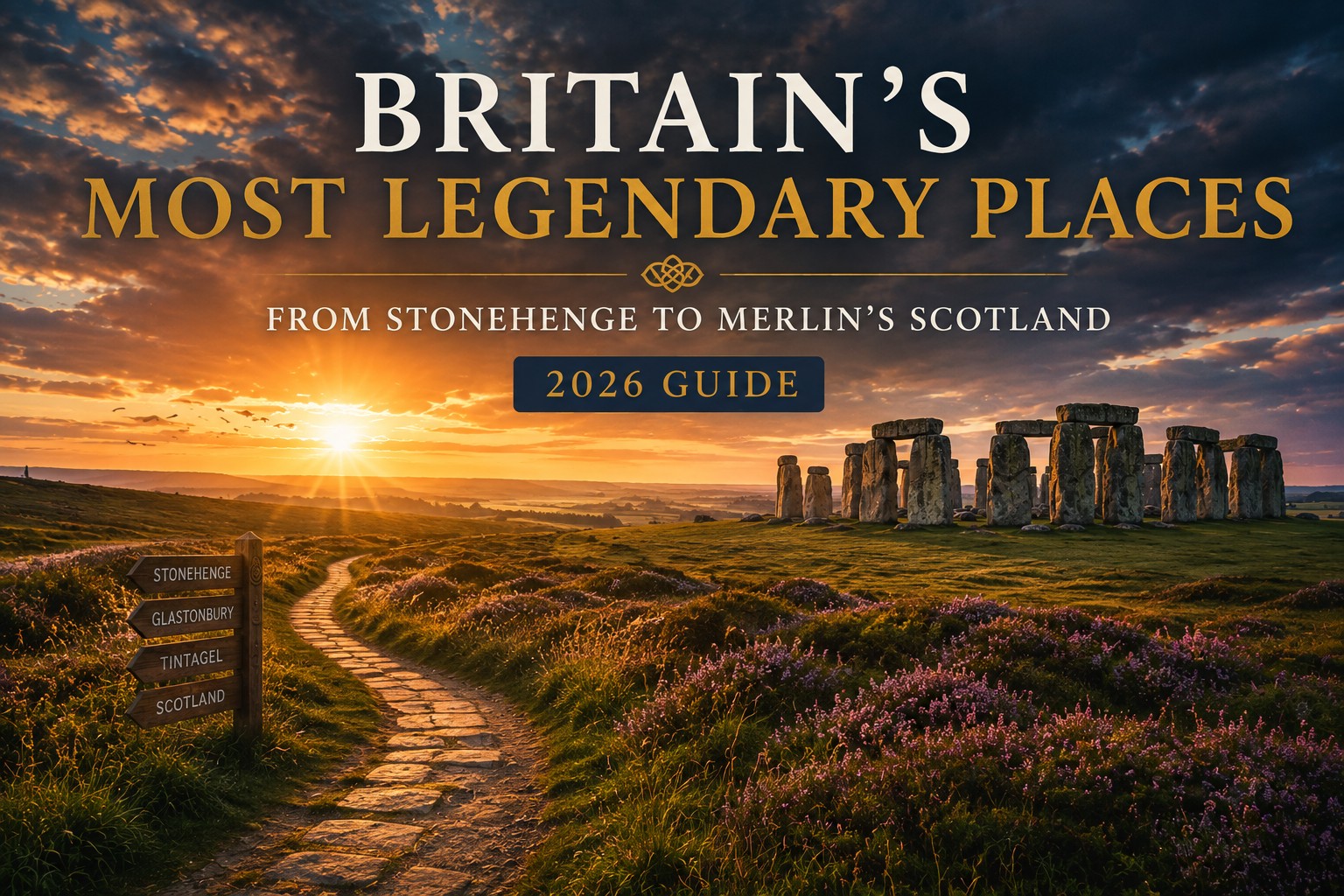
Britain’s greatest legends are connected by more than stories. From Stonehenge to Merlin’s Scotland, this journey follows remarkable landscapes where archaeology, history and mythology have shaped the nation’s cultural heritage
Britain’s most legendary places are not confined to a single region, historical period or tradition. They stretch from prehistoric monuments and ruined castles to volcanic hills, remote border valleys and islands shaped by centuries of folklore. Together, they form a travel landscape where archaeology, medieval literature and local storytelling continually overlap.
This journey begins at Stonehenge, Britain’s most recognisable prehistoric monument and one of the strongest starting points for exploring the country’s legendary past. From Salisbury Plain, the route moves west through the Arthurian traditions of Glastonbury and Tintagel before turning north towards Edinburgh, Drumelzier and the wider mythical landscapes associated with Merlin’s Scotland.
The places are real, but the stories attached to them vary greatly. Some are supported by archaeology. Others were shaped by medieval writers, local traditions or much later romantic interpretation. The richest experience comes not from treating every legend as fact, but from understanding how each place acquired meaning across different generations.
Stonehenge provides the prehistoric opening chapter. Arthurian England carries the journey into medieval imagination. Scotland reveals how Merlin’s legendary afterlife expanded far beyond the world of Camelot and became rooted in new landscapes, communities and traditions.
Some journeys follow roads. This one follows Britain’s greatest stories.
🗺️ Britain’s Legendary Places at a Glance
Britain’s greatest legendary journey stretches from prehistoric monuments and medieval castles to ancient hills, remote valleys and dramatic islands. Here’s a quick overview of the remarkable places you’ll discover throughout this guide.
| Destination | Best Known For | Legendary Connection |
|---|---|---|
| 🪨 Stonehenge | Britain’s greatest prehistoric monument | Merlin, Druids and the Giants’ Dance |
| 👑 Glastonbury | Historic abbey and Glastonbury Tor | Avalon and the legendary resting place of King Arthur |
| 🏰 Tintagel | Dramatic Cornish castle and coastline | Traditional birthplace of King Arthur |
| ⚔️ Winchester | Historic cathedral city | Later traditions linking the city with Camelot and the Round Table |
| 🧙 Drumelzier | Peaceful Scottish Borders village | Britain’s strongest traditional association with Merlin’s grave |
| ⛰️ Arthur’s Seat | Ancient volcanic hill overlooking Edinburgh | Arthurian landscape and legendary Scottish setting |
| 🏔️ Isle of Skye & Highlands | Britain’s most dramatic natural scenery | Gaelic folklore, fairy traditions and Scotland’s mythical landscapes |
✨ Your Legendary Journey
This guide begins at Stonehenge, where archaeology and legend first meet, before following Britain’s most celebrated stories west through Arthurian England and north into Merlin’s Scotland. Together, these remarkable destinations create one of Britain’s richest cultural and travel experiences.
🪨 Stonehenge — Where the Legendary Journey Begins
Stonehenge is an ideal starting point because it combines physical antiquity with an extraordinary cultural afterlife. Its earliest construction began around 3000 BC, while the major stone settings developed later during the Neolithic period. The communities responsible left no written explanation of what the monument meant to them, allowing later societies to interpret the stones through their own beliefs and imagination.
That absence of a surviving prehistoric narrative did not make Stonehenge empty of meaning. It made the monument remarkably open to reinterpretation. Medieval chroniclers connected it with Merlin and the Giants’ Dance, antiquarians later associated it with the Druids, and modern visitors continue to approach it through archaeology, folklore, astronomy and personal curiosity.
Stonehenge therefore offers three distinct but connected experiences. Archaeology reveals what physical evidence can tell us about its construction and landscape. Legend records how later generations tried to explain it. The modern visitor experience brings those histories together in one of Britain’s most atmospheric heritage settings.
Stonehenge is not the birthplace of every British legend. It is something more useful for this journey: the place where prehistory, storytelling and travel meet with exceptional force.
🔍 Why Stonehenge Inspired So Many Legends
Stonehenge invited legend because it combined visible human achievement with the loss of its original voice. The stones were enormous, the builders were unknown to later generations, and the monument stood within a landscape already ancient by the time written British traditions developed. For medieval chroniclers and early antiquarians, the site seemed to demand an explanation equal to its scale.
Geoffrey of Monmouth supplied one of the most influential. In his twelfth-century narrative, Merlin transported the Giants’ Dance from Ireland to Salisbury Plain, giving Stonehenge a dramatic legendary origin. Centuries later, antiquarians strengthened associations with the Druids before modern archaeological dating demonstrated that the monument predated the historical Druids by more than two millennia.
These traditions are not archaeological explanations, but they remain part of Stonehenge’s cultural history. They show how later generations responded to an ancient monument whose original meanings were no longer accessible. Rather than diminishing the site, understanding these layers helps visitors distinguish prehistoric evidence, medieval legend and modern interpretation while appreciating why Stonehenge continues to hold such imaginative power.
📊 Why Stonehenge Became Britain’s Legendary Starting Point
| Layer | What It Contributes |
|---|---|
| Prehistoric evidence | Reveals the monument’s construction, landscape and changing use over many centuries. |
| Medieval legend | Connects Stonehenge with Merlin, giants, kingship and remembrance. |
| Later interpretation | Adds Druidic associations, antiquarian theories and modern cultural meanings. |
| Visitor experience | Brings archaeology, atmosphere and storytelling together in one place. |
This combination makes Stonehenge more than a celebrated ancient monument. It becomes the opening gateway into a much wider journey through legendary places in Britain.
⏳ Five Thousand Years of Britain’s Legendary Landscape
Britain’s legendary places belong to very different historical periods. This timeline shows how prehistoric Stonehenge, Arthurian tradition and Merlin’s later Scottish associations became connected across more than five thousand years.
c. 3000 BC
Stonehenge Begins
Prehistoric communities create the monument’s earliest earthwork enclosure on Salisbury Plain.
c. 2500 BC
The Great Stone Settings Rise
The major sarsen circle, trilithons and bluestone arrangements create the monument recognised today.
Late Iron Age and Roman Period
The Historical Druids Enter Written History
Classical writers describe Druids in Britain and Gaul, more than two thousand years after Stonehenge’s principal construction.
5th–6th Centuries AD
The Traditional Age of Arthur
Later legend places King Arthur and the earliest traditions behind Merlin within post-Roman Britain.
c. AD 1136
Merlin Becomes Linked with Stonehenge
Geoffrey of Monmouth describes Merlin transporting the Giants’ Dance from Ireland to Salisbury Plain.
Medieval to Early Modern Period
Arthurian and Merlin Traditions Spread
Tintagel, Glastonbury, Winchester, Drumelzier and other real landscapes become increasingly associated with Britain’s legendary figures.
Modern Britain
History, Archaeology and Legend Meet
Scientific research clarifies the true age of Britain’s ancient places while literature, folklore and travel keep their legendary traditions alive.
💡 The Essential Timeline
Stonehenge came first. Arthurian tradition developed thousands of years later, while Merlin’s strongest literary and Scottish associations emerged later still. The destinations are connected not by one historical period, but by centuries of storytelling layered onto Britain’s extraordinary landscapes.
👑 Following King Arthur Across England
From Stonehenge, the route naturally moves into Arthurian England. Unlike Stonehenge, which belongs securely to prehistory, Arthurian tradition emerges from the poorly documented centuries following the end of Roman rule and expands dramatically through medieval literature.
The historical Arthur, if he existed, remains difficult to identify with confidence. Yet the legend became attached to real landscapes across England, particularly places that medieval writers, local traditions and later travellers connected with Camelot, Avalon, Excalibur and the birth or burial of Britain’s ideal king.
👑 Arthurian England: Where Legend Meets the Landscape
King Arthur remains Britain’s most celebrated legendary ruler, not because historians have proved every detail of his story, but because successive generations transformed him into a symbol of courage, leadership and hope. His legend grew from early Welsh traditions before expanding dramatically through medieval literature, eventually becoming intertwined with castles, abbeys and historic towns across England.
Travelling through these places reveals something important about Britain’s legendary landscape. The locations themselves are genuine, their histories are fascinating, and their Arthurian associations vary from long-established medieval tradition to later interpretation. Appreciating both the historical evidence and the evolution of the legends creates a far richer experience than viewing either in isolation.
🔍 Tintagel — Where Arthur’s Story Begins
Few places are more closely associated with King Arthur than Tintagel Castle on Cornwall’s dramatic Atlantic coast.
According to medieval tradition, particularly Geoffrey of Monmouth and later writers, Tintagel was Arthur’s birthplace. Archaeology tells a different, though equally compelling, story. Excavations have revealed that Tintagel was an important high-status settlement during the post-Roman period, demonstrating that the site held genuine political significance during the centuries when an historical Arthur, if one existed, may have lived.
Although archaeology cannot confirm Arthur’s birth there, standing on Tintagel’s windswept cliffs makes it easy to understand why medieval storytellers chose such a dramatic location for Britain’s greatest legendary king.
🔍 Glastonbury — Avalon and Britain’s Greatest Mystery
From Cornwall, the journey naturally continues to Glastonbury, where history and legend become even more closely intertwined.
For centuries, Glastonbury has been associated with the mythical island of Avalon, the place where Arthur was taken after the Battle of Camlann. During the twelfth century, monks at Glastonbury Abbey announced that they had discovered the graves of Arthur and Queen Guinevere. The claim attracted pilgrims from across medieval Europe, although modern historians regard the discovery as highly questionable.
Whether or not Avalon truly lay at Glastonbury, the abbey and the nearby Glastonbury Tor remain among Britain’s most evocative historic landscapes, where medieval tradition continues to enrich the visitor experience.
📊 England’s Legendary Arthurian Places
| Destination | Legendary Association | What History Can Confirm | Why Visit |
|---|---|---|---|
| Tintagel Castle | Arthur’s traditional birthplace | High-status post-Roman settlement with strong medieval importance | Spectacular coastal scenery and Arthurian interpretation |
| Glastonbury | Avalon and Arthur’s legendary burial | Medieval abbey, pilgrimage centre and centuries of evolving tradition | Historic abbey, Glastonbury Tor and rich folklore |
| Winchester | Frequently linked with Camelot | Medieval city; the famous Round Table display dates from the medieval period rather than Arthur’s lifetime | Cathedral, Great Hall and one of England’s finest historic cities |
These destinations are connected not because they prove Arthur’s existence, but because together they illustrate how Britain’s landscapes became inseparable from one of the world’s greatest literary traditions.
Following that tradition north reveals another fascinating development.
While Arthur’s story is most closely associated with southern Britain, Merlin’s legendary afterlife expands far beyond Camelot, leading naturally into Scotland.
👑 From King Arthur’s England to Merlin’s Scotland
Britain’s legendary journey does not end with one king, one wizard or one landscape. Continue from Stonehenge through the Arthurian traditions of southern England before following Merlin’s story north into Scotland.
⚔️ Stonehenge & King Arthur Sites Tour
Follow a legendary journey connecting Stonehenge with the landscapes, castles and traditions associated with King Arthur across southern England.
🏰 Tintagel Castle & King Arthur
Discover the dramatic Cornish stronghold traditionally associated with Arthur’s birth, where archaeology, medieval history and legend meet above the Atlantic coast.
🗺️ Britain’s Most Legendary Places
You are here: this guide connects prehistoric Stonehenge, Arthurian England and Merlin’s Scotland into one continuous journey through Britain’s most remarkable legendary landscapes.
🧙 The Journey Continues North
Arthur’s legends lead through Tintagel, Glastonbury and Winchester. Merlin’s later traditions then carry the journey into Drumelzier, Edinburgh and Scotland’s wider mythical landscapes—creating a cultural bridge between two of Britain’s greatest legendary traditions.
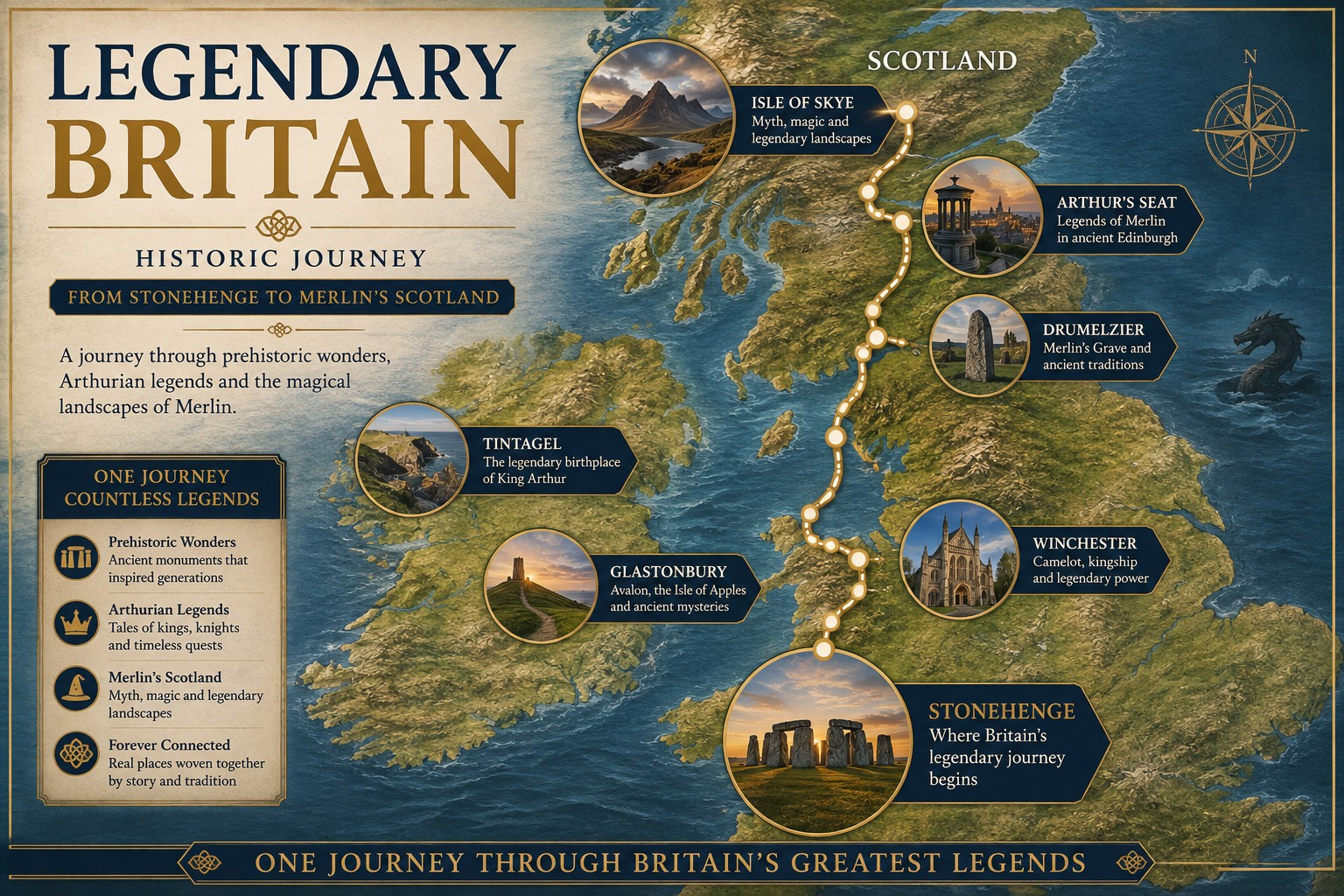 This illustrated journey map links Britain’s most iconic legendary destinations, tracing a route from prehistoric Stonehenge through Arthurian England and onwards to Merlin’s Scotland
🧙 Following Merlin North into Scotland
For many travellers, Merlin seems inseparable from King Arthur and Camelot. Yet one of the most fascinating aspects of Britain’s legendary landscape is that Merlin’s story does not end in southern England. As medieval traditions spread and local folklore evolved, Merlin gradually became associated with parts of Scotland, creating a remarkable cultural bridge between the two nations.
This evolution reflects the way great legends often develop. Rather than remaining fixed to one location, they adapt to new landscapes and communities, allowing different regions to embrace familiar characters while adding traditions of their own.
For modern visitors, following Merlin north is about far more than tracing one legendary figure. It is an opportunity to experience some of Britain’s most spectacular scenery while exploring places where mythology, medieval literature and local folklore continue to shape the visitor experience.
🔍 Drumelzier — Merlin’s Most Famous Scottish Association
Among all the places connected with Merlin in Scotland, Drumelzier in the Scottish Borders possesses the strongest traditional association.
According to long-standing local tradition, the village marks the place where Merlin—often identified with the legendary Myrddin—met his end and was buried near the meeting of the River Tweed and Powsail Burn. While historians cannot verify this tradition as historical fact, it has formed part of the Borders’ folklore for centuries and remains one of the most significant Merlin locations in Britain.
Unlike many later literary associations, Drumelzier’s connection feels deeply rooted in the surrounding landscape. The peaceful valley, ancient woodland and gently flowing rivers create an atmosphere that makes it easy to appreciate why local communities preserved Merlin’s story here for generations.
🔍 Arthur’s Seat and Edinburgh
Travelling north to Edinburgh introduces another important legendary landscape.
Arthur’s Seat, the extinct volcano rising above Scotland’s capital, owes its name to long-standing Arthurian tradition rather than to a direct Merlin connection. Even so, it forms part of the wider legendary geography linking Arthur, Merlin and Britain’s medieval imagination.
From its summit, visitors enjoy panoramic views across Edinburgh, the Firth of Forth and the surrounding countryside. It is a place where geology, history and legend combine naturally, demonstrating how Britain’s most memorable stories often became attached to landscapes of exceptional character.
🔍 Beyond the Borders — Highlands and Skye
Further north, the Scottish Highlands and the Isle of Skye belong less to Merlin himself than to Scotland’s wider world of myth and folklore.
The Highlands are renowned for ancient glens, remote lochs and dramatic mountains that have inspired countless tales of prophecy, clans, warriors and supernatural encounters. Skye, meanwhile, is celebrated for its Fairy Pools, rugged Cuillin mountains and rich Gaelic storytelling traditions.
These are not primary Merlin sites in the historical or literary sense.
Instead, they complete the wider mythical landscape of Scotland, helping visitors understand why Merlin’s later traditions found such a natural home north of the border.
📊 Merlin’s Scotland at a Glance
| Destination | Type of Legendary Connection | Why Visit |
|---|---|---|
| Drumelzier | Strong local Merlin tradition | Traditional site of Merlin’s grave and peaceful Borders scenery |
| Arthur’s Seat | Arthurian landscape | Panoramic Edinburgh views and legendary associations |
| Scottish Highlands | Broader Scottish folklore | Ancient landscapes, glens, lochs and enduring mythology |
| Isle of Skye | Gaelic folklore and fairy traditions | Spectacular scenery, Fairy Pools and island legends |
Together, these destinations reveal that Merlin’s Scotland is not defined by one single location but by an evolving legendary landscape. The strongest traditions remain centred on Drumelzier, while the wider Scottish scenery provides the atmospheric backdrop that has helped Merlin’s story flourish for centuries.
🗺️ Legendary Britain Route Map
Britain’s greatest legendary journey unfolds naturally from south to north. Beginning at Stonehenge, the route follows Arthurian England before continuing into Merlin’s Scotland, linking some of the country’s most remarkable historic and legendary landscapes.
| Journey | Destination | Why It Matters |
|---|---|---|
| ① | 🪨 Stonehenge Wiltshire |
The starting point where prehistory, archaeology and legend first come together. |
| ⬇️ | Journey west into Arthurian England | |
| ② | 👑 Glastonbury Somerset |
Avalon, Arthurian tradition and Britain’s greatest legendary mystery. |
| ③ | 🏰 Tintagel Cornwall |
The traditional birthplace of King Arthur on Cornwall’s spectacular coast. |
| ④ | ⚔️ Winchester Hampshire |
Later traditions connect the city with Camelot and the Round Table. |
| ⬆️ | Continue north into Merlin’s Scotland | |
| ⑤ | 🧙 Drumelzier Scottish Borders |
Britain’s strongest traditional association with Merlin’s grave. |
| ⑥ | ⛰️ Arthur’s Seat Edinburgh |
A legendary landscape overlooking Scotland’s historic capital. |
| ⑦ | 🏔️ Highlands & Isle of Skye | The journey concludes among Scotland’s most dramatic mythical landscapes. |
🧭 One Journey, Many Stories
Although these destinations belong to different historical periods, together they create one remarkable travel route through Britain’s prehistoric monuments, Arthurian traditions and Merlin’s enduring Scottish legacy. Each stop builds naturally upon the one before it, transforming individual landmarks into one unforgettable legendary journey.
🏔️ Legendary Landscapes That Shaped Britain’s Greatest Stories
Britain’s greatest legends have survived not simply because of memorable characters, but because they became inseparable from extraordinary landscapes.
Across the country, prehistoric monuments, rugged coastlines, ancient hills, remote valleys and mist-covered mountains have inspired generations of storytellers. These places possess a timeless quality that encourages curiosity. Even before visitors learn the history behind them, many instinctively feel that they have stepped into landscapes where remarkable stories belong.
Stonehenge demonstrates this perfectly. Rising from the open chalk downland of Salisbury Plain, the monument commands the surrounding landscape in a way that immediately captures the imagination. The stones themselves are extraordinary, but so too is the setting that frames them. It is easy to understand why medieval writers believed such a place deserved equally extraordinary legends.
The same pattern repeats across Britain. Dramatic locations became natural homes for kings, wizards, saints, warriors and mythical creatures because their landscapes already possessed an atmosphere that invited storytelling.
Rather than creating the legends, the landscapes helped sustain them.
📊 Britain’s Legendary Landscapes
| Destination | Historical Importance | Legendary Tradition | Why It Continues to Inspire |
|---|---|---|---|
| Stonehenge, Wiltshire | One of Europe’s greatest prehistoric monuments | Merlin, Druids and the Giants’ Dance | Combines archaeology, mystery and an unforgettable landscape |
| Tintagel, Cornwall | High-status post-Roman settlement | King Arthur’s traditional birthplace | Dramatic Atlantic cliffs and medieval romance |
| Glastonbury, Somerset | Historic abbey and pilgrimage centre | Avalon and Arthurian traditions | Spiritual atmosphere, Tor and centuries of legend |
| Drumelzier, Scottish Borders | Historic Borders landscape | Merlin’s traditional grave | Peaceful rivers, woodland and enduring local folklore |
| Isle of Skye | Ancient Highland island | Fairy traditions and Gaelic mythology | Spectacular scenery, waterfalls and mountain landscapes |
Although each destination tells a different story, together they demonstrate how Britain’s landscapes became lasting companions to its greatest legends.

From Stonehenge and Tintagel to Arthur’s Seat and the Isle of Skye, Britain’s legendary landscapes combine prehistoric monuments, medieval tradition and spectacular scenery into one unforgettable journey
🗺️ Planning Your Own Legendary Britain Journey
One of the pleasures of exploring Britain’s legendary places is discovering how naturally they build upon one another. Rather than treating each destination as an isolated attraction, consider them chapters within one continuous journey through Britain’s cultural history.
For first-time visitors, Stonehenge provides the perfect introduction. From there, a journey west through Glastonbury and Tintagel follows the heart of Arthurian England before continuing north into Scotland, where Drumelzier, Edinburgh and the wider legendary landscapes of the Borders and Highlands provide a fitting conclusion.
It is worth remembering that Britain may appear compact on a map, but these destinations are spread across considerable distances. Allowing adequate travel time transforms the experience from a rushed checklist into an enjoyable exploration, giving each landscape the opportunity to tell its own story.
📊 Suggested Legendary Britain Itineraries
| Time Available | Recommended Journey | Best For |
|---|---|---|
| 1 Day | Stonehenge | First introduction to Britain’s legendary landscape |
| 3 Days | Stonehenge, Glastonbury and Tintagel | Arthurian England and prehistoric Britain |
| 5 Days | Stonehenge, Glastonbury, Tintagel and Winchester | A deeper exploration of England’s legendary heritage |
| 7–10 Days | Stonehenge, Arthurian England, Edinburgh, Drumelzier and selected Highland destinations | A complete journey from prehistoric Stonehenge to Merlin’s Scotland |
Whether you choose a single destination or a journey across both England and Scotland, Britain’s legendary places reward travellers who take time to appreciate both the evidence of history and the enduring power of imagination.
⚖️ History vs Legend: Two Ways to Experience Britain
Britain’s legendary places are most rewarding when visitors appreciate both the evidence of history and the power of storytelling. Each perspective adds something different to the journey.
| 🏛️ History & Archaeology | 📖 Legend & Tradition |
|---|---|
| Examines physical evidence, documented history and archaeological research. | Explores medieval literature, local folklore and stories passed between generations. |
| Helps explain when monuments, castles and settlements were created and how they developed. | Helps explain why later communities connected those places with kings, wizards and mythical events. |
| Shows what can be supported through excavation, dating, written records and material evidence. | Shows how imagination, cultural memory and identity shaped the meaning of real landscapes. |
| Encourages careful interpretation and respect for what remains uncertain. | Encourages curiosity, atmosphere and a deeper emotional connection with each destination. |
💡 The Best Travel Experience Includes Both
History helps you understand what happened. Legend helps you understand what a place came to mean. When travelling through Stonehenge, Arthurian England and Merlin’s Scotland, appreciating both creates a richer and more memorable journey.
💡 Expert Traveller Tip
One of the most rewarding ways to explore Britain’s legendary places is to experience them through both history and legend. Visit each location with an open mind—appreciate what archaeology and historical research reveal while also enjoying the stories that have inspired generations of writers, artists and travellers.
Rather than asking whether a legend is historically true, consider why it became attached to a particular landscape. Understanding both perspectives transforms a sightseeing trip into a richer journey through Britain’s cultural heritage.
🧭 BVT Planning Advice
Allow plenty of time at each destination. The most memorable visits combine exploring the historic site itself with discovering the local stories, viewpoints, museums and surrounding landscapes that bring Britain’s legendary past to life.
❤️ Why Britain’s Legendary Places Still Matter
Britain’s greatest legends have endured because they offer something that facts alone rarely can.
They invite us to imagine.
Whether the subject is Stonehenge, Merlin or King Arthur, these stories encourage visitors to look beyond dates and architectural remains and consider the generations of people who have stood in the very same places, asking the same questions. Who built Stonehenge? Did Arthur really exist? Why has Merlin remained such a compelling figure for nearly a thousand years?
Archaeology provides evidence. History offers context. Literature preserves imagination. Together, they create travel experiences that are richer than any one discipline could provide alone.
That is why Britain’s legendary places continue to appeal to such a diverse audience. Some visitors arrive to explore prehistoric engineering and archaeological discoveries. Others are inspired by medieval literature, Celtic folklore or Arthurian romance. Many simply enjoy walking through landscapes whose atmosphere still encourages reflection, curiosity and storytelling.
These perspectives do not compete with one another.
They complement one another.
Stonehenge can be appreciated as one of Europe’s greatest prehistoric achievements while still inspiring the legends of Merlin. Tintagel can be explored as an important medieval stronghold while continuing to celebrate Arthurian tradition. Drumelzier can be valued both as a peaceful Borders village and as the home of one of Britain’s most enduring Merlin traditions.
Britain’s legendary places therefore offer something increasingly rare in modern travel: destinations that reward both careful study and simple wonder.
📅 Begin Your Legendary Journey with the BVT Stonehenge Inner Circle Access Calendar
Every memorable journey needs a fitting beginning.
For Britain’s legendary landscape, that beginning is Stonehenge.
Experiencing the monument from within the stone circle during an authorised Stonehenge Inner Circle Access visit offers a perspective that relatively few visitors enjoy. Standing among the ancient stones at sunrise or sunset helps explain why Stonehenge has inspired historians, archaeologists, artists and storytellers for thousands of years.
Planning ahead is essential because Inner Circle Access opportunities are limited and available only on selected dates throughout the year. Seasonal lighting, visitor demand and changing weather conditions all influence the atmosphere and photographic opportunities, making advance planning especially worthwhile.
The BVT Stonehenge Inner Circle Access Calendar makes this process considerably easier by allowing you to compare available sunrise and sunset dates throughout the year before arranging the rest of your itinerary.
Whether Stonehenge becomes the opening chapter of a wider legendary journey through England and Scotland or the highlight of a dedicated prehistoric adventure, careful planning helps ensure the experience matches your expectations.
📅 Begin Your Legendary Journey at Stonehenge
Every great journey needs a starting point, and for many visitors that begins at Stonehenge. One of the most unforgettable ways to experience this iconic monument is through Stonehenge Inner Circle Access, where you can stand among the ancient stones during an exclusive sunrise or sunset visit.
Our Stonehenge Inner Circle Access Calendar helps you compare available dates throughout the year, identify seasonal opportunities and choose the experience that best fits your wider Legendary Britain itinerary.
📅 View the Stonehenge Inner Circle Access Calendar
💡 Why Start Here?
Stonehenge is the gateway to Britain’s legendary landscapes. Planning your visit here first makes it easier to build the rest of your itinerary around Arthurian England, Merlin’s Scotland and the many remarkable places that follow.
📚 Continue Exploring Legendary Britain
Your journey through Britain’s legendary landscapes doesn’t end here. Continue exploring the stories, places and traditions that connect Stonehenge, King Arthur and Merlin across England and Scotland.
🗺️ Britain’s Most Legendary Places
Discover how Stonehenge, Arthurian England and Merlin’s Scotland come together to create one unforgettable journey through Britain’s greatest legendary destinations.
⚔️ Stonehenge & King Arthur Sites Tour
Follow a remarkable route linking Stonehenge with Tintagel, Glastonbury and other places closely associated with the legends of King Arthur.
🧙 Merlin, Druids and Stonehenge
Separate historical evidence from enduring legend as you discover how Merlin, the Druids and Stonehenge became connected through centuries of storytelling.
✨ Build Your Own Legendary Britain Adventure
Every article reveals another chapter in Britain’s remarkable story. Together, they create a connected journey through prehistoric monuments, Arthurian legends, Merlin traditions and some of the country’s most spectacular historic landscapes.
🌍 Protecting Britain’s Legendary Landscapes
Britain’s legendary places have survived because countless generations recognised their importance and chose to protect them. From prehistoric stone circles and medieval castles to fragile coastal paths and remote Highland glens, these remarkable landscapes deserve the same care from today’s visitors as they received from those who came before.
Responsible travel begins with respect for both heritage and place.
At Stonehenge, following designated pathways and respecting English Heritage guidance helps safeguard not only the famous stone circle but also the wider UNESCO World Heritage landscape, which contains ancient burial mounds, ceremonial avenues and archaeological features still being studied today. Every visitor who treats the site with care contributes to preserving one of the world’s most significant prehistoric landscapes.
Other legendary destinations present different responsibilities. At Tintagel, keeping to established paths helps protect fragile cliff-top environments. Around Glastonbury, respecting historic buildings and places of worship ensures they remain welcoming to future visitors. In the Scottish Borders, Arthur’s Seat and the Highlands, responsible walking, careful parking and consideration for local communities help preserve both the landscape and the visitor experience.
Supporting local businesses, travelling sustainably where practical and allowing sufficient time to explore each destination also benefits the communities that continue to care for these remarkable places.
Britain’s legends have endured because the landscapes that inspired them have endured too.
Looking after both ensures future generations can enjoy the same sense of discovery.
Travel with purpose. Explore with care.
🌿 Travel with Purpose. Explore with Care.
Britain’s legendary places have inspired visitors for centuries. From the ancient stones of Stonehenge and the dramatic cliffs of Tintagel to the peaceful valleys of the Scottish Borders and the wild beauty of the Highlands, every destination is part of a shared cultural and natural heritage that deserves to be protected.
Travelling responsibly means more than simply visiting famous landmarks. It means respecting historic sites, supporting local communities, staying on designated paths where requested and helping preserve these remarkable places so future generations can experience the same sense of wonder.
🌍 Every Journey Leaves a Legacy
Whether you’re exploring prehistoric monuments, medieval castles or legendary landscapes, choosing thoughtful, responsible travel helps protect Britain’s history, wildlife and cultural heritage. Small actions by every visitor make a lasting difference.
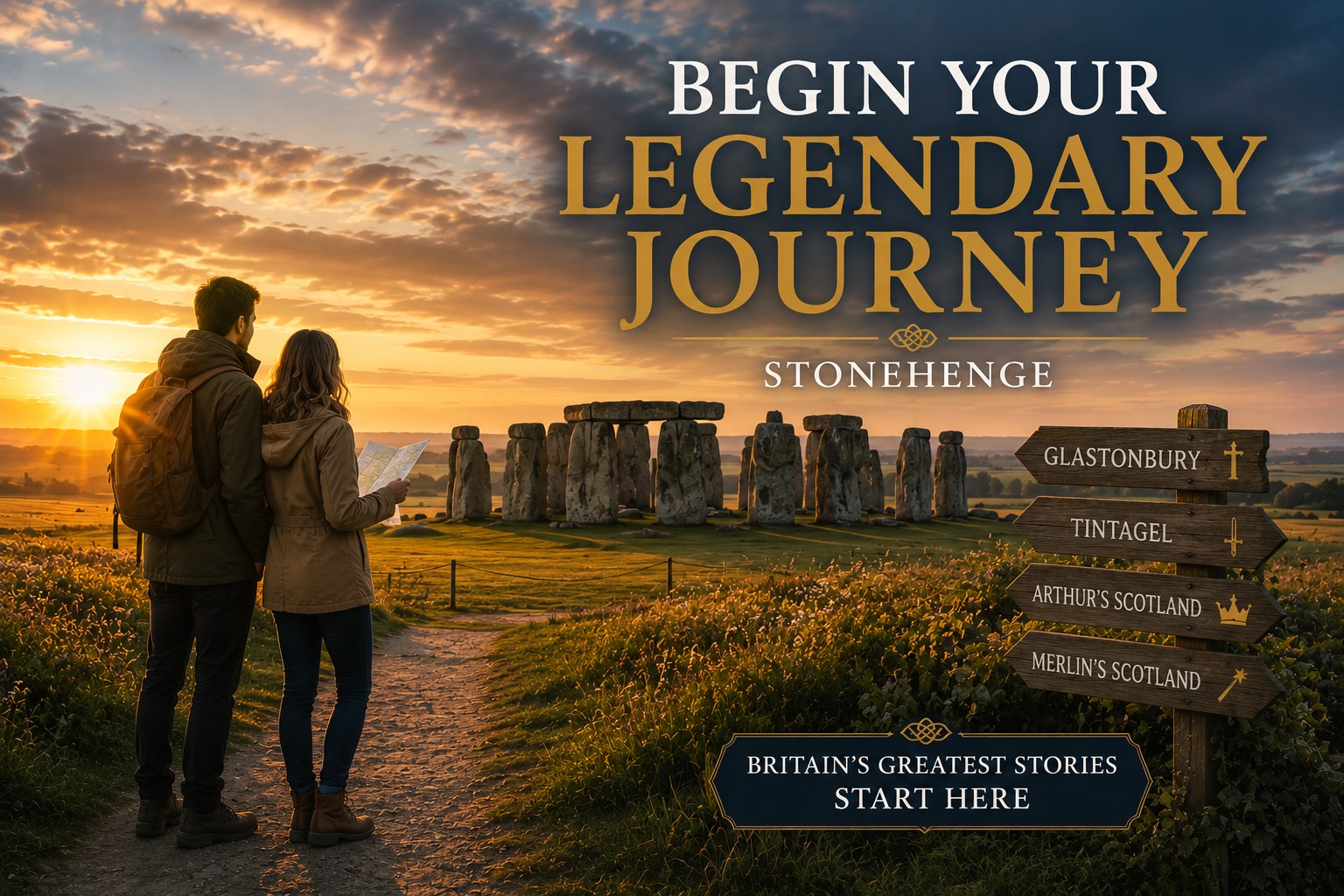
Every legendary journey needs a beginning. Stonehenge provides the perfect starting point for exploring Britain’s extraordinary landscapes of archaeology, history, Arthurian legend and Merlin tradition
❓ Frequently Asked Questions
❓ What are Britain’s most legendary places?
Stonehenge, Tintagel, Glastonbury, Winchester, Drumelzier, Arthur’s Seat and many parts of the Scottish Highlands are among Britain’s best-known legendary destinations. Together they combine prehistoric archaeology, medieval literature, local folklore and spectacular landscapes.
❓ Is Stonehenge connected with Merlin?
Yes, through medieval literature rather than archaeological evidence. Geoffrey of Monmouth’s Historia Regum Britanniae permanently linked Merlin with Stonehenge, creating one of Britain’s most influential legendary traditions.
❓ Where is Merlin traditionally associated in Scotland?
The strongest traditional association is Drumelzier in the Scottish Borders, where long-standing local tradition identifies the area as Merlin’s final resting place. Other Scottish locations contribute to the wider legendary landscape but do not share the same direct Merlin connection.
❓ Is Tintagel really King Arthur’s birthplace?
There is no historical proof that King Arthur was born at Tintagel. However, medieval tradition firmly established the castle as Arthur’s birthplace, while archaeology confirms the site was an important high-status settlement during the post-Roman period.
❓ Is Winchester really Camelot?
Winchester has long been associated with Camelot in later tradition. Its famous Round Table is a remarkable medieval object rather than evidence from Arthur’s own era, but it remains one of England’s most popular Arthurian attractions.
❓ Can visitors climb Arthur’s Seat?
Yes. Arthur’s Seat is one of Edinburgh’s best-known walks, offering outstanding views across the city. As with any hill walk, visitors should choose appropriate footwear and be prepared for changing weather conditions.
❓ How long should a legendary Britain itinerary be?
A week to ten days allows enough time to enjoy Stonehenge, Arthurian England and Merlin’s Scotland without rushing. Shorter itineraries centred on Stonehenge or southern England are also highly rewarding.
❓ Are the legends associated with these places historically proven?
Some locations have strong archaeological or historical evidence, while many of the legends developed through medieval literature and local tradition. Understanding both the evidence and the storytelling creates the richest visitor experience.
❓ Where should a legendary Britain journey begin?
Stonehenge is the ideal starting point. It combines prehistoric history, archaeological significance and centuries of legend, making it the perfect introduction to Britain’s wider legendary landscape.
❓ Why do Britain’s legendary places remain so popular?
Because they offer far more than history alone. They combine extraordinary landscapes, remarkable heritage, enduring stories and unforgettable visitor experiences, allowing every traveller to connect with Britain’s past in their own way.
🏁 Final Thoughts — Following Britain’s Greatest Stories
Britain’s legendary places are far more than individual visitor attractions.
Together they form a connected landscape where prehistory, history, literature and folklore have influenced one another for thousands of years. Every destination adds another chapter, whether it is the prehistoric achievement of Stonehenge, the Arthurian traditions of southern England or the evolving Merlin legends of Scotland.
Stonehenge remains the natural place to begin. From there, the journey expands through castles, abbeys, ancient hills and spectacular coastlines before reaching the peaceful valleys and dramatic scenery that have helped shape Scotland’s legendary heritage. Along the way, visitors discover that Britain’s greatest stories are not confined to museums or medieval manuscripts—they continue to live within the landscapes themselves.
Whether your interests lie in archaeology, mythology, photography, literature or simply exploring extraordinary places, this journey offers something genuinely distinctive. It rewards curiosity, encourages slower travel and demonstrates that history and legend often become most meaningful when experienced together.
Some monuments preserve history.
Some landscapes preserve legend.
Britain’s greatest destinations preserve both.
🧭 Continue Planning Your Legendary Britain Journey
From the mystery of Stonehenge to the legends of King Arthur and the enduring traditions of Merlin’s Scotland, you’ve explored some of Britain’s most remarkable stories. If you’re ready to experience these legendary landscapes for yourself, these expert resources are the perfect place to continue your journey.
✨ Your Adventure Starts Here
Stonehenge is more than Britain’s most famous prehistoric monument—it’s the gateway to a wider journey through Arthurian England, Merlin’s Scotland and the legendary landscapes that have inspired travellers for centuries. Begin by planning your Stonehenge visit, then let the stories lead you onwards.