


Merlin, Druids and Stonehenge: Separating Legend from History (2026 Guide)
30th July 2026
🏛️ Merlin, Druids and Stonehenge: Separating Legend from History (2026 Guide)
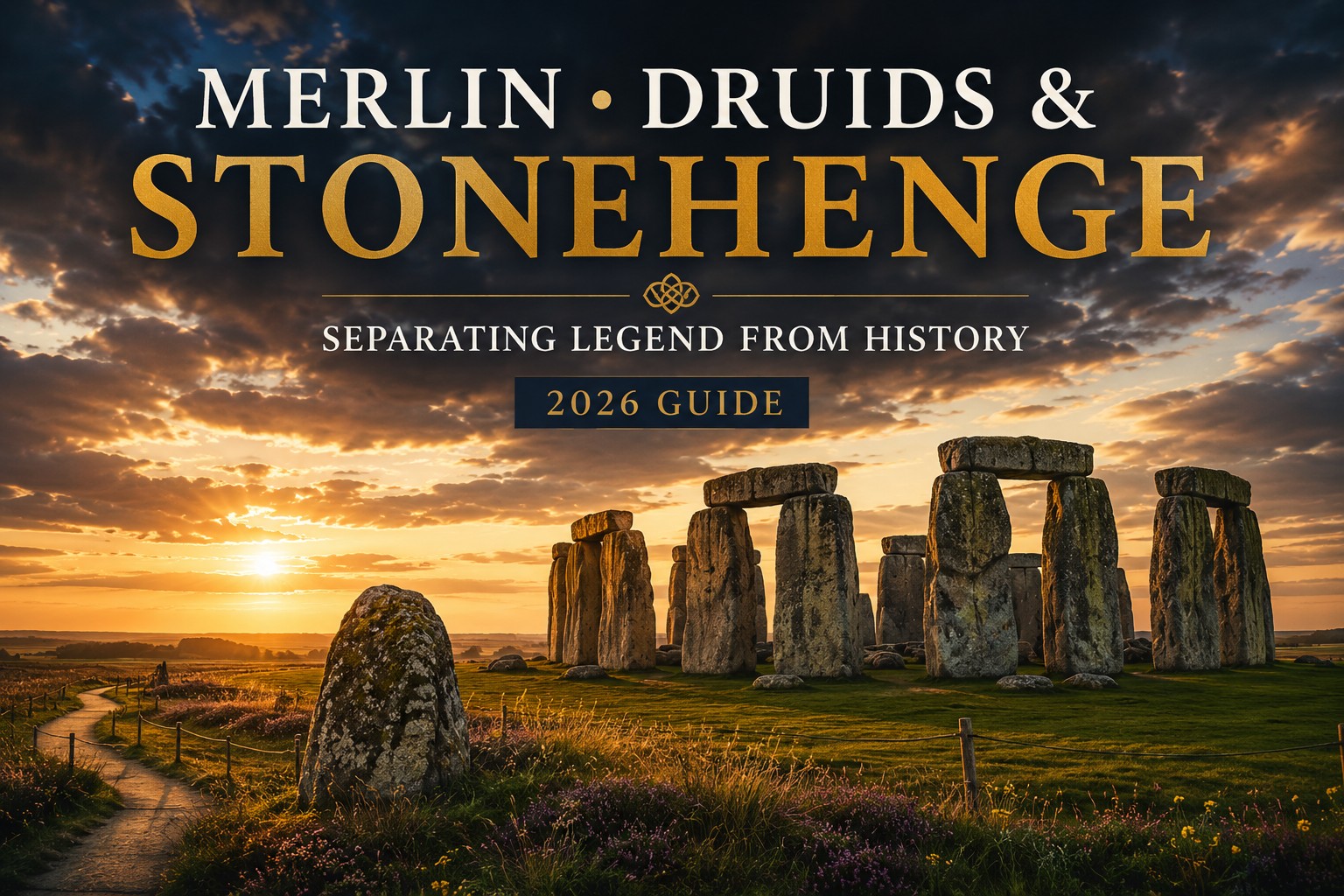
A winding path leads towards Stonehenge beneath dramatic evening skies, symbolising the journey through archaeology, history and medieval legend that has shaped one of Britain’s most enduring cultural stories
Stonehenge has attracted stories of magic, ritual and ancient wisdom for centuries. In popular imagination, Merlin commands its stones, white-robed Druids gather beneath the rising sun, and mysterious ceremonies unfold within the monument’s great circle. The imagery is powerful, memorable and deeply embedded in Britain’s cultural past.
The historical reality is more complex—and far more interesting.
Merlin, Druids and Stonehenge did not belong to the same age. Stonehenge was created by prehistoric communities beginning around 3000 BC. Druids appear in surviving written accounts from the much later Iron Age and Roman period. Merlin’s connection with the monument emerged later still, principally through medieval literature written thousands of years after Stonehenge’s earliest construction.
Over time, these three separate histories became woven into one enduring legend. Antiquarian theories, medieval storytelling, modern spiritual traditions, literature, art, film and tourism all contributed to the familiar image of Merlin and the Druids at Stonehenge.
This guide separates what archaeology can demonstrate from what later tradition added. It explains who built Stonehenge, what is genuinely known about the historical Druids, how Merlin became connected with the monument and why modern Druid groups still gather there today.
The purpose is not to strip Stonehenge of mystery. It is to show how an extraordinary prehistoric monument accumulated new meanings across more than five thousand years.
⚡ Merlin, Druids & Stonehenge at a Glance
Before diving into the fascinating history, here’s a quick overview of what archaeology and historical evidence tell us about the relationship between Merlin, the Druids and Stonehenge.
| Question | Evidence-Based Answer |
|---|---|
| Did Druids build Stonehenge? | No. Stonehenge’s principal construction phases predate the earliest surviving written descriptions of the historical Druids by more than two thousand years. |
| Could Druids have known Stonehenge? | Probably. The monument already stood within the landscape of Iron Age Britain, although no direct evidence confirms Druid ceremonies there. |
| Did Merlin build Stonehenge? | No historical evidence supports this. Merlin’s association with Stonehenge comes from Geoffrey of Monmouth’s influential twelfth-century legend. |
| Was Merlin a Druid? | No. Geoffrey of Monmouth portrays Merlin as a prophet, adviser and magician. The connection with Druids developed much later through literature and popular culture. |
| Why are Merlin, Druids and Stonehenge linked today? | Centuries of medieval storytelling, antiquarian scholarship, modern Druidry and popular culture gradually combined three separate histories into one enduring legend. |
💡 Key Takeaway: Stonehenge came first, the historical Druids belonged to a much later period, and Merlin entered the story centuries afterwards through medieval legend. Understanding that timeline helps separate archaeological evidence from Britain’s rich tradition of storytelling.
⚡ The Short Answer
| Question | Evidence-Based Answer |
|---|---|
| Did Druids build Stonehenge? | No. Its principal construction phases predate the first surviving written descriptions of Druids by more than two millennia. |
| Could Druids have known Stonehenge? | Probably. The monument already stood within the landscape of later Iron Age Britain, although no direct evidence confirms Druid ceremonies there. |
| Did Merlin build Stonehenge? | No historical evidence supports this. The connection comes from Geoffrey of Monmouth’s influential twelfth-century legend. |
| Was Merlin a Druid? | Geoffrey of Monmouth does not describe him as one. Later popular culture gradually merged the traditions. |
| Why are all three linked today? | Medieval storytelling, antiquarian interpretation, modern Druidry and popular culture layered separate traditions onto the same ancient monument. |
The clearest way to understand the relationship is through chronology. Stonehenge came first, the historical Druids belonged to a much later world, and the literary Merlin entered the story centuries after both.
To discover how those separate traditions became inseparable in the public imagination, we must begin with the monument itself.
🪨 Stonehenge Is the Oldest Part of the Story
The first essential fact is also the simplest: Stonehenge is vastly older than either the Druids described in surviving classical sources or the medieval Merlin of British legend.
The monument developed over many centuries rather than appearing in a single act of construction. Its earliest known phase began around 3000 BC, when prehistoric communities created a circular earthwork enclosure with a surrounding bank and ditch. Later generations transformed the site, adding timber settings, cremation burials and eventually the great sarsen stones and smaller bluestones that define Stonehenge today.
Much of the monument’s most recognisable architecture was erected around 2500 BC, during the Late Neolithic. Activity continued afterwards, extending into the Early Bronze Age as the wider landscape acquired burial mounds, ceremonial routes and other significant features.
This long development reveals something important about the people who created Stonehenge. They were not primitive communities relying on chance or brute strength. The monument required advanced planning, extensive cooperation, specialised knowledge and the ability to organise labour across considerable distances. The builders left no written explanation of their intentions, but the archaeology demonstrates sophisticated social and technical achievement.
⏳ A Monument Already Ancient in Ancient Britain
By the time the earliest surviving writers described Druids, Stonehenge had already stood for more than two thousand years.
For an Iron Age community encountering the monument, its origins may have been as remote and mysterious as they are to many visitors today. The identities of its builders had long faded from living memory, while the enormous stones remained fixed within the Wiltshire landscape.
This helps explain why later societies repeatedly reinterpreted Stonehenge. When the people responsible for an ancient structure can no longer explain it themselves, subsequent generations often create new meanings through religion, folklore, scholarship and imagination.
📊 Stonehenge, Druids and Merlin: A Chronological Comparison
| Development | Approximate Date |
|---|---|
| First Stonehenge earthwork enclosure | c.3000 BC |
| Principal sarsen and bluestone settings | c.2500 BC |
| Continued use and change during the Bronze Age | c.2200–1600 BC |
| Druids appear in surviving classical accounts | Late Iron Age and Roman period |
| Geoffrey of Monmouth connects Merlin with Stonehenge | c.AD 1136 |
The chronology does not solve every question surrounding Stonehenge, but it does establish the correct order. Prehistoric communities created the monument first. The historical Druids belonged to a much later cultural world, while Merlin entered Stonehenge’s story through medieval literature.
That sequence is the foundation for separating evidence from legend.
🌿 Who Were the Historical Druids?
Few figures from ancient Britain have captured the imagination quite like the Druids. Popular culture often portrays them as white-robed priests conducting mystical ceremonies at Stonehenge, but the historical evidence paints a more nuanced—and ultimately more fascinating—picture.
The Druids were members of an educated elite within several Iron Age societies across Britain and Gaul. Classical writers, particularly Julius Caesar, described them as religious leaders, judges, teachers, advisers and keepers of tradition. Rather than relying on written texts, they appear to have passed knowledge orally from one generation to the next, which explains why so little survives directly from the Druids themselves.
That absence of first-hand records presents historians with a challenge. Almost everything we know comes from later Roman accounts, archaeological evidence and medieval Welsh and Irish literature written many centuries after the Iron Age. Each source provides valuable clues, but none offers a complete picture.
Even with these limitations, one conclusion is remarkably secure.
By the time the historical Druids appear in surviving written sources, Stonehenge had already been standing for over two thousand years.
That simple chronological fact changes the question entirely.
Instead of asking whether Druids built Stonehenge, historians ask something far more interesting:
No definitive answer survives, but the evidence allows us to explore what is genuinely possible without moving beyond it.
🔍 Did Druids Build Stonehenge?
Modern archaeology answers this question with considerable confidence.
No credible archaeological evidence suggests that the historical Druids built Stonehenge.
Radiocarbon dating, excavation, environmental analysis and the monument’s material evidence consistently place its principal construction phases in the Late Neolithic and Early Bronze Age. These dates precede the earliest surviving written descriptions of Druids by more than two millennia.
Today, this chronology is one of the strongest conclusions archaeologists can make about Stonehenge.
📚 Why Did People Once Believe They Did?
Before modern archaeological dating techniques became available, scholars naturally searched for a known civilisation capable of explaining Britain’s most remarkable prehistoric monument.
During the seventeenth and eighteenth centuries, influential antiquarians such as John Aubrey and later William Stukeley proposed strong links between Stonehenge and the Druids. Working without the benefit of radiocarbon dating or modern archaeological science, they believed the monument belonged to Britain’s ancient priesthood.
Their ideas proved enormously influential.
Although archaeology has since demonstrated that Stonehenge is far older than the historical Druids, those early interpretations shaped books, paintings, guidebooks and public understanding for generations. Many of today’s popular assumptions can still be traced back to these antiquarian theories.
🧠 Did You Know?
For centuries, many scholars genuinely believed the Druids built Stonehenge.
During the seventeenth and eighteenth centuries, long before radiocarbon dating and modern archaeological science existed, influential antiquarians such as John Aubrey and William Stukeley concluded that Britain’s ancient Druids must have constructed the monument. Their ideas appeared in books, illustrations and early guidebooks, shaping public understanding for generations.
Today, archaeological dating has shown that Stonehenge’s principal construction phases predate the historical Druids by more than two thousand years. Even so, those early interpretations left a lasting legacy, helping explain why the image of white-robed Druids at Stonehenge remains so familiar today.
🔍 Could the Historical Druids Have Used Stonehenge?
Although archaeology shows that the historical Druids did not build Stonehenge, a more intriguing question remains: did they visit or use the monument?
The honest answer is that we do not know.
Stonehenge would almost certainly have been known to Iron Age communities. Its towering sarsen stones dominated the landscape just as they do today, and any significant monument that had already stood for thousands of years would naturally have attracted curiosity, respect and perhaps spiritual importance.
However, historians must distinguish carefully between possibility and evidence.
No archaeological discovery has conclusively demonstrated that Druids regularly performed ceremonies at Stonehenge. Equally, no evidence proves they ignored it. The surviving archaeological record simply does not allow either conclusion.
Recognising that uncertainty is not a weakness—it is one of the strengths of responsible historical interpretation. Good archaeology explains what the evidence can support while acknowledging what remains unknown.
This balanced approach allows Stonehenge to retain both its historical integrity and much of its enduring mystery.
🧙 How Merlin Became Connected with Stonehenge
If the Druids did not build Stonehenge, where does Merlin enter the story?
Unlike the historical Druids, Merlin’s connection with Stonehenge comes not from archaeology but from medieval literature. The most influential source is Geoffrey of Monmouth’s Historia Regum Britanniae, written around AD 1136.
In Geoffrey’s account, the British king Aurelius Ambrosius wishes to create a magnificent memorial for slain British nobles. Merlin advises him to obtain the Giants’ Dance, a legendary stone monument standing on Mount Killaraus in Ireland. When ordinary men cannot move the enormous stones, Merlin uses his extraordinary knowledge and magical abilities to enable their transport across the Irish Sea before the monument is reassembled on Salisbury Plain.
To medieval readers, the story answered an obvious question.
How could ancient people possibly have moved such enormous stones?
Long before archaeology revealed prehistoric engineering techniques, attributing Stonehenge to giants and Merlin provided an explanation that seemed both logical and inspiring.
Today, historians regard Geoffrey’s account as one of Britain’s greatest medieval legends rather than a historical record. Nevertheless, its influence has been extraordinary. For nearly nine centuries it has shaped literature, art, tourism and the popular imagination, ensuring that Merlin remains permanently associated with Stonehenge.
📖 Was Merlin Ever Described as a Druid?
One of the most persistent modern misconceptions is that Merlin himself was a Druid.
Geoffrey of Monmouth does not describe Merlin as a Druid.
Instead, Merlin appears as a prophet, counsellor, visionary and magician whose wisdom often transcends ordinary human understanding. Later novels, films, television dramas and fantasy adaptations gradually blended Merlin with popular images of Druids, creating a character that feels entirely natural to modern audiences despite having little basis in the earliest medieval texts.
Understanding this distinction helps separate literary tradition from historical evidence without diminishing either.
📖 Geoffrey of Monmouth & Merlin
Geoffrey of Monmouth (c.1100–c.1155) was a medieval cleric and writer whose Historia Regum Britanniae (History of the Kings of Britain), completed around AD 1136, became one of the most influential works ever written about Britain’s legendary past.
It was Geoffrey who permanently linked Merlin with Stonehenge. In his famous account, Merlin advises King Aurelius Ambrosius to bring the legendary Giants’ Dance from Ireland to Salisbury Plain, using his extraordinary knowledge and magical abilities to accomplish what ordinary men could not.
Although historians regard the story as medieval legend rather than historical fact, Geoffrey’s narrative shaped nearly nine centuries of literature, art, folklore and tourism. Without his work, Merlin would almost certainly never have become so closely associated with Stonehenge.
💡 Did You Know?
Geoffrey never describes Merlin as a Druid. He presents him as a prophet, adviser and magician. The familiar image of “Merlin the Druid” developed much later through literature, paintings, films and modern popular culture.
🔄 How Merlin, Druids and Stonehenge Became One Enduring Legend
Stonehenge, the historical Druids and Merlin did not begin as a single story.
Instead, they became connected gradually over many centuries, with each generation adding its own interpretation to Britain’s most famous prehistoric monument. Understanding this process is one of the most rewarding ways to appreciate Stonehenge because it reveals how history, literature and cultural memory can become intertwined without being the same thing.
The prehistoric communities who built Stonehenge left no written explanation of its purpose. By the Iron Age, the monument was already unimaginably old, inviting new generations to wonder who had created it and why. Medieval writers later filled those gaps with powerful narratives, while antiquarian scholars and modern popular culture added further layers until the familiar image of Merlin and the Druids at Stonehenge became firmly established.
Rather than replacing one another, these interpretations accumulated over time.
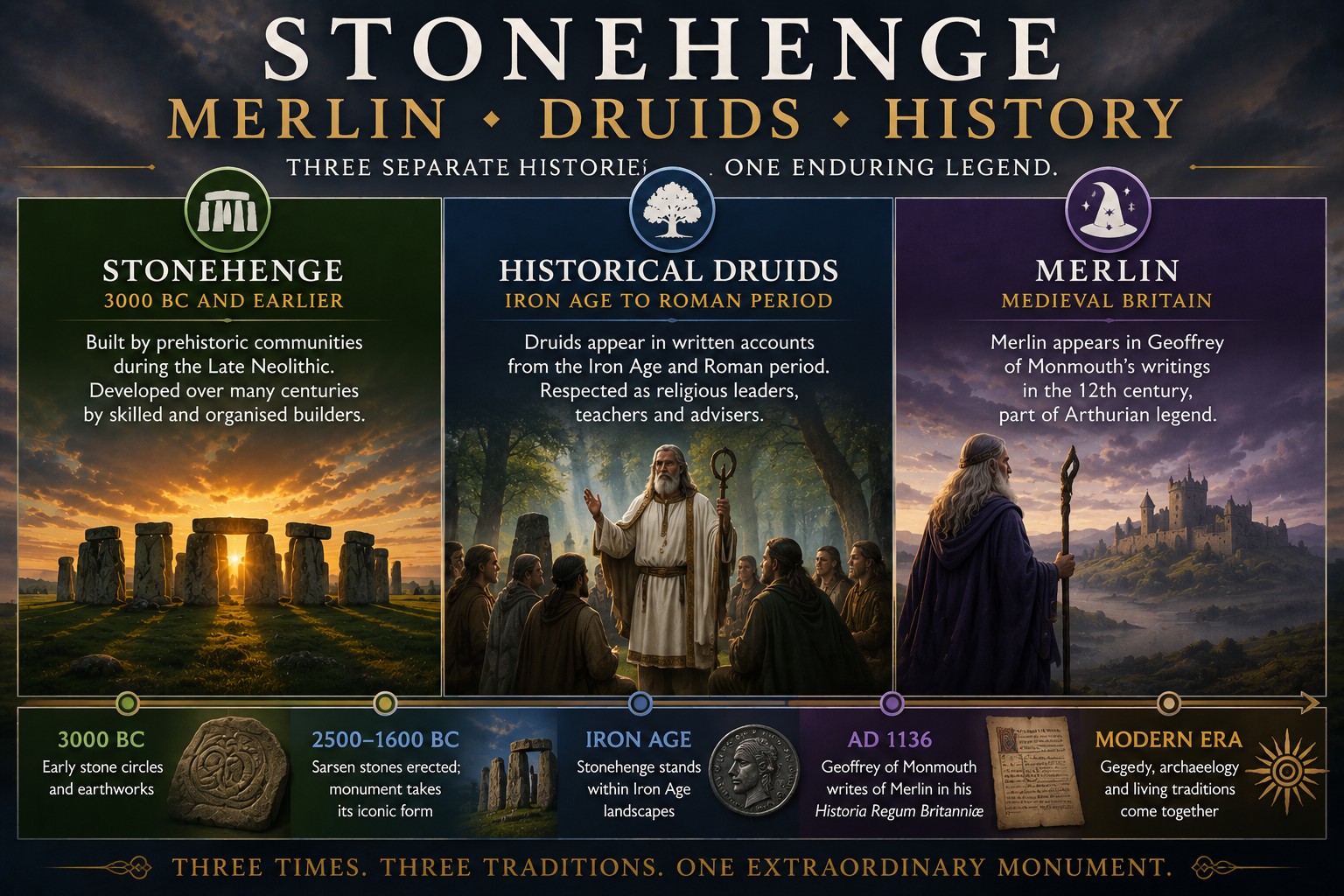
Stonehenge, the historical Druids and Merlin all belong to different periods of British history. This infographic shows how three separate traditions gradually combined to form one of Britain’s most enduring cultural legends
📊 How the Stonehenge Legend Evolved
| Period | What Was Added to the Stonehenge Story |
|---|---|
| Late Neolithic & Early Bronze Age | Prehistoric communities designed, constructed and developed Stonehenge as a ceremonial monument. |
| Iron Age & Roman Period | Historical Druids became known through surviving classical accounts, although there is no evidence they built Stonehenge. |
| Medieval Period | Geoffrey of Monmouth linked Merlin to Stonehenge through the legend of the Giants’ Dance. |
| Seventeenth & Eighteenth Centuries | Antiquarian scholars associated Stonehenge with Druids before modern archaeological dating became available. |
| Modern Era | Archaeology explained the monument’s true age, while literature, film, modern Druidry and tourism reinforced the combined legend. |
This layered history explains why so many people instinctively associate Merlin and the Druids with Stonehenge even though they belong to entirely different historical periods.
The connection is not the result of one historical event.
It is the product of centuries of storytelling, scholarship, artistic imagination and cultural tradition.
🏺 Archaeology and Legend Tell Different Stories
People sometimes assume that archaeology and legend compete with one another.
In reality, they answer different questions.
Archaeology investigates what the physical evidence can demonstrate. Through excavation, radiocarbon dating, landscape analysis and scientific research, it helps explain when Stonehenge was built, how it developed and what can reasonably be concluded about its prehistoric creators.
Legend asks a different question.
It explores how later generations understood the monument when its original story had already been lost. Tales of Merlin, giants and ancient priests reveal what medieval and later societies valued, imagined and wished to explain. They form an important part of Britain’s cultural heritage, even though they should not be read as archaeological evidence.
Together, these two perspectives make Stonehenge richer rather than more confusing. One reveals the monument’s prehistoric reality; the other explains why it has remained such a powerful source of inspiration for more than five thousand years.
⚖️ Legend vs History: Understanding Stonehenge Through Two Different Lenses
Stonehenge can be appreciated in two equally fascinating ways. One explores the monument through stories passed down over centuries, while the other examines the physical evidence left behind by its prehistoric builders.
| 📖 Legend & Tradition | 🏺 Archaeology & History |
|---|---|
| Preserves Britain’s myths, folklore and cultural imagination. | Investigates the monument using excavation, science and physical evidence. |
| Explains Stonehenge through stories such as Merlin, the Giants’ Dance and ancient magic. | Explains when Stonehenge was built, how it developed and who constructed it. |
| Shows how later generations interpreted and celebrated the monument. | Shows what modern research can confidently demonstrate about Stonehenge’s past. |
| Keeps Britain’s legendary heritage alive for new generations. | Continues to refine our understanding as new discoveries are made. |
💡 The Best Way to Understand Stonehenge
Stonehenge doesn’t become less remarkable when archaeology replaces legend—it becomes even more fascinating. Archaeology helps us understand how the monument came to exist, while legend explains why it has continued to inspire people’s imagination for centuries. Together, they tell the complete story of Britain’s most famous prehistoric monument.
🌅 Why the Legends Still Matter Today
Learning that Merlin did not build Stonehenge or that the historical Druids did not construct the monument does not make Stonehenge any less remarkable.
If anything, it makes the story richer.
Few places in the world have accumulated so many layers of meaning across such an extraordinary span of time. Stonehenge has inspired prehistoric builders, Iron Age communities, Roman writers, medieval chroniclers, antiquarian scholars, archaeologists, artists, modern Druid groups and millions of visitors. Each generation has viewed the monument through its own beliefs, knowledge and imagination, adding another chapter to its remarkable cultural life.
That continuing evolution explains why Stonehenge remains both an archaeological treasure and a living symbol within Britain’s heritage.
Understanding the distinction between prehistoric history and later legend allows visitors to appreciate both without confusing one for the other.
🌿 Why Modern Druids Still Gather at Stonehenge
Although there is no archaeological evidence linking the historical Druids directly with the construction of Stonehenge, the monument holds profound significance for many modern Druid organisations and contemporary Pagan communities.
Each year, particularly during the Summer and Winter Solstices, thousands of people gather at Stonehenge to celebrate seasonal change, observe ancient astronomical alignments and experience one of Britain’s most iconic ceremonial landscapes. These modern gatherings are part of Stonehenge’s continuing cultural story rather than evidence of uninterrupted prehistoric religious practice.
Modern Druidry developed many centuries after the historical Druids and encompasses a wide variety of beliefs and traditions. While participants often draw inspiration from Britain’s ancient past, modern ceremonies should not be interpreted as direct reconstructions of Neolithic or Iron Age rituals.
Recognising this distinction allows archaeology, heritage and living spiritual traditions to coexist respectfully. Each contributes something valuable to our understanding of why Stonehenge continues to inspire people from around the world.
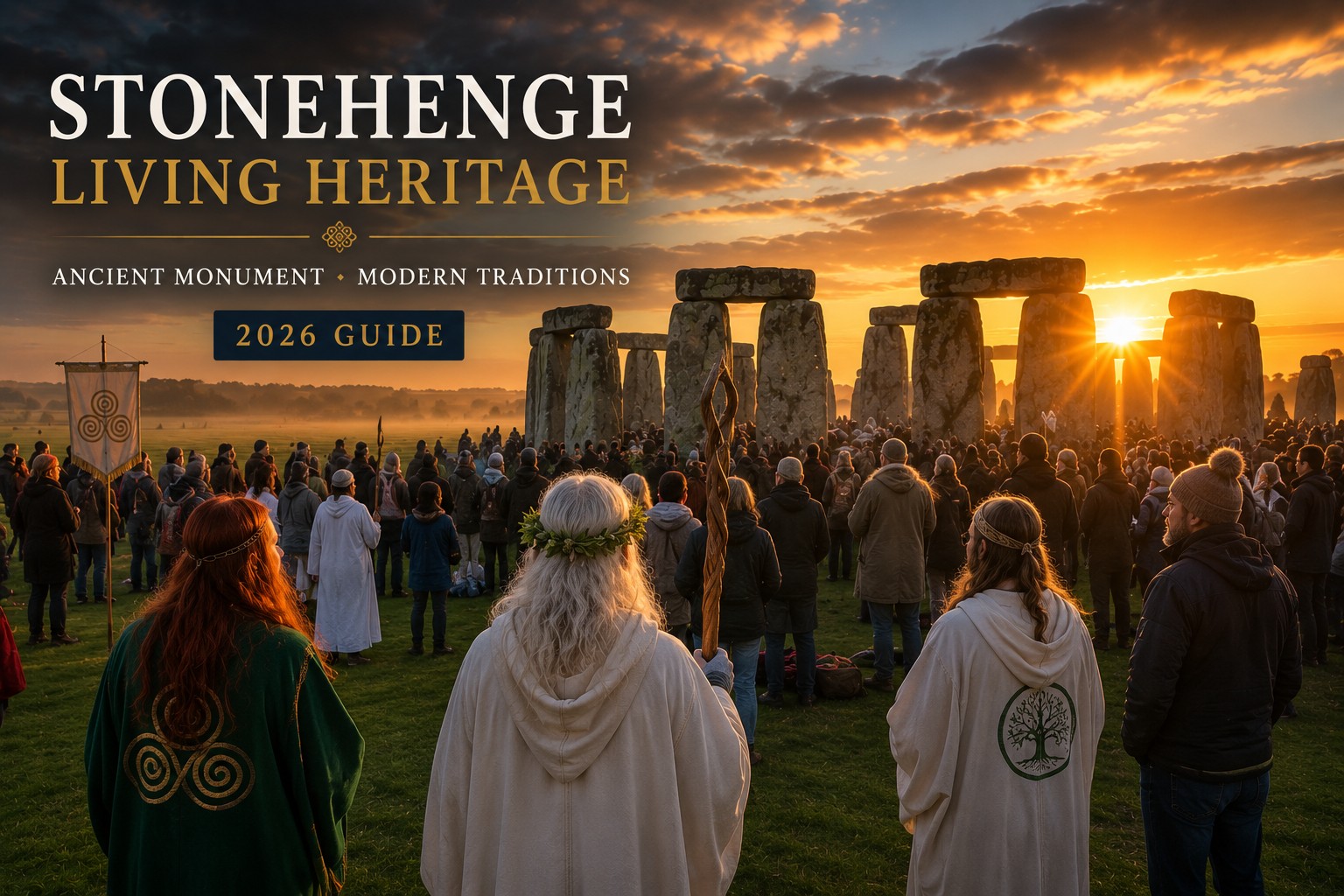
Stonehenge remains a living cultural landscape. While modern Druid gatherings are not direct continuations of Iron Age practices, they form an important part of the monument’s continuing story and enduring significance
📅 Planning Your Visit to Stonehenge
Understanding the history behind Stonehenge often changes the way visitors experience the monument itself.
Rather than simply viewing an ancient circle of stones, you begin to recognise a landscape that has inspired thousands of years of interpretation. Seeing where archaeology ends and later legend begins gives every visit additional depth, whether your interests lie in prehistory, photography, medieval literature or Britain’s enduring folklore.
If you’re hoping to experience the monument more closely, planning ahead is essential. Special Stonehenge Inner Circle Access visits are available only on selected dates throughout the year and are considerably more limited than standard admission.
Using the BVT Stonehenge Inner Circle Access Calendar allows you to compare available sunrise and sunset access dates, understand seasonal differences, identify periods of higher demand and choose the experience that best matches your travel plans before booking.
Whether you dream of standing among the stones at first light or witnessing the changing colours of sunset across Salisbury Plain, advance planning gives you the greatest choice and the best opportunity to secure your preferred date.
📅 Planning Your Stonehenge Visit Starts Here
Now that you understand the remarkable history, archaeology and legends surrounding Stonehenge, the next step is choosing the right time to experience it for yourself. If you’re hoping to enjoy the unforgettable experience of entering the stone circle at sunrise or sunset, planning ahead is essential.
Our Stonehenge Inner Circle Access Calendar makes it easy to compare available dates throughout the year, understand seasonal differences, identify periods of higher demand and choose the experience that best matches your travel plans.
📅 View the Stonehenge Inner Circle Access Calendar
Compare sunrise and sunset access dates, explore seasonal opportunities and start planning your perfect Stonehenge visit.
💡 Expert Planning Tip
If Stonehenge Inner Circle Access is on your wish list, don’t wait until you’ve booked the rest of your trip before checking availability. Special access takes place on selected sunrise and sunset dates throughout the year, and the dates that best match your itinerary may not always be available.
A few minutes spent comparing the available dates first can make planning much easier. Once you’ve identified the best options, you can organise accommodation, transport and the rest of your itinerary with greater confidence.
🧭 BVT Planning Advice
Start by choosing the best Stonehenge experience, then build the rest of your itinerary around it. Many visitors find this approach gives them greater flexibility and a better overall trip.
🌍 Protecting Stonehenge for Future Generations
Stonehenge has endured for more than five thousand years, surviving changing climates, shifting civilisations and countless generations of visitors. Preserving this remarkable monument is a shared responsibility that extends far beyond protecting the stones themselves.
The wider Stonehenge World Heritage Site includes ancient burial mounds, ceremonial avenues, prehistoric earthworks and an extraordinary archaeological landscape that provides essential context for understanding the monument. Respecting marked pathways, following site guidance and avoiding unnecessary disturbance helps protect archaeological evidence that may still lie beneath the surface.
Responsible travel also means planning thoughtfully. Booking appropriate tours, using shared transport where practical, respecting seasonal visitor management and allowing plenty of time for your visit all contribute to a more sustainable experience for both visitors and the landscape itself.
Whether your interest is prehistoric engineering, medieval legend, astronomy or Britain’s rich folklore, careful stewardship ensures that future generations will be able to experience the same sense of wonder.
Stonehenge has connected people across thousands of years.
Responsible visitors help ensure that connection continues.
🌿 Travel with Purpose. Explore with Care.
Stonehenge has stood at the heart of the Wiltshire landscape for more than 4,500 years. Every visitor plays a part in protecting this remarkable World Heritage Site by respecting the monument, following designated paths and helping preserve the wider archaeological landscape for future generations.
Responsible travel isn’t just about protecting the stones themselves. It also means appreciating the ancient earthworks, burial mounds and surrounding landscape that together tell the complete story of one of Britain’s greatest prehistoric treasures.
🌍 Every Visit Makes a Difference
By exploring thoughtfully and leaving no trace, you help ensure that Stonehenge continues to inspire archaeologists, historians, local communities and visitors from around the world for generations to come.
❓ Frequently Asked Questions
❓ Did the Druids really build Stonehenge?
No. Archaeological dating consistently shows that Stonehenge’s principal construction phases belong to the Late Neolithic and Early Bronze Age, more than two thousand years before the earliest surviving written descriptions of the historical Druids.
❓ Could the historical Druids have visited Stonehenge?
They may well have known about the monument because it already dominated the landscape during the Iron Age. However, no direct archaeological evidence confirms that Druids regularly held ceremonies there.
❓ Was Merlin a real historical person?
No firm historical evidence confirms the existence of Merlin as described in medieval literature. The figure is best understood as a legendary character whose story developed through Welsh tradition before being popularised by Geoffrey of Monmouth.
❓ Was Merlin ever described as a Druid?
No. Geoffrey of Monmouth portrays Merlin as a prophet, adviser and magician, not as a Druid. The popular association developed much later through literature, art, film and modern retellings.
❓ Why is Merlin connected with Stonehenge?
The connection comes principally from Geoffrey of Monmouth’s Historia Regum Britanniae (c.AD 1136), which tells how Merlin transported the legendary Giants’ Dance from Ireland to Salisbury Plain.
❓ Are modern Druids descendants of the historical Druids?
Modern Druid organisations draw inspiration from Britain’s ancient past, but they are not regarded by historians as uninterrupted continuations of Iron Age Druid traditions. They represent modern spiritual movements with diverse beliefs and practices.
❓ Can visitors attend Stonehenge Solstice celebrations?
English Heritage normally allows managed public access for the Summer Solstice and, in a more limited form, the Winter Solstice. Arrangements can vary each year, so it is always advisable to check the latest visitor information before travelling.
❓ Can visitors enter the Stonehenge stone circle?
General admission follows the visitor pathway around the monument. Entering the stone circle is normally restricted to authorised special-access experiences, including selected Stonehenge Inner Circle Access visits and certain managed ceremonial occasions.
❓ Does learning the real history make Stonehenge less mysterious?
Quite the opposite. Understanding how prehistoric archaeology, medieval legend and modern cultural traditions became intertwined often gives visitors a much deeper appreciation of Britain’s most famous prehistoric monument.
❓ Why do Merlin and the Druids remain so strongly linked with Stonehenge?
Because the association developed gradually over many centuries. Medieval legends, antiquarian scholarship, Victorian art, modern literature, contemporary Druid gatherings and popular culture all reinforced the connection until it became part of Stonehenge’s enduring public identity.
📚 Continue Exploring Stonehenge
If you’ve enjoyed discovering how archaeology, legend and history combine to shape the story of Stonehenge, continue your journey with these carefully selected guides.
⚔️ Stonehenge & King Arthur Sites Tour
Explore the legendary places that connect Stonehenge with the enduring stories of King Arthur, from ancient monuments to some of southern England’s most iconic historic landscapes.
🗿 Stonehenge Tours from London & UK: Complete Guide
Compare tour options, discover expert planning advice and learn how to choose the best Stonehenge experience from London and across the UK.
🌅 Stonehenge Inner Circle Access: Complete Guide
Everything you need to know about the unforgettable sunrise and sunset experiences inside the Stone Circle, including how access works and what to expect.
🏛️ Final Thoughts — One Monument, Many Stories
Stonehenge is often described as one of history’s greatest mysteries, but perhaps its greatest achievement is something else entirely.
Across five millennia, it has continually inspired new interpretations without losing the power to astonish those who stand before it.
Archaeology reveals the extraordinary skill of the prehistoric communities who planned, built and transformed the monument. History introduces the historical Druids, whose reputation for wisdom and spiritual authority later became intertwined with Britain’s ancient landscapes. Medieval literature contributes Merlin, whose legendary journey with the Giants’ Dance permanently reshaped Stonehenge’s place within British folklore. Modern archaeology, scholarship and heritage conservation have since helped separate historical evidence from later tradition while demonstrating that both remain valuable parts of the monument’s story.
Stonehenge is not remarkable because it has only one history.
It is remarkable because it has accumulated many.
When you visit today, you are not simply looking at an ancient circle of stones. You are standing within a landscape that has inspired prehistoric builders, classical writers, medieval storytellers, antiquarian scholars, archaeologists, artists, modern spiritual communities and curious travellers for more than five thousand years.
Understanding where archaeology ends and later legend begins does not diminish Stonehenge’s magic.
It reveals why its story continues to grow.
🗺️ Continue Planning Your Stonehenge Visit
You’ve discovered how prehistoric history, medieval legend and modern archaeology combine to make Stonehenge one of Britain’s most extraordinary places. If you’re now inspired to experience it yourself, these expert resources will help you take the next step with confidence.
✨ Where Next?
Whether you’re comparing the best time to visit, looking for exclusive Inner Circle access or choosing the right tour, these trusted guides will help you plan a memorable Stonehenge experience from start to finish.