


The Isle of Skye: Fairy Pools, Magic & Merlin Legends (2026 Guide)
30th July 2026
🏔️ The Isle of Skye: Fairy Pools, Magic & Merlin Legends (2026 Guide)

The Fairy Pools combine crystal-clear mountain water, cascading waterfalls and the dramatic Black Cuillin to create one of Scotland’s most iconic Highland landscapes, where natural beauty has inspired centuries of folklore and imagination
The Fairy Pools on the Isle of Skye flow through a wild Highland glen beneath the Black Cuillin, combining clear mountain water, dark volcanic rock and some of Scotland’s most atmospheric scenery. Water tumbles through a sequence of cascades and rock pools on a stream descending towards the River Brittle, while cloud, mist and sunlight continually alter the appearance of the surrounding mountains.
For many visitors, the first impression is one of enchantment. The water can appear blue, green or almost silver depending on its depth, the submerged rock and the changing Highland light. Mist may conceal the Cuillin within minutes, only for the peaks to reappear as sunlight crosses the glen. Even when the path is busy, the combination of rushing water and immense mountain scenery can make the landscape feel detached from ordinary life.
It is easy to understand why such a place became associated with fairies, magic and, more recently, Merlin. Yet there is no historical evidence that Merlin visited the Fairy Pools, and no securely documented ancient tradition placing him beside these waterfalls.
That distinction is important.
The Fairy Pools are not extraordinary because a legendary magician once stood here. Instead, the setting helps explain why people have always imagined that powerful stories belong in powerful landscapes. Long before geology revealed how volcanic activity, glaciation and erosion shaped Skye, communities interpreted dramatic natural features through storytelling. Unusual pools became enchanted waters, mist suggested unseen worlds, and mountains appeared capable of sheltering heroes, spirits or wise figures living beyond ordinary society.
The Fairy Pools therefore occupy a fascinating meeting point between natural history and human imagination.
Their geological origins are real. Skye’s fairy traditions form part of a wider Gaelic cultural inheritance. Merlin belongs principally to Welsh, medieval and later Arthurian literature rather than to the documented history of Glen Brittle. Each strand should be understood separately, but together they reveal how exceptional places accumulate layers of meaning.
This guide explores what makes the Fairy Pools special, how the landscape was formed, why water and remote places became central to Scottish folklore, and why Merlin feels imaginatively at home here despite the absence of a direct historical connection. It also provides practical advice on walking routes, weather, photography, swimming, seasonal conditions and responsible visiting.
The Fairy Pools do not ask visitors to believe in magic.
They show us why generations of people once did.
🏔️ Discover Merlin’s Scotland
Scotland’s most dramatic landscapes have inspired myths, legends and storytellers for centuries. Throughout this special Merlin’s Scotland series, we explore remarkable places where history, folklore and Arthurian tradition meet—from the remote Fairy Pools of Skye to ancient standing stones, legendary mountain summits and forgotten corners of the Highlands.
Every location tells a different story. Some are supported by historical evidence, others belong to folklore or medieval literature, while many combine all three to reveal how extraordinary landscapes continue to shape the imagination.
This guide explores one chapter of Merlin’s Scotland, where breathtaking scenery and enduring legend come together in one of the Highlands’ most captivating locations.
🌊 What Makes the Fairy Pools on the Isle of Skye So Special?
The Fairy Pools are among Scotland’s most recognisable natural landscapes, yet their appeal cannot be explained by a single waterfall or viewpoint. Unlike destinations built around one dramatic feature, the experience unfolds gradually as the stream winds through Glen Brittle beneath the towering Black Cuillin.
Each section of the walk reveals something different.
One pool reflects the mountains like polished glass. Another sends white water crashing through narrow rock channels before spilling into deep, clear basins. Around the next bend, sunlight catches the water at a different angle, transforming it from pale blue to vivid turquoise. The landscape is constantly changing, which means no two visits are ever quite the same.
This continual transformation is one reason the Fairy Pools leave such a lasting impression. Visitors often arrive expecting a beautiful series of waterfalls and leave talking instead about the atmosphere. The combination of mountain silence, fast-flowing water and rapidly shifting Highland weather creates an experience that feels immersive rather than simply scenic.
Photography has undoubtedly contributed to the Fairy Pools’ international reputation, but photographs rarely capture their full character. Images cannot reproduce the sound of rushing water echoing through the glen, the cool air descending from the Cuillin or the subtle way mist drifts across the mountains before lifting again moments later.
The Fairy Pools reward visitors who slow their pace.
Rather than rushing to the most photographed cascade, take time to notice the smaller details: water flowing over polished volcanic rock, tiny waterfalls hidden between larger drops, changing reflections beneath passing clouds and the remarkable contrast between crystal-clear water and the dark mountain skyline.
It is this combination of scale and subtlety that makes the Fairy Pools memorable.
🪨 The Geological Story Behind the Fairy Pools
The Fairy Pools may inspire stories of magic, but their origins are rooted in one of Scotland’s most dramatic geological landscapes.
Millions of years ago, powerful volcanic activity helped create the foundations of the Isle of Skye. Later, during successive Ice Ages, vast glaciers carved through the mountains, shaping valleys and exposing the rugged terrain that defines the Black Cuillin today. As the ice gradually retreated, meltwater found natural routes through the landscape, carving streams, waterfalls and plunge pools into the hard volcanic rock.
The Fairy Pools developed through this long natural process.
The stream flowing down from the Cuillin gradually eroded weaker sections of rock while leaving more resistant formations behind. Over thousands of years, swirling water deepened natural hollows beneath small waterfalls, producing the sequence of clear pools visitors enjoy today.
Their famous colours are also entirely natural.
The vivid blue and green tones result from exceptionally clear water, the pale rock beneath the surface, varying water depth and constantly changing Highland light. Cloud cover, sunlight and reflections from the surrounding mountains can alter their appearance dramatically within minutes, giving each pool a different character throughout the day.
Understanding the science behind the Fairy Pools does not diminish their beauty.
If anything, it makes the landscape even more impressive. Nature achieved over immense geological timescales what no human designer could recreate—a place where volcanic fire, glacial ice and flowing water combined to produce one of Britain’s most captivating natural scenes.
Science explains how the Fairy Pools were formed.
It does not explain why they continue to inspire such powerful emotions.
📊 Fairy Pools Visitor Snapshot
| Feature | Information |
|---|---|
| 📍 Location | Glen Brittle, Isle of Skye |
| 🥾 Main Experience | Walking beside a series of waterfalls and crystal-clear pools |
| 🚶 Typical Visit | Around 2–3 hours for the main pools, longer if exploring further into the glen |
| 📸 Best For | Landscape photography, walking, nature and Scottish folklore |
| 🌦️ Best Conditions | Clear mornings or changeable weather for dramatic mountain views |
| 👨👩👧 Suitable For | Most reasonably fit visitors with appropriate footwear |
| 🥾 Recommended Equipment | Waterproof walking boots, layered clothing and waterproof jacket |
📊 At a Glance
Before continuing, here are the four things most visitors should know about the Fairy Pools.
- 🥾 It’s a genuine Highland walk – Expect uneven paths, changing weather and sturdy footwear rather than an easy stroll.
- 🌦️ Conditions change quickly – Sunshine, mist and rain can all arrive within a short period, even during summer.
- 📸 Allow more time than you think – Most visitors stop frequently for photographs and to enjoy the scenery, so avoid rushing your visit.
- 🌿 Respect the landscape – Staying on established paths helps preserve one of Scotland’s most beautiful natural environments.
🧚 Why Are They Called the Fairy Pools?
The name Fairy Pools immediately sparks the imagination.
Even visitors who know nothing about Scottish folklore often feel that it perfectly suits the landscape. Crystal-clear water tumbles through a chain of waterfalls beneath dark mountain peaks, while changing mist and shifting light create an atmosphere that seems almost otherworldly.
Surprisingly, the exact origin of the English name is uncertain.
Although the Fairy Pools have become one of Scotland’s best-known natural attractions, there is no securely documented medieval tradition proving that these particular pools were regarded as the home of fairies. Instead, the name reflects a much broader relationship between Scotland’s landscapes and its storytelling traditions.
Across the Highlands, beautiful yet remote places frequently inspired tales of the supernatural. Ancient hills, secluded glens, waterfalls and quiet lochs all became settings where the ordinary world seemed to meet something beyond everyday experience. Rather than explaining a specific historical event, the name “Fairy Pools” captures the feeling that generations of people experienced when standing in this remarkable landscape.
That emotional response remains remarkably familiar today.
Modern visitors may understand the geology of the Black Cuillin and the natural processes that formed the pools, yet many still describe the experience using words such as magical, enchanted or otherworldly. The language has changed surprisingly little over the centuries.
The landscape continues to inspire the same sense of wonder.
🍃 Scottish Fairy Traditions and the Gaelic Imagination
The fairies of traditional Scottish folklore differ greatly from the tiny winged figures popularised by Victorian art and children’s stories.
Within Gaelic tradition, supernatural beings were often described as the daoine sìth (pronounced “dee-na shee”), meaning the “people of the fairy mound” or “people of peace.” These mysterious beings occupied a world that existed alongside our own rather than a separate fantasy realm. They were neither wholly good nor entirely evil and were treated with respect rather than affection.
Many Highland traditions associated these otherworldly beings with landscapes that already felt unusual or mysterious.
Fairy hills.
Ancient standing stones.
Remote glens.
Woodland clearings.
Hidden waterfalls.
Quiet pools.
Such places represented natural boundaries where everyday life seemed to blur into something older and less easily explained.
Whether these traditions are viewed as cultural heritage or personal belief, they reveal something important about the people who created them.
Before geology explained volcanic mountains or hydrology explained crystal-clear rivers, folklore provided another way of understanding extraordinary places. Stories helped communities express emotions that were difficult to describe through practical observation alone.
Wonder.
Respect.
Curiosity.
The Fairy Pools fit naturally within that wider tradition. Their beauty encouraged stories—not because anyone could prove supernatural beings lived here, but because the landscape itself seemed worthy of them.
🌊 Water, Reflection and the Gaelic Imagination
Water has always occupied a special place within Scotland’s folklore.
Springs sustained communities.
Rivers connected settlements.
Waterfalls inspired awe.
Deep pools concealed unknown depths.
Unlike mountains or forests, water constantly changes. A calm pool can become turbulent after heavy rain. Reflections transform with passing clouds. Morning mist rises unexpectedly before disappearing in bright sunshine. These continual changes made rivers and pools appear mysterious to earlier generations who lacked modern scientific explanations.
Throughout Scotland, stories frequently connected water with healing, prophecy, hidden worlds and encounters with supernatural beings. Sacred wells became places of pilgrimage, while isolated waterfalls and secluded pools often appeared in local legends passed from one generation to the next.
The Fairy Pools belong comfortably within this wider cultural tradition.
Nothing in the historical record proves that fairies once gathered beside these waterfalls. Instead, the pools possess many of the qualities that repeatedly inspired folklore across Scotland: exceptional beauty, clear water, changing weather and a sense of peaceful isolation beneath towering mountains.
Understanding that distinction is one of the strengths of the Fairy Pools.
The geology explains how they formed.
Folklore helps explain why they captured the imagination.
Together, they tell a richer story than either could alone.
⚖️ Understanding Legend, Folklore & Historical Evidence
One of the strengths of Scotland’s legendary landscapes is that they can be appreciated from several different perspectives. Distinguishing between evidence, folklore and literary tradition allows the Fairy Pools to remain both historically honest and imaginatively inspiring.
| Perspective | What It Means |
|---|---|
| 📜 Historical Evidence | Supported by reliable historical, archaeological or contemporary documentary evidence. |
| 🍃 Folklore | Traditional stories and beliefs passed through generations that help explain how people understood extraordinary landscapes. |
| 🧙 Literary Tradition | Later writers often placed legendary figures within landscapes that reflected their character and symbolism, even where no historical connection existed. |
💡 Why This Matters
The Fairy Pools are a genuine geological wonder and an important part of Scotland’s folklore. Their association with Merlin belongs to the world of literary imagination rather than documented history. Appreciating each tradition on its own terms allows the landscape to become even more fascinating.
🧙 Are the Fairy Pools Connected with Merlin?
For many visitors, the Fairy Pools seem like exactly the sort of place where Merlin should appear.
The combination of dramatic mountains, fast-flowing water, changing mist and profound tranquillity feels perfectly suited to Britain’s most famous legendary magician. It is therefore unsurprising that modern articles, photographs and travel features occasionally link the Fairy Pools with Merlin.
From a historical perspective, however, the answer is clear.
There is no archaeological, historical or medieval evidence that places Merlin at the Fairy Pools or anywhere specifically within Glen Brittle. Unlike places directly associated with Arthurian literature, the connection here is imaginative rather than documented.
Rather than weakening the story, this distinction actually makes it more interesting.
Throughout the Merlin mini-cluster, one principle remains central: history, folklore and literature should complement one another, not be confused with one another.
History asks what can be supported by reliable evidence.
Folklore explores the stories communities created to explain extraordinary places.
Literature builds upon those traditions, allowing writers to place legendary figures into landscapes that naturally inspire wonder.
The Fairy Pools are an excellent example of this process.
Their atmosphere encourages imagination, but imagination should never be presented as historical fact.
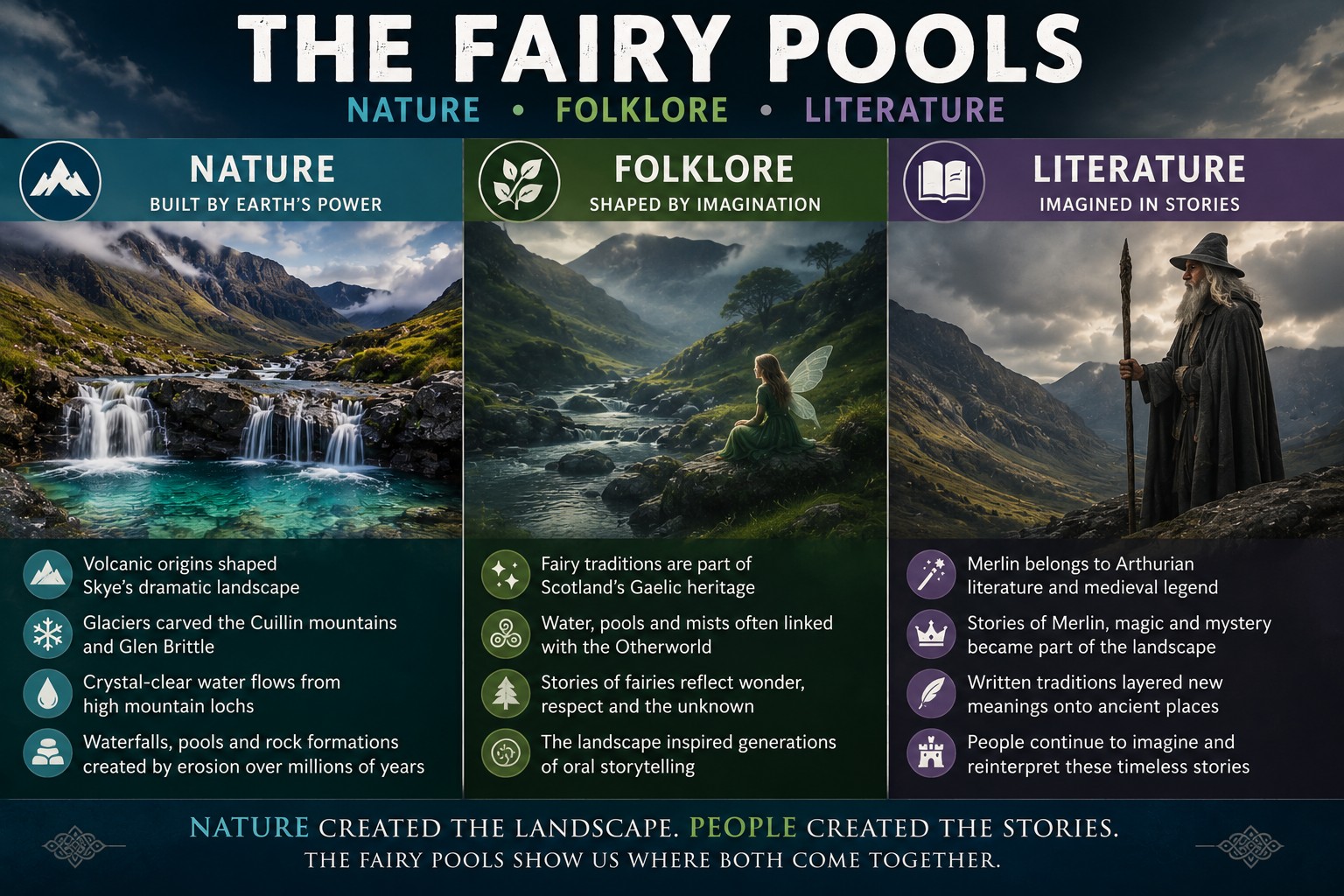
The Fairy Pools are best understood through three complementary perspectives: the natural forces that created them, the Gaelic folklore that grew around them and the literary traditions that later connected landscapes like Skye with Merlin
📖 Merlin in Medieval Literature
Merlin did not begin life as the elderly wizard familiar from modern films and novels.
His earliest roots lie within Welsh tradition, where the figure of Myrddin appears as a prophetic character closely connected with wilderness, solitude and the natural world. During the twelfth century, Geoffrey of Monmouth drew together earlier traditions and reshaped Merlin into the adviser, prophet and magician who became central to the developing Arthurian legends.
As medieval romance spread across Britain and Europe, Merlin’s world expanded.
He was repeatedly associated with ancient forests, remote valleys, mysterious caves, standing stones and dramatic mountain landscapes. These settings reflected his role as a figure who existed slightly beyond ordinary society—someone whose wisdom came not from courts or cities, but from observing the deeper rhythms of the natural world.
That literary tradition explains why readers instinctively connect Merlin with places like the Fairy Pools.
Not because medieval writers specifically placed him here, but because the landscape embodies many of the qualities long associated with his character.
Wild. Ancient. Remote. Beautiful. Thought-provoking.
The Fairy Pools do not need a documented Merlin connection to feel like a landscape worthy of his legend.
🏰 Skye’s Own Legendary Heritage
Although Merlin provides the thematic thread for this mini-cluster, the Isle of Skye possesses an extraordinary legendary tradition entirely its own.
For centuries, Gaelic-speaking communities passed stories from one generation to the next through oral tradition. These narratives blended memory, landscape, family history and imagination, creating a rich cultural heritage that remains closely tied to the island today.
Among Skye’s best-known legendary figures is Scáthach, the formidable warrior woman of Irish heroic literature.
According to tradition, she trained elite warriors at Dún Scáith, a legendary fortress generally associated with the Sleat Peninsula in southern Skye. Her most famous pupil was the hero Cú Chulainn, who travelled to learn the arts of combat before becoming one of the greatest champions in Celtic legend.
It is important to distinguish the tradition from the surviving archaeology.
The ruins of present-day Dunscaith Castle date from the medieval period, while the stories of Scáthach belong to a much older literary tradition. The castle should therefore be understood as a place traditionally associated with her legend rather than evidence of her historical existence.
This distinction mirrors the approach taken throughout this article.
The value of these stories lies not in proving they literally happened, but in understanding how they shaped the cultural identity of Skye and the wider Celtic world.
Merlin joins this broader tapestry of legendary figures.
He does not replace Skye’s own traditions.
If you’re deciding how Skye fits into a wider Scottish adventure, our Scotland travel guide compares the Highlands, islands and major cities to help you build the perfect itinerary.
📜 How Extraordinary Landscapes Become Extraordinary Legends
The Fairy Pools illustrate a pattern that appears repeatedly throughout human history.
People first encounter a landscape unlike anything they have seen before.
They experience surprise, admiration or awe.
They begin telling stories about the place.
Those stories become local traditions.
Over time, traditions merge with wider mythology before later writers develop them into enduring legends recognised far beyond their place of origin.
The Fairy Pools continue that process today.
Modern photography introduces the landscape to millions of people across the world. Visitors arrive with expectations shaped by travel writing, documentaries and social media before adding their own experiences to the continuing story.
The landscape itself has not changed.
Our interpretation of it continues to evolve.
This is why science and folklore should never be viewed as rivals.
Geology explains how the Fairy Pools were formed.
Folklore explains how people responded to their beauty.
Literature explores how those responses grew into enduring stories.
Together, they create a richer understanding than any single perspective could provide on its own.
📊 Myth, Evidence and Interpretation
| Topic | Evidence | Responsible Interpretation |
|---|---|---|
| Merlin visited the Fairy Pools | No historical evidence | A modern literary association inspired by the landscape |
| Fairy traditions in Scotland | Strong cultural tradition | Part of Scotland’s wider Gaelic folklore |
| The Fairy Pools’ beauty inspired stories | Highly plausible | A recurring pattern seen throughout Scottish folklore |
| Geological formation | Well established | Created through volcanic activity, glaciation and long-term erosion |
🧙 Merlin Through Time: From Myrddin to Arthurian Legend
The Merlin recognised today developed gradually through centuries of storytelling. This timeline shows how an early prophetic figure associated with Welsh tradition evolved into the magician, adviser and guardian of Arthurian legend.
🌿 Early Welsh Tradition
The figure of Myrddin appears within Welsh tradition as a prophet associated with wilderness, solitude, conflict and the natural world. These early traditions did not yet present him as the familiar court magician of later Arthurian stories.
📖 Twelfth Century: Geoffrey of Monmouth
Geoffrey of Monmouth combined and reshaped earlier traditions, developing Merlin into a prophet and adviser connected with Britain’s legendary past and the emerging story of King Arthur.
🏰 Medieval Arthurian Romance
Later writers expanded Merlin’s role. He became a magician, strategist and guardian of Arthur’s destiny, increasingly associated with castles, forests, caves, standing stones and remote landscapes.
✨ Modern Imagination
Modern books, films and travel storytelling continue to place Merlin within landscapes that feel ancient, mysterious and powerful. Connections such as Merlin and the Fairy Pools belong primarily to this imaginative tradition rather than documented history.
🔎 Evidence Check: This timeline traces the literary development of Merlin. It does not establish that Merlin was a historical visitor to the Isle of Skye or the Fairy Pools.
📚 Understanding Scotland’s Legendary Landscapes
One remarkable landscape can tell several different stories at the same time. Appreciating each on its own terms allows us to enjoy Scotland’s rich heritage without confusing fact, tradition and imagination.
| Layer | What It Adds |
|---|---|
| 🪨 Nature | Geology explains how extraordinary places such as the Fairy Pools were created. |
| 🍃 Folklore | Communities created stories that expressed wonder, mystery and respect for unusual landscapes. |
| 🧙 Literature | Writers later placed legendary figures such as Merlin into landscapes that reflected their symbolic character. |
| 💡 Interpretation | Together these perspectives create a richer understanding than any single explanation could provide on its own. |
✨ The key message of this guide: You do not have to choose between science, history, folklore or literature. The Fairy Pools are most remarkable when each perspective is appreciated for what it genuinely contributes to understanding this extraordinary landscape.
🚶 Visiting the Fairy Pools Today
The Fairy Pools may feel timeless, but visiting them is a very modern experience. Improved paths, international recognition and spectacular photography have transformed this once relatively quiet Highland location into one of Skye’s most popular natural attractions.
Despite that popularity, the Fairy Pools remain exactly what visitors hope to find—a wild mountain landscape rather than a managed visitor attraction.
There are no elaborate viewing platforms, artificial lighting or landscaped gardens.
Instead, the experience is shaped by the natural environment itself. Fast-moving water, changing weather and the dramatic backdrop of the Black Cuillin create a walk that rewards observation far more than speed.
One of the greatest surprises for first-time visitors is that there is no single “main attraction.”
The Fairy Pools are a sequence of waterfalls, cascades and crystal-clear pools rather than one dramatic destination. Every few hundred metres the landscape changes, encouraging visitors to stop frequently rather than simply walk to a fixed viewpoint.
The best experiences are often the quietest ones.
Pause beside a smaller waterfall.
Watch cloud shadows move across the mountains.
Listen to the sound of water echoing through the glen.
The Fairy Pools are at their finest when you allow the landscape to dictate the pace.
Before deciding exactly when to travel, our Scotland Events Calendar is a useful companion for discovering island festivals, nearby Highland Games and other seasonal events that could enrich your Skye adventure.
Because reaching Skye requires more planning than many first-time visitors expect, our guide to the best Scotland tours from London and across Britain compares the touring styles and itinerary lengths that work best for journeys including the island.
🥾 Fairy Pools Walk: Route, Distance and Difficulty
Most visitors begin their walk from the dedicated Fairy Pools car park in Glen Brittle.
From there, a well-established path follows the stream towards the best-known waterfalls and pools. Improvements over recent years have made the main route easier to follow, with bridges replacing some of the older stepping-stone crossings, although the path remains an outdoor mountain trail rather than a fully surfaced walkway.
The walk to the principal pools and back typically takes around two to three hours, depending on how often you stop to admire the scenery or take photographs.
Visitors looking for a longer adventure can continue further into the surrounding landscape, extending the walk into a rewarding half-day outing beneath the Black Cuillin.
Although the route is suitable for most reasonably fit visitors, it should not be underestimated.
Expect uneven ground, exposed rocks, muddy sections after rain and occasional gradients. Waterproof walking boots with good grip make the experience considerably more enjoyable than lightweight trainers, particularly outside the driest summer periods.
The Highland weather also deserves respect.
Conditions can change quickly, even during the height of summer. Sunshine can give way to mist or rain within minutes, so carrying waterproof clothing and an extra warm layer is always sensible.
🥾 Before You Set Off
For the most enjoyable visit:
- Wear waterproof walking boots with good grip.
- Dress in layers and carry a waterproof jacket.
- Allow plenty of time rather than rushing.
- Carry drinking water and snacks if exploring beyond the main pools.
- Check the weather forecast before travelling, while remembering that mountain conditions can change rapidly.
- Keep to established paths to help protect fragile vegetation.
Visitors with limited mobility should note that the route includes uneven natural surfaces and gradients, so it may not be suitable for everyone. Checking the latest local access information before travelling is recommended.
🥾 Expert Walking Tips for the Fairy Pools
The Fairy Pools walk is achievable for most reasonably fit visitors, but it is a genuine Highland walk rather than a paved tourist attraction. A little preparation makes the experience safer, more comfortable and far more enjoyable.
| ✔ Tip | Why It Matters |
|---|---|
| 🥾 Wear proper walking boots | Rocky paths, wet ground and stream crossings can become slippery, even after dry weather. |
| 🧥 Dress in layers | Highland weather changes quickly, with sunshine, wind and rain often arriving within the same walk. |
| ⏰ Start early if possible | Earlier visits usually mean quieter paths, easier parking and calmer conditions for photography. |
| 📱 Keep your phone protected | Waterproof pouches or dry bags help protect phones and cameras from rain and spray. |
| 🚶 Walk at your own pace | The route rewards slow exploration, with viewpoints and waterfalls appearing throughout the walk. |
💡 Local Tip: Many visitors focus on reaching the largest waterfall, but some of the Fairy Pools’ most beautiful colours, reflections and quieter viewpoints are found between the main stopping points. Allow plenty of time to explore rather than simply walking to the end and back.
📸 Photography Tips for the Fairy Pools
The Fairy Pools are among Scotland’s most photographed landscapes, but the finest images rarely depend on bright sunshine alone.
Soft cloud often produces richer colours by reducing glare on the water, while drifting mist can add depth and atmosphere to views of the Black Cuillin. Conditions immediately after light rain are also popular with photographers, as the waterfalls become more powerful and the surrounding rock takes on a deeper tone.
Early morning remains one of the best times to visit.
Not only is the light often softer, but the paths are generally quieter, allowing more opportunities to appreciate the landscape without distraction.
Rather than focusing only on the largest waterfalls, look for smaller details that many visitors overlook.
Water flowing across polished volcanic rock.
Mountain reflections in still pools.
Wildflowers beside the stream during spring and summer.
The contrast between dark mountains and luminous water.
These quieter compositions often capture the true character of the Fairy Pools far better than a single panoramic view.
Wherever you stop, be considerate of other visitors and avoid leaving established paths simply to reach a different photographic angle.
The landscape is at its most beautiful when it remains undisturbed.
📸 Plan Your Fairy Pools Photography
The Fairy Pools can look dramatically different depending on the weather, water level and time of day. Use this quick-reference guide to make the most of the conditions you find.
| Conditions | Best Approach |
|---|---|
| 🌤️ Soft morning light | Use wider compositions to capture the pools, waterfalls and surrounding Cuillin landscape before the paths become busier. |
| ☁️ Overcast skies | Look for saturated colours, reflections and detail in the water. Cloud cover often produces balanced light with fewer harsh shadows. |
| 🌧️ After rainfall | Waterfalls may appear more powerful, but paths and rocks can be slippery. Prioritise safe footing over reaching a particular viewpoint. |
| ☀️ Bright sunlight | Photograph from several angles to manage glare and reflections. A polarising filter can help reveal more colour beneath the water’s surface. |
| 🌫️ Mist and low cloud | Use the atmosphere creatively by including dark rocks, moving water and partially hidden mountains to create a more dramatic composition. |
🌿 Photograph Responsibly: Stay on established paths and durable surfaces, avoid trampling vegetation for a clearer angle, and never block narrow sections of the route while setting up a photograph. The best image is never worth damaging the landscape or putting yourself or other visitors at risk.
🏊 Can You Swim in the Fairy Pools?
One of the questions visitors ask most often is whether you can swim in the Fairy Pools.
The simple answer is yes—but only if you fully understand the conditions and accept the risks.
The pools are fed by mountain streams flowing directly from the Black Cuillin. Even on warm summer days, the water remains exceptionally cold throughout the year. Cold-water shock can occur within seconds of entering, reducing muscle control and making even confident swimmers vulnerable.
The pools are also natural features rather than managed swimming areas.
Water depth varies considerably, submerged rocks can be slippery, and stronger currents often develop after periods of heavy rainfall. Conditions that appear calm from the bank may be very different beneath the surface.
For these reasons, many visitors choose simply to enjoy the remarkable clarity of the water without entering it.
Those with experience of cold-water swimming should assess conditions carefully, avoid swimming alone, and never enter the water after heavy rain or when water levels are unusually high. Jumping or diving into the pools is strongly discouraged due to hidden rocks and changing depths.
Whether you decide to swim or simply admire the scenery, the Fairy Pools are best appreciated with respect for the powerful natural environment that created them.
🌦️ When Is the Best Time to Visit the Fairy Pools?
The Fairy Pools can be visited throughout the year, with each season revealing a different side of the landscape.
Spring brings fresh greenery, quieter paths and waterfalls that are often at their most impressive after winter rainfall. Wildflowers begin to appear around the glen, while the surrounding mountains gradually emerge from the colder months.
Summer offers the longest daylight hours and the greatest chance of comfortable walking conditions. It is also the busiest season, particularly during school holidays and on clear days, so arriving early in the morning or later in the afternoon usually provides a more peaceful experience.
Autumn is often considered by experienced visitors to be one of the finest times to explore the Fairy Pools. Cooler temperatures, rich colours and more frequent dramatic skies combine to create exceptional photographic conditions, while visitor numbers begin to ease.
Winter transforms the landscape completely. Snow occasionally dusts the Black Cuillin, streams become even more dramatic after seasonal weather, and the glen feels wonderfully quiet. However, daylight is limited, weather conditions can change rapidly and extra care is essential on wet or icy paths.
There is no single perfect season.
Instead, the Fairy Pools reward visitors who embrace the changing character of the Highlands rather than expecting identical conditions on every visit.
📊 Fairy Pools Visitor Planning Guide
| Planning Topic | Recommendation |
|---|---|
| ⏱️ Typical Visit | Allow 2–3 hours for the main walk, longer if exploring further into Glen Brittle |
| 🌅 Best Time of Day | Early morning for quieter paths and softer light |
| 👟 Footwear | Waterproof walking boots with good grip are strongly recommended |
| 🧥 Clothing | Dress in layers and carry waterproofs in every season |
| 📸 Photography | Early morning, overcast conditions or after light rain often produce the best images |
| 🏊 Swimming | Possible but only for experienced cold-water swimmers who fully understand the risks |
| 🌦️ Weather | Always check the forecast, but expect conditions to change quickly in the mountains |
| 🚶 Visitor Etiquette | Stay on established paths and leave the landscape exactly as you found it |
💡 Expert Planning Tip
Many visitors try to complete the Fairy Pools walk as quickly as possible before moving on to another attraction.
The opposite approach usually creates the most rewarding experience.
Allow time to stop frequently, listen to the waterfalls, watch changing light move across the Black Cuillin and appreciate how the landscape continually transforms throughout the day. The Fairy Pools are not simply a place to tick off an itinerary—they are somewhere to experience at a slower pace.
That sense of immersion is precisely why this corner of Skye has inspired travellers, photographers and storytellers for generations.
🌱 Visiting the Fairy Pools Responsibly
The popularity of the Fairy Pools has brought significant benefits to the local economy, but it has also increased pressure on one of Scotland’s most fragile mountain environments.
Every visitor can help preserve this remarkable landscape for future generations through a few simple choices.
Remain on established paths to reduce erosion and protect sensitive vegetation. Take all litter home, including biodegradable waste, and avoid disturbing wildlife or livestock that may be grazing nearby. If you’re travelling with a dog, keep it under close control, particularly during the bird nesting season and around sheep.
The Fairy Pools are also protected by the principles of the Scottish Outdoor Access Code, which encourages everyone to enjoy Scotland’s landscapes responsibly while respecting local communities, wildlife and the natural environment.
Responsible travel is about more than following rules. It is about recognising that extraordinary places remain extraordinary because generations of visitors choose to care for them. Every thoughtful decision—however small—helps preserve Glen Brittle’s remarkable landscape for those who will discover it in the years ahead.
By treading lightly, visitors help ensure that future generations will experience the same sense of wonder that has drawn people to Glen Brittle for decades.
🌿 Travel with Purpose. Explore with Care.
Scotland’s most memorable landscapes are also among its most vulnerable. Small decisions—staying on established paths, taking litter home, respecting local communities and allowing wildlife plenty of space—help protect these places for residents, future visitors and generations still to come.
Responsible visits begin with simple choices:
- 🥾 Remain on established paths to reduce erosion and protect fragile vegetation.
- 🗑️ Leave no trace by carrying all litter and personal belongings away with you.
- 🚗 Plan journeys carefully and use shared or lower-impact transport where practical.
- 🏡 Support local communities through responsible spending and respectful behaviour.
- 📸 Protect the view you came to capture by never damaging the landscape for a photograph.
💙 The BVT approach: Meaningful travel should create lasting memories without leaving lasting damage. Discover how responsible choices can help build a greener and more sustainable future for travel.
❓ Frequently Asked Questions
❓ Are the Fairy Pools free to visit?
Yes. The Fairy Pools themselves are free to access, although parking charges apply at the official visitor car park. Using the designated parking area helps support visitor facilities and protects the surrounding environment.
❓ How long does it take to walk to the Fairy Pools?
Most visitors spend two to three hours exploring the main route at a comfortable pace. If you enjoy photography or continue further into Glen Brittle, you should allow additional time.
❓ Are the Fairy Pools difficult to walk?
The walk is considered moderately easy for most reasonably fit visitors, but it is still a mountain trail. Expect uneven surfaces, exposed rocks and muddy sections, particularly after wet weather. Good walking boots make a significant difference.
❓ Can children visit the Fairy Pools?
Yes. Families regularly enjoy the walk, although young children should be closely supervised near fast-flowing water, slippery rocks and steep riverbanks.
❓ Can you swim in the Fairy Pools?
Some visitors do swim, but the water remains extremely cold throughout the year and conditions can change rapidly. Anyone considering entering the water should understand the risks of cold-water shock, slippery rocks and varying depths.
❓ Is there really a connection between Merlin and the Fairy Pools?
There is no historical evidence that Merlin visited the Fairy Pools.
The connection is literary and imaginative rather than historical. Throughout Britain, dramatic landscapes have often become associated with legendary figures, and the atmosphere of Glen Brittle naturally complements the themes found within Arthurian literature.
❓ What is the best time of year to visit?
Every season offers a different experience.
Spring brings fresh colours and energetic waterfalls, summer provides long daylight hours, autumn often delivers spectacular photography conditions, while winter offers dramatic mountain scenery with far fewer visitors. The ideal time depends on the type of experience you are seeking.
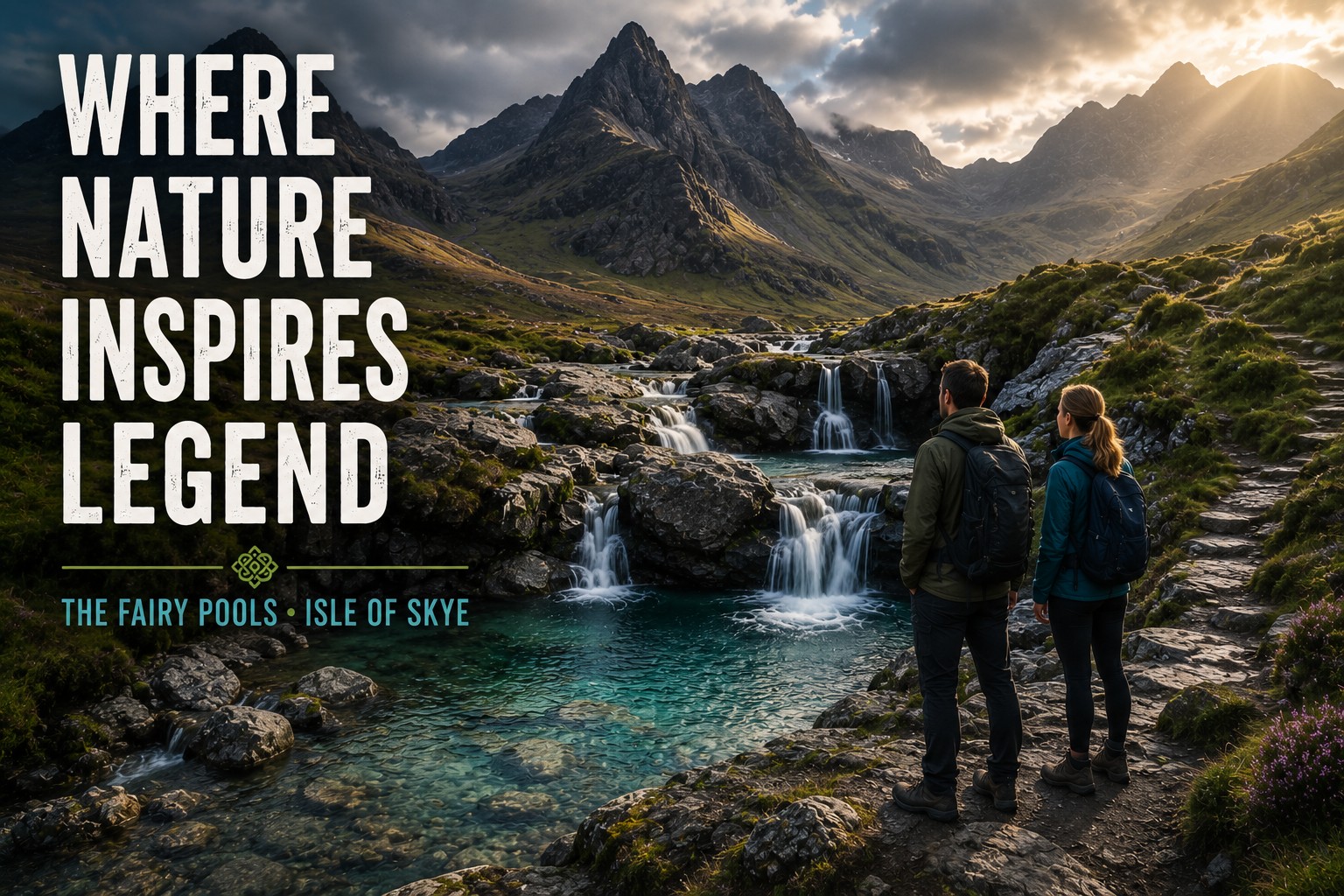
The Fairy Pools offer far more than spectacular scenery. Their remarkable combination of clear mountain water, dramatic Highland landscapes and ever-changing light helps explain why places like this have inspired folklore, legend and imagination for generations
🏔️ Final Thoughts: Where Nature and Legend Meet
Few places demonstrate the relationship between landscape and storytelling as beautifully as the Fairy Pools.
Their remarkable colours, cascading waterfalls and the ever-changing backdrop of the Black Cuillin create a setting that feels timeless. Long before geology explained how volcanic rock, glaciers and flowing water shaped this valley, people responded to its beauty with stories. Those stories became folklore, folklore inspired literature, and literature helped legendary figures such as Merlin become woven into Britain’s cultural imagination.
That is the true magic of the Fairy Pools.
Not that they prove ancient legends happened here, but that they reveal why extraordinary places continue to inspire extraordinary stories.
Standing beside these crystal-clear waters, it becomes easy to understand why generations of travellers have struggled to describe the experience using ordinary language. The landscape encourages reflection as much as exploration, inviting visitors to slow down, observe and appreciate the remarkable forces—both natural and cultural—that have shaped this corner of Skye.
Whether you arrive as a walker, photographer, history enthusiast or simply someone seeking one of Scotland’s finest natural landscapes, the Fairy Pools reward curiosity.
They remind us that understanding a place does not diminish its mystery.
Quite the opposite.
The more we learn about the Isle of Skye—its geology, its Gaelic heritage and its enduring legends—the more remarkable it becomes.
✨ Continue Your Journey Through Merlin’s Scotland
If the Fairy Pools have sparked your curiosity about the relationship between Scotland’s landscapes and the legends of Merlin, this is only the beginning.
Across Scotland you’ll find dramatic mountains, ancient standing stones, legendary castles and historic places that have inspired stories for centuries. Together they form part of a much larger journey through myth, history and some of Britain’s most breathtaking scenery.
For inspiration on seasonal events, festivals and places to include in your wider Scottish adventure, explore the Scotland Events Calendar, where you’ll find ideas to help plan the perfect trip throughout the year.
📅 Plan Scotland Around the Moments That Matter
Scotland changes throughout the year. Seasonal landscapes, cultural celebrations, traditional festivals and major events can all shape what you experience—and when it is best to travel.
Use the Scotland Events Calendar to explore key dates, discover what is happening during your visit and begin building a journey around the places and experiences that interest you most.
The calendar can help you:
- 🎭 Discover major festivals and cultural events across Scotland.
- 🌦️ Compare different seasons and understand how they may affect your plans.
- 🏰 Combine legendary landscapes with events, heritage attractions and local experiences.
- 🗓️ Identify important dates early before accommodation and tours become limited.
💡 Start with the date, then build the journey: Choosing when to travel can help determine which landscapes, celebrations and seasonal experiences become part of your Scotland adventure.
🧙 Explore Merlin’s Scotland
Journey through Scotland’s legendary landscapes with Merlin, ancient standing stones, Edinburgh traditions, Highland mythology and a complete itinerary inspired by the places where history and legend meet.
📖 Begin with the Complete Merlin Guide
Start with the central guide to Merlin’s Scottish traditions, historical associations and the places visitors can explore today.
🏰 Discover Scotland’s Legendary Places
Explore the landscapes, monuments and historic locations connected with Merlin, Arthurian tradition and Scotland’s ancient stories.
🏔️ Continue into the Scottish Highlands
Discover how wilderness, mountains, hidden places and Highland storytelling helped shape Merlin’s Scottish identity.
🗺️ Follow the Complete Merlin-Inspired Route
Bring the legends together with a carefully planned 3–5 day itinerary linking Edinburgh, the Highlands and Scotland’s most atmospheric Merlin locations without unnecessary backtracking.
🇬🇧 Turn the Legends into Your Own Scotland Journey
Explore guided day tours, longer Highland journeys and Scotland’s year-round events as you move from inspiration into practical travel planning.
Discover the legend → explore the places → enter the Highlands → follow the itinerary → plan your Scotland journey