


Standing Stones of Scotland: Merlin, Druids & Ancient Power
31st July 2026
🪨 Standing Stones of Scotland: Merlin, Druids & Ancient Power

The Calanais Standing Stones have watched over the Isle of Lewis for more than 5,000 years. Older than the legends of Merlin and the historical Druids, they remain among Scotland’s most extraordinary prehistoric monuments
Across Lewis, Orkney, Arran, Argyll and the Highlands, the standing stones of Scotland still break the horizon where prehistoric communities raised them thousands of years ago. Some stand alone above open moorland. Others form circles, avenues or ceremonial landscapes beside lochs, burial cairns and distant mountain skylines.
They are older than Scotland itself.
Many were already ancient before Greek and Roman writers described the Druids, and they had stood for thousands of years before medieval authors transformed Merlin into Britain’s legendary prophet and magician. Yet Druids, Merlin, giants, fairies and supernatural power have all become part of the stories later generations told about these monuments.
That chronological contrast lies at the heart of their fascination.
The people who built Scotland’s great stone settings left no written explanation of their intentions. No surviving inscription identifies the communities who selected the sites, transported the stones or directed the work. Archaeology can investigate when monuments were constructed, how they changed and what activities took place nearby, but many of the builders’ beliefs remain beyond recovery.
The silence created space for legend.
Once the original explanations disappeared from living memory, later societies interpreted the stones through stories that made sense within their own world. Circles became gathering places for Druids. Solitary monoliths became petrified warriors. Unexplained alignments were attributed to giants, saints or magical intervention. Merlin entered this tradition because medieval literature presented him as a guardian of ancient knowledge capable of understanding mysteries ordinary people could not explain.
These stories are not archaeological records, but they remain part of the monuments’ cultural history.
The most rewarding way to experience Scotland’s standing stones is therefore not to choose between evidence and imagination. It is to understand the different questions they answer. Archaeology reveals the monuments’ construction, chronology and changing use. Folklore shows how later communities continued to interpret places whose first meanings had been lost.
This guide explores who built Scotland’s standing stones, why the Druids did not construct the earliest circles, how Merlin became associated with ancient monuments and what “ancient power” can responsibly mean. It also introduces some of Scotland’s greatest prehistoric landscapes, from Calanais and Orkney to Clava Cairns, Machrie Moor and Kilmartin Glen.
The stones came first.
The legends followed.
Their ability to inspire both has never disappeared.
🏛️ Prehistoric Scotland at a Glance
Long before Scotland had castles, kingdoms or written history, prehistoric communities were shaping the landscape with remarkable ambition. Across the country they raised standing stones, built ceremonial circles, created burial cairns and established sacred landscapes that still survive more than five thousand years later.
Many of these monuments were already ancient long before the historical Druids appeared, and thousands of years older than the medieval legends that later linked Merlin with Britain’s mysterious stone circles. Understanding this timeline allows archaeology and folklore to be appreciated together while recognising that they belong to different chapters of Scotland’s story.
Key Points
- 🪨 Most standing stones were raised during the Neolithic and Bronze Age.
- 📜 They predate the historical Druids by many centuries.
- 🧙 Merlin became connected through medieval legend, not prehistoric history.
- 🌄 Scotland’s ceremonial landscapes remain among Europe’s greatest archaeological treasures.
The remarkable journey begins with Scotland’s earliest monument builders — thousands of years before history, legend and myth became intertwined.
⏳ Who Built Scotland’s Standing Stones?
Understanding the standing stones of Scotland begins with recognising that they do not belong to a single period or a single culture. Instead, they form part of a long prehistoric story that spans many centuries, reflecting changing communities, beliefs and ceremonial traditions.
The earliest great monuments were created by Neolithic farming societies between approximately 4000 BC and 2500 BC. As people settled more permanently across Scotland, they began reshaping the landscape in entirely new ways. Alongside homes, fields and tombs, they constructed ceremonial monuments intended to endure for generations. Stone circles, individual standing stones, burial cairns and other ritual sites became permanent landmarks within landscapes that held social, spiritual and ancestral importance.
Later Bronze Age communities continued this tradition rather than replacing it. New standing stones were erected, burial cairns became increasingly prominent and older ceremonial places were reused or reinterpreted. Scotland’s prehistoric landscapes therefore evolved over many centuries, with each generation adding new layers of meaning while often respecting monuments that were already ancient.
Although visitors often use the phrase “standing stones” to describe every prehistoric monument, several different monument types exist.
| Monument Type | Description |
|---|---|
| Standing Stone | A single upright stone placed deliberately within the landscape. |
| Stone Circle | Upright stones arranged to enclose an open ceremonial space. |
| Stone Avenue or Alignment | Stones deliberately positioned in lines or processional routes. |
| Cairn | A constructed mound of stone, frequently associated with burial or remembrance. |
| Ceremonial Landscape | A wider prehistoric setting containing multiple monuments that worked together rather than independently. |
This diversity is one reason Scotland’s prehistoric heritage remains so compelling.
Rather than following one standard design, different regions developed their own distinctive ceremonial landscapes. Some communities preferred large circles that dominated open ground, while others created burial monuments surrounded by standing stones or isolated monoliths overlooking glens, rivers or coastlines. The monuments reflected local geography, available stone and the traditions of the people who built them.
Despite these differences, they all shared one remarkable characteristic.
Constructing monuments from multi-tonne stones required planning, cooperation and long-term commitment on an extraordinary scale. Without metal cranes, modern machinery or wheeled transport, prehistoric communities quarried stone, transported it across challenging terrain and raised it with impressive precision. These projects demanded leadership, shared knowledge and a willingness to invest enormous effort in places whose importance extended well beyond everyday life.
The standing stones therefore represent far more than impressive engineering.
They reveal societies capable of working together to create landscapes that would shape memory, ceremony and identity for thousands of years.
⏳ Scotland’s Standing Stones Through Time
Scotland’s standing stones, historical Druids and Merlin traditions belong to very different periods. This timeline shows when the monuments were built and how later generations gradually connected them with religion, folklore and medieval legend.
🪨 Neolithic Scotland
Approximately 4000–2500 BC
Farming communities created many of Scotland’s earliest ceremonial landscapes, including major stone settings, burial monuments and gathering places. Sites such as Calanais and the Stones of Stenness began taking shape during this vast prehistoric period.
🌅 Bronze Age Scotland
Approximately 2500–800 BC
Later communities continued erecting standing stones, developed prominent burial cairns and reused ceremonial places that were already ancient. Landscapes such as Clava Cairns reflect growing connections between monuments, ancestry, remembrance and seasonal change.
🌿 Iron Age Druids
Approximately 800 BC–AD 400
The Druids described by Greek and Roman writers belonged broadly to the much later Iron Age. Scotland’s earliest stone circles had already stood for many centuries—and in some cases for more than two thousand years—before these historical Druids appeared in written accounts.
🧙 Medieval Merlin
From approximately the 12th century
Medieval authors transformed Merlin into a prophet and guardian of Britain’s ancient knowledge. Geoffrey of Monmouth’s legendary account of Merlin and the Giants’ Dance helped connect him with prehistoric monuments, thousands of years after Scotland’s earliest stones were raised.
The stones came first. Druids and Merlin became connected with them through much later history, interpretation and legend.
🔮 Did the Druids Build Scotland’s Standing Stones?
It is one of the most persistent myths surrounding Britain’s prehistoric monuments.
The answer is no.
Modern archaeology has shown that the majority of Scotland’s great standing stones and stone circles were erected during the Neolithic and early Bronze Age, many centuries before the Druids described by Greek and Roman writers belonged to Iron Age Celtic societies. By the time those historical Druids entered the written record, many of Scotland’s most famous monuments had already stood for well over two thousand years.
A simple timeline helps place these periods into context.
| Period | Approximate Dates | Significance |
|---|---|---|
| Neolithic | c. 4000–2500 BC | Construction of many of Scotland’s earliest ceremonial landscapes and major stone settings. |
| Bronze Age | c. 2500–800 BC | Continued monument building, burial cairns and the reuse of older sacred places. |
| Iron Age | c. 800 BC–AD 400 | Historical Druids belong broadly to this later period. |
| Medieval Britain | From around the 12th century | Geoffrey of Monmouth and later Arthurian writers link Merlin with ancient monuments. |
Once this chronology is understood, the archaeological evidence becomes much clearer.
So why do so many people still associate Druids with standing stones?
Before archaeology developed reliable dating techniques, historians and antiquarians knew the monuments were immensely old but had little idea exactly how old. Because Druids were already recognised as religious figures from Britain’s distant past, they became convenient explanations for mysterious stone circles whose true origins had been forgotten. During the eighteenth and nineteenth centuries, Romantic artists and writers reinforced this connection, creating dramatic images of white-robed Druids performing ceremonies among ancient stones.
Those powerful images remain influential today, even though archaeology tells a different story.
That does not mean the Druids ignored prehistoric monuments.
Ancient ceremonial landscapes would almost certainly have remained impressive places within Iron Age Britain, and later communities may have gathered at some of them, attached new traditions to them or regarded them with respect. Appreciating an ancient monument, however, is very different from constructing it.
The same distinction applies today.
Many modern Druid organisations and contemporary spiritual communities continue to value standing stones as meaningful places for reflection and seasonal gatherings. Their relationship forms part of the monuments’ continuing cultural life, but it does not change the archaeological evidence surrounding their original construction.
Understanding that difference allows both history and living tradition to be appreciated on their own terms.
The prehistoric builders created the monuments.
Later generations—including the Druids—added new meanings to them.
⚖️ Druids and Standing Stones — Myth, History and Living Tradition
The connection between Druids and Scotland’s standing stones is culturally important, but it needs to be understood in the correct historical order. Archaeology, later folklore and modern spiritual practice each tell a different part of the story.
🪨 Archaeology
Scotland’s earliest stone circles and standing-stone landscapes were created by Neolithic and Bronze Age communities. Many were already ancient long before historical Druids appeared in Iron Age written accounts.
📜 Folklore and Later Interpretation
Centuries after the original purpose of the monuments had been forgotten, antiquarians, artists and storytellers associated stone circles with Druids. These later interpretations helped create the familiar image of white-robed figures gathering among ancient stones.
🌿 Modern Druidism
Modern Druid organisations and contemporary spiritual communities may value prehistoric monuments as places of reflection, ceremony and seasonal gathering. This forms part of the stones’ continuing cultural life, but it does not mean those groups—or the historical Druids—built the monuments.
The prehistoric builders created the stones. Later Druids, writers and spiritual communities gave them new meanings.
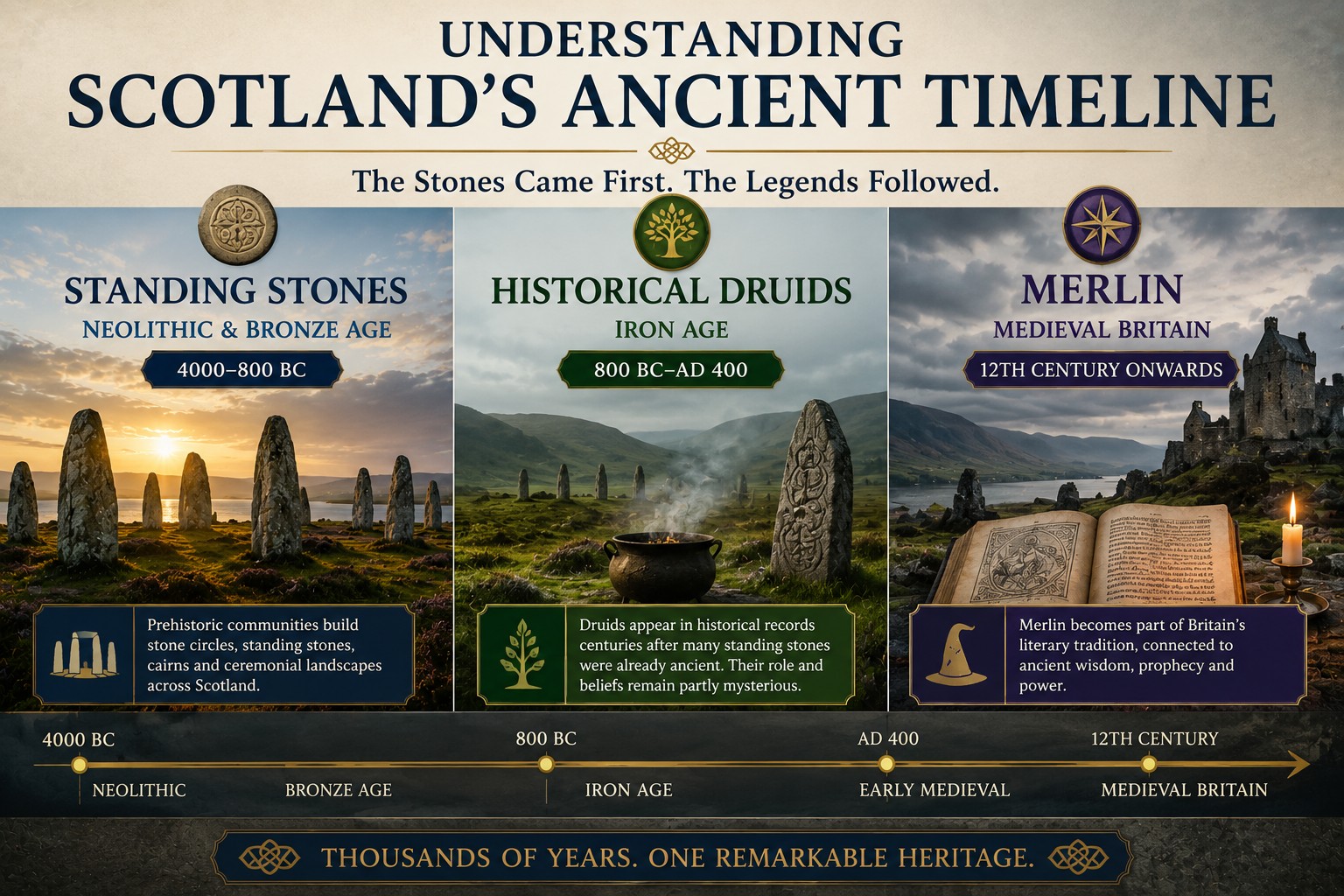
Scotland’s standing stones, the historical Druids and Merlin belong to three distinct periods of history. This timeline explains how they later became connected through folklore, literature and cultural tradition
🧙 Why Merlin Became Connected with Ancient Stones
If the Druids did not build Scotland’s standing stones, how did Merlin become so closely associated with them?
The answer lies not in prehistory but in medieval literature.
By the Middle Ages, Britain’s great stone monuments had already stood in the landscape for thousands of years. Their original builders were unknown, their ceremonies forgotten and their purpose increasingly mysterious. Medieval writers inherited extraordinary monuments without the historical knowledge needed to explain them, so they naturally turned to legendary figures capable of filling those gaps.
No figure proved more influential than Merlin.
As Arthurian legend developed, Merlin evolved into far more than a royal adviser or prophet. He became the keeper of ancient wisdom, a man whose understanding extended beyond ordinary history into the oldest mysteries of Britain itself. Ancient stone monuments therefore became natural settings within stories about his knowledge, power and foresight.
The most famous example appears in the twelfth-century work of Geoffrey of Monmouth.
In his Historia Regum Britanniae (History of the Kings of Britain), Geoffrey tells the legendary story of the Giants’ Dance, a great stone monument supposedly transported from Ireland to Salisbury Plain through Merlin’s guidance and supernatural knowledge. According to the tale, the stones were reassembled to create what later generations recognised as Stonehenge.
Modern archaeology has demonstrated that this story is legendary rather than historical. Stonehenge was constructed over many centuries by prehistoric communities, not transported intact by Merlin. Geoffrey’s account was never intended as archaeological evidence; it was part of a broader medieval narrative that blended history, legend and political storytelling.
Its cultural influence, however, was enormous.
Once Merlin became associated with Britain’s most famous prehistoric monument, he increasingly appeared within later interpretations of other mysterious stone landscapes. Although there is no archaeological evidence linking Merlin with Scotland’s standing stones, the idea fitted naturally into an already flourishing tradition of folklore, mystery and forgotten origins.
The same process shaped many other local legends.
Across Scotland, prehistoric monuments acquired stories of giants, enchanted warriors, petrified dancers, supernatural guardians and magical encounters. These tales developed because later communities wanted explanations for monuments whose original stories had disappeared thousands of years earlier.
Seen in that light, Merlin’s connection with Scotland’s standing stones becomes easier to understand.
He is not part of their prehistoric history.
He is part of their medieval literary history and their continuing cultural imagination.
That distinction allows visitors to appreciate both the archaeological reality of the monuments and the rich storytelling traditions that have helped keep them alive in Britain’s imagination for centuries.
🧙 Merlin and Scotland’s Ancient Landscapes
Merlin’s connection with Scotland is not confined to one monument or one legend. Across ancient hills, dramatic islands and historic landscapes, later storytellers associated him with prophecy, hidden knowledge and places where history and imagination meet.
🏔️ Merlin in Scotland
Begin with the wider story of Merlin’s Scottish legends, historical traditions and the places visitors can still explore today.
🏰 Arthur’s Seat and Ancient Edinburgh
Discover how Edinburgh’s volcanic landscape became connected with Merlin, Arthurian tradition and some of the capital’s most enduring legends.
✨ Magic and Legend on the Isle of Skye
Continue into Skye’s dramatic scenery, where fairy traditions, magical landscapes and later Merlin associations form part of the island’s rich cultural imagination.
Follow the Merlin mini-cluster to explore how Scotland’s landscapes became part of a much wider tradition of history, mythology and storytelling.
🗺️ Scotland’s Greatest Standing-Stone Landscapes
No single monument can represent the full story of prehistoric Scotland.
Instead, the country’s most important standing-stone sites reveal how different communities interpreted their landscapes, developed their ceremonial traditions and expressed their beliefs over many centuries. Each location has its own character, yet together they illustrate the remarkable diversity of Scotland’s prehistoric heritage.
Because these remarkable prehistoric sites are scattered across the country, our Scotland travel guide is a useful companion for comparing regions before planning your journey.
Many visitors also enjoy combining these remarkable prehistoric landscapes with Highland Games and regional festivals, making our Scotland Events Calendar a useful planning companion before choosing your travel dates.
Many of these remarkable sites are best explored as part of a wider touring route, and our guide to the best Scotland tours from London and across Britain explains which travel styles are most suitable for reaching them.
🌊 Calanais Standing Stones — Isle of Lewis
Few prehistoric monuments in Britain create such an immediate sense of place as the Calanais Standing Stones on the Isle of Lewis.
Constructed between approximately 2900 BC and 2600 BC, Calanais predates the principal stone phase of Stonehenge and remains one of Scotland’s most recognisable prehistoric monuments. Rather than forming a simple circle, the site combines a central ring with radiating rows of standing stones that extend across a low ridge overlooking Loch Roag, creating a ceremonial landscape that appears inseparable from the surrounding Hebridean scenery.
The setting is as memorable as the monument itself.
Open moorland, ever-changing Atlantic skies and distant hills continually transform the appearance of the stones. Depending on the weather and the season, the same monument can feel dramatic, peaceful or deeply contemplative, helping explain why Calanais has inspired generations of folklore alongside archaeological investigation.
Research suggests that the monument remained significant for many centuries after its construction. Later environmental changes gradually buried parts of the site beneath layers of peat before modern excavation revealed much of its original form once again. This long history reminds visitors that prehistoric monuments were not static relics but landscapes that continued to change long after their builders disappeared.
🔵 Ring of Brodgar and the Stones of Stenness — Orkney
If Calanais demonstrates the atmosphere of a single ceremonial monument, Orkney reveals the scale of an entire prehistoric ceremonial landscape.
The Stones of Stenness and the nearby Ring of Brodgar form part of the UNESCO-recognised Heart of Neolithic Orkney, where settlements, ceremonial monuments and burial sites exist within one interconnected landscape.
Stenness is believed to be one of Britain’s earliest stone circles. Although only four of its original twelve great stones remain standing today, their impressive height still conveys the ambition of the prehistoric builders. Just over a kilometre away, the Ring of Brodgar originally contained around sixty stones arranged within a vast circle enclosed by a substantial rock-cut ditch, making it one of the largest prehistoric stone circles in Britain.
Experiencing these monuments together helps visitors appreciate that prehistoric communities often planned entire ceremonial landscapes rather than isolated structures.
🗺️ Scotland’s Great Standing-Stone Landscapes Compared
Scotland’s prehistoric monuments each tell a different chapter of the country’s ancient story. Some impress through their scale, others through their atmosphere, archaeological importance or dramatic setting. Together they reveal the extraordinary diversity of Scotland’s prehistoric heritage.
| Site | Region | Highlights | Best For |
|---|---|---|---|
| 🌊 Calanais | Isle of Lewis | Iconic stone circle with radiating avenues and spectacular Atlantic scenery. | Atmosphere & photography |
| 🔵 Ring of Brodgar & Stones of Stenness | Orkney | Part of the UNESCO Heart of Neolithic Orkney ceremonial landscape. | World-class archaeology |
| 🌅 Clava Cairns | Highlands | Remarkable Bronze Age burial landscape with winter solstice alignments. | History & tranquillity |
| 🌾 Machrie Moor | Isle of Arran | Stone circles, standing stones and prehistoric landscapes across open moorland. | Walking & scenery |
| 🌀 Kilmartin Glen | Argyll | One of Britain’s richest concentrations of prehistoric monuments. | Complete prehistoric landscapes |
Visitor Tip
If time allows, try to experience more than one landscape. Each monument reflects different communities, different traditions and different ways prehistoric Scotland understood its world, making every visit a unique part of the wider story.
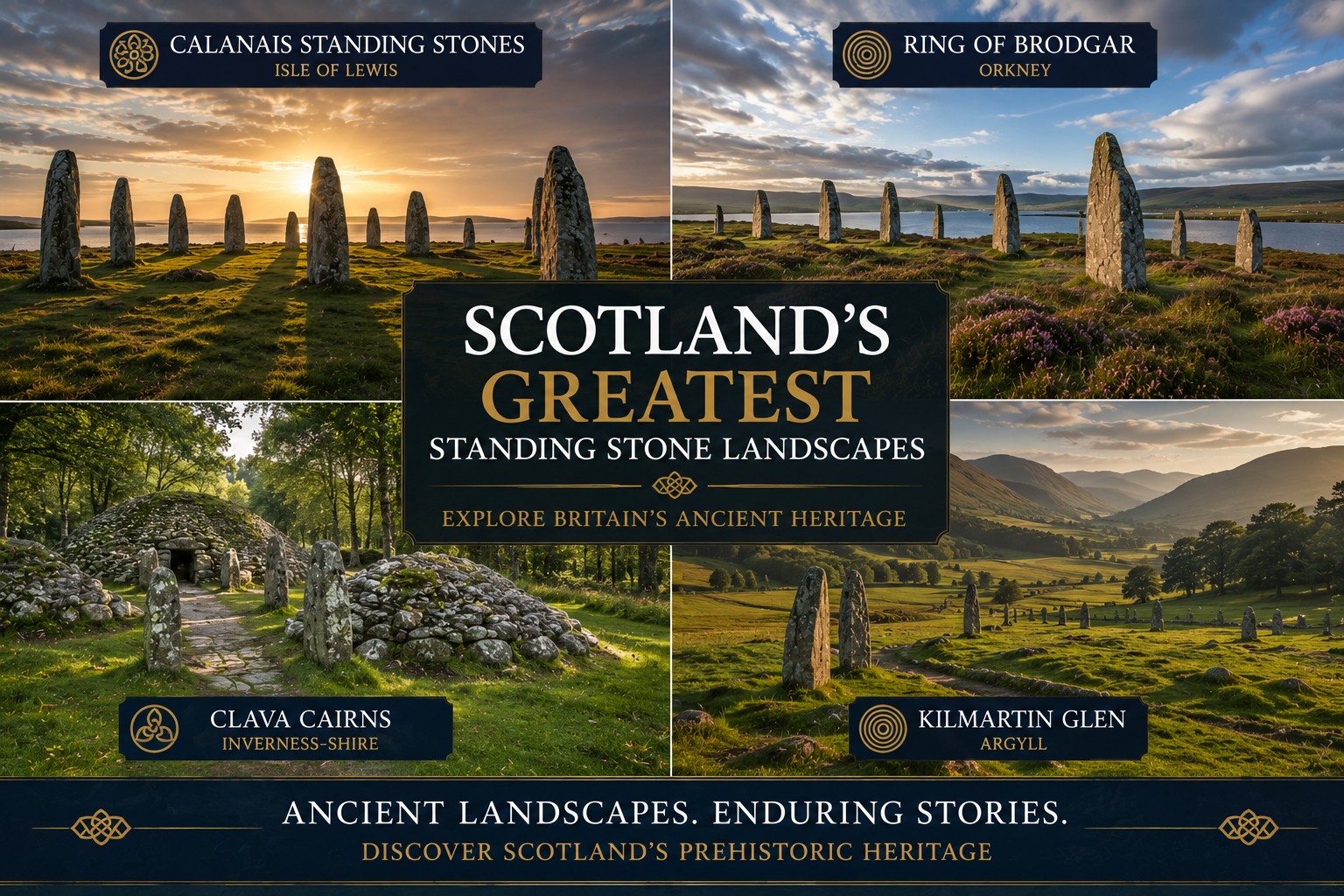
From the windswept Hebrides to the prehistoric heartland of Argyll, Scotland’s standing stone landscapes reveal thousands of years of ceremonial tradition, remarkable engineering and enduring cultural heritage
🌅 Clava Cairns, Machrie Moor and Kilmartin Glen
While Calanais and Orkney are internationally recognised icons of prehistoric Scotland, several other remarkable landscapes help complete the story of how ancient communities shaped the country over thousands of years.
🌅 Clava Cairns — A Landscape of Memory
Just outside Inverness, the Clava Cairns provide one of Scotland’s finest examples of a Bronze Age burial landscape.
Built around 4,000 years ago, the site combines passage graves, ring cairns and carefully positioned standing stones into a unified ceremonial setting. Unlike many earlier monuments that emphasise large communal gathering spaces, Clava focuses attention on remembrance, ancestry and the relationship between the living and the dead.
One of its most intriguing characteristics is its connection with the midwinter sunset. Several cairns appear deliberately aligned so that the setting winter sun illuminates key parts of the monuments, suggesting that seasonal change played an important role in the beliefs of the communities who built them. While archaeologists continue to debate the full significance of these alignments, they demonstrate the sophisticated way prehistoric people observed both landscape and sky.
Today, the peaceful woodland setting encourages quiet reflection, making Clava one of Scotland’s most atmospheric prehistoric sites.
🌾 Machrie Moor — Ceremony Within a Living Landscape
On the Isle of Arran, Machrie Moor offers a different perspective on prehistoric Scotland.
Rather than showcasing one dominant monument, the moor contains multiple stone circles, standing stones, burial cairns, cists and traces of prehistoric settlement spread across an open landscape. These monuments developed over many centuries, illustrating that ritual activity existed alongside farming, community life and everyday survival.
Some circles also appear aligned towards distinctive features within the surrounding hills, reminding visitors that prehistoric builders carefully considered both the heavens and the landscape when selecting their sites.
Machrie Moor demonstrates that standing stones rarely stood in isolation.
They formed part of wider cultural landscapes where ceremony and daily life existed side by side.
🌀 Kilmartin Glen — Scotland’s Prehistoric Heartland
Argyll’s Kilmartin Glen contains one of the richest concentrations of prehistoric monuments in Britain.
Within only a few kilometres, visitors encounter standing stones, burial cairns, rock art, linear cemeteries and ceremonial monuments spanning thousands of years. Rather than representing a single moment in history, Kilmartin reveals how successive generations repeatedly returned to the same landscape, adding new monuments while preserving older traditions.
Together, Clava, Machrie Moor and Kilmartin Glen reinforce an important truth.
There was never one blueprint for Scotland’s standing stones.
Each region tells its own chapter of a much larger prehistoric story.
⚡ What Did “Ancient Power” Really Mean?
The phrase “ancient power” often appears in books, documentaries and online discussions about prehistoric monuments. It is easy to understand why. Standing among towering stones that have survived for five thousand years can be an emotional experience, particularly when surrounded by Scotland’s dramatic landscapes.
Archaeology, however, suggests a more tangible and arguably more remarkable form of power than the supernatural explanations often found in popular culture.
The first was community power.
Transporting and raising multi-tonne stones demanded careful planning, skilled leadership and sustained cooperation. Hundreds of people may have contributed to quarrying, moving and erecting the monuments, demonstrating that prehistoric societies possessed sophisticated organisational abilities long before written history reached Scotland.
The second was ceremonial power.
Standing stones created places where communities could gather for important occasions, reinforce shared traditions and strengthen social identity. While archaeologists cannot reconstruct every ceremony that took place, the deliberate positioning of monuments and their repeated use over many generations strongly suggest they played an important role in communal life.
A third form was ancestral power.
Sites such as Clava Cairns remind us that many prehistoric monuments were closely associated with remembrance and burial. These places helped connect communities with earlier generations, creating visible reminders that individual lives formed part of a much longer shared history.
There was also seasonal power.
Several monuments demonstrate carefully considered relationships with the movements of the sun, particularly around the winter solstice. Although it would be incorrect to describe every stone circle as an astronomical observatory, some sites clearly reveal an awareness of recurring seasonal events that shaped farming, ceremony and the rhythm of community life.
Finally, there was landscape power.
Scotland’s standing stones were rarely positioned at random. Builders selected hilltops, ridges, river valleys, coastal terraces and open horizons that enhanced the visual impact of their monuments while connecting them with the surrounding natural world. Mountains, water, changing light and distant skylines all became part of the experience.
Seen together, these different forms of power present a richer interpretation than simple tales of magic.
The earliest power of Scotland’s standing stones came from the communities who imagined them, built them and used them.
Their enduring power comes from the fact that, thousands of years later, they continue to inspire curiosity, scholarship, reflection and storytelling in equal measure.
⚡ Understanding the “Ancient Power” of Scotland’s Standing Stones
The phrase “ancient power” often evokes mystery and magic, yet archaeology reveals something equally remarkable. The enduring influence of Scotland’s standing stones comes not from supernatural forces, but from the people who created them, the ceremonies they hosted and the landscapes they transformed.
👥 Community Power
Thousands of hours of shared effort, planning and cooperation enabled prehistoric communities to quarry, transport and raise enormous stones without modern technology.
🔥 Ceremonial Power
Standing stones created places where communities gathered, celebrated, remembered and reinforced shared beliefs over many generations.
🪦 Ancestral Power
Many monuments strengthened connections between the living and those who came before, preserving memory, identity and continuity across centuries.
☀️ Seasonal Power
Some monuments align with important solar events, reminding us how closely prehistoric life followed the changing seasons and the rhythms of nature.
🏔️ Landscape Power
The builders carefully chose dramatic ridges, coastlines, valleys and open horizons, making the surrounding landscape an inseparable part of every monument’s meaning and impact.
The greatest “ancient power” was not magic—it was the vision, cooperation and imagination of the communities who shaped Scotland’s prehistoric landscapes, leaving a legacy that continues to inspire today.
🔎 What Archaeology Knows—and What Remains a Mystery
Modern archaeology has transformed our understanding of Scotland’s standing stones, but it has not answered every question.
Researchers can estimate construction dates by analysing associated charcoal, burials and other organic material, investigate how monuments changed over time, identify quarry sources, examine artefacts and study how prehistoric sites relate to settlements, rivers, mountains and the wider landscape. These scientific methods have replaced much of the speculation that surrounded standing stones only a century ago.
Even so, archaeology has limits.
The people who raised these monuments left no written explanations of their beliefs or ceremonies. While evidence can reveal how monuments were built and often how they developed, it cannot always explain precisely why every stone was placed in a particular position or exactly what happened during every gathering held there.
That uncertainty is not a weakness.
It is one of the reasons Scotland’s prehistoric landscapes continue to inspire both careful research and respectful imagination.
The strongest interpretations are those that recognise the difference between evidence and speculation.
📊 Myth, Evidence and Interpretation
| Popular Belief | Archaeological Evidence | Responsible Interpretation |
|---|---|---|
| Druids built Scotland’s standing stones | No evidence supports this. The earliest monuments predate the historical Druids by many centuries. | Druids may have respected older monuments but did not build the earliest stone circles. |
| Merlin created or enchanted the stones | No archaeological evidence. | Merlin’s connection comes from medieval literature and later folklore. |
| Every stone circle was an astronomical observatory | Evidence varies considerably between sites. | Some monuments show meaningful alignments, but purposes differed across Scotland. |
| Standing stones possess measurable supernatural energy | No scientific evidence confirms this. | Visitors may experience a powerful atmosphere, but that is a personal rather than archaeological conclusion. |
| All standing stones served the same purpose | Evidence suggests considerable variety. | Different monuments fulfilled ceremonial, commemorative, social and landscape roles over many centuries. |
Understanding this distinction allows archaeology and folklore to complement one another rather than compete.
Archaeology helps explain how Scotland’s standing stones were created and developed.
Folklore explains how later generations continued to understand them.
🚗 Planning a Standing-Stones Journey Through Scotland
Scotland’s greatest prehistoric monuments are spread across widely separated regions, making it unrealistic to experience them all during a short holiday.
Instead, consider exploring them as regional journeys. The Outer Hebrides reward visitors with the dramatic Calanais Standing Stones, while Orkney offers one of Europe’s finest concentrations of Neolithic archaeology. The Highlands combine Clava Cairns with spectacular scenery, and both Arran and Argyll provide rewarding opportunities to discover Machrie Moor and Kilmartin Glen at a more relaxed pace.
For many visitors, Scotland Events Calendar is also a useful planning resource, helping you combine prehistoric sites with seasonal festivals, local events and the best times to explore different regions of the country.
Allow time not only for the monuments themselves but also for the landscapes that surround them.
The scenery is part of the experience.
📅 Plan Your Visit with the BVT Scotland Events Calendar
Scotland’s standing stones can be enjoyed throughout the year, but every season offers a different experience.
Spring brings fresh colour to the Highlands and islands, while longer summer days provide more time to explore remote landscapes such as Lewis, Orkney and Arran. Autumn often rewards visitors with dramatic skies, quieter sites and beautiful natural colours, while winter creates a very different atmosphere around monuments such as Clava Cairns, where the relationship with the midwinter sun has fascinated archaeologists for decades.
When planning a wider Scottish journey, it is worth checking the Best Value Tours Scotland Events Calendar. Seasonal festivals, cultural celebrations, Highland games and heritage events can add another dimension to a trip, helping visitors combine Scotland’s prehistoric landscapes with the country’s living traditions.
Whether your itinerary centres on archaeology, island exploration, scenic touring or Scottish history, careful planning allows you to experience much more than the monuments alone.
📅 Plan More of Scotland Around Your Visit
Scotland’s standing stones can be experienced in every season, but the wider journey can change considerably throughout the year. Festivals, Highland games, cultural celebrations and regional events may all influence when and where you choose to travel.
Use the Best Value Tours Scotland Events Calendar to explore upcoming occasions and combine Scotland’s prehistoric landscapes with the country’s living traditions.
Discover seasonal events, cultural highlights and useful dates for planning a memorable Scotland journey.
🌱 Visiting Scotland’s Ancient Monuments Responsibly
Scotland’s standing stones have survived for thousands of years because successive generations have respected them. Every visitor has a role in ensuring they remain protected for future generations.
Stay on recognised paths where they are provided, avoid climbing on standing stones or burial monuments and never remove stones, artefacts or natural features from archaeological sites. Respect temporary conservation measures, grazing livestock and nearby farmland, and take care not to block narrow roads or gateways when parking.
Support local communities by using local cafés, accommodation, museums and visitor centres whenever possible. These businesses help sustain the rural economies that care for many of Scotland’s most important historic landscapes.
Above all, remember that these monuments are not simply tourist attractions.
They are irreplaceable parts of Scotland’s shared heritage.
Travel with purpose. Explore with care.d the Sustainable Travel Guide →
❓ Frequently Asked Questions
❓ Who built Scotland’s standing stones?
Most of Scotland’s famous standing stones were erected by Neolithic and Bronze Age communities between approximately 4000 BC and 800 BC.
❓ Did the Druids build the stone circles?
No. The earliest monuments were already ancient long before the historical Druids appeared in Iron Age Britain.
❓ Is Merlin historically connected with Scotland’s standing stones?
No archaeological or historical evidence connects Merlin directly with the monuments. His association comes from medieval Arthurian literature and later folklore.
❓ Are Scotland’s standing stones older than Stonehenge?
Some are. Sites such as Calanais were constructed during the Neolithic and are broadly contemporary with, or earlier than, the principal stone phase at Stonehenge.
❓ Which standing-stone site should I visit first?
For many visitors, Calanais, the Ring of Brodgar, the Stones of Stenness and Clava Cairns provide excellent introductions, each offering a different perspective on prehistoric Scotland.
❓ Can visitors walk among the stones?
Access varies by site. Many monuments allow visitors to walk around or among the stones, while others have designated paths to help protect fragile archaeology.
❓ Were all stone circles built for astronomy?
No. Some monuments display significant alignments with the sun or landscape, but archaeology indicates that their purposes varied considerably.
❓ When is the best time to visit?
Spring and autumn often provide an excellent balance of quieter conditions, changing scenery and comfortable weather, although every season offers its own distinctive atmosphere.
🧭 Final Thoughts — Where History and Legend Meet
Scotland’s standing stones continue to inspire because they bring together two very different worlds.
One is the world of archaeology, where careful research reveals how prehistoric communities shaped the landscape with remarkable skill, organisation and vision. The other is the world of legend, where Merlin, Druids, giants and ancient stories reflect the imagination of later generations trying to explain monuments whose true origins had long been forgotten.
Neither diminishes the other.
Instead, they create a richer appreciation of Scotland’s past, allowing visitors to enjoy both the evidence uncovered by archaeology and the folklore that has kept these extraordinary places alive within Britain’s cultural imagination.
As the Merlin mini-cluster continues, the journey now moves beyond prehistoric monuments and into the vast glens, mountains and lochs that helped shape many of Scotland’s greatest legends.
Our next destination explores those landscapes in Merlin & the Scottish Highlands: Mythical Landscapes and Hidden Places, where dramatic scenery and enduring folklore combine to tell the next chapter of Merlin’s Scottish story.
🧙 Explore Merlin’s Scotland
Journey through Scotland’s legendary landscapes with Merlin, ancient standing stones, Edinburgh traditions, Highland mythology and a complete itinerary inspired by the places where history and legend meet.
📖 Begin with the Complete Merlin Guide
Start with the central guide to Merlin’s Scottish traditions, historical associations and the places visitors can explore today.
🏰 Discover Scotland’s Legendary Places
Explore the landscapes, monuments and historic locations connected with Merlin, Arthurian tradition and Scotland’s ancient stories.
🏔️ Continue into the Scottish Highlands
Discover how wilderness, mountains, hidden places and Highland storytelling helped shape Merlin’s Scottish identity.
🗺️ Follow the Complete Merlin-Inspired Route
Bring the legends together with a carefully planned 3–5 day itinerary linking Edinburgh, the Highlands and Scotland’s most atmospheric Merlin locations without unnecessary backtracking.
🇬🇧 Turn the Legends into Your Own Scotland Journey
Explore guided day tours, longer Highland journeys and Scotland’s year-round events as you move from inspiration into practical travel planning.
Discover the legend → explore the places → enter the Highlands → follow the itinerary → plan your Scotland journey