


Merlin’s Grave at Drumelzier
28th July 2026
🧙 Merlin’s Grave at Drumelzier: Scotland’s Most Enduring Merlin Legend (2026 Guide)
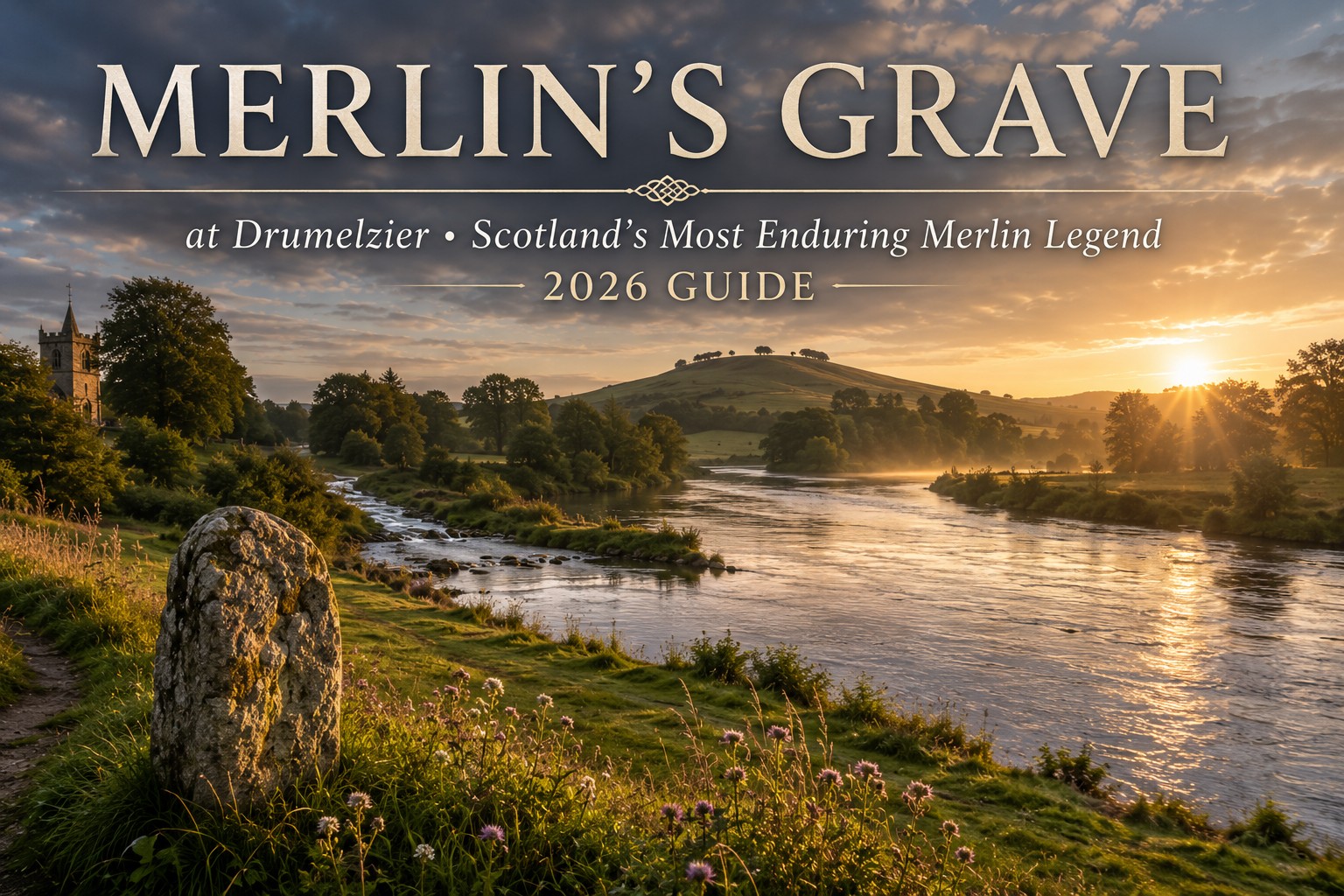
The quiet valley of Drumelzier has been linked with Merlin for centuries. Rather than a monumental tomb, visitors discover a peaceful riverside landscape where medieval tradition, archaeology and local memory continue to shape one of Scotland’s most enduring legends
On low ground beside the River Tweed, near the quiet Scottish Borders village of Drumelzier, tradition places the final resting place of Merlin. The reputed burial area lies north of Drumelzier Church, close to the point where the Powsail Burn approaches the river. Nothing resembling a monumental tomb awaits visitors, and no burial has been identified conclusively as Merlin’s grave. What survives instead is something more unusual: a medieval narrative rooted in named local places, a burial tradition documented for centuries and an early medieval landscape that modern archaeology has begun to understand in remarkable detail.
The legend does not originally concern the familiar robed magician standing beside King Arthur at Camelot. Its central figure is Lailoken, a prophetic wild man closely related to the northern traditions surrounding Myrddin Wyllt. Medieval storytellers connected him with battle, madness, wilderness, prophecy and an extraordinary threefold death at Drumelzier. Only through later literary development did these related traditions become absorbed into the internationally recognised character now called Merlin.
That distinction is central to understanding the site. Drumelzier cannot provide a verified biography of a historical wizard, and archaeology cannot establish that every event in the medieval narrative occurred. It can, however, reveal whether the story was attached to an appropriate historical landscape or imported arbitrarily into the valley long afterwards.
Recent investigations have made that question far more interesting. Excavation beneath the later remains of Tinnis Castle found that the prominent hillfort overlooking the area was occupied during the late sixth and early seventh centuries, approximately when the story is set, and possessed characteristics associated with a high-status stronghold. A geophysical survey of the reputed burial ground found nothing at the precise point traditionally marked on maps, but it did detect a nearby archaeological feature resembling a grave. The feature has not been excavated or identified, so it cannot be claimed as Merlin’s burial. Even so, the combined results suggest that the legend grew from an intimate knowledge of Drumelzier’s real early medieval topography.
This guide investigates every layer of that story. It explains what the medieval sources say, how Lailoken became associated with Merlin, what archaeology has genuinely discovered and what remains uncertain. It also provides realistic guidance for visiting a location that is culturally important precisely because it has never been transformed into a conventional tourist attraction.
Drumelzier does not offer a simple answer to the question of where Merlin was buried.
It offers something better: the opportunity to examine how literature, local memory, geography and archaeology can preserve the same story within one landscape for hundreds of years.
🏞️ One of Britain’s Most Remarkable Merlin Landscapes
Drumelzier is not famous because of a magnificent monument or an excavated royal tomb. Its importance lies in something far rarer: a peaceful Scottish Borders landscape where medieval literature, local tradition, archaeology and centuries of memory continue to converge around one of Britain’s most enduring Merlin legends.
Rather than asking visitors simply to believe the legend, Drumelzier invites them to explore the evidence, understand the landscape and decide for themselves why this quiet valley has remained central to Merlin’s story for hundreds of years.
✓ A landscape rooted in medieval literature and local memory
✓ Archaeological discoveries that strengthen the historical setting
✓ A peaceful Borders valley where legend and history still meet
🌄 Why Is Drumelzier Linked with Merlin?
Drumelzier lies in Upper Tweeddale, approximately eight miles south-west of Peebles. The village occupies a broad rural valley shaped by the River Tweed, surrounding farmland and the hills rising on either side. Today it feels peaceful and geographically removed from the royal courts, warfare and political instability normally associated with early medieval Britain.
During the period in which the legend is set, however, the area belonged to a very different world. Modern Scotland and England did not yet exist as recognisable nations, and northern Britain contained a shifting collection of Brittonic, Anglian, Gaelic and Pictish territories. Communities living across southern Scotland and northern England shared languages, political relationships and cultural traditions that did not respect the modern border.
The wider story of Myrddin Wyllt belongs to this northern Brittonic setting. He appears in later literature as a man driven into the wilderness by the consequences of battle, becoming a solitary prophet whose insight separates him from ordinary society. Drumelzier’s tradition develops a closely related figure under the name Lailoken and anchors his final days to specific locations around the village.
That local precision differentiates Drumelzier from many looser places associated with Arthurian legend. The narrative does not simply say that Merlin died somewhere in a remote Scottish valley. It refers to a ruler’s stronghold, the River Tweed, the Powsail Burn and a burial place on the eastern side of the river. Those features remain recognisable within the modern landscape.
The association was also preserved beyond the medieval text. In 1689, Alexander Pennecuik recorded that a local minister had shown him the particular place believed to contain Merlin’s grave. The burial location subsequently appeared on eighteenth-century maps, including Mostyn Armstrong’s map of 1775. These records do not prove that a historical Merlin was interred there, but they demonstrate that the tradition had become attached to a defined piece of ground rather than surviving only as a general village tale.
📍 Where Is Merlin’s Grave?
The traditional burial area is described as lying on the riverside haugh—the low, level ground beside the Tweed—north of Drumelzier Church and near the Powsail Burn. It is not an excavated tomb, marked medieval grave or substantial surviving monument. Visitors should expect a field location within a working rural landscape rather than a formal heritage attraction.
This modest physical presence is part of the site’s character. Drumelzier’s significance comes from the relationship between the narrative and its geography, not from an impressive structure built to commemorate it. The river, burn, hillfort and surrounding valley collectively tell the story more effectively than one modern marker ever could.
📍 Where Is Merlin’s Grave?
The traditional burial area is described as lying on the riverside haugh—the low, level ground beside the Tweed—north of Drumelzier Church and near the Powsail Burn. It is not an excavated tomb, marked medieval grave or substantial surviving monument. Visitors should expect a field location within a working rural landscape rather than a formal heritage attraction.
This modest physical presence is part of the site’s character. Drumelzier’s significance comes from the relationship between the narrative and its geography, not from an impressive structure built to commemorate it. The river, burn, hillfort and surrounding valley collectively tell the story more effectively than one modern marker ever could.
| 📍 Drumelzier Visitor Snapshot | Details |
|---|---|
| Region | Scottish Borders |
| Nearest principal town | Peebles |
| Traditional grave setting | Low ground beside the River Tweed, near the Powsail Burn |
| Historic stronghold | Tinnis hillfort beneath the later castle ruins |
| Suggested time | Approximately 1–3 hours for the immediate Merlin landscape |
| What visitors should expect | Rural tracks, working land, limited facilities and no excavated grave |
| Best combined with | Peebles, Upper Tweeddale and selected Borders heritage locations |
Visitors should check current local access information before travelling. Conditions may involve uneven or muddy ground, and any route through farmland must be approached with respect for livestock, gates, residents and land management.
📍 Drumelzier at a Glance
Before setting out, it helps to understand what kind of place Drumelzier really is. This is not a traditional visitor attraction with ticket offices, interpretation centres or a clearly marked archaeological site. Instead, visitors discover a peaceful Borders landscape where medieval tradition, archaeology and natural scenery combine to tell one of Scotland’s most enduring Merlin stories.
| 📍 What to Expect | Details |
|---|---|
| Location | Upper Tweeddale in the Scottish Borders, close to Peebles and the River Tweed. |
| What You’ll Find | A quiet rural landscape, the reputed burial area, the River Tweed, surrounding countryside and the historic setting beneath Tinnis hillfort. |
| Travel Expectations | Limited facilities, peaceful surroundings and a visit centred on history, landscape and interpretation rather than major tourist infrastructure. |
| Walking Difficulty | Easy to moderate. Expect uneven grass, rural paths and potentially muddy ground depending on recent weather. |
| Atmosphere | Quiet, reflective and authentic—a place where history, folklore and the natural landscape remain closely connected. |
💡 Visitor Tip
Drumelzier rewards visitors who slow down. Rather than searching for a single dramatic landmark, take time to appreciate how the river, surrounding hills, medieval traditions and archaeological discoveries combine to create one of Britain’s most remarkable legendary landscapes.
⚔️ How Does the Drumelzier Death Legend End?
The Drumelzier narrative gives its prophet one of the strangest deaths in medieval literature. Lailoken does not simply foresee that his life will end. He predicts three apparently incompatible forms of death: he will be struck or crushed, pierced by a sharpened wooden object and drowned.
The story survives in versions associated with the Vita Merlini Silvestris, or Life of Merlin of the Forest. Although the tale is set within the early medieval north, it was probably composed during the twelfth century, and the surviving manuscript evidence is later. Walter Bower subsequently incorporated the tradition into his fifteenth-century Scotichronicon, helping preserve Drumelzier’s place within Scotland’s medieval historical imagination.
After obtaining his freedom, Lailoken foretells that he will soon die and asks to be buried east of the Tweed, close to its meeting with the Powsail Burn. His prophecy is then fulfilled through one violent sequence. He is beaten or struck, falls onto a sharpened stake and enters the river, where he drowns. Each apparently contradictory death therefore becomes part of the same event.
The precise details vary between retellings. Some versions emphasise shepherds or assailants; others connect the death more closely with the ruler’s household and Lailoken’s prophetic knowledge. The differences matter because they remind us that this is an evolving medieval narrative rather than an eyewitness account.
For medieval audiences, the threefold death demonstrated the inescapable power of prophecy. Lailoken could perceive his fate but could not prevent it, making him both an extraordinary seer and a tragic figure. The story also bound his death inseparably to Drumelzier’s physical geography: the stronghold above the valley, the river below and the burial ground beside the meeting waters.
| 📜 Element of the Tradition | 🔎 What the Evidence Supports |
|---|---|
| Lailoken predicted a threefold death | A recurring literary motif preserved in the Drumelzier narrative |
| He was held by a ruler at a stronghold | Part of the medieval legend; archaeology confirms contemporary occupation at Tinnis, not the imprisonment |
| He died through violence, piercing and drowning | The principal legendary explanation of how the prophecy was fulfilled |
| He requested burial beside the Tweed and Powsail Burn | A geographically specific element of the medieval account |
| Merlin is conclusively buried there | Not established by archaeology or documentary proof |
The legend should therefore be treated neither as verified history nor as an empty invention. It is a medieval account with unusually strong geographical roots, preserved in a landscape that was demonstrably important during the period in which the events were imagined to have occurred.
⚖️ How Historians Build the Drumelzier Story
No single source can explain Drumelzier’s Merlin tradition on its own. Instead, historians compare different types of evidence, each contributing another piece of the story. Together they create a balanced understanding that respects both the legend and the available historical evidence.
💡 Why This Matters
Drumelzier is remarkable because these different strands reinforce one another. Medieval writers preserved the story, later generations recorded the location, archaeologists investigated the landscape and visitors today can still explore the same valley where all these traditions continue to meet.
📜 Lailoken, Myrddin and the Medieval Sources
The names Lailoken, Myrddin Wyllt and Merlin are often used interchangeably, but doing so can obscure the development of the tradition.
Lailoken is the name given to the prophetic wild man within the narrative most directly associated with Drumelzier. Myrddin Wyllt belongs to a closely related Brittonic literary tradition centred upon a traumatised prophet who retreats into the wilderness after a catastrophic northern battle. Both figures share characteristics including madness, isolation, prophecy and separation from organised political life.
They may preserve different branches of a connected northern tradition, but the surviving evidence does not allow them to be treated confidently as one documented historical person. Medieval authors inherited material that had already passed through oral transmission, literary adaptation and changing political contexts.
The Drumelzier text itself acknowledges the developing identification. It names the protagonist Lailoken while reporting that some people called him Merlin and regarded him as an exceptional prophet among the Britons. This makes the narrative particularly valuable: it captures a stage at which related traditions were already being connected but had not yet been fused completely into the familiar Arthurian wizard.
✍️ How Merlin Entered Arthurian Literature
The transformation became far more influential through Geoffrey of Monmouth during the twelfth century. Geoffrey created a composite literary Merlin by drawing upon existing prophetic material and combining it with the legendary political history of Britain. His Merlin advised rulers, interpreted supernatural signs and later became associated with the conception of Arthur and the legendary transportation of Stonehenge.
This was not simply Lailoken receiving a new name.
It was a major act of literary synthesis.
Later romance writers expanded Merlin again, bringing him closer to Arthur’s court, giving him more elaborate magical abilities and developing the stories now associated with Camelot. The wilderness prophet of the north was consequently absorbed into a much larger body of Arthurian literature.
Drumelzier preserves a different side of that development. Its Merlin is not primarily the commanding magician of royal legend. He is a damaged, morally complex and isolated prophet whose story ends beside a Borders river rather than within the splendour of a mythical court.
That older, darker character gives Merlin’s Grave much of its power. Visitors are not merely following a famous name into Scotland. They are entering one of the landscapes that preserves an important stage in the long evolution of Merlin himself.
⏳ How the Drumelzier Tradition Developed
Drumelzier’s association with Merlin was not created in a single moment. It developed through successive layers of northern tradition, medieval literature, local memory, historic mapping and modern archaeological investigation.
💡 What the Timeline Shows
The timeline does not prove that Merlin was buried at Drumelzier. It shows how one geographically precise tradition survived through literature, testimony, mapping and archaeological enquiry for many centuries.
| ⏳ Period | 📖 Development |
|---|---|
| Late sixth century | Traditional historical setting of the northern battle, prophet and Drumelzier narrative |
| Twelfth century | Probable composition period of the Vita Merlini Silvestris tradition |
| Fifteenth century | Surviving manuscript evidence and Walter Bower’s inclusion of the story in the Scotichronicon |
| Seventeenth century | Alexander Pennecuik records being shown the reputed grave location |
| Eighteenth century | Merlin’s Grave appears on maps of the Drumelzier area |
| 2022–2024 | Archaeological excavation and geophysical research examine the legend’s physical setting |
The timeline does not convert legend into biography. It demonstrates something equally important: the relationship between Drumelzier and Merlin was preserved through successive layers of literature, local testimony, mapping and archaeological inquiry.
🏞️ Why This Landscape Became Part of the Story
Many legendary places acquire famous stories long after the events they supposedly commemorate. A castle becomes associated with Arthur centuries after it was built. An ancient standing stone is given a mythical origin long after its true purpose has been forgotten.
Drumelzier appears to be different.
Rather than attaching a famous character to a convenient location, the medieval tradition describes a landscape whose physical features correspond remarkably well with the valley that still exists today. The River Tweed, the Powsail Burn, the elevated stronghold at Tinnis and the traditional burial ground all remain identifiable elements within the local geography.
That correspondence is one of the reasons modern historians and archaeologists take the Drumelzier tradition seriously—not because it proves every event occurred exactly as described, but because the story demonstrates an unusually detailed familiarity with a real place.
This distinction is important.
Legends often become more valuable when they are examined as cultural documents rather than as literal historical records. They reveal how medieval communities understood the landscapes around them, how they preserved memory and how stories became inseparable from particular valleys, rivers and hills.
Drumelzier offers one of Britain’s clearest examples of that relationship.
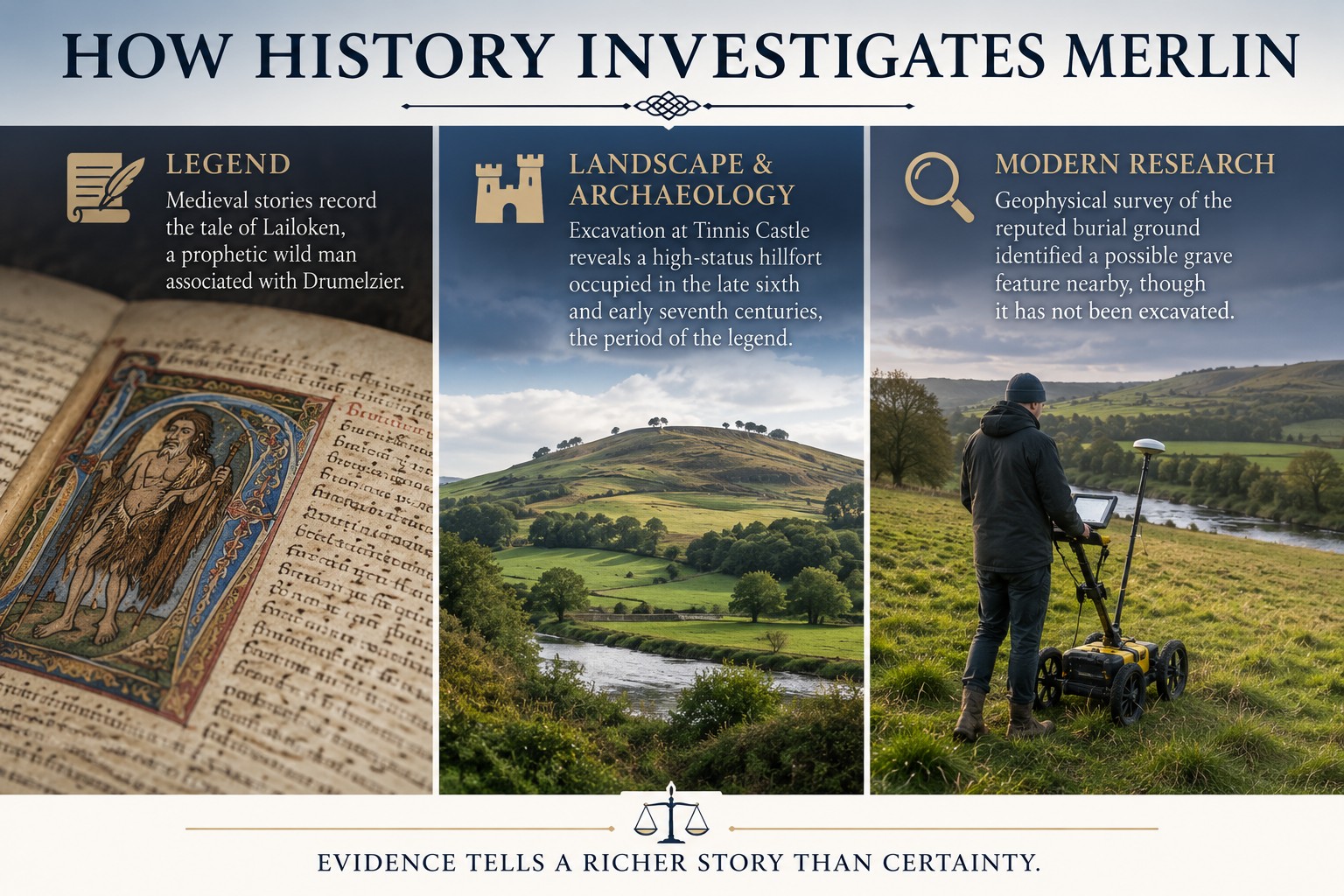
Merlin’s Grave at Drumelzier is best understood by bringing together medieval literature, archaeological evidence and the surviving Scottish Borders landscape rather than relying on legend alone
🌄 The Landscape Itself Preserves the Legend
Drumelzier’s importance does not depend upon one monument or one authenticated grave. The story survives because the same river, burn, hillfort and valley described through centuries of tradition can still be understood within the modern landscape.
💡 Why This Matters
Drumelzier should be experienced as one connected landscape rather than as a search for a single visible grave. The river, burn, hillfort and valley together explain why this particular place became inseparable from Merlin’s Scottish tradition.
🌊 The River Tweed as More Than a Backdrop
Throughout the medieval narrative, the River Tweed is never merely scenery.
It is part of the story’s structure.
The river forms the setting for Lailoken’s final prophecy, the place where the threefold death reaches its conclusion and the landmark beside which he asks to be buried. The nearby Powsail Burn adds further geographical precision, transforming what could have been a generic legend into one anchored to a remarkably specific location.
Standing beside the Tweed today, visitors encounter much the same broad valley that earlier generations would have recognised. Although farming practices, roads and settlements have naturally changed over the centuries, the river itself continues to shape the landscape in much the same way it always has.
That continuity explains why the legend retains such authenticity.
The story has not survived because later generations constructed elaborate monuments to preserve it.
It survived because the landscape itself continued to make sense of the narrative.
🏰 Tinnis Hillfort and the Valley Below
High above Drumelzier stands the earthwork known as Tinnis, later crowned by the remains of Tinnis Castle.
For many years this prominent hill attracted attention primarily because of its commanding position above the Tweed Valley. Modern archaeological investigation has demonstrated that it deserves attention for another reason entirely.
Excavation beneath the later medieval remains revealed evidence that the hillfort was occupied during the late sixth and early seventh centuries, broadly matching the period traditionally associated with Lailoken’s story. Archaeologists also identified features consistent with a high-status defended settlement rather than an insignificant rural enclosure.
These discoveries are significant because medieval accounts connect Lailoken with a local ruler named Meldred and a stronghold overlooking the valley.
Archaeology cannot demonstrate that Meldred lived at Tinnis.
Nor can it identify Lailoken among the site’s inhabitants.
What it can demonstrate is that an important defended centre occupied this commanding position during approximately the right historical period.
That alignment between text and archaeology represents one of the most compelling aspects of the Drumelzier tradition.
🌿 A Landscape That Preserved Memory
Not every historic landscape preserves its stories equally well.
Some valleys become industrialised.
Others are transformed by expanding towns, major roads or changing patterns of land use.
Upper Tweeddale has certainly evolved over the centuries, yet much of its underlying geography remains recognisable. The Tweed still follows its broad course through the valley, the surrounding hills continue to define the skyline and the relationship between river, burn and hillfort remains immediately apparent.
For historians, this continuity matters because stories survive more easily when landscapes remain understandable.
People continue using familiar place names.
Routes change gradually rather than disappearing entirely.
Communities pass local traditions between generations.
Even where written evidence is limited, the landscape itself provides a framework within which memory can endure.
That is one reason Drumelzier feels so different from reconstructed heritage attractions.
Visitors are not stepping into a modern interpretation of Merlin’s world.
They are entering a genuine Borders landscape where literature, local memory and geography have remained intertwined for centuries.
🌄 The Landscape Still Tells the Story
Drumelzier’s greatest historical asset is not a monument, an inscription or a confirmed burial. It is something far more unusual: the enduring relationship between an ancient landscape and a story that has remained rooted within it for centuries.
The River Tweed still flows through the valley. Tinnis Hill still watches over the surrounding countryside. The places described by medieval writers can still be recognised today, allowing visitors to experience the setting much as generations before them imagined it.
even if the legend can never be fully proven.
That is what makes Drumelzier exceptional. Rather than offering certainty, it offers continuity—a rare opportunity to stand within a landscape where history, memory and mythology have remained intertwined for hundreds of years.
🪨 What Archaeology Reveals About Merlin’s Grave at Drumelzier
For generations, people asked a straightforward question:
Has archaeology found Merlin’s grave?
The honest answer remains no.
Yet modern archaeology has transformed understanding of Drumelzier in ways that are arguably more important than simply locating a single burial.
Instead of searching only for one legendary individual, archaeologists have investigated the wider landscape in which the story developed. By combining excavation, geophysical survey, environmental evidence and careful study of medieval texts, researchers have asked a broader and ultimately more rewarding question:
Does the historical landscape support the tradition?
The answer is far more nuanced—and considerably more interesting—than many visitors expect.
🏺 Archaeology Investigates Landscapes, Not Legends
Modern archaeology rarely begins by trying to prove a famous story.
Instead, it seeks to understand the people, settlements and environments that existed when those stories first emerged.
At Drumelzier, that means investigating questions such as:
- Was this an important early medieval landscape?
- Were high-status settlements present?
- Do the geographical descriptions within the medieval narrative correspond with real locations?
- Is there archaeological evidence that helps explain why this particular valley became associated with Lailoken?
These are questions archaeology can answer with increasing confidence.
They also produce stronger historical understanding than simply asking whether Merlin’s grave has been found.
The archaeological evidence does not diminish the Drumelzier tradition.
Instead, it provides an independent framework through which historians can evaluate how accurately the medieval narrative reflects the landscape in which it was preserved.
🏰 Excavation at Tinnis
One of the most important discoveries came from excavation beneath the later remains of Tinnis Castle.
Archaeologists established that the underlying hillfort was occupied during the late sixth and early seventh centuries, precisely the broad historical period traditionally associated with Lailoken’s story. The site appears to have functioned as an important defended settlement overlooking the Tweed Valley rather than as an isolated hilltop refuge.
This finding deserves careful interpretation.
It does not prove that the ruler Meldred lived there.
It does not demonstrate that Lailoken was imprisoned there.
It does show that the landscape described in the medieval tradition contained an elite centre whose date corresponds remarkably well with the period in which the story is set.
That correspondence strengthens the historical credibility of the setting without transforming legend into established fact.
🔎 The Grave-Like Geophysical Anomaly
The reputed burial ground has also been investigated using geophysical survey.
Researchers found no archaeological feature directly beneath the exact location traditionally identified on historic maps.
However, they did identify a nearby anomaly whose characteristics resemble those of a grave or grave-like feature.
This distinction is extremely important.
The anomaly has not been excavated.
Its date remains unknown.
Its occupant—if it represents a burial at all—is equally unknown.
There is therefore no basis for claiming that archaeologists have discovered Merlin’s grave.
Equally, it would be inaccurate to suggest that archaeology found nothing of interest.
Instead, the investigations have revealed a landscape containing exactly the kinds of archaeological questions that justify continued research.
⚖️ What the Evidence Really Shows
One of the strengths of the Drumelzier story is that different forms of evidence answer different questions.
Rather than competing with one another, medieval literature, archaeology and local tradition combine to create a fuller picture of why the site matters.
| 🧩 Evidence | ✅ What It Establishes | ❌ What It Does Not Establish |
|---|---|---|
| Medieval texts | A detailed Drumelzier death-and-burial tradition existed | That every event occurred exactly as described |
| Excavation at Tinnis | An elite hillfort occupied the valley around the appropriate period | That Meldred or Lailoken personally lived there |
| Geophysical survey | A grave-like archaeological feature exists near the reputed burial area | The identity, date or significance of the feature |
| Local tradition and historic mapping | The burial location remained culturally recognised for centuries | A verified historical grave |
| Regional history | The valley belonged to the northern Brittonic world associated with related prophetic traditions | The historical identity of Merlin himself |
Seen together, the evidence leads to a balanced conclusion.
Archaeology has not solved the Merlin legend.
It has made the legend historically richer.
Researchers can now demonstrate that the story developed within a genuine early medieval landscape whose geography, chronology and archaeological character correspond strikingly with important elements of the medieval narrative.
That is a far more meaningful discovery than either proving or disproving one legendary burial.
🧪 How Strong Is the Evidence?
Drumelzier’s Merlin tradition contains several different levels of evidence. Some elements are clearly documented, others are supported by landscape or archaeology, while the central claim that Merlin was buried here remains possible but unproven.
💡 The Balanced Conclusion
The strongest interpretation is neither to dismiss Drumelzier as pure invention nor to present the burial tradition as proven fact. The evidence shows that this is a genuine early medieval landscape with a remarkably persistent Merlin association, but the identity of the person behind the legend remains unresolved.
The archaeology therefore changes the way visitors experience Drumelzier.
Rather than arriving at a place where “nothing has been found,” they arrive in a landscape where modern research has confirmed that the setting behind one of Britain’s most enduring legends deserves to be taken seriously.
🚶 Can You Visit Merlin’s Grave at Drumelzier?
Yes, but visitors should arrive with realistic expectations.
Merlin’s Grave is not a formal archaeological attraction, an excavated burial or a monumental tomb. There is no large visitor centre, reconstructed site or dramatic memorial marking the supposed resting place. The traditional burial area forms part of a living rural landscape beside the River Tweed, and much of the experience comes from understanding how the surrounding geography relates to the medieval narrative.
For travellers accustomed to highly managed historic attractions, Drumelzier can initially feel understated. That modesty is also one of its greatest strengths. The valley has not been redesigned around the legend, allowing visitors to experience the same broad relationship between river, burn, hillside and settlement that helped preserve the story for centuries.
A successful visit therefore depends less upon locating one precise patch of ground and more upon reading the landscape as a whole.
🚶 What Should Visitors Expect?
Drumelzier offers a very different experience from Scotland’s major heritage attractions. Visitors who arrive expecting a visitor centre or spectacular monument may be surprised. Those who come to experience an authentic historical landscape are often rewarded with one of the country’s most atmospheric Merlin locations.
| What You’ll Experience | What You Shouldn’t Expect |
|---|---|
| ✔ Peaceful countryside and beautiful scenery | ✖ A large managed visitor attraction |
| ✔ A landscape rich in medieval tradition | ✖ A confirmed archaeological grave |
| ✔ Quiet walking and reflective exploration | ✖ Museums, cafés or extensive facilities on site |
| ✔ One of Scotland’s strongest Merlin traditions | ✖ Definitive proof that Merlin was buried here |
💡 Best Approach
Visit Drumelzier with curiosity rather than certainty. The experience is about understanding how landscape, history and legend have remained connected for centuries—not about finding one dramatic landmark. For many visitors, that quieter, more thoughtful experience becomes the highlight of their journey.
📋 What Can Visitors Actually See?
The reputed grave site itself is not visually dramatic. Visitors should not expect an open burial, inscribed medieval stone or authenticated grave marker. The traditional location lies within low riverside ground associated with the Tweed and Powsail Burn, while the broader legendary landscape extends towards the prominent heights of Tinnis.
What makes the visit meaningful is the ability to connect several elements:
- the River Tweed, central to the threefold death tradition;
- the Powsail Burn, named within the burial narrative;
- the haugh or low ground where the reputed grave was identified;
- Tinnis hillfort, whose early medieval occupation corresponds with the broad period of the story;
- Drumelzier village and the surrounding valley that preserved the association.
Seen separately, these features may appear unremarkable.
Seen together, they form one of Britain’s most coherent legendary landscapes.
⏱️ How Long Should You Allow?
Most visitors should allow approximately one to three hours for the immediate Drumelzier experience.
A shorter visit may be sufficient for travellers who want to understand the basic setting, see the valley and appreciate the relationship between the river and reputed burial area. Those interested in photography, walking, archaeology or the wider Merlin tradition should allow longer.
A half-day visit becomes worthwhile when Drumelzier is combined with Peebles, Stobo, Dawyck Botanic Garden or another Upper Tweeddale location. A full day allows the journey to become a broader exploration of Borders scenery, early medieval history and local heritage rather than a single-purpose stop.
Drumelzier is best approached slowly.
Rushing through the valley in search of one visible object risks missing the very qualities that allowed the legend to survive.
The significance of Drumelzier lies not in a monumental grave but in a remarkable landscape where medieval legend, archaeological evidence and centuries of local memory remain closely connected
🥾 Terrain, Access and Conditions
Visitors should expect a rural environment rather than a surfaced attraction.
Possible conditions include:
- uneven ground;
- wet or muddy grass;
- narrow rural roads;
- working farmland;
- livestock;
- limited shelter;
- restricted local facilities.
Sturdy footwear is advisable, particularly after rain. Waterproof clothing is sensible throughout much of the year, while layered clothing helps visitors adapt to rapidly changing Borders weather.
Access arrangements can change, especially where routes pass close to farmland or privately managed land. Visitors should check current local information before travelling, follow recognised routes where available and never assume that open countryside permits unrestricted access through every field or farm entrance.
Parking should also be approached carefully. Local parking provision is limited, and vehicles must not obstruct gates, narrow roads, homes or agricultural access.
| 🚶 Practical Visit Planning | Guidance |
|---|---|
| Suggested duration | 1–3 hours for the immediate Merlin landscape |
| Terrain | Rural paths, grass and potentially uneven or muddy ground |
| Footwear | Sturdy walking shoes or boots recommended |
| Facilities | Limited within the immediate village area |
| Parking | Limited; check current arrangements and avoid obstruction |
| Best approach | Slow exploration with realistic expectations |
| Accessibility | Conditions may not suit all mobility levels |
🧳 Drumelzier Visitor Planning Checklist
A little preparation will help you enjoy Drumelzier for what it truly is—a peaceful historical landscape where folklore, archaeology and natural beauty come together. Use this quick checklist before you travel.
☐ Check the local weather forecast.
☐ Wear comfortable footwear suitable for uneven rural ground.
☐ Bring a waterproof jacket—Borders weather can change quickly.
☐ Carry water and any refreshments you may need.
☐ Download directions or maps before travelling if mobile signal is limited.
☐ Allow plenty of time to explore without rushing.
☐ Bring a camera or binoculars if you enjoy landscapes and wildlife.
☐ Approach the site with curiosity rather than expecting a traditional tourist attraction.
• History lovers
• Landscape photographers
• Gentle countryside walks
• Readers interested in medieval Scotland
📸 When Is the Best Time to Visit?
Spring, summer and early autumn generally provide the most comfortable conditions for exploring Drumelzier.
Spring brings longer days, fresh colour and quieter roads before the main summer travel period. Summer offers the greatest amount of daylight, making it easier to combine Drumelzier with other Borders destinations. Early autumn can be especially atmospheric, with softer light, changing foliage and a stronger sense of seasonal transition across the valley.
Winter creates a more austere experience. Short days, wet ground and colder conditions can make practical exploration more difficult, but the landscape often feels at its most reflective. Visitors choosing this season should plan conservatively and avoid relying upon lengthy daylight.
Early morning and late afternoon usually provide the most rewarding photography. Softer light can reveal the form of the river valley more effectively than the flatter conditions of midday, while quieter surroundings enhance the contemplative character of the site.
The best time is ultimately the moment when visitors can explore without haste, poor preparation or pressure to move immediately to the next destination.
🗺️ What Else Can You Explore Near Drumelzier?
Drumelzier works best as part of a wider exploration of Upper Tweeddale and the Scottish Borders.
The surrounding region offers historic towns, riverside walks, gardens, churches, archaeological landscapes and scenic roads. None needs to overwhelm the central Merlin story. A carefully chosen neighbouring stop can instead help visitors understand the broader cultural and geographical setting in which the legend developed.
🌳 Peebles
Peebles is the most practical nearby base for many visitors.
The town provides cafés, shops, accommodation and riverside walks while retaining a strong sense of Borders character. Its location on the Tweed also creates a natural continuation of the river landscape experienced at Drumelzier.
Visitors can use Peebles as a starting point, lunch stop or overnight base. This avoids treating Drumelzier as an isolated roadside curiosity and allows the journey to become part of a more relaxed Borders itinerary.
⛪ Stobo and the Wider Tweeddale Tradition
Stobo is frequently included within explorations of the wider Merlin landscape.
Its historic church and long local associations contribute to the broader religious and cultural setting surrounding the medieval narrative. The connection should be approached carefully, without presenting every local tradition as proven history, but Stobo can help visitors understand how stories surrounding Lailoken, St Kentigern and the Tweed Valley became interwoven.
This wider geographical context is particularly valuable for readers interested in how medieval saints’ lives, prophetic traditions and local places influenced one another.
🌺 Dawyck Botanic Garden
Dawyck Botanic Garden offers a contrasting experience within the same broad area.
Its woodland setting and extensive plant collections provide an excellent slower-travel addition for visitors who want to combine folklore and history with nature. It also makes the journey more rewarding for mixed-interest groups in which not everyone shares the same enthusiasm for medieval legend.
Seasonal opening arrangements should always be checked before travel.
🏰 Tinnis and the Hillfort Landscape
Tinnis is central to understanding Drumelzier’s archaeological importance, but visitors should not assume that it functions as a straightforward developed attraction.
The hillfort occupies elevated terrain, and any exploration must account for route conditions, land access, weather and personal fitness. Even when visitors do not attempt a closer approach, the prominence of Tinnis above the valley helps explain why the site became associated with power and imprisonment within the medieval narrative.
Its significance lies not merely in the surviving remains but in the relationship between the hill and the low riverside ground below.
🚗 A Simple Drumelzier Half-Day
A relaxed half-day might follow this sequence:
| 🕰️ Suggested Order | Experience |
|---|---|
| Morning | Travel through Upper Tweeddale towards Drumelzier |
| Late morning | Explore the village and immediate Merlin landscape |
| Midday | Pause beside the Tweed or continue towards Peebles |
| Early afternoon | Lunch in Peebles or visit a selected nearby attraction |
| Later afternoon | Riverside walk, garden visit or scenic return journey |
This is not a rigid itinerary.
Its purpose is to protect the visit from becoming a rushed search for a single marker. Drumelzier becomes more rewarding when it is allowed to sit naturally within the broader Borders landscape.
[INSERT NEARBY PLACES WORTH EXPLORING PANEL]
Recommended Panel Placement
Panel: Nearby Places Worth Exploring Panel
Insert Position: Immediately below the suggested half-day itinerary and before 🤔 Why Has the Drumelzier Legend Survived?
Purpose: Provides readers with a natural progression from the Merlin landscape into the wider Borders region while maintaining the article’s focus on thoughtful, slower exploration rather than checklist tourism.
🤔 Why Has the Drumelzier Legend Survived?
Many local legends disappear.
Place names change, communities move, landscapes are redeveloped and stories gradually lose their connection with the locations that once sustained them. Drumelzier’s Merlin tradition has survived because several forms of continuity reinforced one another.
The first was geographical precision.
The medieval narrative referred to recognisable features rather than an undefined wilderness. The Tweed, the Powsail Burn, the stronghold and the reputed burial ground gave later generations a physical framework through which the story could be remembered.
The second was written preservation.
The legend entered medieval literature and historical compilation, allowing it to survive beyond the limits of oral transmission. Even where texts changed, the Drumelzier setting remained sufficiently distinctive to retain its identity.
The third was local recognition.
Later witnesses recorded being shown a specific grave location, while maps helped formalise that tradition within the physical landscape. This did not authenticate the burial, but it ensured that the association remained attached to a definite place.
The fourth was landscape continuity.
The valley changed, but it did not become unrecognisable. The river continued through the same broad setting, Tinnis remained prominent and the burial area remained understandable in relation to the surrounding topography.
Together, these four factors created an unusually durable legend.
| 🧭 Why the Tradition Endured | Why It Matters |
|---|---|
| Named topography | The story could be located within real geography |
| Medieval written accounts | The narrative survived beyond oral memory |
| Local testimony and mapping | The reputed grave remained attached to a defined area |
| Recognisable landscape | Later generations could still understand the setting |
| Continuing investigation | New research repeatedly renewed interest in the site |
The legend therefore survives not because every generation accepted it literally, but because each generation found something worth preserving.
Medieval writers saw a tragic prophet.
Local communities inherited a distinctive place-story.
Antiquarians recorded a reputed grave.
Modern archaeologists investigated the landscape behind the narrative.
Today’s visitors encounter all those layers at once.
[INSERT WHY THE LEGEND ENDURES PANEL]
Recommended Panel Placement
Panel: Why the Legend Endures Panel
Insert Position: Immediately below the concluding paragraph beginning “Today’s visitors encounter all those layers at once.” and before 💭 Legend, Heritage and Historical Truth.
Purpose: This is the ideal point to summarise the four reasons for the legend’s survival, giving readers a clear transition from historical continuity into the article’s concluding reflection on evidence, heritage and belief.
💭 Legend, Heritage and Historical Truth
It is tempting to believe that a legendary site must be either true or false.
Drumelzier demonstrates why that framework is inadequate.
The claim that Merlin is conclusively buried beside the Tweed remains unproven. The existence of the tradition, the medieval narrative, the mapped grave location and the archaeological significance of the surrounding landscape are all historically real.
The legend and the heritage are therefore not the same thing.
The legend asks whether a prophetic figure died and was buried here.
The heritage shows that people have connected that death with Drumelzier for centuries.
Recognising the difference allows visitors to remain critical without becoming dismissive. It also prevents wonder from depending upon a claim that the evidence cannot sustain.
Drumelzier does not need a proven wizard’s grave to be significant.
Its importance lies in the rare survival of a story whose literature, geography and archaeology can still be examined together within the same valley.
🧭 Continue the Merlin Journey Across Scotland
Merlin’s Grave at Drumelzier is one part of a much wider Scottish legendary landscape.
The Drumelzier tradition is unusually specific because it connects a medieval death narrative with named local features and an archaeologically significant early medieval setting. Elsewhere in Scotland, Merlin appears more indirectly through related prophetic traditions, Arthurian associations, standing-stone folklore and landscapes that later storytellers interpreted as places of magic, exile or ancient power.
Together, these locations reveal how legends change as they move.
At Drumelzier, Merlin is remembered through Lailoken: a wounded prophet, wilderness figure and tragic outsider whose fate is tied to one valley. In Edinburgh, Arthurian associations are woven into the dramatic presence and contested traditions surrounding Arthur’s Seat. Across the Highlands and islands, the connection becomes less biographical and more atmospheric, emerging through stories of seers, supernatural landscapes and places where history and folklore remain difficult to separate.
Readers continuing through the Merlin in Scotland series can explore:
- Arthur’s Seat and the ancient legends associated with Edinburgh;
- the standing stones of Scotland and the later traditions that connected prehistoric monuments with Merlin and the Druids;
- the Isle of Skye, where Gaelic folklore creates a different but equally powerful legendary landscape;
- Merlin and the Scottish Highlands, examining how forests, mountains, lochs and remoteness influenced stories of prophecy and exile.
These places should not be treated as pieces of one proven historical itinerary. Their value lies in showing how Scotland repeatedly became a setting through which later generations explored memory, kingship, wilderness and the supernatural.
[INSERT CONTINUE YOUR MERLIN JOURNEY PANEL]
Recommended Panel Placement
Panel: Continue Your Merlin Journey Panel
Insert Position: Immediately below the concluding paragraph of this section and before 🪨 From Drumelzier to Stonehenge.
Purpose: This is the natural expansion point within the Merlin mini-cluster. The panel should guide readers deeper into the related Scotland Merlin articles while preserving the editorial flow before the article transitions into Merlin’s connection with Stonehenge.
📅 Discover What’s Happening Across Scotland
Scotland changes dramatically throughout the year. Festivals, Highland Games, wildlife seasons, historic celebrations and cultural events can all influence when and where you choose to travel.
Use the Scotland Events Calendar to explore major events, compare different seasons and build a journey that matches your interests.
View the Scotland Events Calendar →
🎪 Festivals •
🏴 Highland Games •
🦌 Wildlife seasons •
🥃 Whisky events
🚌 Discover Scotland on a Day Tour
Drumelzier offers a quiet glimpse into Scotland’s legendary past. A guided day tour can help you continue that journey through historic towns, dramatic glens, ancient castles, famous lochs and some of the country’s most memorable landscapes.
Explore Scotland at a comfortable pace with a knowledgeable guide, organised transport and a choice of experiences departing from Edinburgh.
Browse available experiences and choose the journey that best matches your interests.
🏴 Experience More of Scotland on a Multi-Day Tour
Scotland reveals far more when you give the journey time. A multi-day tour allows you to travel beyond the immediate surroundings of Edinburgh and explore the Highlands, famous lochs, island landscapes, historic castles and remote regions that cannot be experienced properly in a single day.
With transport and itinerary planning organised for you, these longer journeys offer a relaxed way to discover Scotland’s history, scenery and regional character while spending less time worrying about logistics.
Explore Scotland Multi-Day Tours →
Browse longer Scotland journeys and choose an itinerary that matches your available time and travel interests.
🪨 From Drumelzier to Stonehenge
The literary history of Merlin also leads far beyond Scotland.
Geoffrey of Monmouth famously placed Merlin at the centre of Stonehenge’s legendary story, describing him as the architect of the monument’s miraculous transportation from Ireland to Salisbury Plain. Archaeology provides a very different account of Stonehenge’s prehistoric construction, yet Geoffrey’s version became one of the most influential medieval explanations of the monument.
The contrast between Drumelzier and Stonehenge is revealing.
At Drumelzier, the tradition preserves the death of a northern wilderness prophet within a precise Borders landscape. At Stonehenge, Merlin becomes a commanding royal adviser capable of moving one of Britain’s greatest monuments through extraordinary knowledge and power.
Both traditions belong to literature rather than archaeological explanation, but together they demonstrate the extraordinary range of the character’s development.
Travellers hoping to compare Scotland’s quieter Merlin landscape with Britain’s most famous prehistoric monument can use the Best Value Tours Stonehenge Inner Circle Access Calendar to understand the limited dates and times available for special access.
[INSERT STONEHENGE INNER CIRCLE ACCESS CALENDAR CTA PANEL]
Recommended Panel Placement
Panel: Stonehenge Inner Circle Access Calendar CTA Panel
Insert Position: Immediately below the paragraph introducing the calendar and before 🌱 Visiting Drumelzier Responsibly.
Purpose: This provides the ideal cross-cluster transition, allowing interested readers to continue naturally from Scotland’s Merlin traditions into the established Stonehenge Merlin narrative while supporting the flagship Stonehenge calendar hub.
🌱 Visiting Drumelzier Responsibly
Drumelzier remains a living village within a working rural landscape.
That authenticity is central to the experience, but it also means visitors share the area with local residents, landowners, farmers, livestock and wildlife. There are no extensive visitor-management systems designed to absorb large crowds or protect every field edge from careless access.
Responsible exploration therefore begins with restraint.
Visitors should follow recognised routes where available, respect signs and temporary restrictions, and avoid entering fields or farm access points merely because a location appears close on a map. Gates should be left exactly as they are found, dogs should be kept under close control and livestock should be given generous space.
Parking requires equal care. Narrow roads, gateways and passing places must remain clear for residents, agricultural vehicles and emergency access. A visit should never inconvenience the community whose landscape has preserved the tradition.
The natural environment also deserves protection.
The riverside ground can be sensitive, particularly after prolonged rain. Walking on already worn routes, avoiding unnecessary disturbance to vegetation and taking all litter away help reduce the cumulative effect of visitors. Photography should never require climbing fences, moving stones or entering restricted land.
🌿 Make the Visit Benefit the Borders
A responsible visit can also contribute positively to the wider region.
Using independent accommodation, cafés, shops and local services in Peebles or neighbouring communities helps ensure that tourism supports the people who maintain the cultural landscape. Combining Drumelzier with one or two nearby locations encourages a slower journey and gives visitors a more complete understanding of Upper Tweeddale.
This approach is preferable to treating the village as a rapid photograph stop.
Drumelzier rewards attention rather than consumption. The most respectful visitor is not the person who reaches every possible location, but the one who understands the landscape without placing pressure upon it.
[INSERT SUSTAINABLE SCOTLAND TRAVEL PANEL]
Recommended Panel Placement
Panel: Sustainable Scotland Travel Panel
Insert Position: Immediately below the final paragraph of the sustainability section and before ❓ Frequently Asked Questions.
Purpose: Reinforces the article’s sustainability message while providing readers with practical responsible-travel guidance. This is the standard position for sustainability panels across the Scotland editorial cluster and creates a smooth transition into the FAQ section.
❓ Frequently Asked Questions
❓ Where is Merlin’s Grave at Drumelzier?
The traditional burial area lies on low ground beside the River Tweed, north of Drumelzier Church and close to the Powsail Burn. It is a reputed location within a rural landscape rather than a formally excavated or monumental grave.
❓ Is Merlin really buried at Drumelzier?
There is no conclusive historical or archaeological proof that Merlin was buried there. Drumelzier does, however, preserve one of Britain’s most detailed and enduring Merlin burial traditions, supported by medieval literature, later local testimony and historic mapping.
❓ What can visitors actually see?
Visitors can experience the river valley, the traditional burial landscape, the Powsail Burn area and the prominent setting of Tinnis. They should not expect an open grave, authenticated burial stone or major visitor attraction.
❓ Did archaeologists find Merlin’s grave?
No confirmed grave of Merlin has been found. Geophysical survey detected a nearby feature resembling a grave, but it has not been excavated, dated or connected with any known individual.
❓ What did archaeologists discover at Tinnis?
Excavation showed that the hillfort beneath the later castle remains was occupied during the late sixth and early seventh centuries. The evidence suggests a high-status defended site existed there at approximately the period in which the legend is set.
❓ Who was Lailoken?
Lailoken is the prophetic wild man named within the medieval tradition most directly connected with Drumelzier. His story shares important characteristics with the traditions of Myrddin Wyllt and later became associated with the wider figure of Merlin.
❓ Is Lailoken the same person as Myrddin Wyllt?
They are closely related literary figures and may represent connected branches of the same northern prophetic tradition. The surviving evidence does not prove that they were one historical person, so it is more accurate to describe them as overlapping traditions rather than identical documented individuals.
❓ How is Drumelzier’s Merlin different from the Arthurian wizard?
The Drumelzier figure is a tragic wilderness prophet associated with battle, madness, prophecy and exile. The familiar Arthurian Merlin was developed later as a powerful adviser to kings, partly through the influential writings of Geoffrey of Monmouth and subsequent romance authors.
❓ Can you visit Tinnis?
The hillfort landscape can be appreciated from the valley, but closer access may involve elevated rural terrain, changing conditions and land-management considerations. Visitors should check current route and access information rather than assuming unrestricted entry.
❓ How long should you spend at Drumelzier?
Allow approximately one to three hours for the immediate legendary landscape. A half day is more suitable when combining Drumelzier with Peebles, Stobo, Dawyck Botanic Garden or another Upper Tweeddale location.
❓ Is Drumelzier suitable for children?
Families interested in legends and outdoor exploration may find the visit rewarding, but the location is not a managed attraction with interactive facilities. Uneven ground, weather, water and working farmland require close supervision and realistic planning.
❓ When is the best time to visit?
Spring, summer and early autumn generally offer the easiest conditions and longest useful daylight. Winter can be atmospheric but requires greater care because of short days, colder weather and potentially wet ground.
❓ Is Drumelzier worth visiting?
Yes, particularly for visitors interested in Merlin, medieval literature, Scottish folklore, archaeology or quiet rural landscapes. Its value lies in the relationship between the story and the place rather than in a dramatic monument.
🧠 What Drumelzier Ultimately Tells Us About Legend
The search for a historical Merlin often begins with the wrong question.
Readers understandably want to know whether Merlin existed, whether he died at Drumelzier and whether the reputed grave contains his remains. Those questions are compelling, but the available evidence cannot resolve them conclusively.
Drumelzier becomes more revealing when the investigation shifts from proving one person to understanding the survival of one tradition.
The medieval narrative was anchored to specific local geography. The associated hillfort was occupied during the broad period in which the story is set. Later residents continued identifying a burial area beside the Tweed, and antiquarians and mapmakers preserved that location. Modern archaeology then returned to the same landscape and found enough historical substance to show that the setting was never arbitrary.
None of those facts proves the legend in a literal sense.
Together, however, they demonstrate why it endured.
Drumelzier shows that legendary heritage is not created by belief alone. It survives when story, place and community continue reinforcing one another across time. Remove the river from the narrative, the hillfort from the valley or the local tradition from the mapped landscape, and the connection becomes weaker. At Drumelzier, all those elements remain visible.
That is the site’s true distinction.
It is not simply a place where people say Merlin was buried.
It is a place where the evolution of a legend can still be read across literature, topography, archaeology and local memory.
🧭 Final Thoughts
Merlin’s Grave at Drumelzier does not offer certainty.
There is no authenticated tomb, no inscription naming a prophet and no archaeological discovery capable of transforming the medieval narrative into a verified biography. Visitors searching for definitive proof will leave without it.
Yet Drumelzier offers a form of historical experience that may be more valuable.
Here, a medieval story can still be compared with the river, burn, hillfort and burial ground named within its tradition. Archaeology has confirmed that the valley contained a significant early medieval centre, while later records show that generations continued to recognise a particular place as Merlin’s grave.
The result is neither straightforward history nor disposable folklore.
It is a layered cultural landscape in which every form of evidence has its own limits and its own value.
Drumelzier invites visitors to question the story without dismissing it, to appreciate archaeology without exaggerating it and to experience the landscape without demanding that it reveal every secret.
Perhaps Merlin was never buried beside the Tweed.
Perhaps the tradition preserves a distorted memory of a real northern prophet whose identity disappeared behind centuries of storytelling.
Or perhaps the grave matters most because no final answer has ever been able to close the story.
The river continues through the valley.
Tinnis still overlooks the surrounding ground.
The reputed burial place remains part of local memory.
And the same question that drew antiquarians, storytellers and archaeologists to Drumelzier now awaits every new visitor:
Was Merlin really here?
🧙 Explore Merlin’s Scotland
Journey through Scotland’s legendary landscapes with Merlin, ancient standing stones, Edinburgh traditions, Highland mythology and a complete itinerary inspired by the places where history and legend meet.
📖 Begin with the Complete Merlin Guide
Start with the central guide to Merlin’s Scottish traditions, historical associations and the places visitors can explore today.
🏰 Discover Scotland’s Legendary Places
Explore the landscapes, monuments and historic locations connected with Merlin, Arthurian tradition and Scotland’s ancient stories.
🏔️ Continue into the Scottish Highlands
Discover how wilderness, mountains, hidden places and Highland storytelling helped shape Merlin’s Scottish identity.
🗺️ Follow the Complete Merlin-Inspired Route
Bring the legends together with a carefully planned 3–5 day itinerary linking Edinburgh, the Highlands and Scotland’s most atmospheric Merlin locations without unnecessary backtracking.
🇬🇧 Turn the Legends into Your Own Scotland Journey
Explore guided day tours, longer Highland journeys and Scotland’s year-round events as you move from inspiration into practical travel planning.
Discover the legend → explore the places → enter the Highlands → follow the itinerary → plan your Scotland journey