


Merlin in Scotland: Myth, History & Places You Can Visit (2026 Guide)
27th July 2026
🧙 Merlin in Scotland: Myth, History & Places You Can Visit (2026 Guide)
Follow Merlin’s legendary journey through Scotland, where dramatic landscapes, ancient standing stones, historic castles and enduring folklore combine to create one of Britain’s most fascinating mythical travel experiences
Scotland’s strongest connection with Merlin begins not with the familiar wizard of Camelot, but with the older traditions surrounding Myrddin Wyllt and the borderlands of southern Scotland. The village of Drumelzier preserves the country’s most important place-specific Merlin legend, while Arthur’s Seat, the Highlands, the Isle of Skye and Scotland’s prehistoric monuments reveal how Arthurian stories, local folklore and evocative landscapes later became woven into his wider mythology.
That distinction matters. Not every Scottish place described as “magical” has an ancient connection with Merlin, and not every local tradition can be treated as documented history. Some associations emerge from early literature, some belong to long-established community folklore, and others use Merlin as a modern narrative guide into landscapes shaped by entirely different Scottish traditions.
This guide separates those strands rather than blending them together. It explores what is known, what is traditionally believed and what visitors can genuinely experience today. In doing so, it uses Merlin not as a fantasy character superimposed upon Scotland, but as a doorway into the country’s history, geography and cultural imagination.
You can begin beside the River Tweed, where Drumelzier’s grave tradition has survived for centuries. You can climb above Edinburgh from Arthur’s Seat, explore the folklore-rich landscapes of the Highlands and Skye, or stand among prehistoric monuments that long pre-date both Merlin and the Druids. Each place offers a different relationship with the legend—and a different reason to discover Scotland.
🏴 Discover Scotland Through Its History, Landscapes and Legends
Scotland is a country where remarkable landscapes, centuries of history and enduring local traditions combine to create unforgettable journeys. From medieval cities and ancient standing stones to Highland glens, dramatic coastlines and legendary figures such as Merlin, every region offers its own distinctive story.
This guide separates documented history, long-standing folklore and later literary traditions, helping you explore Scotland with confidence while appreciating both the evidence and the legends that have shaped its cultural identity.
Throughout this guide you’ll discover:
✔ Authentic Scottish history and heritage.
✔ Legendary places and the stories behind them.
✔ Practical visitor planning advice.
✔ Scenic destinations worth exploring.
✔ Responsible travel tips to help protect Scotland’s remarkable landscapes.
Whether you’re following a legendary trail or simply discovering Scotland for the first time, every journey is an opportunity to explore one of Britain’s richest historical and cultural landscapes.
📖 Who Was Merlin?
The Merlin most people recognise today is the white-bearded prophet and magician who advises King Arthur, foresees the rise and fall of kingdoms and appears at crucial moments within the stories of Camelot. That character was not created all at once. He developed through layers of Brittonic tradition, medieval historical writing, Arthurian romance and later popular culture.
One of the most important earlier figures absorbed into the legend was Myrddin Wyllt, sometimes described in English as “Myrddin the Wild.” In medieval Brittonic literature, Myrddin is associated with battle, exile, prophecy and retreat into the wilderness. His story belongs principally to the northern British world that once extended across areas now divided between southern Scotland and northern England.
The familiar Arthurian Merlin was shaped most decisively during the twelfth century by Geoffrey of Monmouth. Geoffrey drew upon earlier prophetic and legendary material, combining different traditions into a compelling literary figure who would later be expanded by French romance writers and generations of storytellers. The result was not a straightforward biography of one historical man, but a composite character whose identity changed as the legend travelled.
For modern readers, this makes the search for the “real Merlin” both fascinating and difficult. There may have been historical memories behind parts of the tradition, but the evidence does not allow us to identify one proven individual who lived every event later attributed to Merlin. Scotland’s contribution is therefore best understood through surviving literature, local tradition and the landscapes in which those stories became rooted.
Visitors following Scotland’s legendary Merlin trail can also read our guide to the best Scotland tours from London and across Britain to compare the different ways of reaching these remarkable locations and linking them into one practical itinerary.
📜 Myrddin Wyllt and the Northern Tradition
Later accounts connect Myrddin Wyllt’s retreat into the wilderness with the Battle of Arfderydd, traditionally dated to AD 573. The battle appears in medieval sources, although the identities of every participant, its precise circumstances and the relationship between the historical event and later Merlin literature remain open to interpretation.
In the legendary version, Myrddin witnesses the destruction of battle, loses his place within ordered society and escapes into the forest. There he becomes a solitary prophetic figure, living close to nature and speaking of political upheaval, loss and events yet to come. This is a very different character from the court magician of later Arthurian romance.
The tradition’s northern geography is important. Sixth-century Britain was not organised according to the borders of modern Scotland and England. Brittonic-speaking kingdoms and communities occupied territories on both sides of today’s frontier, and their cultural connections extended through Cumbria, the Scottish Borders, Strathclyde and neighbouring regions.
Myrddin’s world should therefore not be squeezed into a modern national identity. Nevertheless, southern Scotland forms an essential part of the geographical and cultural setting in which the northern tradition developed. That is why Merlin’s Scottish story is more substantial than a collection of modern tourism legends.
✍️ How Medieval Writers Created the Merlin We Know
Geoffrey of Monmouth transformed the developing tradition during the twelfth century. In his works, Merlin became a prophet of national events, a figure connected with kingship and an increasingly central presence in Britain’s legendary history.
Later authors carried the transformation further. They brought Merlin into closer association with Arthur, gave him a more extensive role at court and expanded the magical elements of his character. Over time, the wilderness prophet and the royal adviser became fused within the same legendary identity.
This literary evolution helps explain why Merlin can appear connected with places separated by considerable distance and by very different cultural traditions. Medieval and later storytellers were not producing modern historical investigations. They were adapting powerful stories for new audiences, attaching them to recognisable rulers, monuments and landscapes.
Rather than making Scotland’s Merlin associations less interesting, that process gives the journey greater depth. Readers can encounter the remnants of an early northern prophetic tradition, medieval Arthurian storytelling, enduring local folklore and modern interpretations without pretending they all belong to the same level of evidence.
📖 History, Literature or Folklore?
Scotland’s rich heritage has been shaped by thousands of years of history, alongside centuries of storytelling. While many famous places are supported by archaeological evidence or historical records, others are preserved through medieval literature, oral tradition or long-established local folklore. Understanding the difference allows you to appreciate each story for what it is, without diminishing its cultural importance.
Why this matters: Scotland’s most fascinating destinations often combine all three. A castle may be historically documented, later celebrated in medieval literature and surrounded by centuries of local legend. Appreciating where evidence ends and tradition begins creates a richer, more authentic understanding of Scotland’s remarkable heritage.
🏰 Arthur’s Seat and Edinburgh’s Arthurian Landscape
Rising above Edinburgh within Holyrood Park, Arthur’s Seat is one of the most recognisable natural landmarks in Scotland’s capital. Its volcanic slopes provide an immediate contrast with the ordered streets, monuments and historic buildings below, creating a place where urban heritage and rugged landscape meet within walking distance of the Royal Mile.
Despite its evocative name, there is no reliable evidence that King Arthur, Merlin or any identifiable Arthurian court occupied the hill. The origin of the name remains uncertain, and several explanations have been proposed over time. It is therefore better understood as part of Scotland’s wider Arthurian landscape than as a proven location from Merlin’s life.
That distinction does not make the hill any less significant to this journey. Arthur’s Seat shows how names, stories and memorable terrain can combine to shape the way later generations experience a place. Because Merlin became inseparable from Arthurian literature, a landmark carrying Arthur’s name provides a natural point from which to explore Edinburgh’s place within Britain’s legendary imagination.
The hill also gives visitors something especially valuable: a direct physical encounter with the landscape. Rather than viewing the city only through museums, closes and historic buildings, travellers can climb above it, look across the Firth of Forth and appreciate how Edinburgh developed between volcanic ridges, rocky crags and the surrounding coast.
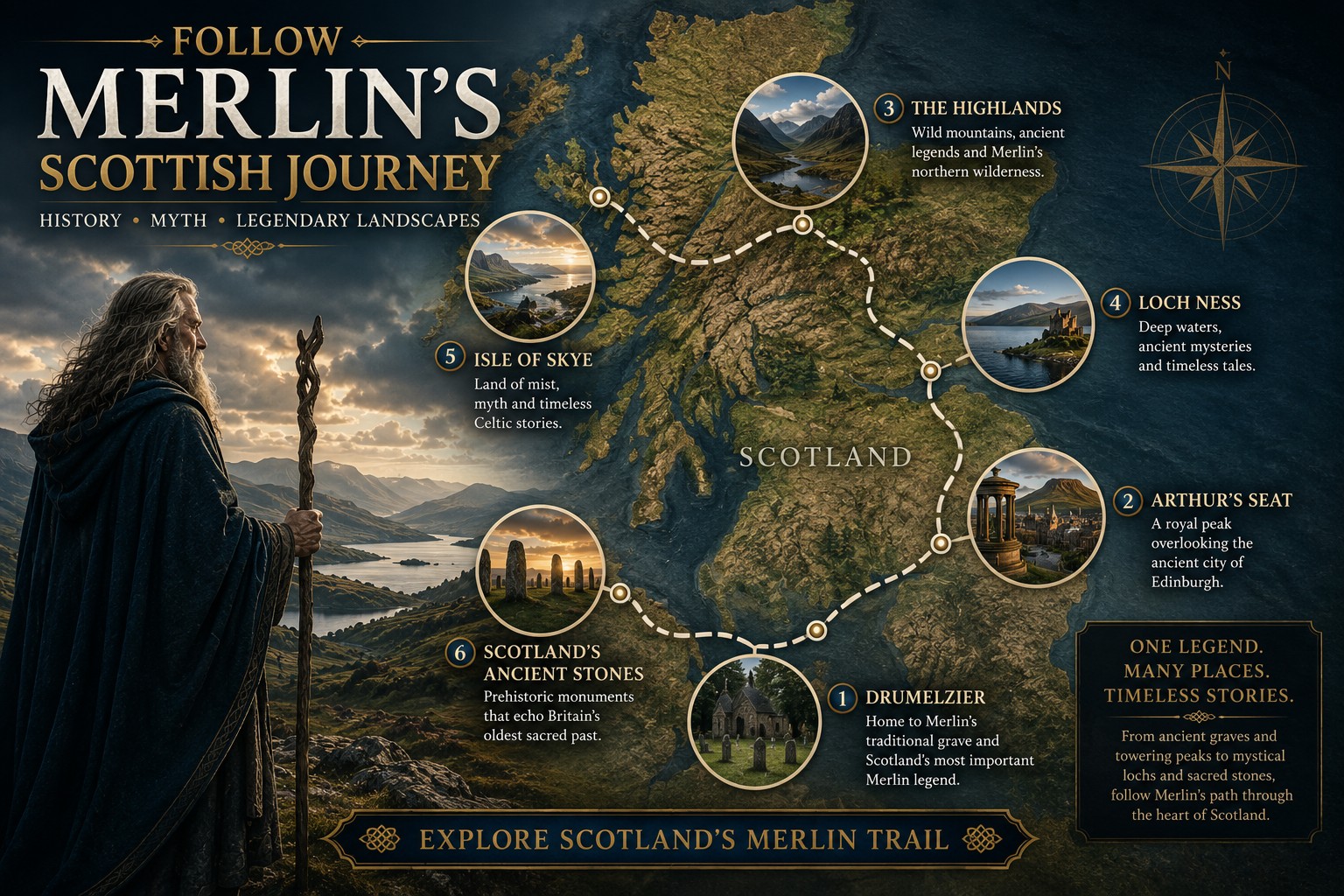
Trace Merlin’s legendary route across Scotland, from his traditional resting place at Drumelzier to the Highlands, Loch Ness, the Isle of Skye and ancient stone circles, discovering the landscapes where history and legend continue to meet
👑 What Is the Arthurian Connection?
Arthurian place names occur across Britain, often in locations where their origins are difficult to establish. Some may preserve genuinely old traditions. Others may have acquired legendary associations much later, after the stories of Arthur and Merlin had become widely known.
Arthur’s Seat belongs within that uncertain but fascinating category. Its name has encouraged centuries of speculation, yet the hill itself offers no archaeological proof of a direct connection with Arthur. It should not be presented as evidence that the legendary king or Merlin stood on its summit.
Its importance is cultural rather than biographical. The place demonstrates how Arthurian stories spread far beyond one supposed kingdom or court, becoming attached to prominent hills, caves, stones and ruins throughout Britain. For readers following Merlin north into Scotland, Arthur’s Seat represents that wider literary geography.
It is also an effective bridge between Drumelzier and the rest of the country. Drumelzier offers a concentrated local Merlin tradition, while Arthur’s Seat introduces the broader process through which legendary figures became connected with dramatic and recognisable landscapes.
🥾 Walking Arthur’s Seat Today
Arthur’s Seat is among Edinburgh’s best-known outdoor experiences, but the walk should not be underestimated. Several routes cross Holyrood Park, ranging from gentler approaches and lower viewpoints to steeper, rougher paths leading towards the summit.
Conditions can change quickly. Wind, rain and low cloud may affect visibility even when the weather appears settled elsewhere in the city. Sturdy footwear is sensible, particularly after wet weather, and visitors should choose a route that matches their mobility, confidence and fitness.
Reaching the highest point rewards walkers with wide views over Edinburgh’s Old Town and New Town, Salisbury Crags, the Firth of Forth and the countryside beyond the city. On clearer days, the scale of the surrounding landscape becomes one of the most memorable aspects of the experience.
Travellers who do not wish to complete the full ascent can still enjoy Holyrood Park from lower paths and viewpoints. This makes the area adaptable for different visitors while preserving its central appeal: the opportunity to experience Edinburgh as a landscape rather than only as a historic city.
Afterwards, the Palace of Holyrood house, the lower end of the Royal Mile and Edinburgh’s museums and galleries provide natural ways to continue exploring. Arthur’s Seat therefore works particularly well within a full day devoted to the city’s history, geology and legendary associations.
Visitors building a wider journey around these legendary locations can also explore our Scotland travel guide to compare the Highlands, islands and historic cities that could easily form part of the same adventure.
🥾 Planning Your Visit to Arthur’s Seat
Arthur’s Seat offers one of Edinburgh’s most memorable outdoor experiences, but the summit route is steeper and rougher than many first-time visitors expect. Choosing the right route, allowing enough time and preparing for changing weather will make the walk safer and more enjoyable.
Planning tip: Visitors who do not want to complete the full ascent can still enjoy rewarding views from the lower paths, Salisbury Crags and other viewpoints within Holyrood Park.
Flexible route choices make Arthur’s Seat accessible as part of a wider Edinburgh day, even when time or weather prevents a summit walk.
🏔️ Merlin, Loch Ness and the Scottish Highlands
The Scottish Highlands are not central to the earliest surviving traditions of Myrddin Wyllt. Those traditions belong more closely to the northern borderlands and the Brittonic world associated with southern Scotland and northern England.
Even so, the Highlands have become an important part of the modern imaginative landscape surrounding Merlin. Mountains, forests, rivers and remote glens reflect many of the qualities later associated with him: solitude, prophecy, distance from political power and a close relationship with the natural world.
This is an interpretive connection rather than evidence of a historical journey. There is no reliable basis for claiming that Merlin travelled through the Highlands, lived beside Loch Ness or practised magic in a particular glen. What the region offers instead is a powerful setting through which visitors can explore Scotland’s wider traditions of folklore, storytelling and place.
That distinction protects the integrity of the article while preserving the Highlands’ genuine appeal. Merlin does not need to be artificially inserted into every local legend. He can instead act as a narrative guide, leading readers towards landscapes and cultural traditions that developed independently of his own story.
If you’re deciding when to follow this legendary journey, our Scotland Events Calendar can help you combine Merlin’s landscapes with Highland Games, seasonal festivals and other memorable celebrations taking place during your visit.
🌲 A Region of Many Traditions
The Highlands should never be treated as one uniform mythical territory. The region contains distinct communities, histories, dialects, landscapes and cultural traditions, including a rich Gaelic inheritance that cannot be reduced to a general idea of “magic.”
Stories associated with water, weather, mountains, animals and supernatural beings vary from place to place. They reflect local experience and the ways communities understood environments that could be beautiful, productive, dangerous and unpredictable.
Merlin fits most naturally here as a comparative figure. His retreat into wilderness and his association with prophecy resonate with broader themes found throughout northern European storytelling, but that does not make every Highland tradition part of the Merlin legend.
For visitors, this more careful approach creates a better experience. Instead of searching for invented Merlin landmarks, travellers can appreciate how landscape shaped belief, how stories differed between communities and why certain places continue to feel culturally powerful.
The Highlands also reward slower travel. Distances can appear modest on a map but take much longer to cover because of winding roads, mountain routes and frequent stops. A journey planned around scenery, local heritage and time outdoors will usually be more satisfying than an itinerary that attempts to collect too many locations in a single day.
🌊 Loch Ness Beyond the Monster
Loch Ness is one of the most internationally recognised places in Scotland, but its importance extends far beyond the modern legend of Nessie. The loch forms part of the Great Glen, a dramatic geological corridor cutting across the Highlands between Inverness and Fort William.
Its scale, depth, changing light and surrounding hills have helped create an atmosphere that visitors often describe as mysterious. Those qualities have encouraged modern storytellers to place a wide range of supernatural narratives around the loch, including later Merlin-themed interpretations.
Loch Ness is not, however, one of Scotland’s strongest early Merlin locations. Its role within this mini-cluster is broader. It shows how modern tourism, folklore and familiar legendary figures can overlap, creating new ways for travellers to interpret an already famous landscape.
Visitors can experience the area through loch cruises, waterside viewpoints, nearby villages and the ruins of Urquhart Castle. Each provides a different perspective, from the immense length of the loch to the strategic importance of the Great Glen across many periods of Scottish history.
The best visit does not depend on proving or disproving a monster story, nor on forcing Merlin into the landscape. It comes from understanding why deep water, shifting weather and limited visibility have supported speculation for so long.
For travellers interested in folklore, Loch Ness can therefore be approached as part of a wider Highland journey rather than as a single novelty attraction. Time spent exploring the surrounding region gives greater context to the stories and reveals how much more the area offers beyond its most famous legend.
🧭 Build a Scotland Journey That Works
Scotland rewards thoughtful planning. Distances can appear manageable on a map but take considerably longer to cover because of rural roads, ferry connections, mountain routes and the temptation to stop at viewpoints along the way. A stronger itinerary usually comes from connecting a small number of compatible regions rather than trying to experience the entire country in one journey.
1. Choose
Begin with the places or experiences that matter most. Choose one principal region, city, landscape or theme rather than treating every famous attraction as essential.
2. Connect
Add destinations that fit naturally around your main choice. Consider geography, transport links and the type of journey you want rather than connecting places solely because they are well known.
3. Allow
Allow realistic time for travel, meals, walks, viewpoints and unexpected discoveries. Scotland is usually more rewarding when fewer destinations receive more attention.
4. Adapt
Keep part of the itinerary flexible. Weather, road conditions, ferry services and seasonal opening times can affect even carefully prepared Scotland journeys.
A useful Scotland planning rule
Build each day around one principal experience, then add nearby stops only where they improve the journey. This creates space for changing weather, scenic pauses and the unplanned moments that often become the most memorable part of travelling through Scotland.
Before finalising your route, check:
✔ How long the journey takes on rural roads.
✔ Whether accommodation needs advance booking.
✔ Seasonal opening times and daylight hours.
✔ Ferry, rail or public-transport connections.
✔ Walking conditions and suitable equipment.
✔ Where a slower overnight stop would improve the experience.
The strongest Scotland itinerary is not necessarily the one that includes the most places—it is the one that gives each chosen destination enough time to feel genuinely experienced.
✨ Skye, Fairy Folklore and Magical Landscapes
The Isle of Skye is frequently described as magical, but its traditions should not be folded carelessly into Merlin’s story. Skye does not preserve a strong early Merlin association comparable with Drumelzier, and its Gaelic folklore belongs to its own cultural world.
Within this article, Merlin serves as a narrative guide into that world rather than as a figure claimed by every local tale. Skye demonstrates how a landscape can acquire a powerful reputation through the combination of geology, oral tradition, place names and generations of human experience.
The island’s appeal is immediate. The Cuillin mountains dominate the skyline, sea cliffs rise above exposed coasts, waterfalls descend through dark rock and narrow roads lead between crofting settlements, moorland and sheltered bays.
Yet scenery alone does not explain Skye’s cultural depth. Gaelic stories associated with supernatural beings, enchanted places and the unseen world reflect traditions developed within island communities over many centuries. They deserve to be understood on their own terms rather than treated simply as decorative evidence that Merlin must once have been present.
🌫️ Why Skye Feels Like a Legendary Landscape
Skye’s geography constantly changes the way visitors experience distance and weather. A mountain ridge may disappear into cloud, a coastal view may open unexpectedly between hills, and sunlight can transform a grey landscape within minutes.
These shifts help explain why the island lends itself so readily to storytelling. Places that appear different according to weather, tide and season encourage observation, memory and interpretation. Over time, narratives become attached to waterfalls, hills, rock formations and stretches of coast.
The Fairy Pools are a well-known modern example of this relationship between name, landscape and expectation. Their clear water and position beneath the Cuillin make them visually striking, but the attraction’s current reputation should not automatically be treated as proof of one ancient, continuous Merlin or fairy tradition.
A more responsible interpretation allows several truths to coexist. Skye possesses genuine Gaelic folklore, extraordinary geological scenery and a modern tourism identity that often emphasises enchantment. Visitors can enjoy all three without confusing them.
For readers following the wider Merlin mini-cluster, Skye provides an important lesson. Mythical travel is most rewarding when it leads towards the culture of a place rather than replacing that culture with a familiar story imported from elsewhere.
🚗 Planning a Responsible Visit to Skye
Skye’s popularity brings practical challenges, particularly during the busiest months. Accommodation can fill well in advance, car parks at major viewpoints may reach capacity and narrow single-track roads require patience from drivers unfamiliar with rural Scottish conditions.
Passing places must be kept clear and should never be used for parking. Drivers should allow vehicles travelling more quickly behind them to pass when it is safe, while always giving priority to local access, emergency services and working traffic.
Weather can change rapidly, even in summer. Waterproof clothing, suitable footwear and flexible plans are more valuable than attempting to follow a rigid timetable. Some walks become muddy or slippery after rain, while mountain routes may require experience far beyond that needed for roadside viewpoints.
Popular locations are best enjoyed either early, later in the day or outside the busiest periods where practical. Visitors should use designated parking and facilities, remain on durable paths and avoid contributing to erosion around heavily visited natural features.
Spending at locally owned accommodation, cafés, shops, tours and craft businesses helps tourism support island communities. Staying for more than one night also allows a slower, less pressured experience and reduces the temptation to race between distant landmarks.
Skye should not be treated as a single-day checklist. Its roads, weather and cultural character reward time. For many travellers, two or three nights provide a far more realistic introduction than a rushed circuit from the mainland.
🏴 Discover Scotland in a Day
Whether you’re fascinated by ancient castles, dramatic Highland scenery, legendary locations or picturesque lochs, a guided day tour makes it easy to experience some of Scotland’s most remarkable places without the stress of planning every detail yourself.
Browse our Scotland day tours to compare itineraries, discover iconic destinations and find the perfect experience for your visit.
Explore Scotland with confidence through professionally planned day tours that showcase spectacular landscapes, historic landmarks and unforgettable experiences.
🏴 Explore Scotland Beyond a Single Day
Some of Scotland’s greatest experiences unfold over several days. From the Highlands and islands to historic cities, castles and breathtaking coastlines, a multi-day tour allows you to explore more deeply while leaving the planning to experienced travel specialists.
Discover carefully planned Scotland itineraries that combine iconic landmarks with hidden gems, comfortable travel and unforgettable scenery, making it easy to experience more of the country in one memorable journey.
Explore Scotland Multi-Day Tours →
Travel with confidence on expertly planned Scotland tours that showcase spectacular landscapes, historic landmarks, legendary locations and the very best of the country over several unforgettable days.
🪨 Merlin, Standing Stones and Scotland’s Ancient Past
Long before the earliest stories of Merlin or Myrddin were written down, people across Scotland were raising standing stones, building ceremonial circles and constructing monumental burial cairns. These remarkable prehistoric monuments remain among the country’s greatest archaeological treasures and continue to inspire curiosity thousands of years after they were built.
For many visitors, it is easy to see why Merlin eventually became associated with these ancient places. Their original builders left no written explanations, many monuments occupy dramatic natural settings, and their immense age encouraged later generations to seek legendary rather than historical answers.
However, one of the strengths of Scotland’s heritage is that archaeology and folklore can both be appreciated without confusing one for the other.
The standing stones themselves were not built by Merlin, nor is there historical evidence that they were erected by Druids. Most date from the Neolithic and Bronze Age, many centuries before Iron Age Druidic traditions emerged and well over two thousand years before medieval writers shaped the Merlin familiar today.
Rather than weakening their mystery, understanding their true chronology makes these monuments even more remarkable. They demonstrate that Scotland possessed sophisticated prehistoric communities capable of transporting, shaping and erecting enormous stones long before recorded history.
For visitors interested in Merlin, these sites reveal something equally fascinating: how later generations attached familiar legendary figures to ancient landscapes whose original purpose had been forgotten.
⏳ Scotland’s Extraordinary Prehistoric Monuments
Scotland’s prehistoric monuments vary enormously in both age and purpose. Some stand alone in open fields or on windswept hillsides, while others form carefully planned ceremonial landscapes stretching across surprisingly large areas.
Although archaeologists continue to investigate their precise functions, there is no single explanation that applies to every monument. Some appear to have served ceremonial purposes, others relate to burial practices, while many may have fulfilled several roles over long periods of use.
Among the country’s finest examples are:
- Ring of Brodgar (Orkney) – one of Britain’s greatest Neolithic stone circles and part of the Heart of Neolithic Orkney UNESCO World Heritage Site.
- Calanais (Callanish) Standing Stones (Isle of Lewis) – a remarkable prehistoric standing-stone complex whose setting and preservation continue to inspire visitors from around the world.
- Clava Cairns (near Inverness) – Bronze Age burial cairns surrounded by standing stones, famous for both their archaeological significance and atmospheric woodland setting.
- Machrie Moor (Isle of Arran) – an extensive ceremonial landscape containing multiple stone circles set beneath dramatic mountain scenery.
Each monument reflects a different chapter of Scotland’s prehistoric story, yet all share one quality: they encourage questions that still cannot be answered completely.
How were communities organised to construct such monuments?
Why were particular locations chosen?
What ceremonies, gatherings or seasonal events took place here?
These unanswered questions have naturally encouraged centuries of folklore. Merlin became one possible explanation among many, illustrating humanity’s enduring desire to connect mysterious places with equally remarkable figures.
🌿 Merlin, Druids and Popular Imagination
Few misconceptions appear more frequently than the idea that Merlin was a Druid who built Britain’s ancient stone circles.
Modern novels, television programmes, films and fantasy artwork have made this image instantly recognisable. It is visually compelling—but historically inaccurate.
The historical Druids belonged to Iron Age Celtic societies that flourished many centuries after Scotland’s great Neolithic stone circles had already stood for generations. Likewise, the literary Merlin emerged much later still through medieval writing.
These three periods—prehistoric monument builders, Iron Age Druids and medieval Merlin traditions—belong to very different chapters of British history.
So why are they so often linked?
When medieval writers encountered impressive monuments whose true origins had largely disappeared from popular memory, they frequently explained them through familiar legendary figures. Geoffrey of Monmouth’s Historia Regum Britanniae famously attributes the creation of Stonehenge to Merlin’s extraordinary powers, providing one of the most influential literary examples of this process.
That story belongs to medieval literature rather than archaeology, but it profoundly influenced later interpretations of ancient monuments across Britain. Over time, Merlin became associated not only with Stonehenge but also, more generally, with mysterious standing stones, sacred landscapes and forgotten places whose origins inspired speculation.
Understanding this literary tradition allows visitors to appreciate both worlds simultaneously. Archaeology explains when and how monuments were built, while folklore reveals how later generations interpreted places that had already become ancient.
Rather than competing with one another, the two perspectives enrich the visitor experience.
📊 Understanding Scotland’s Merlin Connections
One of the easiest ways to appreciate Merlin’s Scottish story is to recognise that different locations contribute in different ways. Some preserve early literary or local traditions, while others are included because they illuminate broader folklore or cultural landscapes.
| 📍 Destination | 📖 Type of Association | ⭐ Strength of Merlin Tradition | 👣 What Visitors Discover |
|---|---|---|---|
| Drumelzier | Early literary tradition and long-standing local folklore | ★★★★★ | Scotland’s strongest Merlin location and grave tradition |
| Arthur’s Seat | Arthurian landscape association | ★★★☆☆ | Edinburgh’s legendary setting and panoramic city walk |
| Scottish Highlands | Broader thematic landscape connection | ★★☆☆☆ | Folklore, scenery and the atmosphere surrounding later interpretations |
| Isle of Skye | Distinct Gaelic folklore | ★★☆☆☆ | Island culture, fairy traditions and exceptional natural landscapes |
| Prehistoric monuments | Later literary and popular association | ★★☆☆☆ | Archaeology, ancient ceremonial landscapes and evolving folklore |
The table illustrates why this guide separates evidence from interpretation. Every destination has value, but not every destination contributes to Merlin’s story in exactly the same way. Appreciating those differences creates a richer and more authentic journey through Scotland.
🚗 Planning a Merlin-Inspired Journey Through Scotland
One of the greatest strengths of following Merlin’s story is that it encourages visitors to experience Scotland as a connected destination rather than a collection of isolated attractions.
Unlike conventional sightseeing itineraries, there is no single correct order in which these places should be visited. Your ideal route depends upon where you arrive, how much time you have available and whether your interests lean more towards history, archaeology, scenery or folklore.
Merlin simply provides the narrative thread linking these different experiences together.
🧭 Option 1 – Edinburgh and the Borders (2–3 Days)
This shorter itinerary introduces Scotland’s strongest Merlin traditions while remaining easy to manage.
Spend time exploring Edinburgh, including Arthur’s Seat and the historic Royal Mile, before travelling south into the Scottish Borders to visit Drumelzier and discover the landscapes associated with Merlin’s grave tradition.
This option suits visitors arriving by rail, those with limited holiday time or travellers combining Scotland with other parts of Britain.
🏔️ Option 2 – Highlands Extension (5–7 Days)
Travellers with additional time can continue north through the Highlands after visiting Edinburgh.
Rather than rushing between famous landmarks, allow time to explore glens, forests, historic villages and Loch Ness. Distances are greater than many first-time visitors expect, and slower travel often produces the most rewarding experience.
The Highlands introduce another dimension to Merlin’s story by demonstrating how Scotland’s landscapes helped sustain folklore long after the earliest literary traditions had developed.
🌊 Option 3 – The Complete Merlin Journey (7–10 Days)
Visitors wishing to experience the full mini-cluster should allow at least a week.
This itinerary combines:
- Edinburgh
- Drumelzier
- the Highlands
- Loch Ness
- the Isle of Skye
- one or more prehistoric monument sites
The route introduces several distinct regions, each with its own history, landscape and traditions. By allowing sufficient time between destinations, travellers can appreciate the remarkable diversity that exists within Scotland rather than simply driving through it.
📋 Journey Planning Guide
| 🚙 Destination | ⏱️ Suggested Time | ⭐ Main Experience | 💡 Planning Considerations |
|---|---|---|---|
| Drumelzier | Half day | Merlin tradition and Borders scenery | Rural location with limited facilities; combine with other Borders attractions |
| Edinburgh | Full day | Arthur’s Seat and historic city | Weather changes quickly; routes vary in difficulty |
| Highlands | 2–4 days | Scenic touring, folklore and landscapes | Distances are longer than maps often suggest |
| Loch Ness | Half to full day | Great Glen scenery and castle heritage | Combine with wider Highland itinerary |
| Isle of Skye | 2–3 nights | Island landscapes and Gaelic culture | Book accommodation well in advance during busy periods |
| Prehistoric monuments | Flexible | Archaeology and heritage | Many sites are remote and reward slower exploration |
The suggested timings are intended as realistic planning guidance rather than strict rules. Spending longer in fewer regions generally produces a more rewarding journey than attempting to visit every destination as quickly as possible.
📅 From Merlin to Scotland’s Greatest Adventures
One of the most rewarding discoveries readers make after following Merlin’s story is that the legend quickly opens the door to a much broader appreciation of Scotland itself.
Many visitors begin by searching for Merlin’s grave, wondering whether Arthur’s Seat has genuine Arthurian roots or hoping to understand why the Highlands feel so closely associated with Britain’s legendary past. By the end of the journey, they often find themselves planning castle visits, scenic railway journeys, island adventures, archaeological sites, whisky distilleries, wildlife experiences and walking holidays that have little to do with Merlin—but everything to do with Scotland.
That is precisely why Merlin works so well as the opening chapter of the wider Scotland Cluster.
Rather than encouraging travellers to follow a rigid historical trail, the legend naturally leads them through some of the country’s most distinctive regions. The Scottish Borders introduce peaceful valleys, historic abbeys and centuries of local tradition. Edinburgh combines medieval streets, royal history and dramatic volcanic landscapes. The Highlands reveal mountain scenery on an unforgettable scale, while Skye demonstrates how island culture, Gaelic heritage and extraordinary geology create places unlike anywhere else in Britain.
Every destination broadens the journey.
Every region tells a different story.
Together, they encourage visitors to return again and again to experience more of Scotland.

As the sun sets behind Scotland’s ancient standing stones, Merlin reflects on a landscape where history, folklore and spectacular scenery have inspired legends for centuries
🗓️ Scotland Through the Seasons
Scotland rewards visitors throughout the year, but each season offers a noticeably different experience. Understanding these seasonal differences helps travellers plan a journey that matches their interests, photography opportunities and preferred style of travel.
🌸 Spring (March–May)
Longer daylight, fresh greenery and quieter attractions make spring one of the most enjoyable times to explore the Borders, Edinburgh and many archaeological sites. Wildflowers begin appearing across glens and woodlands, while temperatures are generally comfortable for walking.
☀️ Summer (June–August)
Summer provides Scotland’s famous long daylight hours, allowing visitors to explore well into the evening. This is ideal for extended road trips through the Highlands and islands, although accommodation should be booked well in advance and popular destinations are naturally busier.
🍂 Autumn (September–November)
Many experienced travellers consider autumn one of Scotland’s finest seasons. Forests display rich autumn colours, visitor numbers begin to reduce and landscapes often become especially photogenic beneath changing skies. Some attractions may operate shorter opening hours later in the season, so advance planning becomes more important.
❄️ Winter (December–February)
Winter offers a quieter, more reflective experience. Snow occasionally transforms higher ground, while crisp mornings and dramatic weather create memorable conditions for photography. Travellers should allow for shorter daylight hours, changing road conditions in some regions and seasonal operating times.
As the wider Scotland Cluster continues to expand, readers will also be able to use the Scotland Events Calendar to identify festivals, Highland Games, seasonal celebrations and regional events throughout the year.
🪨 Merlin, Stonehenge and Britain’s Legendary Landscapes
Although Scotland preserves some of the earliest traditions associated with Myrddin Wyllt, Merlin’s literary story eventually expanded far beyond the Borders.
One of the most influential developments came through Geoffrey of Monmouth’s Historia Regum Britanniae, in which Merlin is given a central role within the legendary account of Stonehenge. According to Geoffrey’s narrative, Merlin uses his extraordinary knowledge and powers to help transport the great stones from Ireland to Salisbury Plain.
Modern archaeology tells a very different story. Stonehenge was built thousands of years before the medieval Merlin tradition developed, and its construction is now understood through decades of archaeological research rather than legendary explanation.
Yet Geoffrey’s account remains enormously important from a literary perspective.
It established one of the strongest links between Merlin and Britain’s prehistoric monuments, influencing later writers, artists and popular imagination for centuries. It also provides a natural bridge between Scotland’s Merlin traditions and England’s most famous prehistoric monument.
For travellers interested in exploring Britain’s legendary landscapes more widely, Stonehenge offers a fascinating companion experience to Scotland’s Merlin locations. Experiencing both allows visitors to see how mythology, medieval literature and archaeology have shaped public understanding of ancient monuments in very different ways.
Visitors wishing to experience Stonehenge from inside the stone circle during designated Inner Circle access sessions can use the Best Value Tours planning resources when organising a future trip.
📅 Discover What’s Happening Across Scotland
Scotland changes dramatically throughout the year. Festivals, Highland Games, seasonal landscapes, wildlife, historic celebrations and cultural events can all influence when and where you choose to travel. Planning around these experiences often transforms a good holiday into an unforgettable one.
Explore our Scotland Events Calendar to discover the best times to visit different regions, find major events throughout the year and build an itinerary that matches your interests.
View the Scotland Events Calendar →
From Edinburgh festivals and Highland Games to seasonal wildlife, castles, whisky events and island adventures, our calendar helps you choose the right time for your perfect Scotland journey.
🌱 Exploring Merlin’s Scotland Responsibly
One of the defining characteristics of Merlin’s Scotland is that many of its most memorable locations remain closely connected with the natural landscape.
From quiet riverside villages in the Borders to exposed mountain viewpoints, prehistoric monuments and fragile island environments, these places deserve thoughtful and respectful exploration. Responsible travel protects both the landscapes themselves and the communities that continue to care for them.
Where practical, spend longer in fewer destinations rather than attempting to cover the entire country at speed. Slower travel reduces unnecessary driving, creates more meaningful experiences and often supports local businesses more effectively than rushed itineraries.
When exploring rural Scotland, always respect farmland, livestock, private property and local access guidance. Keep to established paths where appropriate, avoid damaging archaeological sites and never climb on fragile prehistoric monuments.
If travelling through Skye or other rural areas with single-track roads, use passing places correctly, never park within them and allow local traffic to pass safely whenever possible.
Supporting independent accommodation providers, cafés, visitor attractions, guides and craft businesses helps ensure tourism benefits local communities throughout the year. Choosing locally owned businesses also provides visitors with opportunities to learn directly from people who know the area’s history and traditions best.
Scotland’s internationally respected Scottish Outdoor Access Code encourages responsible enjoyment of the countryside while protecting wildlife, land management and rural communities. Following its principles helps preserve these remarkable landscapes for everyone who visits in the future.
Merlin’s story is, at heart, one of humanity’s relationship with nature, wisdom and place. Exploring Scotland with care allows today’s travellers to experience that same sense of wonder while helping ensure it remains available for generations to come.
🌿 Explore Scotland with Care
Scotland’s landscapes, castles, islands, mountains and historic sites have inspired visitors for centuries. Protecting these places helps ensure future generations can enjoy the same remarkable experiences. Small, thoughtful choices during your journey can make a meaningful difference.
| Travel Thoughtfully | Why It Matters |
|---|---|
| 🥾 Stay on established paths | Protects fragile habitats and reduces erosion. |
| 🏡 Support local businesses | Helps sustain communities throughout Scotland. |
| 🗑️ Leave no trace | Preserves natural and historic environments for everyone. |
| 🦌 Respect wildlife and heritage | Keeps Scotland’s natural and cultural treasures protected. |
Every responsible traveller helps protect Scotland. By planning carefully, respecting local communities and treating landscapes and historic sites with care, you help preserve the places that make Scotland one of the world’s most memorable destinations.
❓ Frequently Asked Questions
❓ Was Merlin Scottish?
Not in the modern national sense. The earliest traditions associated with Myrddin Wyllt belong to the Brittonic-speaking north, a cultural landscape that included parts of what is now southern Scotland and northern England. Scotland therefore forms an important part of Merlin’s earliest literary tradition rather than being the exclusive homeland of the legendary figure.
❓ Who was Myrddin Wyllt?
Myrddin Wyllt is a prophetic figure who appears in medieval Brittonic literature and is widely regarded as one of the principal inspirations for the later Merlin legend. While historians cannot confirm him as a single identifiable historical individual, his story played an important role in the development of Arthurian tradition.
❓ Where is Merlin’s grave in Scotland?
Local tradition places Merlin’s grave near the village of Drumelzier in the Scottish Borders. Although archaeology has not confirmed the grave itself, Drumelzier preserves Scotland’s strongest long-standing association with Merlin’s death and burial.
❓ Can you visit Merlin’s grave?
Visitors can explore the Drumelzier landscape associated with the tradition, but it should not be viewed as a conventional visitor attraction. Some locations are within a rural environment, so visitors should follow local guidance, respect private land and appreciate the site as part of the wider landscape rather than expecting a formal monument.
❓ Is Arthur’s Seat connected with Merlin?
Arthur’s Seat is linked primarily with the wider Arthurian tradition rather than with Merlin directly. Its name and legendary associations make it an important stop within a Merlin-inspired journey, but there is no reliable historical evidence that Merlin himself visited the hill.
❓ Did Merlin ever travel through the Highlands?
There is no historical evidence demonstrating that Merlin travelled through the Scottish Highlands. Their inclusion within this guide reflects the region’s broader folklore, dramatic landscapes and the way later generations associated such environments with Merlin’s legendary character.
❓ Is the Isle of Skye part of Merlin’s story?
Not in the same way as Drumelzier. Skye’s importance lies in its own rich Gaelic folklore, remarkable scenery and enduring traditions. Within this guide, Merlin acts as a narrative bridge introducing visitors to one of Scotland’s most culturally distinctive regions.
❓ Did Merlin or the Druids build Scotland’s standing stones?
No. Scotland’s standing stones were erected during the Neolithic and Bronze Age, many centuries before the historical Druids and over two thousand years before medieval Merlin literature emerged. Their association with Merlin belongs to later storytelling rather than archaeology.
❓ How long should I allow for a Merlin-inspired journey?
A two- or three-day visit comfortably covers Edinburgh and the Borders. Allow five to seven days if you wish to include the Highlands, and seven to ten days for a more complete itinerary incorporating Skye and several prehistoric sites.
❓ When is the best time to explore Merlin’s Scotland?
Late spring, summer and early autumn generally provide the best combination of weather and daylight, although every season offers different advantages. The ideal choice depends on whether you prioritise walking, photography, quieter attractions or seasonal events.
🧭 Discover Scotland Through Merlin’s Story
Merlin has inspired readers, writers and travellers for centuries, but Scotland offers something uniquely compelling: the opportunity to explore the landscapes that helped shape one of Britain’s greatest legends while discovering a country whose history stretches far beyond mythology.
From the rivers of Drumelzier to the heights of Arthur’s Seat, from Highland glens to the Isle of Skye and Scotland’s extraordinary prehistoric monuments, every destination contributes something different. Some preserve early literary traditions. Others reveal the evolution of folklore, medieval storytelling or archaeological discovery. Together, they demonstrate that Scotland’s relationship with Merlin is richer, more varied and more historically interesting than many visitors expect.
Perhaps that is the greatest reward of following Merlin’s Scottish journey.
The search rarely ends with one legendary figure.
Instead, it becomes an exploration of landscapes, communities, traditions and heritage that continue to shape Scotland today.
Whether this is your first visit or the beginning of many future journeys, Merlin provides an unforgettable introduction to a country where history, literature, archaeology and folklore meet in remarkable ways.
And ultimately, that is what this guide has always been about.
Not simply discovering Merlin.
Discovering Scotland itself.
🏴 Discover Scotland in a Day
Whether you’re fascinated by ancient castles, dramatic Highland scenery, legendary locations or picturesque lochs, a guided day tour makes it easy to experience some of Scotland’s most remarkable places without the stress of planning every detail yourself.
Browse our Scotland day tours to compare itineraries, discover iconic destinations and find the perfect experience for your visit.
Explore Scotland with confidence through professionally planned day tours that showcase spectacular landscapes, historic landmarks and unforgettable experiences.
🏴 Explore Scotland Beyond a Single Day
Some of Scotland’s greatest experiences unfold over several days. From the Highlands and islands to historic cities, castles and breathtaking coastlines, a multi-day tour allows you to explore more deeply while leaving the planning to experienced travel specialists.
Discover carefully planned Scotland itineraries that combine iconic landmarks with hidden gems, comfortable travel and unforgettable scenery, making it easy to experience more of the country in one memorable journey.
Explore Scotland Multi-Day Tours →
Travel with confidence on expertly planned Scotland tours that showcase spectacular landscapes, historic landmarks, legendary locations and the very best of the country over several unforgettable days.
🧙 Explore Merlin’s Scotland
Journey through Scotland’s legendary landscapes with Merlin, ancient standing stones, Edinburgh traditions, Highland mythology and a complete itinerary inspired by the places where history and legend meet.
📖 Begin with the Complete Merlin Guide
Start with the central guide to Merlin’s Scottish traditions, historical associations and the places visitors can explore today.
🏰 Discover Scotland’s Legendary Places
Explore the landscapes, monuments and historic locations connected with Merlin, Arthurian tradition and Scotland’s ancient stories.
🏔️ Continue into the Scottish Highlands
Discover how wilderness, mountains, hidden places and Highland storytelling helped shape Merlin’s Scottish identity.
🗺️ Follow the Complete Merlin-Inspired Route
Bring the legends together with a carefully planned 3–5 day itinerary linking Edinburgh, the Highlands and Scotland’s most atmospheric Merlin locations without unnecessary backtracking.
🇬🇧 Turn the Legends into Your Own Scotland Journey
Explore guided day tours, longer Highland journeys and Scotland’s year-round events as you move from inspiration into practical travel planning.
Discover the legend → explore the places → enter the Highlands → follow the itinerary → plan your Scotland journey