


How to Plan a Stress-Free Stonehenge Inner Circle Visit (2026 Guide)
27th July 2026
🏛️ How to Plan a Stress-Free Stonehenge Inner Circle Visit (2026 Guide)

Careful planning begins long before you arrive at Stonehenge. Organising your travel window, comparing suitable dates and building a flexible itinerary can help create a calm and memorable Inner Circle experience
Planning a Stonehenge Inner Circle visit should feel exciting. Yet many travellers spend more time worrying about choosing the perfect date than imagining what it will feel like to stand inside one of the world’s most extraordinary prehistoric monuments.
Limited access dates, transport arrangements, accommodation choices and the pressure of planning a once-in-a-lifetime experience can make the process feel more complicated than it really is. The good news is that a stress-free visit does not require a perfect itinerary. It requires a few important decisions made in the right order.
Once those decisions are organised properly, the rest of the trip becomes much easier to shape. Rather than trying to control every variable, you can create a clear, realistic plan that gives you confidence, flexibility and enough breathing space to enjoy the experience.
This guide takes you through the complete planning process, from defining your travel window and comparing suitable dates to preparing for the day itself. The aim is simple: to help you arrive at Stonehenge feeling calm, organised and ready to appreciate every moment.
💡 Quick Answer
To plan a stress-free Stonehenge Inner Circle visit, begin with a realistic travel window, shortlist two or three suitable dates and confirm the Inner Circle experience before arranging the flexible parts of your itinerary. Allow sensible travel margins, prepare for changing weather and stop comparing alternatives once your essential arrangements work together.
The most important principles are:
- Start with your travel window rather than one fixed date.
- Compare two or three workable Inner Circle options.
- Secure genuinely fixed commitments before flexible ones.
- Build accommodation, transport and sightseeing around the confirmed visit.
- Leave practical breathing space in your schedule.
- Stop researching once the important parts of the plan are settled.
Good decisions beat perfect decisions.
🤔 Why Stonehenge Inner Circle Planning Can Feel Overwhelming
Stonehenge Inner Circle access is more exclusive than a standard daytime visit, so it is understandable that visitors want to organise it carefully. Many people are travelling from London, another part of Britain or overseas, and the experience may be one of the main reasons for their trip.
That importance can create unnecessary pressure. The more special the experience feels, the more tempting it becomes to search for the single best date, the ideal month, the perfect weather and the most impressive itinerary.
Before long, planning stops feeling exciting and starts feeling like a problem that must be solved perfectly.
In reality, most of the stress comes from uncertainty rather than genuine complexity. Visitors often try to make every decision at once, even though many of those decisions depend on choices that have not yet been confirmed.
A hotel may depend on the date of the Inner Circle visit. Transport may depend on the hotel. Other attractions may depend on the travel route. When these decisions are approached in the wrong order, the itinerary begins to feel fragile.
When they are approached in the right order, the same trip becomes far easier to manage.
Perfect planning tries to remove every possible uncertainty.
Good planning secures the essential parts of the trip and prepares sensibly for the things that cannot be controlled.
That distinction is the foundation of a stress-free visit.
🧠 Stonehenge Inner Circle access is one of Britain’s most exclusive visitor experiences.
Unlike a standard Stonehenge visit, Inner Circle access allows visitors to enter the stone circle itself during specially managed early morning sunrise or evening sunset experiences. Because access is limited, careful planning almost always creates a smoother and more enjoyable visit.
Rather than searching endlessly for one “perfect” date, experienced visitors usually compare several suitable options and build the rest of their itinerary around the confirmed experience. That simple approach often removes far more stress than trying to plan every detail in advance.
🧠 Good Decisions Beat Perfect Decisions
There is rarely only one correct way to plan a Stonehenge Inner Circle visit.
Several dates may work equally well. Sunrise and sunset visits can both be extraordinary. Different seasons create different light, landscapes and atmospheres, but that does not mean one option is automatically better than every other.
A crisp winter morning can feel wonderfully dramatic. A spring visit may bring softer light and a fresh landscape. Summer evenings can feel expansive and atmospheric, while autumn often adds rich colour and changing skies.
The right choice is therefore not the date that looks most impressive in isolation. It is the date that works best within your wider trip.
That same principle applies to accommodation, transport and sightseeing. Staying in Salisbury may suit one itinerary, while travelling from London may suit another. An organised tour may simplify the day for some visitors, while independent travel may suit those who value greater flexibility.
Good planning recognises these differences. It focuses on suitability rather than superiority.
A useful question is not:
“What is the absolute best option?”
A more helpful question is:
“Which option gives me an excellent experience while fitting comfortably into the rest of my trip?”
That question is easier to answer, and it usually leads to better decisions.
Confidence comes from having a clear plan, not from eliminating every possible uncertainty.
Once that mindset is in place, the practical planning process becomes surprisingly straightforward. Instead of treating the visit as one enormous decision, divide it into four manageable stages.
🪜 How to Plan a Stress-Free Stonehenge Inner Circle Visit in Four Steps
The Four-Step Calm Planning Method is designed to reduce decision fatigue and keep the planning process in the correct order.
Each step answers one important question. Once that question has been settled, you move to the next stage rather than reopening every earlier decision.
📅 Step 1 — Define Your Travel Window
Do not begin with one exact date unless your wider travel plans are already completely fixed.
Start by defining the period in which your Stonehenge visit could realistically take place.
Your travel window may be shaped by:
- international arrival and departure dates;
- confirmed accommodation elsewhere in Britain;
- other fixed attractions, tours or events;
- the days you expect to spend in London or southern England;
- how much flexibility exists within the rest of your itinerary.
For example, an overseas visitor may know that they will be in Britain for ten days but have three possible days available for Stonehenge. A couple travelling around southern England may have a full week in which several Inner Circle dates could work. A visitor based in London may have fewer accommodation constraints but still need to consider transport and early or late timings.
Thinking in terms of a travel window immediately reduces pressure. Instead of becoming attached to one date before checking the wider consequences, you create a realistic group of possibilities.
This also protects you from disappointment. If one option is unavailable or awkward to organise, you already have alternatives that fit the same trip.
At this stage, you are not choosing the final date.
You are identifying where the opportunity exists.
🔍 Step 2 — Shortlist Two or Three Workable Dates
Once your travel window is clear, shortlist two or three dates that could all produce an excellent visit.
There is no need to compare every date on the calendar. Too many options can make decision-making harder rather than easier.
For each shortlisted date, consider five practical questions:
- Does it fit naturally within the wider itinerary?
- Is the required travel realistic?
- Would sunrise or sunset suit your preferred pace?
- Is suitable accommodation available?
- Does the date leave enough breathing space before or after other major travel?
The strongest option is usually the one that works well across all five areas rather than the one that appears most impressive on paper.
This is also the point where flexibility becomes valuable. A visitor who is prepared to consider several dates is far less likely to feel rushed into a decision or disappointed by one unavailable option.
Shortlisting protects the quality of the experience without creating unnecessary complexity.
Instead of thinking: “I must secure this exact day.”
You can think: “I have several excellent possibilities, and I only need one of them to work.”
That is a much calmer position from which to plan.
💡 The strongest itineraries are usually built around flexibility, not perfection.
Visitors often assume they need to identify one perfect Stonehenge Inner Circle date before planning anything else. In reality, experienced travellers usually begin with a realistic travel window, compare several suitable options and then choose the date that works best within the wider itinerary.
This approach reduces unnecessary pressure, creates practical alternatives if one option is unavailable and often produces a smoother, more enjoyable journey from beginning to end.
📊 High-Stress Planning vs Confident Planning
Stress-free planning does not mean ignoring the practical details. It means handling those details in an order that reduces uncertainty instead of creating more of it.
The difference is often visible in the way decisions are approached.
| High-Stress Approach | Confident Approach | Why It Helps |
|---|---|---|
| Fixate on one supposedly perfect date | Shortlist two or three workable dates | Preserves alternatives and reduces disappointment |
| Book dependent elements too early | Secure the controlling date before flexible details | Reduces the likelihood of later changes |
| Reopen every decision repeatedly | Review decisions only when circumstances materially change | Protects confidence and saves time |
| Fill every hour of the itinerary | Leave practical breathing space | Makes delays and changes easier to absorb |
| Continue researching indefinitely | Stop when the essential arrangements work together | Prevents decision fatigue |
The confident approach cannot control every variable. Weather may change, traffic may be heavier than expected and a day may unfold differently from the original plan.
What it can do is create an itinerary strong enough to absorb those changes without losing its shape.
That is the real purpose of planning.
😌 Four Small Habits That Make Planning Easier
The biggest planning decisions matter, but small habits often determine whether the process feels calm or exhausting.
⏰ Protect the Arrival Time
The most important practical margin in the itinerary is the time before the visit.
Follow the joining instructions supplied with your booking and plan around the designated meeting point, not merely the general location of Stonehenge. Allow for traffic, parking, transfers, unfamiliar roads and any additional instructions connected with your access arrangements.
A sensible margin does more than protect punctuality. It changes the emotional tone of the day.
Arriving with time to spare allows you to settle, confirm where you need to be and focus on the experience ahead. Arriving at the last possible moment creates pressure that can overshadow the beginning of the visit.
🗺️ Avoid an Overloaded Itinerary
Stonehenge can be combined with other destinations, but that does not mean every nearby attraction should be added to the same day.
Salisbury, Bath, Avebury, Windsor and Oxford can all make sense in the right itinerary. The problem begins when the schedule becomes so crowded that each destination is reduced to a brief stop between journeys.
A relaxed plan protects the main experience.
If the Inner Circle visit is the reason for the day, allow it to remain the centrepiece. Additional sightseeing should complement the journey rather than compete with it.
🔄 Keep One Element Flexible
Not every part of the itinerary needs to be fixed months in advance.
A flexible meal, an optional afternoon stop or a choice between two nearby activities can give the day room to adapt. If travel takes longer than expected or you simply want more time in one place, that flexibility becomes valuable.
The most resilient itineraries combine a few secure anchors with several adjustable details.
That balance creates structure without rigidity.
🎯 Prioritise the Experience Over the Schedule
A schedule is useful only when it supports the visit.
It should not become a scorecard against which every minute is judged.
Some visitors spend so much energy trying to keep the day perfectly on time that they struggle to notice what is happening around them. A few small changes do not mean the plan has failed.
The purpose of the itinerary is to help you experience Stonehenge well, not to make the day unfold with mechanical precision.
📋 Four Simple Steps to a Stress-Free Stonehenge Inner Circle Visit
Planning becomes much easier when you tackle one decision at a time. Instead of trying to organise every detail at once, follow this simple sequence and let each decision naturally support the next.
Expert Tip: Each step depends on the one before it. Once a decision has been made, move confidently to the next stage rather than continually reopening earlier choices. Good planning builds momentum, not uncertainty.
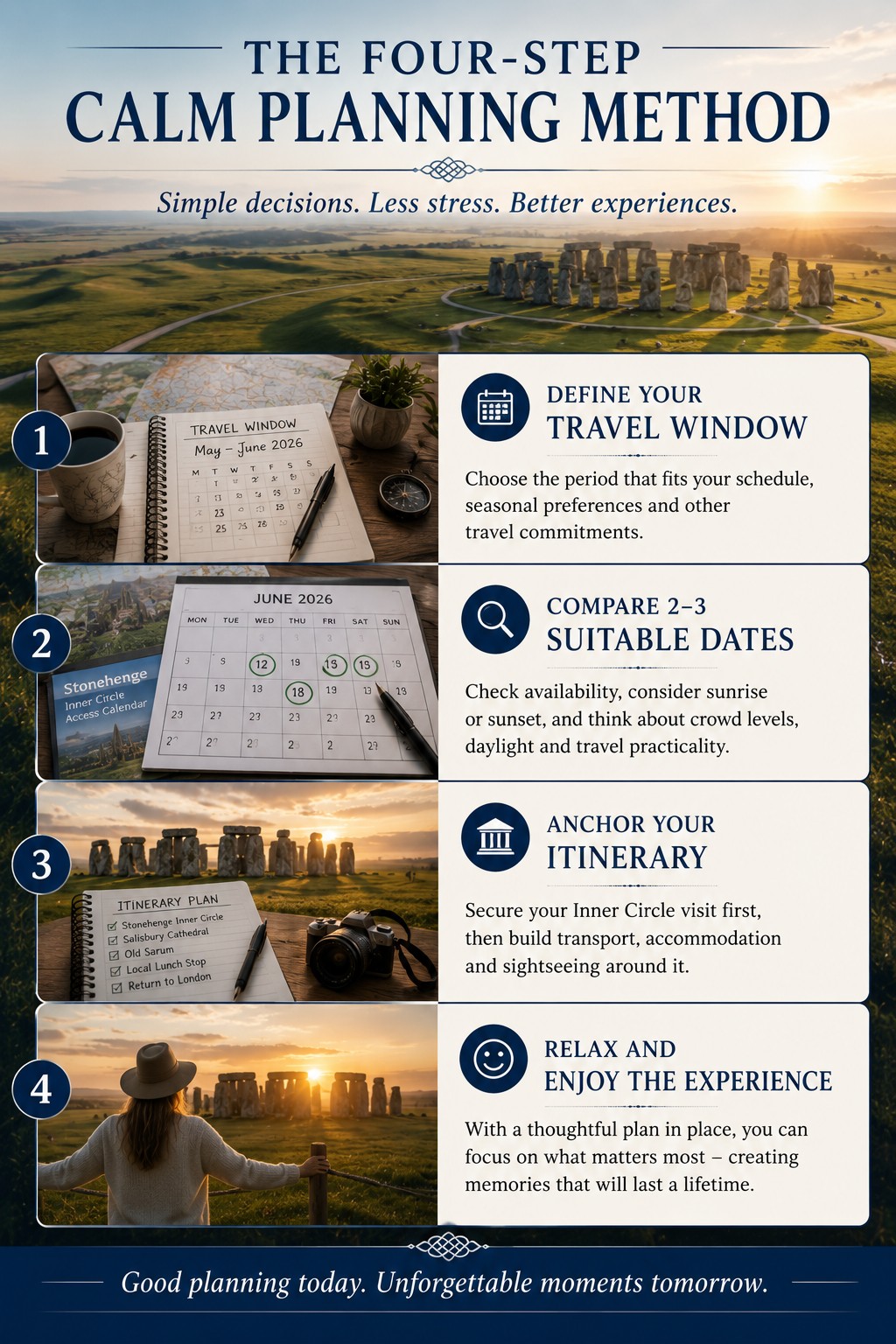
Reduce planning stress by following four simple steps: define your travel window, compare suitable dates, build your itinerary around the confirmed visit and enjoy the experience with confidence
📅 How the Stonehenge Inner Circle Access Calendar Reduces Uncertainty
The Stonehenge Inner Circle Access Calendar is most useful when treated as a decision-making tool rather than a simple list of dates.
Its value lies in helping you compare realistic possibilities within the context of your wider trip.
A high-stress approach begins with one preferred date and treats every alternative as a compromise. A calmer approach begins with a travel window and looks for several options that could all work well.
This changes the way availability feels.
Instead of asking:
“Is my one perfect date available?”
You can ask:
“Which of the available dates fits my complete itinerary most comfortably?”
That is a much more useful question.
The calendar can help you:
- identify opportunities within your travel window;
- compare sunrise and sunset possibilities;
- avoid becoming attached to one isolated date;
- align the visit with accommodation and transport;
- recognise suitable alternatives before urgency develops.
This does not mean you should postpone decisions indefinitely. Once a date works well and the surrounding arrangements are realistic, there is little benefit in continuing to search for a marginally better option.
The calendar is there to reduce uncertainty, not prolong it.
📈 Compare Complete Trip Options, Not Isolated Dates
The easiest way to use the calendar is to compare complete trip scenarios.
For example, do not compare only:
- Tuesday versus Thursday.
Compare:
- Tuesday with your likely accommodation, transport and next destination;
- Thursday with the same surrounding arrangements.
One date may appear equally attractive on the calendar but create a far easier journey when the rest of the itinerary is considered.
A practical three-step method is:
- Identify every suitable date within your travel window.
- Shortlist the two or three options that fit the wider trip best.
- Confirm the strongest option once transport and accommodation appear realistic.
This keeps the calendar connected to the real journey rather than treating it as an isolated booking exercise.
It also makes flexibility feel positive. An alternative date is not necessarily a second-best date. It may produce a smoother itinerary, a better overnight location or more comfortable travel arrangements.
That is why the calendar should be used as part of the complete planning process.
📅 Make the Calendar Your First Planning Tool
One of the easiest ways to simplify your planning is to begin with the Stonehenge Inner Circle Access Calendar. Rather than researching dozens of possible dates individually, the calendar brings the available sunrise and sunset access opportunities together in one place, making it much easier to compare your options.
Many experienced visitors start by identifying a realistic travel window, then use the calendar to shortlist several suitable dates before building the rest of their itinerary. This simple approach keeps planning organised, reduces unnecessary stress and provides greater flexibility if your preferred date is unavailable.
The simplest planning sequence:
- Choose your preferred travel window.
- Compare several available Inner Circle dates.
- Select the option that best fits your wider itinerary.
- Arrange accommodation, transport and sightseeing around your confirmed visit.
Planning Tip: The goal is not to find one perfect date. The goal is to find the date that works best for your trip, giving you the confidence to organise everything else around it.
📅 Check the Stonehenge Inner Circle Access Calendar
Start your planning with confidence by comparing available Stonehenge Inner Circle sunrise and sunset dates in one place. The calendar helps you identify suitable visit options before organising accommodation, transport and the rest of your itinerary.
✓ Compare multiple options before committing
✓ Build your itinerary around your preferred visit
✓ Reduce planning stress with a clear overview
View the Stonehenge Inner Circle Access Calendar →
A few minutes spent comparing dates now can make planning the rest of your trip much easier.
🌱 How Calm Planning Supports More Sustainable Travel
One of the less obvious benefits of careful planning is that it often leads to more responsible travel.
When people leave important decisions until the last minute, they are naturally forced into quicker choices. That can mean longer journeys than necessary, unnecessary backtracking, rushed itineraries or transport arrangements that are driven by urgency rather than practicality.
Planning ahead creates opportunities to travel more thoughtfully.
By organising your journey in a logical sequence, you can often reduce unnecessary travel, choose accommodation that naturally supports your itinerary and avoid doubling back between destinations. Those choices not only make the day less stressful, but they can also reduce the overall impact of the journey.
Stonehenge is not simply a collection of ancient stones.
It forms part of one of Britain’s most important prehistoric landscapes and is recognised as a UNESCO World Heritage Site. Appreciating that wider setting encourages visitors to slow down, respect the landscape and experience the monument as part of a much larger archaeological story.
Responsible travel can be remarkably simple.
It may involve:
- following designated visitor routes;
- respecting staff guidance;
- allowing enough time to explore without rushing;
- supporting local cafés, accommodation providers and independent businesses where practical;
- disposing of litter responsibly and helping preserve this extraordinary landscape for future generations.
A calmer itinerary often creates space to enjoy nearby communities such as Salisbury rather than simply passing through them. Spending time locally can support the area’s economy while creating a richer and more rewarding day for visitors.
Perhaps most importantly, sustainable travel and stress-free planning are built on exactly the same principle.
Neither is about adding unnecessary rules.
Both encourage thoughtful decisions, realistic expectations and a journey that places quality ahead of rushing from one destination to another.
A calmer itinerary is often a more sustainable one.
🌱 Small Planning Decisions Can Make Your Visit More Sustainable
Careful planning doesn’t just reduce stress—it can also help minimise your environmental impact. Choosing realistic travel times, avoiding unnecessary journeys and building an organised itinerary all contribute to a more responsible way to experience one of Britain’s most important ancient monuments.
Stonehenge has stood in the landscape for thousands of years. By travelling thoughtfully and respecting both the monument and its surrounding World Heritage Site, every visitor plays a small part in helping to protect this remarkable place for future generations.
Simple ways to travel more sustainably:
- Plan your itinerary carefully to reduce unnecessary travel.
- Travel with responsible operators who help manage visitor numbers sensitively.
- Respect marked pathways and protected areas throughout the World Heritage Site.
- Leave no litter and help preserve the landscape for future visitors.
- Support tourism that values conservation alongside unforgettable visitor experiences.
Travel with Purpose. Explore with Care.
Every thoughtful decision—from planning your journey efficiently to respecting this remarkable World Heritage Site—helps protect Stonehenge for future generations while creating a better experience for everyone who visits.

The best Stonehenge Inner Circle visits begin with thoughtful planning, allowing you to arrive relaxed, confident and ready to enjoy one of Britain’s most extraordinary prehistoric landscapes
📋 Final Stress-Free Planning Confidence Check
Before closing the browser tabs and considering your planning complete, spend a minute working through this final confidence check.
This is not intended to replace a detailed planning checklist. Instead, it helps confirm that the essential parts of your trip now work together.
If most of your answers are “Yes”, you can be confident that you have built a strong foundation for an enjoyable Stonehenge Inner Circle experience.
| Confidence Check | Your Answer |
|---|---|
| Have I defined a realistic travel window? | ☐ Yes / ☐ Review |
| Have I shortlisted two or three suitable dates? | ☐ Yes / ☐ Review |
| Have I used the Stonehenge Inner Circle Access Calendar to compare complete trip options? | ☐ Yes / ☐ Review |
| Does my confirmed Inner Circle visit now anchor the rest of my itinerary? | ☐ Yes / ☐ Review |
| Are my transport arrangements realistic for the day? | ☐ Yes / ☐ Review |
| Have I allowed sensible breathing space in the schedule? | ☐ Yes / ☐ Review |
| Am I prepared for changing weather rather than trying to predict it months ahead? | ☐ Yes / ☐ Review |
| Have I stopped reopening decisions that already work well? | ☐ Yes / ☐ Review |
Planning confidence is not about eliminating every uncertainty.
It is about knowing that the important decisions have been made well.
Good decisions beat perfect decisions.
❓ Frequently Asked Questions
❓ Is planning a Stonehenge Inner Circle visit difficult?
Not usually. While Inner Circle access requires a little more preparation than a standard daytime visit, the planning process becomes much simpler when approached in stages. Start with your travel window, compare suitable dates and then build the wider itinerary around the confirmed visit rather than trying to organise everything simultaneously.
❓ What should I organise first?
Begin by identifying the dates during which you could realistically visit Stonehenge. Once that travel window is clear, compare suitable Inner Circle dates before arranging the more flexible parts of your itinerary such as accommodation, transport and additional sightseeing.
❓ How far ahead should I start planning?
The ideal timing depends on your circumstances.
Visitors travelling internationally or planning a longer holiday often benefit from researching their options earlier, while domestic travellers with greater flexibility may have more freedom. In every case, checking suitable Inner Circle dates as early as practical usually makes later planning easier.
❓ Should I book accommodation before choosing my Inner Circle date?
Secure genuinely fixed commitments first.
If flights, package holidays or other non-refundable arrangements are already confirmed, work within those dates. Wherever practical, choose the Inner Circle visit before committing to flexible accommodation so that the rest of the itinerary can naturally support the experience.
❓ What if my preferred date is unavailable?
Avoid becoming attached to one specific date.
If you have already shortlisted two or three suitable alternatives within your travel window, selecting another option often becomes straightforward. Several different dates can provide equally memorable experiences.
❓ How does the Stonehenge Inner Circle Access Calendar help?
The calendar is most useful as a planning tool rather than simply an availability checker.
It allows you to compare multiple dates within the context of your wider itinerary, helping you identify the option that creates the smoothest overall journey instead of focusing on one isolated day.
❓ Is sunrise or sunset easier to organise?
Both can be planned successfully.
The better choice depends on your wider itinerary, preferred pace of travel, accommodation location and transport arrangements. Neither option is automatically easier when planning begins early enough.
❓ Can an organised tour make planning less stressful?
For many visitors, yes.
An organised tour can simplify the experience by combining transport, timings and access arrangements into one booking. Independent travel may still suit visitors who prefer greater flexibility, but the best choice is usually the one that makes the wider itinerary feel simpler rather than more complicated.
❓ How much extra travel time should I allow?
Allow a realistic margin appropriate to your route, transport method and joining arrangements.
The goal is to arrive comfortably rather than at the last possible minute. A little extra time can significantly reduce stress if traffic, parking or unfamiliar roads delay your journey.
❓ Can you over-plan a Stonehenge visit?
Yes.
Planning becomes less helpful when you repeatedly reopen decisions that are already sensible or continue researching alternatives that would make very little practical difference. Once the important parts of the itinerary work together, additional research rarely improves the experience.
🎯 Final Planning Advice
Planning a Stonehenge Inner Circle visit should never feel like solving an impossible puzzle.
It is perfectly natural to want everything to go well when you are preparing for one of Britain’s most remarkable travel experiences. However, the strongest itineraries are rarely created through endless research or by trying to eliminate every uncertainty.
They are created by making the right decisions in the right order.
Begin with a realistic travel window.
Compare several suitable dates.
Use the Stonehenge Inner Circle Access Calendar to understand your options.
Anchor the rest of the itinerary around the confirmed visit.
Leave enough flexibility for real travel.
Then stop planning.
One of the easiest traps to fall into is believing that there must be one perfect date, one perfect itinerary or one perfect sequence of decisions.
In reality, Stonehenge has inspired visitors for thousands of years through changing seasons, different weather conditions and countless personal journeys.
Your experience does not need to be identical to someone else’s to be unforgettable.
It simply needs to work well for you.
If your plans allow you to arrive feeling organised instead of rushed, curious instead of anxious and excited instead of overwhelmed, then you have already achieved something important.
The planning has done its job.
Now the focus can return to what truly matters.
Standing within the ancient stone circle.
Watching the light change across Salisbury Plain.
Experiencing one of the world’s most significant prehistoric monuments in a way that relatively few visitors ever will.
Good decisions beat perfect decisions.
That simple principle is the easiest way to remove unnecessary stress from planning—and the best way to arrive ready to enjoy every moment.
🧭 Continue Planning Your Stonehenge Inner Circle Visit
You now have the foundations of a calm and confident planning process. Continue with these carefully selected guides to avoid common mistakes, organise the wider itinerary and make the most of your time before and after the Inner Circle experience.
Avoid the Most Common Planning Mistakes
Discover the small decisions that often make Inner Circle planning harder than it needs to be—and learn how to avoid them.
Build the Wider Itinerary Around Your Visit
Use your confirmed Inner Circle date as the anchor for accommodation, transport, sightseeing and the wider journey.
Plan What to Do Before and After
Explore practical ideas for turning your Inner Circle visit into a smoother and more rewarding day or short break.
avoid preventable mistakes, build the itinerary around the confirmed experience, then plan how to enjoy the wider day.
📅 Turn Your Planning into a Confirmed Stonehenge Inner Circle Visit
You do not need to solve every detail today. Begin by checking the Stonehenge Inner Circle Access Calendar, comparing several suitable dates and identifying the option that works best within your wider travel plans.
✓ Compare several suitable access dates
✓ Select the option that fits your trip best
✓ Build the remaining itinerary around it
View the Stonehenge Inner Circle Access Calendar →
Compare your options, make one confident decision and let the rest of the itinerary follow naturally.
🏛️ Why a Calm Plan Creates a Better Stonehenge Experience
A successful Stonehenge Inner Circle visit is not measured by how many spreadsheets you created, how many booking websites you compared or how many versions of the itinerary you produced.
It is measured by how confidently you step into the experience itself.
Visitors who enjoy the day most are rarely those who tried to control every possible detail months in advance.
More often, they are the people who:
- understood what really mattered;
- organised the important decisions first;
- accepted that some variables could not be controlled;
- left room for genuine travel experiences to unfold naturally.
That approach removes pressure without reducing preparation.
It replaces uncertainty with confidence.
It replaces endless comparison with informed decisions.
Most importantly, it allows Stonehenge to become the focus—not the planning process.
🏛️ Experience Stonehenge from Inside the Ancient Stone Circle
Planning is only the first step. When you’re ready, explore our carefully selected Stonehenge Inner Circle tours and discover one of Britain’s most exclusive visitor experiences, with privileged access during the peaceful sunrise or sunset sessions.
✓ Experience the monument at sunrise or sunset
✓ Enjoy a quieter, more atmospheric visit
✓ Travel with experienced Stonehenge specialists
Explore Stonehenge Inner Circle Tours →
Find the tour that best matches your preferred travel dates and begin planning an unforgettable Stonehenge experience.
📚 Quick Summary
Before you finish planning, remember these five principles:
- Define your travel window before selecting an exact date.
- Compare two or three strong alternatives rather than chasing one “perfect” option.
- Build accommodation, transport and sightseeing around the confirmed Inner Circle visit.
- Allow realistic travel margins and prepare for changing conditions.
- Once the important arrangements work together, stop researching and start looking forward to your visit.
These simple principles reduce planning stress while increasing the likelihood of a relaxed, memorable and rewarding Stonehenge experience.
Final Editorial Reflection
Stonehenge has fascinated people for thousands of years.
Every visitor arrives with different expectations, different itineraries and different reasons for making the journey.
There is no universally perfect way to experience it.
What matters is creating a plan that gives you the confidence to enjoy the moment when you finally stand among the stones.
The purpose of planning is not to control every possibility.
It is to remove unnecessary distractions so your attention can remain where it belongs—on one of Britain’s greatest historic landscapes and one of the world’s most extraordinary prehistoric monuments.
When your planning reaches that point, there is only one thing left to do.
Look forward to the journey.
🚌 Explore Our Stonehenge Tours
Whether you’re planning an exclusive Stonehenge Inner Circle experience or a classic visit to Britain’s most famous prehistoric monument, explore our range of carefully selected Stonehenge tours. Choose the itinerary that best matches your travel plans, interests and available time.
✓ Day tours from London
✓ Small group and private tours
✓ Multi-day tours featuring Stonehenge
✓ Seasonal and special event departures
From first-time visitors to returning travellers, you’ll find tour options designed to help you experience Stonehenge in the way that suits you best.