


Stonehenge Inner Circle Planning Mistakes That Are Easy to Avoid (2026 Guide)
26th July 2026
🏛️ Stonehenge Inner Circle Planning Mistakes That Are Easy to Avoid (2026 Guide)
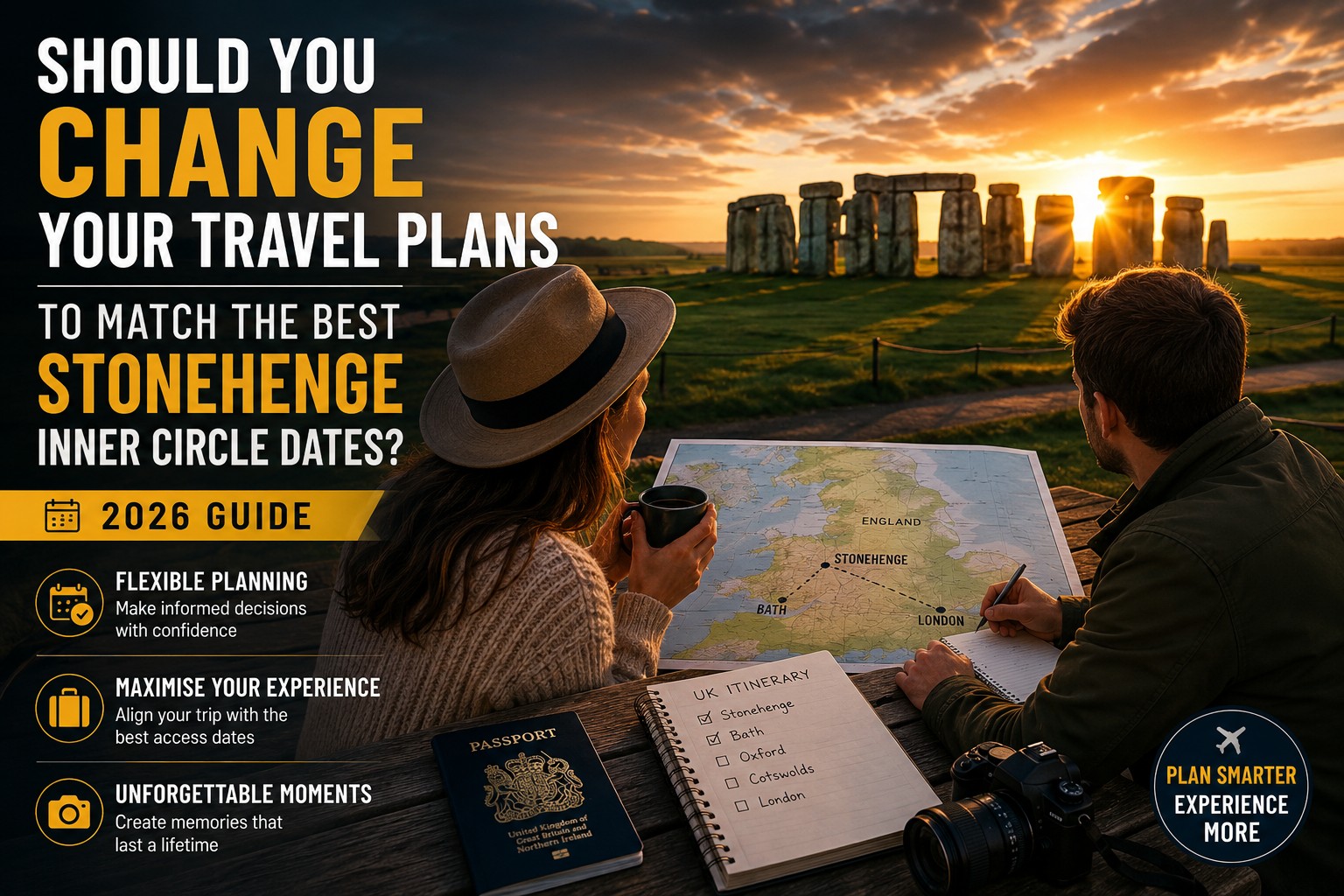
Sometimes adjusting your itinerary by just a day or two can make planning a Stonehenge Inner Circle visit easier, helping create a smoother journey and a more memorable experience
Planning a Stonehenge Inner Circle visit is one of the most exciting stages of organising a trip to southern England. Standing within the ancient stone circle during an exclusive sunrise or sunset visit is an experience that relatively few people enjoy, and for many travellers it becomes the highlight of an entire holiday.
Most visitors leave with unforgettable memories.
The difference between a relaxed, rewarding visit and a stressful one, however, is often decided long before you arrive.
Fortunately, the mistakes that can affect an Inner Circle visit are rarely major. They are usually small planning decisions that seem perfectly reasonable at the time but can make organising the rest of your trip unnecessarily difficult.
Many first-time visitors naturally assume that planning an Inner Circle experience is much the same as booking any other attraction. In reality, because access is limited to selected dates and carefully managed visitor numbers, a little extra planning can make an enormous difference.
The good news is that avoiding these pitfalls is straightforward once you know what to look for.
This guide brings together the practical lessons experienced Stonehenge visitors often discover over time, helping you make informed decisions before you confirm your itinerary. Whether you’re travelling from elsewhere in Britain or planning a once-in-a-lifetime holiday from overseas, these simple planning principles can help you enjoy a smoother, more flexible and ultimately more memorable experience.
✅ How Can You Avoid the Most Common Stonehenge Inner Circle Planning Mistakes?
Most Stonehenge Inner Circle planning mistakes are easy to avoid once you understand the order in which to make your decisions. Rather than building your entire holiday first, begin by exploring available Inner Circle dates, compare several suitable options, understand the difference between sunrise and sunset experiences, allow realistic travel time and use the Stonehenge Inner Circle Access Calendar as a planning tool—not simply an availability checker.
- 📅 Check available Inner Circle dates before fixing the rest of your itinerary.
- 🔄 Keep two or three suitable dates in mind rather than relying on one preferred option.
- 🌅 Choose between sunrise and sunset based on the experience you want—not assumptions.
- 🚆 Allow realistic travel time and avoid overloading the day.
- 🗓️ Use the Stonehenge Inner Circle Access Calendar to compare options and build your itinerary with confidence.
Follow these simple principles and you’ll greatly increase the chances of enjoying a relaxed, flexible and memorable Stonehenge Inner Circle experience.
📌 Common Stonehenge Inner Circle Planning Mistakes
Before exploring each topic in detail, here are the planning mistakes that most commonly catch out first-time visitors:
- Waiting too long before exploring available dates.
- Building an entire holiday before choosing an Inner Circle date.
- Assuming sunrise and sunset offer the same experience.
- Planning around just one preferred date.
- Underestimating travel logistics.
- Expecting Inner Circle access to feel like a standard Stonehenge visit.
- Focusing entirely on photography.
- Not making full use of the Stonehenge Inner Circle Access Calendar.
Fortunately, every one of these is easy to avoid with a little preparation.
🤔 Why Good Stonehenge Trips Usually Begin with Good Planning
One of the biggest misconceptions about Stonehenge Inner Circle access is that careful planning somehow removes the spontaneity from a trip.
In reality, the opposite is usually true.
Thoughtful planning creates freedom.
When the important decisions have already been considered, you spend far less time worrying about logistics and far more time enjoying the experience itself.
Unlike a standard visit to Stonehenge, Inner Circle access takes place on carefully managed dates with either sunrise or sunset entry. Because visitor numbers are limited, your chosen session often becomes the anchor around which the rest of your itinerary naturally develops.
Experienced planners rarely begin with hotels.
They rarely begin with transport.
Instead, they begin by understanding the opportunities available to them before building everything else around those choices.
This doesn’t mean creating a rigid timetable.
It means making one or two smart decisions early so every decision afterwards becomes easier.
That small shift in thinking is often what separates a relaxed Stonehenge visit from one that feels rushed or unnecessarily complicated.
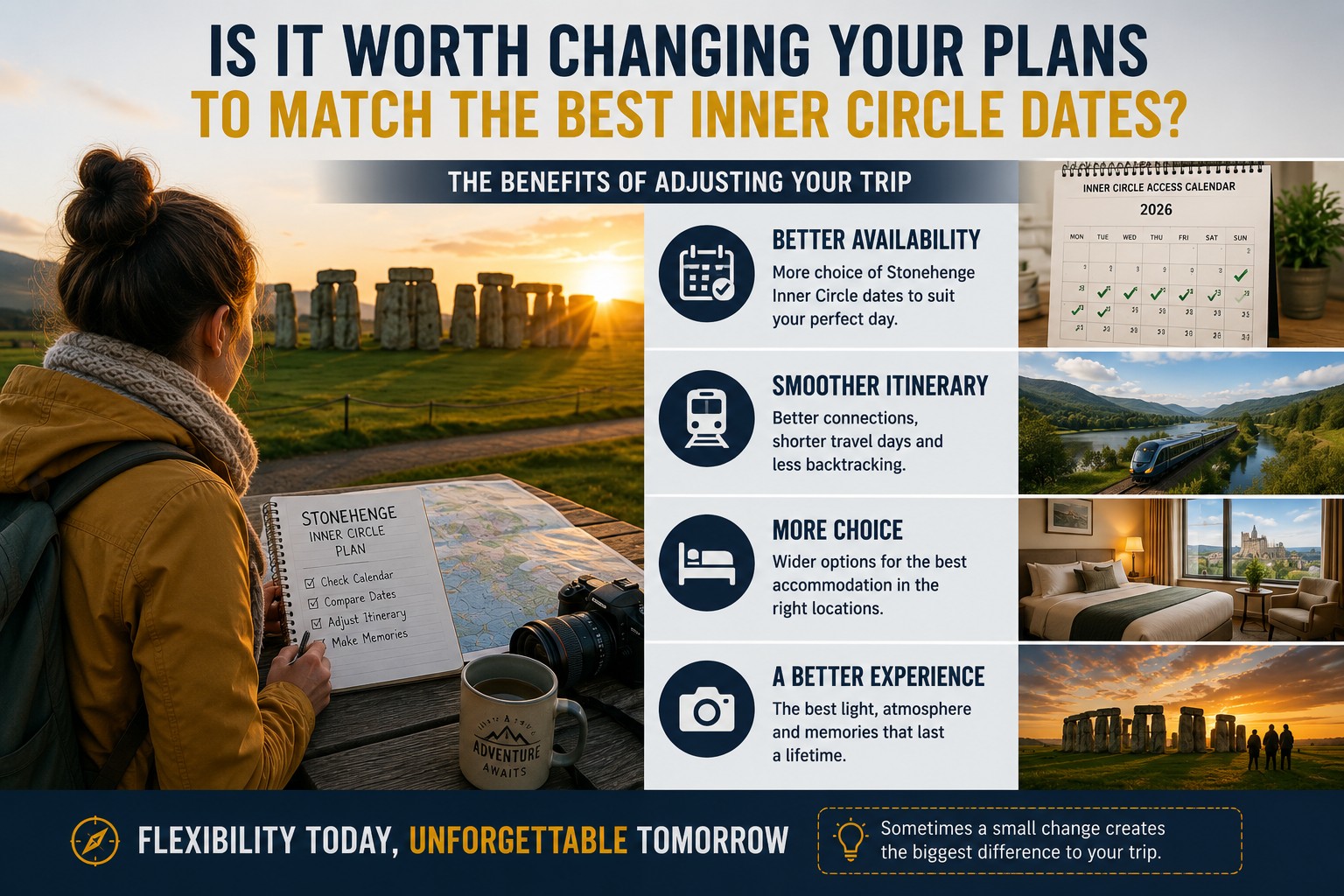
Adjusting your itinerary by just a day or two can sometimes unlock better availability, simpler travel arrangements and a more enjoyable Stonehenge Inner Circle experience
💡 Why Visitors Make Planning Mistakes
The word “mistake” can sound dramatic, but in reality most planning issues develop from perfectly understandable assumptions.
Imagine you’re organising a two-week holiday around England.
You’ve found flights at a good price, reserved hotels in London and Bath, planned a day in Oxford and perhaps even booked afternoon tea somewhere special.
Only afterwards do you begin looking at Stonehenge Inner Circle dates.
Suddenly, your preferred date doesn’t fit comfortably within the itinerary you’ve already created.
Nothing has gone wrong.
You simply planned in the order that most people naturally would.
Many visitors find themselves in similar situations because they’re coordinating flights, accommodation, annual leave, family commitments and transport all at the same time. When so many moving parts are involved, it’s easy to overlook one detail that later affects the entire journey.
Fortunately, almost every one of these situations can be avoided with a small change in planning sequence rather than a complete change of plans.
Experienced planners don’t necessarily spend more time organising their trips.
They simply organise the important decisions in a slightly different order.
📅 Mistake 1: Waiting Too Long Before Exploring Available Dates
One of the easiest planning mistakes to make is believing there’s no point looking at available dates until you’re completely ready to book.
In practice, there are three separate stages that are worth thinking about independently:
- Research – understanding how Inner Circle access works.
- Monitoring – exploring available dates and recognising seasonal patterns.
- Booking – committing once your wider plans are ready.
Many people accidentally combine all three into one decision.
Experienced planners usually separate them.
Researching and monitoring dates months in advance doesn’t commit you to anything. Instead, it gives you valuable information that helps shape every other decision you make later.
For example, you might discover that several suitable dates fall comfortably within your travel window. You may also realise that choosing a session only a few days earlier or later creates better accommodation choices, simpler transport connections or a more relaxed overall itinerary.
That knowledge is valuable long before you’re ready to confirm a booking.
Early research is particularly useful if Stonehenge is only one part of a wider holiday including destinations such as Bath, Windsor, Salisbury or Oxford. Knowing your options before making fixed commitments elsewhere gives you much greater flexibility if plans change.
Think of it this way.
Research creates understanding.
Monitoring creates options.
Booking simply confirms the decision you’ve already made with confidence.
That sequence removes much of the pressure that first-time visitors sometimes experience.
📅 Research First. Monitor Second. Book Last.
One of the biggest misconceptions about Stonehenge Inner Circle planning is believing you need to be ready to book before looking at available dates. In reality, experienced planners separate the process into three simple stages, allowing them to make informed decisions without feeling rushed.
A smarter planning sequence:
🔍 Research – Learn how Inner Circle access works.
👀 Monitor – Compare available dates and identify suitable options.
✅ Book – Confirm your preferred date once your wider plans are ready.
Following this simple sequence keeps your options open, makes it easier to build the rest of your itinerary and greatly reduces the risk of needing to rearrange hotels, transport or sightseeing plans later.
🧭 Mistake 2: Building Your Holiday Before Choosing Your Inner Circle Date
This is perhaps the planning mistake experienced visitors mention most often.
It’s completely understandable why it happens.
Most people naturally begin by arranging flights, reserving accommodation and deciding which destinations they want to visit. Stonehenge is then fitted into the remaining space in the itinerary.
For a standard attraction, that approach often works perfectly well.
Inner Circle access is slightly different because available dates are limited.
A more effective approach is to let your travel window guide the process rather than trying to force the experience into an itinerary that’s already fixed.
Experienced planners often follow a simple sequence:
Travel Window → Compare Available Dates → Shortlist the Best Options → Confirm Your Inner Circle Visit → Build Everything Else Around It
Notice what isn’t included.
There is no rush to book hotels first.
No pressure to commit to transport immediately.
No assumption that your first preferred date will automatically be the best choice.
Imagine two visitors planning almost identical holidays.
The first books flights, hotels and attractions before checking Inner Circle availability. When their preferred date proves unsuitable, several other reservations become awkward or expensive to change.
The second begins by comparing available Inner Circle dates within the same travel window. Once the best option is confirmed, accommodation, transport and sightseeing naturally fall into place around it.
Both visitors reach Stonehenge.
Only one arrives feeling that the journey has been working with them rather than against them.
This planning philosophy doesn’t reduce flexibility. It creates it.
⚓ Anchor → 🧳 Build → ✨ Enjoy
A successful Stonehenge Inner Circle itinerary becomes much easier when you make the important decisions in the right order. Use your confirmed Inner Circle date as the anchor, build the rest of your holiday around it and leave yourself enough space to enjoy the experience without unnecessary pressure.
Anchor
Compare suitable options and confirm the Stonehenge Inner Circle date that works best within your travel window.
Build
Arrange accommodation, transport, meals and sightseeing around the confirmed date rather than trying to fit it into a fixed itinerary later.
Enjoy
Arrive with realistic timings, fewer logistical concerns and the freedom to appreciate the experience rather than watching the clock.
The principle is simple: anchor the trip around the least flexible experience, build the flexible arrangements around it and then enjoy the day with confidence.
🌅 Mistake 3: Choosing Sunrise or Sunset Without Understanding the Experience
One of the first decisions visitors make is whether to choose sunrise or sunset access.
The mistake isn’t selecting one instead of the other.
The mistake is assuming they’re essentially interchangeable.
Both experiences allow visitors inside the ancient stone circle, yet they create noticeably different moods, rhythms and practical considerations.
Sunrise visits often appeal to travellers who enjoy quiet mornings, soft early light and the feeling of watching the surrounding landscape gradually awaken. Sunset sessions provide a completely different atmosphere, with warmer evening colours and the sense of concluding the day in one of Britain’s most remarkable prehistoric settings.
Neither experience is objectively better.
Neither guarantees better weather.
Neither promises better photographs.
Instead, each offers a different way to experience Stonehenge.
The decision should therefore reflect the type of visit you hope to enjoy rather than assumptions about which option is considered “best.”
Weather, cloud cover and seasonal conditions all influence the atmosphere, often in unexpected ways. Some visitors remember mist drifting across the landscape at sunrise. Others recall dramatic evening skies or changing light during sunset. These moments cannot be planned, but choosing the experience that best matches your travel style gives you the greatest opportunity to enjoy whatever nature provides.
| Consideration | Sunrise | Sunset |
|---|---|---|
| Overall atmosphere | Calm and quietly anticipatory | Relaxed and reflective |
| Natural light | Soft early morning tones | Rich evening colours |
| Practical timing | Earlier start | Later finish |
| Photography | Crisp morning light when conditions allow | Warm evening light when conditions allow |
| Best suited to | Early risers seeking tranquillity | Visitors preferring a gentler pace |
🌅 Compare the Experience Before You Choose
Sunrise and sunset Inner Circle visits both provide access inside the ancient stone circle, but they create very different rhythms, atmospheres and practical considerations. The best choice is the one that most closely matches the experience you want and the way you prefer to travel.
Sunrise Inner Circle
Atmosphere: Calm, quiet and anticipatory as the surrounding landscape begins to awaken.
Timing: Requires a very early start and careful planning around transport and accommodation.
Light: Soft morning tones, changing quickly as daylight develops.
Practical implications: Often works best when staying nearby or allowing a quiet evening beforehand.
Best suited to: Early risers, photographers and visitors seeking tranquillity.
Sunset Inner Circle
Atmosphere: Reflective, relaxed and often more atmospheric as the day draws to a close.
Timing: Allows a gentler start but may create a later finish and affect onward travel.
Light: Warmer evening colours when conditions allow, with changing tones across the landscape.
Practical implications: Works well for visitors who prefer a slower day but requires planning for the journey afterwards.
Best suited to: Visitors seeking a gentler pace, evening atmosphere and a reflective end to the day.
Remember: neither option guarantees better weather, clearer skies or stronger photographs. Choose according to your preferred pace, travel arrangements and the type of atmosphere you would most enjoy.
🔄 Mistake 4: Planning Around Only One Preferred Date
It’s completely natural to have a particular date in mind.
Perhaps it fits perfectly with your annual leave, coincides with another part of your holiday or simply feels like the ideal time to visit.
The difficulty arises when that single date becomes the only acceptable option.
Psychologists often describe this as anchoring—placing so much importance on one choice that alternative options receive very little consideration, even when they may be equally suitable.
Many first-time visitors do exactly this without realising it.
They identify one ideal date, build the rest of the itinerary around it and only later discover that a date a few days earlier or later would have created a smoother journey with less travel pressure and more accommodation choices.
Experienced planners usually take a different approach.
Instead of asking:
“What’s the perfect date?”
they ask:
“Which dates would all work well?”
That simple shift in thinking creates flexibility rather than disappointment.
A useful planning strategy is to identify:
- Your first-choice date – the ideal option if everything aligns.
- A second-choice date – almost as suitable with only minor adjustments.
- A third workable option – still capable of delivering an excellent experience.
Having several realistic possibilities doesn’t mean lowering your expectations.
It means giving yourself room to make smarter decisions if circumstances change.
This flexibility becomes especially valuable when coordinating flights, accommodation or longer touring holidays, where moving your Stonehenge visit by only a day or two may produce a much more comfortable overall itinerary.
Confident planners rarely rely on a single solution.
They create several good ones.
🔄 Choose Three Dates, Not Just One
A strong Stonehenge Inner Circle plan should not depend on one perfect date. Shortlisting three realistic options gives you room to compare transport, accommodation and the wider itinerary before making a final decision.
First Choice
The date that fits your travel window, preferred experience and wider holiday plans most comfortably.
Strong Alternative
A nearby date that would still work very well with only minor adjustments to the rest of your itinerary.
Workable Backup
A fully practical option that still delivers an excellent experience if your preferred dates are unavailable.
Flexibility is not compromise. It is a simple form of risk reduction that protects your itinerary, gives you more options and makes the entire planning process easier.
🚆 Mistake 5: Underestimating the Journey
One of the easiest planning mistakes has very little to do with Stonehenge itself.
It’s underestimating how the journey fits into the overall experience.
Many visitors naturally focus on the time they will spend inside the ancient stone circle, yet the quality of the day often depends just as much on everything that happens before and afterwards.
For example, sunrise access usually begins much earlier than many people initially imagine. Sunset sessions naturally finish later in the evening. Neither option is difficult to manage when planned well, but each deserves careful consideration when organising accommodation, transport and onward travel.
After a long-haul flight, it can be tempting to fill every day with activities to make the most of your holiday. In reality, leaving a little breathing space often leads to a much more enjoyable experience. Recovering from travel, adjusting to time differences and avoiding overly ambitious schedules allows you to appreciate the visit rather than simply rushing through it.
Many visitors also underestimate driving times or assume they can comfortably combine Stonehenge with several other major attractions in a single day. While some itineraries make this possible, trying to do too much often means spending more time watching the clock than enjoying one of Britain’s most remarkable prehistoric sites.
Before confirming your plans, ask yourself a few simple questions:
- Have I allowed realistic travel time?
- Will I need an early start or a late finish?
- Would staying nearby make the day more enjoyable?
- Have I left enough flexibility if travel takes longer than expected?
- Am I trying to fit too much into one day?
Experienced planners understand that the journey is part of the experience.
Removing unnecessary time pressure allows anticipation to replace anxiety, making the entire day feel more relaxed from beginning to end.
💡 Give Yourself Breathing Space
One of the simplest ways to improve your Stonehenge Inner Circle experience is to avoid scheduling a major onward journey immediately after an early sunrise visit or a late sunset session. Leaving yourself a little breathing space makes unexpected delays easier to manage and allows you to enjoy the experience without constantly watching the clock.
🚆 Have You Planned the Whole Journey?
Stonehenge Inner Circle access is only one part of the day. Before confirming your plans, work through this quick checklist to make sure the journey is as enjoyable as the experience itself.
✔ Before You Book
☐ Have I allowed realistic journey times?
☐ Am I prepared for an early start or a late finish?
☐ Would nearby accommodation make the day easier?
☐ Do I know what I’m doing with luggage during the trip?
☐ Have I planned meals, refreshments and comfort breaks?
☐ If I’m travelling internationally, have I allowed time to recover from a long-haul flight?
☐ Have I included buffer time for unexpected delays?
☐ Have I checked the weather and packed accordingly?
☐ Do I have a clear plan for my onward journey after the visit?
Remember: the most memorable Stonehenge Inner Circle visits are rarely the most tightly scheduled. Building realistic travel time into your day gives you flexibility, reduces stress and lets you focus on the experience rather than the logistics.
🏛️ Mistake 6: Expecting an Ordinary Stonehenge Visit
Many visitors have already experienced Stonehenge during normal opening hours before considering Inner Circle access.
That previous visit can unintentionally shape expectations.
It’s easy to assume that Inner Circle access is simply a “better” version of the standard experience.
In reality, it’s better understood as a different experience.
A standard visit allows visitors to explore the visitor centre, learn about the site’s history and view the monument from the designated pathways.
Inner Circle access offers something else entirely.
Visitor numbers are carefully controlled, entry takes place outside normal public opening hours and the atmosphere is often noticeably quieter. Whether you visit at sunrise or sunset, the reduced numbers create a sense of space that many visitors find every bit as memorable as the opportunity to stand close to the stones themselves.
Because the experience is carefully managed, timings are more structured than during a standard visit. This helps protect both the monument and the quality of the experience for everyone attending.
Approaching the visit with realistic expectations helps you appreciate what makes it unique.
Rather than expecting a faster, upgraded or exclusive version of a standard visit, think of it as a completely different way of experiencing one of the world’s most famous prehistoric monuments.
That small shift in mindset often transforms the experience itself.
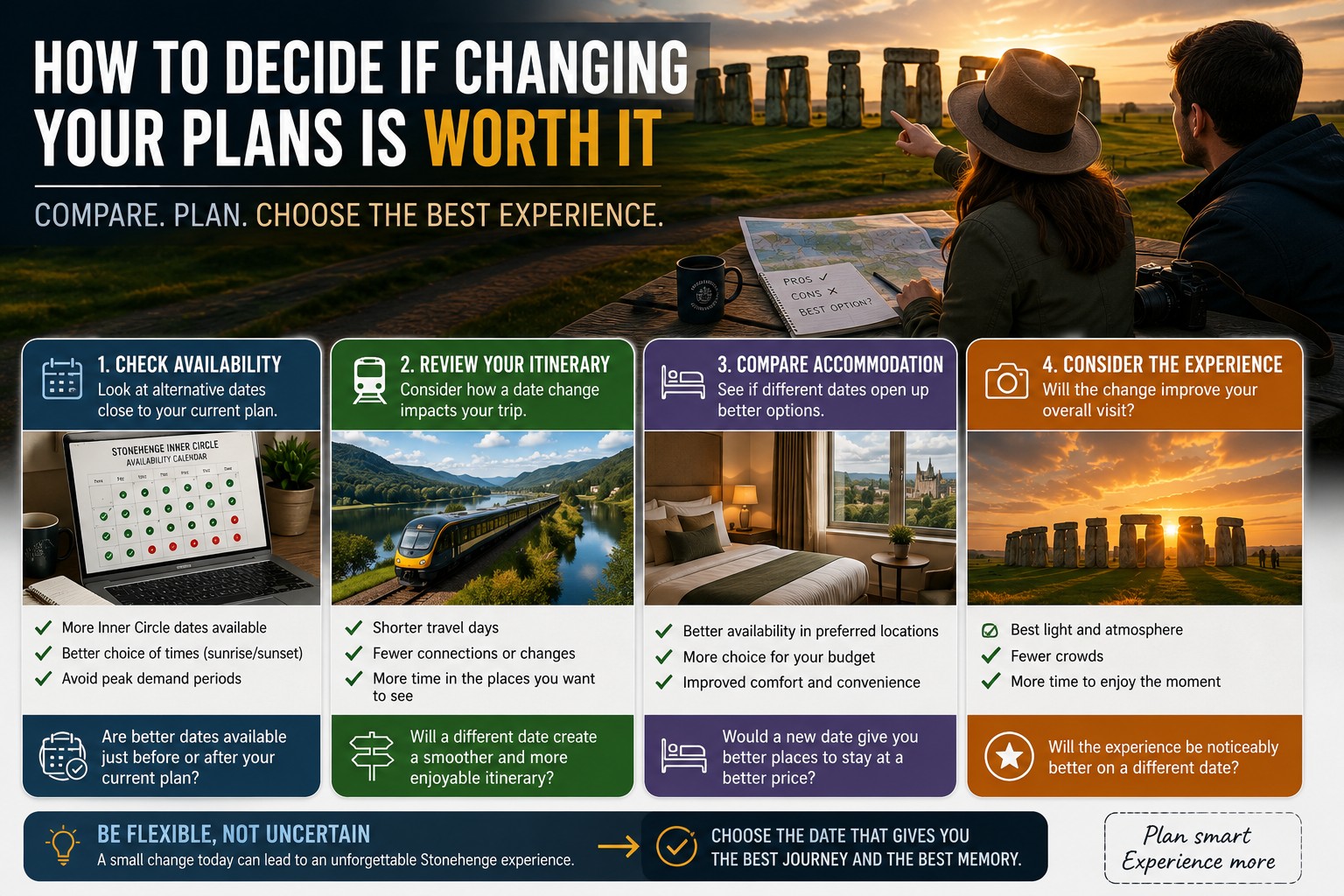
Changing your travel dates isn’t always the right choice. This practical decision framework helps you compare availability, itinerary flexibility, accommodation and the overall experience before making any changes
📷 Mistake 7: Planning Only Around Photography
Stonehenge has inspired artists, photographers and travellers for generations, so it’s perfectly understandable that many visitors think about photographs while planning their trip.
The mistake isn’t wanting memorable pictures.
The mistake is allowing photography to become the only reason for choosing a particular date or experience.
Some of the most treasured memories from an Inner Circle visit never appear in a photograph.
The quiet before sunrise.
The changing colours across the Salisbury Plain.
The first glimpse of the ancient stones as you approach.
The conversations shared afterwards.
The feeling of standing among a monument that has fascinated people for thousands of years.
These are often the moments visitors describe most vividly long after they’ve returned home.
Weather also deserves a balanced perspective.
Many people imagine clear blue skies as the ideal backdrop, yet some of the most atmospheric visits take place beneath dramatic cloud formations, soft morning mist or colourful evening light. No photograph can fully capture the atmosphere created by those changing conditions.
Instead of planning solely around the image you hope to take home, plan around the experience you hope to remember.
Ironically, when you’re fully present in the moment, the best photographs often happen naturally.
🌿 Some of the Best Moments Can’t Be Captured
Photographs help preserve memories, but they are only one part of the Stonehenge Inner Circle experience. Many visitors later remember the atmosphere, the silence and the feeling of standing among the ancient stones far more vividly than any individual image they captured.
The moments visitors often remember most:
🌅 The changing light across the stones.
🤫 The unexpected quiet before or after the crowds.
🌿 The surrounding landscape and open skies.
❤️ The emotional connection with one of Britain’s most remarkable prehistoric monuments.
👨👩👧 Sharing the experience with family or friends instead of viewing everything through a camera lens.
A simple idea to remember: take the photographs you want, then put the camera away for a few minutes. Some of the most meaningful memories are created when you simply pause, look around and experience Stonehenge as it is.
🗓️ Mistake 8: Not Making Full Use of the Stonehenge Inner Circle Access Calendar
One of the most useful planning resources available to anyone considering an Inner Circle visit is the Stonehenge Inner Circle Access Calendar.
Yet many visitors only use it for a few seconds.
They check whether a single preferred date is available and then move on to booking the rest of their trip.
Experienced planners tend to use the calendar very differently.
Rather than treating it as a simple availability checker, they use it as the foundation for planning their entire itinerary.
A good planning process often follows four straightforward steps:
🔍 Compare
Start by exploring the range of available dates rather than focusing immediately on one specific day. Looking across several weeks or months gives you a much better understanding of your options.
📋 Shortlist
Identify two or three dates that would all work comfortably within your travel window.
Don’t think only about your ideal day.
Think about your ideal experience.
🧳 Plan
Once you’ve shortlisted suitable dates, begin considering accommodation, transport and any other destinations you hope to include during your holiday.
At this stage you’ll often discover that one option naturally produces a smoother itinerary than the others.
✅ Confirm
Only once you’re comfortable that everything works together should you finalise the booking and complete the rest of your travel arrangements.
This planning sequence removes much of the uncertainty that first-time visitors often experience.
It also makes changing plans far easier should circumstances alter before your trip.
Perhaps more importantly, using the calendar in this way encourages thoughtful decision-making rather than rushed decision-making.
Instead of asking:
“Is my preferred date available?”
you begin asking:
“Which available date gives me the best overall holiday?”
That small change in thinking often leads to a much more enjoyable Stonehenge experience.
🗓️ Think of the Calendar as a Planning Tool, Not Just an Availability Checker
Many visitors make the mistake of using the Stonehenge Inner Circle Access Calendar simply to see whether a particular date is available. While availability is important, the real value of the calendar is that it helps you compare options, identify workable alternatives and build your entire itinerary in the right order.
Instead of searching for one perfect date, use the calendar to explore several possibilities, understand the timing of sunrise and sunset experiences and choose the option that works best for your wider travel plans.
Use the calendar to:
✔ Compare several available dates.
✔ Shortlist the options that suit your travel window.
✔ Understand whether sunrise or sunset better fits your plans.
✔ Build accommodation, transport and sightseeing around your chosen date.
✔ Make informed decisions with greater confidence.
📅 Ready to Start Planning Your Stonehenge Inner Circle Visit?
Now that you know how to plan effectively, the next step is to explore the available Stonehenge Inner Circle dates. Rather than focusing on a single day, compare several suitable options and choose the one that fits your wider itinerary, travel style and preferred experience.
The official planning calendar helps you identify available sunrise and sunset sessions, compare alternatives and begin building your itinerary with confidence before making any final bookings.
Compare available dates, shortlist your best options and build your itinerary before confirming your plans.
📋 A Simple Planning Checklist Before You Book
Before confirming your Stonehenge Inner Circle experience, it’s worth spending just a few minutes reviewing your plans one final time.
Think of this as a confidence check rather than a list of tasks.
If you’ve worked through most of these points already, you’re well on your way to creating a relaxed and enjoyable visit.
| Planning Check | Why It Matters | ✓ |
|---|---|---|
| Explored several possible dates | Gives flexibility if plans change | ✓ |
| Compared sunrise and sunset experiences | Helps match the visit to your preferences | ✓ |
| Built your itinerary around the confirmed date | Reduces unnecessary changes later | ✓ |
| Allowed realistic travel time | Makes the day less stressful | ✓ |
| Considered accommodation and transport together | Creates a smoother overall journey | ✓ |
| Used the Stonehenge Inner Circle Access Calendar properly | Improves planning decisions | ✓ |
| Left flexibility where possible | Makes adapting much easier | ✓ |
| Planned time to enjoy the wider experience | Creates a more memorable visit | ✓ |
Experienced planners aren’t necessarily more organised.
They simply ask themselves the right questions before confirming their bookings.
🌱 Thoughtful Planning Can Also Support More Sustainable Travel
Good planning doesn’t only benefit your own trip.
It can also encourage more responsible and sustainable travel.
By organising your itinerary carefully, you’re less likely to make unnecessary journeys, double back between destinations or make last-minute transport decisions that increase both costs and travel time. Efficient planning often allows visitors to spend longer enjoying each destination instead of rushing between them.
Stonehenge also sits within one of Britain’s most significant prehistoric landscapes. Respecting the wider World Heritage Site means recognising that the experience extends beyond the stones themselves. Walking thoughtfully, following site guidance and appreciating the surrounding landscape all help preserve this remarkable place for future generations.
Thoughtful travel also benefits local communities. Spending time in nearby towns, supporting independent cafés, restaurants and accommodation providers, and allowing space within your itinerary to explore Wiltshire beyond Stonehenge contributes to a richer visitor experience while supporting the local economy.
In many ways, the same planning decisions that create a calmer holiday also encourage more sustainable tourism.
Travelling with purpose.
Exploring with care.
Those simple principles help ensure that future generations can enjoy Stonehenge just as we do today.
🌱 Thoughtful Planning Can Support More Responsible Travel
Good itinerary planning does more than make a Stonehenge visit easier. By arranging accommodation, transport and sightseeing in a sensible order, visitors can reduce unnecessary journeys, make better use of shared transport and spend more meaningful time in the places they have travelled to experience.
More thoughtful planning can help you:
🌍 Reduce avoidable or repeated journeys.
🚆 Make more considered use of public and shared transport.
🏡 Stay longer rather than rushing between destinations.
🤝 Support local accommodation, businesses and communities.
🌿 Explore Stonehenge while respecting its wider historic landscape.
Responsible travel is not about making every journey perfect. It is about making informed choices that protect the places we visit, benefit local communities and create a more rewarding experience for travellers.
❓ Stonehenge Inner Circle Planning Mistakes: Frequently Asked Questions
❓ What is the biggest planning mistake first-time visitors make?
The most common mistake is fixing flights, hotels and a detailed itinerary before checking available Inner Circle dates. Starting with your travel window and then comparing available dates usually creates a much smoother planning process.
❓ Should I choose my holiday dates before checking the Stonehenge Inner Circle Access Calendar?
If possible, begin by checking the Stonehenge Inner Circle Access Calendar early in your planning. Even if you’re not ready to book immediately, understanding your available options makes it much easier to organise the rest of your holiday.
❓ How many possible Inner Circle dates should I consider?
Having two or three realistic options is usually a sensible approach. If your preferred date isn’t available, you’ll already have practical alternatives without needing to redesign your entire itinerary.
❓ Should I book accommodation before choosing my Inner Circle date?
In most cases, it’s better to identify your preferred Inner Circle date first and then arrange accommodation around it. This reduces the likelihood of needing to make costly or inconvenient changes later.
❓ Is sunrise always better than sunset?
No. Both experiences offer exclusive access inside the stone circle, but each creates a different atmosphere. Sunrise appeals to visitors who enjoy peaceful early mornings, while sunset often suits those who prefer a gentler pace later in the day.
❓ Can the weather affect my planning?
Weather can influence the atmosphere of your visit, but it shouldn’t determine your planning strategy. Conditions change throughout the year and neither sunrise nor sunset guarantees clearer skies or better photographs.
❓ What should I do if my preferred date isn’t available?
Don’t assume you’ve missed your opportunity. Compare nearby dates, consider other suitable options within your travel window and use the calendar to identify alternatives that may fit your itinerary just as well.
❓ How does the Stonehenge Inner Circle Access Calendar help?
The calendar allows you to compare available dates, identify seasonal patterns and make informed planning decisions before confirming accommodation, transport and the rest of your itinerary.
❓ Can organised tours make planning easier?
For many visitors, particularly those travelling from overseas or visiting Stonehenge for the first time, organised tours simplify transport, timings and logistics, allowing them to focus on enjoying the experience rather than coordinating every detail themselves.
❓ Is it worth leaving flexibility in my itinerary?
Absolutely. A small amount of flexibility often creates a much more relaxed holiday, making it easier to adapt if travel plans, accommodation or preferred dates need to change.
🧭 Ready to Plan the Rest of Your Stonehenge Inner Circle Visit?
Now that you know how to avoid the most common planning mistakes, these guides will help you complete the rest of your Stonehenge Inner Circle itinerary with confidence.
Check Your Planning
Use our complete planning checklist to make sure you’ve covered every important step before confirming your visit.
Build Your Itinerary
Discover how to organise accommodation, transport and sightseeing around your confirmed Inner Circle date.
Need a Backup Plan?
Find out what to do if your preferred Stonehenge Inner Circle date isn’t available and how to choose an excellent alternative.
📅 Put Your Planning Into Action
You’ve now seen the most common planning mistakes and how to avoid them. The next step is simply to compare available Stonehenge Inner Circle dates and identify the options that work best for your itinerary.
Rather than searching for one perfect date, use the calendar to shortlist several suitable choices before confirming accommodation, transport and the rest of your travel plans.
Compare available dates, build your itinerary with confidence and choose the option that’s right for your trip.
🎯 Final Thoughts: Good Planning Creates Better Memories
Planning a Stonehenge Inner Circle visit doesn’t have to be complicated.
In fact, the best-planned visits rarely feel over-planned at all.
They simply feel effortless.
By understanding how Inner Circle access differs from a standard visit, exploring your options early, remaining flexible where possible and using the Stonehenge Inner Circle Access Calendar as the starting point for your decisions, you give yourself every opportunity to enjoy a smoother and more rewarding experience.
Experienced planners don’t necessarily spend longer organising their trips.
They simply make the important decisions in the right order.
That small difference often transforms the entire journey.
Instead of worrying about logistics, you’ll have the freedom to appreciate what you’ve travelled to see—one of the world’s most remarkable prehistoric monuments, experienced in a way that relatively few visitors ever enjoy.
Long after the planning is forgotten, the memories remain.
Make those memories the reason you remember your Stonehenge Inner Circle visit—not the avoidable planning mistakes along the way.
🏛️ Ready to Choose Your Stonehenge Inner Circle Experience?
Once you’ve shortlisted the dates that work best for your trip, the next step is choosing the Stonehenge Inner Circle tour that best matches your travel plans. Different tours offer different departure points, itineraries and visitor experiences, so it’s worth comparing the available options before making your final decision.
Whether you’re looking for a sunrise or sunset visit, travelling from London or planning a wider sightseeing day, exploring the available tours will help you find the experience that’s right for you.
Compare available tours, departure options and itineraries to choose the Inner Circle experience that’s right for your visit.
🚌 Would Another Stonehenge Tour Suit Your Plans Better?
Stonehenge Inner Circle access is a remarkable experience, but its limited dates and early-morning or evening timings will not suit every itinerary. A standard Stonehenge visit may provide greater flexibility while still allowing you to explore the monument, visitor centre and surrounding historic landscape.
Explore the wider range of Stonehenge tours to compare day trips, combination itineraries, private experiences, small-group options and longer tours. This can be especially useful when Inner Circle availability does not match your travel dates or when you want to include Stonehenge within a broader sightseeing itinerary.
A wider Stonehenge tour may suit you better if:
✔ Inner Circle dates do not fit your holiday.
✔ You prefer a more convenient daytime visit.
✔ You want to combine Stonehenge with other destinations.
✔ A private or small-group experience better matches your travel style.
✔ You are planning a longer or multi-day tour.
Compare Stonehenge tour formats, itineraries and travel options to find the visit that works best for your holiday.