


Stonehenge Inner Circle Sunrise Throughout the Year: How to Build the Perfect Stonehenge Itinerary Around Your Inner Circle Date (2026 Guide)
23rd July 2026
🏛️ Stonehenge Inner Circle Sunrise Throughout the Year: How to Build the Perfect Stonehenge Itinerary Around Your Inner Circle Date (2026 Guide)

The best Stonehenge itinerary starts with your confirmed Inner Circle access time. Once that fixed point is secured, every other part of your journey can be planned to create a smoother, more enjoyable and less stressful experience
Standing inside Stonehenge during an exclusive Inner Circle visit is one of Britain’s most remarkable travel experiences. Yet while many visitors spend weeks deciding which date to book, surprisingly few spend the same amount of time considering how that date should shape the rest of their journey.
That’s a missed opportunity.
Whether you’ve secured sunrise or sunset access, your allocated entry time is the least flexible part of your trip. Everything else—where you stay, when you travel, what you visit and even where you stop for lunch—can usually be adjusted.
Experienced travel planners understand an important principle.
They don’t fit Stonehenge into an itinerary. They build the itinerary around Stonehenge.
It’s a simple shift in thinking, but one that transforms the entire experience.
Instead of rushing between famous landmarks, worrying about traffic or constantly checking the time, you’ll enjoy a journey that feels calmer, better balanced and far more memorable.
Throughout this guide you’ll discover a simple planning framework used by experienced travellers:
💬 Quick Answer
The best Stonehenge itinerary begins with your confirmed Inner Circle access time, not your hotel, transport or sightseeing plans.
Once your sunrise or sunset slot is secured, use it as the fixed point around which every other decision is made. By anchoring accommodation, travel, meals and nearby attractions around your exclusive visit, you’ll create a smoother, less stressful and far more rewarding experience.
Put simply:
Don’t build Stonehenge into your itinerary. Build your itinerary around Stonehenge.
🎯 Why Your Inner Circle Date Should Be the Centre of Your Journey
Every successful itinerary starts by identifying the decision that can’t easily be changed.
For Stonehenge Inner Circle visitors, that’s your access time.
Accommodation can usually be moved.
Lunch can happen earlier or later.
Nearby attractions can be swapped around.
Your driving route can often be adjusted.
Your allocated Inner Circle visit, however, is fixed.
That makes it the natural foundation for everything that follows.
Professional travel planners often think in terms of fixed decisions and flexible decisions.
| Fixed Decisions | Flexible Decisions |
|---|---|
| Inner Circle access time | Accommodation location |
| Sunrise or sunset session | Sightseeing order |
| Tour departure time | Meal breaks |
| Confirmed booking date | Travel route |
| Entry requirements | Extra attractions |
Once the fixed decisions are in place, the flexible ones become much easier to organise.
Many travellers instinctively do the opposite. They book hotels, plan sightseeing and map out driving routes before securing their preferred Inner Circle date. When availability changes, the whole itinerary has to be rearranged.
Starting with your confirmed access time avoids that problem entirely.
It also creates something far more valuable than convenience.
It creates confidence.
Instead of wondering whether you’ll arrive in time, you’ll know your day has been designed around the experience that matters most.
That’s why experienced visitors often enjoy a more relaxed trip without necessarily travelling any further or spending any more money.
They simply begin with the right priority.
If you’re still deciding which date to choose, understanding how different dates suit different travel styles can make planning the rest of your itinerary much easier.
🌅 Step One: Anchor Your Day Around Sunrise or Sunset
Every Stonehenge Inner Circle experience is unique, but one choice influences almost every planning decision you’ll make afterwards.
Will you be visiting at sunrise or sunset?
The answer doesn’t just determine the lighting for your photographs.
It shapes the rhythm of your entire day.
Many articles compare sunrise and sunset as though one is objectively better than the other.
That’s rarely the most useful question.
A better question is:
Once you understand how each option naturally influences travel, accommodation and sightseeing, planning becomes much more intuitive.
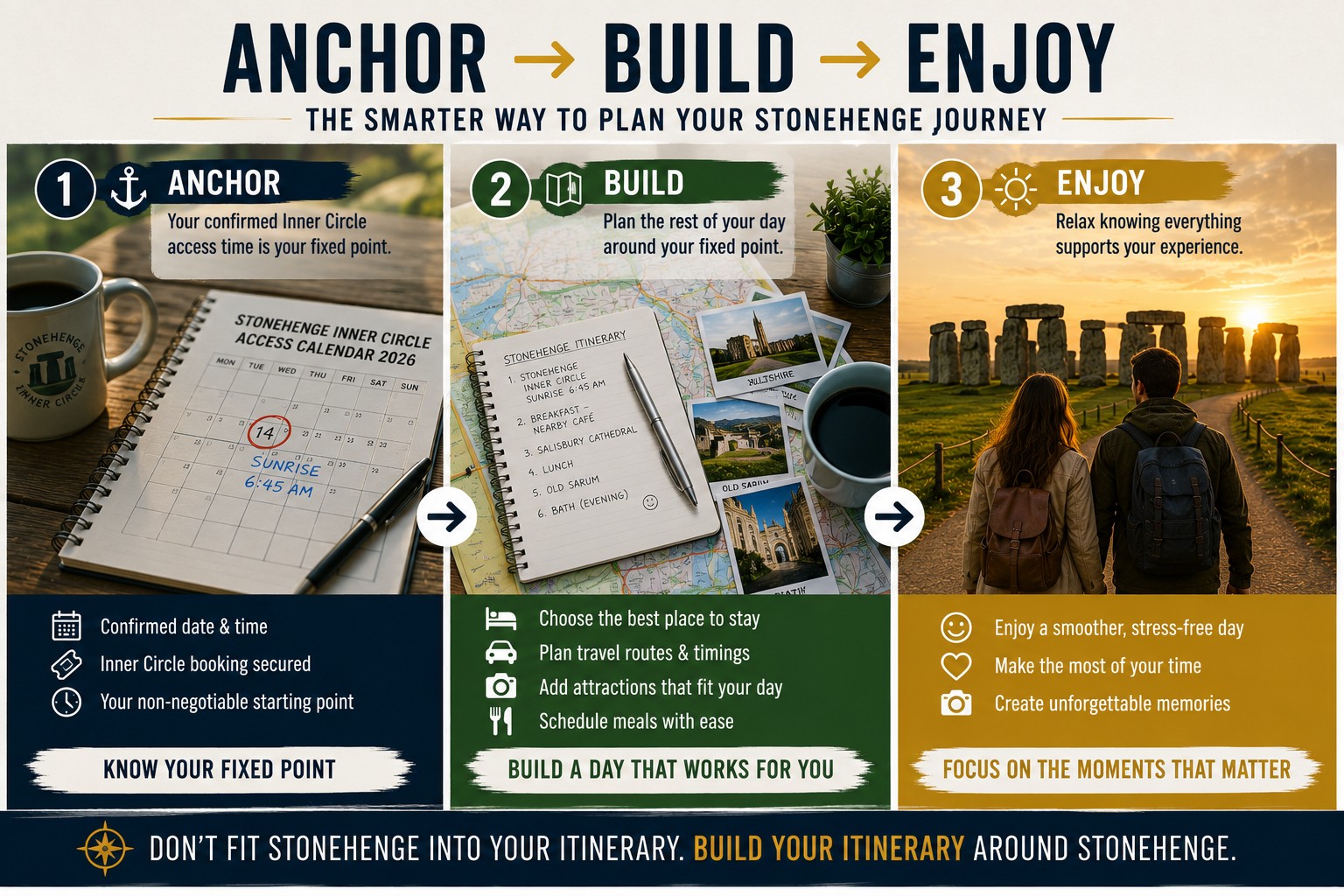
The best Stonehenge itinerary starts with one fixed point—your confirmed Inner Circle access time. Build everything else around it and you’ll enjoy a calmer, more rewarding journey from beginning to end
🌄 Building Around a Sunrise Experience
A sunrise visit asks a little more of you—but it often rewards that preparation with one of the most atmospheric experiences available anywhere in Britain.
The biggest mistake first-time visitors make is treating sunrise like an ordinary early attraction.
It isn’t.
The experience begins long before you reach the stones.
Experienced travellers nearly always remove as many variables as possible by staying close to Stonehenge the evening before. Eliminating a lengthy pre-dawn drive means you arrive feeling rested instead of rushed, allowing the morning to unfold at a much gentler pace.
That small planning decision can completely change how the experience feels.
Rather than worrying about traffic, navigation or the clock, you’re free to focus on why you’ve travelled there in the first place.
As daylight gradually reaches Salisbury Plain and the first rays of sunlight illuminate the ancient stones, you’ll appreciate having given yourself the time and space to enjoy the moment without unnecessary pressure.
Once your visit is complete, the day opens up beautifully.
Instead of racing home, many visitors choose to enjoy breakfast nearby before exploring Salisbury, discovering the Wiltshire countryside or continuing towards destinations such as Bath or the South West.
Interestingly, the quieter pace after sunrise often becomes one of the day’s greatest pleasures.
The highlight has already happened.
Everything afterwards feels like a bonus rather than a deadline.
That’s one reason many experienced visitors describe sunrise not simply as an early start, but as an entirely different way of experiencing the landscape.
Many visitors also find that planning the perfect Stonehenge Inner Circle visit starts long before they arrive on Salisbury Plain, with thoughtful decisions about timing, accommodation and the wider itinerary.
🌇 Building Around a Sunset Experience
A sunset Inner Circle visit creates an entirely different style of day.
Rather than beginning before dawn, your itinerary has time to breathe. The morning becomes an opportunity to travel at a relaxed pace, explore the surrounding area or simply enjoy the journey without constantly watching the clock.
This creates a very different emotional rhythm.
With a sunrise visit, the unforgettable moment comes first.
With a sunset visit, anticipation builds throughout the day until you finally walk through the gates and into the stone circle.
Many visitors find that gradual build-up becomes part of the experience itself.
If you’re travelling from London, you might enjoy a leisurely drive through the countryside, stop for lunch in a market town or spend time exploring Salisbury before heading towards Stonehenge later in the afternoon.
Unlike a tightly packed sightseeing schedule, the day naturally gathers momentum instead of feeling rushed.
As the afternoon light begins to soften, your attention gradually shifts towards the reason you’ve travelled here.
The landscape changes almost hour by hour.
Colours become warmer.
Shadows lengthen across Salisbury Plain.
The atmosphere grows quieter as the day draws to a close.
For photographers, couples and visitors looking for a slower, more reflective experience, this progression often feels every bit as memorable as the time spent inside the stones themselves.
After your visit there’s no need to rush immediately back onto the road.
Many experienced travellers choose to stay locally, enjoy dinner nearby or continue their holiday the following morning. Finishing the day this way allows the experience to settle naturally rather than ending with a long, tiring drive.
Sunset doesn’t simply change the lighting.
It changes the entire character of the journey.
If you’re still weighing up the two experiences, sunrise and sunset create very different styles of visit, with each offering its own advantages depending on how you want your day to unfold.
🔄 Experience-First Planning Beats Destination-First Planning
One of the biggest differences between first-time visitors and experienced travellers isn’t the route they take.
It’s the way they think.
Many people naturally plan like this:
Destination First
- Book accommodation.
- Decide where to have lunch.
- Add sightseeing stops.
- Fit Stonehenge somewhere into the schedule.
Experienced travellers usually reverse the process.
Experience First
- Secure the Inner Circle date.
- Build travel around that fixed point.
- Add accommodation that supports the visit.
- Include only the attractions that comfortably fit around it.
The difference may seem subtle, but the results are significant.
Instead of spending the day trying to protect your schedule from unexpected delays, you’ve designed the schedule to protect the experience itself.
That single change often removes far more stress than shaving a few minutes off a driving route.
It also helps avoid a common trap—trying to recreate someone else’s itinerary.
Every visitor has different priorities, travel distances and interests.
The perfect itinerary isn’t one copied from the internet.
It’s one built around your confirmed access time, your pace and your travel style.
Remember the planning framework introduced earlier:
⚓ Anchor → Build → Enjoy
First, anchor your plans around the experience that can’t move.
Then build everything else around it.
Finally, enjoy the day knowing your itinerary has been designed to support the experience rather than compete with it.
Experienced visitors also understand that choosing the best Stonehenge Inner Circle date is only the beginning—the real value comes from building the entire journey around that decision.
🗺️ Step Two: Build the Rest of Your Day Around the Fixed Point
Once your Inner Circle access time is confirmed, the difficult decisions become surprisingly straightforward.
Instead of wondering where Stonehenge fits into your plans, you’re simply arranging everything else around the day’s fixed anchor.
Professional itinerary planners often talk about creating buffer time.
Buffer time isn’t empty time.
It’s protected time.
It allows for changing traffic conditions, slower journeys, unexpected discoveries and those moments that make travelling enjoyable rather than stressful.
Without buffer time, every minor delay feels like a problem.
With buffer time, most delays simply disappear into the schedule without affecting the overall experience.
This is particularly valuable for an Inner Circle visit where punctual arrival is essential.
One of the simplest ways to improve your day is to stop thinking in terms of squeezing more attractions into the itinerary and start thinking about improving the quality of the experience.
Ask yourself questions such as:
- Will this journey still feel enjoyable after several hours of travelling?
- Am I allowing enough time to arrive feeling relaxed?
- Could one less attraction actually create a better day?
- Would an overnight stay remove unnecessary pressure?
These questions rarely appear on planning checklists, yet they’re often the ones that determine whether a trip feels memorable or exhausting.
Many experienced travellers find that planning your perfect Stonehenge Inner Circle visit becomes much easier once every other decision naturally follows from the confirmed access time.
🚗 Think in Travel Time, Not Distance
A common planning mistake is assuming that destinations close together on a map automatically fit comfortably into the same day.
Stonehenge may appear only a relatively short distance from places such as Bath, Windsor or Salisbury, but travel conditions vary enormously depending on:
- the season
- the time of day
- local traffic
- roadworks
- organised tour movements
- major events in the surrounding area
Experienced travellers therefore plan using travel time rather than simple mileage.
They also recognise that the journey itself is part of the experience.
Stopping at a countryside viewpoint, discovering an independent café or taking an unexpected photograph often becomes just as memorable as arriving at the next destination.
An itinerary filled with constant deadlines rarely leaves room for those moments.
One designed with realistic pacing almost always does.
📊 Sunrise vs Sunset: How Your Planning Changes
| Planning Factor | 🌄 Sunrise Access | 🌇 Sunset Access |
|---|---|---|
| Best accommodation | Stay nearby the previous evening | Stay nearby afterwards if possible |
| Ideal morning | Early departure and exclusive access | Relaxed sightseeing before your visit |
| Ideal afternoon | Explore Salisbury or nearby attractions | Travel gradually towards Stonehenge |
| Evening | Continue your journey or stay locally | Dinner or overnight stay after your visit |
| Stress level | Low when staying nearby | Low with generous afternoon buffer |
| Best suited to | Early risers, photographers, first-time visitors | Couples, relaxed travellers and evening photographers |
Neither approach is inherently better.
Each simply creates a different style of day.
The best choice is the one that matches how you want to experience Stonehenge.
✅ A Simple Planning Checklist
Before finalising your itinerary, ask yourself:
- ✓ Is my Inner Circle access time confirmed?
- ✓ Have I built the day around that fixed point?
- ✓ Am I allowing realistic travel time?
- ✓ Do I have buffer time before arrival?
- ✓ Have I avoided trying to fit too many attractions into one day?
- ✓ Will I arrive feeling excited rather than rushed?
If the answer is “yes” to each question, you’re already thinking like an experienced itinerary planner.
Good planning also starts with checking the Stonehenge Inner Circle calendar before booking, ensuring the rest of your itinerary is built around confirmed availability rather than assumptions.
🚗 Step Three: Match Your Itinerary to the Type of Trip You’re Taking
One of the easiest mistakes to make is assuming there’s a single “perfect” Stonehenge itinerary.
There isn’t.
The ideal itinerary depends entirely on why you’re travelling.
A couple celebrating a special occasion will naturally plan differently from a family on a UK holiday.
A photographer chasing the perfect sunrise will have different priorities from an overseas visitor touring Britain for two weeks.
Rather than trying to copy someone else’s schedule, begin by identifying the type of journey you’re actually taking.
Once you understand that, the rest of the planning becomes much more intuitive.
Experienced visitors also know that the best Stonehenge Inner Circle date isn’t necessarily the same for everyone—it depends on your travel style, priorities and the type of experience you want to create.
🚆 One-Day Trips from London
A one-day visit is by far the most common way to experience Stonehenge Inner Circle Access, and when planned well, it can be exceptional.
The secret isn’t trying to see everything.
It’s accepting that Stonehenge deserves to be the centrepiece of the day.
Many first-time visitors fall into the trap of believing that a successful itinerary must include as many famous places as possible.
The result is often a day spent watching the clock instead of enjoying the journey.
Experienced travellers usually do the opposite.
They deliberately leave room for flexibility.
If you’re travelling for sunrise, consider arriving in the area the previous evening or joining an organised tour that removes much of the logistical planning.
If you’re attending a sunset session, use the day to enjoy one carefully chosen destination before making your way gradually towards Stonehenge.
By removing unnecessary pressure, you’ll remember far more about the experience itself than the roads you drove or the timetable you followed.
If you’re travelling from the capital, planning a Stonehenge day trip from London around your confirmed Inner Circle visit creates a far more relaxed and enjoyable experience.
🏨 Weekend Breaks
If your schedule allows, turning your Stonehenge visit into a weekend break changes the entire pace of the experience.
Instead of rushing to arrive and immediately rushing away again, you can begin to appreciate the wider landscape that surrounds one of Britain’s most famous prehistoric monuments.
Spend an evening exploring Salisbury’s medieval streets.
Enjoy dinner in a traditional pub.
Take time to discover the villages and countryside that many visitors never see because they’re focused solely on reaching Stonehenge.
Then, when your Inner Circle visit arrives, it feels like the natural highlight of a carefully planned weekend rather than a brief stop on a hectic road trip.
This slower approach offers another advantage.
If weather conditions change, traffic is heavier than expected or you simply discover somewhere you’d like to spend longer, you have the flexibility to adapt without affecting the overall enjoyment of the trip.
Sometimes the greatest luxury in travel isn’t visiting more places.
It’s having enough time to enjoy the places you’ve already chosen.
✈️ Longer UK Holidays
For international visitors, Stonehenge is often one chapter in a much larger journey through Britain.
That makes planning even more important.
Instead of creating a route first and then trying to squeeze Stonehenge into it, reverse the process.
Begin with your confirmed Inner Circle date.
Then arrange accommodation and onward travel around that fixed point.
For example, a sunrise experience might naturally lead into a leisurely drive towards Bath or the South West later that morning.
A sunset visit, meanwhile, may work perfectly after spending the day exploring Windsor, Salisbury or another nearby destination.
This approach creates a journey that feels connected rather than fragmented.
Instead of constantly travelling between unrelated attractions, each stage of the trip flows naturally into the next.
Professional tour planners use this principle every day because it reduces unnecessary mileage, improves pacing and creates a far better overall experience.
Travellers exploring more of the country often discover that Stonehenge works particularly well as part of a wider tour of England, rather than as an isolated stop.
⭐ Step Four: Putting the Framework into Practice
The Anchor → Build → Enjoy method isn’t simply a theory.
It works because it reflects the natural rhythm of a successful travel day.
Rather than following rigid timetables, think about how you want the day to feel from beginning to end.
The following examples aren’t intended to be copied exactly.
Instead, they demonstrate the thinking behind a well-designed Stonehenge itinerary.
🌄 Example: A Sunrise Experience
The evening before your visit, you arrive close to Stonehenge ready for your Sunrise Experience and enjoy a relaxed dinner before getting an early night’s sleep. Instead of worrying about a long drive before dawn, you wake knowing you’re only a short distance from one of the most exclusive experiences in Britain.
As daylight slowly appears across Salisbury Plain, you arrive feeling calm rather than hurried. Inside the stone circle, the atmosphere is remarkably peaceful. When your visit finishes, there’s no pressure to race away.
You enjoy breakfast nearby before heading into Salisbury as the city begins to come alive. By arriving slightly later in the morning, you’ll often find yourself exploring at a gentler pace than visitors rushing between attractions. The remainder of the day becomes wonderfully flexible. Perhaps you continue towards Bath. Perhaps you discover a quiet Wiltshire village.
Or perhaps you simply enjoy the countryside before returning home. The experience has already happened. Everything else feels like a bonus.
🌇 Example: A Sunset Experience
The morning begins without urgency. You travel through southern England, stopping wherever your interests take you. Perhaps you spend time in Salisbury Cathedral, browse independent shops or enjoy a leisurely lunch overlooking the countryside.
Throughout the afternoon there’s a quiet sense of anticipation. Unlike a sunrise visit, where the highlight comes immediately, today’s experience is still waiting ahead. As evening approaches, the landscape begins to change.
The light softens. The colours become richer. By the time you enter Stonehenge, you’ve spent the entire day building towards this moment. Afterwards there’s no need to hurry away.
Dinner nearby or an overnight stay allows the Sunset Experience to linger long after you’ve left the stones. For many visitors, that’s exactly what makes sunset so memorable.
🧳 Example: A Weekend Escape
A weekend itinerary isn’t simply longer.
It’s calmer.
Instead of measuring success by the number of attractions visited, measure it by how much you actually experienced.
Arrive on Friday evening or Saturday morning.
Explore Salisbury at your own pace.
Enjoy local food, independent cafés and the surrounding countryside.
Attend your Inner Circle visit without feeling rushed.
Then continue exploring on the following day before travelling home.
The journey feels less like ticking off famous landmarks and more like discovering a region properly.
🌍 Example: An Overseas Holiday
If you’re travelling from overseas, your Stonehenge visit deserves to shape your wider holiday.
Secure your preferred Inner Circle date first.
Only then confirm hotels, transport and the order of the rest of your journey.
Many experienced international travellers discover that this simple planning change makes the entire holiday flow more naturally while reducing unnecessary travel between destinations.
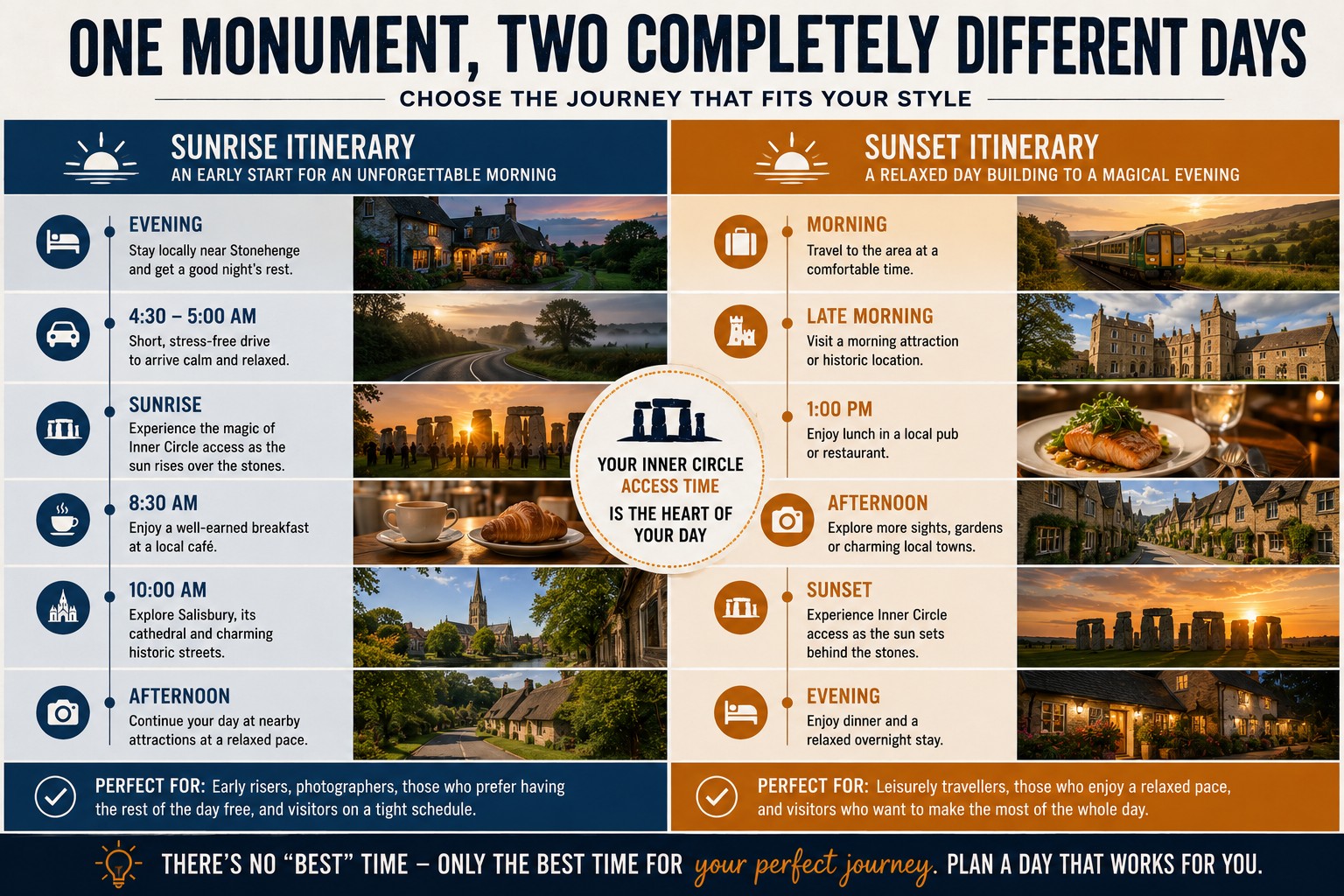
Sunrise and sunset Inner Circle visits create two very different travel experiences. Choosing the right one depends less on which is “better” and more on the style of journey you want to enjoy
⚠️ Step Five: Common Planning Mistakes That Are Easy to Avoid
One of the advantages of learning from experienced travellers is that you can avoid many of the mistakes they made on their first visit.
Here are the ones that matter most.
❌ Trying to Visit Too Much
A packed itinerary often looks impressive on paper but feels exhausting in reality.
Choosing fewer destinations almost always creates a richer experience.
❌ Ignoring Buffer Time
Every successful itinerary contains protected time.
Traffic changes.
Roadworks happen.
Unexpected opportunities appear.
Buffer time allows your day to absorb those changes without creating unnecessary stress.
❌ Staying Too Far Away for Sunrise
Saving a little money on accommodation can sometimes create hours of additional travel before dawn.
For sunrise visitors especially, staying nearby often provides exceptional value because it dramatically improves the overall experience.
❌ Treating Sunrise and Sunset the Same
Although both offer exclusive access, they create completely different travel days.
Planning them in exactly the same way usually means missing the unique advantages each experience offers.
❌ Copying Someone Else’s Itinerary
The best itinerary isn’t the one with the most attractions.
It’s the one built around your travel style, your pace and your confirmed Inner Circle booking.
If you’re still refining your plans, learning how to build your itinerary around your Stonehenge date will usually produce a smoother and more rewarding experience than copying someone else’s schedule.
🌱 Travel More Thoughtfully: A Sustainable Way to Plan Your Visit
One of the unexpected benefits of planning your itinerary around your Stonehenge Inner Circle date is that it naturally encourages more responsible travel.
Good itinerary design isn’t just about making life easier for you—it often reduces unnecessary journeys, supports local communities and helps preserve the places you’re visiting.
When your Inner Circle access time becomes the anchor of the day, you’re less likely to spend hours driving backwards and forwards between attractions or constantly changing plans. Instead, your route becomes more efficient, more enjoyable and often more environmentally conscious.
There are several simple ways to travel more sustainably without compromising the quality of your visit.
If you’re attending a sunrise session, consider staying locally the night before rather than making a long journey before dawn. Not only does this remove much of the early morning stress, but it also supports local accommodation providers and reduces unnecessary travel.
If you’re joining an organised Stonehenge tour, travelling as part of a shared group can significantly reduce the number of vehicles travelling to the monument while allowing you to relax and enjoy the journey.
Whenever possible, choose independent cafés, restaurants and local businesses in nearby towns such as Salisbury. Spending a little more time in the area helps support the communities that welcome visitors throughout the year.
Perhaps the most sustainable decision of all is simply slowing down.
Instead of trying to experience five destinations in a single day, spend longer enjoying two or three.
You’ll travel fewer miles, experience each place more deeply and return home with richer memories than if the day had been spent constantly rushing from one attraction to the next.
The best journeys aren’t always the busiest.
They’re usually the ones that leave enough space to appreciate where you are.
If you’d like to make an even bigger positive impact, travelling more sustainably when visiting Stonehenge benefits both the landscape and the local communities that make the experience possible.
❓ Frequently Asked Questions
🌄 Should I stay overnight before a sunrise Inner Circle visit?
For most visitors, yes.
Because sunrise access begins very early, staying close to Stonehenge the previous evening removes the stress of travelling before dawn. You’ll arrive feeling rested, have more time to enjoy the experience and won’t need to worry about unexpected delays on the morning of your visit.
🌇 Is a sunset itinerary easier to organise?
For many visitors, it is.
Sunset access provides much greater flexibility during the morning and early afternoon, allowing you to explore nearby attractions before making your way to Stonehenge later in the day. It also avoids the exceptionally early start required for sunrise visits.
🚗 Should I drive or join an organised tour?
That depends on the type of trip you’re planning.
Driving offers maximum flexibility if you’re exploring southern England independently, while an organised tour removes the responsibility of navigation, parking and scheduling. Many first-time visitors appreciate the convenience of having the logistics handled for them.
🏨 Should I book accommodation before securing my Inner Circle date?
Ideally, no.
Because Inner Circle availability is limited, it’s usually better to confirm your preferred access date first and then book accommodation that supports that schedule. This gives you far greater flexibility and reduces the chance of needing to rearrange your plans.
For the smoothest planning process, checking the Stonehenge Inner Circle calendar before booking accommodation helps avoid unnecessary changes later.
🌦️ Can the weather affect my itinerary?
The weather can influence your comfort and photography opportunities, but the experience remains memorable in almost every condition.
Allowing generous buffer time, dressing appropriately and keeping the rest of your schedule flexible will help you make the most of your visit whatever the forecast.
🏛️ Can I combine Stonehenge with Bath or Windsor?
Yes, but the best approach depends on your access time.
Sunrise visitors often enjoy exploring nearby attractions afterwards, while sunset visitors usually have more flexibility to visit places such as Windsor or Bath before travelling to Stonehenge later in the day.
The key is choosing quality over quantity.
📅 Is one day enough for a Stonehenge Inner Circle experience?
Absolutely.
A carefully planned one-day itinerary can be exceptional.
However, if your schedule allows, extending the trip into a weekend gives you more time to explore Salisbury, the surrounding Wiltshire countryside and other nearby attractions without feeling rushed.
⚓ What’s the single best planning tip?
Anchor your entire itinerary around your confirmed Inner Circle access time.
Once that fixed point is in place, accommodation, transport and sightseeing become much easier to organise—and the entire journey usually feels more relaxed.
🏁 Conclusion
Planning a Stonehenge Inner Circle visit isn’t simply about choosing a date on a calendar.
It’s about designing an experience.
The visitors who remember their day most fondly aren’t necessarily the ones who travelled the furthest or squeezed the greatest number of attractions into their itinerary.
They’re usually the ones who planned with purpose.
Throughout this guide we’ve used one simple framework:
⚓ Anchor → Build → Enjoy
First, anchor your plans around your confirmed Inner Circle access time.
Next, build the rest of your journey around that fixed point using realistic travel times, comfortable pacing and carefully chosen attractions.
Finally, enjoy the experience knowing that every part of your itinerary has been designed to support the highlight of your trip rather than compete with it.
Whether you’re planning a sunrise experience, an unforgettable sunset visit, a day trip from London or a leisurely holiday through southern England, this approach helps create something far more valuable than an efficient schedule.
It creates a journey that feels effortless.
One final thought is worth remembering.
The date you choose determines far more than when you’ll stand inside the stones.
When planned well, it shapes how you’ll remember the entire journey.
That’s the difference between simply visiting Stonehenge…
…and experiencing it in a way you’ll remember for years to come.
If you’re now ready to put everything into practice, the Stonehenge Inner Circle Access Calendar is the ideal place to begin planning your visit.