


Scottish Islands Travel Guide: Skye, Orkney, Hebrides and Remote Coastal Adventures
8th August 2026
🏝️ Scottish Islands Travel Guide: Skye, Orkney, Hebrides and Remote Coastal Adventures
Scotland’s islands offer remarkably different journeys, from the mountain landscapes of Skye to ancient Orkney and the Atlantic coastlines of the Hebrides
There is a moment on many island journeys when mainland Scotland begins to fall away. It might happen from a ferry deck as mountains recede behind you, on the road towards Skye as sea lochs widen beside the route, or from the air as beaches, islands and a fragmented coastline appear below.
However you arrive, travelling into island Scotland feels different.
This Scottish Islands Travel Guide explores why Skye, Orkney, the Hebrides and Scotland’s more remote coastal islands offer such contrasting experiences—and how to choose the journey that best suits you.
There is no single destination that adequately represents “the Scottish islands”.
Skye offers mountain drama, remarkable geology and some of Scotland’s most recognisable coastal landscapes. Orkney opens onto an archipelago shaped by prehistoric archaeology, maritime history and centuries of Norse influence. Farther west, Lewis and Harris combine immense Atlantic beaches, mountains, ancient monuments and a living Gaelic culture, while islands including Mull, Iona, Islay and Arran offer their own distinct combinations of wildlife, history, whisky, coast and community.
That variety is exactly why choosing well matters.
A traveller drawn primarily to dramatic mountain scenery may find Skye the natural choice. Someone fascinated by archaeology could regard Orkney as one of the most rewarding places in Britain, while visitors seeking beaches, Gaelic culture and remote Atlantic landscapes may feel more at home in the Outer Hebrides.
This guide is not about collecting islands or declaring one destination the winner. It is about understanding how Scotland’s principal island regions differ, matching those differences to your own interests and allowing enough time to experience the place you choose properly.
Because the strongest island journeys rarely begin with:
“How many islands can I fit in?”
They begin with a better question:
Which island Scotland do I actually want to experience?
🏝️ Choose Your Island Scotland
Don’t start by asking how many islands you can visit. Decide which island Scotland you actually want to experience.
Scotland’s islands reward thoughtful choices. Start with the experience that interests you most, then choose an island region that fits the time you have and the practical journey required to reach it.
| ⛰️ Skye | Mountains, remarkable geology and a natural continuation of a Western Highlands journey |
| 🗿 Orkney | Prehistoric archaeology, Norse heritage and distinctive maritime landscapes |
| 🌊 Outer Hebrides | Atlantic beaches, Gaelic culture, living island communities and a greater sense of remoteness |
| 🦅 Inner Hebrides | Wildlife, history, whisky, coastal scenery and varied island experiences |
| ⛴️ Arran | An accessible introduction combining mountains, coastline, villages and varied landscapes |
Best planning principle: Choose the experience first. Then choose the island—and give yourself enough time to experience it properly.
🌊 Why Scotland’s Islands Feel Different
Scotland’s islands are shaped as much by the water between them as by the land itself.
Sea, geology, climate and centuries of human settlement have created places with remarkably individual identities. Some islands rise dramatically into mountains; others stretch towards the horizon through low coastal landscapes, fertile machair and enormous skies. Ancient monuments, fishing harbours, crofting townships and modern communities often occupy the same landscapes, separated by surprisingly short distances.
The cultural differences can be equally striking. Gaelic language and traditions remain important parts of identity in the Outer Hebrides and other western communities, while Orkney carries a powerful Norse inheritance alongside a human story stretching back thousands of years. Across the islands, fishing, farming, crofting, seafaring, food, music and storytelling continue to shape local character.
This is why describing island Scotland simply as “remote” can be misleading.
Remote does not mean empty.
These are living communities with schools, businesses, farms, ferries and essential services. Visitors share roads, shops, harbours and landscapes with people going about everyday life. Recognising that from the outset encourages more considerate travel and usually leads to a richer understanding of the places being visited.
Weather also contributes to the islands’ character. Wind, rain, sunlight and changing visibility can transform a coastline remarkably quickly, while exposed conditions may affect walking, driving and transport as well as the view. Good island planning therefore leaves room for conditions to change.
The journey itself becomes part of the experience. Ferries provide changing perspectives on mainland and island coastlines, while slower roads encourage a different relationship with distance. The unexpected harbour, coastal viewpoint or conversation in a small community can become every bit as memorable as the landmark around which the day was originally planned.
🧭 Which Scottish Island Is Right for You?
There is no universally best Scottish island. Start instead with the experience you most want.
⛰️ Choose Skye for Mountain Drama
Skye suits travellers seeking spectacular mountains, geological scenery and a natural continuation of a Western Highlands journey. Its bridge connection makes it comparatively straightforward to reach by road, although easy access should not be confused with quick exploration.
🗿 Choose Orkney for Ancient Scotland
Orkney offers an entirely different proposition: an archipelago of open maritime landscapes, prehistoric sites and strong Norse heritage. It is particularly compelling for travellers whose interest in Scotland extends deep into archaeology and history.
🌊 Choose Lewis and Harris for Atlantic Scotland
Lewis and Harris combine beaches, mountains, peatlands, ancient monuments and a powerful Gaelic cultural identity. They particularly reward visitors prepared to slow down and experience the Outer Hebrides as living communities rather than simply a sequence of scenic stops.
🦅 Choose the Inner Hebrides for Variety
The Inner Hebrides offer remarkable diversity. Mull combines mountains, wildlife and coastal scenery; Iona provides a smaller, historically significant island experience; and Islay brings together whisky heritage, beaches, wildlife and a strong sense of community.
For travellers interested in experiencing contrasting islands within a wider west-coast journey, this variety can be particularly appealing.
⛴️ Consider Arran for an Accessible Island Introduction
Arran provides another option for visitors who want to experience island Scotland without immediately travelling towards the more distant archipelagos.
The island combines mountains, coastline, villages and varied landscapes within comparatively compact geography. It is often described as “Scotland in miniature”, although it is better understood as a distinctive destination in its own right rather than a substitute for the country as a whole.
The important decision is therefore not which island is most famous. Decide whether mountains, archaeology, beaches, wildlife, Gaelic culture, history or a stronger sense of remoteness matters most, then allow that priority to shape the journey.
🧭 Which Scottish Island Is Right for You?
Start with the experience you want most, then choose the island that delivers it best.
Scotland’s islands are too different to rank meaningfully from best to worst. Mountains, archaeology, wildlife, whisky, beaches, culture and accessibility all point towards different destinations, so the strongest choice begins with your own priorities.
⛰️ Want Dramatic Mountains and Iconic Scenery?
→ Skye
Choose Skye for rugged mountain landscapes, striking geology, waterfalls, sea lochs and a natural connection with the Western Highlands.
🗿 Fascinated by Prehistoric Archaeology and Norse History?
→ Orkney
Choose Orkney for Neolithic sites, ceremonial landscapes, maritime history and a powerful Norse inheritance within a distinctive island setting.
🌊 Want Atlantic Beaches, Gaelic Culture and Greater Remoteness?
→ Lewis and Harris
Choose the Outer Hebrides for expansive beaches, mountains, crofting landscapes, ancient monuments and a strong living Gaelic cultural identity.
🦅 Want Wildlife and Varied West-Coast Islands?
→ Mull and the Inner Hebrides
Choose this region for wildlife, coastal scenery, mountains, historic islands and opportunities to combine contrasting west-coast experiences.
🥃 Want Whisky, Coast and a Specialist Island Stay?
→ Islay
Choose Islay for whisky heritage combined with beaches, wildlife, working landscapes and a strong sense of island community.
⛴️ Want an Accessible First Island Experience?
→ Arran
Choose Arran for a comparatively compact introduction combining mountains, coastline, villages and varied scenery without immediately committing to Scotland’s more distant island groups.
🧭 Quick Island Decision
Mountains + iconic scenery → Skye
Archaeology + Norse heritage → Orkney
Beaches + Gaelic culture → Lewis and Harris
Wildlife + island variety → Mull / Inner Hebrides
Whisky + specialist island stay → Islay
Accessible first island → Arran
Choose the experience first → then choose the island.
🧭 BVT Island Planning Principle: The strongest island journey is built around the experience that matters most to you, not the destination with the greatest fame or the longest list of attractions.
📊 Scottish Islands Compared
Scotland’s principal island destinations become easier to understand when compared by character rather than ranked from best to worst.
| Island or Group | Character | Particularly Good For | Journey Style |
|---|---|---|---|
| Skye | Mountainous and dramatic | Scenery and first island journeys | Highlands and island |
| Orkney | Ancient and maritime | Archaeology and history | Dedicated island stay |
| Lewis and Harris | Atlantic and culturally distinctive | Beaches and Gaelic culture | Slow island journey |
| Mull | Mountainous, coastal and wildlife-rich | Nature and scenery | West-coast island break |
| Islay | Maritime and culturally distinctive | Whisky, wildlife and coast | Specialist island stay |
| Arran | Varied and accessible | Shorter island escapes | Accessible introduction |
🌊 Three Island Scotlands: Which Experience Calls to You?
Scotland’s islands are not variations of the same journey. Three of its best-known island regions offer remarkably different landscapes, cultures and reasons to travel.
Rather than asking which is simply “best”, think about the version of island Scotland you most want to experience.
⛰️ Skye — Mountain Scotland
Think: rugged peaks • extraordinary geology • waterfalls • dramatic coastal scenery • Western Highlands
Choose Skye if: the landscape itself is your principal reason for travelling and you want an island that fits naturally into a wider Western Highlands journey.
🗿 Orkney — Ancient Scotland
Think: prehistoric archaeology • Norse heritage • open horizons • ancient settlements • maritime history
Choose Orkney if: you want your island journey shaped as much by thousands of years of human history as by the surrounding landscape and sea.
🌊 Outer Hebrides — Atlantic Scotland
Think: Atlantic beaches • Gaelic culture • crofting landscapes • wild coastlines • remoteness
Choose the Outer Hebrides if: you are drawn towards a slower, more remote journey where island communities, Gaelic heritage and the Atlantic landscape become inseparable parts of the experience.
Three Islands. Three Very Different Scotlands.
Skye for mountain drama • Orkney for ancient history • Outer Hebrides for Atlantic culture and remoteness
🧭 BVT Planning Principle: Don’t choose an island because it appears on somebody else’s must-see list. Decide whether you are seeking Mountain Scotland, Ancient Scotland or Atlantic Scotland first — then build the journey around that experience.
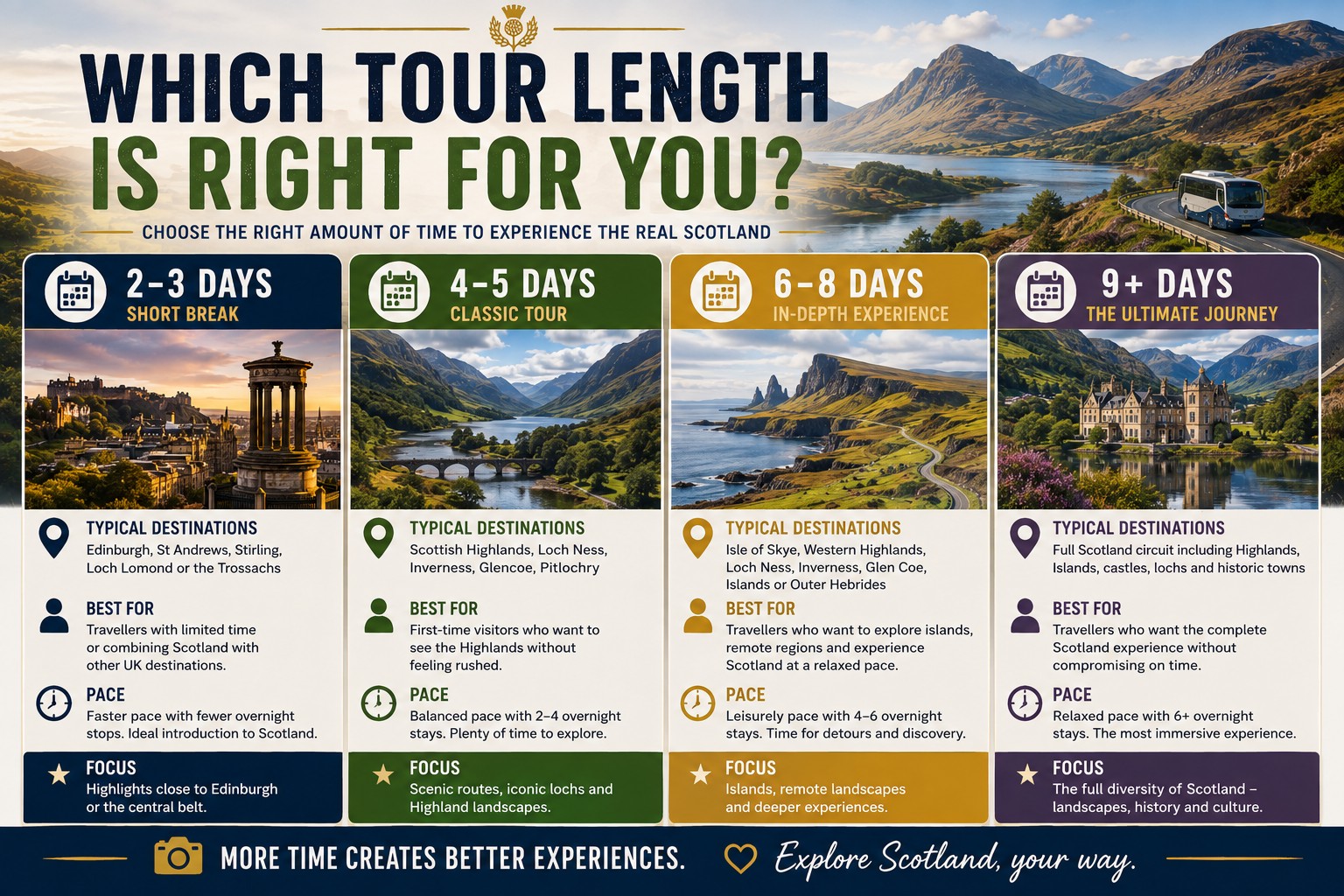
From Skye’s mountain drama and Orkney’s ancient landscapes to the Atlantic character of Lewis and Harris, the varied Inner Hebrides and accessible Arran, Scotland’s islands offer very different travel experiencesThere is deliberately no winner in this comparison. A traveller fascinated by Neolithic archaeology may value Orkney more highly than Skye, while someone dreaming of mountain photography may make precisely the opposite choice.
The strongest decision comes from matching an island’s character to your own interests, available time and wider Scotland itinerary.
That principle becomes particularly important with perhaps the most internationally recognisable of them all: the Isle of Skye.
⛰️ Isle of Skye: Mountains and Western Highland Connections
Skye’s international reputation is understandable. Mountains, sea lochs, cliffs, waterfalls and extraordinary geological formations are concentrated within an island that can be reached directly from mainland Scotland by road.
The Cuillin form its mountainous heart, creating a rugged skyline that gives southern Skye much of its distinctive character. Farther north, the Trotternish peninsula reveals another side of the island, where geological processes have created some of Scotland’s most unusual terrain.
Waterfalls, castles, legends and places such as the Fairy Pools add further layers to Skye’s appeal. Yet the island is at its best when treated as somewhere to explore rather than as a collection of famous photographs to reproduce.
Its accessibility can create the illusion that Skye is easy to cover quickly.
It is not.
Narrow and single-track roads in some areas, changing conditions, busy viewpoints and the temptation to stop repeatedly mean that journeys can take considerably longer than distance alone suggests. A tightly packed itinerary may technically reach several celebrated locations while leaving very little time to experience the island itself.
Skye also makes geographical sense as part of a wider Western Highlands journey. Travellers approaching through Glen Coe, Fort William and the landscapes farther west can experience a gradual transition from mainland mountains towards sea lochs and the north-west coast before crossing onto the island.
That progression can be considerably more rewarding than treating Skye as an isolated excursion.
Transport should therefore be considered before attractions. Decide where you will stay, understand the distances involved and build the sightseeing around a realistic route rather than assembling a wish list first and attempting to connect it afterwards.
For many visitors, allowing several days rather than attempting a rushed circuit produces the stronger experience, particularly when weather or walking forms part of the plans.
Skye may be comparatively easy to reach.
The better question is whether you have given yourself enough time to explore it well.
⛰️ BVT Expert Tip: Plan Skye as a Journey
Easy to reach does not mean quick to explore.
The Skye Bridge makes reaching the island straightforward by road, but Skye itself rewards a much slower approach. Distances that appear modest on a map can involve narrow roads, changing conditions, scenic stops and places where you will naturally want to spend longer than expected.
🚗 Reach Skye
↓
🛏️ Choose Your Overnight Base
↓
🗺️ Group Sights Geographically
↓
⏳ Allow for Narrow Roads and Scenic Stops
↓
🌦️ Build in Weather Flexibility
↓
🥾 Explore Rather Than Collect Viewpoints
🧭 Why this works: Grouping nearby places into the same part of your day reduces unnecessary backtracking and gives you more time to walk, stop for photographs, respond to changing weather and experience Skye beyond its most famous viewpoints.
⛰️ BVT Expert Tip: Treat Skye as the continuation of a Western Highlands journey rather than an isolated sightseeing excursion whenever your itinerary allows. The journey through the Highlands towards the island can be part of the experience, not simply the transfer required to reach it.
Give Skye time. The aim is not to see the greatest number of viewpoints — it is to experience the island properly.
🗿 Orkney Islands: Prehistory, Norse Heritage and Coast
Travel north to Orkney and the character of island Scotland changes dramatically.
The mountainous skylines associated with Skye give way to an archipelago of open horizons, fertile landscapes, sweeping coastlines and an exceptional concentration of prehistoric remains.
Some of Britain’s most important prehistoric sites survive here not behind museum glass but within the landscapes where communities lived, farmed, gathered and built thousands of years ago.
Skara Brae provides perhaps the most famous example. This remarkably preserved Neolithic settlement offers an unusual opportunity to contemplate domestic life in prehistoric Orkney, while the Ring of Brodgar and Standing Stones of Stenness reveal part of a wider ceremonial landscape whose surviving monuments still command attention today.
Their significance extends beyond the individual attractions.
In Orkney, archaeology is part of the landscape.
Travelling between ancient sites helps reveal how settlements, stone monuments, water and surrounding terrain relate to one another. That wider setting gives Orkney an intellectual depth that makes the archipelago especially rewarding for travellers interested in understanding Scotland’s past rather than simply photographing its surviving monuments.
Prehistory is only one chapter. Centuries of Norse influence remain fundamental to Orcadian identity, while later maritime history, farming communities and modern island life continue the story. The result is somewhere that feels culturally as well as geographically distinct from the Highlands and western islands.
Beyond the archaeological sites, cliffs, beaches and marine environments provide further reasons to explore slowly. Wildlife can add memorable encounters, particularly at different points in the seasonal cycle, although sightings should always be regarded as possibilities rather than promises.
Orkney therefore offers something very different from Scotland’s classic mountain journey.
It asks you to look across an apparently open landscape and recognise just how much history it contains.
🌅 Lewis and Harris: Outer Hebrides Beaches and Gaelic Culture
Travel west towards the Outer Hebrides and island Scotland changes character again.
Lewis and Harris are not separate islands geographically. They form two traditionally distinct regions of the same large island, connected by land but possessing landscapes and identities that can feel strikingly different.
Harris is renowned for rugged mountains and extraordinary stretches of pale sand facing the Atlantic. Lewis opens into broader expanses of moorland, lochs, crofting townships and immense western horizons.
The beaches can be breathtaking, but reducing Lewis and Harris to turquoise water and white sand would miss much of what makes this part of Scotland distinctive.
Gaelic language and culture remain important elements of life here, while crofting, traditional industries, music and the relationship between communities, land and sea contribute to a sense of place fundamentally different from a conventional scenic touring route.
Visitors who take time to understand that cultural context often discover considerably more than those simply moving between viewpoints.
The islands also contain one of Scotland’s great prehistoric landscapes. The Calanais Standing Stones on Lewis were erected thousands of years ago and remain an extraordinary presence within their setting, providing another reminder that these seemingly remote landscapes have been inhabited, cultivated and understood by communities for millennia.
🌾 Beaches, Machair and Living Landscapes
Along parts of the western coastline, sandy soils support machair, a distinctive fertile coastal habitat particularly associated with north-western Scotland and Ireland. During the flowering season, these landscapes can become rich with wildflowers while supporting wildlife, grazing and traditional land use.
They deserve thoughtful treatment from visitors.
The same applies to crofting areas, beaches and apparently empty stretches of countryside. Gates, livestock, working land and local access routes are reminders that the landscapes visitors have travelled to admire are also places where people live and work.
Lewis and Harris therefore reward time. Allow room for beaches, small communities, archaeological sites and unplanned coastal stops rather than treating the islands as a circuit to complete against the clock.
Come for the remarkable scenery, certainly, but leave enough time to understand something of the culture and communities that give the Outer Hebrides their distinctive identity.
🐋 Mull, Iona and Islay: Exploring the Inner Hebrides
Beyond Skye, the Inner Hebrides contain islands with remarkably different personalities. For visitors interested in combining scenery with wildlife, history, local culture and distinctive communities, they can provide some of western Scotland’s most rewarding journeys.
🦅 Mull: Wildlife, Mountains and Coastal Scenery
Mull combines mountains, sea lochs, beaches and a deeply indented coastline within an island that encourages exploration rather than hurried sightseeing. Tobermory, with its colourful waterfront, provides one of the island’s most recognisable scenes, but Mull’s wider appeal lies in the landscapes beyond its principal settlements.
Wildlife is another important attraction. The surrounding marine and coastal environments create opportunities to encounter seabirds, seals and other species, while Mull is particularly associated with eagle watching.
As everywhere in wild Scotland, however, nature determines the encounter. Season, conditions, location and good fortune all matter, and sightings should never be treated as guaranteed.
⛪ Iona: A Small Island with an Extraordinary Story
Reached from Mull by ferry, Iona demonstrates that an island does not need immense mountains or long scenic drives to leave a powerful impression.
Its importance in the story of early Christianity in Scotland gives this small island a historical and spiritual significance far greater than its physical size. Iona Abbey, the surrounding landscape and the relative simplicity of exploring the island create a markedly different experience from the dramatic road touring associated with Skye.
🥃 Islay: Whisky, Wildlife and Island Character
Islay is internationally associated with whisky, and its distilleries remain an important part of the island’s culture and economy. Yet visitors who arrive solely for whisky discover a considerably broader destination of beaches, wildlife, historic places, working landscapes and communities.
Nearby Jura adds another distinctive island possibility, while Staffa demonstrates the remarkable geological and marine diversity found elsewhere in the Inner Hebrides.
The strength of this island group lies precisely in that variety. With sufficient time, carefully chosen combinations can create a journey in which every crossing leads somewhere genuinely different rather than merely adding another island to a checklist.
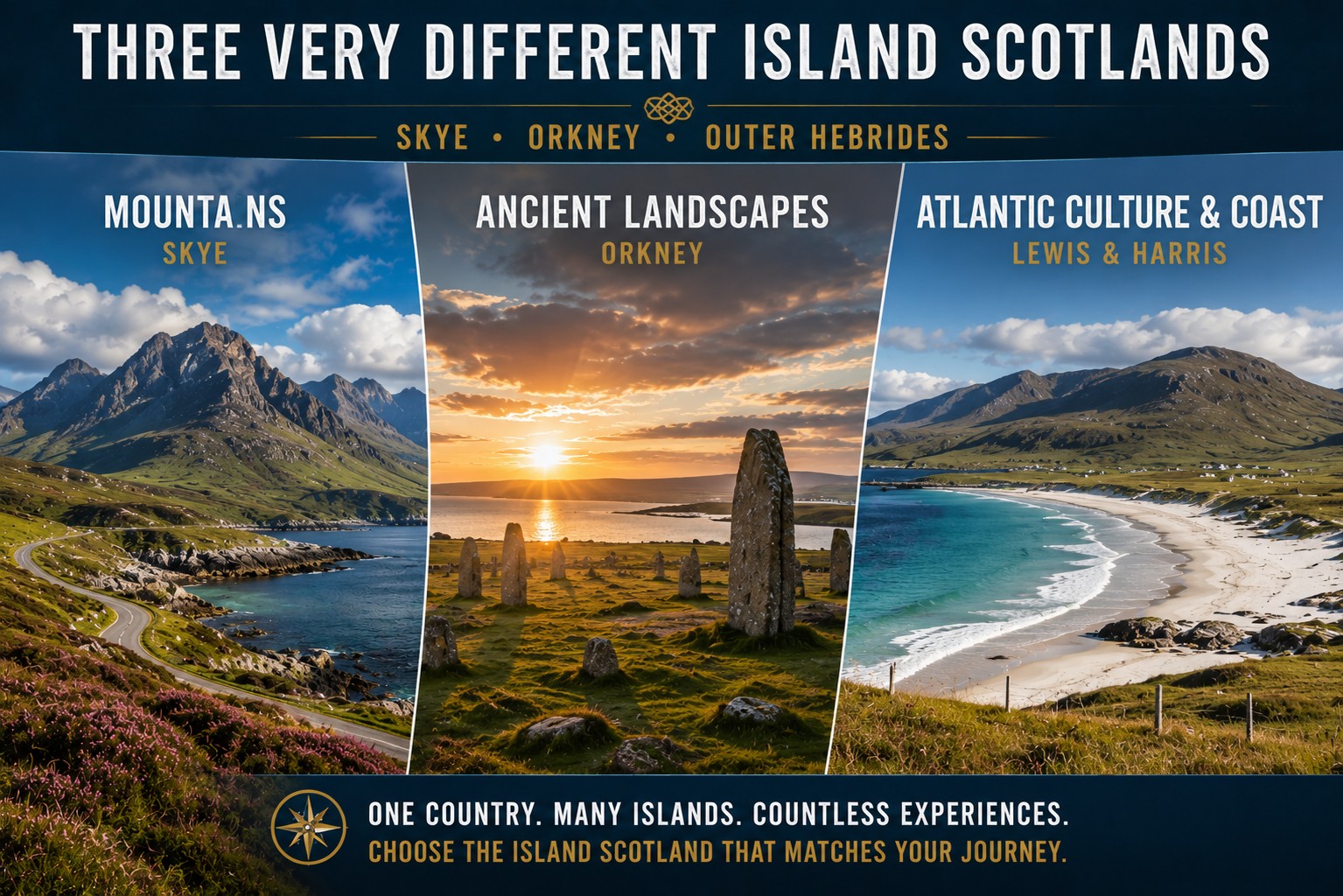
Skye, Orkney and the Outer Hebrides reveal three very different versions of island Scotland, from rugged mountains to ancient landscapes and sweeping Atlantic coastlines
🐬 Wildlife, Beaches and Remote Coastal Adventures
Scotland’s islands are among the country’s most rewarding destinations for travellers who enjoy experiencing landscapes at their wildest edges.
Mountains descend towards sea lochs, beaches face the open Atlantic and cliffs provide important habitat for seabirds. Depending on destination, season, conditions and simple good fortune, visitors may encounter seals around rocky shores, eagles above coastal landscapes, or dolphins and whales offshore.
The important word is may.
Wildlife does not operate according to a sightseeing timetable. Some of the most memorable encounters come from slowing down, watching quietly and accepting that nothing is guaranteed. Maintaining an appropriate distance protects animals from unnecessary disturbance and makes responsible observation part of the experience.
Scotland’s island beaches deserve the same respect.
The Outer Hebrides contain some of the country’s most celebrated stretches of sand, but beautiful coastal landscapes occur throughout the Inner Hebrides, Orkney and numerous smaller islands. Their appearance can change dramatically with tide, weather and light.
Dunes, machair, nesting areas and fragile coastal vegetation can also be damaged surprisingly easily. Follow established access routes and local guidance rather than leaving paths simply to reach a quieter photograph.
You do not always need to travel farther to feel more remote. Sometimes you simply need to travel more slowly.
⛴️ How to Get to Scotland’s Islands
Reaching an island is part of the adventure, but successful island travel usually requires more planning than moving between mainland destinations.
Ferries, flights, road connections, accommodation locations and weather all influence what is realistically possible. A useful principle is to plan the transport first and build the attractions around it, particularly when a journey depends on a specific crossing.
🚗 Car and Ferry
Taking a vehicle can provide considerable freedom on larger islands where communities, beaches and attractions are widely dispersed. Vehicle capacity on popular ferry crossings can make advance planning particularly important during busy periods, while foot-passenger arrangements may offer greater flexibility on some routes.
Travelling without a car does not automatically make an island simple to explore, however. Always consider how you will travel after arriving.
Once on the islands, driving requires patience. Roads can be narrow or single-track, journey times may exceed expectations, and passing places must remain available for their intended purpose rather than being used for parking.
🚆 Rail and Ferry
Mainland rail connections can form part of an enjoyable route towards selected ferry gateways, allowing the transition from city to coast to become part of the journey.
Depending on the destination, onward island travel may involve buses, taxis, walking, cycling or organised touring. Public transport can work extremely well for particular itineraries, but never assume that every remote beach, archaeological site or coastal viewpoint will be easily accessible.
✈️ Flying to More Remote Islands
Flights can reduce overland and ferry travel time for some itineraries involving Orkney or the Outer Hebrides. The important question then becomes how you intend to explore after arrival.
🌉 Reaching Skye by Road
Skye differs from many major Scottish island destinations because its principal mainland road approach crosses the Skye Bridge, so a ferry is not required for that route.
This makes the island particularly easy to combine geographically with the Western Highlands.
Whatever destination you choose, avoid building critical connections with almost no margin for disruption. Check current ferry and flight arrangements directly with the relevant operator before travelling.
Contingency time is not wasted time. It is good island planning.
⛴️ Island Access and Ferry Planning
For a Scottish island journey, transport is part of the itinerary—not simply the way you reach it.
Before choosing accommodation or filling each day with attractions, establish how you will reach the island, how you will travel once there and whether any ferry, flight or onward connection places a fixed point in your itinerary.
🌉 Skye
→ Road access via the Skye Bridge
Straightforward road access removes the need for a ferry on the principal mainland route, but you should still allow realistic time for onward island driving.
🗿 Orkney
→ Ferry or flight + onward island transport
Plan the mainland connection and what happens after arrival as one complete journey, particularly if you intend to explore beyond your arrival point.
🌊 Outer Hebrides
→ Ferry or flight + carefully planned local transport
Greater distances and multiple possible gateways make the sequence of your journey especially important.
🦅 Inner Hebrides
→ Route-specific ferry planning
Access varies considerably between islands, so establish the appropriate crossing and onward travel arrangements for your chosen destination.
⛰️ Arran
→ Ferry + onward island transport
Its relative accessibility makes Arran an attractive introduction to island Scotland, but your plans should still account for the crossing and travel after arrival.
🧭 Solve These Questions Before You Book
🚗 Taking a car?
→ Investigate whether vehicle reservations are required or advisable for the crossings in your itinerary.
🚌 Travelling without a car?
→ Check how you will continue from the ferry terminal or airport before committing to accommodation.
⏱️ Relying on a critical ferry or flight connection?
→ Build contingency time into the itinerary rather than creating an unnecessarily tight transfer.
🏝️ Visiting multiple islands?
→ Establish the transport sequence first. Only then decide which attractions and experiences fit naturally around it.
⚠️ Important: Ferry timetables, flight schedules, vehicle capacity and local transport can vary by route, season and operating conditions. Check current arrangements with the relevant transport operators before finalising your journey.
Transport First → Accommodation Second → Sightseeing Third
⛴️ BVT Island Planning Principle: On the mainland, transport can often be adapted around your itinerary. On Scotland’s islands, transport may determine the itinerary. Solve the fixed connections first and build the enjoyable parts of the journey around them.
⏳ How Many Days Do You Need for the Scottish Islands?
The temptation to island hop can be strong. Scotland’s map makes neighbouring islands appear tantalisingly close, and it is easy to create an ambitious itinerary before considering ferry crossings, road speeds, accommodation changes and the time required simply to enjoy each destination.
A better starting point is to decide how deeply you want to explore.
| Time Available | Recommended Island Approach |
|---|---|
| 1 day | One locally accessible island experience or focused Skye excursion where practical |
| 2–3 days | Concentrate on one principal island |
| 4–5 days | Explore one island deeply or make one logical combination |
| 6–8 days | Selected island hopping becomes more realistic |
| 9+ days | Multiple islands or island regions with genuine breathing space |
Two or three days spent exploring one island can reveal considerably more than the same period divided between ferry terminals, accommodation changes and long driving days. Four or five days provides greater freedom, while a week or more opens opportunities for carefully planned combinations.
Geography should determine those combinations.
Island hopping works best when destinations belong to a coherent route or island group. Attempting to include Skye, Orkney and Lewis and Harris within a short journey may look impressive on paper, but their geographical separation can turn much of the holiday into a transport exercise.
Outside summer, available daylight should also influence how ambitious each day becomes. A route that feels comfortable during long June evenings may provide far less useful exploration time later in the year.
An additional night or flexible half-day can sometimes protect the entire itinerary. It provides breathing room when weather changes, transport is disrupted or somewhere unexpectedly deserves more time.
More islands do not automatically create a better island holiday.
⏳ How Long Do You Need for Scotland’s Islands?
Island journeys are shaped by geography, ferry connections and realistic travelling time as much as by the number of days available.
Use your available time to decide how deeply you can explore. Adding another island is worthwhile only when the journey between destinations still leaves enough time to experience them properly.
🕐 1 Day — One Focused Island Experience
Realistic: Choose one locally accessible island or a focused experience that works naturally from your existing base.
Don’t: Attempt meaningful island hopping. Connections and onward travel can consume too much of a single day.
🌊 2–3 Days — Concentrate on One Principal Island
Realistic: Establish one base and experience one island with enough time for its principal landscapes, communities and attractions.
Don’t: Divide a short stay between geographically separate island groups simply to increase the number of destinations visited.
🏝️ 4–5 Days — Explore Properly or Make One Logical Combination
Realistic: Explore one major island in greater depth or combine destinations where the geography and transport connections create a coherent journey.
Don’t: Confuse additional ferry crossings with additional experiences. Every transfer uses time that could otherwise be spent exploring.
⛴️ 6–8 Days — Selected Island Hopping Becomes Realistic
Realistic: Combine carefully selected islands or explore a coherent island region while allowing time for journeys, overnight stays and changing conditions.
Don’t: Combine distant archipelagos without calculating the complete transfer time between them, including ferries, flights and onward road journeys.
🧭 9+ Days — Build a Deeper Island Journey
Realistic: Multiple islands or island regions become increasingly practical, with greater opportunity for slower travel, longer stays and contingency time.
Still: Follow geographical logic. A longer holiday is not a reason to collect disconnected island names.
🧭 Before Adding Another Island, Ask:
✓ How much time will the complete transfer actually take?
✓ Does the next island fit naturally into the route?
✓ Will I gain a genuinely different experience?
✓ Have I allowed enough time for ferry, flight or weather disruption?
✓ Am I leaving enough time to enjoy the islands rather than continually travelling between them?
More Islands ≠ A Better Island Journey
Depth, geographical logic and enough time in each place usually create the more rewarding experience.
⏳ BVT Island Planning Principle: Treat travelling time as part of your island experience. Build the itinerary around what you can comfortably enjoy, not the maximum number of islands that can technically be connected.
🌦️ Best Time to Visit Scotland’s Islands
There is no universally perfect season for island Scotland. Daylight, weather, wildlife, visitor demand and the atmosphere of the landscapes all change throughout the year.
🌸 Spring
Increasing daylight, emerging wildlife activity and potentially quieter journeys can make spring particularly rewarding. Conditions remain changeable, so flexibility still matters.
☀️ Summer
Summer provides the longest days and generous time for outdoor exploration, but it also brings stronger demand for popular accommodation and important transport connections.
🍂 Autumn
Autumn can bring atmospheric light, changing landscapes and fewer visitors in some places. Shortening daylight means daily itineraries should become correspondingly less ambitious.
❄️ Winter
Winter offers a very different island experience, with short days, seasonal opening patterns and greater potential for weather-related disruption requiring more careful planning.
The best season therefore depends less on finding a universally perfect month and more on deciding what matters most to you: long days, quieter roads, wildlife possibilities, cultural events or the atmosphere of travelling outside peak summer.
Before fixing your dates, there is another useful question to ask: what will be happening on the islands while you are there?
🌦️ Which Season Is Right for Your Scottish Island Journey?
There is no single best season for Scotland’s islands. The strongest choice depends on the balance you want between daylight, weather flexibility, transport reliability, accommodation demand, wildlife opportunities and events.
Island travel is particularly sensitive to seasonal conditions because ferries, flights, daylight and onward connections can all influence what is realistic. Choose the season that best matches the experience you want—and build enough flexibility into the journey to enjoy it.
🌱 Spring — Quieter Exploration and Increasing Daylight
Choose spring if you want: lengthening days, emerging landscapes and potentially quieter island experiences before the busiest summer period.
Keep in mind: conditions can still change quickly, so retain flexibility around outdoor plans and transport connections.
☀️ Summer — Maximum Daylight and Touring Flexibility
Choose summer if you want: long days, greater flexibility for sightseeing and more time for scenic journeys, walking and outdoor exploration.
Keep in mind: popular islands, accommodation and key transport services can experience greater demand, making advance planning particularly valuable.
🍂 Autumn — Atmosphere, Colour and a Slower Pace
Choose autumn if you want: changing landscapes, atmospheric light and potentially fewer visitors after the busiest summer period.
Keep in mind: daylight reduces as the season progresses, so journey times and outdoor plans become increasingly important.
❄️ Winter — Solitude and Maximum Flexibility Required
Choose winter if you want: quieter landscapes, dramatic atmosphere and a very different experience of island life.
Keep in mind: shorter daylight, seasonal availability and greater potential for weather-related transport disruption mean winter itineraries require the most flexibility.
🧭 Five Questions to Choose Your Island Season
🌅 Daylight
How many usable daylight hours do you want for driving, walking, photography and sightseeing?
⛴️ Ferry and Flight Resilience
How much flexibility can your itinerary tolerate if weather affects an important connection?
🛏️ Accommodation Demand
Are you prepared to book well ahead during popular periods, or would you prefer potentially quieter travel?
🦅 Wildlife Interests
Are particular landscapes, birds, marine life or other seasonal wildlife experiences important to your journey?
🎉 Events
Would an island festival, traditional gathering, Highland Games or seasonal celebration make your visit more memorable?
Season → Conditions → Transport → Experience
Choose when to travel by considering the complete island journey—not the weather forecast alone.
📅 Next Planning Step: Once you have identified the season that suits you, check what is happening during your potential travel dates. Festivals, Highland Games and local celebrations can add something special to an island journey, while popular events can also increase demand for accommodation and transport.
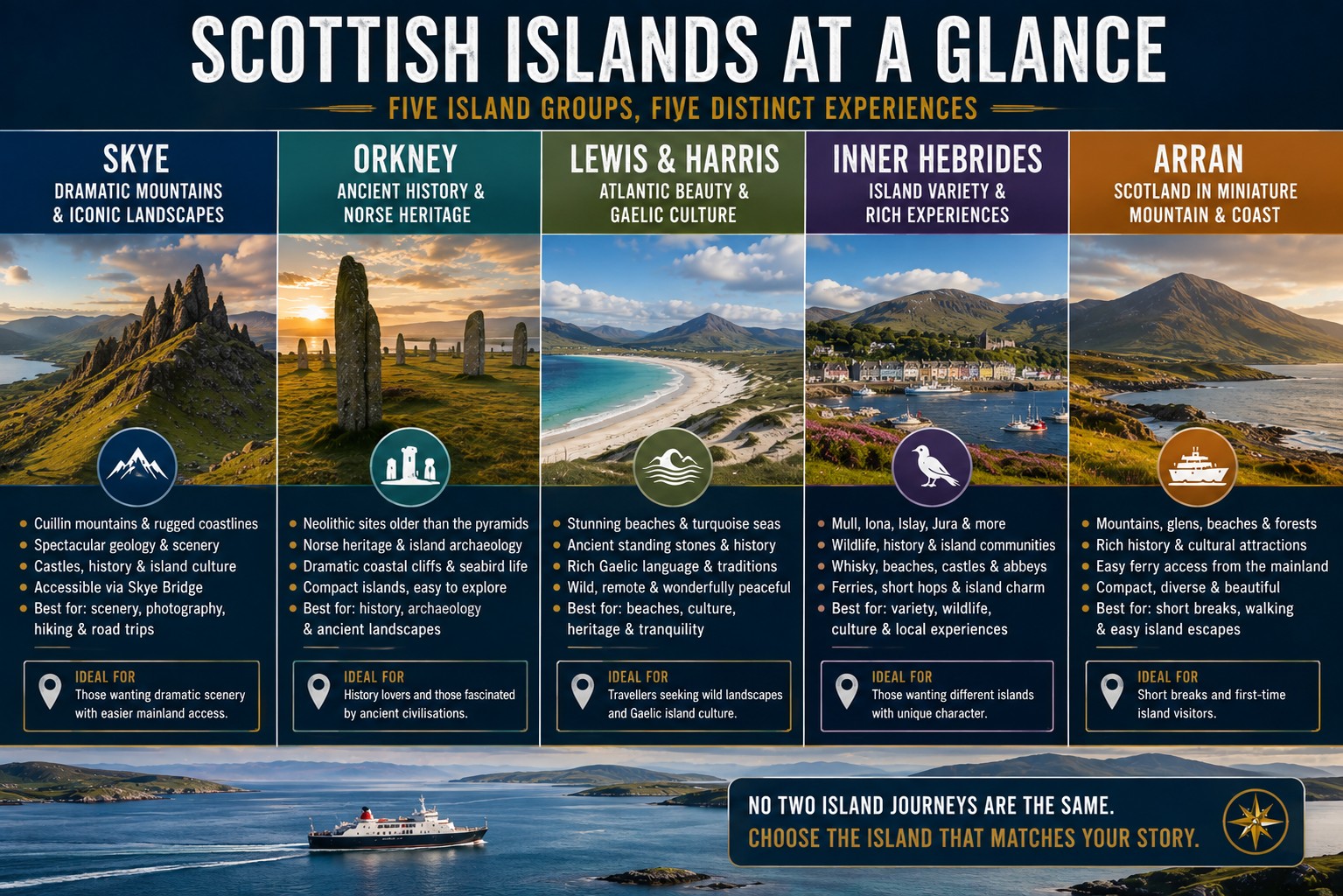
Skye, Orkney, Lewis and Harris, the Inner Hebrides and Arran offer distinctly different island experiences, from dramatic mountains and ancient heritage to Atlantic beaches, wildlife and accessible coastal escapes
📅 Discover Island Events with the BVT Scotland Events Calendar
Scotland’s islands are memorable for their landscapes, but timing a journey around a local event can reveal another dimension of island life.
Traditional music, Highland Games, agricultural gatherings, food and drink celebrations, festivals and community events can provide opportunities to experience places beyond their scenery. On smaller islands in particular, an event may offer visitors an insight into traditions and community connections that are difficult to appreciate during a brief sightseeing stop.
This is where planning dates as carefully as destinations can pay dividends.
The BVT Scotland Events Calendar provides a useful starting point for discovering events that could complement a Scottish island journey. Rather than choosing travel dates first and later discovering what was happening nearby, checking the calendar during the planning stage can help identify experiences worth incorporating into a wider itinerary.
Events also have a practical consequence.
Accommodation and transport capacity can be limited in smaller island communities, so major gatherings may create considerable local demand. Travellers hoping to attend a particular festival, Highland Games or seasonal celebration should therefore plan ahead and confirm current dates, programmes, availability and ticket arrangements directly with the relevant organisers.
Sometimes an event becomes the reason for travelling to an island. On another journey, discovering that one coincides with plans already made can become an unexpected highlight.
Either way, Scotland’s islands become richer when experienced as communities as well as landscapes.
📅 Plan Your Island Journey with the Scotland Events Calendar
The dates you choose can shape both what you experience on Scotland’s islands and how easily your journey fits together.
Island festivals, traditional music, Highland Games, agricultural gatherings, food and drink events and seasonal celebrations can add a memorable dimension to a Scottish island journey. They can also increase demand for accommodation, ferries and other transport, making it worthwhile to check what is happening before finalising your route.
🏝️ Why Check Events Before You Travel?
🎻 Island Festivals & Traditional Music
Discover celebrations that can bring local culture, music and communities to the heart of your visit.
🏴 Highland Games & Traditional Gatherings
See whether your journey coincides with one of Scotland’s distinctive traditional events.
🐑 Agricultural & Community Events
Local shows and gatherings can offer a different perspective on living and working island communities.
🥃 Food & Drink Events
Regional produce, seafood, whisky and other local specialities can become part of the island experience.
🎉 Seasonal Celebrations
Festive periods and annual celebrations can change the atmosphere of a destination and provide an additional reason to choose particular dates.
⛴️ Accommodation & Transport Demand
Popular events can increase pressure on accommodation, ferry capacity and local transport, so important arrangements may need to be made earlier.
🧭 BVT Island Planning Tip: Don’t consider an event separately from the rest of your itinerary. If a festival or gathering is important to you, secure the critical accommodation and transport connections first, then build the surrounding island journey around them.
Choose your island. Choose your season. Then see what Scotland has happening while you’re there.
🌱 Sustainable Travel Across Scotland’s Islands
The qualities that make island Scotland so appealing—small communities, wildlife, working landscapes and wild coastlines—also make thoughtful travel particularly important.
Ferries are not simply visitor experiences; they provide essential connections for residents. Island roads serve local families, businesses and working vehicles. Crofting landscapes support livelihoods, while beaches, dunes and machair provide habitats that can be surprisingly vulnerable to disturbance.
Responsible island travel begins by recognising that these extraordinary destinations are also places people call home.
One of the simplest ways to improve both the journey and its impact is to slow the itinerary down. Staying longer on one island can mean fewer transfers and less unnecessary mileage while creating more opportunities to use locally owned accommodation, cafés, restaurants, guides, shops and producers.
It often produces a better holiday too.
Instead of spending another morning packing, driving and waiting for transport, you might have time to walk a coastal path, explore a village or return to a favourite landscape when the weather and light have completely changed.
🌿 Respect Working Landscapes and Wildlife
Island scenery can appear wild and untouched, but much of it is also working land. Crofts, grazing areas, access tracks and field gates form part of everyday island life. Scotland offers generous opportunities to enjoy the outdoors, but responsible access still means following local guidance, respecting livestock and leaving gates as you find them.
The same principle applies to wildlife. Seals resting along the shore, nesting seabirds and other animals should be observed from an appropriate distance rather than approached for photographs. Established paths are particularly important around fragile dunes, machair, peatland and heavily visited viewpoints where repeated footfall can cause erosion.
🚗 Travel Considerately
Single-track roads depend on passing places functioning correctly. Never block them for photographs or use them as parking spaces, allow faster traffic to pass when appropriate, and remember that the scenic road you are enjoying may also be someone’s daily route to work, school or essential services.
Beaches and coastal areas deserve equally careful treatment. Take litter away, use suitable parking and avoid disturbing sensitive habitats simply to reach a quieter viewpoint.
Sustainable island travel does not mean removing spontaneity or adventure. It means recognising that landscapes, communities and ecosystems are interconnected—and travelling in ways that help preserve what made the destination worth visiting.
On Scotland’s islands, slower travel is not merely a sustainability compromise.
Very often, it is the better journey.
Travel with purpose. Explore with care.
🌱 Travel Scotland’s Islands with Care
Responsible island travel is not about experiencing less. It is about travelling in a way that gives you more time with each place while respecting the landscapes and communities that make Scotland’s islands so distinctive.
Island environments can be particularly sensitive to visitor pressure. Thoughtful choices around routes, accommodation, wildlife, roads and local businesses can reduce unnecessary impact while creating a slower and often much richer journey.
🏝️ Stay Longer on Fewer Islands
Reduce unnecessary transfers and give yourself more time to experience individual landscapes, communities and local culture rather than continually travelling to the next destination.
🏡 Support Island Businesses
Where appropriate, choose local accommodation, cafés, guides, shops and producers. Visitor spending can make a meaningful contribution to island economies and can also introduce you to experiences that are difficult to discover by simply moving between major attractions.
🐑 Respect Working Landscapes
Remember that crofts, farmland and access routes are part of people’s everyday lives. Respect livestock, gates, private property and local access guidance, and avoid obstructing routes needed by residents and land managers.
🌿 Protect Fragile Habitats
Dunes, machair, peatland and nesting areas can be vulnerable to disturbance. Follow established paths and local guidance where appropriate, take litter away and avoid damaging sensitive ground for the sake of a photograph or shortcut.
🦅 Observe Wildlife Responsibly
Enjoy wildlife from an appropriate distance and avoid disturbing animals or nesting sites. Treat sightings as memorable possibilities rather than guaranteed attractions that must be pursued or approached closely.
🚗 Use Island Roads Considerately
On narrow and single-track roads, keep passing places clear, allow faster local traffic to pass when safe and never treat passing places as parking or photography stops. Build enough time into your itinerary so that you never need to rush.
⛴️ Remember That Ferries Are Lifelines
Island ferries do more than transport visitors. They connect communities with work, education, healthcare, supplies and the mainland. Travel with patience when services are busy or conditions affect schedules, and follow operator guidance throughout your journey.
🧭 A Better Island Journey
Fewer Islands
↓
Longer Stays
↓
Less Unnecessary Travel
↓
More Local Experiences
↓
Deeper Connection with Island Scotland
Travel with purpose. Explore with care.
🌱 BVT Responsible Island Travel Principle: Leave enough time to enjoy where you are. Supporting local communities, protecting fragile landscapes and reducing unnecessary movement can make the journey better for both the visitor and the islands themselves.
🎒 Practical Tips Before Your Scottish Island Journey
Good island planning should create flexibility rather than eliminate it.
Reserve important accommodation and transport early when travelling during busy periods, particularly where your itinerary depends on a specific crossing. Before departure, confirm current ferry or flight arrangements directly with the relevant operator and check important attractions for current opening information.
Think about accommodation location as well as price. A room that appears close to an attraction on a map may involve a much longer drive on narrow or single-track roads, while staying in a well-positioned base can substantially reduce unnecessary mileage.
Pack for changing conditions rather than the forecast you hope to receive. Waterproof outer layers, practical footwear and additional warm clothing can remain useful even during summer, particularly around exposed coasts.
Calculate driving times conservatively and plan fuel stops before travelling into more remote areas. Where mobile coverage may be unreliable, download useful maps, booking confirmations and essential travel information in advance rather than assuming you will always have a strong signal.
Families and travellers with accessibility requirements should investigate individual routes, accommodation and attractions before committing to an itinerary. Island experiences vary enormously: a destination that works exceptionally well for one traveller may require considerably more preparation for another.
Most importantly, avoid scheduling every hour.
Leaving even half a day deliberately flexible during a longer stay creates room for changing weather, transport disruption or an unexpected place that proves too good to hurry away from.
🎒 BVT Expert Checklist: Preparing for Remote Island Travel
Remote island travel rewards preparation, but it also rewards flexibility.
Ferries, flights, single-track roads, limited accommodation and changing weather can all influence an island itinerary. Complete the essentials before travelling, then leave enough breathing space for the journey to adapt when conditions or opportunities change.
⛴️ Transport and Connections
✓ Confirm ferry and flight arrangements before beginning the journey.
✓ Reserve critical crossings where appropriate, particularly when travelling with a vehicle or during periods of greater demand.
✓ Check onward transport after arrival. Reaching the ferry terminal or airport is only part of the journey.
✓ Allow extra road and transfer time. Avoid building an itinerary around unnecessarily tight connections.
🛏️ Accommodation and Route Planning
✓ Book scarce accommodation ahead when travelling to smaller or particularly popular island communities.
✓ Plan fuel before remote sections. Do not assume the next filling station will be as close or as convenient as it would be on the mainland.
✓ Keep daily distances realistic. Narrow roads, ferries, viewpoints and unplanned stops can make apparently short journeys considerably longer.
✓ Leave contingency time around important transfers and the final stages of your journey.
📱 Navigation and Practical Preparation
✓ Download offline maps and important confirmations before entering areas where connectivity may be limited.
✓ Don’t rely on continuous mobile coverage. Keep essential journey information available offline.
✓ Carry waterproofs and practical footwear even when conditions look favourable at the beginning of the day.
🚗 Island Road Etiquette
✓ Keep passing places clear. They are there to allow traffic to pass safely, not for parking or prolonged photography stops.
✓ Allow local traffic to pass when safe. Island roads are working transport routes for residents as well as scenic journeys for visitors.
🧭 Build Flexibility into the Itinerary
✓ Avoid making every hour dependent on the previous connection running exactly to plan.
✓ Keep at least part of the itinerary flexible for changing weather, transport disruption or an unexpected place worth exploring for longer.
✓ Where a ferry, flight or accommodation booking is fixed, build the rest of the day’s plans around that commitment rather than squeezing it between too many attractions.
Preparation Creates Freedom
Secure the essentials. Allow realistic time. Leave space for the island journey to unfold.
🎒 BVT Expert Principle: On an island journey, flexibility is part of the plan—not evidence that the plan failed. Good preparation protects the important parts of your itinerary while giving you the freedom to respond to weather, transport and the unexpected experiences that often make island travel memorable.
❓ Scottish Islands Frequently Asked Questions
❓ Which Scottish island is best for a first visit?
Skye is a strong choice for many first-time visitors because it combines spectacular scenery with comparatively straightforward road access from mainland Scotland. It also fits naturally into a Western Highlands itinerary. Travellers primarily interested in archaeology may prefer Orkney, while beaches, Gaelic culture and Atlantic landscapes may make Lewis and Harris more appealing.
❓ Which Scottish islands have the best beaches?
The Outer Hebrides are particularly celebrated for extensive beaches, including remarkable stretches of sand around Harris and elsewhere along the western islands. Beautiful coastal landscapes can also be found throughout the Inner Hebrides, Orkney and other island groups, so the strongest choice depends on what else you want from the journey.
❓ Is Skye part of the Hebrides?
Yes. Skye belongs to the Inner Hebrides, principally located off Scotland’s western coast. The Outer Hebrides form a separate island chain farther west and include Lewis and Harris, North Uist, Benbecula, South Uist and Barra among their principal inhabited islands.
❓ Scottish Islands Frequently Asked Questions
❓ How many days should I spend on Skye?
Two or three days provides a much stronger introduction than attempting to compress Skye into a rushed visit. Additional time creates greater flexibility around weather, road conditions and busy locations, while visitors interested in walking, photography or slower exploration may comfortably stay longer.
❓ Is Orkney worth visiting?
For travellers interested in archaeology, history and distinctive maritime landscapes, Orkney can be one of Scotland’s most rewarding island destinations. Its combination of Neolithic sites, Norse heritage, coastal scenery and living island communities creates an experience fundamentally different from the mountains commonly associated with the Highlands and Skye.
❓ Can you visit the Outer Hebrides without a car?
Yes, but careful planning is important. Public transport serves selected communities and locations, while walking, cycling, taxis and organised experiences can provide additional options. Practicality varies significantly according to the island, accommodation location, season and places you want to reach, so research the individual journey rather than assuming every remote attraction will be easily accessible.
❓ Can you island hop around Scotland?
Yes. Island hopping works particularly well when destinations form a geographically coherent route or island group. Trying to connect widely separated destinations simply because they appear on the same wish list can consume valuable holiday time in transfers.
❓ What is the best time of year to visit the Scottish islands?
There is no universal best season. Summer provides long daylight hours, while spring and autumn can offer different landscapes and potentially quieter journeys. Winter creates a more demanding but atmospheric experience, with shorter days and greater need for flexibility.
❓ Which Scottish islands are best for wildlife?
Mull is particularly associated with wildlife experiences, while Orkney, the Outer Hebrides and many other islands support important seabird and marine environments. What may be encountered varies with season, location and conditions, and sightings of seals, eagles, dolphins, whales or other wildlife can never be guaranteed.
❓ Should Scottish ferries be booked in advance?
Where an itinerary depends on a particular crossing, investigate booking requirements well ahead of travel. Advance planning can be especially important when taking a vehicle during busy periods because vehicle capacity may be limited. Routes and arrangements vary, so always confirm current information directly with the relevant ferry operator.
🧭 Final Thoughts: Choose Your Island Scotland
Scotland’s islands are sometimes grouped together as though they offer variations of the same experience. Travel among them and the opposite quickly becomes apparent.
Skye provides mountain drama, extraordinary geology and a natural continuation of a journey through the Western Highlands. Orkney opens onto a different Scotland of prehistoric monuments, Norse inheritance and broad maritime horizons. Lewis and Harris combine immense Atlantic landscapes with Gaelic culture and communities whose relationship with the land and sea remains central to island identity.
Across Mull, Iona, Islay, Arran and the wider Inner Hebrides, still more versions of island Scotland emerge through wildlife, history, beaches, whisky, coastal landscapes and distinctive local communities.
There is no need to experience all of them at once.
The strongest Scottish island itinerary is rarely the one containing the greatest number of destinations. It is the one that gives a chosen island—or a carefully connected group of islands—enough time to reveal its character beyond the headline attractions.
Choose according to what genuinely interests you. If mountains matter most, look towards Skye. If ancient Scotland fascinates you, consider Orkney. If Atlantic beaches, Gaelic culture and a stronger sense of geographical separation appeal, the Outer Hebrides may provide the journey you are searching for.
Then plan the practical details with equal care. Build transport into the itinerary before filling every day with attractions, leave sensible margins around important connections and preserve enough flexibility for Scotland’s famously changeable conditions.
Above all, give yourself permission to slow down.
An unexpected harbour, a quiet beach, an archaeological landscape, an island event or an evening when the weather suddenly clears may ultimately become more memorable than the destination originally marked as essential on the itinerary.
Eventually comes one of the great pleasures of island travel itself: the mainland slipping behind, open water ahead and another coastline gradually taking shape.
Crossing the water is not simply how you reach Scotland’s islands. It is where the island journey begins.
🏔️ Explore Scotland Multi-Day Tours
Ready to turn your island plans into a longer Scotland journey?
Multi-day touring gives you the time to move beyond a brief introduction and experience Scotland’s landscapes as a connected journey. Explore Highland scenery, travel towards the islands, enjoy overnight stays and discover routes where the journey between destinations becomes part of the experience.
🗺️ Go Further into Scotland
Highlands and islands • Isle of Skye • scenic routes • overnight journeys • organised touring • deeper regional exploration
Why choose a multi-day journey? More time allows you to follow geographically coherent routes, spend longer in the landscapes you came to experience and avoid turning Scotland’s islands and Highlands into a succession of rushed stops.
For island-focused travellers: look for itineraries that give sufficient time to the island itself and make the surrounding Highland journey part of the experience rather than simply treating it as a transfer.
Take your time. Choose a coherent route. Experience more of Scotland.
🧭 Continue Exploring Island Scotland
Your island journey can continue in several directions.
Once you have decided which island experience appeals most, use these guides to answer the next questions: where else should you explore, how much time should you allow, how do the Highlands connect with the islands, and when should you travel?
🏔️ Plan the Highlands Before Heading to the Islands
Explore the mountains, lochs, castles and scenic mainland routes that form the natural gateway to many Scottish island journeys.
⏳ Give the Highlands and Islands More Time
See how a multi-day journey creates room for overnight stays, coherent routes and deeper exploration of Scotland’s Highlands and islands.
🚆 Decide How to Travel Through Scotland
Compare rail, escorted touring, small-group journeys and self-drive travel when planning how your island adventure fits into a wider Scotland holiday.
🏴 Discover Where Else to Explore
Step back to the complete Scotland journey and compare the Highlands, islands, cities and legendary landscapes before choosing what belongs in your itinerary.
📅 Choose When to Make Your Island Journey
Discover festivals, Highland Games, seasonal events and travel inspiration that could influence both the character and timing of your Scotland journey.
🧭 Build the Journey in the Right Order
Choose your island → understand the mainland connection → allow enough time → choose how to travel → select the right dates.
🏝️ BVT Island Planning Principle: The strongest island itinerary is rarely the one containing the most islands. Build outward from the experience you want, follow Scotland’s geography and give each part of the journey enough time to be enjoyed properly.