


Scottish Highlands Travel Guide: Mountains, Lochs, Castles and Scenic Journeys
7th August 2026
🏔️ Scottish Highlands Travel Guide: Mountains, Lochs, Castles and Scenic Journeys
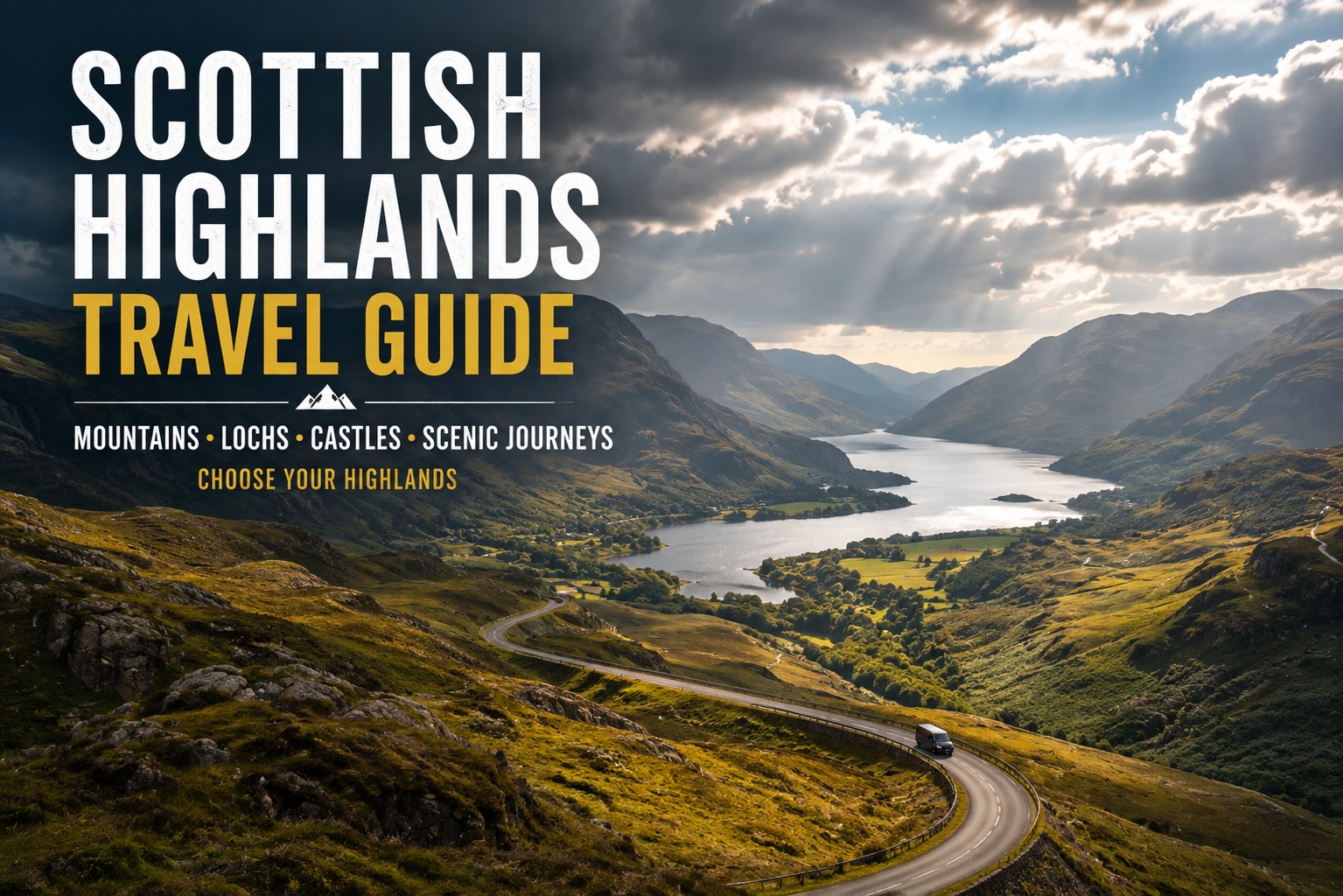
The Scottish Highlands combine mountains, lochs, castles and spectacular scenic journeys, with each region offering a distinctly different way to experience Scotland
The Scottish Highlands are not a single destination. They are a vast collection of mountain ranges, deep glens, shimmering lochs, historic castles, forests, coastlines and remote communities, with landscapes that can change dramatically during the course of a single journey.
For first-time visitors, that scale is part of the excitement—and one of the biggest planning challenges. Glen Coe, Loch Ness, the Cairngorms and the remote north-west may all appear beneath the broad label of “the Highlands”, but they offer distinctly different experiences. Trying to include too much can turn an extraordinary journey into a succession of long drives and hurried stops.
The secret is to choose your Highlands rather than attempt to see them all.
Perhaps your idea of Scotland is a road winding beneath the towering mountains of Glen Coe. You may be drawn towards Loch Ness and the Great Glen, want to explore castles surrounded by spectacular scenery, or prefer the forests, wildlife and walking opportunities of the Cairngorms. Travellers with more time can venture farther into Wester Ross, Torridon and Assynt, where the landscapes become increasingly remote and the journey itself becomes one of the principal attractions.
This Scottish Highlands travel guide is designed to help you make those choices.
It builds on the wider BVT Scotland travel-planning journey by looking closely at the Highlands themselves: how the principal regions differ, which lochs and castles fit naturally into particular routes, how many days you realistically need and the best ways to travel between them.
There is no need to cover enormous distances to have an unforgettable Highland experience. A carefully planned two or three-day journey can be immensely rewarding, while four or five days creates opportunities to explore more deeply and experience the quieter atmosphere that appears after many day visitors have departed.
Above all, allow the landscape to set the pace.
In the Highlands, the road between two famous places can be every bit as memorable as the places themselves. Mountain passes, unexpected viewpoints, changing weather and quiet loch shores are not interruptions to the itinerary. They are part of it.
🏔️ Choose Your Scottish Highlands
Don’t try to see all of the Highlands. Choose the Highland experience that suits you.
The Scottish Highlands cover an enormous and remarkably varied area. A rewarding journey begins by deciding what kind of Highland experience you want, then matching your available time, route and travel style to that choice.
Region → Time Available → Route → Travel Style
⛰️ Western Highlands
Choose for dramatic mountains, deep glens and a classic first Highland experience. Glen Coe and Fort William provide an especially strong introduction.
🌊 Great Glen
Choose for Loch Ness, castles and a naturally coherent touring route linking Fort William with Fort Augustus and Inverness.
🌲 Cairngorms
Choose for forests, wildlife, mountain landscapes and outdoor experiences where spending longer in one area can be particularly rewarding.
🏔️ North-West Highlands
Choose for remoteness, photography, wild coast and mountain scenery, and slower journeys through Wester Ross, Torridon and Assynt.
🧭 BVT Planning Principle: Start with one principal Highland region and build a geographically coherent journey around it. Scotland rewards travellers who give the landscape enough time rather than trying to collect the greatest number of destinations.
🧭 Understanding the Scottish Highlands
Before deciding which castles to visit or scenic roads to follow, it helps to understand just how varied the Highlands really are.
There is no single Highland experience. The western mountains around Glen Coe feel markedly different from the forests and high plateaux of the Cairngorms, while landscapes become wilder and settlements increasingly scattered as you travel towards the north-west.
Choosing between these regions is therefore one of the most important decisions in planning your journey.
⛰️ The Western Highlands
For many first-time visitors, the Western Highlands provide the scenery they imagined before arriving in Scotland.
Glen Coe is the great introduction: a dramatic landscape of steep mountain slopes, deep valleys and changing light that can make the same view appear completely different within minutes. Continue towards Fort William and the landscape remains imposing, with Ben Nevis—the highest mountain in the British Isles—rising above an area that has become one of Scotland’s principal centres for walking and outdoor adventure.
The Western Highlands also provide a natural route towards the coast. From Fort William, the celebrated Road to the Isles travels west through increasingly remote scenery towards Mallaig, creating opportunities to experience mountains, lochs, coastline and small communities within one journey.
For travellers seeking maximum scenic impact on a first Highland visit, this region is difficult to surpass.
🌊 The Great Glen and Loch Ness
Running between Fort William and Inverness, the Great Glen creates one of Scotland’s most natural touring corridors.
Here, mountains and long stretches of water guide the journey north-east through a landscape shaped by geology and centuries of human history. Loch Ness is its internationally famous centrepiece, but treating the loch as an isolated attraction misses much of what makes this route rewarding.
Fort Augustus, the Caledonian Canal, Urquhart Castle and Inverness can all form part of the wider journey, making the Great Glen particularly suitable for travellers wanting scenery, history and recognisable Scottish landmarks within a coherent route.
🌲 The Cairngorms
The Cairngorms offer a noticeably different Highland experience.
Rather than the steep-sided drama associated with Glen Coe, visitors encounter expansive mountain country, forests, rivers and communities surrounded by remarkable natural landscapes. Walking, cycling and wildlife watching are major attractions, although sightings of particular species can never be guaranteed.
This is a region that often rewards staying longer rather than simply driving through.
🏔️ The North-West Highlands
Travel farther towards Wester Ross, Torridon and Assynt and remoteness increasingly becomes part of the attraction.
Distances become more significant, services less frequent and the landscapes exceptionally wild. Isolated mountains, ancient rock formations, sea lochs and dramatic coastline make the north-west particularly rewarding for photographers, walkers and travellers who actively seek quieter places.
It also demands realistic planning. This is not a region to squeeze casually into an already crowded itinerary.
| Highland Region | Character | Best For | Useful Time to Allow |
|---|---|---|---|
| Western Highlands | Dramatic mountains and glens | First visits and scenery | 2–3 days |
| Great Glen | Lochs, castles and history | Classic touring | 2–3 days |
| Cairngorms | Mountains, forests and wildlife | Outdoor experiences | 2–4 days |
| North-West Highlands | Remote mountains and coast | Slow travel and photography | 3–5+ days |
🧭 Which Highland Region Is Right for You?
There is no single “best” part of the Scottish Highlands. Start with the experience you most want from your journey, then choose the region that delivers it without forcing too much distance into the time you have available.
First Highland visit?
↓
Choose the experience that matters most to you
⛰️ Want maximum mountain drama?
→ Western Highlands
A particularly strong choice for a first visit, with Glen Coe, Fort William, dramatic mountain scenery and classic Highland landscapes.
🌊 Want Loch Ness, castles and a classic touring route?
→ Great Glen
Ideal for travellers who want a naturally connected journey through Fort William, Fort Augustus, Loch Ness and Inverness.
🌲 Want walking, forests and wildlife?
→ Cairngorms
Best suited to travellers who want outdoor experiences, mountain landscapes and enough time to explore one region in greater depth.
📷 Want remoteness, photography and slow travel?
→ North-West Highlands
Choose Wester Ross, Torridon and Assynt for wild landscapes, remote roads and journeys where the scenery between destinations becomes part of the experience.
⏳ How much time do you have?
1–3 days → Western Highlands or Great Glen
These regions work particularly well for shorter first journeys because strong Highland experiences can be combined within relatively coherent routes.
Longer stay → Cairngorms or North-West Highlands become increasingly viable
Additional time allows you to travel more slowly, explore in greater depth and absorb the longer distances involved without turning the journey into a race.
🧭 BVT Planning Principle: Choose your Highlands before choosing your attractions. One well-matched region explored properly will usually create a more rewarding journey than trying to combine several distant Highland areas simply because they appear on a map.
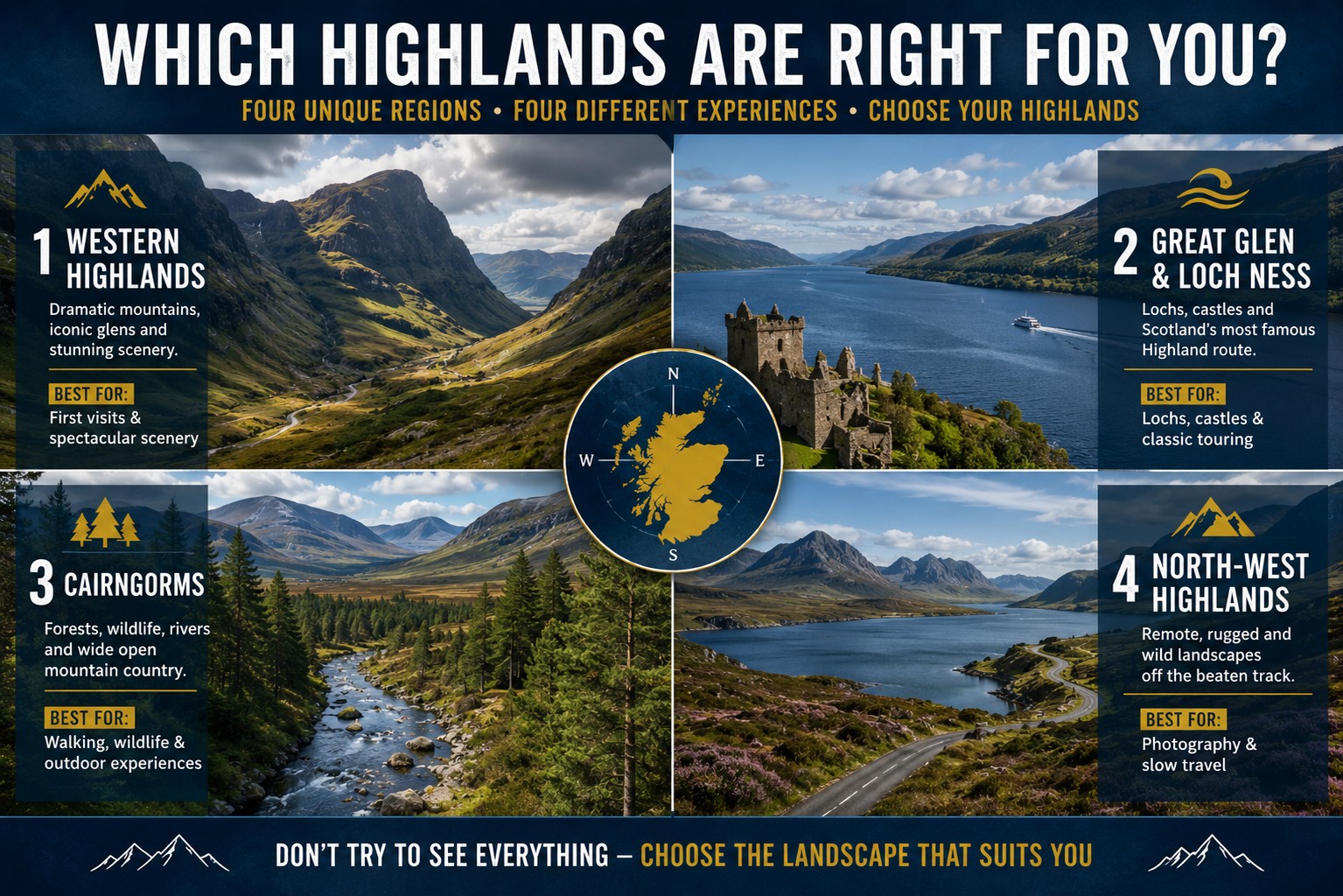
The Scottish Highlands offer very different experiences, from the dramatic mountains of the west and classic Great Glen touring to the forests of the Cairngorms and remote landscapes of the north-west
⛰️ Glen Coe and the Western Highlands
If there is one Highland landscape capable of demonstrating why travelling slowly matters, Glen Coe makes a compelling case.
Frequently described as one of Scotland’s most dramatic glens, its impact comes from more than sheer scale. The road passes beneath steep mountain walls and through an open valley where waterfalls, cloud and shifting light continually alter the character of the landscape. Even visitors who have seen countless photographs often find the scale and atmosphere considerably more powerful in person.
Its history adds another dimension. Glen Coe is closely associated with the infamous massacre of 1692, when members of Clan MacDonald were killed following a period in which government soldiers had received their hospitality. Understanding even a little of this history gives the landscape greater context and helps explain why the glen occupies such a distinctive place in Scottish memory.
For travellers, Glen Coe also works exceptionally well geographically.
The route north continues towards Fort William, creating a natural progression through the Western Highlands. Fort William sits beneath Ben Nevis and serves as an important base for walking, outdoor activities and journeys farther west or north. You do not need to climb mountains to appreciate the area; much of its appeal can be experienced simply by travelling through the landscape and allowing sufficient time for well-chosen stops.
🚂 From Fort William Towards the Coast
Travellers continuing west can follow one of Scotland’s great scenic corridors towards Mallaig.
The Road to the Isles passes through a landscape of mountains, freshwater lochs and increasingly strong coastal influences. The celebrated West Highland Line follows part of this same remarkable corridor, demonstrating how both road and rail can become experiences in their own right rather than merely ways of reaching the next destination.
Mallaig provides ferry connections towards Skye and other island communities, making the Western Highlands a natural component of a longer Scotland journey.
The important planning lesson is not to underestimate this region. Glen Coe, Fort William and the western route may appear close together on a map, but viewpoints, historic places and the scenery itself continually encourage stops.
Allocating enough time turns what could be a hurried transfer into one of the defining journeys of a Scotland holiday.
For a first visit, the Western Highlands offer an exceptionally strong combination of accessibility, mountain drama and onward touring possibilities.
🌊 Loch Ness and the Great Glen
From Fort William, another of Scotland’s great natural routes leads north-east through the Great Glen towards Inverness.
Loch Ness may provide the famous name, but the wider journey reveals why this remarkable geographical corridor deserves to be experienced as a whole.
⛰️ Glen Coe and the Western Highlands
If there is one Highland landscape capable of demonstrating why travelling slowly matters, Glen Coe makes a compelling case.
Frequently described as one of Scotland’s most dramatic glens, its impact comes from more than sheer scale. The road passes beneath steep mountain walls and through an open valley where waterfalls, cloud and shifting light continually alter the character of the landscape. Even visitors who have seen countless photographs often find the scale and atmosphere considerably more powerful in person.
Its history adds another dimension. Glen Coe is closely associated with the infamous massacre of 1692, when members of Clan MacDonald were killed following a period in which government soldiers had received their hospitality. Understanding even a little of this history gives the landscape greater context and helps explain why the glen occupies such a distinctive place in Scottish memory.
For travellers, Glen Coe also works exceptionally well geographically.
The route north continues towards Fort William, creating a natural progression through the Western Highlands. Fort William sits beneath Ben Nevis and serves as an important base for walking, outdoor activities and journeys farther west or north. You do not need to climb mountains to appreciate the area; much of its appeal can be experienced simply by travelling through the landscape and allowing sufficient time for well-chosen stops.
🚂 From Fort William Towards the Coast
Travellers continuing west can follow one of Scotland’s great scenic corridors towards Mallaig.
The Road to the Isles passes through a landscape of mountains, freshwater lochs and increasingly strong coastal influences. The celebrated West Highland Line follows part of this same remarkable corridor, demonstrating how both road and rail can become experiences in their own right rather than merely ways of reaching the next destination.
Mallaig provides ferry connections towards Skye and other island communities, making the Western Highlands a natural component of a longer Scotland journey.
The important planning lesson is not to underestimate this region. Glen Coe, Fort William and the western route may appear close together on a map, but viewpoints, historic places and the scenery itself continually encourage stops.
Allocating enough time turns what could be a hurried transfer into one of the defining journeys of a Scotland holiday.
For a first visit, the Western Highlands offer an exceptionally strong combination of accessibility, mountain drama and onward touring possibilities.
🌊 Loch Ness and the Great Glen
From Fort William, another of Scotland’s great natural routes leads north-east through the Great Glen towards Inverness.
Loch Ness may provide the famous name, but the wider journey reveals why this remarkable geographical corridor deserves to be experienced as a whole.
The Great Glen cuts diagonally across the Highlands, creating a natural corridor of lochs and waterways between Fort William and Inverness. Travelling through it provides an excellent sense of Highland geography because the route combines mountain scenery, historic settlements and some of Scotland’s most recognisable landmarks without requiring constant detours.
Loch Ness dominates the journey.
Stretching for more than 20 miles through the Great Glen, its dark waters and steep surrounding hills create an atmosphere that remains compelling regardless of whether you have any interest in its legendary monster. The Nessie story has given the loch worldwide fame, but its landscape, scale and history provide more substantial reasons to visit.
🏰 Urquhart Castle and Loch Ness
Urquhart Castle occupies one of the most memorable positions on Loch Ness.
Its ruins stand beside the water against a backdrop of Highland hills, combining centuries of Scottish history with one of the country’s classic views. The castle witnessed repeated conflict and changes of control, while its position makes it a natural historical stop rather than an attraction requiring an awkward diversion from the wider Great Glen journey.
Farther south, Fort Augustus provides another perspective. Here, visitors can watch boats moving through the locks of the Caledonian Canal while exploring a compact Highland village at the southern end of Loch Ness.
The canal itself is an important part of the story. By connecting natural lochs with constructed waterways through the Great Glen, it creates a navigable route between Scotland’s east and west coasts and adds another layer to the region’s remarkable geography.
🧭 Inverness as a Highland Gateway
At the north-eastern end of the Great Glen, Inverness is both a destination in its own right and an important gateway for exploring farther afield.
Travellers can continue towards the Cairngorms, venture into the northern Highlands or use the city as a practical overnight base before beginning another regional journey. Its transport connections are particularly useful for visitors who want to experience the Highlands without driving every stage of their holiday.
For a first visit, the Great Glen works especially well because its principal experiences fit together naturally.
Rather than racing to Loch Ness for a photograph and immediately turning back, allow the wider corridor to become part of the experience. Glen Coe, Fort William, Fort Augustus, Loch Ness and Inverness can form a coherent journey in which scenery, geography and history develop progressively along the route.
🌊 The Great Glen and Loch Ness Journey
Loch Ness works best as part of a Highland journey, not as an isolated attraction.
The Great Glen creates one of Scotland’s most naturally coherent touring corridors. Rather than treating each famous location as a separate stop, follow the landscape north and allow the journey itself to connect mountains, lochs, castles and Highland communities.
⛰️ Glen Coe
Dramatic mountain gateway
↓
🏔️ Fort William
Western Highland base beneath Ben Nevis
↓
⚓ Fort Augustus
Great Glen stopping point at the southern end of Loch Ness
↓
🌊 Loch Ness
The iconic loch at the heart of the route
↓
🏰 Urquhart Castle
Historic ruins overlooking the loch
↓
🏙️ Inverness
Natural gateway to the northern Highlands
🧭 Think corridor, not checklist.
Following a coherent route reduces unnecessary backtracking and gives each stop geographical context. Glen Coe introduces the mountain landscape, Fort William leads naturally into the Great Glen, and Loch Ness becomes part of a wider journey towards Inverness rather than simply another attraction to collect.
🌊 BVT Route Principle: Build the journey around the geography. When destinations naturally connect, the travelling between them becomes part of the Highland experience rather than time lost moving from one attraction to another.
🌲 The Cairngorms: A Different Highland Experience
The Cairngorms demonstrate just how misleading it can be to imagine the Scottish Highlands as one uniform landscape.
Instead of the steep-sided glens and rugged western mountains encountered around Glen Coe, the Cairngorms open into a vast environment of high plateaux, broad valleys, rivers and forests. Much of this remarkable landscape lies within Cairngorms National Park, creating a Highland experience that feels spacious, natural and particularly rewarding for visitors who want to spend meaningful time outdoors.
The mountains remain impressive, but the experience is not simply about their height.
Caledonian pinewoods, heather-covered landscapes, rivers and freshwater habitats support a rich variety of wildlife. Visitors may hope to encounter red deer, red squirrels or some of the region’s distinctive birdlife, but wildlife should always be appreciated on its own terms: sightings cannot be guaranteed, and responsible observation is essential.
🥾 A Highland Region Worth Exploring Slowly
The Cairngorms are particularly well suited to travellers who want to do rather than simply see.
Walking opportunities range from gentle forest and loch-side outings to serious mountain expeditions requiring appropriate experience, equipment, preparation and conditions. Cycling, scenic touring and nature watching provide rewarding alternatives, meaning visitors do not need to venture onto the highest ground to experience the character of the region.
Highland communities and villages also give the Cairngorms a different rhythm from a conventional sightseeing circuit. Aviemore provides a practical base for exploring the surrounding landscape, while other communities offer opportunities to slow down rather than change accommodation every night.
Seasonality matters here.
Summer brings long daylight hours and extensive opportunities for outdoor exploration, while autumn can transform woodland landscapes with rich colour. Winter creates an altogether different environment, with snow, limited daylight and rapidly changing mountain conditions demanding considerably greater care and flexibility.
Rather than treating the Cairngorms as another stop between Scotland’s cities and Inverness, consider spending at least a full day exploring one part properly. Travellers with strong interests in walking, wildlife or outdoor experiences may comfortably devote several days to the wider area.
If your priority is immediately dramatic roadside scenery, the Western Highlands may have greater first-visit appeal. If you want forests, wildlife, mountain activity and time immersed in a large natural landscape, the Cairngorms may suit you better.
Neither represents the definitive Highlands.
Together, they demonstrate its remarkable variety.
🏔️ Explore the Remote North-West Highlands
Beyond Scotland’s best-known Highland corridors, the landscape becomes quieter, distances grow longer and communities become increasingly scattered.
Wester Ross, Torridon and Assynt belong to a different kind of journey—one in which remoteness is not an inconvenience to overcome, but a fundamental part of the experience.
The North-West Highlands contain some of Scotland’s most extraordinary scenery, but they reward a very different approach from the better-known routes around Glen Coe and Loch Ness.
In Wester Ross, mountains rise beside sea lochs and long stretches of sparsely populated coastline. Torridon is renowned for immense, isolated peaks that appear particularly dramatic against the surrounding glens and water, while farther north around Assynt the landscape becomes even more distinctive, with individual mountains rising from ancient rocky terrain punctuated by countless lochs.
This is Scotland on a grand scale.
Yet the attraction is not simply visual. The north-west encourages travellers to slow down because progress itself is naturally slower. Roads can be narrow or single-track, communities are farther apart and an apparently modest distance on a map may take considerably longer than expected.
🚗 Plan for Remoteness, Not Against It
Successful journeys through the north-west begin with realistic expectations.
Accommodation can be limited during popular periods, fuel stations and shops may be separated by considerable distances, and reliable mobile coverage should not be assumed everywhere. Weather can also transform conditions quickly, particularly for travellers planning walks or journeys through exposed landscapes.
These are not reasons to avoid the region. They are reasons to give it sufficient time.
Single-track roads require particular consideration. Passing places must remain clear for their intended purpose and should never be treated as parking spaces. Drivers should also remain conscious that these roads serve local communities and working traffic, not simply visitors following scenic itineraries.
Travellers who approach the north-west patiently are rewarded with an experience markedly different from Scotland’s busiest visitor corridors.
There are fewer headline attractions demanding attention and more opportunities simply to appreciate the landscape: a quiet sea loch beneath changing skies, an isolated mountain reflected in still water or a stretch of coastline that feels wonderfully removed from the pace of Scotland’s cities.
The North Coast 500 has introduced many more travellers to northern Scotland, but the region deserves more than being treated as a circuit to complete. Exploring a smaller area properly can be considerably more rewarding than racing around an ambitious route simply to say you have finished it.
For photographers, walkers and experienced independent travellers, the North-West Highlands may ultimately become the most memorable part of Scotland.
For a short first Highland visit, however, Glen Coe or the Great Glen will usually provide a more practical introduction.
That difference is precisely why choosing the right Highland region matters.
🌊 Highland Lochs Beyond Loch Ness
Loch Ness may possess the famous name, but Highland Scotland is shaped by water.
Across different regions, lochs define valleys, frame castles, reflect mountains and often determine the natural direction of a journey.
Different lochs belong naturally to different Highland journeys, and choosing them according to your route usually creates a better itinerary than attempting to collect famous names individually.
🌊 Loch Ness
Loch Ness fits naturally within a Great Glen itinerary.
Its immense scale, Highland setting, international legend and proximity to Urquhart Castle make it particularly rewarding for first-time visitors. Rather than treating the loch as an isolated destination, combine it with Fort Augustus, Inverness or a wider journey between Fort William and the north.
🌿 Loch Lomond
Loch Lomond provides one of the most accessible gateways towards Highland scenery.
Its location makes it particularly convenient for travellers beginning in Glasgow or continuing towards the Western Highlands. Wooded shores, islands and surrounding hills provide a gentler introduction than Glen Coe, while the loch’s position makes it especially valuable as part of a wider journey through western Scotland.
🏞️ Loch Shiel
Loch Shiel belongs naturally to a journey through the Western Highlands.
Surrounded by mountains and closely associated with the scenic corridor towards Scotland’s west coast, it offers the kind of landscape many travellers hope to discover beyond the largest visitor centres. It fits particularly well into journeys towards Mallaig along the Road to the Isles.
🌄 Loch Maree
Farther north-west, Loch Maree provides a markedly wilder experience.
Mountains rise around this long freshwater loch within the landscapes of Wester Ross, making it particularly attractive to photographers and travellers exploring Scotland at a slower pace. It is not a sensible addition to a short first-time itinerary, but becomes highly rewarding when the north-west itself is the destination.
| Loch | Main Appeal | Natural Route |
|---|---|---|
| Loch Ness | Legend, history and scale | Great Glen |
| Loch Lomond | Accessible scenic gateway | Glasgow towards Western Highlands |
| Loch Shiel | Mountains and western landscapes | Road to the Isles |
| Loch Maree | Remote scenery | Wester Ross and North-West Highlands |
The practical lesson is simple: do not chase lochs around Scotland.
Choose a strong route and allow the lochs to become part of the landscape through which you travel.
🏰 Castles of the Scottish Highlands
Scotland’s castles are often at their most memorable when history and landscape work together.
Urquhart Castle overlooking Loch Ness is an obvious example, while Eilean Donan occupies an extraordinary waterside setting on a natural approach towards Skye. Farther north, Dunrobin Castle can complement a northern Scotland itinerary, while Inveraray Castle belongs naturally within journeys through Argyll and western Scotland.
Trying to include every famous castle would create an inefficient itinerary.
Instead, select historic sites that fit the region you have chosen. This preserves time for the landscape while allowing castles to deepen your understanding of the places through which you are travelling.
🏰 Choose Highland Castles That Fit Your Route
The best Highland castle is often the one that belongs naturally to the journey you are already making.
Scotland has far too many remarkable castles to treat them as a separate checklist. A stronger itinerary begins with the region you want to explore, then adds the historic site that fits that route without creating unnecessary detours or rushed travel.
🌊 Great Glen and Loch Ness
→ Urquhart Castle
A natural historical stop overlooking Loch Ness, fitting directly into journeys between Fort Augustus and Inverness.
🏝️ Route Towards Skye
→ Eilean Donan Castle
One of Scotland’s most recognisable castle settings and particularly convenient when travelling west towards Skye.
🏔️ Northern Highlands
→ Dunrobin Castle
A strong addition to a longer northern Scotland journey, rather than something to force into a short first-time Highland itinerary.
🌿 Argyll and Western Scotland
→ Inveraray Castle
A logical historic stop for travellers exploring Argyll, Loch Fyne and the western side of Scotland.
🧭 The Better Planning Order
Choose Your Region → Build Your Route → Add the Castle That Naturally Belongs
🏰 BVT Planning Principle: Do not drive across the Highlands simply to collect famous castles. Choose historic sites that deepen the route you are already travelling and preserve enough time for the landscapes around them.
🚗 Scotland’s Great Highland Scenic Journeys
In the Highlands, getting there is rarely just a logistical necessity.
A successful itinerary treats scenic roads and railways as experiences rather than empty space between attractions. Distances that appear modest on a map can become memorable half-day journeys once viewpoints, villages and natural stops are allowed sufficient time.
⛰️ Through Glen Coe
The journey through Glen Coe is one of Scotland’s classic scenic experiences.
Mountains rise dramatically around the road, while waterfalls, moorland and rapidly changing weather continually reshape the landscape. The strongest itineraries resist the temptation to hurry through simply because Fort William or Loch Ness lies farther ahead.
🌊 Along the Great Glen
The Great Glen offers a different kind of journey.
Running between Fort William and Inverness, this remarkable natural corridor combines lochs, mountains, the Caledonian Canal and historic settlements. It works particularly well for first-time visitors because major Highland experiences connect logically rather than requiring lengthy diversions.
🚂 The Road to the Isles
Travelling west from Fort William towards Mallaig reveals another side of Highland Scotland.
Mountains gradually give way to sea lochs and coastal landscapes, while road and railway share parts of the same spectacular corridor. For travellers continuing towards Skye or the western islands, the transition from mountains to coast becomes part of the adventure.
🌲 Through the Cairngorms
Journeys through the Cairngorms feel broader and more open.
Forests, rivers, mountain views and Highland communities replace some of the steep-sided drama of the west. This is an excellent region for combining scenic travel with walking, wildlife watching and longer stops.
🏔️ Into the North-West
Farther north-west, conventional ideas about journey time become increasingly unhelpful.
Routes through Wester Ross, Torridon and Assynt are shaped by single-track roads, isolated landscapes and viewpoints that encourage frequent pauses. Trying to maintain an aggressive timetable largely defeats the purpose of travelling here.
| Scenic Journey | Character | Best For | Planning Note |
|---|---|---|---|
| Glen Coe | Dramatic mountain corridor | First visits | Allow time for scenic stops |
| Great Glen | Lochs, history and mountains | Classic touring | Combines naturally with Loch Ness |
| Road to the Isles | Mountains to western coast | Skye and island journeys | Make the journey part of the day |
| Cairngorms | Forests and open mountain country | Nature and active travel | Stay longer where possible |
| North-West Highlands | Remote coast and mountains | Photography and slow travel | Keep daily distances realistic |
The best scenic Highland journey is not necessarily the longest.
It is the one where your timetable leaves enough space to stop when Scotland gives you a reason.
🚗 Choose Your Highland Scenic Journey
In the Scottish Highlands, the road is often part of the destination.
Choose the scenic journey that best matches the experience you want, then give the route enough time to work properly. Different Highland corridors offer very different combinations of mountains, lochs, coast, forests and remoteness.
⛰️ Want Classic Mountain Drama?
→ Glen Coe
Choose this route for steep mountain walls, dramatic glens, waterfalls and one of Scotland’s strongest first-visit Highland experiences.
🌊 Want Lochs, History and a Natural Touring Corridor?
→ Great Glen
Follow the Highland geography between Fort William and Inverness, combining Loch Ness, Fort Augustus, historic sites and mountain scenery within one coherent journey.
🚂 Want Mountains Gradually Becoming Coast?
→ Road to the Isles
Travel west from Fort William towards Mallaig as mountains, freshwater lochs and Highland scenery gradually give way to sea lochs, coastline and island connections.
🌲 Want Forests and Outdoor Exploration?
→ Cairngorms
Choose broad mountain country, forests, rivers, walking opportunities, wildlife watching and Highland communities where spending longer in one area is often particularly rewarding.
🏔️ Want Remote Landscapes and Slow Travel?
→ North-West Highlands
Explore Wester Ross, Torridon and Assynt when isolated mountains, sea lochs, quieter roads, photography and the journey itself are your priorities.
🧭 Quick Scenic Journey Selector
Mountain drama → Glen Coe
Lochs + history → Great Glen
Mountains + coast → Road to the Isles
Forests + outdoor experiences → Cairngorms
Remoteness + photography → North-West Highlands
🚗 In the Highlands, journey time is experience time.
Do not calculate scenic roads as simple transfers. Viewpoints, villages, changing weather and unexpected stops are part of the journey, so realistic itineraries should leave space for them.
🧭 BVT Planning Principle: Choose one scenic corridor that matches your priorities and protect enough time to enjoy it. A shorter route travelled well is often more memorable than a longer route driven against the clock.
⏳ How Many Days Do You Need in the Scottish Highlands?
There is no minimum number of days required to appreciate the Highlands, but the experience changes considerably as more time becomes available.
The important distinction is between seeing a Highland landscape and genuinely exploring the Highlands.
⏱️ One Day in the Highlands
A single day can provide an excellent introduction, particularly when travelling from Edinburgh or Glasgow, but expectations need to remain realistic.
Rather than attempting to reach several distant regions, concentrate on one coherent journey. Loch Lomond can work particularly well from Glasgow, while a carefully planned excursion through Glen Coe can provide an impressive introduction to the Western Highlands.
One day should create a taste of the Highlands, not an attempt to conquer them.
🗓️ Two to Three Days
Two or three days significantly improve what is possible.
Travellers can begin combining complementary landscapes rather than constantly returning to the same base. A journey incorporating Glen Coe, Fort William, the Great Glen and Loch Ness becomes much more realistic, particularly when an overnight stay allows the route to unfold naturally.
This is an excellent timeframe for a first Highland tour.
🌄 Four to Five Days
With four or five days, the emphasis can shift from coverage towards exploration.
You might spend longer in the Western Highlands, combine the Highlands with selected experiences on Skye, explore the Cairngorms more meaningfully or build an itinerary around several overnight bases without changing accommodation every evening.
🏞️ Six to Eight Days
A week opens considerably more possibilities.
Multiple Highland regions can be combined at a sensible pace, while the north-west becomes a much more realistic proposition. Longer itineraries also create valuable flexibility for weather, spontaneous stops and slower days.
| Time Available | Realistic Highland Experience |
|---|---|
| 1 day | Focused Loch Lomond or Glen Coe introduction |
| 2–3 days | Western Highlands, Great Glen and Loch Ness |
| 4–5 days | Deeper regional touring or Highlands with Skye |
| 6–8 days | Multiple regions, including more remote areas |
The best itinerary is not the one containing the greatest number of pins on a map.
It is the one that leaves enough time to experience the places between them.
⏳ How Long Do You Need in the Scottish Highlands?
Choose the amount of time that allows your route to breathe.
The Highlands can be rewarding in a single day, but the experience changes considerably as more time becomes available. The key is not simply what can technically fit into the itinerary, but what can be enjoyed without excessive driving, rushed stops or unrealistic regional combinations.
⏱️ 1 Day — One Focused Highland Introduction
Works well for:
Loch Lomond or a focused Glen Coe journey from a suitable Scottish base.
Do not attempt:
Several Highland regions, Loch Ness plus multiple distant stops, or a long route simply to maximise the number of places visited.
🗓️ 2–3 Days — The Classic First Highland Journey
Works well for:
Western Highlands + Glen Coe + Fort William + Great Glen + Loch Ness, particularly when overnight stays allow the route to progress naturally.
Do not attempt:
Adding the remote North-West Highlands or too many major detours. This timeframe is strongest when one coherent Highland corridor remains the priority.
🌄 4–5 Days — Greater Highland Depth
Works well for:
A deeper Western Highlands journey, Highlands plus selected Skye experiences, more meaningful Cairngorms exploration or several carefully connected overnight bases.
Do not attempt:
Collecting every famous Highland destination. Four or five days creates more choice, but strong priorities still produce the better journey.
🏞️ 6–8 Days — Multiple Regions and Remote Landscapes
Works well for:
Combining several Highland regions at a sensible pace, including longer stays, scenic detours and more remote areas such as Wester Ross, Torridon or Assynt.
Do not attempt:
Treating a week as permission to cover the whole Highlands. Even longer itineraries benefit from geographical focus and realistic daily mileage.
🧭 Quick Highlands Time Planner
1 Day → Loch Lomond or Glen Coe
2–3 Days → Western Highlands + Great Glen + Loch Ness
4–5 Days → Deeper Highlands + selected Skye or focused regional exploration
6–8 Days → Multiple Highland regions + remote north-west becomes realistic
⏳ More time should create more depth—not simply more destinations.
Use additional days to slow the pace, reduce backtracking, stay longer in rewarding places and leave room for weather, viewpoints and unplanned stops.
🧭 BVT Planning Principle: Choose the shortest itinerary that comfortably supports the Highland experience you want. If the route only works by rushing, it is too ambitious.
🚆 How to Explore the Scottish Highlands
Once you know where you want to go and how much time you have, the next decision is how to travel.
There is no universally best option. Rail, guided touring, small-group travel and self-drive each suit different Highland journeys—and understanding their limitations is just as important as recognising their advantages.
🚆 Exploring the Highlands by Rail
Scotland has several railway journeys that are experiences in their own right.
Rail can take travellers to important Highland gateways including Inverness and Fort William, while routes through mountain and coastal landscapes provide opportunities to enjoy the scenery without concentrating on the road. For visitors combining Scotland’s cities with selected Highland destinations, the train can be an exceptionally comfortable option.
Its limitation is reach. Many remote glens, lochs, castles and north-western landscapes lie well beyond the railway network, so additional transport or organised excursions may still be required.
🚌 Guided Highland Tours
For first-time visitors, an organised tour can remove much of the logistical pressure from exploring the Highlands.
Driving, navigation and route planning are handled for you, leaving more time to watch the landscape and understand what you are seeing. A knowledgeable guide can also provide historical and geographical context that transforms an attractive viewpoint into a much richer experience.
Guided touring is particularly useful when available time is limited and you want several complementary experiences arranged into a coherent route.
👥 Small-Group Touring
Small-group tours can provide a more personal way to explore.
Smaller vehicles may suit certain Highland routes particularly well, while fewer passengers can create a relaxed atmosphere and greater interaction with the guide. They can be an excellent choice for couples, solo travellers and visitors who value interpretation but would rather not drive themselves.
The itinerary is still organised, however, so travellers wanting complete freedom may prefer independent touring.
🚗 Self-Drive Highlands
Driving provides maximum flexibility.
You can pause at viewpoints, adapt plans and explore remote regions that are difficult to reach by public transport. This freedom becomes particularly valuable in Wester Ross, Torridon, Assynt and other areas where the journey itself is central to the experience.
It also brings responsibility. Highland roads may be narrow or single-track, weather can change rapidly, parking should never obstruct roads or passing places, and ambitious daily mileage can become tiring surprisingly quickly.
| Travel Style | Main Strength | Main Limitation |
|---|---|---|
| Rail | Comfortable scenic travel | Limited access to remote areas |
| Guided Tour | Easy planning and interpretation | Predetermined route |
| Small Group | Personal touring experience | Less freedom than self-drive |
| Self-Drive | Maximum route flexibility | Driving and planning responsibility |
Choose the travel style that makes the Highlands easier to enjoy—not simply the one that appears to cover the greatest distance.
🚆 How Should You Explore the Scottish Highlands?
The best way to explore the Highlands depends on how much independence you want, how comfortable you are with driving and how much of the route planning you want someone else to handle.
There is no universally better travel style. Start with the way you prefer to travel, then choose the option that gives you the right balance of freedom, guidance and access to the places you most want to experience.
🚫 Don’t Want to Drive?
→ Rail or Guided Touring
Use rail for comfortable travel between suitable gateways, or choose guided touring when you want easier access to Highland landscapes beyond the principal rail network.
🚌 Want the Route Planning Handled for You?
→ Guided Tour
A strong choice when you prefer an organised itinerary, established sightseeing route and less responsibility for navigating, parking and daily logistics.
👥 Want Guidance with a More Personal Atmosphere?
→ Small-Group Tour
Useful for travellers who value local interpretation and an organised route but prefer a smaller group environment and a more informal touring experience.
🚗 Want Maximum Independence and Remote Access?
→ Self-Drive
Best suited to confident drivers who want control over their route, stopping times and overnight locations, particularly when exploring quieter or more remote Highland areas.
🚆 Want Independent Gateway Travel but Guided Highland Exploration?
→ Rail + Regional Tour
Travel independently to a suitable Scottish gateway, then join a regional tour for the parts of the Highlands where organised road transport and local guidance add the greatest value.
🧭 Quick Travel Style Selector
Avoid driving → Rail or guided touring
Minimum planning responsibility → Guided tour
Guidance + smaller group atmosphere → Small-group tour
Maximum independence → Self-drive
Independent arrival + organised Highlands → Rail + regional tour
🚆 Match the transport to the journey—not the journey to the transport.
Rail can be excellent for reaching Highland gateways, guided touring can simplify complex regional routes, and self-drive provides greater independence. Many successful journeys combine more than one approach.
🧭 BVT Planning Principle: Decide how much planning responsibility and independence you want before choosing your transport. The strongest option is the one that lets you experience the Highlands comfortably without making the logistics dominate the journey.
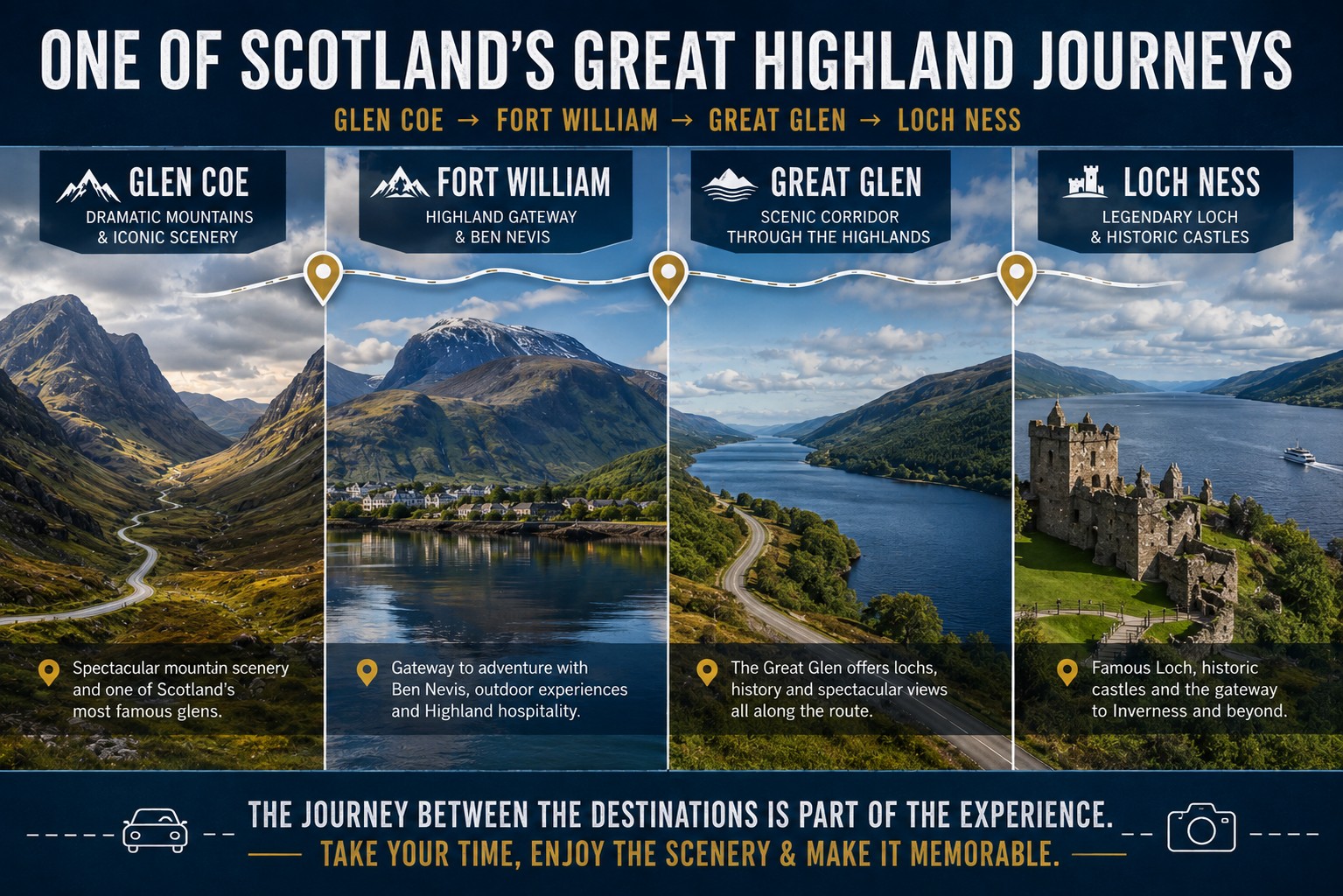
Glen Coe, Fort William, the Great Glen and Loch Ness form one of Scotland’s classic Highland journeys, where the landscapes and roads between destinations are an important part of the experience
📅 When Is the Best Time to Visit the Highlands?
There is no single perfect season.
Spring, summer, autumn and winter each change the landscapes, daylight, visitor numbers and practical conditions, meaning the best time to visit depends largely on the Highland experience you want.
🌸 Spring in the Highlands
Spring gradually brings longer daylight hours, fresh colour and greater opportunities for exploring outdoors.
Visitor numbers can be lower than during peak summer, while woodland, glens and loch shores begin to change character as the season develops. Conditions can still be unpredictable, particularly in mountain areas, so waterproof clothing, sensible layers and flexible plans remain important.
For travellers who value quieter roads and landscapes awakening after winter, spring can be an excellent time to explore.
☀️ Summer in the Highlands
Summer offers the longest daylight hours and the greatest freedom for ambitious sightseeing days.
Long evenings are particularly valuable in the Highlands, where an extra scenic stop or unhurried evening walk can become a highlight of the journey. Summer is also an important season for Highland Games, festivals and community events.
The trade-off is demand. Popular destinations, accommodation and certain roads can be considerably busier, so advance planning becomes more important.
🍂 Autumn in the Highlands
Autumn can be exceptionally atmospheric.
Woodlands develop rich seasonal colour, lower light can transform familiar landscapes and visitor pressure begins to ease in many places. Photographers may particularly appreciate the combination of changing vegetation, reflective lochs and increasingly dramatic weather.
Daylight reduces as the season progresses, however, so itineraries should become correspondingly less ambitious.
❄️ Winter in the Highlands
Winter reveals another Scotland entirely.
Snow on the mountains, low sunlight and quieter landscapes can create extraordinary scenes, but this is not simply summer touring with fewer visitors. Short daylight hours, changing road conditions, seasonal closures and serious mountain weather require greater preparation and flexibility.
For appropriately prepared travellers, the rewards can be considerable.
📆 Plan Your Journey with the BVT Scotland Events Calendar
Choosing where to explore is only part of planning a memorable Highland journey. When you travel can influence the experience just as strongly.
Highland Games, traditional gatherings, cultural festivals and community events can add an entirely different dimension to a Scotland itinerary. They can also increase local accommodation demand and visitor traffic, particularly in smaller communities where capacity is naturally limited.
The BVT Scotland Events Calendar provides a useful starting point for matching your travel dates with events taking place across Scotland. It can help you discover an experience you would otherwise have missed—or identify particularly busy dates before accommodation and transport plans are finalised.
Always confirm individual event dates, programmes and ticket arrangements with organisers before travelling, as schedules can change.
A Highland journey built around the right event can provide something scenery alone cannot: an opportunity to experience the traditions, communities and living culture behind the landscape.
📅 Plan Your Highland Journey Around Scotland’s Events
The right date can add an entirely different dimension to a Scottish Highlands journey.
Highland Games, traditional gatherings, festivals and seasonal celebrations take place across Scotland throughout the year. Checking what is happening before fixing your route can help you discover experiences worth building into the journey—and identify periods when accommodation, roads and local communities may be particularly busy.
🏴 Highland Games and Traditional Gatherings
Discover opportunities to experience sporting traditions, piping, dancing and community gatherings as part of a wider Highland journey.
🎪 Festivals and Special Events
See what may be taking place around the regions and dates you are considering, then decide whether an event deserves a place in your itinerary.
🍂 Seasonal Celebrations
Match your journey with different times of year, from long summer days and local celebrations to autumn experiences and Scotland’s winter festivities.
🛏️ Plan for Busier Dates
Major events can increase demand for accommodation and affect local traffic. Checking the calendar early can help you plan overnight stops, journey times and important bookings more realistically.
🧭 Choose Your Highlands → Check Your Dates → Discover What’s Happening → Refine Your Route
Use the BVT Scotland Events Calendar as a planning companion rather than an afterthought. A well-timed Highland Games, festival or traditional gathering can become one of the most memorable experiences of the entire journey.
📅 BVT Planning Tip: If a particular event matters to you, check dates before finalising accommodation and transport. Popular gatherings can make the Highlands especially rewarding, but they can also increase demand in smaller communities.
🌱 Sustainable Travel in the Scottish Highlands
The qualities that make the Highlands so rewarding—wild landscapes, small communities and a sense of space—also make thoughtful travel particularly important.
Responsible Highland tourism begins with a simple principle: seeing less, better, can often create a richer journey.
One of the most effective ways to travel more responsibly in the Highlands is to resist the temptation to cover enormous distances simply because a route looks achievable on a map.
Spending longer in fewer places reduces unnecessary mileage while giving more of your time and travel spending to individual communities. An extra night in a Highland town or village can mean another meal in a local restaurant, time to visit an independent attraction and opportunities to discover places that hurried visitors simply pass through.
🥾 Respect the Landscape
Highland landscapes can appear immensely resilient, but some environments are surprisingly vulnerable.
Where established paths are provided, using them helps limit erosion and damage to surrounding vegetation. Peatlands, wetlands and sensitive habitats deserve particular care, while wildlife should always be observed without disturbance or attempts to approach animals too closely.
The principle is straightforward: enjoy wild places without leaving unnecessary evidence of your visit.
🚗 Travel Considerately
Responsible behaviour matters on the road as well as on the trail.
Never block passing places, gateways or access required by local residents and land managers. Park only where it is safe and permitted, allow realistic journey times and remember that scenic Highland roads are also everyday transport routes for the people who live and work here.
Reducing unnecessary backtracking through good itinerary planning can make the journey both more relaxing and more efficient.
🏡 Support Highland Communities
Tourism can make an important contribution to rural economies when visitors spend locally.
Independent accommodation, cafés, restaurants, shops, guides and visitor attractions all provide opportunities for tourism expenditure to remain within the communities being explored. Travelling outside the busiest periods can also help spread demand more evenly, provided local businesses and attractions are operating.
Sustainable travel should never feel like a sacrifice that diminishes the holiday.
In the Highlands, it often produces the opposite result. Slower journeys, locally rooted experiences and greater respect for the landscape can create a more meaningful connection with the places you have travelled so far to see.
Travel with purpose. Explore with care.
🌱 Travel Thoughtfully in the Scottish Highlands
The Highlands are best experienced slowly, carefully and with respect for the landscapes and communities that make them extraordinary.
Responsible Highland travel is not about restricting the journey. It is about planning it more intelligently: reducing unnecessary mileage, giving places more time and making choices that protect fragile environments while supporting the people who live and work there.
🏡 Stay Longer in Fewer Places
Spend more time within individual Highland regions instead of changing location constantly. Slower travel can reduce unnecessary mileage while creating more opportunities to support local accommodation, cafés, restaurants, guides and attractions.
🗺️ Minimise Unnecessary Backtracking
Build a geographically coherent route so that each day progresses naturally. Good sequencing usually means less driving, fewer repeated journeys and more time actually experiencing the Highlands.
🥾 Use Established Paths Where Appropriate
Follow marked or established routes where they are provided, particularly in heavily visited landscapes. This can help reduce erosion and unnecessary damage to surrounding vegetation.
🌿 Protect Peatland and Sensitive Habitats
Peatlands, wetlands and fragile mountain environments can be more vulnerable than they appear. Avoid unnecessary disturbance and follow local guidance when travelling through sensitive areas.
🦌 Observe Wildlife Responsibly
Enjoy wildlife without approaching, feeding or disturbing animals. Give wildlife space, keep noise low and remember that sightings should never be forced or guaranteed.
🚗 Never Park in Passing Places
Passing places on single-track roads are part of the road system, not scenic parking bays. Keep them clear, use designated parking wherever possible and avoid obstructing local traffic.
🚜 Respect Local Access
Do not block gateways, tracks or access used by residents, farmers, land managers or emergency services. Highland roads and rural spaces are working environments as well as visitor destinations.
🤝 Support Highland Communities
Where practical, choose local accommodation, independent cafés and restaurants, regional guides, shops and attractions. Spending locally helps more of the value of tourism remain within the communities you are visiting.
🍂 Consider Travelling Outside Peak Periods
Spring, autumn and other quieter periods can provide rewarding Highland experiences while helping spread demand more evenly, provided the accommodation, attractions and services you need are operating.
🌱 Sustainable Highlands at a Glance
Stay longer → fewer rushed transfers
Plan logically → less unnecessary mileage
Tread carefully → protect sensitive landscapes
Give wildlife space → reduce disturbance
Use rural roads responsibly → respect local communities
Spend locally → support Highland businesses
🌿 Seeing less, better, can create a richer Highland journey.
Slower travel often means more time for landscapes, local communities and the unexpected moments that make the Highlands memorable.
🌱 BVT Responsible Travel Principle: Travel with purpose. Explore with care. Leave enough time to enjoy the Highlands without placing unnecessary pressure on the landscapes, roads and communities that make the journey possible.
❓ Frequently Asked Questions
❓ Where do the Scottish Highlands begin?
There is no single visitor gateway where the Highlands suddenly begin. In practical touring terms, travellers commonly approach Highland landscapes north and west from Scotland’s Central Belt, with Loch Lomond, Perthshire and routes towards Glen Coe or the Cairngorms providing different transitions into Highland country.
❓ Which part of the Highlands is best for a first visit?
The Western Highlands and Great Glen make an excellent first introduction because places such as Glen Coe, Fort William and Loch Ness can be combined into a logical scenic journey. Visitors more interested in forests, wildlife and outdoor activity may prefer the Cairngorms.
❓ How many days do I need in the Scottish Highlands?
Two or three days can provide a rewarding introduction, while four or five days allows substantially more depth. A week is preferable if you want to combine several regions or explore the more remote north-west without rushing.
❓ Can you visit the Scottish Highlands from Edinburgh?
Yes. Edinburgh is a practical starting point for guided day tours and longer journeys into the Highlands. A day trip can provide an excellent introduction, but travellers wanting to reach deeper into the Great Glen, Loch Ness or the Western Highlands will usually benefit from an overnight or multi-day itinerary.
❓ Do you need a car to explore the Highlands?
No. Rail services reach important gateways including Inverness and Fort William, while guided tours provide access to many major Highland landscapes without requiring visitors to drive.
A car becomes particularly useful when exploring remote areas where public transport is limited, but self-drive visitors should be comfortable with narrow roads, single-track sections and passing-place etiquette.
❓ Is Glen Coe or Loch Ness better?
They offer different experiences.
Choose Glen Coe if dramatic mountain scenery is your priority. Choose Loch Ness if you want to combine a famous loch with castles, legends and the wider Great Glen. With two or three days available, both can fit naturally into the same journey.
❓ Is Inverness worth staying in?
Yes, particularly if your itinerary continues into the northern or north-eastern Highlands. Inverness provides accommodation, transport connections and a useful base for Loch Ness and wider regional exploration, while also offering enough character to reward time in the city itself.
❓ Can you combine the Highlands with the Isle of Skye?
Absolutely, but allow enough time.
Skye combines particularly naturally with the Western Highlands, with routes through Glen Coe and Fort William leading towards the island. A four or five-day itinerary provides a much more comfortable starting point than trying to squeeze Skye into a rushed Highland visit.
❓ Which castles should I visit in the Highlands?
Choose castles that fit your route. Urquhart Castle works naturally with Loch Ness, while Eilean Donan is particularly convenient for journeys towards Skye. Farther north, Dunrobin Castle can complement a longer northern Scotland itinerary.
❓ When is the best time to visit the Scottish Highlands?
Late spring through early autumn offers longer daylight and the broadest range of touring possibilities, but there is no universally best month. Summer brings maximum daylight and stronger visitor demand, while spring and autumn can provide quieter journeys. Winter requires considerably greater flexibility around weather, daylight and seasonal opening.
❓ Are the Scottish Highlands suitable for families?
Yes, provided the itinerary matches the ages and interests of the children travelling. Lochs, castles, short nature walks, boat trips and wildlife experiences can create an excellent family journey, but excessively long driving days should be avoided.
❓ Are Highland roads difficult to drive?
Main roads are generally straightforward for confident drivers, but more remote areas can include narrow and single-track roads. Allow extra time, use passing places correctly, never obstruct them when stopping, and avoid building an itinerary around unrealistic daily mileage.
🧭 Final Thoughts: Choose Your Highlands
The Scottish Highlands reward curiosity, but they reward patience even more.
It is tempting to approach the Highlands with a map full of famous names and an ambition to see as many as possible. Yet the journeys that remain most vivid are often those with enough space for the unexpected: cloud lifting from a mountain ridge, still water reflecting an entire glen, an unplanned village stop or a road that becomes more memorable than the attraction at its end.
That is why choosing your Highlands matters.
For a first journey, Glen Coe and the Western Highlands provide extraordinary mountain drama, while the Great Glen combines Loch Ness, castles and history within a natural touring corridor. The Cairngorms offer forests, wildlife and outdoor experiences, while Wester Ross, Torridon and Assynt reward travellers prepared to venture farther and move more slowly.
None is the definitive Scottish Highlands experience.
The best choice is the one that matches your interests, available time and preferred style of travel.
Start with one principal region and build logically around it. Add a castle because it belongs naturally to your route, not simply because it appears on a list of famous Scottish landmarks. Choose lochs that complement the journey, and treat scenic roads, railways and Highland communities as experiences rather than gaps between headline attractions.
Most importantly, leave room in the itinerary.
Scotland’s mountain weather does not follow sightseeing schedules, remote roads take longer than maps sometimes suggest, and some of the finest Highland moments are impossible to timetable in advance. A journey with breathing space gives you the freedom to stop, look and experience the landscape rather than simply move through it.
Whether you have one day or an entire week, the same principle applies: you do not need to see all of the Highlands to experience something remarkable.
Choose well. Travel thoughtfully. Give the landscape time.
The mountains, lochs, castles and scenic journeys will do the rest.
🚌 Explore the Scottish Highlands Your Way
Once you know which Highlands you want to experience, the next decision is how much of Scotland you want your journey to include.
A focused day tour can provide an excellent introduction to Highland scenery from a Scottish gateway, while a multi-day journey creates the time needed to travel deeper into the Highlands, stay overnight within the region and connect destinations such as Glen Coe, Loch Ness and the Isle of Skye at a more natural pace.
🏞️ Scotland Day Tours
Best suited to travellers based in Edinburgh or another suitable gateway who want a focused introduction to Scotland’s landscapes without committing to a longer touring itinerary.
Ideal for: shorter stays, first Highland experiences and visitors who want to keep one principal accommodation base.
🏔️ Scotland Multi-Day Tours
Choose a multi-day journey when you want to travel deeper into Scotland and give major Highland landscapes the time they deserve, with overnight stays creating more realistic regional exploration.
Ideal for: Glen Coe, Loch Ness, the Isle of Skye, longer scenic routes and travellers who want to experience more than one Highland area without compressing everything into a single day.
🧭 Which Should You Choose?
One focused Highland experience → Day Tour
Deeper regional journey with overnight stays → Multi-Day Tour
🚌 BVT Touring Tip: Match the tour to the Highlands you have chosen. If the places you want to experience require long distances or several regions, additional days usually create a more rewarding journey than trying to compress the route.
🌦️ Which Season Is Right for Your Highland Journey?
There is no single best season for the Scottish Highlands. The better question is which season best matches the experience you want.
Daylight, weather, visitor demand and the activities you hope to enjoy can all change the character of a Highland journey. Choose according to your priorities rather than assuming that the busiest months automatically provide the best experience.
🌸 Want Quieter Touring and Increasing Daylight?
→ Spring
A strong choice for travellers who value quieter roads and attractions, lengthening days and landscapes beginning to change with the season. Be prepared for variable Highland weather.
☀️ Want Maximum Daylight and the Greatest Choice of Events?
→ Summer
Long days provide more flexibility for scenic touring and outdoor experiences, while Highland Games, festivals and traditional gatherings can add another dimension to the journey. Expect greater visitor and accommodation demand in popular areas.
🍂 Want Colour, Photography and Fewer Visitors?
→ Autumn
Changing landscapes and softer seasonal light can make autumn particularly rewarding for scenic journeys and photography. Allow for shortening daylight and increasingly changeable conditions as the season progresses.
❄️ Want Winter Landscapes and Are Comfortable with Greater Uncertainty?
→ Winter
The Highlands can feel exceptionally atmospheric in winter, but shorter daylight, changing road conditions, weather disruption and reduced seasonal services require greater flexibility and more conservative planning.
🧭 Four Questions Before Choosing Your Season
🌧️ Weather Tolerance — How comfortable are you changing plans when Highland conditions change?
🌅 Daylight — Do you need long touring days, or would a shorter and slower itinerary suit you?
🛏️ Accommodation Demand — Are you happy to book popular locations well ahead, or do you prefer quieter travel periods?
🥾 Intended Activities — Are scenic touring, walking, wildlife, photography or special events central to your journey?
📅 Choose the experience first. Then choose the season that supports it.
Once you have narrowed down your preferred time of year, check Scotland’s events calendar before fixing your final dates. A Highland Games, festival or seasonal celebration may give you an excellent reason to adjust the journey by a few days.
🌦️ BVT Planning Principle: Highland weather is variable in every season. Build flexibility into the itinerary, carry appropriate clothing and allow the conditions—not an over-packed schedule—to influence the pace of your journey.
🚘 Highland Road and Remote Travel Checklist
Remote Highland journeys reward preparation.
Distances that look modest on a map can take considerably longer on single-track roads, scenic routes and roads where frequent stops are part of the experience. Before travelling into the North-West Highlands or other remote areas, use this checklist to make sure the practical details support rather than disrupt your journey.
✓ Fuel Before Remote Sections
Do not assume the next fuel stop will be close. Check your route and refuel before entering longer or more isolated sections.
✓ Download Maps and Offline Navigation
Save the route before departure so that temporary loss of mobile data does not leave you dependent on a continuous signal.
✓ Book Scarce Accommodation Ahead
Remote communities may have limited accommodation, particularly during popular travel periods. Secure important overnight stops rather than assuming rooms will be available on arrival.
✓ Allow Substantially More Journey Time
Narrow roads, changing conditions, local traffic and scenic stops can make Highland journeys considerably slower than the mileage suggests.
✓ Keep Passing Places Clear
Passing places are part of the single-track road system, not parking spaces or viewpoint bays. Use them correctly and leave them available for approaching and following traffic.
✓ Don’t Rely on Continuous Mobile Coverage
Coverage can be inconsistent in remote areas. Keep essential information available offline and avoid making important parts of the journey dependent on a reliable signal.
✓ Carry Suitable Highland Clothing
Conditions can change quickly. Waterproof outer layers, suitable footwear and additional warm clothing can remain useful even when the day begins well.
✓ Check Conditions Before Walking
Weather at road level may not reflect conditions on higher ground. Check appropriate forecasts and local guidance before committing to walks or mountain activities.
✓ Keep Daily Mileage Realistic
Do not plan remote Highland days using motorway expectations. Leave room for slower roads, viewpoints, meals, weather and the unplanned stops that often become highlights of the journey.
🧭 Before Setting Out
Fuel ✓ Offline Maps ✓ Accommodation ✓ Weather ✓ Realistic Timing ✓
🏔️ Plan for remoteness, not against it.
The slower roads, greater distances and quieter landscapes are part of what makes the remote Highlands special. Build the itinerary around those characteristics rather than trying to overcome them.
🚘 BVT Remote Travel Principle: A realistic Highland driving day is measured by the quality of the journey, not simply the number of miles covered. Allow enough time to travel safely, stop responsibly and enjoy the landscape along the way.
🧭 Continue Exploring Island Scotland
Your island journey can continue in several directions.
Once you have decided which island experience appeals most, use these guides to answer the next questions: where else should you explore, how much time should you allow, how do the Highlands connect with the islands, and when should you travel?
🏔️ Plan the Highlands Before Heading to the Islands
Explore the mountains, lochs, castles and scenic mainland routes that form the natural gateway to many Scottish island journeys.
⏳ Give the Highlands and Islands More Time
See how a multi-day journey creates room for overnight stays, coherent routes and deeper exploration of Scotland’s Highlands and islands.
🚆 Decide How to Travel Through Scotland
Compare rail, escorted touring, small-group journeys and self-drive travel when planning how your island adventure fits into a wider Scotland holiday.
🏴 Discover Where Else to Explore
Step back to the complete Scotland journey and compare the Highlands, islands, cities and legendary landscapes before choosing what belongs in your itinerary.
📅 Choose When to Make Your Island Journey
Discover festivals, Highland Games, seasonal events and travel inspiration that could influence both the character and timing of your Scotland journey.
🧭 Build the Journey in the Right Order
Choose your island → understand the mainland connection → allow enough time → choose how to travel → select the right dates.
🏝️ BVT Island Planning Principle: The strongest island itinerary is rarely the one containing the most islands. Build outward from the experience you want, follow Scotland’s geography and give each part of the journey enough time to be enjoyed properly.