


Why Autumn Is One of the Most Atmospheric Times to Visit Stonehenge (2026 Guide)
9th August 2026
🍂 Why Autumn Is One of the Most Atmospheric Times to Visit Stonehenge (2026 Guide)
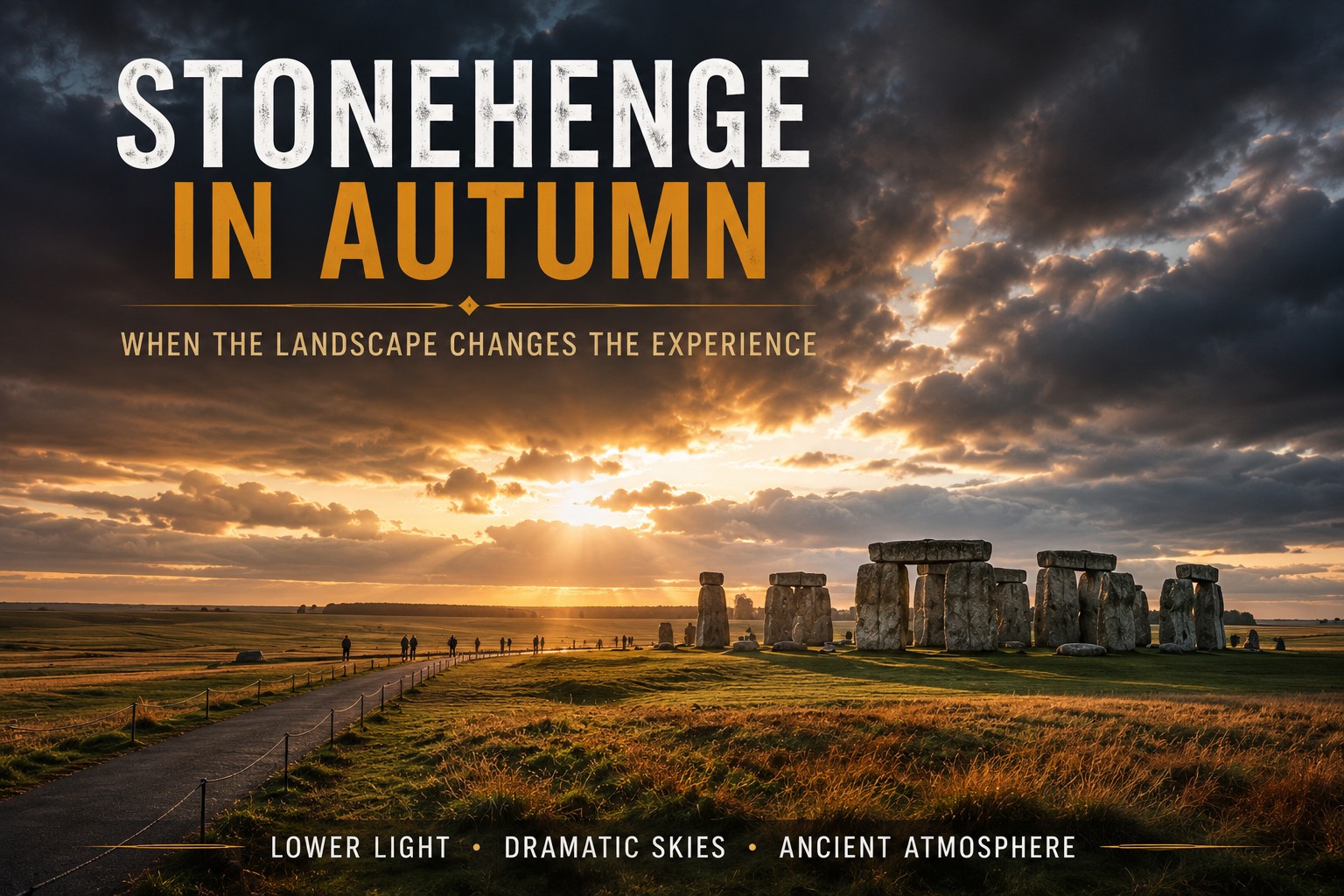
Lower autumn light, dramatic skies and the exposed landscape of Salisbury Plain can give Stonehenge a particularly ancient and atmospheric character
There are days when Stonehenge seems almost inseparable from the weather around it. In autumn, lower-angle sunlight can catch the edges of the stones, long shadows can stretch across the ground, and fast-changing cloud can make Salisbury Plain feel more expansive and elemental.
None of those conditions is guaranteed. An autumn visit might bring soft sunshine, grey skies, wind, rain or several changes of weather within the same day. Yet that unpredictability is part of the season’s appeal.
Summer can make Stonehenge feel monumental. Autumn can make it feel ancient.
The monument itself does not change, but its relationship with light, sky and landscape does. Stonehenge was never simply a collection of stones isolated from its surroundings, and autumn can make that wider setting particularly difficult to ignore.
There are practical trade-offs. Daylight becomes progressively shorter, temperatures generally become cooler and visitors need to be prepared for changeable conditions. Anyone seeking maximum daylight and the greatest likelihood of warmer weather may prefer another season.
But if you value atmosphere more than predictability, autumn can be especially rewarding. The season may bring dramatic skies, softer landscape tones, lower light, striking shadows and a stronger sense of Stonehenge as part of an ancient and exposed landscape.
This guide explains what it is really like to visit Stonehenge in autumn, how September, October and November differ, why seasonal light matters, what to wear and which type of visit may suit you best. It also looks at sunrise and sunset, introduces the autumn equinox and explains how to investigate Stonehenge Inner Circle Access if you want to explore a more distinctive experience.
🍂 Stonehenge in Autumn — When the Landscape Changes the Experience
Stonehenge is extraordinary in every season, but autumn can reveal a different side of the monument. From September into November, changing light, cooler air and an increasingly dramatic landscape can make the stones feel more atmospheric, more mysterious and somehow closer to their ancient past.
☀️ Summer and 🍂 Autumn — Two Different Stonehenges
☀️ Summer can make Stonehenge feel monumental.
Long daylight, brighter skies and the openness of Salisbury Plain emphasise the scale and physical presence of the monument.
🍂 Autumn can make Stonehenge feel ancient.
Lower light, longer shadows, changing skies and a quieter seasonal landscape can emphasise atmosphere, mystery and the extraordinary age of the stones.
🗓️ Autumn Changes Month by Month
🍃 September — Balance
Remaining warmth and useful daylight combine with the first signs of seasonal change.
🍂 October — Atmosphere
Lower light, cooler conditions and increasingly changeable skies can give the landscape a distinctly autumnal character.
🌫️ November — Elemental
Shorter days, colder air and more dramatic weather can create one of the year’s most powerful versions of the Stonehenge landscape.
💡 Autumn Is Not One Experience
A September visit can feel very different from one in late November. That variation is part of autumn’s appeal. Rather than looking for a single “best” autumn month, think about whether you want balance, atmosphere or a more elemental encounter with Stonehenge.
🍁 Why Stonehenge Changes Character in Autumn
Stonehenge is sometimes reduced in photographs to the familiar circle of enormous stones. Visit in person, however, and the surrounding landscape becomes part of the experience.
Salisbury Plain creates space around the monument. The horizon, cloud, wind and seasonal light all influence how Stonehenge appears, and autumn gradually alters each of those relationships.
As the sun sits lower in the sky, shadows can lengthen and the texture of individual stones become more pronounced. Vegetation and landscape tones shift, daylight contracts and cooler air can make the setting feel markedly different from a bright midsummer visit.
On some autumn days, mist or haze may soften the distance; on others, strong wind and rapidly moving cloud can make the entire setting feel more exposed. Neither should ever be promised as an “autumn experience.” The value of the season lies in the wider range of moods it can create.
That matters because Stonehenge is not simply a monument to be viewed in isolation. The stone circle sits within a much larger prehistoric landscape, and weather that draws your attention towards the horizon and surrounding plain can make that broader setting feel much more present.
There is also an important boundary between modern experience and ancient interpretation. We can describe how autumn changes what visitors see and feel today, but we should not invent beliefs for the prehistoric communities who built and used Stonehenge unless archaeology supports them.
The modern visitor experience is compelling enough on its own.
And there is no single version of autumn at Stonehenge.
🌤️ What Is Stonehenge Really Like in Autumn?
🍃 September — The Transition from Summer
September is often the most balanced part of the season.
Daylight remains relatively generous compared with later autumn, while lower seasonal light and changing landscape tones can begin to give Stonehenge a noticeably different character. For first-time visitors who like the idea of autumn but still value flexibility and longer sightseeing days, September can be an excellent compromise.
It should not, however, be treated as guaranteed late-summer warmth. Weather remains variable, and visitor demand can still be influenced by weekends, events and broader travel patterns.
🎃 October — Autumn Takes Centre Stage
By October, the seasonal transition is much harder to miss.
The sun sits lower, evenings arrive earlier and weather preparation becomes more important. For photographers, couples and travellers drawn to stronger autumn character, October can be especially appealing because the relationship between light, cloud and landscape becomes more visually pronounced.
The trade-off is straightforward: conditions become less forgiving. A bright autumn afternoon can be superb, but cold wind or rain are equally plausible companions.
🌫️ November — Stonehenge Becomes More Elemental
November is the most committed autumn choice.
Daylight is shorter, itinerary planning becomes more consequential and visitors should be prepared for colder, wetter or windier conditions. In return, the monument can take on a more austere character, with subdued landscape tones and potentially dramatic skies.
For travellers who want maximum daylight or milder conditions, November may not be ideal.
For those who deliberately want a more elemental version of Stonehenge, it can be deeply rewarding.
📊 September vs October vs November at Stonehenge
Choosing when to visit Stonehenge in autumn is less about finding a single “best” month and more about deciding which version of the season suits you.
| Factor September October November | |||
|---|---|---|---|
| Seasonal character | Late summer moving into autumn | Strong autumn transition | Cooler and more elemental |
| Daylight | Relatively generous | Reducing noticeably | Much shorter |
| Landscape feel | Transitional | Strong seasonal character | Stark and potentially dramatic |
| Weather preparation | Important | Very important | Essential |
| Photography appeal | Versatile light and longer opportunities | Lower light and stronger autumn mood | Dramatic-weather potential |
| Particularly suits | First-time and flexible visitors | Atmosphere seekers and photographers | Weather-ready travellers |
September offers balance, October brings a stronger sense of transition, and November offers greater intensity. None is universally superior.
The best autumn month is the one whose daylight, weather and seasonal character most closely match the Stonehenge experience you want.
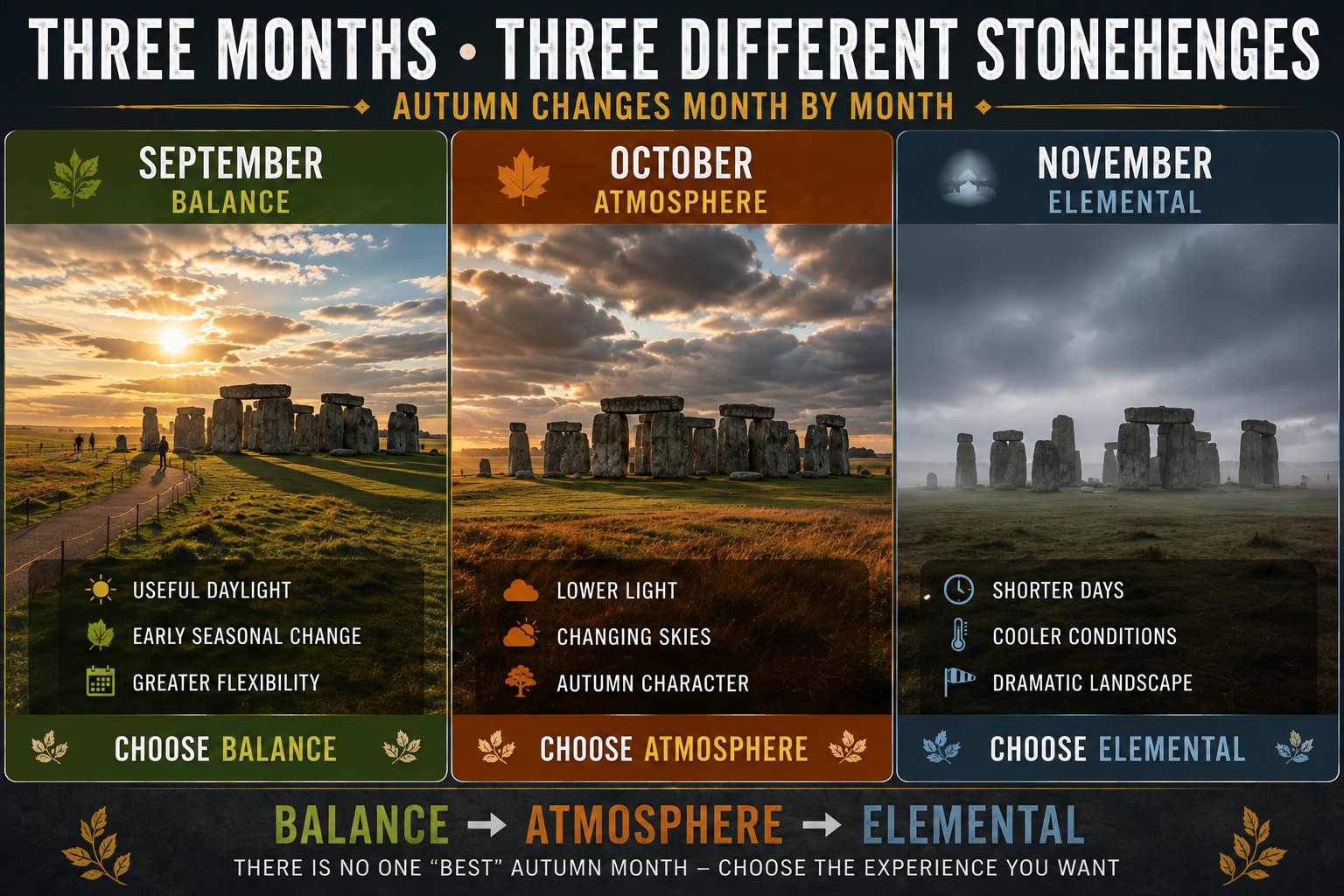
Stonehenge progresses from September balance through October atmosphere to November’s more elemental character as daylight, weather and seasonal light change across autumn
🍁 Which Autumn Month Suits You Best?
There is no single best month for an autumn visit to Stonehenge. September, October and November each offer a different balance of daylight, weather and atmosphere. The right choice depends on the kind of experience you want.
🍃 SEPTEMBER — Choose Balance
Best for: Visitors wanting the gentlest transition into autumn.
September can combine useful daylight and relatively mild conditions with the first signs of seasonal change. Choose it if you want some of autumn’s atmosphere without moving too far away from the practical advantages of late summer.
🍂 OCTOBER — Choose Atmosphere
Best for: Visitors seeking the classic autumn Stonehenge experience.
October brings lower light, longer shadows, cooler air and more changeable skies. Choose it if atmosphere and photography matter strongly to you and you are comfortable preparing for less predictable weather.
🌫️ NOVEMBER — Choose Elemental
Best for: Visitors drawn to Stonehenge at its starkest and most dramatic.
November brings shorter days, colder conditions and the possibility of dramatic skies across Salisbury Plain. Choose it if you value mood and a powerful sense of landscape more than warmth or long sightseeing hours.
🎯 Match the Month to Your Priorities
Want the easiest balance of autumn atmosphere and practical conditions?
→ 🍃 SEPTEMBER
Want changing light, autumn character and photographic atmosphere?
→ 🍂 OCTOBER
Want the most dramatic and elemental version of the landscape?
→ 🌫️ NOVEMBER
💡 Balance → Atmosphere → Elemental
Think of autumn at Stonehenge as a progression rather than a single season. September offers balance, October intensifies the atmosphere, and November reveals a more elemental landscape. Choose the month whose character best matches the experience you want.
🌅 Why Autumn Light Can Transform Stonehenge
One of autumn’s greatest visual strengths at Stonehenge is the changing angle of the sun.
Lower-angle light can create longer shadows and reveal more of the irregular texture of the stones. Instead of appearing evenly illuminated, individual surfaces can shift between brightness and shadow, adding depth while strengthening the visual relationship between the monument, foreground and sky.
Cloud does not necessarily spoil the experience either. Broken cloud can allow brief shafts of sunlight across Salisbury Plain, while darker skies may create striking contrast behind the stones. On some mornings, mist or haze can soften the wider landscape and produce an entirely different mood.
None of this can be scheduled.
Visitors sometimes imagine “perfect Stonehenge weather” as uninterrupted sunshine and a cloudless blue sky. Those conditions can certainly be beautiful, but they are not the only ones capable of making the monument memorable.
At Stonehenge, good weather and good atmosphere are not always the same thing.
Autumn photography therefore rewards flexibility. Wet stone may appear richer in tone, moving cloud can transform a composition within minutes, and low sunlight may briefly illuminate one part of the monument while another remains in shadow.
Rather than trying to reproduce a familiar postcard, look at what the day is actually giving you.
Atmospheric weather should always be enjoyed sensibly, however. Follow site guidance and weather warnings rather than pursuing a photograph in unsuitable conditions.
Sometimes the most memorable Stonehenge photograph is not technically perfect. It is the one that captures how the monument genuinely felt on that particular autumn day.
📸 Expert Tips for Photographing Stonehenge in Autumn
Autumn photography at Stonehenge is often less about waiting for perfect blue skies and more about recognising what changing light and weather can bring to the landscape. Clouds, shadows and brief changes in sunlight can completely alter the mood of the stones.
🌦️ Work With the Weather
Overcast or changeable conditions are not necessarily disappointing. Darker skies, mist, rain clouds and sudden breaks of sunlight can create some of autumn’s most atmospheric views.
☁️ Watch the Changing Sky
Autumn conditions can shift quickly across Salisbury Plain. Be ready when sunlight breaks through cloud, because a relatively ordinary scene can change dramatically within minutes.
🌅 Use Lower Light and Longer Shadows
As the sun sits lower in the sky, shadows can become more pronounced and help reveal the shape, texture and scale of the stones.
🎒 Protect Your Equipment
Carry suitable protection for your camera or phone if showers are possible. A simple weather-resistant cover can be invaluable when conditions change unexpectedly.
⚠️ Never Chase the Photograph at the Expense of Safety
Dramatic weather can produce dramatic images, but no photograph is worth taking unnecessary risks. Follow visitor guidance, remain within permitted areas and respond sensibly if conditions deteriorate.
💡 BVT Expert Photography Tip
Don’t judge an autumn photography day by the forecast alone. At Stonehenge, changing cloud, low light and fleeting bursts of sunshine can be part of the opportunity rather than a problem. Stay observant, be patient and let the weather help tell the story of the landscape.
🌄 Sunrise and Sunset at Stonehenge in Autumn
Autumn does more than change the quality of the light. It progressively changes when that light arrives.
As the season advances, sunrise becomes later and sunset earlier. That shortening day alters the practical rhythm of a Stonehenge visit and makes the edges of daylight increasingly relevant to travellers interested in atmosphere, photography and unusual perspectives on the monument.
Later autumn sunrises can also make very early starts less extreme than around midsummer, while earlier sunsets may fit more naturally into some wider itineraries. Exact timings change throughout the season, however, and beautiful sunrise or sunset conditions can never be guaranteed.
Weather remains decisive. A clear horizon can produce a very different experience from heavy cloud, rain or mist, while conditions on exposed Salisbury Plain can change remarkably quickly.
There is also an important distinction between experiencing Stonehenge during ordinary visitor hours and attending an appropriate managed special-access session. Simply arriving near sunrise or sunset should never be assumed to provide access to the monument or the stone circle.
For visitors particularly drawn to seasonal light, autumn can nevertheless be an excellent time to explore what may be possible.
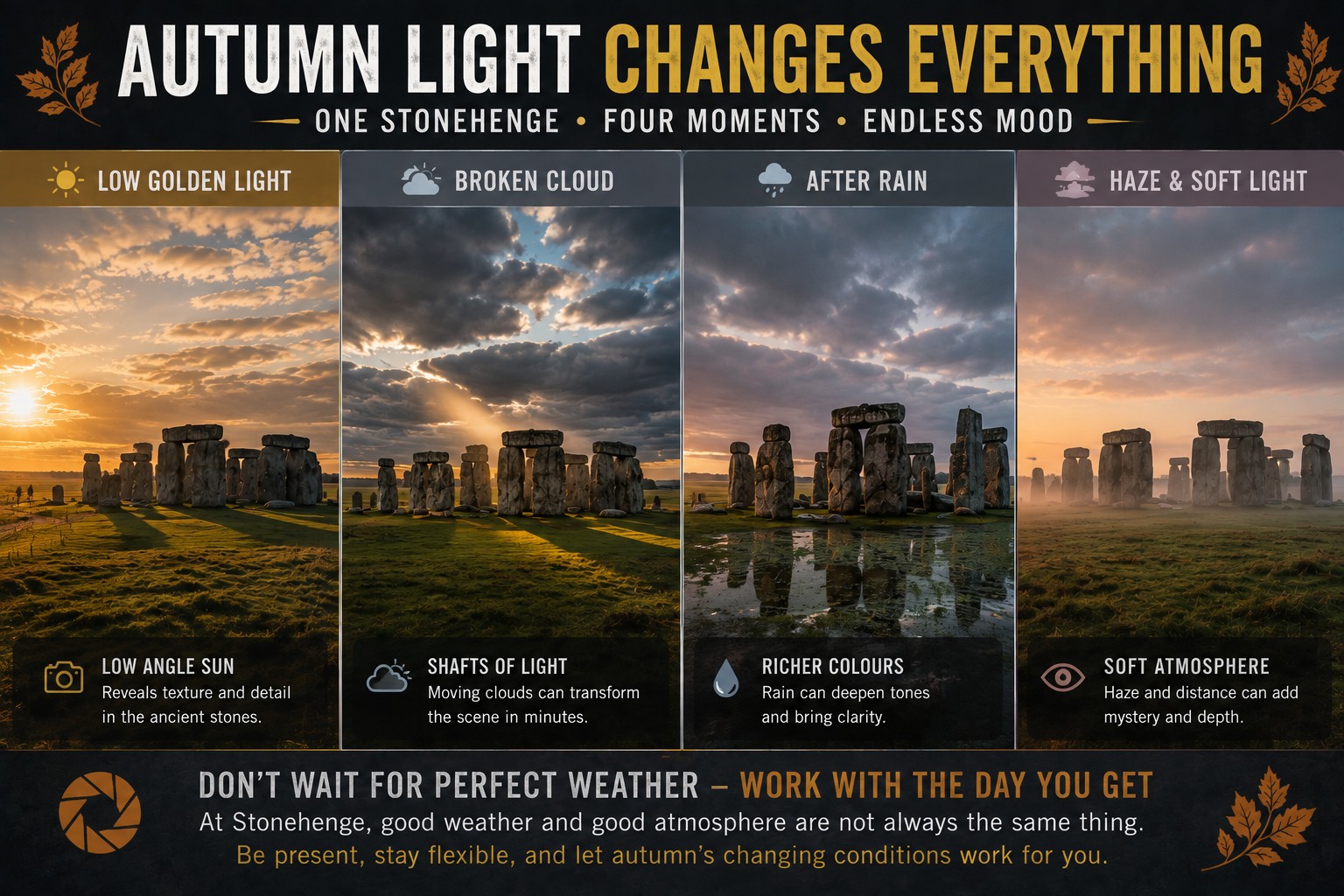
Autumn light and changing weather can transform Stonehenge, from long golden shadows and shafts of sunlight to richer post-rain tones and atmospheric haze
🌗 Autumn Also Brings the Stonehenge Equinox
The autumn equinox adds another dimension to the season.
Stonehenge’s clearest monumental solar alignments are associated with the solstices, but modern interest in the monument and the changing solar year also extends to the equinox. As summer gives way to autumn and day and night approach seasonal balance, Stonehenge attracts visitors interested in experiencing this particular point in the year.
An equinox visit should not be treated as an ordinary autumn sightseeing day with an event simply added to it. Access arrangements, timings and the character of the occasion may differ, so anyone travelling specifically for the equinox should check current information rather than assume normal visitor arrangements apply.
We will explore the equinox itself in dedicated planning guidance, including what happens, how to prepare and what visitors should expect.
For some autumn travellers, the changing season simply adds atmosphere to Stonehenge. For others, it becomes the reason to plan a visit around the equinox itself.
🌗 Experience Stonehenge Around the Autumn Equinox
Autumn at Stonehenge is not only about changing light, cooler weather and atmospheric landscapes. The season also brings the Autumn Equinox—one of the key astronomical turning points of the year and a natural reminder of Stonehenge’s enduring relationship with the movement of the sun and the changing seasons.
☀️ Stonehenge, the Seasons and the Equinox
Around the equinox, day and night move towards a near balance before the shorter days of late autumn and winter become increasingly noticeable.
For visitors already fascinated by Stonehenge’s prehistoric landscape, seasonal alignments and astronomical significance, this can add another fascinating dimension to an autumn journey.
🧭 Interested in Stonehenge’s Seasonal Story?
Explore BVT’s dedicated Stonehenge Solstice & Equinox Tours to discover tour options connected with these important seasonal moments at the monument.
🌗 Explore Stonehenge Solstice & Equinox Tours
💡 Follow the Seasons at Stonehenge
The Autumn Equinox forms part of a much larger seasonal story. From the long days surrounding the Summer Solstice to the darker approach towards winter, Stonehenge provides an extraordinary place from which to consider how people have observed the changing year for thousands of years.
🧥 What Should You Wear and Bring to Stonehenge in Autumn?
Autumn rewards preparation at Stonehenge. The monument stands within an exposed landscape, so conditions can feel noticeably different from those experienced earlier in the day in central London or another sheltered location.
Layers are usually the most practical starting point.
They allow you to adjust as temperatures, wind and sunshine change through the day, while a weather-resistant outer layer can make a considerable difference if conditions deteriorate. Comfortable footwear is equally important, particularly after wet weather or if you intend to spend time appreciating the wider visitor landscape rather than treating the stones as a quick photographic stop.
A reusable water bottle remains useful even on cooler days, and a compact bag can help when layers need to be removed or added. Protecting phones, cameras and other electronics against rain is sensible too. An umbrella can be useful in some conditions, but the exposed setting means wind may sometimes make a waterproof outer layer more practical.
Most importantly, check the forecast close to your actual travel date rather than packing according to what autumn weather is “normally” supposed to be like.
Do not assume the weather you experience in central London will precisely reflect conditions on exposed Salisbury Plain.
Being properly equipped means a sudden shower, colder breeze or rapidly changing sky is less likely to dominate the visit—and may even become part of what makes it memorable.
🧥 What to Bring to Stonehenge in Autumn
Autumn weather on Salisbury Plain can change quickly, so the most useful approach is to prepare for changing conditions rather than one fixed forecast. A few practical essentials can make the difference between simply coping with the weather and comfortably enjoying the landscape.
☑️ 🧥 Wear Layers
Choose several comfortable layers that can be added or removed as temperatures, wind and sunshine change during your visit.
☑️ 🌧️ Bring a Weather-Resistant Outer Layer
A lightweight waterproof or weather-resistant jacket is particularly useful when showers or stronger winds are possible.
☑️ 👟 Choose Comfortable Footwear
Wear practical shoes suitable for walking outdoors and potentially damp ground rather than footwear chosen purely for the journey.
☑️ 💧 Carry Water
Cooler weather can make hydration easier to overlook, so keep water with you even when the day does not feel particularly warm.
☑️ 🎒 Keep Your Bag Compact
Bring the essentials without overpacking. A manageable bag makes moving around the visitor experience and landscape considerably easier.
☑️ 📸 Protect Your Camera or Phone
If photography matters to you, carry simple weather protection so an unexpected shower does not end your photography for the day.
☑️ 🌦️ Check the Forecast Before You Leave
Review the latest conditions on the day of your visit and adjust your clothing and equipment accordingly rather than relying on seasonal averages alone.
🎯 The Autumn Rule
Layers + weather protection + comfortable footwear + flexibility
Prepare for conditions to change and you can concentrate on enjoying Stonehenge rather than worrying about the weather.
💡 Pack for the Landscape, Not Just the Temperature
Stonehenge stands in an exposed landscape, so wind, showers and changing light can matter just as much as the temperature. Autumn preparation does not require carrying everything—just bringing versatile essentials that let you adapt comfortably as the day changes.
🚌 Is Autumn a Good Time to Take a Stonehenge Tour?
For many travellers, yes. Autumn can be an excellent time for a Stonehenge tour, particularly if changing light and seasonal landscape are part of the attraction rather than conditions you simply tolerate.
An organised tour can remove much of the transport planning from a day outside London and provide a clear structure for visitors unfamiliar with the area. That can become especially useful as daylight shortens or when Stonehenge forms part of a wider sightseeing itinerary.
Independent travel remains an equally valid choice for visitors who prioritise control over their own timings and pace. The better option depends on how you prefer to travel.
🚍 Standard Stonehenge Tours
A standard tour can suit first-time visitors who value straightforward transport and a structured sightseeing day without wanting to organise every stage themselves.
👥 Small-Group Stonehenge Tours
Small-group touring may appeal to travellers who prefer a more personal touring environment and potentially easier interaction within the group, depending on the particular itinerary and product selected.
🚘 Private Stonehenge Tours
Private touring can be particularly attractive for couples, photographers, family groups, special occasions and visitors who value greater control over the structure of their day.
It does not make one version of Stonehenge inherently better than another. The advantage is flexibility.
The strongest choice is therefore not automatically the most elaborate tour. It is the format that best matches how you want to experience Stonehenge in autumn.
🚌 Which Autumn Stonehenge Tour Suits You?
Autumn can be an excellent season for an organised Stonehenge visit, but the best tour format depends on how you prefer to travel. Start with the wider tour selection, choose a smaller-group experience, or explore a private option when flexibility and personalisation matter most.
👣 Stonehenge Tours
Best starting point for comparing your options
Explore the wider range of Stonehenge tours if you want to compare different itineraries, timings and ways of including the monument within your autumn trip.
👥 Small Group Stonehenge Tours
Best for travellers who prefer a smaller touring environment
Consider a small-group option if you like the organisation and convenience of a tour but would prefer to travel as part of a smaller group.
⭐ Private Stonehenge Tours
Best for greater flexibility and personalisation
Explore a private tour when you want a more personalised touring experience or greater flexibility around the way Stonehenge fits into your wider day.
🎯 Match the Tour to Your Travel Style
Want to see the widest range of possibilities? → 👣 Browse Stonehenge Tours
Prefer a smaller touring environment? → 👥 Explore Small Group Tours
Want greater flexibility and personalisation? → ⭐ Explore Private Tours
💡 Choose the Experience, Not Just the Tour Name
Compare the complete day: itinerary, transport, timings, group format and how much flexibility you want. The best autumn Stonehenge tour is the one that matches your preferred pace and wider travel plans.
🧭 Is Autumn at Stonehenge Right for You?
Autumn has broad appeal, but it is not automatically the ideal season for every visitor. The strongest match is usually someone who values atmosphere and seasonal character more than predictable weather.
Photographers may appreciate lower-angle light and rapidly changing skies, while history enthusiasts can enjoy the way autumn draws attention towards Stonehenge’s relationship with Salisbury Plain. Couples may find the season adds a distinctive sense of occasion, while families can have an excellent visit provided clothing, daylight and changing weather are considered when planning the day.
Visitors whose priorities are dependable warmth and maximum daylight may prefer another season.
| Traveller Autumn Fit Why | ||
|---|---|---|
| First-time visitor | Very good | Strong atmosphere, with sensible preparation required |
| Photographer | Excellent | Changing light, shadows and dramatic-weather potential |
| Couple | Excellent | Distinctive setting and strong sense of occasion |
| History enthusiast | Excellent | Seasonal conditions can emphasise the ancient landscape |
| Family | Good | Rewarding when clothing, weather and daylight are planned carefully |
| Visitor wanting dependable warmth | Lower | Autumn weather is inherently variable |
| Weather-flexible traveller | Excellent | Changing conditions can become part of the experience |
The question is therefore not simply whether autumn is a good time to visit.
Ask whether the qualities that make autumn unpredictable are also the qualities that make it appealing to you.
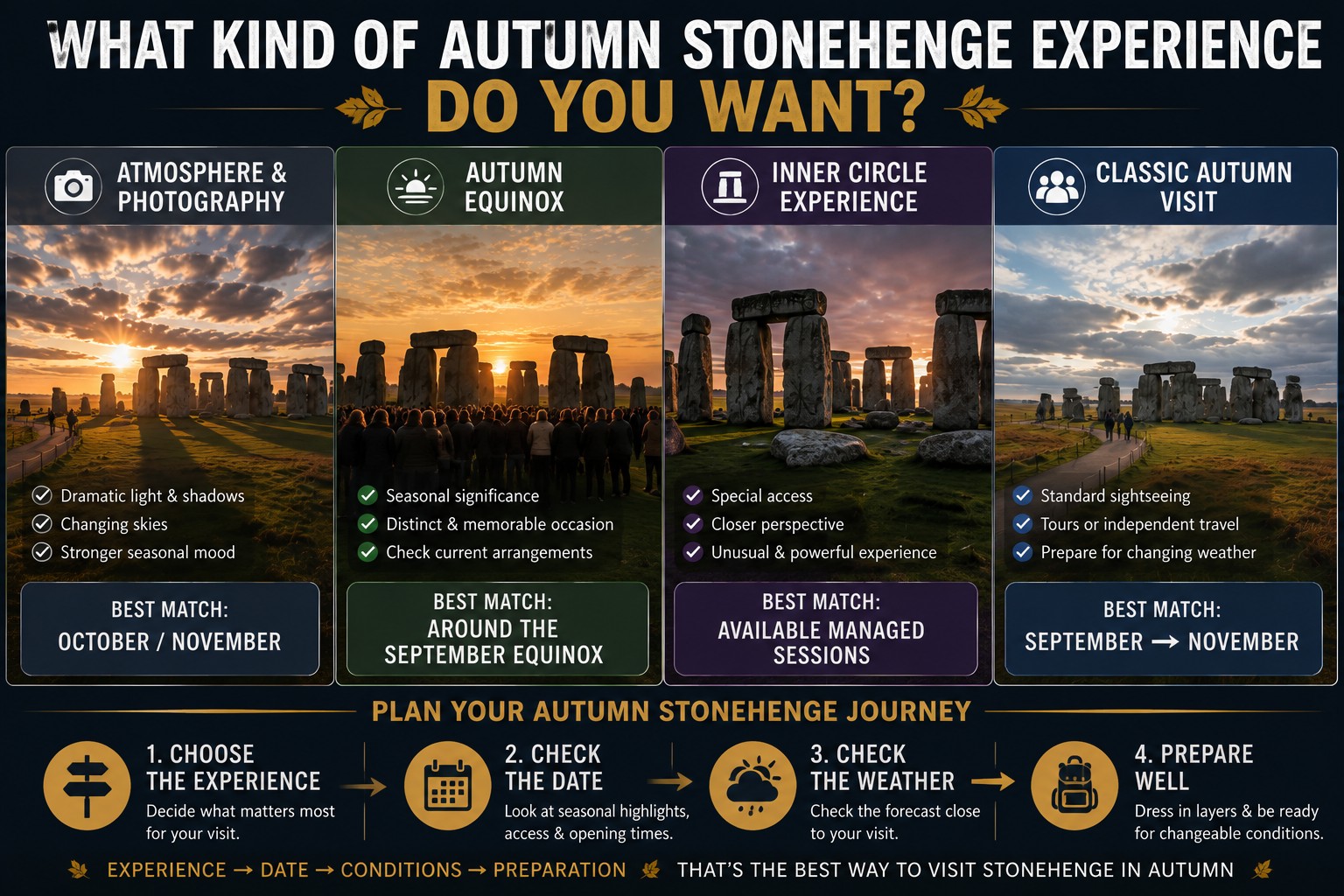
Choose your autumn Stonehenge experience first, then check the appropriate dates, weather and access arrangements before building the rest of your visit
📅 Planning Stonehenge Inner Circle Access in Autumn
For some visitors, experiencing Stonehenge from the standard visitor route will be exactly what they want. Others may be interested in investigating Stonehenge Inner Circle Access.
These are distinctly different experiences.
Normal daytime admission allows visitors to appreciate the monument from the established public viewing route and explore its wider story. Managed Inner Circle Access opportunities can, on selected dates and sessions, provide special access within the stone circle outside normal public opening hours.
Autumn makes the possibility particularly intriguing. Lower seasonal light, changing sunrise and sunset times and the atmosphere of Salisbury Plain can appeal strongly to photographers, couples, repeat visitors and anyone hoping to experience Stonehenge from an unusual perspective.
Atmospheric conditions, of course, cannot be booked.
The BVT Stonehenge Inner Circle Access Calendar 2026–2027 provides a practical starting point for investigating scheduled opportunities, comparing dates and considering how special access could fit within a wider UK itinerary.
A scheduled opportunity is not the same as confirmed live availability. Always verify the relevant arrangements before building flights, accommodation or other important travel plans around a particular session.
📅 Plan Your Autumn Stonehenge Inner Circle Experience
Autumn can bring lower light, changing skies and a powerful atmosphere to Stonehenge. If you would like to experience the monument more closely, Inner Circle Access can turn an autumn visit into something particularly memorable—but special-access opportunities are limited and should be planned carefully.
🗓️ Step 1 — Check the Inner Circle Access Calendar
Start by exploring the BVT Stonehenge Inner Circle Access Calendar 2026–2027. This helps you investigate future special-access opportunities and see how potential dates could fit into your wider autumn travel plans.
🪨 Step 2 — Explore Inner Circle Tour Options
Once you understand the special-access possibilities, explore the dedicated Stonehenge Inner Circle tour options and consider which experience best fits your dates and wider itinerary.
🎯 Your Autumn Inner Circle Planning Route
1. 📅 Check potential special-access dates
2. 🪨 Explore the available Inner Circle tour options
3. 🍂 Consider the autumn conditions and experience you want
4. 🧭 Build the rest of your itinerary around the option that works best
💡 Plan Special Access First
If Inner Circle Access is one of the highlights you most want from your trip, start with the special-access possibilities rather than building the rest of your itinerary first. Once you know what may work, you can shape the surrounding autumn journey much more effectively.
🌱 Experiencing Stonehenge Responsibly in Autumn
One of autumn’s greatest strengths is that it encourages visitors to notice more than the monument itself.
Changing light and weather draw attention towards Salisbury Plain and reinforce an important point: Stonehenge forms part of a much wider archaeological environment. Responsible visiting therefore means respecting not only the stones, but also the setting that gives them much of their power.
Following designated visitor routes helps protect sensitive areas. Taking litter away, carrying a reusable water bottle and choosing durable wet-weather clothing rather than unnecessary disposable items are simple practical measures. Where it works for your itinerary, shared or organised transport may also help reduce the number of separate vehicle journeys involved in visiting.
Autumn is an excellent season for slowing the experience down. Rather than arriving, taking the expected photograph and immediately moving on, allow time to look beyond the stone circle. Notice the horizon, shifting sky and openness of the plain while respecting wildlife, archaeological areas and other visitors.
The more autumn encourages us to notice the landscape around Stonehenge, the clearer it becomes that protecting that setting is part of protecting the monument itself.
Travel with purpose. Explore with care.
🌱 Experience Stonehenge Responsibly This Autumn
Autumn is a wonderful season for experiencing Stonehenge and the surrounding landscape. A few thoughtful choices can help protect this internationally important archaeological setting while making your own visit more comfortable and responsible.
🚶 Respect Designated Routes
Follow visitor guidance and remain within permitted areas. Autumn weather can leave parts of the landscape wet or vulnerable, making responsible movement particularly important.
🪨 Protect the Archaeological Landscape
Stonehenge is part of a much wider prehistoric landscape. Treat the surrounding environment with the same care and respect as the monument itself.
💧 Bring a Reusable Water Bottle
A reusable bottle is an easy way to reduce unnecessary single-use waste while keeping water available throughout your visit.
🧥 Choose Reusable Weather-Ready Clothing
Good layers and a reusable weather-resistant outer layer can keep you comfortable through changing autumn conditions without relying on disposable solutions.
🚌 Consider Shared Transport Where Practical
When it works for your itinerary, organised or shared transport can provide an efficient way to reach Stonehenge while reducing the need for separate vehicle journeys.
♻️ Leave No Trace
Take everything you bring with you, dispose of waste responsibly and leave the landscape ready to be appreciated by the visitors who follow.
🌿 Travel with purpose. Explore with care.
Enjoy the atmosphere, respect the archaeology and help protect the Stonehenge landscape for generations still to come.
❓ Frequently Asked Questions About Visiting Stonehenge in Autumn
🍂 Is Autumn a Good Time to Visit Stonehenge?
Yes. Autumn can be particularly rewarding if you value changing light, seasonal scenery and atmospheric conditions. The trade-off is shorter daylight and increasingly variable weather as the season progresses, so sensible preparation matters.
👥 Is Stonehenge Quieter in Autumn?
Possibly, but never assume an autumn visit will be quiet. Visitor levels can vary according to the date, time of day, weekends, school holidays, special occasions and wider travel patterns.
Choose autumn primarily for its seasonal character, not because you expect to have Stonehenge to yourself.
🌦️ What Is the Weather Like at Stonehenge in Autumn?
It can vary considerably. September may still produce relatively mild days, while later autumn increasingly calls for cooler-weather preparation. Wind and rain can make the exposed setting feel markedly different from sheltered locations.
Check a reliable forecast shortly before travelling rather than relying on seasonal averages.
📆 Is September or October Better for Stonehenge?
Choose September if longer daylight and greater seasonal flexibility matter most. Choose October if you are more interested in stronger autumn character, lower seasonal light and the changing atmosphere of Salisbury Plain.
Neither month is universally better.
🌫️ Is Stonehenge Worth Visiting in November?
Yes—for the right traveller. November brings shorter days and potentially more demanding weather, but those same characteristics can produce a more austere and elemental setting.
If you value atmosphere more than predictable conditions, November can be highly rewarding.
🧥 What Should I Wear to Stonehenge in Autumn?
Layers are generally the most versatile choice, combined with comfortable footwear and an outer layer appropriate for the forecast. Stonehenge’s exposed setting means wind and rain can make conditions feel quite different from those experienced in central London or other sheltered locations.
Protect phones and cameras if wet weather is possible, and check the forecast shortly before travelling rather than relying on assumptions about what an autumn day should be like.
🌅 Can I See Stonehenge at Sunrise or Sunset in Autumn?
Potentially, but the type of visit and access arrangements matter. Ordinary visitor opening hours and managed special-access opportunities are different, so simply arriving around sunrise or sunset should never be assumed to provide access to Stonehenge or the stone circle.
If experiencing the monument close to the edges of daylight is important to you, investigate the appropriate current arrangements before building the rest of your itinerary around it.
🪨 Can I Visit the Stonehenge Inner Circle in Autumn?
Potentially, through appropriate managed Inner Circle Access opportunities on selected dates and sessions. These experiences operate separately from normal daytime admission, and a scheduled opportunity does not necessarily mean spaces remain available.
Use the BVT Stonehenge Inner Circle Access Calendar 2026–2027 as a planning starting point, then confirm current availability before making important travel arrangements.
🌗 What Happens at Stonehenge During the Autumn Equinox?
The autumn equinox attracts modern interest in Stonehenge as the seasons change and day and night approach seasonal balance. It should be regarded as a distinct occasion rather than simply an ordinary autumn sightseeing visit.
Anyone travelling specifically for the equinox should check dedicated current guidance covering access, timings and practical arrangements.
🏁 Final Verdict — Is Autumn One of the Best Times to Visit Stonehenge?
Yes—for travellers who value atmosphere more than predictability, autumn can be one of the most rewarding times to experience Stonehenge.
September offers balance, with comparatively generous daylight as summer begins to recede. October brings a stronger seasonal transition and increasingly distinctive light. November asks more of the visitor, but can reward those prepared for shorter days and more variable conditions with a particularly elemental sense of place.
Autumn’s appeal does not depend on promises of empty paths, perfect photographs or beautiful weather. Its strength lies precisely in the fact that conditions can change: sunlight may reveal the texture of the stones, cloud may transform the sky, and cooler air can make the openness of Salisbury Plain feel increasingly present.
Visitors wanting dependable warmth and maximum daylight may reasonably prefer another season. But for photographers, history enthusiasts, couples and weather-flexible travellers, autumn offers something different—a chance to experience Stonehenge when the season itself becomes part of the story.
Stonehenge does not simply sit in the autumn landscape. On the right day, the landscape seems to become part of the monument.
🍂 Continue Planning Your Stonehenge Autumn Visit
If autumn sounds like the Stonehenge experience you are looking for, the next step is turning atmosphere into a practical plan. Choose when to visit, prepare for the weather, investigate Inner Circle Access or explore the wider range of Stonehenge tours.
🍁 Choose When to Visit
Compare the seasons and decide where autumn fits within the wider Stonehenge year, including the balance between daylight, weather, atmosphere and your own travel priorities.
🌦️ Prepare for the Weather
Understand Stonehenge’s exposed setting, seasonal weather patterns and the practical preparation that can help you stay comfortable when conditions change.
📅 Explore Autumn Inner Circle Dates
If experiencing Stonehenge more closely is one of your priorities, use the BVT calendar to investigate scheduled Inner Circle Access opportunities and consider how they could fit your autumn itinerary.
🚌 Explore Stonehenge Tours
If you would prefer transport and the structure of the day organised for you, explore the wider Stonehenge tour range and compare the options that best fit your autumn plans.
🧭 Build Your Autumn Visit
Decide when autumn works best for you → 🍁 Compare the seasons
Prepare for Salisbury Plain → 🌦️ Check the weather guidance
Want something more unusual? → 📅 Investigate Inner Circle Access
Prefer an organised day? → 🚌 Explore Stonehenge tours
✨ Let Autumn Become Part of the Experience
The best autumn Stonehenge visit is not necessarily the one with perfect weather. It is the one planned well enough that changing light, cooler air and the atmosphere of Salisbury Plain become part of the experience rather than obstacles to it. Choose the month, prepare intelligently and leave room for the landscape to surprise you.
🍂 Continue Planning Your Stonehenge Autumn Visit
If autumn sounds like the Stonehenge experience you are looking for, the next step is turning that inspiration into a practical plan. Choose when to visit, prepare for the weather, explore Inner Circle Access dates or compare the wider range of Stonehenge tours.
🍂 Choose When to Visit
Compare Stonehenge across the year and decide how autumn’s changing light, weather, daylight and atmosphere fit your own travel priorities.
🌦️ Prepare for the Weather
Understand the conditions you may encounter on Salisbury Plain and prepare properly for Stonehenge’s exposed setting and changeable seasonal weather.
📅 Explore Inner Circle Dates
If experiencing Stonehenge more closely would make your autumn visit particularly special, investigate future Inner Circle Access opportunities before fixing the rest of your itinerary.
🚌 Explore Stonehenge Tours
Prefer the convenience of an organised visit? Compare the wider range of Stonehenge tour options and find the format that best matches your autumn travel plans.
🍂 Continue Planning Your Stonehenge Autumn Visit
If autumn sounds like the Stonehenge experience you are looking for, the next step is turning that inspiration into a practical plan. Choose when to visit, prepare for the weather, explore Inner Circle Access dates or compare the wider range of Stonehenge tours.
🍂 Choose When to Visit
Compare Stonehenge across the year and decide how autumn’s changing light, daylight, weather and atmosphere fit your own travel priorities.
🌦️ Prepare for the Weather
Understand Stonehenge’s exposed setting and prepare properly for the changing conditions that can make an autumn visit so atmospheric.
📅 Explore Inner Circle Dates
If experiencing Stonehenge more closely would make your autumn visit particularly special, investigate future Inner Circle Access opportunities before fixing the rest of your itinerary.
🚌 Explore Stonehenge Tours
Prefer the convenience of an organised visit? Compare the wider range of Stonehenge tour options and find the format that best matches your autumn plans.
🍂 Continue Planning Your Stonehenge Autumn Visit
If autumn sounds like the Stonehenge experience you are looking for, the next step is turning that inspiration into a practical plan. Choose when to visit, prepare for the weather, explore Inner Circle Access dates or compare Stonehenge tour options.
🍂 Choose When to Visit
Compare Stonehenge throughout the year and decide how autumn’s changing light, daylight, weather and atmosphere fit your travel priorities.
🌦️ Prepare for the Weather
Understand Stonehenge’s exposed setting and prepare for the changing conditions that can make an autumn visit so atmospheric.
📅 Explore Inner Circle Dates
If experiencing Stonehenge more closely would make your autumn visit particularly special, investigate future Inner Circle Access opportunities before fixing the rest of your itinerary.
🚌 Explore Stonehenge Tours
Prefer the convenience of an organised visit? Compare Stonehenge tour options and find the format that best matches your autumn plans.
🧭 Your Autumn Planning Route
Choose your timing → 🍂 Compare the seasons
Prepare properly → 🌦️ Understand the weather
Want special access? → 📅 Explore Inner Circle dates
Want an organised visit? → 🚌 Explore Stonehenge tours
✨ Let Autumn Become Part of the Experience
Stonehenge does not need perfect blue skies to be extraordinary. Plan intelligently for the season and lower light, changing weather, cooler air and the atmosphere of Salisbury Plain can become part of what makes your visit memorable.