


Scotland Through the Seasons: Spring, Summer, Autumn and Winter Travel Guide
9th August 2026
🌦️ Scotland Through the Seasons: Spring, Summer, Autumn and Winter Travel Guide
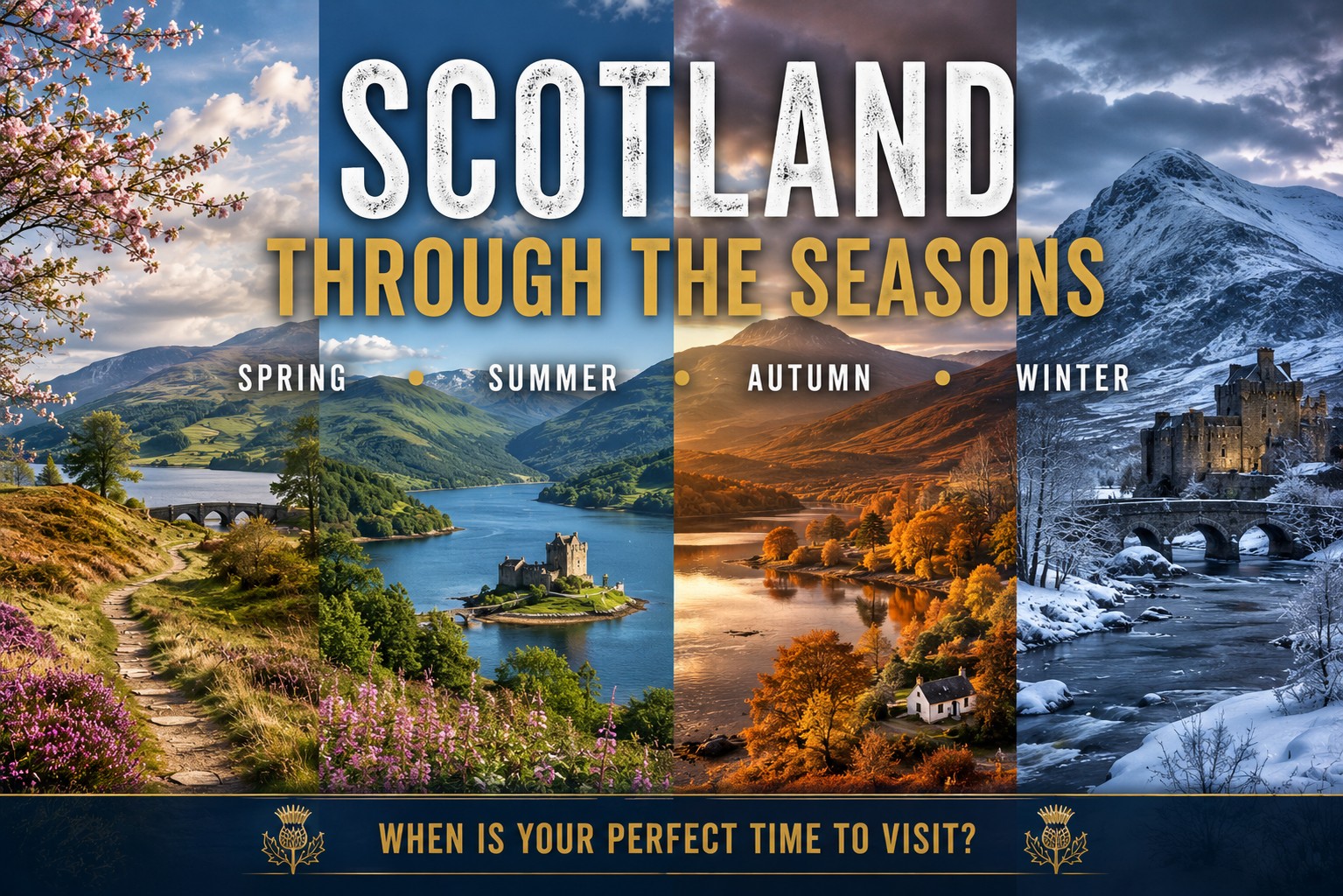
Scotland changes dramatically through spring, summer, autumn and winter, with each season bringing different daylight, landscapes, atmosphere and opportunities for exploring the country
Scotland never presents quite the same journey twice.
Arrive in spring and the days are stretching noticeably longer, gardens and woodland are returning to life, and rural landscapes begin to emerge from winter. Travel in summer and evening light can linger remarkably late, creating generous days for Highland roads, island adventures and outdoor exploration. By autumn, changing woodland, lower-angle light and atmospheric lochs give the country another character, while winter brings short days, festive cities and some of Scotland’s most dramatic seasonal landscapes.
For travellers asking about the best time to visit Scotland, the answer therefore involves much more than finding the month with the highest average temperature.
Season affects daylight, touring hours, landscapes, events, attraction schedules, visitor demand and the amount of Scotland that can realistically fit into each day. It can influence whether an ambitious Highlands route feels comfortable, how much contingency an island journey requires and whether a city break or scenic road trip makes the stronger choice.
There is no single perfect season.
There is a best season for the Scotland you want to experience.
This guide compares spring, summer, autumn and winter from a traveller’s perspective. It will help you consider daylight, landscapes, Highlands and islands, events, outdoor experiences and practical planning before deciding when your own Scottish journey should begin.
🌦️ Choose the Scotland Season That Fits Your Journey
There is no single best season for Scotland. There is a best season for the Scotland you want to experience.
Start with the journey you want, then match Scotland’s changing daylight, landscapes and seasonal character to it. The strongest planning sequence is simple:
Experience
↓
Geography
↓
Daylight
↓
Season
🌱 Spring — Expanding Daylight and Changing Landscapes
Choose spring for progressively longer days, countryside returning to life and increasingly flexible touring. It suits travellers who are comfortable adapting to variable conditions.
☀️ Summer — Maximum Daylight and Touring Freedom
Choose summer for the longest days, ambitious Highland and island journeys, outdoor exploration and one of Scotland’s richest periods for festivals and events.
🍂 Autumn — Colour, Atmosphere and Heritage
Choose autumn for changing landscapes, softer seasonal light, scenic road journeys, castles, heritage and photography when atmosphere matters more than maximum daylight.
❄️ Winter — Festive Cities and Slower Journeys
Choose winter for Christmas and Hogmanay experiences, dramatic seasonal landscapes and deliberately slower itineraries designed around shorter days and greater flexibility.
🧭 The Better Question
Not: “Which season is best?”
Ask: “Which season best supports the Scotland I want to experience?”
Choose the experience first. Then choose the season that supports it.
🌦️ BVT Seasonal Planning Principle: Scotland’s seasons change not only the weather, but also the usable daylight, touring possibilities, events and character of the journey. Match the time of year to your priorities rather than choosing dates by temperature alone.
🧭 When Is the Best Time to Visit Scotland?
The most useful answer begins with your priorities rather than a particular month.
Spring brings rapidly increasing daylight, fresh landscapes and expanding opportunities for touring. Summer provides the longest days and greatest freedom for ambitious itineraries, although many popular destinations also experience stronger seasonal demand. Autumn trades some of that daylight for colour, atmosphere and changing landscapes. Winter reveals a very different Scotland of festive celebrations, low seasonal light and journeys that need to be designed around shorter days.
Geography matters too.
Conditions during an Edinburgh city break may be very different from those encountered on Skye, in the northern Highlands or across Orkney. Elevation, coastal exposure and Scotland’s Atlantic and North Sea influences can all affect what travellers experience.
That is why weather forecasts alone never tell the whole story.
When planning Scotland, daylight can matter just as much as temperature.
📊 Scotland’s Seasons at a Glance
Each season offers a different balance of daylight, landscape, atmosphere and practical opportunity. This comparison is best used as a starting point rather than a rigid rule, because the experience can vary considerably according to where in Scotland you travel.
| Season | Character | Major Advantage | Main Consideration | Particularly Good For |
|---|---|---|---|---|
| Spring | Fresh and transitional | Rapidly increasing daylight | Variable conditions | Touring, gardens, walking and changing landscapes |
| Summer | Energetic and expansive | Longest days | Stronger seasonal demand | Highlands, islands, events and outdoor exploration |
| Autumn | Atmospheric and colourful | Distinctive landscapes and light | Shortening daylight | Scenic journeys, photography and heritage |
| Winter | Dramatic and festive | Unique seasonal character | Short days and possible disruption | Cities, celebrations and slower journeys |
The differences become clearer when you consider the journey rather than the calendar. Someone hoping to explore Skye and the Highlands over long scenic days has very different requirements from a traveller planning Edinburgh at Christmas or photographing wooded glens, lochs and castles during autumn.
Decide what matters most before choosing your dates.
If extensive outdoor exploration is the priority, usable daylight may sit near the top of the list. If Highland Games, festivals or seasonal celebrations matter, Scotland’s events programme becomes an important part of the decision. Travellers seeking photography, atmosphere or a less hurried pace may willingly accept shorter days in return for a different seasonal experience.
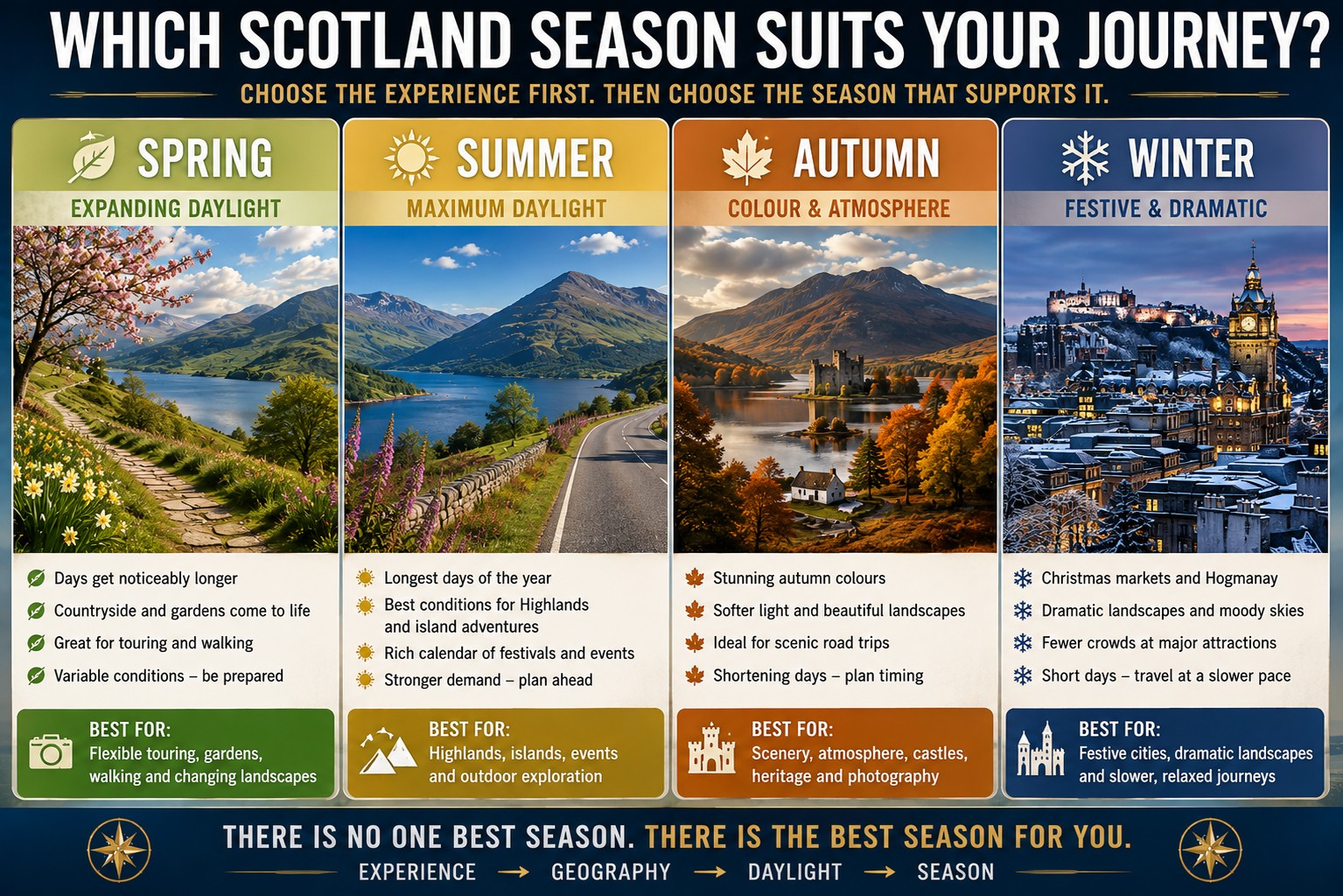
Spring, summer, autumn and winter each create a different Scotland, from expanding spring daylight and long summer touring days to autumn atmosphere and festive winter journeys
🧭 Which Scotland Season Suits You Best?
Choose the season that best matches the experience you want from Scotland.
Instead of beginning with a month, begin with your priorities. Daylight, landscapes, events and current conditions all affect what a Scottish journey can realistically include.
🌱 Want Increasing Daylight and Changing Landscapes?
→ Spring
A strong choice for progressively longer days, fresh landscapes and increasingly flexible touring, provided you are comfortable with variable conditions.
☀️ Want Maximum Daylight and the Greatest Touring Freedom?
→ Summer
Best suited to long scenic days, Highlands and island exploration, outdoor experiences and travellers who want the greatest amount of usable daylight.
🍂 Want Colour, Photography and Atmosphere?
→ Autumn
Choose autumn when changing landscapes, lower seasonal light, heritage and a more atmospheric style of touring matter more than maximum daylight.
❄️ Want Festive Scotland and Dramatic Seasonal Landscapes?
→ Winter
Choose winter for Christmas and Hogmanay experiences, distinctive low light and slower journeys designed around shorter days and greater contingency.
🗺️ Then Ask Where You Are Travelling
🏔️ Highlands and Islands
Daylight, road conditions, ferry resilience and transport contingency become particularly important.
🏙️ Cities and Heritage
Shorter days are easier to accommodate because museums, galleries, restaurants, historic attractions and evening experiences can provide greater flexibility.
🎪 Events
Check important dates before fixing accommodation and transport. A Highland Games, festival or seasonal celebration may become one of the defining experiences of the journey.
🥾 Outdoor Activities
Current weather, daylight, elevation, route difficulty and ground conditions matter more than the season name alone.
Your Priorities + Scotland’s Seasonal Conditions = Your Best Season
🧭 BVT Seasonal Decision Principle: The best season is the one that creates the strongest match between what you want to experience and what Scotland can realistically offer at that time of year.
🌱 Spring in Scotland: Longer Days and Changing Landscapes
Spring is one of Scotland’s most interesting transitional periods because the country can change considerably between the beginning and end of the season.
A journey in early March may still encounter distinctly wintry conditions, particularly across higher or more northerly ground. By late May, daylight is substantially more generous, gardens and woodland have returned to colour, and the practical possibilities for road touring, walking and outdoor sightseeing have expanded considerably.
🌼 What Spring in Scotland Feels Like
As the days lengthen, gardens, wooded landscapes and rural Scotland gradually become more colourful. Lambing and other signs of the agricultural year can add another seasonal dimension to countryside journeys, while increasing daylight gives travellers more freedom to linger at castles, villages and scenic stops.
The weather remains capable of changing quickly, however. Sunshine, rain, wind and colder spells can all feature during a spring trip, making adaptable plans considerably more useful than expectations of consistently mild conditions.
🚗 Why Spring Can Be Excellent for Touring
As spring advances, the combination of longer days and landscapes returning to life can make it an excellent period for exploring Scotland. There is progressively more time to pause at viewpoints, visit historic places and travel between towns, lochs and Highland landscapes without the tight daylight constraints of winter.
The season is particularly appealing for travellers who want variety. A journey might combine Edinburgh or Glasgow with castles, gardens and designed landscapes before continuing north into rural Scotland and the Highlands. Island travel becomes increasingly practical as spring progresses too, although ferry schedules, accommodation and seasonal services should always be checked for the intended dates.
Some destinations may experience less booking pressure than during the height of summer, but spring should never be treated as universally quiet. Easter, school holidays and public holidays can create concentrated demand, while Scotland’s most famous places remain popular whenever conditions are attractive. If a particular hotel, ferry or experience is central to the trip, advance planning remains sensible.
🌦️ What Spring Travellers Should Plan For
Adaptability is spring’s most useful travelling companion. Conditions in the mountains can remain very different from those at lower elevations, and anyone considering substantial hillwalking or remote outdoor activities should plan according to current conditions and personal experience rather than assuming winter hazards have disappeared because the calendar says spring.
Layers, practical footwear and a waterproof outer layer belong in the luggage even when the forecast looks promising. It is also worth confirming opening days and hours for castles, gardens, visitor attractions and seasonal transport services rather than assuming they have already moved to their full summer schedules.
The reward for that preparation is a season that becomes noticeably more generous as it progresses. Longer evenings create breathing room in an itinerary, gardens and countryside develop almost week by week, and scenic journeys become easier to enjoy without constantly watching the clock.
Spring is not simply a quieter substitute for July or August. It has its own rhythm: transitional, increasingly energetic and especially rewarding for travellers willing to let the day’s conditions influence the route.
Spring becomes progressively more generous with daylight, but adaptability remains part of the experience.
☀️ Summer in Scotland: Long Days, Festivals and Highland Adventures
Summer changes the scale of what is possible during a day in Scotland. Its greatest advantage is not guaranteed heat or uninterrupted sunshine, but daylight. Around the June solstice, particularly farther north, evenings remain light remarkably late and travellers gain considerably more freedom to explore without constantly racing the clock.
🌅 Long Summer Days Change the Journey
Extra daylight can transform an itinerary. A Highland journey can accommodate scenic pauses without every unexpected stop threatening the day’s schedule, while visitors exploring Skye or other Scottish islands have more time for coastlines, villages, viewpoints and walks. Photography and outdoor attractions also become easier to combine with longer touring routes.
The important distinction is between having more usable time and feeling obliged to fill it.
Scotland often rewards the unplanned pause: a loch suddenly illuminated by evening light, a village worth exploring properly or a viewpoint that deserves considerably longer than the ten minutes originally allocated. Long summer days are most valuable when they create breathing room rather than encouraging an overloaded itinerary.
🎪 Festivals, Highland Games and Summer Energy
Summer also brings another dimension to Scotland through its extensive programme of cultural events, Highland Games and community gatherings. Music, sport, tradition and local celebrations can turn an already interesting destination into one of the most memorable experiences of a trip.
Edinburgh becomes particularly energetic during its major festival season, while Highland Games and other gatherings take place in communities across Scotland. Dates and programmes vary from year to year, so travellers hoping to experience a particular event should incorporate it into their planning rather than assuming something suitable will happen spontaneously.
That popularity has practical consequences. Accommodation around major events can become heavily sought after, transport may require earlier planning, and otherwise straightforward itineraries can become more complicated when large numbers of visitors are travelling for the same occasion.
Summer therefore offers exceptional opportunity, but it rewards organisation.
The longest days give you greater freedom—not an obligation to fill every hour.
🏔️ Highlands and Islands in Summer
For travellers hoping to combine several of Scotland’s great landscapes, summer offers obvious advantages. Longer daylight makes journeys through the Highlands easier to pace, while extended evenings provide valuable breathing room on Skye and other islands, where single-track roads, coastal scenery, walking opportunities and spontaneous stops can quickly consume more time than expected.
Those advantages also make summer extremely attractive to other visitors. Famous viewpoints, popular Highland routes and some island destinations can become busy, particularly during peak holiday periods. Accommodation may require advance booking, while travellers taking vehicles on important ferry crossings should investigate capacity early rather than constructing an itinerary around a connection that has not been secured.
Foot passengers and individual routes can have different requirements, so checking the operator’s current arrangements is more useful than assuming every Scottish ferry journey needs identical advance planning.
Long daylight can also spread sightseeing across a wider part of the day, but it does not make popular locations empty. Some well-known routes and viewpoints remain active into the evening precisely because visitors have more hours available to explore.
A successful summer itinerary therefore balances preparation with freedom. Secure the elements that could compromise the wider trip if unavailable—such as essential accommodation or critical transport—while preserving enough space for Scotland itself to influence the pace.
🦟 What About Midges?
Midges are frequently mentioned in discussions about Scottish summer travel, but they should be kept in perspective. These tiny biting insects can be particularly noticeable in parts of western and northern Scotland when local conditions are warm, damp and relatively still, especially around sheltered outdoor environments.
Their activity varies with location, season, wind and weather. Suitable repellent, covering exposed skin when necessary and adjusting outdoor plans to local conditions can make a considerable difference.
Midges are therefore a practical consideration rather than a reason to abandon an entire region or season.
Summer’s wider advantages remain substantial: long days, extensive touring possibilities, outdoor experiences and one of the richest periods in Scotland’s events calendar.
Summer gives you more Scotland each day—but it does not automatically give you solitude.
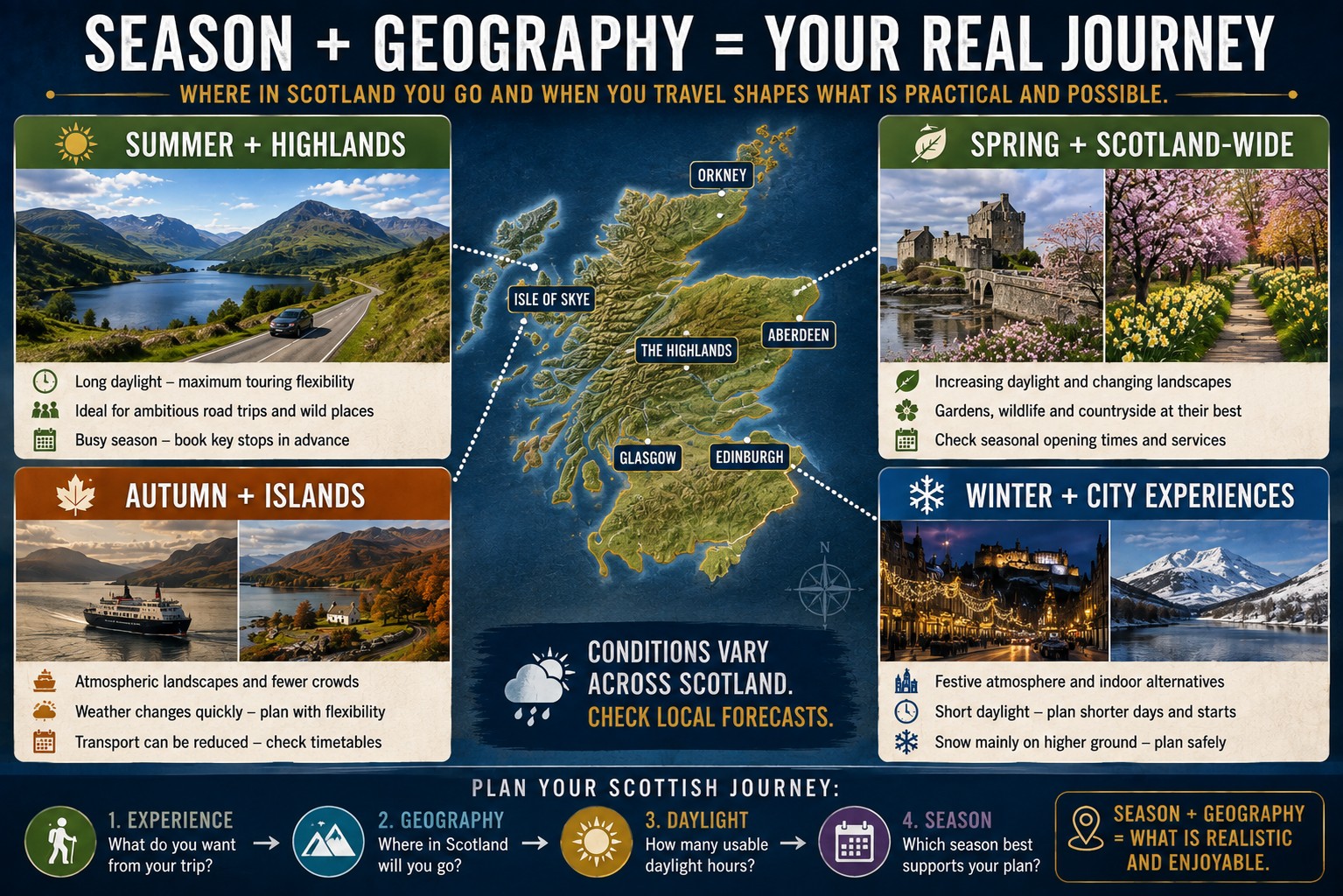
Where you travel in Scotland and when you visit work together, with daylight, geography, weather and seasonal transport all influencing what is realistic and enjoyable
☀️ BVT Expert Tip: Use Summer Daylight for Freedom, Not More Stops
Longer daylight should create breathing room—not a longer checklist.
Summer gives you more usable time across Scotland, particularly for Highland roads, island journeys and outdoor exploration. The strongest itineraries use those extra hours to make the day more flexible, not simply more crowded.
🌅 Longer Days
↓
🚗 More Touring Flexibility
↓
📸 More Time for Scenic Stops
↓
🧭 Greater Freedom to Respond Spontaneously
↓
😌 Less Need to Rush
☀️ The advantage of summer: A viewpoint worth lingering at, an unexpected village stop, a walk that takes longer than expected or changing evening light can fit into the journey without immediately compromising everything that follows.
⚠️ More Daylight ≠ Fewer Visitors
Long summer days create more opportunity for you—and for everyone else. Popular Highland routes, island viewpoints, accommodation and major events can all experience stronger demand, so additional daylight should not be confused with guaranteed quiet.
🧭 BVT Expert Tip: Secure the elements that could disrupt the whole journey—critical accommodation, important ferry connections and major events—but leave space within each day for Scotland itself to change the plan.
Use summer to travel better, not simply farther.
🍂 Autumn in Scotland: Colour, Castles and Scenic Journeys
Autumn brings another distinctive shift in Scotland’s character. The expansive daylight of midsummer gradually retreats, landscapes begin to change and lower seasonal light can give lochs, glens and historic places a particularly atmospheric quality. For travellers who value scenery, photography, heritage and journeys with a less hurried rhythm, it can be one of the most rewarding periods of the year.
🍁 Scotland’s Changing Landscapes
Autumn colour is often associated with Scotland, but the most spectacular displays occur where woodland and vegetation support them rather than spreading uniformly across every Highland landscape. Forests, wooded glens, country estates and loch shores can become particularly striking, while open moorland and mountain country develop their own subtler palette of seasonal tones.
The changing light matters just as much as the foliage. Lower sun can create dramatic conditions around mountains, lochs and castles, while mist, passing showers and sudden clear spells can completely transform a familiar landscape. Autumn therefore suits travellers prepared to appreciate variety rather than waiting for an uninterrupted blue-sky forecast.
🏰 Autumn for Castles, Heritage and Road Touring
Historic Scotland can feel especially well matched to autumn. Castles, old towns and Highland landscapes gain atmosphere from softer light and seasonal vegetation, while scenic roads become part of the experience rather than merely a means of travelling between attractions.
After the height of summer, some destinations may experience reduced booking pressure, although this varies considerably by place, date and event. Popular locations remain popular, and accommodation should never be assumed to be readily available simply because August has ended.
Opening arrangements also become increasingly important as autumn progresses. Some castles, visitor attractions, transport services and seasonal businesses begin reducing their schedules, making it sensible to confirm opening days and times before committing to a route.
Autumn’s appeal lies partly in that transition. The landscape is changing, the light is changing and the practical shape of a Scottish touring day is changing with them.
🌧️ September Is Not November
One of the easiest mistakes to make when planning an autumn trip is treating the entire season as though it offers roughly the same experience. In Scotland, the practical difference between early September and late November can be substantial.
September can retain comparatively generous daylight, making longer scenic routes and outdoor exploration relatively easy to accommodate. As October progresses, daylight shortens more noticeably, landscapes continue their seasonal transformation and itineraries benefit from greater breathing room. By November, daily planning begins to resemble winter much more closely, with substantially less daylight available for sightseeing and road touring.
Attraction schedules can change during this progression too. A castle, visitor centre or seasonal service available regularly in September may operate reduced days or hours later in autumn, while some seasonal businesses may close altogether. Checking current arrangements becomes increasingly important when an individual attraction or connection is essential to the itinerary.
The lesson is simple: choose the part of autumn as carefully as the season itself.
Autumn rewards travellers prepared to exchange maximum daylight for atmosphere.
❄️ Winter in Scotland: Festive Cities and Highland Landscapes
Winter reveals a side of Scotland often missed by travellers focused on long summer days. Daylight becomes precious, landscapes can feel more exposed and dramatic, and towns and cities develop a completely different energy around Christmas and New Year.
It can be an immensely rewarding season, but the experience differs significantly between an urban break and a journey into remote Scotland.
🌨️ What Winter Scotland Really Means
Snow is part of Scotland’s winter story, particularly across higher ground, but it should never be treated as guaranteed. Conditions vary considerably according to geography, elevation and individual weather systems. A Highland summit may be white while lower landscapes remain green, wet or frost-covered.
The more predictable difference is limited daylight. Short winter days reduce the number of sensible sightseeing hours and make ambitious road itineraries less practical, particularly in remote areas.
That limitation can also become part of winter’s appeal. Low seasonal light can create remarkable landscapes, while choosing fewer destinations allows more time to experience castles, lochs and Highland scenery without turning the day into a race against darkness.
🎄 Christmas, Hogmanay and Scotland’s Winter Cities
Scotland’s cities provide a powerful counterpoint to the winter countryside. Edinburgh becomes especially associated with festive travel and Hogmanay, while Glasgow and other towns and cities offer their own seasonal programmes, cultural attractions and indoor experiences when the available sightseeing day is much shorter.
Christmas markets, performances, illuminations and individual festive programmes can change from year to year. If a particular celebration is important, check current dates, tickets and arrangements before building accommodation or transport around it.
City-based winter travel can also be more forgiving than an ambitious rural itinerary. Museums, galleries, historic attractions, restaurants and evening entertainment provide alternatives when weather makes extended outdoor sightseeing less appealing. That flexibility can make combining a Scottish city with one or two carefully selected countryside experiences particularly effective.
🏔️ Exploring the Highlands in Winter
The Highlands remain compelling in winter, but travelling through them requires a different mindset. Road conditions, short daylight, changing weather and reduced attraction schedules can all influence what is realistically achievable. Some seasonal businesses and visitor attractions may close completely rather than simply operating shorter hours.
Daily distances should therefore be conservative, particularly when travelling through remote country. Monitor current conditions, allow contingency in the itinerary and avoid making one weather-sensitive experience so essential that disruption undermines the entire trip.
The objective is quality rather than mileage.
A winter Highland day built around one beautiful route, several well-chosen stops and enough time to respond to conditions can be far more rewarding than trying to reproduce a packed summer itinerary. Appropriate clothing and realistic expectations matter, but so does recognising what winter offers in return: low light, powerful landscapes and a distinctly different rhythm.
Winter Scotland can be extraordinary, but it rewards realistic planning rather than a summer itinerary transplanted into December.
❄️ Plan Scotland Differently in Winter
Winter Scotland works best when the itinerary is designed for shorter days, changing conditions and a slower pace from the outset.
Do not begin with a summer route and simply remove a few stops. Build the journey around winter daylight, realistic distances, seasonal opening and enough contingency to adapt when conditions change.
🌅 Start with Daylight
↓
🚗 Reduce Daily Mileage
↓
📍 Choose Fewer Destinations
↓
🏛️ Build Indoor Alternatives
↓
🕰️ Check Seasonal Opening
↓
🌨️ Allow Weather Contingency
🏙️ Planning a City-Based Winter Journey?
Build around: museums, galleries, historic attractions, restaurants, cultural experiences, Christmas or Hogmanay events and carefully selected excursions.
Why it works: Cities provide more alternatives when daylight is limited or conditions make extended outdoor sightseeing less appealing.
🏔️ Planning a Highland Winter Journey?
Build around: shorter scenic routes, fewer daily objectives, realistic driving distances, current road and weather conditions and substantial contingency.
Why it works: Highland winter travel becomes far more rewarding when one strong route or landscape is given enough time rather than forcing several distant destinations into limited daylight.
🧭 Winter Planning Check
✓ How many useful daylight hours will the route have?
✓ Are daily driving distances conservative enough?
✓ Are essential attractions operating on the intended dates?
✓ Is there an indoor or lower-risk alternative if conditions change?
✓ Is there enough contingency that one disruption will not undermine the entire journey?
Fewer Miles → More Contingency → Better Winter Journey
❄️ BVT Winter Planning Principle: Do not transplant a summer itinerary into winter. Design a winter itinerary around the season’s strengths: festive cities, atmospheric landscapes, fewer carefully chosen places and enough flexibility to respond to conditions.
🏆 Which Season Is Best for Your Scotland Trip?
Once the seasons are compared, the more useful question becomes personal: what do you most want Scotland to provide?
A traveller planning long Highland journeys has different priorities from someone drawn to autumn photography, island exploration or Edinburgh at Christmas. The strongest choice therefore begins with the experience, not the calendar.
🏔️ Best Season for the Scottish Highlands
For travellers prioritising long scenic days, road journeys and extensive outdoor exploration, late spring and summer provide obvious advantages. Increasing daylight creates more room for viewpoints, walks, castles and unplanned stops without forcing every experience into a tightly compressed schedule.
Autumn changes the emphasis. Touring hours gradually reduce, but softer light, seasonal landscapes and a more atmospheric character can compensate for travellers who value scenery over maximum mileage. Winter offers something different again: potentially dramatic conditions and powerful landscapes, but with shorter routes, greater contingency and considerably less daylight.
The choice is therefore between maximum touring freedom and the seasonal character you most want to experience.
🏝️ Best Season for Scotland’s Islands
Longer days can be particularly valuable on Scotland’s islands because ferries, single-track roads and distances between attractions consume time. Late spring and summer provide practical advantages for travellers hoping to explore extensively, especially when an itinerary involves several islands or important transport connections.
Autumn and winter reveal a more elemental side of island Scotland, but shorter daylight, seasonal services and greater potential for weather disruption demand a less ambitious approach. Ferry schedules and current operating arrangements should always form part of the planning rather than being added after the itinerary has already been built.
🏰 Best Season for Castles and History
Spring through autumn generally provides the broadest opportunities for combining castles, historic landscapes and outdoor heritage sites within longer touring days. Individual properties vary considerably, however, and opening schedules should always be checked rather than assumed.
Winter can still work extremely well for travellers combining historic cities, museums, galleries and selected year-round attractions. In fact, building a winter itinerary around places with strong indoor and outdoor options can provide useful resilience when conditions change.
🥾 Best Season for Walking and Outdoor Adventures
For outdoor travel, the calendar alone is never enough. Route difficulty, elevation, daylight, ground conditions, current weather and individual experience all matter.
Long summer days provide substantial flexibility, while spring and autumn can offer excellent opportunities when conditions are suitable. Winter mountain environments require appropriate skills, equipment and judgement and should never be treated as ordinary sightseeing terrain.
📸 Best Season for Photography
Scotland offers something worthwhile to photographers in every season, but the character of the images changes substantially through the year.
Spring combines fresh vegetation, unsettled skies and increasingly useful evening light. Summer provides exceptionally long days, giving photographers more opportunities to explore early and late when landscapes can feel very different from the busier middle of the day.
Autumn brings the most obvious seasonal transformation around woodland, lochs and historic landscapes, although its appeal extends beyond foliage. Lower-angle light, mist and rapidly shifting weather can create memorable conditions. Winter offers another aesthetic entirely: stark landscapes, frost, low sun and possible snow, balanced against considerably shorter shooting days.
The best season for photography is therefore determined by the character of the images you hope to create, not simply the likelihood of pleasant weather.
👨👩👧 Best Season for Families
Families often benefit from considering practicalities before choosing a season. Daylight, attraction availability, school holidays, daily driving distances and the ability to change plans when the weather turns can matter more than finding Scotland’s warmest or quietest period.
Summer provides maximum daylight and extensive opportunities for outdoor exploration, although school holidays can coincide with stronger booking pressure. Spring and autumn can work extremely well where family schedules permit, particularly when an itinerary combines outdoor experiences with castles, museums, visitor attractions or other indoor alternatives.
Whatever the season, avoiding excessive daily mileage usually improves the experience for adults and children alike. Regular meal and comfort stops also deserve space in longer Highland or island itineraries rather than being treated as interruptions to the sightseeing.
The principle applies well beyond family travel.
Rather than asking which season wins overall, identify the experiences that matter most and choose the period that gives them the strongest setting.
🗓️ Scotland Seasonal Journey Planner
Different Scotland journeys benefit from different seasonal conditions.
Use this as a planning guide rather than a set of fixed rules. Scotland can be rewarding throughout the year, but daylight, transport, seasonal opening and the type of experience you want can make some periods particularly well suited to certain journeys.
| Experience | Strong Seasonal Fit | Main Reason |
|---|---|---|
| 🏔️ Highlands Touring | Late Spring–Summer | Longer daylight provides greater touring flexibility for scenic roads, outdoor stops and geographically ambitious journeys. |
| 🏝️ Islands | Late Spring–Summer | Longer days and greater seasonal touring flexibility can make ferries, onward transport and island exploration easier to combine. |
| 🏰 Castles & Heritage | Spring–Autumn | A broader touring period generally gives greater scope for combining historic attractions with scenic routes and outdoor exploration. |
| 📸 Photography | All Seasons | Each season creates a different visual Scotland, from spring landscapes and long summer evenings to autumn colour and dramatic winter light. |
| 🎄 Festive Cities | Winter | Christmas and Hogmanay can give Edinburgh and other Scottish cities a distinctive seasonal atmosphere and a clear reason to travel in winter. |
🧭 Planning Tendencies, Not Absolute Rules
These are strong seasonal fits rather than restrictions. The Highlands can be spectacular in winter, islands can be deeply atmospheric in autumn, and Scotland’s castles and historic cities can reward visitors throughout the year. The important question is whether the season supports the particular journey you want to make.
🌦️ Start with the Experience
What do you want to experience? → Which conditions help? → Which season provides the strongest fit?
🗓️ BVT Seasonal Planning Principle: Don’t choose a season because it appears to be Scotland’s universal “best” time to visit. Choose it because its daylight, landscapes, atmosphere and practical conditions support the journey you actually want.
📅 Plan with the BVT Scotland Events Calendar
Weather and daylight help determine what a day in Scotland might feel like.
Events reveal something equally important: what Scotland will be doing while you are there.
A journey timed around a Highland Games, cultural festival, traditional gathering or seasonal celebration can provide a completely different perspective on a destination. Events can also influence accommodation availability, transport and local demand, making them worth considering before travel dates become fixed.
Spring can bring Easter activities, cultural programmes and the return of seasonal events as Scotland moves towards longer days. Summer offers the greatest concentration of Highland Games, festivals and outdoor gatherings, while autumn introduces another mix of cultural, food and traditional celebrations. Winter then shifts attention towards Christmas, Hogmanay and events that give Scotland’s towns and cities a particularly distinctive seasonal atmosphere.
The BVT Scotland Events Calendar is designed to help travellers bring this additional layer into their planning. Rather than choosing dates solely around expectations of weather, it provides a useful starting point for discovering festivals, Highland Games and seasonal events that could become part of a wider Scottish itinerary.
Events should be considered practically as well as inspirationally. A major gathering can transform a day in Scotland, but it can also increase demand for accommodation and transport in the surrounding area. If attending a particular event matters to your journey, confirm current dates, programmes, admission arrangements and other essential details directly with the organiser before finalising travel plans.
📅 Plan Your Scotland Season with the BVT Events Calendar
Choosing when to visit Scotland is not only about daylight and weather. Events can completely change the character of a journey.
Highland Games, festivals, traditional gatherings, seasonal celebrations, Christmas events and Hogmanay can provide a memorable reason to choose one period over another. They can also increase demand for accommodation and transport, so checking what is happening before fixing your dates can improve both the experience and the practical planning.
🌦️ Match Events to the Season
🌱 Spring
Look for returning seasonal events, Easter activities, cultural programmes and gatherings that begin as Scotland moves into longer days.
☀️ Summer
The richest period for Highland Games, festivals, outdoor events and traditional gatherings across Scotland.
🍂 Autumn
A good time to discover cultural, food, heritage and seasonal celebrations alongside Scotland’s changing landscapes.
❄️ Winter
Christmas events, festive programmes and Hogmanay give Scotland’s towns and cities a particularly distinctive seasonal atmosphere.
🧭 Why Check the Calendar Before Booking?
✓ Discover Highland Games, festivals and traditional gatherings worth building into the journey.
✓ Match your preferred season with events that strengthen the experience.
✓ Identify Christmas and Hogmanay periods that may require earlier planning.
✓ Anticipate periods of increased accommodation demand.
✓ Allow for events that may affect local transport, traffic and availability.
📅 BVT Seasonal Planning Tip: If a particular event matters to your trip, confirm its current dates, programme and admission arrangements before committing to accommodation or transport. The event can then become a fixed point around which the wider journey is planned.
Choose the season → check the events → refine the dates → build the journey.
🧳 What to Pack for Scotland Through the Seasons
Scotland’s variable conditions make adaptability more useful than packing for an imagined version of the season. A promising summer forecast does not make a waterproof layer unnecessary, just as travelling during spring or autumn does not mean every day will be cold and wet.
A practical waterproof outer layer, comfortable footwear and clothing that can be added or removed in layers provide a strong foundation throughout much of the year. A reusable water bottle and sun protection can be useful during longer outdoor days, while travellers visiting areas where midges may be active can carry suitable protection without allowing the insects to dominate their plans.
Winter requires greater attention to insulation and changing conditions, with hats and gloves sensible additions when appropriate. For remote journeys at any time of year, downloading maps, booking confirmations and essential travel information before departure can also provide reassurance where mobile coverage is unreliable.
The guiding principle is straightforward:
Pack for change, not for a perfect forecast.
🧳 BVT Expert Tip: Pack for Scotland’s Changing Conditions
Pack for change—not simply for the season printed on the calendar.
Scotland’s conditions can vary considerably within a single journey. A practical packing strategy starts with a small foundation of adaptable essentials, then adds only what the season and your intended destinations genuinely require.
🎒 Your Scotland Packing Foundation
✓ Waterproof outer layer — useful when conditions change during the day.
✓ Comfortable footwear — appropriate for the amount of walking and terrain you expect.
✓ Adaptable layers — easier to add or remove as temperatures and conditions change.
✓ Water bottle — particularly useful on longer touring and outdoor days.
✓ Sun protection where appropriate — bright conditions can occur in Scotland in more than one season.
✓ Offline maps and confirmations — particularly useful when travelling through remote areas where mobile coverage may be limited.
🌦️ Then Adapt for Your Season
☀️ Summer
Add midge protection where appropriate, particularly for time outdoors in parts of the Highlands and western Scotland.
🌱 Spring and 🍂 Autumn
Prioritise extra adaptable layers so you can respond comfortably to changing temperatures and conditions during the day.
❄️ Winter
Add suitable insulation, gloves and a warm hat, particularly when the itinerary includes extended periods outdoors.
📍 Remember: Location Matters Too
Edinburgh, Skye and the Highlands can demand different clothing on the same Scottish journey. Consider where you are going, what you will be doing and how long you will be outdoors rather than packing for a season name alone.
Season + Location + Activity = What You Actually Need
🧳 BVT Packing Principle: A few well-chosen adaptable layers are usually more useful than trying to prepare a completely different wardrobe for every possible condition. Check the current forecast shortly before travelling and adjust your final packing accordingly.
🌱 Sustainable Travel Through Scotland’s Seasons
Scotland’s changing seasons do more than alter the appearance of its landscapes. They influence where visitors concentrate, how people move around the country and the pressures experienced by popular destinations and smaller communities. Responsible travel therefore begins with recognising that decisions made while planning an itinerary can matter just as much as behaviour once you arrive.
Travelling outside the busiest summer periods can sometimes help spread visitor demand across more of the year, but an off-season journey should not automatically be described as sustainable. Some island, Highland and rural businesses operate seasonally, and local transport or visitor services may be reduced. Travellers should check what is actually available rather than assuming every community has the same capacity throughout the year.
A better approach is to consider the trip as a whole. Staying longer in one region, reducing unnecessary transfers and grouping destinations into a geographically sensible route can reduce needless mileage while creating more opportunities to support local accommodation, cafés, restaurants, attractions, guides and independent businesses.
Public transport can form part of that approach where routes and schedules make it practical. Equally, quieter roads do not automatically make extensive off-season driving sustainable, particularly if an itinerary still involves repeatedly crossing large distances.
Season also influences how landscapes should be treated. Wet ground during autumn and winter can be particularly vulnerable to repeated footfall, while popular paths, parking areas and viewpoints can experience substantial pressure during summer. Following local guidance, using appropriate paths and parking responsibly are simple but important habits.
Wildlife deserves the same consideration. Spring breeding activity, summer seabird colonies and wildlife encountered throughout the year should be observed from an appropriate distance without disturbance for the sake of a photograph or closer view.
Responsible travel does not mean removing spontaneity from Scotland.
Sometimes the better journey is also the simpler one: travel a little less, stay a little longer and give one part of Scotland enough time to reveal itself properly.
Travel with purpose. Explore with care.
🌱 Travel Scotland Responsibly Through the Seasons
Responsible travel is not only about how you move around Scotland. When you travel, how long you stay and how you respond to seasonal conditions can matter too.
A well-planned seasonal journey can reduce unnecessary movement, support local communities and help protect the landscapes and wildlife that make Scotland so rewarding to explore.
📅 Travel Beyond Peak Periods Where Appropriate
Travelling outside the busiest periods can help distribute visitor demand while offering a different seasonal perspective on Scotland.
🏡 Stay Longer in Fewer Places
Give individual regions more time rather than constantly moving between destinations. A slower itinerary can reduce unnecessary travel while creating a deeper local experience.
🗺️ Build a Geographically Coherent Route
Group destinations that naturally belong together. Following Scotland’s geography can reduce backtracking and avoid turning valuable holiday time into unnecessary mileage.
🤝 Support Businesses Operating During Your Season
Where practical, use local accommodation, cafés, attractions, guides and other businesses along your route. This can be particularly valuable when travelling beyond the busiest summer period.
🥾 Respect Seasonal Landscape Conditions
Wet ground, vulnerable paths, sensitive habitats and changing conditions may require extra care. Follow local guidance, park responsibly and avoid causing unnecessary damage.
🦌 Observe Wildlife Responsibly
Keep an appropriate distance, avoid disturbing animals and take particular care around breeding and nesting periods. Wildlife encounters should never come at the expense of the wildlife itself.
Choose the Season → Follow the Geography → Stay Longer → Travel with Care
🌱 BVT Responsible Travel Principle: A more sustainable Scotland journey can also be a better journey. Fewer unnecessary transfers, more time in individual places and greater awareness of seasonal conditions can create a richer experience while reducing pressure on destinations.
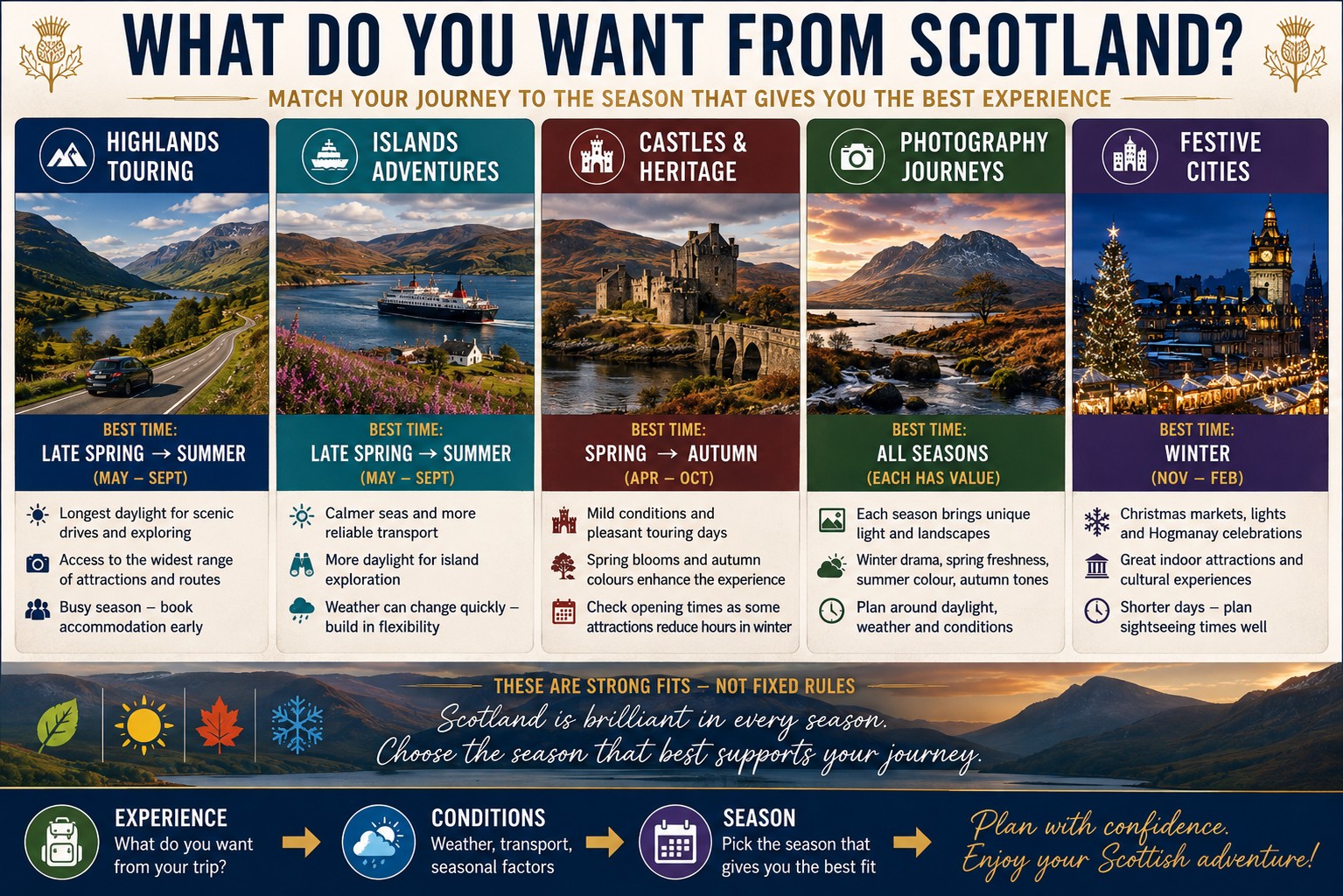
Match the Scotland experience you want with the season that supports it best, from long-daylight Highland and island journeys to autumn heritage touring and festive winter city breaks
❓ Best Time to Visit Scotland FAQs
❓ What Is the Best Month to Visit Scotland?
There is no single month that works best for every traveller. Late spring can combine increasingly long days with landscapes moving towards summer, while June offers exceptional daylight for touring. July and August bring extensive outdoor possibilities and a busy events programme alongside stronger demand, while September can combine useful daylight with the beginnings of autumn atmosphere.
Rather than choosing a month by reputation, consider which compromise best suits your priorities: daylight, events, scenery, outdoor activities, booking pressure or seasonal character.
❓ What Is the Best Season to Visit Scotland?
For ambitious touring, summer generally provides the greatest amount of usable daylight, particularly across the Highlands and islands. Spring becomes progressively easier for extended exploration as the days lengthen, while autumn is particularly attractive for atmospheric landscapes, heritage and photography.
Winter suits travellers interested in festive experiences, cities and slower itineraries specifically designed around short days. Each season offers genuine advantages when matched to the right type of trip.
❓ When Is Scotland Warmest?
Scotland is generally warmest during summer, particularly from June through August, but temperatures and conditions can vary considerably between regions and from one day to another.
Elevation and coastal exposure can matter as much as the date on the calendar. A summer journey might encounter warm sunshine in one location followed by cool wind or rain elsewhere, particularly when travelling between cities, coasts, islands and mountainous areas.
For most sightseeing itineraries, comfortable conditions and usable daylight are ultimately more valuable than pursuing the highest possible temperature.
❓ When Are the Longest Days in Scotland?
Scotland experiences its longest daylight around the summer solstice in June. Its northerly latitude means summer evenings can remain light remarkably late, with the effect becoming increasingly noticeable as you travel farther north.
That additional daylight is one reason summer works so effectively for Highlands and island itineraries. It creates more room for scenic stops and outdoor exploration without forcing travellers to rush between destinations.
Winter brings the opposite planning challenge, when substantially shorter daylight should directly influence daily distances and the amount of sightseeing placed into an itinerary.
❓ Best Time to Visit Scotland FAQs
❓ When Is Scotland Least Busy?
Visitor levels vary considerably by destination, event and time of year, so there is no reliably quiet month across the whole of Scotland. Famous locations can attract visitors well beyond summer, while festivals, school holidays and major local events can create concentrated periods of demand at otherwise less busy times.
Late autumn, winter and parts of spring may offer a different pace in some destinations, but potential reductions in visitor numbers need to be balanced against shorter daylight, seasonal opening arrangements and weather. A quieter period is most rewarding when the season itself also suits the experience you want.
❓ What Is the Best Time to Visit the Scottish Highlands?
For long touring days, scenic road journeys and extensive outdoor exploration, late spring and summer offer clear advantages through increasing or extended daylight. Early autumn can retain useful touring time while introducing softer light and a more atmospheric landscape.
Winter creates a very different Highland experience. Short days and potentially difficult conditions require more contingency, making shorter routes and fewer daily objectives considerably more sensible.
❓ What Is the Best Time to Visit the Isle of Skye?
Skye can be rewarding throughout the year, but each season involves trade-offs. Late spring and summer provide long days for exploring its coast, mountains and extraordinary landscapes, although accommodation, roads and famous viewpoints can experience stronger demand.
Long summer evenings can help spread sightseeing across more of the day, but they do not eliminate that popularity. Autumn offers atmospheric light and changing conditions, while winter creates a more elemental experience alongside shorter daylight, seasonal services and greater potential for disruption.
❓ When Are Midges Most Noticeable in Scotland?
Midges are most commonly encountered during the warmer months when local conditions suit them. They can be particularly noticeable in sheltered parts of western and northern Scotland during damp, relatively still weather.
Their activity varies with location, wind, weather and time of day. Appropriate repellent, suitable clothing and small adjustments to outdoor plans can make them considerably easier to manage.
They are a seasonal practical consideration—not a reason to miss Scotland’s summer landscapes.
❓ Does It Snow in Scotland in Winter?
Yes, Scotland receives snow during winter, but travellers should not expect the entire country to become consistently snow-covered. Snowfall and how long it remains on the ground vary considerably according to location, elevation and individual weather systems. Mountainous areas are generally more likely to experience significant winter conditions than lower-lying cities and many coastal destinations.
If snow is important to your plans, avoid constructing an itinerary that depends upon it appearing on particular dates. Instead, treat snow as one possible element of a Scottish winter and plan primarily around daylight, current forecasts and travel conditions.
❓ Is Scotland Worth Visiting in Winter?
Absolutely—provided the trip is designed specifically for the season.
Winter can offer atmospheric landscapes, festive cities, Christmas experiences, Hogmanay celebrations and a slower style of travel that feels very different from summer. Edinburgh, Glasgow and other urban destinations can work particularly well because museums, galleries, historic attractions, restaurants and cultural experiences provide valuable alternatives when conditions are less suitable for extended outdoor sightseeing.
The principal compromise is daylight. Daily distances should generally be more conservative, outdoor plans need greater contingency and seasonal opening arrangements should be checked before travelling.
❓ When Are Highland Games Held in Scotland?
Highland Games are principally associated with the warmer part of the year, with gatherings taking place in communities across Scotland. Exact dates, programmes and locations vary, so travellers interested in attending should check current information rather than relying on a previous year’s schedule.
The BVT Scotland Events Calendar provides a useful starting point when coordinating a wider journey with Highland Games and other seasonal events.
🌄 Season and Geography Work Together
Season alone does not determine the journey. Geography changes what the season means.
The same month can create very different travel conditions depending on whether you are exploring Edinburgh, driving through the Highlands, crossing to the islands or linking several regions together. The strongest itinerary considers both when you are travelling and where you are going.
🏙️ City + Winter
→ Highly workable with indoor alternatives
Museums, heritage attractions, restaurants, cultural experiences and festive events can make shorter daylight much easier to accommodate.
🏔️ Highlands + Winter
→ Shorter routes + greater contingency
Limited daylight, changing road conditions and weather mean daily mileage should be conservative and the itinerary should remain flexible.
🏝️ Islands + Autumn or Winter
→ Transport resilience becomes critical
Ferries, flights, daylight and seasonal services can have a greater influence on what is realistic, so fixed connections deserve additional planning margin.
☀️ Highlands + Summer
→ Maximum daylight + stronger demand
Long days create exceptional touring freedom, but popular routes, accommodation and major attractions may also be busier.
⛴️ Islands + Summer
→ Excellent touring opportunity + critical logistics to secure
Long daylight can transform an island itinerary, but important ferry crossings, accommodation and vehicle capacity may need to be planned early.
🗺️ Scotland-Wide Journey + Shoulder Season
→ Balance daylight against changing services
Spring and autumn can offer rewarding conditions across several regions, but attraction hours, seasonal transport and daylight may change noticeably during the course of the season.
🧭 The Real Planning Equation
When + Where = What Is Realistically Possible
🌄 BVT Planning Principle: Never judge a Scotland itinerary by season alone. Consider the interaction between daylight, geography, transport, local services and the type of experience you want before deciding what should fit into each day.
🧭 Final Thoughts: There Is More Than One Scotland to Discover
Spring brings renewal and rapidly expanding daylight. Summer opens extraordinarily long days for Highlands, islands and events. Autumn exchanges some of that daylight for colour, softer light and atmosphere, while winter brings festive celebrations, dramatic landscapes and a deliberately slower rhythm.
The Highlands change with those seasons. So do Scotland’s islands, cities, castles, roads and outdoor experiences. Even the amount of Scotland that can comfortably fit into a single day changes substantially across the year.
Do not apply this link yet. The contextual anchor is excellent and this is a high-priority Scotland cluster connection, but I will not invent or reconstruct the Islands Guide URL. Once its verified publication URL is added to the protected master list, this anchor should be activated.
That is why the most useful question is not simply, “When is Scotland best?”
It is: “Which Scotland do I want to meet?”
Choosing between Scotland’s seasons is less about identifying a perfect period and more about matching the country’s changing rhythm to your own priorities.
If you want long days that leave generous room for ambitious scenic journeys, summer has an obvious advantage. If landscapes, photography and atmosphere matter more than maximum daylight, autumn may be more compelling. Spring offers the pleasure of watching Scotland change almost week by week, while winter rewards travellers prepared to slow the pace and experience the country on very different terms.
Where you travel matters just as much as when. A summer island adventure and an Edinburgh festival break place different demands on an itinerary, just as exploring the Highlands in winter requires different preparation from spending Christmas in the capital. Season and geography work together, and the strongest Scotland itineraries recognise both.
Events can add another dimension. A Highland Games gathering, local festival, Hogmanay celebration or community event may become one of the experiences remembered long after the famous viewpoints and landmarks. Checking what is happening during your proposed dates can therefore be just as worthwhile as checking likely weather conditions.
Most importantly, choosing one season does not mean accepting an inferior version of Scotland.
Every part of the year reveals something the others cannot quite reproduce: the anticipation and expanding days of spring, the seemingly endless evenings of summer, autumn’s changing light or the intimacy of a winter journey built around fewer, carefully chosen places.
Scotland does not simply become better or worse as one season gives way to another. It becomes different.
Choose the season whose daylight, landscapes, events and rhythm most closely match the Scotland you want to discover. Plan the essentials, leave breathing room for changing conditions and unexpected stops, and allow the time of year itself to become part of the experience rather than merely the date printed on your booking.
🚌 Explore Scotland Tours
Once you have chosen when to visit Scotland, the next decision is how much of the country you want to experience.
A city-based stay can work particularly well with a focused day tour, while the Highlands, islands and longer scenic routes generally reward more time. Choose the touring style that fits both your season and the scale of the journey.
🏙️ Scotland Day Tours
Ideal for travellers using Edinburgh or another Scottish gateway as their base and wanting to add a focused seasonal excursion without changing accommodation.
Good for: shorter stays • city-based visitors • focused regional experiences • adding countryside and scenery to a city break
🏔️ Scotland Multi-Day Tours
A stronger choice when you want to travel beyond a single region and give Scotland’s landscapes enough time to become part of the journey rather than simply a series of stops.
Good for: Highlands • Loch Ness • islands • scenic routes • overnight regional stays • deeper exploration
🧭 Which Touring Option Fits Your Journey?
Staying in one city and want to explore farther for a day?
→ Consider a Scotland Day Tour.
Want the Highlands, islands or several regions with overnight stays?
→ Consider a Scotland Multi-Day Tour.
🌦️ Let the Season Shape the Journey
Whichever touring style you choose, keep the article’s central principle in mind: match the route, daily pace and amount of travel to the daylight and seasonal conditions you are likely to encounter.
🧭 Continue Planning Your Scotland Journey
You have chosen when Scotland may suit you best. Now turn that seasonal decision into a journey.
Use these planning guides to decide where to go, whether the Highlands or islands fit your priorities, how much time to allow and how to reach and explore Scotland.
🏴 Decide Where to Go in Scotland
Compare Scotland’s Highlands, islands, cities and legendary landscapes and decide which regions belong in your journey.
🏔️ Explore the Scottish Highlands
Plan around mountains, lochs, castles and scenic journeys while choosing the Highland region and route that best fit your available time.
🏝️ Discover Scotland’s Islands
Compare Skye, Orkney, the Hebrides and other island experiences while considering access, journey time and the type of island Scotland you want to discover.
⏳ Give Scotland More Time
See how a multi-day journey can connect the Highlands, islands, lochs and castles while allowing more time for scenic routes and overnight regional stays.
🚆 Plan How to Reach and Tour Scotland
Compare ways to travel into and around Scotland when starting from London or elsewhere in Britain, including rail-based journeys and organised touring.
🧭 Build Your Scotland Journey
When should I go? → Where should I go? → Highlands or islands? → How much time do I need? → How should I travel?
🏴 BVT Scotland Planning Principle: Start with the experience you want, match it to the right season and geography, then give the route enough time. Scotland is usually more rewarding when the journey follows a clear purpose rather than trying to include every possible destination.