


Stonehenge Small Group vs Large Coach Tours: Which Should You Choose? (2026 Guide)
16th August 2026
🗿 Stonehenge Small Group vs Large Coach Tours: Which Should You Choose? (2026 Guide)
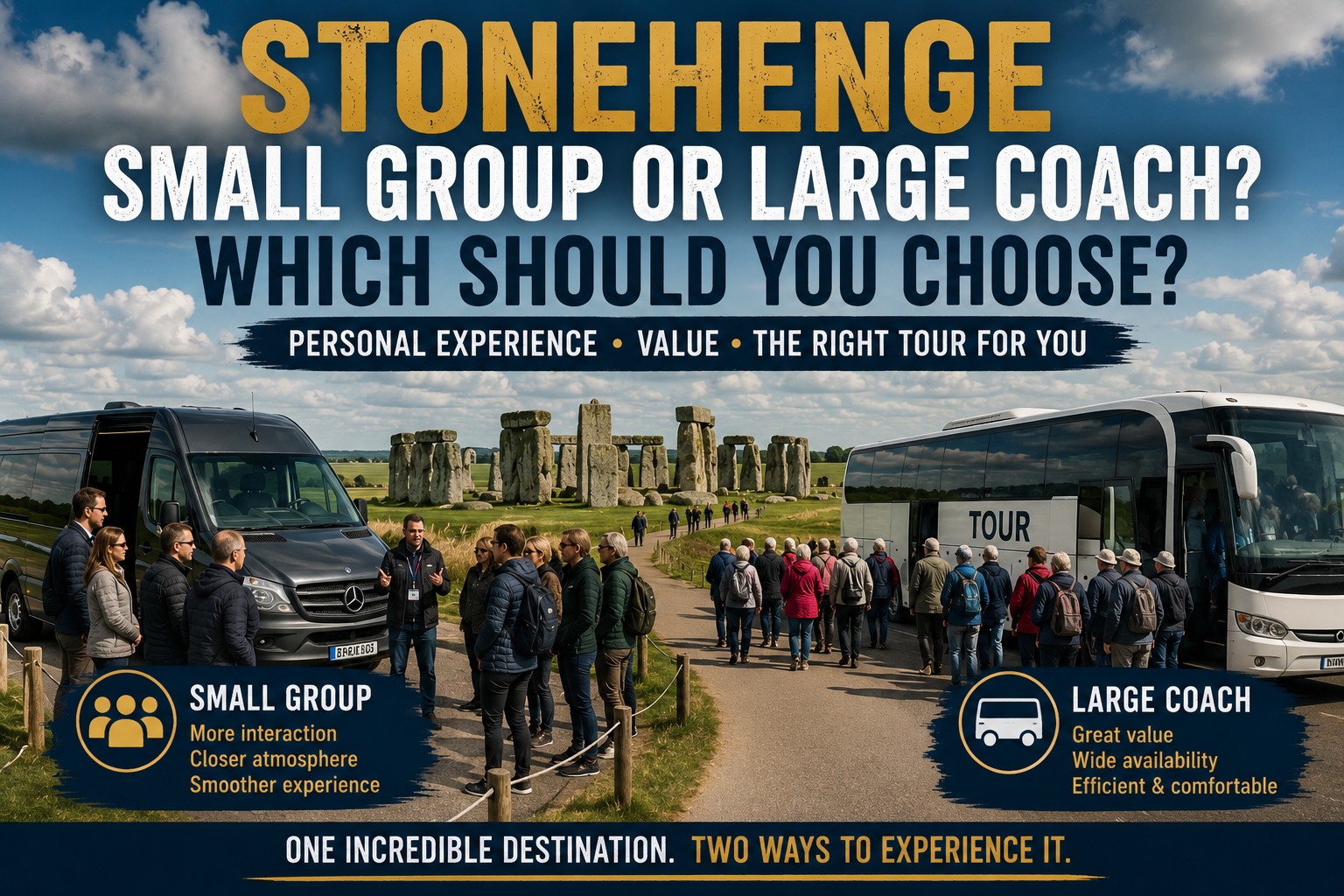
Small-group and large-coach Stonehenge tours offer different advantages, from easier interaction and a more personal atmosphere to broad availability, structured sightseeing and value
🎯 Small Group or Large Coach — Which Is Actually Better?
Choosing between a small-group Stonehenge tour and a large coach tour is not simply a choice between “premium” and “budget”. Both formats can provide an excellent day at Stonehenge, but they create noticeably different travel experiences.
Small-group tours often appeal to travellers who value easier interaction with the guide, a more cohesive atmosphere and smoother movement between stops. Large coach tours can be highly effective for visitors who prioritise price, broad availability, comfortable structured transport and an efficient sightseeing itinerary.
Neither format wins automatically.
A small group can still have an average itinerary, while a well-organised coach tour can deliver an exceptionally strong day. The most important question is not how many people are travelling with you, but whether the tour as a whole matches your priorities.
That means looking at group size alongside guide quality, itinerary design, time at Stonehenge, vehicle comfort, departure arrangements, included destinations and overall value.
Group size affects the experience, but it does not determine tour quality by itself.
Before comparing actual tour options, it therefore helps to decide which differences would genuinely improve your day. If easier guide interaction and a more personal atmosphere matter strongly, a smaller group deserves greater weight. If price, availability and an efficient structured itinerary matter more, a coach may already be the stronger fit.
🧭 What Does Group Size Actually Change?
Group size matters because it changes some of the mechanics and atmosphere of the day.
In a smaller group, it is generally easier to speak directly with the guide, ask follow-up questions and move as one unit. Boarding and leaving the vehicle may be faster, regrouping after stops can be simpler, and there are fewer passengers whose timings need to be coordinated.
The social atmosphere can also feel different. A small group may develop more naturally into a shared travelling group, while a large coach can feel more anonymous. Some travellers enjoy the intimacy and conversation that can develop in a smaller group; others are perfectly happy enjoying the day independently without needing much interaction.
What group size does not determine is just as important. It does not tell you how good the guide will be. It does not guarantee how long you will spend at Stonehenge. It does not reveal how comfortable the vehicle will be, how strong the itinerary is or whether the additional destinations genuinely interest you.
Two tours with very different passenger numbers can still provide similar sightseeing time.
The useful distinction is therefore between group mechanics and tour design. Fewer passengers may improve the way people move through the day, but the planned itinerary determines where the important blocks of time are actually spent.
This distinction is particularly useful when comparing bookable Stonehenge tours. Start with the itinerary and practical arrangements, then decide whether the group format adds enough value to influence your final choice.
📊 Small Group vs Large Coach: Side-by-Side Comparison
The clearest way to compare the two formats is to look at where each tends to offer practical advantages.
| Decision Factor | Small Group Tour | Large Coach Tour | Who May Prefer It |
|---|---|---|---|
| Guide interaction | Easier to engage directly | More limited across a larger group | Travellers who enjoy questions and discussion |
| Boarding and movement | Usually simpler and quicker | Requires more coordination | Time-conscious travellers |
| Social atmosphere | More intimate | Broader and more anonymous | Depends on personality |
| Price | Usually higher | Often lower | Budget-conscious visitors |
| Availability | Can be more limited | Often broader | Fixed-date travellers |
| Personal attention | Greater potential | Naturally less individual | Visitors valuing reassurance or interaction |
| Itinerary flexibility | Some potential | Usually highly structured | Travellers valuing responsiveness |
| Combination touring | Works well | Often very efficient | Broad sightseeing travellers |
| Vehicle experience | Smaller vehicle | Larger coach | Comfort preference varies |
No format wins every category.
A small group may feel more personal but cost more. A coach may offer excellent value but involve more coordination at each stop. A large vehicle may feel more spacious to one traveller, while another prefers the ease and atmosphere of a smaller vehicle.
It is also important to treat the table as a guide rather than a guarantee. “Small group” can describe different passenger numbers and vehicle types, while coach tours vary considerably in itinerary, service and operating style.
The right comparison is therefore not small versus large in isolation, but what each format contributes to the kind of day you want.
Once you have identified those priorities, comparing actual tour options becomes easier. Group size can then be assessed alongside the itinerary, time at Stonehenge, departure arrangements and overall value rather than being used as a shortcut for tour quality.
🗣️ Guide Interaction and the Feel of the Tour
One of the strongest arguments for small-group touring is the greater potential for interaction.
With fewer travellers, asking a question can feel easier. The guide may be able to respond to individual interests more naturally, conversations can continue between destinations, and visitors may feel more involved rather than simply listening to commentary delivered to a larger audience.
For a traveller who enjoys history, archaeology or asking spontaneous questions, that difference can materially improve the experience.
A large coach does not automatically mean poor guiding, however. A skilled guide can hold the attention of a larger group, explain complex subjects clearly and create an engaging narrative throughout the journey. For travellers who mainly want authoritative interpretation rather than sustained conversation, that may provide everything they need.
The key distinction is this:
Smaller groups create better conditions for interaction; they do not automatically create better guiding.
If you mainly want clear interpretation and a well-run day, an excellent coach guide may give you everything you need. If conversation, questions and individual engagement are important parts of how you enjoy travel, a smaller group becomes considerably more attractive.
When evaluating an actual tour, therefore, consider what you want from the guide as well as how many people will be travelling. A smaller group has greatest value when you intend to make use of the additional opportunity for interaction.
⏱️ Boarding, Waiting and Tour Pace
Group logistics are one of the less glamorous differences between the two formats, but they can have a noticeable effect on how the day feels.
Every tour involves getting passengers on and off vehicles, returning after comfort stops, meeting at designated points and ensuring everyone is present before moving on. With fewer passengers, these processes can be simpler and quicker.
A small delay repeated across several stops can gradually affect the rhythm of a large-group day. If one or two travellers return late, everyone waits. Larger groups may also take longer to board and disembark simply because more people are moving through the same space.
Smaller groups can therefore feel more fluid.
But that does not mean a small group automatically receives more sightseeing time.
A smaller group may save minutes around the edges of the day, but the itinerary determines where the important hours go.
A well-run coach tour with disciplined timings may still allocate more time at Stonehenge than a smaller tour attempting an ambitious multi-stop itinerary.
When comparing tours, look beyond the total duration. Consider how many destinations are included, how much road travel is involved and, where the information is available, how much time is actually planned at Stonehenge.
This is one reason the itinerary should be compared before the group-size label. If meaningful time at Stonehenge is one of your principal priorities, protect that first and then decide how much the smoother mechanics of a smaller group add to the experience.
🚌 Comfort: Minibus or Large Coach?
Vehicle comfort is highly personal and should not be confused with group size.
Large coaches may appeal to travellers who prefer the scale and feel of a full-size touring vehicle, particularly on longer road journeys. Depending on the specific coach and service, passengers may value generous luggage capacity, onboard facilities or simply the experience of travelling in a vehicle designed for larger touring groups.
Smaller touring vehicles offer different advantages. Boarding and disembarking may be quicker, the environment can feel more intimate, and a smaller vehicle can contribute to the more personal character that attracts many travellers to small-group touring.
Neither format is automatically more comfortable.
A modern, well-maintained smaller touring vehicle can provide an excellent journey, while the quality and specification of large coaches also vary considerably. Seat dimensions, legroom, access steps, air conditioning, luggage arrangements and onboard facilities cannot be reliably inferred simply from the words “small group” or “large coach”.
If comfort, mobility or luggage capacity is particularly important to you, check the actual vehicle and service information before booking rather than relying on the tour category alone. Accessibility requirements deserve the same care: never assume that a larger or smaller vehicle will automatically be easier to use.
Vehicle size is not the same thing as vehicle quality.
💷 Which Offers Better Value for Money?
Large coach tours often have a natural advantage when price is a major priority. Carrying more passengers can allow operating costs to be spread across a larger group, potentially making coach touring attractive to visitors who want a straightforward and affordable way to experience Stonehenge.
That does not automatically make a coach the better-value option.
A small-group tour may cost more because the traveller is buying a different kind of experience: easier interaction, a more cohesive atmosphere, simpler group logistics and potentially a greater sense of personal involvement.
The correct question is therefore:
Are the advantages of the smaller format important enough to you to justify paying more?
Small-group value tends to rise when you care strongly about guide interaction, group cohesion, easier movement and a more personal touring environment.
Coach value tends to rise when you care more about lower cost, broad availability, efficient structured sightseeing and simply experiencing Stonehenge as part of a well-organised day.
Do not judge value by price alone. Compare what the itinerary includes, how much time is devoted to Stonehenge and whether the tour format provides benefits you will actually notice and appreciate.
Paying extra for features you do not value is not better value. Equally, choosing solely on the lowest price can be a false economy if the resulting experience omits something that matters strongly to you.
When you reach the point of comparing actual Stonehenge tour options, use the same test. The stronger-value choice is not automatically the cheapest or smallest tour; it is the one whose price is proportionate to the itinerary, touring environment and benefits that matter to you.
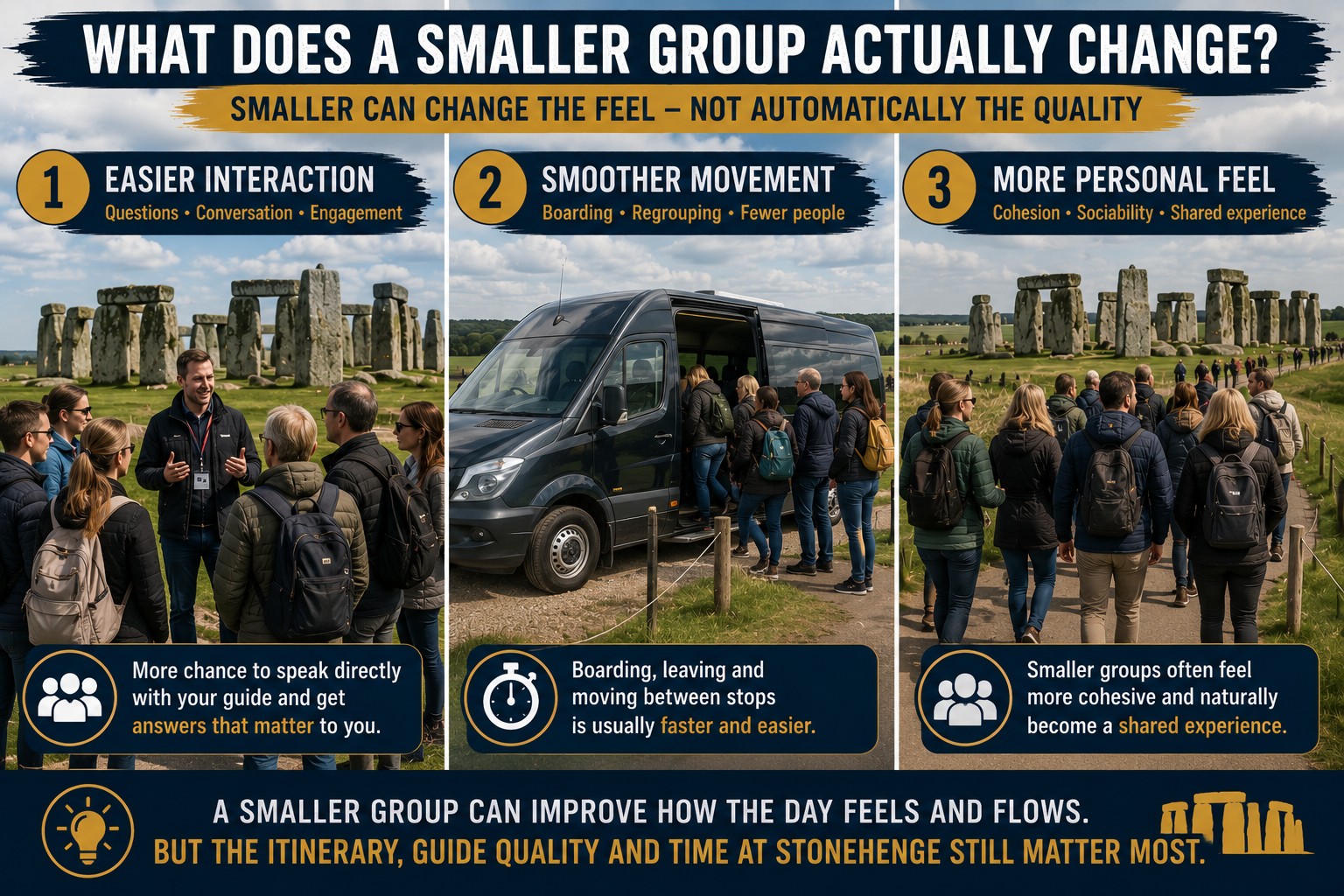
Smaller Stonehenge tour groups can make guide interaction, group movement and social engagement easier, although itinerary quality and time at Stonehenge remain more important than passenger numbers alone.
👤 Which Tour Style Suits Your Type of Traveller?
The best choice often becomes clearer when you think about the way you travel rather than the tour category.
🌍 First-Time Visitors
A small group can be attractive for first-time visitors who expect to ask questions or want a little more reassurance during the day. Easier guide interaction may help someone unfamiliar with Stonehenge, London departure logistics or British touring conventions feel more comfortable.
A coach tour can also be an excellent first experience. Highly structured itineraries and established logistics may suit visitors who simply want a straightforward way to see Stonehenge without overcomplicating the day.
👤 Solo Travellers
Both formats can work well for solo travellers.
A coach may offer attractive value and a broader social environment, while a smaller group may make natural conversation with fellow travellers easier. Neither benefit will appeal equally to everyone: some solo travellers enjoy meeting people, while others prefer to experience the day more independently.
The better choice is the format that matches how sociable and involved you actually want your touring experience to be.
💑 Couples
Couples may appreciate the more relaxed and cohesive feel of a small group, particularly if Stonehenge forms part of an important holiday or special occasion. Easier interaction with the guide and fewer fellow passengers can make the wider touring experience feel more personal.
But the itinerary still matters more than the label. A couple who genuinely wants to combine Stonehenge with another major destination may prefer a well-designed coach tour over a smaller tour that does not include the places they most want to see.
👨👩👧 Families
Family decisions often depend heavily on cost, comfort and pacing.
Paying a small-group premium for several seats can substantially change the overall price. On the other hand, easier boarding and a smaller touring environment may appeal to families whose children respond better to a more personal setting.
The age and temperament of the children, the length of the day and the amount of travel involved are more useful considerations than assuming one group format is universally better for families.
🧓 Older Travellers
Age alone should not determine the choice.
More useful questions concern mobility, vehicle access, step height, rest-stop arrangements, walking requirements and the pace of the itinerary. A full-size coach may feel more comfortable for one traveller, while another may prefer the simpler group movement associated with a smaller tour.
If mobility or accessibility is important, confirm the practical arrangements of the specific service rather than relying on assumptions about vehicle size.
📸 Photographers
Photographers may appreciate a smaller group because moving and communicating can be easier, but passenger count is not the decisive issue.
The most important variable is usually how much usable time the itinerary gives you at Stonehenge. A coach tour with more time at the monument may be better for photography than a small-group tour that quickly moves on to several additional destinations.
For photography-focused travellers, this is another reason to compare the whole itinerary before deciding that smaller automatically means better. Time, pace and the prominence given to Stonehenge may have a greater effect on your photographic experience than the number of passengers travelling with you.
🏰 Are Large Coach Tours Better for Combination Itineraries?
Large coach tours can be particularly effective for structured combination days.
An itinerary connecting Stonehenge with destinations such as Bath, Windsor or Oxford can involve considerable road travel, timed visits and carefully coordinated movement. Larger touring operations are often designed around this kind of structured sightseeing day, allowing several major destinations to be incorporated into a single itinerary.
That can make the format highly efficient, particularly for visitors with limited time in Britain who genuinely want to experience several places.
Small-group tours can also deliver excellent combination itineraries, however. Their potential advantage lies less in the number of destinations they can reach and more in the character of the group experience along the way.
The useful question is:
Do you want to see more places efficiently, or do you want the day to feel more personal?
There is no reason you cannot have elements of both, but every additional destination creates a trade-off. More sightseeing inevitably means that time must be divided between travelling, visiting attractions and keeping to the day’s schedule.
A combination coach tour can therefore represent excellent value when you genuinely want to visit every place on the itinerary. It is less compelling when additional destinations are attractive mainly because they make the tour appear to offer more.
Before booking, ask whether you would choose each destination independently. If the answer is yes, a combination itinerary may use your limited sightseeing time very effectively. If Stonehenge is overwhelmingly your priority, a simpler itinerary may ultimately provide the more satisfying day.
This distinction also helps when comparing the wider range of Stonehenge experiences available. Rather than beginning with the number of attractions included, decide whether you want Stonehenge to function as the principal experience or as one important part of a broader southern England sightseeing day.
⚖️ When Group Size Matters Less Than You Think
By this point, it should be clear that passenger count matters—but sometimes much less than travellers initially assume.
Guide quality can matter more. So can the amount of time actually allocated to Stonehenge. A tour with fewer passengers is of limited benefit if its itinerary does not give sufficient attention to the place you have travelled to see.
The departure location, route, number of additional attractions, vehicle comfort, accessibility arrangements and overall organisation can all have a greater effect on your day than whether fifteen people or forty people are travelling with you.
A useful pre-booking test is:
- Is the itinerary genuinely right for me?
- Is enough time allocated to Stonehenge?
- Does the vehicle suit my practical needs?
- Does the group format suit the way I like to travel?
- Does the price feel proportionate to the overall experience?
Only after those questions have been answered should group size become the deciding factor.
A well-designed large-coach tour can be better than a poorly designed small-group tour.
Equally, a thoughtfully run small-group experience may justify its premium even when two itineraries look remarkably similar on paper. The difference may lie in easier conversation, smoother movement and the overall character of the day rather than a longer list of inclusions.
The most useful booking habit is therefore to compare tours in the right order: itinerary first, practical suitability second, group style third.
Once those fundamentals are clear, comparing appropriate Stonehenge tour options becomes considerably more meaningful. You are no longer choosing according to a label; you are deciding which available experience best satisfies the requirements you have already established.
Choose the whole tour, not merely the passenger count.
🌅 What About Stonehenge Inner Circle Access?
Inner Circle access introduces a different decision from choosing between a small group and a large coach.
It concerns the type of access you want at Stonehenge, whereas small group versus large coach concerns the touring format used for the wider experience. Keeping those decisions separate makes it much easier to compare tours accurately.
A small-group tour does not automatically include Inner Circle access. Equally, choosing special access does not remove the need to consider timing, transport, itinerary design, group style and the practical shape of the rest of your day.
If experiencing Stonehenge from within the stone circle is an important part of your plans, the BVT Stonehenge Inner Circle Access Calendar 2026–2027 can be used as a planning resource to explore scheduled access opportunities and consider how they might fit your travel dates.
There is an important distinction to remember: a scheduled access opportunity is not the same as current bookable availability. Confirm the relevant arrangements before building important flights, accommodation or other fixed travel plans around a particular experience.
Once you know whether Inner Circle access genuinely matters to you, you can return to the wider tour decision and compare group size, itinerary, timing, transport and value on their own merits.
This prevents two separate decisions from becoming confused. First decide whether standard or special access best matches the Stonehenge experience you want; then assess which touring format provides the strongest overall journey.
🧩 Small Group or Large Coach? Final Decision Framework
After comparing the practical differences, the choice becomes considerably easier when you return to your own priorities rather than asking which format is universally “best”.
At this stage, the strongest option should satisfy three tests: the itinerary should give appropriate weight to Stonehenge, the practical arrangements should suit your needs, and the group format should complement the way you prefer to travel.
If those fundamentals are right, price and availability can then help you choose confidently between the suitable options rather than forcing you towards a tour that was never a good fit in the first place.
🚐 Choose Small Group If…
Choose a small-group tour if easier guide interaction, a more cohesive atmosphere and smoother group movement matter strongly to you.
It can be particularly attractive if you enjoy asking questions, prefer a more personal touring environment and like the idea of travelling with a group small enough for interaction to develop naturally. The potential premium makes most sense when you will genuinely value those differences throughout the day.
Do not choose small group simply because it sounds more exclusive. Choose it because the characteristics of smaller-group travel match the way you prefer to experience a destination.
If this description closely matches your priorities, a dedicated small-group Stonehenge experience becomes a logical place to begin comparing suitable tour options.
🚌 Choose Large Coach If…
Choose a large coach when price, broad availability and efficient structured touring are stronger priorities.
This can be an excellent choice if you are comfortable travelling as part of a larger group and mainly want a reliable, well-organised sightseeing day. It may be particularly attractive when your travel dates are fixed or when a combination itinerary includes several destinations you genuinely want to visit.
Large-coach touring should not be regarded simply as the compromise option. For the right traveller and itinerary, its structure, scale and value can be genuine advantages.
When comparing coach-based Stonehenge options, concentrate on the itinerary and experience rather than assuming that a larger passenger capacity automatically means a less rewarding visit.
⚖️ Look Beyond Group Size If…
Do not let passenger count decide the booking when another factor is clearly more important.
A substantially better itinerary, more appropriate time at Stonehenge, superior accessibility arrangements, a more suitable vehicle, more convenient departure arrangements or additional destinations you genuinely want may all outweigh the group-size difference.
And if neither shared format provides the level of control or personalisation you require, the real comparison may not be small group versus coach at all. A private tour may ultimately suit your needs better.
The core principle is simple:
Choose the whole tour, not merely the passenger count.
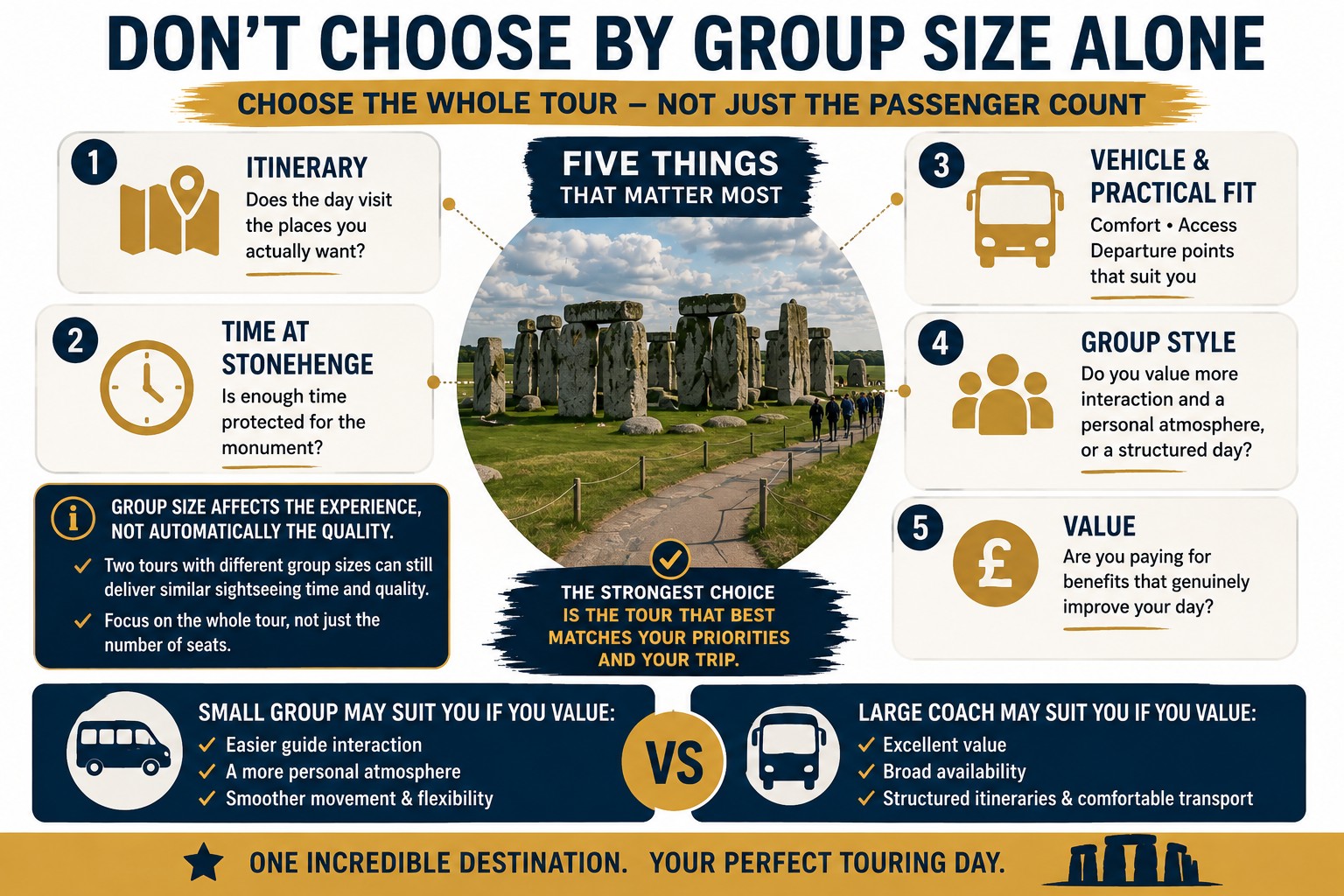
Group size is only one part of choosing a Stonehenge tour. Compare the itinerary, time at Stonehenge, practical arrangements, touring style and value before deciding which format suits you
🌱 A More Responsible Stonehenge Tour
Shared touring can be a practical way to experience Stonehenge while reducing the need for multiple separate car journeys, although the environmental impact of any particular service depends on factors such as vehicle type, occupancy, route design and overall operation.
Responsible planning also means thinking carefully about the itinerary itself. Adding destinations simply because they can be fitted into one day can create unnecessary travel and leave less time to appreciate the places you have travelled to experience.
Whether you choose a smaller touring vehicle or a large coach, look for an itinerary that uses the day purposefully. Shared transport, sensible routing and meaningful destination choices can work together to create a more considered journey.
At Stonehenge itself, remember that the famous stone circle forms part of a much wider prehistoric landscape. Follow visitor guidance, respect managed areas and give the site the attention appropriate to its archaeological and cultural significance.
Travel with purpose. Explore with care.
❓ Frequently Asked Questions
❓ Are Small-Group Stonehenge Tours Better?
They can be better for travellers who value interaction, a more cohesive atmosphere and easier movement through the day.
They are not universally better. A strong large-coach itinerary may provide better value or suit your travel dates, destinations and practical preferences more effectively.
The important distinction is between better for you and simply smaller. If you would make little use of the additional interaction a small group can provide, paying a premium purely for fewer passengers may offer limited additional value.
Before paying more for the smaller format, compare the actual itinerary and practical arrangements. If the small-group option also gives you the Stonehenge experience, departure arrangements and touring style you prefer, the additional cost has a clearer purpose.
❓ Are Large Coach Tours Cheaper?
Large coach tours can often offer competitive per-person pricing because operating costs are spread across more passengers. However, actual prices vary according to the operator, itinerary, inclusions, travel date and departure arrangements.
Do not assume that the lowest-priced tour automatically represents the best value. Compare what you receive as well as what you pay, particularly the itinerary and the amount of attention given to Stonehenge.
A lower price becomes particularly attractive when the tour already satisfies your main priorities. If the itinerary, timing and practical arrangements work well for you, paying more solely to reduce the number of fellow passengers may add little meaningful value.
❓ Do Small Groups Get More Time at Stonehenge?
Not necessarily.
Group size may reduce some boarding, disembarking and regrouping time, but the amount of time allocated to Stonehenge is primarily determined by the itinerary. A small-group tour visiting several destinations may actually provide less time at the monument than a more focused large-coach tour.
Always compare the sightseeing structure rather than assuming fewer passengers automatically means a longer visit.
Where tour information allows, compare the planned time at Stonehenge directly. For travellers who regard the monument as the principal reason for the day, this can be considerably more important than the passenger count.
❓ Is a Small Group Better for First-Time Visitors?
It can be, particularly if you value easier access to the guide and expect to ask questions during the journey.
However, a well-organised coach tour can also provide an excellent first Stonehenge experience. Visitors who prefer a highly structured day and do not require much individual interaction may find that a larger tour suits them perfectly well.
The better first-time option is the one that provides the right combination of guidance, itinerary and practical simplicity for you.
❓ Which Is Better for Families?
There is no universal answer.
Families should compare the total cost across all passengers, vehicle comfort, length of the day, children’s patience, boarding arrangements and overall itinerary pace. A smaller group may feel easier and more personal for some families, while a large coach may offer substantially better value for others.
When comparing family options, it can therefore be useful to calculate the cost of the whole party rather than focusing only on the per-person difference. Then consider whether the smaller-group advantages would materially improve the day for your particular family.
❓ Which Is Better for Solo Travellers?
Both formats can work extremely well for solo travellers.
A large coach may offer attractive pricing and a broader social environment, while a small group can make conversation and interaction with fellow travellers feel more natural. For someone travelling alone who enjoys meeting people, either experience can therefore have advantages.
Your preferred level of sociability matters more than travelling solo itself. Some independent travellers enjoy becoming part of a small group for the day; others value having their own space and are perfectly comfortable within a larger coach environment.
Choose according to the itinerary, budget and degree of interaction you actually want.
❓ Are Small-Group Tours Worth Paying More For?
They can be, but only when the benefits of the smaller format matter strongly to you.
If guide interaction, group atmosphere, easier movement and a more personal touring environment are important parts of your travel experience, the additional cost may feel entirely justified. If your priority is simply a reliable Stonehenge visit with an itinerary you like at an attractive price, a well-run large coach can offer excellent value.
The premium is easiest to justify when the smaller format solves a genuine preference or practical need rather than simply appearing more exclusive.
🎯 Final Verdict: Choose the Whole Tour, Not Just the Group Size
Small-group Stonehenge tours often perform strongly on interaction, group cohesion and smoother logistics. Large coach tours often perform strongly on price, availability and efficient structured sightseeing.
Neither format automatically delivers the better day.
Before booking, compare the itinerary, time at Stonehenge, guide and service quality, vehicle suitability, included destinations, price and departure arrangements alongside group size.
If two tours are otherwise genuinely comparable, your travel preferences can make the final decision. Choose a small group if a more personal environment and easier interaction matter strongly to you. Choose a large coach if value, availability and structured touring matter more.