


London Travel Guide: Your Gateway to Britain and Europe (2027 Guide)
18th August 2026
🌍 London Travel Guide: Your Gateway to Britain and Europe (2027 Guide)

Start with London, then decide where your journey should take you next — through England, north to Scotland or across the Channel to Paris and wider Europe
A good London travel guide should do more than send you racing between famous landmarks. London can be the whole holiday, but it can also be the place where a much bigger journey begins.
For some travellers, several days in the capital will be the centrepiece: Westminster beside the Thames, royal London, world-class museums, historic streets, neighbourhoods, theatre and the simple pleasure of discovering what lies between the headline sights. For others, those same few days are only the opening chapter before Windsor, Stonehenge, Scotland, Paris or a wider journey through Europe.
The best London itinerary is not necessarily the one containing the greatest number of attractions. It is the one that gives London the right role in your trip.
Think of the possibilities in expanding layers:
Explore London → Discover England → Travel farther through Britain → Continue into Europe
You do not need to complete every layer. A short visit may never leave London. A longer holiday might use the capital as a base for one carefully chosen excursion. Another traveller may arrive in London, explore for several days and then simply keep going—north through Britain or across the Channel.
This guide is designed around those decisions. Rather than giving you an impossible checklist, it will help you decide how much time London deserves, what is genuinely worth prioritising, what can sensibly be added and when another destination should become the next stage rather than another exhausting day trip.
⏳ How Many Days Do You Really Need in London?
There is no universal answer because two travellers can spend the same number of days in London and want completely different experiences.
🕑 Two Days in London
Two days can provide an excellent introduction if you are disciplined. There is time for several headline sights and one or two clear interests, but very little room for long museum visits, spontaneous discoveries, unexpected queues or meaningful excursions beyond the city.
For a stopover or tightly planned multi-city holiday, two days can work extremely well. Treat them as a focused introduction, however, rather than an attempt to “complete” London.
🗓️ Three or Four Days in London
For many first-time visitors, three or four days is the sweet spot. It allows you to experience London’s defining sights without making every hour feel scheduled, while leaving space for a museum, a neighbourhood, time beside the Thames or an evening that exists for pleasure rather than itinerary efficiency.
A carefully chosen excursion beyond London can also become realistic at this point, although there is a genuine trade-off. Every day spent elsewhere is a day removed from a capital that could easily fill a week.
🧳 Five Days or More
With five days or longer, London begins to feel less like a sequence of appointments and more like a city you can actually experience. You can cover the major sights while making room for markets, parks, longer museum visits, seasonal events and the unexpected discoveries that rarely survive an overfilled itinerary.
This is also when London’s gateway role becomes particularly useful. You can explore the capital properly and still have enough time either to make a worthwhile excursion or begin the next stage of your journey.
| Time in London | What it realistically allows | Main compromise | Best suited to |
|---|---|---|---|
| 2 days | Major highlights and one or two clear priorities | Very little flexibility | Stopovers and tightly planned multi-city trips |
| 3–4 days | A strong first visit with broader sightseeing and breathing room | Excursions require careful choices | Most first-time visitors |
| 5+ days | Deeper London exploration plus day-trip or slower-travel flexibility | Uses more of your overall holiday | Britain and Europe itineraries |
These ranges are guidance, not rules. A museum enthusiast could happily spend a week in London without leaving the city, while someone building a longer European itinerary may deliberately choose three excellent London days before continuing elsewhere.
🏙️ London Travel Guide Essentials: What Should a First-Time Visitor Prioritise?
London becomes much easier to plan when you stop asking which attractions rank highest and start asking what kind of London you want to experience.
👑 Royal and Ceremonial London
For many international visitors, Westminster and royal London provide an irresistible first encounter. Buckingham Palace, ceremonial spaces and the institutions clustered around Westminster tell overlapping stories of monarchy, government and national identity.
Rather than treating each famous name as an isolated stop, explore this part of London as a connected historical landscape. It creates a more coherent day—and usually involves considerably less time disappearing underground between attractions.
🏛️ Historic London
Travel east and London’s character changes. Around the City and Tower area, royal ceremony gives way to older stories of defence, commerce, religion and urban survival. Medieval churches can sit within sight of glass towers, while street patterns and place names preserve fragments of a city repeatedly rebuilt around them.
That contrast is worth experiencing. Westminster tells one story of power; the City tells another, shaped by merchants, institutions and London’s long relationship with the river and the wider world.
🎭 Culture, Museums and Neighbourhoods
London does not need to be experienced primarily through monuments. Its museums and galleries can occupy an hour or an entire day, while theatre, music, food and neighbourhood life offer completely different ways to understand the capital.
This is where personal priorities should overrule generic “must-see” lists. An art lover may reasonably sacrifice several famous landmarks for the National Gallery or Tate Modern. A family may prefer interactive attractions and parks, while another visitor might remember an afternoon around Covent Garden, Soho or a favourite market more vividly than another formal sightseeing stop.
🌆 London Beyond the Headline Sights
Leave some space for London to happen around you. Walk between nearby districts, linger in a park, follow an interesting street or stop beside the Thames without worrying that you are falling behind schedule.
A strong first visit usually combines iconic London with something more personal. The objective is not to prove that you saw everything; it is to return home feeling that you experienced the city rather than simply passed through it.
Organised sightseeing and attraction tickets can become useful at this stage without dictating the trip. A well-chosen tour may help a time-conscious visitor understand the city efficiently, while booking a priority attraction in advance can protect time for the experiences that matter most.
Neither is automatically necessary. London works best when structure supports curiosity rather than replacing it.
And few features help make sense of the city’s different layers better than the river that has shaped them for centuries.
🌊 See London Through the River Thames
One of the simplest ways to understand London is to pay attention to the river running through it.
The Thames helps connect places that can otherwise feel like unrelated names on a sightseeing list. From Westminster and the South Bank through central riverside London towards the Tower and farther east to Greenwich, the river reveals how the capital grew around trade, government, defence and movement.
Walking beside it offers changing perspectives without requiring a formal attraction at every turn. Bridges become viewpoints, familiar landmarks appear from unexpected angles, and different periods of London architecture sit together in a way that is harder to appreciate from beneath the streets.
Travelling on the Thames provides another perspective. For the right itinerary, a river cruise can combine sightseeing, orientation and movement between different parts of London rather than becoming something squeezed into an already crowded day.
🚇 Getting Around London Without Making Your Holiday Hard Work
London’s transport map can look intimidating, but visitors rarely need to master the entire network. The more useful skill is knowing when to use the Underground, when a bus makes sense and when walking is actually the simplest option.
The Underground is often efficient for longer journeys across the capital. Buses can be useful when the route suits your plans and you would rather watch London pass outside the window. Walking remains essential: many central sights are closer together than first-time visitors expect, and travelling on foot reveals streets, squares and small details that disappear when every movement is made from station to station.
River services can form part of that mix, while London’s mainline railway stations become increasingly important once your plans expand beyond the city.
Payment methods, fares and visitor transport arrangements can change, so check current Transport for London information before travelling rather than relying on an old fare or ticketing recommendation.
🚶 Think in Areas, Not Individual Attractions
One of the easiest ways to lose valuable time is to build a London itinerary from famous names without considering where they actually sit on the map.
Group experiences geographically instead. You will spend less time crossing the capital and more time discovering the character of each area.
Westminster and nearby royal sights can form one part of the trip; the Tower and City another. Museums, shopping streets, neighbourhoods and riverside areas can then be grouped according to their location and your interests rather than scattered randomly across successive days.
This approach does more than save transport time. It creates space for spontaneous discoveries because your itinerary is no longer dominated by repeatedly crossing London to reach the next reservation.
For most conventional sightseeing visits, a car adds little benefit in central London. Public transport and walking usually provide a far more practical combination, while rail, coach or organised excursions become relevant when you begin exploring farther afield.
Efficient planning is therefore not about fitting the maximum number of places into the minimum amount of time. It is about making the places you choose work intelligently together.
And geography is only part of that calculation. Your dates can change the London experience just as significantly as your itinerary.

Plan London geographically rather than zig-zagging across the capital. Explore one area, move efficiently to the next, and use walking, the Underground, buses and the Thames to connect your journey
📅 Plan Around What Is Happening: BVT London Events Calendar 2026–2027
London is never quite the same city from one month to the next. Christmas lights and festive experiences transform winter evenings, Easter brings its own programme of activities, and spring and summer can introduce major sporting occasions, flower shows, outdoor events and seasonal openings.
Exhibitions, royal occasions and one-off celebrations can turn an ordinary travel date into one of the highlights of your visit. They can also increase demand, affect transport and reduce flexibility, so knowing what is happening before you arrive can materially improve your plans.
Before finalising the itinerary, check your dates. If something genuinely interests you, consider whether it deserves to shape a day rather than being squeezed around plans already made. For high-demand experiences, investigate availability early instead of assuming tickets will still be available after arrival.
Before deciding what to do in London, check what London is doing while you’re there.
The calendar can be particularly valuable for repeat visitors. Once you have seen many of the famous landmarks, London’s changing programme of events, exhibitions and seasonal experiences can provide an entirely new reason to return.
🏰 London as Your Base for Exploring England
Once you have given London enough time, another question often emerges: should every remaining day stay within the capital, or could one be used to discover a very different side of England?
London’s connections make that decision unusually rewarding. Royal palaces, prehistoric landscapes, historic cities and maritime heritage can all become realistic extensions of a London stay. The challenge is not finding somewhere to go; it is choosing an excursion that adds something genuinely different to the trip.
Ask yourself a better question than “What are the best day trips from London?”
Which version of England do you most want to experience?
👑 Royal England Beyond the Capital
Windsor and Hampton Court extend London’s royal story in distinctly different directions. Windsor offers the experience of a living royal residence with centuries of monarchy behind it, while Hampton Court immerses visitors more deeply in Tudor power, palace life and the world associated with Henry VIII.
Runnymede introduces another layer nearby. Its Magna Carta associations shift the story from palaces and monarchs towards political rights, law and the long development of Britain’s constitutional history.
| Destination | Best for | What it adds to your London trip | Day trip or onward stay? |
|---|---|---|---|
| Windsor | Royal history | A living royal setting beyond the capital | Well suited to a day trip |
| Hampton Court | Tudor history and palaces | A deeper palace and Tudor experience | Well suited to a day trip |
| Stonehenge | Prehistory and ancient Britain | A dramatic leap thousands of years into Britain’s past | Commonly visited as a day trip |
| Portsmouth | Maritime and naval history | A completely different historical perspective | Practical as a day trip |
| Edinburgh | Scottish history and city culture | An introduction to Scotland and a wider British journey | Possible in a day; richer with more time |
| Paris | Culture and continental Europe | A major change of country, language and atmosphere | Day trip or onward stay |
Editorial Placeholder — Choose Your Journey Beyond London — High Priority
The final two options expose an important distinction. Windsor, Hampton Court, Stonehenge and Portsmouth can fit naturally into a London-based holiday. Edinburgh and Paris raise a bigger planning question:
When should you stop thinking about returning to London and simply continue the journey?
🪨 Stonehenge from London: A Gateway into Ancient Britain
Few excursions provide a greater contrast with London than Stonehenge. In a single day, you can leave a modern global capital and enter a prehistoric landscape shaped thousands of years before London became the city we recognise today.
For many visitors, a conventional Stonehenge visit provides exactly what they want: time to see the monument, understand its broad story and experience something of the surrounding landscape. For others, Stonehenge is not simply another famous sight. A deeper interest in archaeology, ancient Britain or special-access experiences may justify more careful planning.
That leads to a useful question:
Is Stonehenge one attraction within your British holiday, or is it one of the reasons you are coming to Britain?
If it is simply one part of a wider trip, a straightforward day excursion from London may suit you perfectly. If the monument is a major priority, it becomes worth exploring the different ways to visit, including specialist experiences and, where available and appropriate, opportunities connected with Inner Circle access.
The important point is to choose according to your interest rather than automatically assuming that every Stonehenge visitor needs the same experience. BVT’s wider Stonehenge planning resources can help travellers who want to explore those choices in greater depth.
🚆 Could London Be the Beginning of a Wider British Journey?
Day trips are only one way to use London as a gateway. On a longer holiday, the more important question may be whether you need to return to the capital at all.
Britain’s rail network allows London to become a genuine starting point. Instead of travelling out, sightseeing and retracing the same route that evening, you can move directly into the next stage of the trip.
That can produce a more coherent itinerary, particularly when the next destination deserves more than a few hurried hours.
🏴 London to Scotland
Edinburgh provides the clearest example. Direct rail connections make an ambitious visit from London possible on suitable services, and for a traveller with very limited time, that can provide a memorable introduction to the Scottish capital.
But possible does not automatically mean preferable.
If Scotland is one of the main reasons for your journey, Edinburgh deserves to be considered as the beginning of Scotland rather than simply the farthest point of a London day trip.
Staying longer changes the scale of what becomes possible. Edinburgh can be experienced with more breathing room, while additional days open routes into other parts of Scotland rather than reducing an entire country to a few hours in its capital.
🧭 Day Trip or Onward Journey?
The same decision applies whenever you consider travelling farther from London.
A return day trip can be ideal when you want the simplicity of one hotel base, prefer not to move luggage and have a clearly defined experience in mind. Continuing onwards becomes more attractive when the next destination matters enough to deserve several days, or when returning south simply creates unnecessary backtracking.
Consider your available time, luggage, preferred pace and tolerance for long travel days. An itinerary can look impressively efficient on paper while feeling exhausting in reality if every morning begins with an early departure and every evening ends with another late arrival.
This is where London becomes a true gateway to Britain. You might arrive in the capital, spend several days experiencing it properly, travel north by rail and allow Edinburgh—and perhaps more of Scotland—to become the next stage of the holiday.
For travellers who prefer some of the logistics to be organised, London-to-Scotland and wider UK touring options can provide another route. The important thing is that the format should serve the trip you want, not determine it.
Once you become comfortable with the idea of continuing rather than returning, the London Gateway expands again. This time, the next capital lies across the Channel.
🇫🇷 London Today, Paris Tomorrow?
London and Paris make a compelling combination partly because they feel so different. After London’s royal, historic and neighbourhood landscapes, crossing to Paris introduces another language, another rhythm and another great European capital without requiring the journey to begin again from scratch.
Direct Eurostar services make that combination practical, but the real planning question is not simply whether you can travel from London to Paris.
It is what role you want Paris to play in your holiday.
For some visitors, London remains the principal destination and Paris is a deliberately ambitious day trip: a chance to cross the Channel, experience a taste of the French capital and return that evening.
For others, Paris is too important to compress into the hours between two international train journeys. In that case, it should become the next destination.
🚄 Day Trip, Overnight Stay or Onward Journey?
If Paris sits high on your wish list, staying overnight—or for several days—changes the experience considerably. You gain time to explore beyond a handful of headline sights, enjoy the city into the evening and make decisions according to your interests rather than the departure board.
There is also a third option: do not think of Paris as the end of an excursion at all.
A holiday that begins with several days in London can continue to Paris and then farther into continental Europe. Each destination becomes the starting point for the next rather than somewhere visited before repeatedly returning to the original base.
BVT’s existing guide, Paris from London: Day Trip or Stay Longer? The Ultimate Travel Guide, explores this particular decision in greater depth.
For travellers who prefer a more structured experience, London-to-Paris touring options can remove some of the practical work involved in organising a short international visit independently. Others will prefer the flexibility of arranging the journey themselves.
Whichever approach suits you, verify current Eurostar services, passport requirements and border procedures before committing to your plans. International travel arrangements can change, so a 2027 itinerary should be based on current information rather than assumptions carried forward from an older guide.
🌍 From London and Paris to Wider Europe
Once London and Paris belong to the same holiday, the European map can expand remarkably quickly. Brussels, Amsterdam and destinations farther into France or continental Europe may all begin to look tempting.
This is where restraint can improve the trip.
Adding another country is easy on paper. In reality, each additional destination introduces another departure, arrival, hotel change and period spent travelling. Six cities do not automatically create a richer European holiday than three or four experienced properly.
Think instead about how the route flows. London followed by Paris creates a natural progression; what comes next should depend on your interests, available time and preferred pace rather than how many borders you can cross.
Independent travel offers maximum control and can be enormously rewarding if you enjoy arranging rail connections, accommodation and daily plans. Other travellers prefer an organised European tour that establishes the route and handles more of the logistics.
Neither approach is inherently better. The right one is the one that leaves you spending more of your holiday enjoying Europe in the way you prefer.
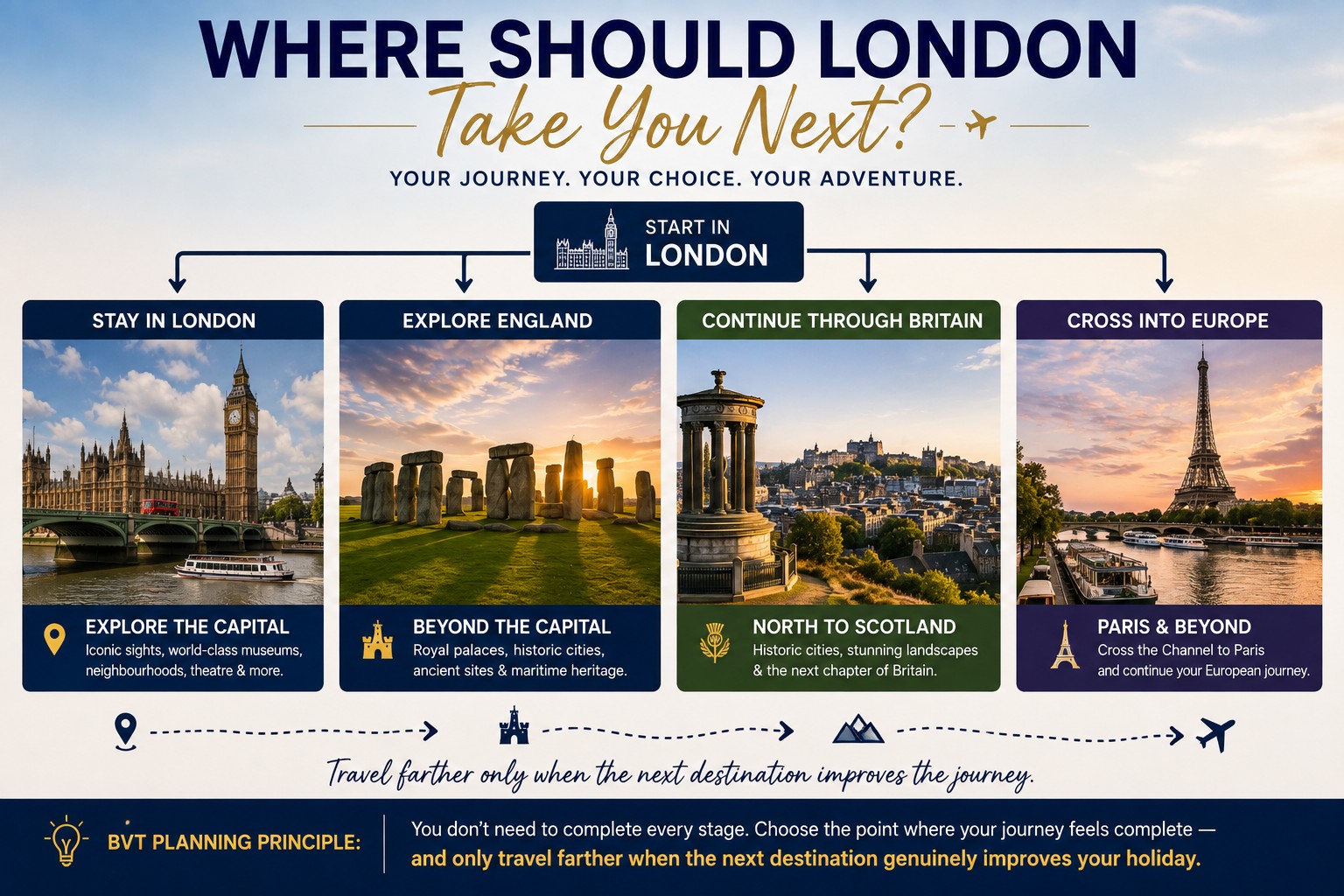
London can be the whole holiday or the starting point for something bigger. Stay in the capital, explore more of England, continue through Britain to Scotland, or cross the Channel to Paris and wider Europe
🌱 Explore London and Beyond More Responsibly
A well-designed itinerary is not only easier to enjoy; it can also reduce unnecessary travel and encourage a more thoughtful relationship with the places you visit.
Within London, walk between nearby sights where practical and use public transport to connect areas that are farther apart. Grouping experiences geographically reduces repeated journeys across the capital while giving you more time to understand individual neighbourhoods rather than seeing them through a train window.
The same principle becomes even more useful once you leave London. Rail can provide an effective way to continue between many major British and European cities, while an itinerary that progresses naturally from one destination to the next may avoid unnecessary backtracking simply to preserve London as a base.
Responsible travel is about more than transport. If your dates are flexible, consider quieter periods as well as peak seasons. Explore beyond the most congested visitor corridors, respect residential neighbourhoods and support local businesses as you move through different parts of London and farther afield.
Most importantly, resist treating destinations as trophies to be collected. Giving somewhere enough time to reveal its character usually produces a better holiday than racing through it simply to add another place to the list.
Travel with purpose. Explore with care.
🧭 So Where Should You Go After London?
By now, the useful question is no longer how many destinations you could add. It is which next step would genuinely improve your trip.
Stay in London if the capital still contains the experiences you care about most. Another day for museums, theatre, neighbourhoods, markets or simply a less hurried pace may be more rewarding than adding another destination.
Discover more of England if you want contrast without fundamentally changing the structure of your London holiday. Windsor and Hampton Court extend its royal story; Stonehenge reaches into prehistoric Britain; Portsmouth opens a maritime perspective.
Continue through Britain if London is intended to be the beginning rather than the centre of your holiday. Edinburgh and Scotland can then become the next stage rather than an exceptionally long return excursion.
Cross to Paris if continental Europe is your next priority. Decide whether Paris is a purposeful day trip or deserves to become your next base.
Explore wider Europe if London and Paris are simply the opening chapters of a longer adventure.
The London Gateway works best when each decision grows naturally from the one before it. You do not need to follow the whole route; you simply need to recognise when the next chapter is right for you.
❓ London Gateway Travel FAQ
⏰ How many days should a first-time visitor spend in London?
For many first-time visitors, three or four days offers an excellent balance. That provides time for major sights, a deeper cultural or historical interest and some less structured exploration without making every day feel rushed. Two days can work as a focused introduction, while five days or more creates much greater freedom for neighbourhoods, events and excursions.
🚇 Is London easy to explore without a car?
Yes. For most visitors, a car is unnecessary for sightseeing in central London. The Underground, buses, walking and river services provide extensive options, while mainline rail connects the capital with destinations farther afield. Planning each day geographically is usually more useful than trying to master every part of London’s transport network.
🏰 Is London a good base for exploring England?
Yes, particularly when you choose excursions that suit your available time and interests. Windsor, Hampton Court, Stonehenge and Portsmouth can each add something very different to a London-centred holiday. For more distant destinations, consider whether continuing onwards would produce a better trip than returning to London.
🪨 Can you visit Stonehenge from London in a day?
Yes. Stonehenge is commonly experienced as a day trip from London, independently or through an organised excursion. If Stonehenge is one of your principal reasons for visiting Britain, however, investigate the different ways to experience the site rather than automatically choosing the simplest option.
🏴 Can you visit Edinburgh from London in a day?
It can be possible using suitable rail services or a structured experience, but it is an ambitious day with substantial travel. If Scotland is an important part of your holiday, staying longer usually provides a far richer introduction than treating Edinburgh solely as a return excursion from London.
🇫🇷 Can you visit Paris from London in a day?
Yes, Paris can work as a purposeful day trip from London when suitable Eurostar services and current travel arrangements allow. It is an ambitious choice, however, and the value depends on what you want from Paris.
If your priority is simply to experience a taste of the French capital while keeping London as your base, a carefully planned day can make sense. If Paris itself is one of the major reasons for your European holiday, staying overnight or for several days will usually provide a much more complete experience.
Always check current train schedules, passport requirements and border procedures before booking.
🎟️ What should I book before travelling to London?
Prioritise anything that would significantly disappoint you if it were unavailable. Depending on your plans, that may include timed-entry attractions, major exhibitions or events, special-access experiences, popular tours and important onward rail or international journeys.
Avoid turning the entire holiday into a sequence of reservations. Securing your genuine priorities while leaving some unscheduled time creates a useful balance between confidence and spontaneity.
✨ London Is Only the Beginning
London can absorb an entire holiday without ever feeling exhausted. You can stand beside the Thames at Westminster, explore centuries of history farther east, disappear into museums, spend an evening at the theatre or discover a neighbourhood that was never part of the original plan.
But one of London’s greatest strengths is what happens when you look beyond it.
The capital can lead naturally towards royal palaces, ancient landscapes and historic England. It can become the departure point for Edinburgh and a deeper exploration of Scotland. Cross the Channel and Paris can become either one remarkable day or the next stage of a European adventure.
There is no obligation to do any of it.
The strongest itinerary is the one in which every destination earns its place, every major experience receives enough time and each new stage feels like a natural continuation rather than another box to tick.
Start by deciding what you want from London. Give the city enough time to deliver it. Then, if the road, railway or Channel crossing beyond genuinely makes your holiday better, follow it.
London is a destination worth crossing the world to experience—and a gateway from which much more of Britain and Europe becomes possible.