


Scotland Events in Autumn: Scenic Highlands, Whisky Season and Autumn Colours
19th August 2026
🍂 Scotland Events in Autumn: Scenic Highlands, Whisky Season and Autumn Colours
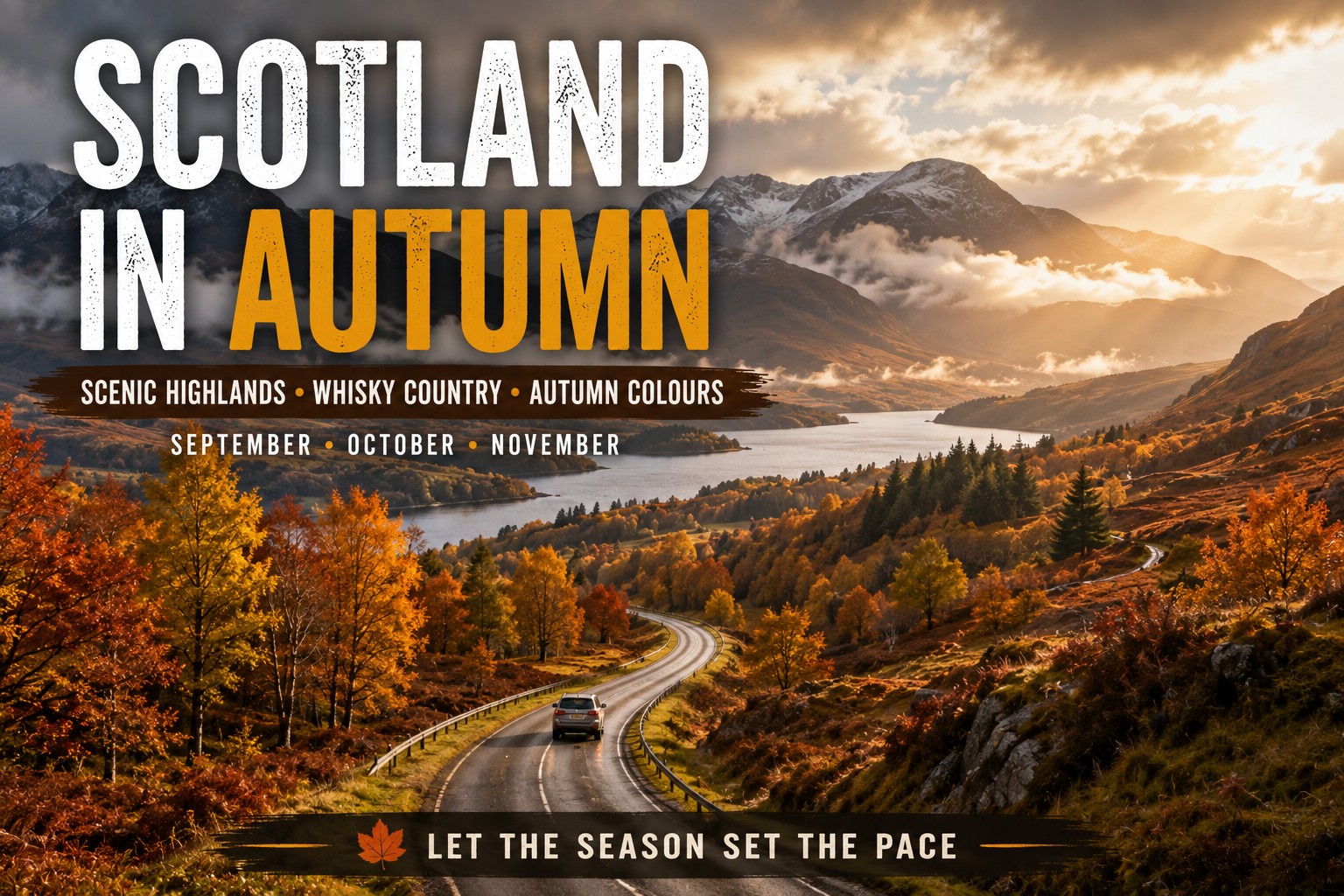
Scotland in autumn brings changing Highland landscapes, lower seasonal light and rich woodland colour, with September, October and November each creating a different kind of journey
Scotland events in autumn bring together Highland scenery, whisky experiences, seasonal festivals and some of the country’s most atmospheric landscapes. Woodland shifts towards gold, copper and russet, bracken deepens across Highland hillsides, lower sunlight transforms familiar views, and mist can alter the character of a loch or glen within minutes.
Yet there is no single Scottish autumn experience. September can retain useful daylight and traces of late summer; October often develops a more recognisably autumnal character; November moves decisively towards winter. Geography matters too. Perthshire woodland, the Cairngorms, Speyside and the West Highlands can each offer a distinctly different seasonal journey.
The key is not to chase one supposedly perfect weekend for colour. Choose the kind of trip you want, understand how rapidly the season develops, and allow Scotland’s landscapes and conditions to help set the pace.
| 🌳 Perthshire | Woodland colour |
| 🏔️ Highlands | Russet landscapes + dramatic seasonal light |
| 🥃 Speyside | Whisky + countryside |
| 🌊 Loch Lomond & Trossachs | Accessible lochs + woodland |
| ⛰️ West Highlands | Mountain atmosphere + changing light |
🗓️ When Is Autumn in Scotland—and Which Month Should You Visit?
Autumn develops progressively across Scotland rather than arriving everywhere on a fixed date. Latitude, elevation, vegetation and annual weather all influence the transition, so September, October and November are better understood as distinct travel periods.
🍁 September, October and November
September often provides the gentlest transition. Early colour may be emerging while relatively useful daylight still supports broader touring, making this a strong period for combining the Highlands, whisky country and events without depending on foliage alone.
October generally brings a stronger autumn identity. Woodland colour can become more prominent, castles and scenic routes gain atmosphere, and shortening days make thoughtful itinerary planning increasingly important.
November is different again. Much shorter daylight and the approach of winter favour a slower trip built around atmospheric landscapes, whisky, heritage, cities and carefully chosen time outdoors.
| Period | Seasonal character | Particularly good for | Main planning consideration |
|---|---|---|---|
| September | Early autumn transition | Highlands, touring, whisky and events | Colour may still be developing |
| October | Stronger autumn character | Woodland, castles and scenic journeys | Shortening days and variable weather |
| November | Late-autumn transition | Whisky, heritage, cities and atmospheric landscapes | Much shorter daylight and seasonal services |
There is no guaranteed national best time to see autumn colours in Scotland. Woodland and exposed Highland vegetation respond differently to elevation and conditions, while strong winds or heavy rain can alter foliage surprisingly quickly. Build the trip around several seasonal experiences rather than making its success depend on trees reaching a specific shade during one predicted week.
Choose the region and journey first. Treat exceptional autumn colour as part of the experience rather than something Scotland can deliver to a timetable.
| 🌍 Region Different parts of Scotland move through autumn at different rates. |
⛰️ Elevation Higher and lower landscapes can show different seasonal stages at the same time. |
| 🌳 Vegetation Woodland, bracken, moorland and exposed vegetation do not change in the same way. |
🌦️ Annual Weather Temperature and seasonal conditions influence how quickly autumn develops. |
| 💨 Wind & Rainfall Strong weather can alter foliage quickly and shorten a particularly colourful period. |
📅 Timing September, October and November represent different stages of the seasonal transition. |
|
⚠️ Weak Planning
Predict One “Peak Weekend”
↓
Build the Entire Trip Around Foliage
↓
Make Success Depend on One Uncontrollable Variable
|
✓ Strong Planning
Choose a Rewarding Region
↓
Build a Good Autumn Journey
↓
Let Exceptional Colour Enhance It
|
🍁 Where to See Autumn Colours in Scotland
Scotland’s autumn palette is far more varied than a landscape simply turning red and gold. Woodland can provide the classic foliage many visitors imagine, while Highland autumn brings russet bracken, forests, moorland tones, mountains and increasingly dramatic seasonal light. Where you go should therefore depend partly on what you want autumn to look and feel like.
🌳 Perthshire and Woodland Scotland
Perthshire is particularly rewarding for travellers seeking woodland colour. Forested hillsides, river valleys and scenic roads create opportunities to combine autumn walks and drives with castles, gardens and small towns. It is also accessible enough to deliver a substantial seasonal landscape experience without requiring a journey into Scotland’s far north.
🏔️ Cairngorms and the Highlands
The Cairngorms offer a broader composition. Forests can produce striking colour, but much of the appeal comes from the relationship between woodland, mountains, open country and vegetation changing across different elevations.
Across the wider Highlands, autumn may be less about dense foliage and more about atmosphere: bracken deepening to rust and bronze, shifting cloud, shafts of low sunlight and hillsides whose appearance can change completely during a single journey.
🌊 Loch Lomond and the Trossachs
Loch Lomond and the Trossachs can be particularly rewarding for travellers who want autumn scenery without committing to a longer Highland expedition. Wooded loch shores, forest landscapes and surrounding hills create a varied seasonal palette, while relatively easy access from Glasgow and central Scotland makes the region practical for shorter itineraries.
⛰️ Glencoe and the West Highlands
Glencoe and the West Highlands offer something different again. This is not primarily about conventional woodland foliage: the autumn appeal comes from mountain vegetation, waterfalls, low light and weather moving through immense landscapes. On the right day, the changing journey can become more memorable than any individual viewpoint.
| Area | Autumn strength | Particularly suited to |
|---|---|---|
| Perthshire | Woodland colour | Scenic drives, walks and castles |
| Cairngorms | Forest and mountain landscapes | Nature and outdoor exploration |
| Loch Lomond & Trossachs | Lochs and woodland | Accessible scenic touring |
| Glencoe & West Highlands | Mountain drama and seasonal light | Road journeys and photography |
| Speyside | Countryside and whisky | Distilleries and autumn touring |
🏔️ Why the Scottish Highlands Feel Different in Autumn
The Scottish Highlands in autumn change in ways that extend far beyond foliage. Lower-angle sunlight emphasises the contours of mountains and glens, russet bracken spreads across hillsides, and mist or rapidly shifting cloud can transform a familiar landscape within minutes.
After peak summer, some roads and viewpoints may feel less pressured, although popular locations can still be busy; quieter travel is a possibility rather than a guarantee. More importantly, usable daylight steadily contracts. Every scenic stop consumes part of a shorter day, so an ambitious September route may become unrealistic later in the season.
Autumn rewards reducing mileage. Allow time for weather, changing light, unexpected viewpoints and places that were never on the original itinerary.
A scenic road journey must also be distinguished from heading into the mountains on foot. Conditions at elevation can be substantially different from those beside a road or loch, and plans should reflect the activity, location and conditions rather than how benign the weather appears from a car park.
|
🚗 Longer Mileage
More Driving
↓
More Daylight Consumed
↓
Less Flexibility
↓
More Pressure to Keep Moving
↓
Greater Pressure to Continue in Poor Conditions
|
🍂 Slower Autumn Journey
Shorter Route
↓
More Scenic Stops
↓
More Weather Flexibility
↓
More Time for Changing Light
↓
Deeper Experience
|
→ Broader touring may remain practical while useful daylight remains.
→ Reduce daily ambition and give scenic stops, weather and changing light more room.
→ Daylight becomes a major itinerary constraint, making shorter and more concentrated journeys increasingly valuable.
🥃 Whisky Country in Autumn
Whisky country deserves to be treated as a core autumn experience, not simply somewhere to retreat when the weather turns. Distilleries, historic whisky landscapes and changing countryside can be combined with scenic touring, local food and heritage, creating days in which indoor and outdoor experiences complement one another naturally.
“Whisky season,” however, does not mean Scotland has one official autumn whisky season. Production cycles and visitor operations vary between distilleries, while whisky tourism continues throughout the year. Autumn’s particular appeal lies in the combination: cooler days, atmospheric landscapes and the opportunity to place whisky within a broader seasonal journey.
🥃 Speyside, the Highlands and Scotland’s Whisky Landscapes
Speyside is an obvious choice when whisky is a major priority. Its concentration of distilleries allows visitors to explore whisky heritage alongside the countryside rather than treating each visit as an isolated attraction.
The Highlands offer a more geographically dispersed experience, with selected distilleries fitting naturally alongside lochs, mountains, castles and scenic roads. Islay provides another distinctive option for committed whisky enthusiasts, although reaching and exploring the island requires more deliberate transport and accommodation planning.
Individual distilleries set their own visitor opening days, tour schedules and booking arrangements. Check current information before travelling, particularly later in autumn when assuming summer operating patterns can lead to disappointment.
🚗 Build Whisky into the Journey
First decide whether you want one distillery experience within a wider Scotland journey or whether whisky should determine the route itself. That decision can prevent an otherwise enjoyable itinerary becoming an inefficient sequence of distant distilleries.
If tastings are involved, arrange transport before the visit. Use an appropriate organised excursion, public or private transport, or designate a driver who will not drink; never build whisky tastings into a self-drive schedule without a safe plan already in place.
|
🥃 Whisky as Part of the Journey?
Choose One Priority Distillery
↓
Combine It with Scenery
↓
Add Food and Heritage
Best when whisky adds depth to an already worthwhile Highland, Speyside or regional Scotland itinerary.
|
🗺️ Whisky as the Reason for the Journey?
Choose a Whisky Region
↓
Select Priority Distilleries
↓
Build the Route Around Them
Best when whisky heritage is the principal theme and the surrounding countryside becomes part of the experience.
|
→
Choose Priority Distilleries
→
Check Visitor Arrangements
→
Arrange Safe Transport
→
Add Scenery, Food & Heritage
•
Public or Private Transport
•
Non-Drinking Designated Driver
🎭 Autumn Festivals, Food and Seasonal Events
Scotland’s autumn events can give a journey cultural depth as well as seasonal atmosphere. Whisky and food celebrations, traditional music, heritage programmes and community gatherings provide opportunities to experience places through the people, produce and traditions associated with them.
The planning logic differs from Scotland’s intense summer festival season. In autumn, it often makes more sense to choose the region and seasonal experience first, then discover which events coincide with your dates. A Speyside whisky journey might gain a food, drink or cultural event; a Perthshire trip centred on woodland colour could coincide with a local heritage gathering; time in the Highlands might reveal traditional music or community events that enrich an itinerary already worth making.
Halloween and traditions associated with Samhain may also feature in late-autumn programming. Modern celebrations vary widely in their balance of history, folklore and entertainment, however, so enjoy individual events for what they are rather than assuming every modern custom is an unchanged survival from Scotland’s ancient past.
Programmes and dates change from year to year. Treat an event as an enhancement to a strong autumn journey, then verify current organiser information before making it a fixed part of your plans.
🏰 Castles, Wildlife and Scotland’s Autumn Atmosphere
Autumn’s appeal extends well beyond scenery and whisky. Castles can gain another dimension when changing woodland, gardens and lower seasonal light become part of their setting, while wildlife brings a less predictable but potentially memorable element to carefully paced days outdoors.
🏰 Castles in Autumn Landscapes
Rather than collecting castles as isolated sightseeing stops, look for combinations that make sense geographically. A castle with wooded grounds can become part of an autumn walk; another may fit naturally into a Highland drive, Perthshire journey or day through whisky country.
The setting can matter as much as the building. Woodland paths, gardens, surrounding hills and the approach to a historic site may all contribute to the seasonal experience.
Opening hours and access can change as the main visitor season recedes, particularly later in autumn. Check current arrangements for priority sites before travelling rather than assuming that summer schedules continue unchanged.
🦌 Autumn Wildlife
Autumn can also be a fascinating season for wildlife, particularly in landscapes where red deer are present. The annual rut brings heightened activity and the unmistakable sound of roaring stags to some Highland areas, while migrating birds and other seasonal changes can add interest to woodland, wetland and coastal journeys.
Wildlife should be allowed to determine the encounter. Sightings are never guaranteed, and rutting deer in particular require extra care and distance. Never approach an animal to improve a photograph, attempt to influence its behaviour or position yourself between deer. Follow local guidance wherever it is provided.
Observe from a safe distance | never approach rutting animals | allow wildlife to determine the encounter
Watch without moving closer simply to improve the view. If your presence appears to affect an animal’s behaviour, give it more space.
Rutting deer are wild animals engaged in competitive behaviour. Do not treat proximity as part of the experience.
Never deliberately place yourself between animals or obstruct the direction in which deer may need to move.
Do not follow, surround or pressure deer for a closer photograph. A better image is never more important than leaving wildlife undisturbed.
Respect local signs, land-management advice and any seasonal access guidance that applies where you are visiting.
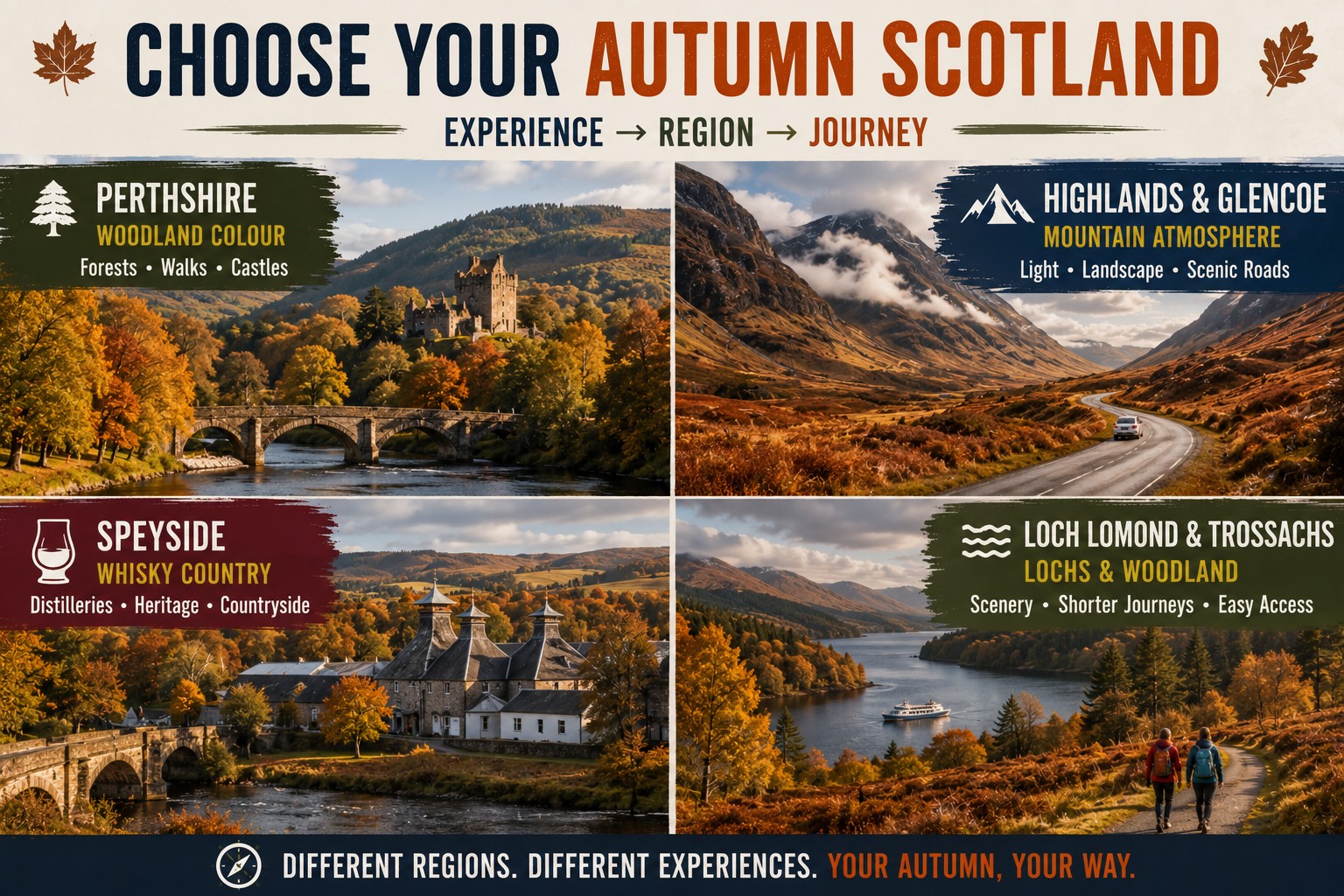
Scotland’s autumn character varies by region, from Perthshire woodland and atmospheric Highland landscapes to Speyside whisky country and the accessible lochs and forests of the Trossachs
🧭 Which Part of Scotland Should You Choose for an Autumn Trip?
The right region depends less on finding a universal “best” destination and more on deciding which aspect of autumn matters most to you.
For woodland colour, Perthshire is a strong choice, combining forests and river landscapes with walks, scenic drives and heritage. For mountain atmosphere, Glencoe and the wider Highlands offer changing vegetation, immense landscapes and dramatic autumn light rather than relying solely on tree colour.
If whisky is the priority, Speyside combines a concentration of distilleries with countryside that can form part of the experience rather than merely the route between visits. Loch Lomond and the Trossachs suits travellers seeking accessible loch and woodland scenery, particularly when time is limited.
For a more varied trip, combinations such as Perthshire and the Cairngorms can unite woodland, mountains and heritage, while the Highlands and Speyside bring together major scenery and whisky country without forcing unrelated destinations into the same itinerary.
The strongest choice is not necessarily the region with the longest attraction list. It is the one whose autumn character best matches the experience you actually want.
|
🌳 + 🏔️ Woodland, Mountains & Heritage
Perthshire + Cairngorms
A complementary progression when you want woodland character alongside broader mountain landscapes and Highland heritage.
|
🏔️ + 🥃 Major Scenery & Whisky Country
Highlands + Speyside
A strong combination when dramatic landscapes and whisky heritage are both major priorities.
|
→ Concentrate geographically. Give one region enough time rather than spending valuable autumn daylight travelling between distant highlights.
→ Combine complementary regions where the route works naturally instead of collecting unrelated destinations simply because more days are available.
🚐 Building an Autumn Scotland Itinerary
A successful Scotland autumn itinerary treats distance differently from summer. Shortening daylight, variable weather and seasonal opening hours make excessive mileage increasingly costly as the season progresses. Instead of measuring success by how many places you reach, concentrate on one region and, where time allows, add one complementary theme.
For a two- to three-day break, Edinburgh or Glasgow can combine with accessible autumn landscapes such as Loch Lomond and the Trossachs or Perthshire. A short trip is rarely improved by trying to squeeze a broad tour of the Highlands into the available time.
With four to five days, choose one principal region and develop the experience around it. Perthshire and the Cairngorms can create a woodland-to-mountain progression, while a Highland stay might combine scenic touring with castles or one carefully chosen whisky experience.
With seven days or more, the Highlands and Speyside can work particularly well together. Additional time allows distilleries, heritage and scenic routes to complement one another without requiring long daily drives simply to keep the itinerary moving.
Whatever the duration, leave room for conditions to change. Check seasonal opening arrangements, avoid stacking distant attractions into the same day, and keep one or two worthwhile indoor possibilities available.
📅 Find Autumn Experiences with the BVT Scotland Events Calendar
Once you have chosen your region and approximate dates, the BVT Scotland Events Calendar can help discover events that enrich the wider journey rather than distort it.
Autumn works particularly well with a place-first approach. A Perthshire colour trip might coincide with a food, cultural or heritage event, while time in Speyside could gain another dimension from a whisky-related experience. The event becomes an additional reason to spend time in a place you already wanted to explore.
A simple planning sequence keeps everything connected:
Choose region → choose approximate dates → discover events → verify current details → refine the itinerary
Always confirm final dates, admission arrangements and programmes with the relevant organiser before travelling.
| 🥃 Whisky & Food Events | 🎻 Traditional Music |
| 🎭 Cultural Programmes | 🏰 Heritage Events |
| 🏘️ Community Gatherings | 🍁 Seasonal Celebrations |
→
Choose Approximate Dates
→
Discover Events
→
Verify Details
→
Refine the Journey
🌦️ Practical Autumn Travel in Scotland
Autumn rewards flexibility, but preparation becomes increasingly important as the season progresses. The difference between early September and late November can be substantial, particularly in available daylight, so avoid treating three months of autumn as though the same touring assumptions apply throughout.
Check sunrise and sunset times for your actual dates and destination before fixing scenic stops—not after the itinerary is already full. This matters especially in the Highlands, where journeys routinely become longer once viewpoints, meals, photographs and unexpected discoveries are included. Later in the season, a route that looks modest on a map can consume much of the usable day.
Weather can change quickly. Pack adaptable layers, waterproof outerwear and footwear appropriate to the activities you have planned. Where ferries or less frequent public transport form part of the journey, check current timetables and allow sensible margins rather than depending on tightly connected arrangements.
Seasonal opening hours matter too. Castles, visitor attractions, distilleries, cafés and other businesses may operate differently as autumn progresses. Verify priority experiences before travelling and keep one or two worthwhile indoor alternatives available.
Do not plan a November Scotland trip using September assumptions.
Check daylight for your actual dates | reduce late-season mileage | verify seasonal opening | keep plans flexible
Useful daylight can still support broader scenic journeys, although weather and seasonal conditions remain variable.
Shorter days make excessive mileage more costly and place greater value on geographically concentrated journeys.
Scenic touring, opening hours and outdoor plans all need to be built around substantially reduced usable daylight.
+
Scenic Stops
+
Meals
+
Photography
+
Unexpected Discoveries
=
Actual Touring Day
|
🌳 Perthshire + Cairngorms
Woodland + Mountains
Combine autumn woodland character with broader mountain landscapes while keeping the journey geographically coherent.
|
🏔️ Highlands + Speyside
Scenery + Whisky
Combine major Highland landscapes with whisky country when both experiences justify a substantial place in the itinerary.
|
+
Geography
+
Seasonal Opening
+
Weather Flexibility
=
Realistic Autumn Journey
🌱 Responsible Autumn Travel in Scotland
Travelling beyond peak summer can support accommodation, restaurants, shops and attractions at a different point in their year, but responsible autumn travel still means respecting local capacity, landscapes and seasonal conditions.
Stay on established paths where appropriate and avoid trampling woodland floors or vegetation simply to reach a photograph. Give wildlife ample space, particularly during the red deer rut, and change outdoor plans when weather or ground conditions make continuing unwise.
Use rail, public transport or shared touring where practical, and consider spending longer within one region rather than repeatedly crossing Scotland to collect attractions.
Slower travel suits autumn particularly well. It leaves more time for changing light, landscapes and communities while reducing unnecessary movement between destinations.
Travel with purpose. Explore with care.
|
🌳 Woodland & Paths
Stay on appropriate routes
Avoid trampling vegetation for photographs, respect wet ground and do not widen paths simply to avoid mud. |
🦌 Wildlife
Give wildlife space
Observe deer and other wildlife from an appropriate distance. Never pursue an encounter or photograph. |
|
🏘️ Communities
Make the quieter season count locally
Support accommodation, cafés, attractions, guides, shops and other businesses as Scotland moves beyond peak summer. |
🚆 Journey Design
Travel efficiently where practical
Consider rail and shared transport, reduce unnecessary crossings of the country and give individual regions more of your time. |
→
More time to experience changing light and seasonal landscapes
→
More opportunities for visitor spending to benefit local communities
→
Greater ability to respond intelligently to changing weather and conditions

Scotland’s whisky country can become a complete autumn journey when distillery experiences are combined with local food, heritage, scenery and safe, carefully planned transport
❓ Scotland in Autumn FAQs
❓ When is the best time to see autumn colours in Scotland?
There is no guaranteed national peak. Colour develops differently according to region, elevation, vegetation and annual weather, while strong wind or rain can alter foliage quickly. September begins the transition in many places, with October often bringing a more recognisably autumnal character. Choose a suitable region and travel window rather than relying on one predicted peak-colour date.
❓ Is September or October better for Scotland?
Both can be excellent, but they suit different priorities. September generally offers more usable daylight and can work well for broader scenic touring. October often feels more distinctly autumnal, with stronger seasonal colour possible in suitable woodland areas. The better month therefore depends on whether daylight, foliage or atmosphere matters most to you.
❓ Is November too late for an autumn trip to Scotland?
No, but November should be treated as a substantially different trip. Days are much shorter, some attractions and services may operate reduced schedules, and landscapes are moving towards winter. Whisky, heritage, cities and carefully selected scenic journeys can consequently work better than an ambitious touring programme.
❓ Is autumn a good time to visit the Scottish Highlands?
Yes. Changing vegetation, lower seasonal light and atmospheric conditions can make the Scottish Highlands particularly memorable in autumn. The trade-off is increasingly limited daylight and variable weather, so allow realistic travel times and distinguish carefully between scenic road touring and activities in higher or exposed terrain.
❓ Can you visit whisky distilleries in Scotland in autumn?
Many distilleries welcome visitors during autumn, but opening days, tours and booking arrangements vary. Check directly with each distillery before travelling, particularly later in the season. If tastings are planned, arrange appropriate transport in advance rather than combining alcohol consumption with a self-drive itinerary.
❓ What should you pack for Scotland in autumn?
Bring adaptable layers, waterproof outerwear and footwear suitable for your planned activities. Conditions can change substantially during a single day and become increasingly wintry later in the season, so practical flexibility is more useful than packing for one expected version of Scottish autumn.
🍂 Let Scotland Set the Pace This Autumn
Scotland in autumn is not about successfully predicting one perfect weekend when every landscape reaches peak colour. Its appeal lies in travelling through a country visibly in transition: woodland turning gold, Highland vegetation deepening towards bronze and russet, castles gaining atmosphere and whisky country adding warmth and character between scenic journeys.
Choose the month carefully, concentrate on a region rather than attempting everything, and leave enough flexibility for weather, changing light and unexpected discoveries. Fewer places experienced at the right pace can reveal far more of Scotland’s autumn character.
|
🚌 Scotland Day Tours
Staying in Edinburgh or another gateway?
A day tour can add a focused scenic, historic or Highland experience to a shorter autumn stay without requiring a full multi-day touring itinerary.
Best suited to travellers who want:
✓ One concentrated excursion
✓ A city or gateway as the main base
✓ Scenic or historic Scotland within a shorter stay
✓ Less responsibility for planning the day’s route
|
🏔️ Scotland Multi-Day Tours
STRONG FIT FOR AUTUMN
Want to give Scotland more time?
Multi-day touring creates more room for Highland landscapes, lochs, castles and regional Scotland while allowing autumn daylight, weather and changing conditions to shape a more measured journey.
Best suited to travellers who want:
✓ Several days in Scotland’s landscapes
✓ Highland and regional depth
✓ Overnight stays within the journey
✓ Less pressure to compress major scenery into one day
|