


European River Cruising Through the Seasons: When Is the Best Time to Go?
14th November 2026
🌍European River Cruising Through the Seasons: When Is the Best Time to Go?

River cruising on the Rhine combines historic towns, vineyard landscapes and scenic journeys through the heart of Europe
A European river cruise can feel entirely different in April, August or December. One departure might bring fresh green vineyards and quieter streets; another might favour long evenings on deck, autumn landscapes or illuminated Christmas markets. Yet choosing a date is not simply a question of finding the warmest weather. The river, the places visited, the excursions you enjoy and the possibility of changes to navigation all matter. This guide compares the seasons and major river regions so you can decide which experience suits you, then check the details of an actual departure before committing.
🌍 1. Understanding the Best Time for a European River Cruise
🧭 What Makes One Cruising Season Better Than Another?
Begin with the holiday you want, not a supposedly perfect month. Would you rather wander historic streets in comfortable walking weather, spend long afternoons watching the countryside pass, enjoy wine-country landscapes or explore a city dressed for Advent? A river cruise is both a journey by water and a sequence of visits ashore. The balance between those two experiences should guide your timing.
The same season can feel different along the Rhine, Danube, Seine, Rhône or Douro. Northern and southern regions do not share identical temperatures or daylight patterns, and a cruise visiting several countries may encounter changing conditions along the way. Consider the ports and excursions on the itinerary, not merely the river name on the brochure.
🌊 Why River Conditions Matter as Much as the Weather
River vessels operate within the physical limits of their waterways. Water that is too high can affect clearance beneath bridges or access to certain landing places; low levels can restrict navigation on shallow stretches. Neither problem follows a reliable Europe-wide calendar. A pleasant week for sightseeing may still coincide with an operational change.
That does not mean you should avoid river cruising. It means you should distinguish an attractive seasonal experience from a guaranteed sailing outcome. Later, check how your chosen operator handles changes, rather than assuming every ship or river section faces the same risk.
🍃 2. European River Cruising in Spring, Summer, Autumn and Winter
🌷 Spring: Fresh Landscapes and Changing Conditions
Spring can be particularly appealing if you enjoy seeing towns, gardens and riverside landscapes emerge from winter. Trees begin to leaf out, parks become inviting and city visits may feel less dominated by midsummer heat. Depending on the region and the exact week, the weather can range from bright and mild to chilly and wet. Layers and a waterproof outer garment are more useful than assuming every afternoon will be warm.
Spring is not automatically a low-crowd season: Easter holidays and popular cultural events can make individual destinations busy. Snowmelt and rainfall can also affect some river systems, but their impact depends on the catchment, river section and prevailing conditions. Treat spring as a choice for changing scenery and flexible sightseeing, not as a promise of quiet ports or uncomplicated navigation.
☀️ Summer: Longer Days and Outdoor Exploration
Summer suits travellers who want extended daylight for walking, photography and time on an open deck. Riverside cafés, gardens and outdoor attractions can be especially enjoyable when the weather cooperates. Longer evenings may also make the journey between ports part of the day’s entertainment rather than simply a transfer.
The trade-off is comfort. Some central and southern European destinations can be very hot, particularly during exposed city walks. Popular ports may also attract substantial numbers of visitors. Low water can affect certain waterways during dry periods, but it would be misleading to label every summer departure as high-risk. Look at the specific river and recent conditions, and check whether excursions offer sensible alternatives for anyone sensitive to heat.
🍂 Autumn: Harvest Landscapes and Cultural Experiences
Autumn offers a different pace. Vineyards and wooded slopes can change colour, historic towns may feel atmospheric in softer light, and wine-producing regions may be particularly interesting around harvest-related activities. The Rhine and Douro, for example, offer different kinds of vineyard scenery, but their seasonal calendars and weather are not interchangeable.
Early autumn may still feel summery in some southern regions while later weeks bring cooler air and shorter days elsewhere. Harvest dates depend on the year, local conditions and the particular crop; do not assume a winery visit will coincide with picking or a public celebration. If a festival or vineyard experience is central to your holiday, confirm it independently rather than relying on the general appeal of autumn.
❄️ Winter: Christmas Markets and Festive River Cruises
Winter river cruising is often about a specific experience rather than a full season of conventional departures. Festive itineraries on selected European rivers may connect cities known for Advent markets, illuminated streets and seasonal traditions. A warm ship can provide a welcome contrast to cold evenings ashore, but shorter daylight hours change the rhythm of sightseeing.
Not every river or route offers winter departures. On the Douro, the availability of multi-day cruises and shorter local trips can differ by provider and itinerary; check published sailing dates and any navigation restrictions rather than assuming a winter service. Christmas markets also have their own opening and closing dates: some finish before Christmas Day and others continue later. A cruise labelled festive does not guarantee that every advertised town has an open market on the day you visit.
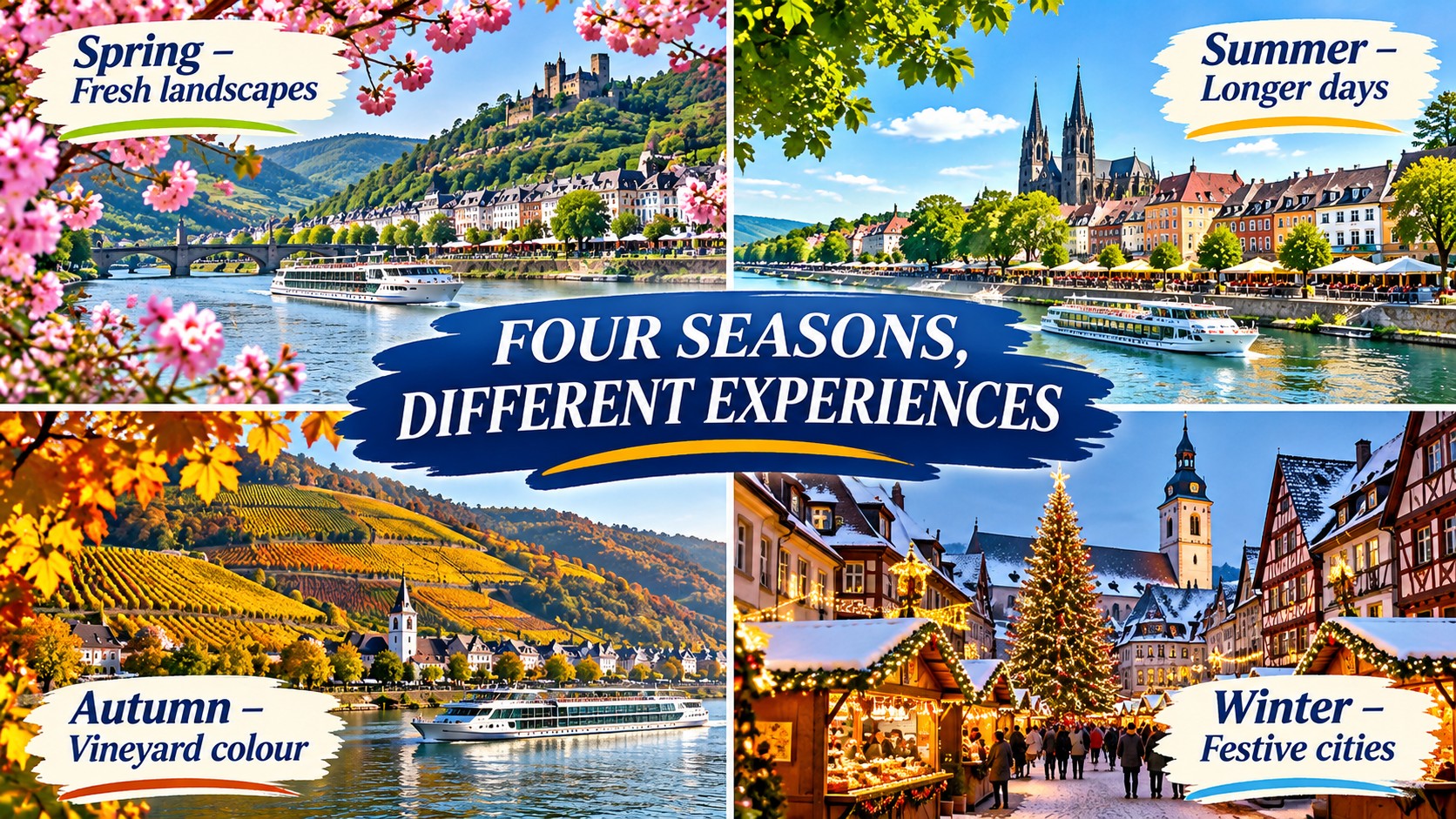
European river cruising offers different experiences throughout the year, from spring landscapes and summer sightseeing to autumn vineyard colours and festive winter cities
European river cruising by season: a practical comparison
| Season | Typical visitor experience | Potential advantages | Important limitations | Best suited to |
|---|---|---|---|---|
| Spring | Emerging greenery, gardens and changing landscapes | Varied sightseeing and fresh scenery | Unsettled weather; river conditions vary | Travellers who enjoy spring landscapes and flexible plans |
| Summer | Long days, outdoor visits and time on deck | More daylight for exploring | Heat, busy ports and possible low-water restrictions on some stretches | Those prioritising daylight and outdoor activities |
| Autumn | Vineyard scenery, changing colours and cultural experiences | Attractive landscapes and regional traditions | Shortening days; harvest timing and weather vary | Travellers interested in scenery, food and local culture |
| Winter | Selected festive sailings and illuminated cities | Christmas atmosphere on suitable itineraries | Limited routes, cold weather and date-specific market openings | Visitors whose priority is an organised festive experience |
This is a comparison of possible experiences, not a ranking of navigation reliability. The best choice depends on your priorities and the itinerary actually available.
🗺️ 3. Which European Rivers Are Best at Different Times of Year?
🏰 Rhine and Danube: Historic Cities and Seasonal Variety
On Rhine itineraries through the Middle Rhine, castles and vineyard slopes can make scenery a particular focus; other stretches emphasise larger cultural centres and towns. Spring greenery and autumn colours can change the appearance of the landscape considerably; selected late-year routes focus on Christmas-market cities. The most rewarding departure depends on which stretch you will travel and how much time the itinerary spends ashore.
A Danube itinerary calling at Vienna and Budapest offers a different city-focused experience from one centred on smaller towns and countryside; compare the actual ports before choosing a season. Warm-season outdoor sightseeing and Advent visits can each be attractive, but there is no single Danube climate or uniform navigation condition. An upper-river itinerary should not be treated as equivalent to every downstream journey. Compare actual ports, excursions and sailing dates before using a broad seasonal recommendation.
🇫🇷 Seine and Rhône–Saône: French Cities, Countryside and Culture
A Seine cruise combines the appeal of Paris and northern French towns or countryside, depending on its route. Spring gardens, summer sightseeing and autumn atmosphere can all be reasons to travel. Northern France’s changeable weather makes flexible clothing and indoor alternatives sensible in any season.
The Rhône and Saône connect a different mix of French cities, food traditions and landscapes. Southern stretches may experience hotter summer conditions than a Seine itinerary, affecting how comfortable long outdoor excursions feel. Spring or autumn may appeal to travellers who prefer moderate sightseeing conditions, but the precise experience depends on the locations and dates. Avoid assuming that one French river’s seasonal advantages automatically apply to another.
🍇 Douro: Portugal’s Landscapes and Wine-Country Seasons
The Douro is particularly associated with terraced vineyards, dramatic valley scenery and the wine culture of northern Portugal. Spring greenery and autumn vineyard colours offer contrasting visual experiences; summer can bring considerable heat in inland areas. If you hope to connect your trip with harvest activity, check the arrangements of the specific vineyard or excursion.
The Douro also demonstrates why operating calendars matter. Multi-day cruises and shorter local trips can have different published operating calendars; navigation through locks is only one of the itinerary details to confirm. A general statement that the Douro is navigable does not establish that your preferred multi-day itinerary operates in January. Confirm the exact route, lock requirements and departure dates with the provider.
These five river systems offer useful contrasts, not an exhaustive list of Europe’s waterways. Choose by the ports and experiences that interest you, then compare seasons within that region.

Portugal’s Douro Valley is celebrated for its dramatic vineyard terraces, winding river and distinctive landscapes, particularly attractive during the warmer months and autumn
🌦️ 4. Weather, Water Levels and the Reliability of Your Cruise
🌧️ High Water, Low Water and Possible Itinerary Changes
High water and low water create different problems. On some stretches, elevated levels may reduce bridge clearance or affect safe navigation and mooring. When levels are unusually low, a vessel may be unable to pass a shallow section safely. Local authorities and operators monitor these conditions, but the consequences depend on the ship, river reach and circumstances at the time.
An itinerary may be revised rather than cancelled outright. Depending on the operator and situation, alternatives can include a different docking point, coach travel between visits, adjusted excursions or a transfer between vessels. Such arrangements are not standard entitlements across the industry. Read the operator’s conditions and ask what happens if the intended route cannot be completed as planned.
The important lesson is not to search for a supposedly disruption-proof month. River levels respond to weather across wider catchments, sometimes far from the place where you embark. Historical patterns can help explain risk but cannot predict an individual departure. Even recent reports are a snapshot, not a forecast for a future holiday.
🌤️ Temperature, Rainfall and Daylight for Shore Excursions
A river cruise’s comfort is often decided on land. Consider how long excursions involve standing or walking, whether streets are steep or cobbled, and how much of the visit is outdoors. Summer heat can make an exposed city tour tiring; winter rain, cold or early darkness can change what feels practical. A cloudy day need not spoil a museum or food-focused visit, while an outdoor viewpoint may be less rewarding.
Check climate information for the actual ports rather than using one European average. Daylight changes with both latitude and season, and local forecasts become useful only nearer departure. Pack for the least comfortable likely excursion, not merely for the conditions you hope to enjoy on deck.
📅 5. Choosing Your Cruise Dates and Planning the Experience
🎄 Festivals, Christmas Markets and Seasonal Highlights
A festival can make a departure memorable, but it should not be the foundation of an unverified itinerary. Christmas markets, wine celebrations and local cultural events differ by town and year. Some take place over several weeks; others may be confined to a weekend or a single day. A ship’s arrival time also matters: reaching a city on a market’s opening date does not establish that you will have time to visit it.
Use seasonal event research to identify promising periods, then check the official organiser’s programme and the cruise’s confirmed port schedule. Keep a worthwhile alternative in mind if an event changes or an excursion cannot operate. The objective is to choose a season that remains rewarding even when one planned highlight is unavailable.
Plan Around Europe’s Seasonal Events
Festivals, Christmas markets and regional celebrations can add a memorable dimension to a European river cruise. Our Seasonal Events Calendar is a useful starting point for exploring what may be happening during your preferred travel period.
Always check official event dates and programmes, then compare them with your cruise itinerary and confirmed port arrival times. Event schedules, excursions and individual cruise arrangements can change.
♿ Accessibility, Shore Excursions and Onboard Practicalities
River ships differ in their facilities, and accessibility ashore can be more complicated than it first appears. Depending on the berth, vessel and water level, boarding arrangements may involve a sloping gangway or passing through another moored vessel; historic ports may also involve steps, cobbles or uneven ground. Ask whether any of these arrangements apply to your sailing. A lift on board does not guarantee step-free access between ship and shore, or to every excursion.
Ask the operator about the specific vessel, cabin, embarkation point and planned excursions. Confirm whether accessible transfers can be arranged and whether any tendering, stairs or extended walking are involved. Travellers with mobility needs should obtain departure-specific information rather than relying on a general claim that a destination is accessible.
🧳 A Practical Checklist Before Booking Your Departure
Use these checks to turn a promising season into a suitable real-world itinerary:
-
Confirm the exact river sections, ports and dates rather than relying on a broad route name.
-
Check that the operator offers the intended sailing and review the itinerary’s current conditions.
-
Compare typical local temperatures, rainfall and daylight for the ports you will visit.
-
Verify any essential festival, market or attraction with its official organiser.
-
Understand what the operator may change if navigation or docking is restricted.
-
Confirm vessel access, gangways, excursions and transfers for your individual requirements.
-
Leave room for alternative sightseeing if weather, river levels or event arrangements change.
If two departures look equally attractive, favour the one whose actual ports and shore experiences best match your interests. An appealing month is only useful when the itinerary delivers the holiday you want.
♻️ 6. Sustainability and Responsible European River Cruising
Rivers are working environments as well as attractive travel corridors. During shore visits, follow local guidance on paths, protected areas and waste, and be considerate of residents in small historic towns. Supporting local guides, cafés and independent businesses can help your spending reach communities along the route, although no individual purchase makes a holiday impact-free.
Consider whether your journey to the embarkation city can sensibly use rail or other public transport, allowing for luggage, mobility and connections. Where an itinerary offers choices, avoid unnecessary extra transfers simply to collect another destination. Respect the time and space of local people during religious observances or crowded seasonal events.
River cruising should not automatically be described as a low-carbon alternative to another holiday. Environmental impacts depend on the vessel, its operations, travel to and from the cruise and other factors. Make practical, evidence-conscious choices without relying on sweeping sustainability claims.
❓ 7. Frequently Asked Questions About European River Cruising
Which Month Is Best for a First European River Cruise?
There is no universal best month. For a first cruise, shortlist two itineraries with ports you genuinely want to visit, then compare their likely walking conditions, daylight and excursions. Late spring or early autumn may suit outdoor sightseeing; summer offers longer days, while festive travel needs a departure aligned with actual market dates.
Are European River Cruises More Likely to Be Disrupted in Certain Seasons?
Yes, some river sections have recurring hydrological patterns, but there is no reliable Europe-wide ranking of disruption risk by month. Ask your operator which sections are most sensitive on your particular route and what alternatives are provided if navigation changes.
Can You Take a European River Cruise in Winter?
Yes, selected festive departures operate on certain rivers, but winter service is not universal. Check whether the actual sailing covers your preferred ports on the dates you need; for the Douro, compare the published calendars for multi-day and shorter local trips.
How Far Ahead Should You Check Events and Sailing Arrangements?
Research broad seasonal possibilities as soon as you begin comparing destinations, but verify the actual operator itinerary and any essential event before making a commitment. Recheck important details closer to departure because river conditions, excursion arrangements and event programmes can change. There is no single deadline that suits every operator, river or festival.
✨ 8. Conclusion: Choosing the Right European River Cruise Season
The best time for a European river cruise is the period that brings together your preferred landscapes, cities and experiences on an itinerary that suits your practical needs. Spring offers renewal, summer longer days, autumn distinctive scenery and selected winter departures a festive atmosphere. None removes the need to check river conditions and operator arrangements. Choose the region first, compare its seasonal character and then confirm the details of a particular sailing. Broader seasonal event research can help you plan the experiences around it.
Plan Around Europe’s Seasonal Events
Festivals, Christmas markets and regional celebrations can add a memorable dimension to a European river cruise. Our Seasonal Events Calendar is a useful starting point for exploring what may be happening during your preferred travel period.
Always check official event dates and programmes, then compare them with your cruise itinerary and confirmed port arrival times. Event schedules, excursions and individual cruise arrangements can change.