


European Christmas Markets by Rail: Destinations, Routes & Travel Planning
13th November 2026
🎄European Christmas Markets by Rail: Destinations, Routes & Travel Planning
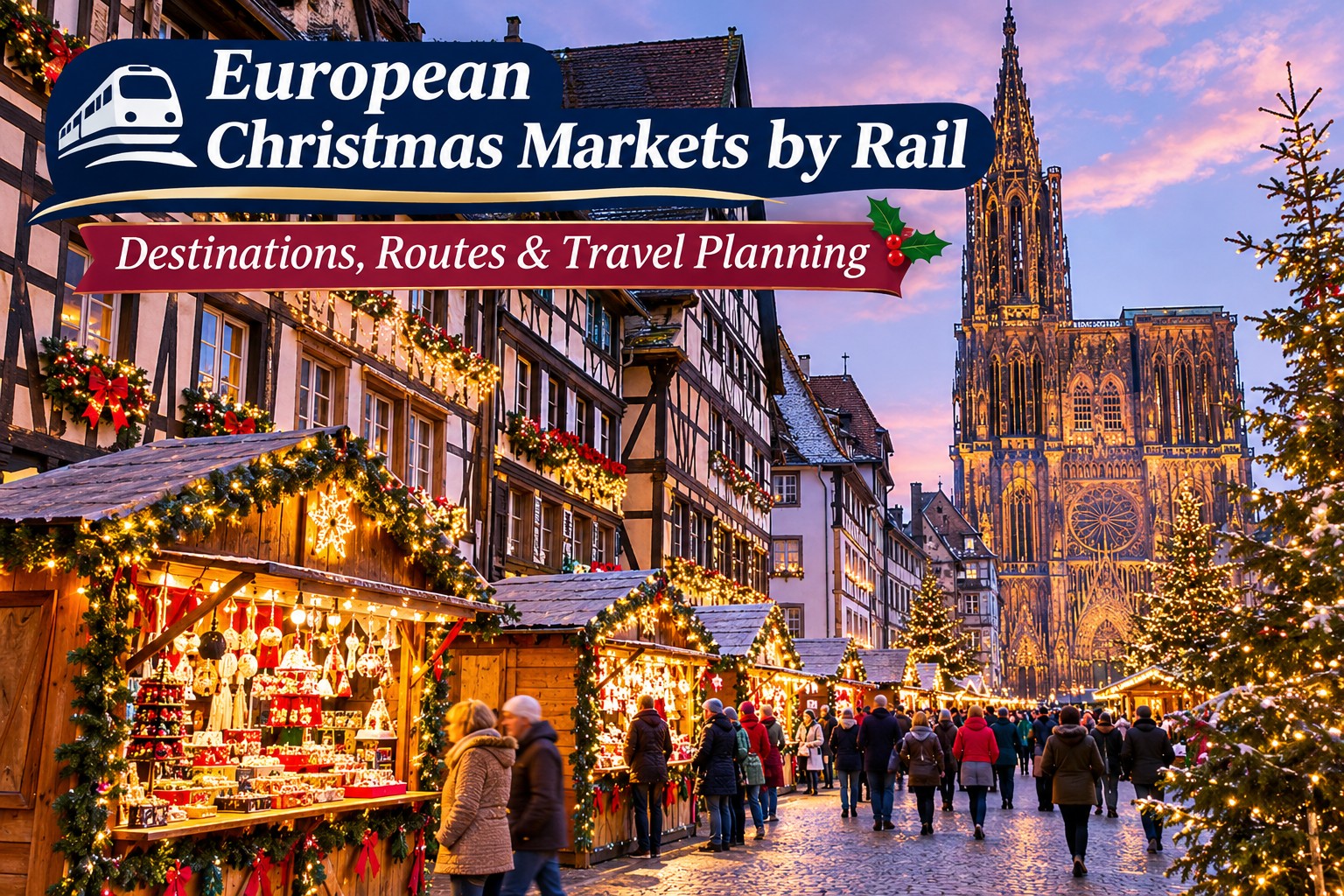
The festive atmosphere of Strasbourg provides inspiration for exploring Europe’s Christmas markets by rail, combining historic city settings with seasonal travel
But an appealing map is not necessarily a workable itinerary. Christmas markets have different opening periods, train connections vary by date and a journey that looks short on paper can consume much of a day once changes and station transfers are included. This guide helps you choose destinations for their festive character and their rail practicality, then plan a trip with enough time to enjoy both.
🎄 1. When Is the Best Time to Visit European Christmas Markets by Rail?
🗓️ Understanding the Christmas Market Season
Many European Christmas markets are associated with Advent, the weeks leading up to Christmas. That does not mean every market opens on the same weekend or closes on Christmas Eve. Cities may run several separately organised markets, each with its own calendar, while illuminations, skating and other winter attractions sometimes continue after the traditional stalls have closed.
A city may still look wonderfully festive while the specific market you hoped to visit has finished. Conversely, a larger winter festival may extend into January. Check the named event rather than assuming that a city’s general Christmas programme guarantees access to its market stalls.
Established traditions are also different from annual operating arrangements. Strasbourg’s historic market heritage, for example, helps explain its atmosphere, but the opening dates for any particular season still depend on the organisers’ published programme. Treat previously announced dates as historical information, not as a promise for the following year.
🚆 Choosing Travel Dates Around Rail Services and Market Opening Days
Start with the markets’ confirmed opening dates, then compare the trains operating on those precise days. A rail itinerary only works when the markets and the transport are available together. If you plan two cities, check that both markets are open during your proposed stay, allowing for the journey between them.
Weekends may bring a livelier atmosphere but also busier streets and greater competition for centrally located accommodation. Weekdays can offer more breathing room, although opening hours and individual attractions may differ. Neither quieter conditions nor cheaper fares should be assumed.
Christmas and New Year public holidays deserve particular attention: train timetables, station facilities and market programmes can change. If your plans depend on an evening arrival, verify the market’s closing time and the last practical connection.
📅 Find Your European Christmas Market Dates
Christmas market dates vary between destinations and from one season to another. Use our seasonal calendar as a starting point, then confirm the individual events before arranging your rail journey.
🎄 Discover the season
Explore seasonal events and festive possibilities across European destinations.
🗓️ Confirm each market
Check official dates and opening arrangements for each named market. City-wide festivities may follow different schedules.
🚆 Match events to rail travel
Compare confirmed market dates with train services, connections and overnight plans before booking.
Always verify current event dates, opening times and access arrangements with the organisers.
🌍 2. Which European Christmas Market Destinations Work Best by Train?
The most useful destination is not necessarily the most famous. Think about how easily you can reach it from your starting point, whether its festive sights are concentrated near the centre and whether nearby cities offer a worthwhile second stop. The following groups illustrate different styles of rail-based Christmas break rather than a definitive ranking.
🇧🇪 Belgium: Brussels, Bruges and Nearby Festive Cities
Belgium is a natural starting point for travellers seeking a compact city break or a manageable two-city holiday. Brussels offers a broad urban festive experience, with activities spread across central squares and streets. Bruges offers a different setting: canals, historic buildings and a smaller centre that encourages unhurried exploration.
However, a connection between railway stations is only one part of the day: you still need to reach your accommodation, walk to the relevant market locations and allow time to explore. A Brussels base with a separate Bruges excursion may suit visitors who prefer to unpack once, subject to the current train schedule and event dates.
Avoid assuming that every nearby festive town is equally easy to reach late in the evening.
🇫🇷 France: Paris, Strasbourg and Alsace Christmas Markets
Paris is an important gateway for journeys beginning in London and offers a broad choice of city experiences alongside its seasonal attractions. Strasbourg has a more concentrated identity as an Alsatian Christmas destination, with decorated streets and historic market traditions.
Strasbourg is particularly appealing when the market itself is the principal reason for travelling. Smaller towns in Alsace may provide an attractive contrast, but some require extra local trains, buses or other transfers; confirm those connections before building them into a rail-only plan.
Travellers coming through Paris must also check whether an onward train uses the same station as their arrival. A cross-city transfer changes the time and complexity of the journey, especially with luggage. For a short break, it may be wiser to choose either Paris or Strasbourg as the main base rather than trying to experience both in a hurry.
🇩🇪 Germany: Cologne, Aachen and Traditional Market Cities
German cities offer a range of Christmas market settings, from prominent central squares to smaller neighbourhood gatherings. Cologne is associated with its cathedral and urban festive atmosphere; Aachen offers a distinctive historic centre close to the borders with Belgium and the Netherlands.
This part of Europe is worth considering for a journey that links cities across borders. Yet a convenient geographical position does not guarantee a direct service, a protected connection or a market that remains open throughout your stay. Compare rail schedules on the actual dates and check each city’s individual market programme, especially if your trip approaches Christmas Eve.
Aachen may appeal to visitors wanting a more focused city experience, while Cologne can support a longer stay with additional sightseeing.
🇦🇹 Austria and Central Europe: Vienna and Further-Afield Options
Vienna suits travellers who want a substantial city break with Christmas markets as part of a wider cultural visit. The city hosts different seasonal events, so check the dates of the specific market you intend to visit rather than relying on a general Vienna Christmas listing.
Further into Central Europe, other rail-connected capitals and historic cities can make attractive longer holidays. The key difference is the time commitment. From Britain, reaching a more distant destination entirely by rail may involve a substantial journey, an overnight stop or several connections. From a continental starting point, the same destination might be much more straightforward.
An extra night in one city may provide more festive enjoyment than another long travel day added to the itinerary.
| Destination / city group | Festive experience | Rail access from Britain / continental hubs | Best-suited trip style | What to verify |
|---|---|---|---|---|
| Belgium: Brussels and Bruges | Larger city festivities contrasted with a compact historic setting | Investigate international access to Belgium from Britain; assess local onward connections from continental hubs | Short break or carefully planned two-city stay | Both event calendars, station transfers and return trains |
| France: Paris, Strasbourg and Alsace | Major-city festivities contrasted with Alsatian market traditions | Paris can serve as an international gateway; Strasbourg and smaller towns require onward-route checks | One main city, or a longer French rail journey | Exact market dates, Paris station changes and local transport |
| Germany: Cologne and Aachen | Historic centres and varied German market settings | Compare cross-border approaches from Belgium and other continental hubs; verify Britain-origin changes | Focused city break or selective multi-city route | Date-specific trains, market sites and holiday services |
| Austria/Central Europe: Vienna and further-afield destinations | Grand-city festive settings with wider cultural sightseeing | Generally a more substantial undertaking from Britain; feasibility varies greatly by continental origin | Longer stay with fewer hotel changes | Journey length, connections and each named market’s programme |
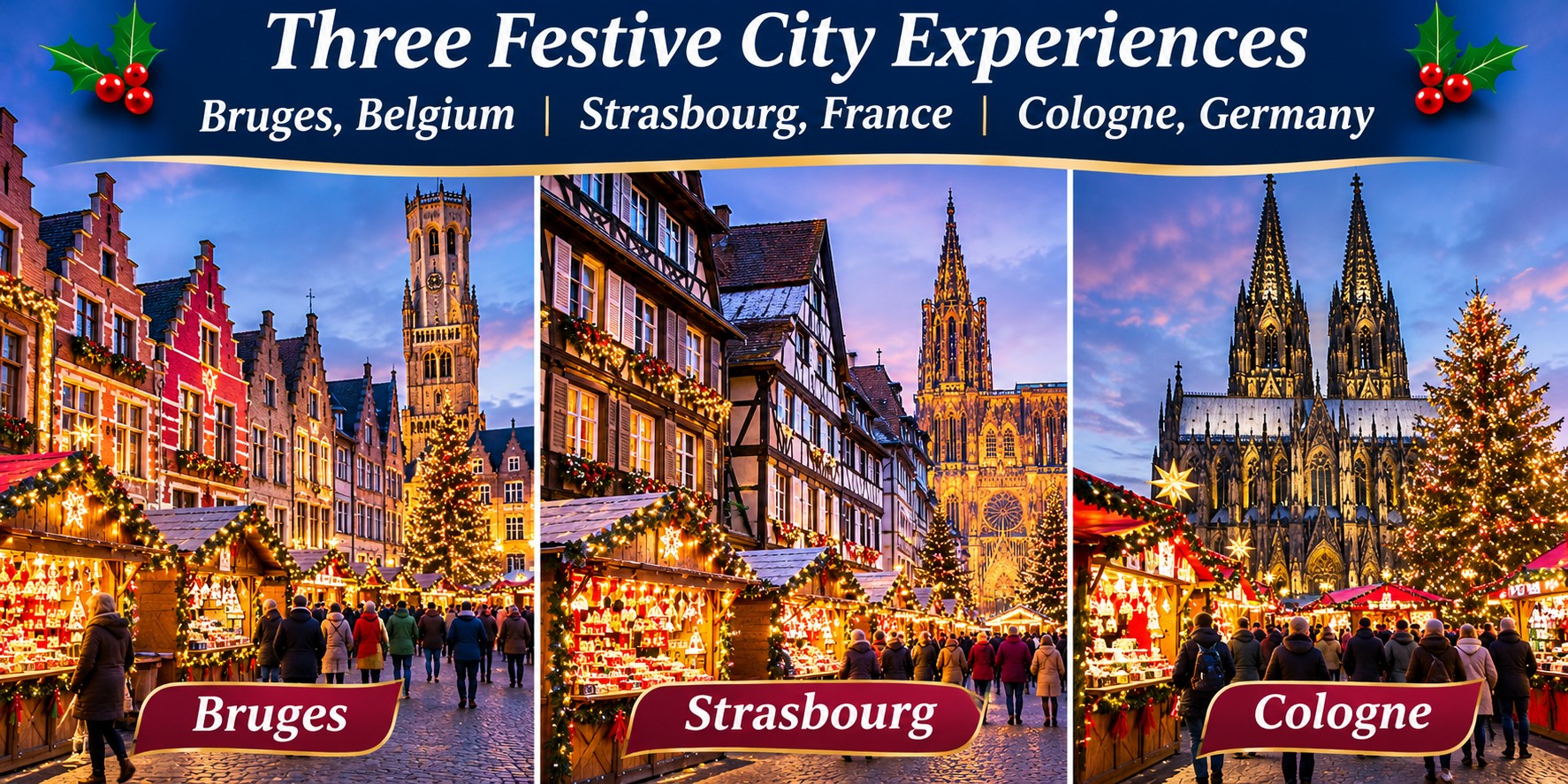
Bruges, Strasbourg and Cologne offer three distinctive Christmas market settings, from medieval Belgian streets to Alsatian architecture and Germany’s cathedral-city traditions
🚄 3. How to Reach European Christmas Markets by Rail
🇬🇧 Travelling from Britain: London and Continental Rail Gateways
For many journeys from Britain, London is the starting point for international rail travel towards continental Europe. The arrival city may be the Christmas market destination itself or a gateway for another train. Decide which applies before comparing fares: a seemingly attractive international ticket can still leave a lengthy onward journey.
International rail travel is not identical to domestic rail travel. Check the operator’s current check-in guidance, travel-document requirements and any applicable border procedures for your nationality and itinerary. Allow time for those formalities rather than arriving as though you were boarding an ordinary commuter service. Government entry guidance should be checked separately from the train company’s boarding instructions.
Travellers starting elsewhere in Britain also need a realistic connection into London, potentially between different stations.
🔄 Direct Trains, Connections and Multi-City Rail Journeys
A direct train is often simpler, but a well-planned connection can widen the range of possible destinations. Look beyond the number of changes. Ask whether you must move between stations, whether the connection is covered by a through ticket and how much time is available if the first train is delayed.
Check the complete door-to-door plan, including the walk or local transport from the arrival station to your accommodation. For a multi-city holiday, consider travelling in a logical geographical sequence instead of repeatedly returning to the same hub.
Treat sample routes as planning possibilities until you have checked date-specific services. Timetables may change around public holidays or engineering works.
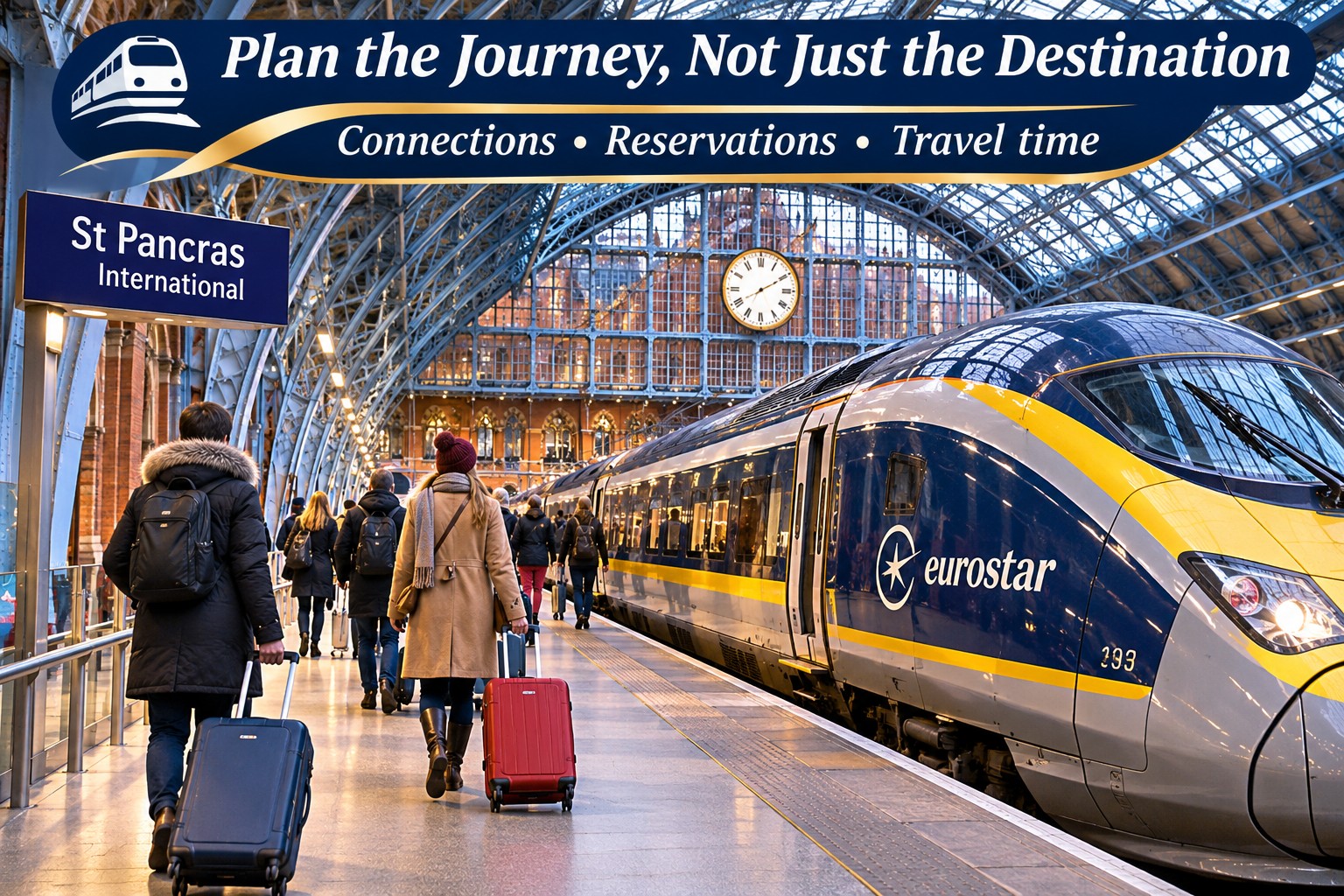
Planning a European Christmas market journey by rail means considering train connections, reservations and realistic travel times alongside the festive destinations themselves
🎟️ Rail Tickets, Reservations and Booking Flexibility
Rail operators and ticket types have different rules. Some services require a seat reservation; other tickets may permit greater flexibility, while discounted advance fares can carry restrictions. Check whether a proposed itinerary is sold as one journey or as separate tickets, since that can affect what happens after a missed connection.
Look at luggage rules, change and refund terms, seat reservations and any special assistance you need. Where separate tickets are unavoidable, allow a sensible buffer and understand the consequences of disruption before committing to accommodation or onward travel.
🧭 4. Planning a Realistic European Christmas Market Rail Itinerary
🏙️ One Christmas Market City or Several?
A single-city break is often the most relaxing choice for a first visit. You can enjoy the markets after dark, return to favourite streets and fit in museums or cafés without watching the clock. It also reduces the number of rail connections and accommodation changes.
A multi-city trip offers contrasting festive traditions and settings, but each additional stop consumes travel time. Two complementary destinations are often more satisfying than a list of cities visited too briefly. A Brussels-and-Bruges combination, for example, is a different planning proposition from a journey spanning France, Germany and Austria; neither should be presented as a confirmed itinerary without checking current services.
🛏️ Choosing Overnight Stops and Allowing Enough Time
Choose accommodation with the full itinerary in mind. A hotel near a station can simplify arrival and departure, but may be less convenient for evening market visits; a central location may reverse that trade-off. Check walking distances, public transport and late-evening access rather than relying on a map’s straight-line distance.
If you want to see several nearby markets, a single base can reduce packing and hotel check-ins. For a longer journey, changing base may make sense when it avoids substantial daily backtracking.
⏱️ Building in Connections, Daylight and Winter Contingencies
Winter days are shorter, especially farther north, so decide which sights are best visited in daylight and which markets you want to experience illuminated in the evening. Cold weather, heavy rain, snow or transport disruption can alter the pace of a day even when the railway is operating.
Do not build an itinerary around the minimum advertised transfer time. Allow for unfamiliar stations, luggage, accessibility needs and potential delays. Keep a fallback plan if a market closes unexpectedly or a connection is missed.
Pre-booking checklist
-
Confirm the opening dates and hours of each named market, including overlapping dates for a multi-city trip.
-
Check the actual international, connecting and return train services for your intended travel days.
-
Review reservations, separate-ticket risks, change conditions and border/check-in requirements.
-
Choose overnight bases with realistic station-to-hotel and hotel-to-market access.
-
Verify step-free routes, mobility assistance, luggage arrangements and any necessary local transport.
-
Check daylight, weather forecasts close to departure and contingency options for disrupted services.
❄️ 5. What to Expect When Visiting Christmas Markets in Winter
🌦️ Weather, Daylight and Seasonal Differences Between Destinations
European winter conditions vary by region and from year to year. A visit to Belgium or northern France may feel damp and chilly, while inland destinations can experience colder spells; none of these general patterns predicts the weather on your particular dates. Consult an official forecast shortly before departure and prepare for changing conditions.
Plan daylight sightseeing deliberately. Outdoor market stalls often gain atmosphere after dark, but walking unfamiliar streets, viewing architecture and making longer excursions may be easier earlier in the day. Leave some flexibility if rain or cold makes an extended outdoor evening less appealing.
♿ Accessibility, Crowds and Getting from Stations to Markets
A market described as central is not necessarily accessible from the railway station without steps, uneven surfaces or a lengthy walk. Historic streets can include cobbles; busy stalls may create narrow routes and queues. Check the accessibility information for both the station and the specific market, including toilets, entrances and any assistance arrangements.
Travellers who need step-free connections should verify each interchange, not only the departure and arrival stations. If crowds are a concern, consider visiting earlier in the day where opening hours permit.
🧳 Packing, Luggage and Comfortable Festive Sightseeing
Comfortable, weather-resistant footwear and adaptable warm layers are more useful than an elaborate wardrobe. Carry a small day bag for essentials and check train luggage rules before departure. If changing cities, find out whether your hotel can hold bags outside check-in hours; do not assume storage is available.
♻️ 6. Sustainability and Responsible Christmas Market Travel
🚆 Making Rail Journeys and Multi-City Travel More Efficient
A thoughtfully planned rail itinerary can avoid unnecessary backtracking and repeated transfers. Consider staying longer in fewer places, using local public transport where suitable and choosing a base from which nearby sights are reasonably accessible. Rail is a practical way to connect many European cities, but the environmental impact of a particular journey depends on its circumstances; avoid treating every itinerary as automatically equivalent.
🌱 Respecting Local Communities and Festive Destinations
Christmas markets take place in working cities where residents share streets and public spaces with visitors. Follow local waste and recycling arrangements, keep entrances and pedestrian routes clear and respect quiet residential areas when leaving evening events. Where practical, support local makers and independent businesses, and use reusable items when appropriate. Responsible travel should improve the experience for visitors and the communities hosting them.
❓ 7. Frequently Asked Questions About European Christmas Markets by Rail
Can You Visit Several European Christmas Markets Without Flying?
Yes, a rail-only holiday can be possible for suitably connected destinations. The practicality depends on where you start, how much time you have and the services operating on your dates. Compare complete journeys rather than assuming every city pair has a direct train.
Do European Christmas Markets Stay Open After Christmas?
Some do, but many traditional markets finish before or around Christmas, while other winter attractions continue later. A city’s festive lights or skating programme may have different dates from its stalls. Always check the named market’s official current-season calendar, particularly for travel between Christmas and New Year.
Is It Better to Book One City or a Multi-City Christmas Market Trip?
Choose one city if you value a relaxed pace, limited luggage handling and time to explore beyond the market. Consider multiple cities when their opening dates overlap and the rail connections leave enough time for enjoyable visits. A single base with a day excursion can be a useful middle ground.
How Far Ahead Should You Arrange Christmas Market Rail Travel?
Begin researching once you have a preferred travel window and destination shortlist, then monitor official market announcements and rail booking availability. Reservation windows and ticket conditions differ by operator and service. Book only when the essential dates and connections are sufficiently confirmed for your plans, and understand the flexibility of each purchase.
✨ 8. Conclusion: Choosing Your European Christmas Market Rail Journey
The best European Christmas market rail trip is the one that balances festive atmosphere with a journey you can genuinely enjoy. Choose a destination for its character, verify the market’s operating dates, check the trains for your actual travel days and allow time for winter conditions and unexpected changes.
Whether you favour a compact Belgian break, an Alsatian Christmas setting, a German market city or a longer stay in Vienna, thoughtful planning matters more than collecting destinations. Keep exploring seasonal events and individual city guidance as you refine your dates, then build a journey with room to savour the experience.
🧭 Continue Your European Festive Rail Journey
Ready to explore further? Discover practical rail guidance, learn more about Europe’s Christmas market season or consider organised European train tours.
🚄 Plan European Rail Travel
Explore the practicalities of travelling from London to Paris by train, including international rail journey planning.
🎄 Explore the Festive Season
Compare the wider Christmas market season across Britain and Europe, including festive timing and planning considerations.
🚆 Explore Organised Train Tours
Browse European train-tour options as an alternative to arranging every connection independently.