


First Time in London? Everything You Need to Know Before You Visit (2027 Guide)
28th August 2026
🏙️ First Time in London? Everything You Need to Know Before You Visit (2027 Guide)

Planning your first London visit becomes easier when you get the essentials right first—from where to stay and how to get around to what genuinely deserves your time
Visiting London for the first time is exciting, but planning that first trip can quickly become complicated. There are several airports, hundreds of places you could stay, an enormous transport network and enough famous attractions to fill weeks rather than days. Add advance tickets, restaurants, events and possible day trips, and an exciting holiday can begin to feel like a logistical exercise.
The good news is that you do not need to understand everything about London before you arrive. You need to make a relatively small number of important decisions in the right order.
Start with your travel dates and how many days you have. Choose an area to stay that suits the London experience you want. Understand how you will reach the city and move around once you are there. Decide which experiences genuinely matter to you, secure anything that needs advance booking, and then organise your days geographically rather than racing between attractions.
Do that, and London becomes much easier.
🧭 What Should You Know Before Your First Trip to London?
The first thing to understand is London’s scale. Tourist maps can make Westminster, the Tower of London, Kensington, Covent Garden and other major areas appear conveniently close together, but repeatedly crossing the capital consumes both time and energy. Security checks, queues, meals and simply finding your way also occupy more of a sightseeing day than many first-time visitors expect.
Fortunately, London’s size does not make it unmanageable. Its extensive public transport network connects the city well, while many individual sightseeing areas are best explored on foot. Once you begin thinking of London as a collection of neighbourhoods and districts rather than one enormous attraction list, planning becomes considerably simpler.
This leads to one of the most useful principles for a first London visit: plan by area, not by attraction count.
You also do not need to see everything. Nobody does.
A rewarding first visit might include several world-famous landmarks, a museum, a neighbourhood you had barely heard of before arriving, a walk beside the Thames and an evening that was never tightly scheduled. Those experiences can be more memorable than completing an ambitious checklist.
Measure a successful London day by the quality of what you experience, not by the number of attractions you cross off.
📅 When Is the Best Time for Your First London Visit?
There is no single best month to visit London. A more useful question is: what kind of London do you want to experience?
🌸 Spring and Summer
Spring brings longer days, parks and gardens returning to colour and an increasingly busy programme of events. Summer provides the longest daylight hours and plenty of opportunity to combine major attractions with parks, neighbourhood walks and evenings outdoors, although popular periods can also bring greater visitor demand.
🍂 Autumn and Winter
Autumn brings cooler conditions for exploring on foot alongside cultural and seasonal events. Winter has shorter daylight hours, but London’s museums, galleries, theatres and historic attractions remain compelling, while festive events can transform parts of the capital.
Weather matters, but it should not make the decision alone. Before finalising your dates, there is another question worth asking:
What will actually be happening in London while you are there?
🎭 Check the BVT London Events Calendar Before You Finalise Your Plans
London’s events calendar can materially change a first visit. Major sporting occasions, royal and ceremonial events, festivals, exhibitions, concerts and seasonal celebrations can influence accommodation demand, transport, crowds and access around particular parts of the city. Just as importantly, something you did not know was happening could become one of the highlights of your trip.
Before fixing every sightseeing day, check the BVT London Events Calendar 2026–2027 to see what coincides with your dates. Treat events as opportunities as well as practical considerations. If something genuinely interests you, protect time for it before filling the itinerary with attractions that can be visited more flexibly.
A useful planning sequence is straightforward: choose your approximate dates → check London’s events → identify anything important to you → protect those priorities → build the rest of your sightseeing around them.
This simple check can prevent avoidable clashes while helping you experience London as it actually is during your visit, rather than following an itinerary that could have been used at any time of year.
⏱️ How Many Days Do You Need in London?
For many first-time visitors, three or four days provides a strong introduction to London. Two days can deliver an enjoyable highlights-focused visit, but choices need to be disciplined. With five days or more, you gain something particularly valuable: time to slow down.
That extra time does not need to mean adding more attractions. It can mean exploring a museum properly rather than rushing through it, taking a longer lunch, walking between neighbourhoods, changing plans because the weather improves, or following a discovery you had never intended to make.
As a practical starting point:
- 2 days: concentrate on your highest priorities and keep geography tight.
- 3–4 days: combine major sights with neighbourhoods, museums, evenings and breathing room.
- 5+ days: explore London at greater depth and consider whether a journey beyond the capital would enhance the trip.
Think about depth and pace, not simply the number of attractions you can fit into each day.
🏨 Where Should a First-Time Visitor Stay in London?
There is no universally best neighbourhood for a first London visit. Instead of asking, “Which area of London is best?”, ask “Which area will make my particular trip easiest?”
Balance four things: location, transport connections, neighbourhood character and budget.
A cheaper hotel is not necessarily better value if reaching your priorities repeatedly consumes time and energy. Equally, you do not always need to pay the highest central-London prices if a well-connected area suits your itinerary better.
🏛️ Westminster and Victoria
Westminster suits visitors who want some of London’s most recognisable landmarks close at hand. Nearby Victoria adds strong transport connections, making the wider area practical as well as central.
🎭 Covent Garden and the West End
Covent Garden and the West End suit travellers who value restaurants, theatre, entertainment and central-London atmosphere. They can be especially convenient in the evening, when being able to dine or enjoy entertainment close to your accommodation becomes more valuable after a full sightseeing day.
🌊 South Bank
South Bank suits visitors who like the idea of beginning and ending their days beside the Thames. Riverside walks, cultural venues and major attractions are close at hand, while bridges provide useful walking connections towards Westminster, Covent Garden and other parts of central London.
It is particularly appealing if you want the journey between sights to feel like part of the London experience rather than simply travelling underground from one attraction to another.
🏰 Tower and the City
The area around the Tower of London and the City offers a striking mixture of historic and contemporary London. Tower Bridge, old churches and centuries of history sit alongside the modern financial district and some of the capital’s most distinctive architecture.
It can be a strong choice for travellers whose priorities lean towards history, architecture and eastern central London. If most of your evenings will be spent around the West End, however, factor those additional journeys into your decision.
🚆 Paddington and Other Transport-Friendly Areas
Sometimes the smartest accommodation choice is influenced by how you will arrive, depart or travel beyond London. Paddington, for example, can be convenient for particular airport and rail journeys, while other well-connected districts may provide a better balance between accommodation cost and accessibility than the most famous tourist areas.
The principle matters more than finding one supposedly perfect neighbourhood: choose accommodation according to the London trip you are actually planning.
✈️ Getting from London’s Airports into the City
For anyone visiting London for the first time, the airport journey deserves more thought than simply identifying the fastest service into central London. Heathrow, Gatwick, Stansted, Luton, London City and Southend serve different parts of the wider London transport system, and your best option depends on where your journey actually ends.
Think about the complete airport-to-accommodation journey.
🚆 Rail and Public Transport
Rail and public transport can provide efficient airport connections, but headline journey times do not tell the whole story. A fast service may become less convenient if it leaves you needing further connections, long station walks or an awkward final journey with luggage.
Check the route all the way to your accommodation, including transfers and the final walk, and confirm current services for your airport and travel date before departure.
🚕 Taxi or Private Transfer
A taxi or pre-arranged private transfer can make sense when door-to-door simplicity matters more than achieving the lowest fare. Families, larger groups, travellers carrying substantial luggage, people with particular accessibility requirements or anyone arriving exhausted after a long journey may reasonably value convenience more highly.
Private transport is not automatically superior. London traffic can affect road journey times, while public transport may sometimes provide the easier option.
The best airport transfer is therefore the one with the least friction for your particular journey, not necessarily the cheapest or fastest on paper.
Compare total journey time, cost, luggage, group size, arrival time, accessibility, final destination and how much you value door-to-door simplicity before deciding.
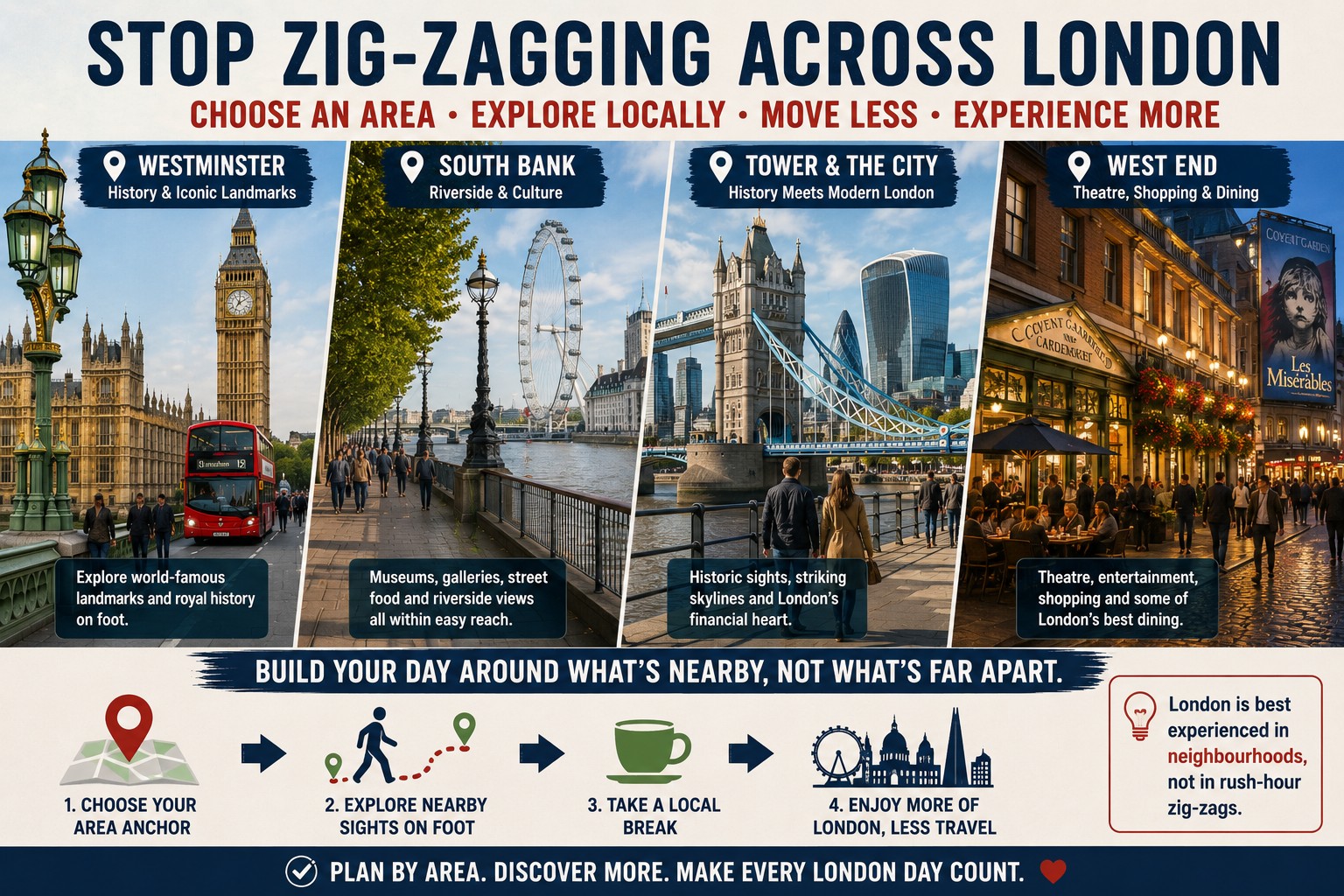
Build each sightseeing day around one part of London, combining nearby landmarks, neighbourhoods, walks and local breaks to spend less time travelling and more time experiencing the city
🚇 How to Get Around London Without Making It Complicated
London’s transport network can look intimidating before you use it, but most first-time visitors become comfortable with it surprisingly quickly. You do not need to learn every line, station or route before arriving. You simply need to understand the main ways of travelling and become confident choosing the best one for each journey.
The Underground is invaluable for covering longer distances across central London, while rail services can make particular cross-city journeys remarkably efficient. Buses let you see London while travelling, walking often makes sense between nearby sights, and the Thames provides another way to experience the capital from an entirely different perspective.
💳 Contactless and Oyster
Contactless payment is widely used across London’s public transport network, while Oyster provides another established payment option. International visitors should check that their chosen card is suitable for contactless travel and whether their bank applies overseas transaction charges.
Fares, payment arrangements and transport services can change. Check current official transport information shortly before travelling rather than relying on prices or instructions saved from an older guide.
👟 Sometimes Walking Is the Better Journey
One of the easiest mistakes to make is assuming every movement across London requires the Tube. Some central stations and attractions are close enough that walking is simpler, while the journey itself may reveal streets, squares, architecture and unexpected views you would miss underground.
Walking also helps London’s geography begin to make sense. After several journeys entirely below ground, famous places can feel disconnected. Walk between neighbouring areas and the city gradually joins together.
🚢 Don’t Forget the Thames
The Thames is not simply a landmark running through London. River services can provide a practical connection between parts of the city while offering a perspective that neither road nor Underground travel can reproduce.
Even when travelling by river is not the fastest option, the journey itself can become part of your sightseeing.
| Travel method Particularly useful when First-timer consideration | ||
|---|---|---|
| Tube | Covering central London distances efficiently | Changes, crowds and accessibility |
| Bus | You want street-level travel while moving around | Traffic can affect journey times |
| Walking | Attractions and neighbourhoods are relatively close | Distance, footwear and weather |
| Rail | A particular cross-city or longer journey suits it | Check the correct station and service |
| Thames | Your journey follows or connects naturally with the river | Check current routes and services |
| Taxi/private transport | Door-to-door simplicity matters | Traffic and cost |
💷 Money, Cards, Tipping and Everyday London Practicalities
Most everyday payments in London are straightforward. Cards and contactless payments are widely accepted, so many visitors use relatively little cash, although carrying an alternative payment method is sensible.
Before travelling, check whether your bank charges for overseas transactions. When paying by card, international visitors should also understand any currency-conversion choices offered at the point of payment rather than automatically accepting them.
Restaurants may add a service charge to the bill, so check before adding an additional tip. There is no need to turn every café, pub or restaurant payment into an etiquette test: read the bill and ask if anything is unclear.
Finally, check your mobile roaming or data arrangements before departure, consider an appropriate eSIM if needed, and make sure you have the correct adaptor for UK electrical sockets.
🎟️ What Should You Book Before You Arrive in London?
Advance planning can remove uncertainty from a first London visit, but booking too much can create a different problem: an itinerary with no room to respond to weather, energy levels or unexpected discoveries.
A better strategy is to separate experiences that need protecting from experiences that can remain flexible.
🔒 Protect Your Genuine Must-Sees
If a particular attraction, exhibition, performance or special experience is one of the main reasons for your trip, consider securing it early enough that limited availability does not make the decision for you later. The same applies to date-specific experiences that cannot simply be moved to another afternoon.
Your priorities do not need to match somebody else’s list of London’s “essential” attractions. If missing something would genuinely disappoint you, treat it as an itinerary anchor.
📆 Build Around Your Anchors
Once those fixed priorities are established, look at where they are located before adding anything else.
A morning reservation in Westminster should not automatically be followed by an afternoon booking on the opposite side of London simply because both attractions appear on your wish list. Instead, use confirmed experiences as geographical anchors and build nearby sights, neighbourhoods, meals and walks around them.
You will spend less time travelling and create days that feel like coherent journeys through London rather than a sequence of appointments.
🌿 Leave Some London Unscheduled
Flexibility has real value. Weather changes, energy levels fluctuate and somewhere discovered unexpectedly at lunchtime may suddenly seem more appealing than what you planned months earlier.
Leave enough space for London to influence the itinerary after you arrive.
A fully booked itinerary is not necessarily a well-planned itinerary.
| Experience priority Planning approach Why | ||
|---|---|---|
| Essential or date-specific | Consider securing early | Protects a major trip priority |
| Important but flexible | Fit around confirmed anchors | Preserves options |
| General sightseeing | Keep adaptable where practical | Weather and energy can change |
| Meals and neighbourhood exploring | Mix planning with spontaneity | Creates room for discovery |
🚌 Do You Need a Sightseeing Tour on Your First Visit?
Being new to London does not automatically mean you need a guided tour. The more useful test is whether guidance will add enough orientation, knowledge, access, storytelling or convenience to justify giving part of your limited London time to it.
A broader sightseeing tour can help you understand the city early in your stay. Walking tours can explore a particular neighbourhood or subject in greater depth, while a Thames experience reveals London from a different perspective. Small-group tours may provide greater interaction, private tours can offer more personalisation, and many visitors will be perfectly happy exploring substantial parts of London independently.
There is no universally superior approach. A particularly effective first visit may combine independent exploration with one or two carefully chosen guided experiences where expertise genuinely improves what you would otherwise experience alone.
Choose a tour for what it adds to your journey, not simply because it is your first time in London.
🗺️ Plan London by Area, Not by Attraction Count
One of the most effective ways to improve a first London itinerary is to stop asking, “How many attractions can I fit into today?”
Ask instead:
“Which part of London am I exploring today?”
That small change can transform the pace, geography and quality of your visit.
👑 Westminster
Westminster is one of the clearest examples of why geographical planning works. The Houses of Parliament, Westminster Abbey, Whitehall, St James’s Park and Buckingham Palace can form part of the same broad sightseeing journey, with the streets, parks and ceremonial spaces between them becoming part of the experience.
Instead of treating each landmark as a separate appointment, choose one or two priorities as anchors and allow the surrounding area to complete the day.
🌊 South Bank
Across the Thames, South Bank creates another natural sightseeing zone. Riverside walking connects cultural attractions, viewpoints and landmarks, while bridges make it easy to combine parts of South Bank with Westminster or continue eastwards along the river.
🏰 Tower and the City
The Tower of London and Tower Bridge provide obvious anchors for exploring the City and its surroundings. Historic churches, remnants of much older London and contemporary architecture sit remarkably close together, rewarding visitors who give the area time rather than inserting a single attraction between unrelated journeys elsewhere.
🎭 West End and Covent Garden
Covent Garden, Soho and the wider West End naturally combine sightseeing with restaurants, shopping, theatre and evening entertainment. This makes the area particularly useful when you want an afternoon to evolve into an evening without repeatedly crossing London.
🏛️ Bloomsbury and Museum London
Bloomsbury works especially well for museum-focused visitors who also want historic squares, literary associations and quieter streets. A major museum does not always need to be followed by another headline attraction; exploring the surrounding neighbourhood can provide welcome contrast.
| Area Natural sightseeing anchors What it combines well with | ||
|---|---|---|
| Westminster | Parliament, Westminster Abbey, ceremonial London | St James’s Park, Buckingham Palace, Whitehall |
| South Bank | Thames, cultural attractions, riverside landmarks | Westminster, walking and river journeys |
| Tower and the City | Tower of London, Tower Bridge, historic City | Architecture, churches and the Thames |
| West End and Covent Garden | Covent Garden, Soho, theatre district | Dining, shopping and evening entertainment |
| Bloomsbury | Major museums and historic squares | Literary London and slower neighbourhood exploring |
🌙 What Should You Do on Your First Evening in London?
Plan your first evening according to how you are likely to feel when you arrive, not according to how energetic you imagined you would be when creating the itinerary.
After a long journey, checking into your accommodation, eating nearby and taking a gentle walk may provide a better introduction than rushing towards another timed attraction. If you arrive earlier and still have plenty of energy, an orientation walk can help you understand your surroundings without committing the evening to an ambitious sightseeing schedule.
Let your location help make the decision. Staying near the Thames creates an obvious opportunity for a riverside walk; Covent Garden or the West End can naturally lead into dinner, theatre or simply experiencing central London after dark.
If you arrive late, expect even less of yourself. Settle in, understand your immediate surroundings and begin exploring properly the following morning.
Your first evening doesn’t have to prove that you’ve arrived in London.
Sometimes the best introduction is simply having enough space to realise that you finally have.

Your first evening in London does not need a packed sightseeing schedule. Settle in, explore locally, enjoy a meal and give yourself time to take in the city
⚠️ First-Time London Mistakes That Are Easy to Avoid
By this stage, most of the decisions that shape a successful first visit should be clearer. Before finalising your plans, use this as a quick diagnostic. If several points describe your itinerary, it may be worth adjusting it before you travel.
1. Trying to see everything. If your itinerary looks like a race through London’s most famous attractions, remove something. London rewards time and attention far more than completion.
2. Crossing the city repeatedly. If morning, afternoon and evening plans sit in completely different areas, regroup them geographically. Less transit usually means more London.
3. Underestimating real journey time. A transport app may show the time between stations, but your day also includes walking, waiting, changing services and finding the entrance when you arrive.
4. Booking almost every hour. If one delay would disrupt the entire day, the itinerary is probably too rigid. Protect genuine priorities and give everything else room to move.
5. Choosing accommodation on room price alone. Before booking, consider the time and effort required to reach the places you expect to visit most often. Value is about the whole stay, not simply the nightly rate.
6. Forgetting to check London’s events. Your dates may coincide with something that affects transport or crowds—or with an event that deserves a place in the itinerary itself.
7. Ignoring queues and security checks. Reaching an attraction is not necessarily the same as beginning your visit. Allow sensible margins around timed plans.
8. Taking the Tube automatically. Before heading underground, check whether walking, a bus or even the Thames would make the journey simpler or more enjoyable.
9. Treating meals and breaks as lost sightseeing time. A pub, café, market or unhurried lunch can be part of experiencing London rather than an interruption to it.
10. Judging the trip by how much you completed. If you return home remembering the experiences rather than the unfinished checklist, the itinerary worked.
🚆 Should Your First London Trip Include Somewhere Beyond the Capital?
London is an exceptional base for exploring further, but that does not mean every first-time visitor should immediately leave it.
With only two or three days, protecting your London time will often produce a more satisfying trip than sacrificing a substantial part of it simply because a day trip appears on somebody else’s itinerary.
With four, five or more days, the calculation changes. Windsor, Stonehenge, Bath and Oxford can reveal very different aspects of England while allowing you to return to your London base. Travellers with longer holidays can think beyond individual day trips altogether, using London as the starting point for a wider journey through Britain, Scotland or continental Europe.
Ask one question before adding anything beyond the capital:
Do I have enough time for this journey to improve my first London visit rather than dilute it?
If the answer is yes, exploring beyond London can become one of the trip’s defining experiences. If the answer is no, there is nothing incomplete about staying in the capital.
🌱 How to Make Your First London Visit More Sustainable
Many of the choices that make a London visit more sustainable also make it more enjoyable.
Group sightseeing geographically so you are not making unnecessary journeys across the city. Walk sensible distances and use public transport where practical. Give neighbourhoods enough time to reveal themselves rather than moving continuously between headline attractions.
Consider where your visitor spending goes too. Eating, shopping and stopping within the neighbourhoods you explore can support local businesses while giving you a closer connection with everyday London.
Sustainable travel does not need to become another complicated set of holiday rules. Often it means travelling more thoughtfully: reducing unnecessary journeys, respecting the places you visit and allowing enough time to experience them properly.
Travel with purpose. Explore with care.
❓ Frequently Asked Questions About Visiting London for the First Time
🇬🇧 Is London Easy for First-Time Visitors?
Yes. London’s size and transport network can look complicated before you arrive, but most visitors adapt quickly. Understand the basic transport options, organise sightseeing geographically and decide which experiences need advance planning, and the city becomes considerably easier to navigate.
📆 How Many Days Should I Spend in London on My First Visit?
Three or four days provides a strong first visit for many travellers. Two days works for carefully chosen highlights, while five days or more gives you greater depth, flexibility and the option of exploring beyond the capital without sacrificing too much London time.
🏨 What Is the Best Area to Stay in London for a First Visit?
There is no single best area. Westminster and Victoria suit landmark-focused visitors, Covent Garden and the West End place entertainment and dining close at hand, South Bank offers a riverside setting, and well-connected areas such as Paddington may provide greater transport convenience. Choose according to your itinerary, connections, preferred atmosphere and budget.
🚇 Is London’s Public Transport Difficult to Use?
Generally, no. You only need to understand the journeys relevant to your own plans rather than mastering the entire network. Check routes before travelling, allow sensible time for changes and remember that walking, buses or river services can sometimes provide a better journey than automatically using the Underground.
💳 Do I Need Cash in London?
Many visitors use relatively little cash because cards and contactless payments are widely accepted. Carrying an alternative payment method remains sensible, particularly for international travellers who should also check card compatibility and overseas transaction charges before departure.
🎟️ What Should I Book in Advance?
Prioritise attractions, performances, exhibitions or special experiences that genuinely matter to you, particularly where dates or availability may be limited. Keep more flexible sightseeing adaptable wherever practical so your itinerary still has room to respond after you arrive.
🚌 Do I Need a Guided London Tour?
No. A guided experience is worthwhile when orientation, specialist knowledge, storytelling, access or convenience will improve your visit. Many travellers find that combining mostly independent exploration with one or two carefully chosen tours gives them the best of both approaches.
🌙 Is London Safe to Explore in the Evening?
London is a major international city, so normal urban awareness is appropriate. Stay aware of your surroundings, look after phones and valuables, plan unfamiliar late-night journeys and check current official advice when needed.
👟 How Much Walking Should I Expect in London?
Potentially quite a lot. Even when using public transport, sightseeing involves walking through stations, around large attractions and between nearby places. Comfortable footwear, sensible pacing and geographically organised days can make a noticeable difference.
🚆 Should I Take a Day Trip on My First London Visit?
Only if you have enough time for it to improve rather than dilute your London experience. With a short stay, concentrate on the capital. With additional days, Windsor, Stonehenge, Bath, Oxford or another carefully chosen destination can add a very different dimension to your journey.
✨ Your First London Trip Doesn’t Need to Be Perfect
A successful first visit does not require you to master London before you arrive or control every hour once you are there.
Choose your dates thoughtfully and check what is happening during your stay. Give yourself enough days for the experience you want. Select accommodation according to your actual itinerary, understand your airport journey and become comfortable with London’s main transport options. Protect the experiences that matter most, then organise your sightseeing geographically and leave some space between the anchors.
Most importantly, resist measuring the trip by how much London you managed to complete.
Some of the memories that define your first visit may not be the ones you booked months beforehand. They could be a view across the Thames, a pub discovered because you walked instead of taking the Tube, an unexpected street or square, a conversation over lunch or a neighbourhood you explored because an afternoon was deliberately left unfinished.
London rewards preparation, but it also rewards curiosity.
Prepare well enough to feel confident—and then give London room to surprise you.