


How to Get to the Channel Islands: Ferries, Flights and Inter-Island Travel
25th August 2026
✈️ How to Get to the Channel Islands: Ferries, Flights and Inter-Island Travel
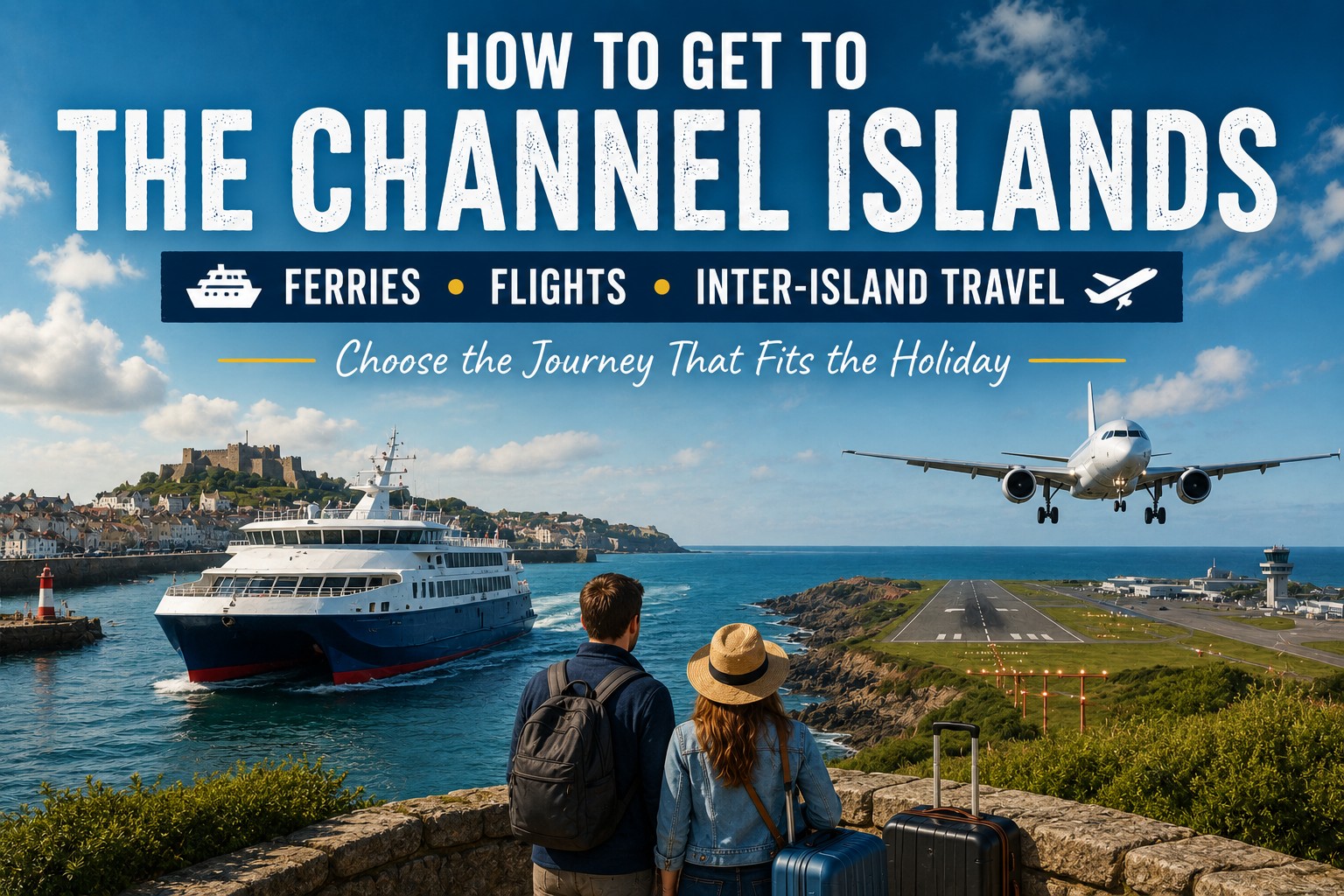
Flights and ferries provide different ways to reach the Channel Islands, with the best choice depending on your complete journey, luggage, vehicle requirements and onward travel plans
If you are deciding how to get to the Channel Islands, the most useful starting point is not simply to compare a ferry timetable with a flight time. The better question is whether the transport works for your complete journey.
Jersey and Guernsey are the principal gateways, while Herm, Sark and Alderney fit into the wider inter-island network in different ways. That means the best route depends on more than geography.
Before booking anything, consider five variables:
Where are you travelling from? Which island do you want to reach first? How much usable holiday time do you have? Are you bringing a car, bicycle or substantial luggage? And does your journey end in the Channel Islands or continue towards France and wider Europe?
Those answers can change the optimum choice completely.
A short flight may appear fastest, but airport transfers, check-in, security and baggage collection all contribute to the real door-to-door journey. A ferry may take longer in motion yet become more practical if you want to bring a vehicle, carry additional equipment or continue onwards by sea.
The island that is easiest to reach directly is not always the island that makes the best gateway for everything that follows either. Someone primarily interested in Herm, Sark or Alderney may need to think differently from a traveller whose holiday centres on Jersey.
The objective is therefore simple: choose the destinations that matter first, then build transport around them intelligently.
⚖️ Ferry or Flight: Which Is Better?
There is no universally better option. Channel Islands ferries and flights solve different traveller problems, and the strongest choice depends on the entire route rather than one advertised travel time.
✈️ When Flying Makes More Sense
Flying can be particularly attractive for shorter breaks, travellers with convenient access to a suitable departure airport and anyone wanting to maximise usable time on Jersey or Guernsey. Flights to the Channel Islands can also make sense when travelling relatively light and when the arrival airport works conveniently with your accommodation and first day’s plans.
However, a short flight is not the same thing as a short journey.
Travel to the departure airport, recommended arrival time, security procedures, boarding, baggage collection and the transfer after landing all count. Someone living conveniently for a ferry port may therefore complete their door-to-door journey surprisingly efficiently by sea.
⛴️ When Ferry Travel Makes More Sense
Ferry travel becomes especially attractive when the holiday involves more than transporting passengers.
Taking your own car may significantly improve the practicality of exploring Jersey or Guernsey. Additional luggage, bicycles, family equipment or specialist gear can also change the calculation, subject to the transport provider’s current conditions.
For some travellers, the crossing itself is another advantage. Rather than treating every minute in transit as lost holiday time, arriving across the water can become part of the experience.
Ferries also deserve particular consideration when the wider itinerary involves Northern France.
🔄 Could You Fly One Way and Sail the Other?
Yes—when doing so solves a genuine geographical or logistical problem.
A traveller beginning in Britain, exploring the islands and then continuing towards France may discover that different transport modes suit different stages. There is little benefit, however, in creating a complicated mixed-mode itinerary simply for novelty.
| Consideration Flying Ferry | ||
|---|---|---|
| Door-to-door time | Often strong | Depends heavily on departure point |
| Taking your own car | No | Often possible |
| Larger luggage needs | More restrictions likely | Often more practical |
| Bicycles/equipment | Carrier-dependent | Often convenient |
| Short breaks | Frequently attractive | Route-dependent |
| Journey character | Faster transition | Sea crossing may become part of the holiday |
| France integration | Route-dependent | Particularly relevant |
| Disruption exposure | Possible | Possible |

Flying can maximise island time, while ferry travel can work better for vehicles, additional luggage and onward journeys towards France. The best option depends on the complete door-to-door trip
🇯🇪 Getting to Jersey
Jersey is one of the principal gateways to the Channel Islands and can be a natural first arrival point for travellers coming from Britain or incorporating the islands into a journey involving France.
Air travel may work particularly well when your starting point has convenient access to a suitable airport, while arriving by sea can become more attractive when bringing a vehicle, travelling with substantial luggage or approaching Jersey as one stage of a wider coastal itinerary.
But there is a useful distinction between the easiest island to reach and the best gateway for the holiday you are actually planning.
If Jersey is your principal destination, arriving there directly will often be the obvious approach. If several islands are involved, look one or two stages ahead before booking. A convenient journey into Jersey should not automatically dictate the rest of an itinerary if another sequence creates better onward connections.
Also consider what happens immediately after arrival. Airport or harbour transfers, accommodation location, local public transport and whether you genuinely need a car can all influence the real convenience of the route.
🇬🇬 Getting to Guernsey
Guernsey is another major gateway, but its position becomes particularly important for travellers interested in the smaller islands.
Herm, Sark and Alderney fit naturally into itineraries structured through Guernsey, so the first booking should reflect what you hope to do later.
Conceptually, think:
Britain or France → Guernsey → Smaller-Island Exploration
This does not make Guernsey universally preferable to Jersey. It means the optimum arrival gateway can depend on the onward itinerary.
If Herm, Sark or Alderney ranks highly among your priorities, examine those connections before fixing accommodation and transport around a different sequence.
🏝️ Getting to Herm, Sark and Alderney
Beyond Jersey and Guernsey, transport becomes more island-specific. Herm, Sark and Alderney should not be treated as interchangeable additions: each occupies a different place within Channel Islands inter-island travel, and those differences can influence whether you visit for a day, stay overnight or restructure the wider itinerary.
🏖️ How to Get to Herm
Herm fits naturally into a Guernsey-centred journey, with access by boat from Guernsey.
For a day visit, this can simplify the practicalities considerably. Most belongings can remain at your principal accommodation while you take only what is needed for the excursion. Staying overnight changes the equation, so verify current sailing and baggage arrangements before making dependent bookings.
The simplicity is part of Herm’s appeal. An island defined by walking, beaches and a slower rhythm should not require an unnecessarily complicated itinerary around it.
🚲 How to Get to Sark
Sark also fits naturally into a journey through Guernsey, but arrival introduces an important change in how you explore.
Private cars are not part of ordinary visitor transport on Sark, making walking and cycling integral to the experience rather than substitutes for having a vehicle. A day trip can provide a rewarding introduction, while staying overnight creates more freedom to explore beyond the main visitor period.
In either case, verify outward and return connections before arranging other bookings around them.
Getting to Sark is part of understanding Sark.
🐦 How to Get to Alderney
Alderney deserves more deliberate transport planning because air and sea options can play different roles according to your dates and the services operating.
Think in three broad possibilities:
Fly directly where suitable services are available.
Connect through Guernsey.
Use sea travel where current arrangements make it practical.
Establish the workable route before forcing Alderney into an already crowded schedule. For travellers drawn by its wildlife, wartime history, coastal walking and distinctive island character, the additional planning can be thoroughly worthwhile.
🔄 How Inter-Island Travel Actually Works
One of the most important things to understand when planning a multi-island holiday is that the Channel Islands do not operate as an evenly connected transport network.
Their proximity on a map can make it tempting to imagine that you can simply move from one island to the next in whichever order looks most appealing. In reality, different routes, transport modes and operating patterns mean some combinations fit together much more naturally than others.
Think less like a metro map and more like a set of gateways and onward connections.
Jersey and Guernsey are the principal gateways, while Guernsey has a particularly important role in journeys involving Herm, Sark and Alderney. This makes sequencing critical. Before booking accommodation across several islands, identify the most constrained transport stage in your proposed itinerary and check that first.
There is little benefit in securing three hotels only to discover that the connection on which the entire sequence depends does not work conveniently for your dates.
| Journey Natural Planning Role Main Question | ||
|---|---|---|
| Jersey ↔ Guernsey | Larger-island combination | Does the current service work for your dates? |
| Guernsey → Herm | Smaller-island addition | Day visit or overnight stay? |
| Guernsey → Sark | Day or overnight experience | How much usable time do you want? |
| Guernsey → Alderney | More deliberate extension | Which available transport works best? |
Choose your islands according to interest, but sequence them according to workable transport.
That distinction protects the quality of the holiday. Your interests should determine why each island earns a place; the transport network should determine the most intelligent order in which to experience them.
If a proposed sequence creates unnecessary backtracking, repeated accommodation changes or a fragile same-day connection, test another order before committing.
🧳 Cars, Bikes, Luggage and Travelling with Equipment
The best transport choice can change considerably once you are travelling with more than an ordinary suitcase. A car, bicycle, children’s equipment or specialist luggage may make an option that initially appears slower considerably more practical when the entire trip is considered.
🚗 Taking a Car to the Channel Islands
Bringing your own vehicle can make ferry travel attractive, particularly if you intend to explore extensively on Jersey or Guernsey and value having familiar transport available immediately after arrival.
But a car that proves useful on one island does not automatically belong on every subsequent stage. Smaller islands operate differently, and carrying a vehicle farther than necessary can add cost and logistical complexity without improving the experience.
A useful rule is to ask where the car genuinely earns its place, rather than assuming it must accompany you simply because it began the holiday with you.
🚲 Travelling with a Bicycle
Cycling can become part of the Channel Islands experience rather than merely a method of transport. Before travelling, verify the provider’s current bicycle-carriage conditions and consider whether taking your own bike through several stages is actually worthwhile.
Local hire can sometimes be the simpler solution. Sark, for example, lends itself naturally to cycling, but that does not necessarily justify transporting a bicycle through every preceding connection.
🧳 Day-Trip Luggage vs Relocation Luggage
This distinction can simplify an island-hopping itinerary considerably.
For a day trip, leaving your main luggage at your principal accommodation allows you to travel lightly. A relocation day, when changing islands and accommodation, requires greater attention to baggage allowances, handling arrangements and onward transfers.
Families carrying children’s equipment and travellers with specialist gear should compare these practical requirements before choosing between air and sea travel.
🪪 Passports, Photo ID and Entry Requirements
Travel documentation deserves careful attention because a simple statement such as “you don’t need a passport for the Channel Islands” can become misleading once your route, nationality and transport provider are taken into account.
The Channel Islands sit within the Common Travel Area arrangements, but that does not mean every traveller on every route can arrive without identification. Carrier requirements still matter, and journeys involving France or another destination outside the Common Travel Area introduce a different set of considerations.
For a straightforward journey from Britain, check what identification your airline or ferry operator requires before departure. Do not assume that documentation accepted on a previous visit—or by another transport provider—will automatically be sufficient for your current booking.
International itineraries need another level of attention. If you are travelling:
Britain → Channel Islands → France
or:
France → Channel Islands → Britain
check the requirements for every stage and every traveller. Nationality, route and individual circumstances can affect what documentation or travel authorisation is necessary, while something acceptable for one leg may not satisfy the next.
This is also an area where information can change. An evergreen travel article can explain the planning principle, but it should never replace current official guidance when you are making an immigration or identification decision.
Always check current official government information and your transport provider’s requirements before travelling.
That final verification should happen early enough to resolve any issue—and again before departure if your journey was booked well in advance.
🌦️ Weather, Disruption and Protecting Your Connections
Channel Islands transport involves sea crossings and island airports, so weather and operational changes deserve consideration—especially when several independently arranged stages depend on one another.
The aim is not to plan around worst-case scenarios. It is to recognise the difference between a resilient itinerary and a fragile chain of bookings.
A delayed flight or changed sailing may be relatively easy to absorb when you are arriving on one island and remaining there for several nights. The consequences become greater when another ferry, flight, accommodation change or onward journey to France is scheduled immediately afterwards.
This is where booking dependency matters.
A through journey arranged as one booking can have a very different risk profile from several independently purchased tickets. Never assume that one transport provider will protect, rebook or compensate an onward journey purchased separately from another provider.
The more stages you book independently, the more responsibility you assume for protecting the connections between them.
Allow sensible margins around critical transfers, particularly where missing one stage would affect several later bookings. Understand cancellation and amendment conditions before committing, keep important reservation details accessible and reconfirm significant arrangements as departure approaches where appropriate.
Travel insurance may also deserve consideration for a multi-stage itinerary, but policies differ substantially. Read the actual terms, including relevant exclusions and missed-connection provisions, rather than assuming that every disruption will be covered.
The objective is resilience, not anxiety.
A strong Channel Islands itinerary has enough structure to work efficiently while retaining enough flexibility that one altered connection does not unravel the entire holiday.
🇫🇷 Travelling Between France and the Channel Islands
The Channel Islands do not have to be approached only from Britain. Their position close to the French coast creates another compelling possibility: making the islands part of a journey involving Northern France.
That opportunity works in both directions.
Britain → Channel Islands → Northern France
or:
Northern France → Channel Islands → Britain
Once France enters the itinerary, however, the transport question changes. You are no longer simply deciding how to reach Jersey or Guernsey; you are connecting an island journey with an international stage, potentially involving additional accommodation, luggage movements and onward transport.
Check the sea connections operating for your actual dates before arranging dependent bookings around them. The most constrained stage should generally be established first, particularly when one sailing determines when you must leave an island, arrive in France or reach your next accommodation.
Documentation also requires greater attention because travelling between France and the Channel Islands takes you beyond the Common Travel Area. Verify current passport, entry and carrier requirements for every traveller rather than assuming the arrangements used for the Britain–Channel Islands stage will remain sufficient.
Luggage deserves similar whole-route thinking. Travelling relatively light may become increasingly valuable once a straightforward island break evolves into several accommodation changes and international connections.
At this point, ask a useful question:
Are you still arranging transport to a destination—or are you now constructing a multi-destination European journey?
The distinction matters because complexity can increase quickly. The reward can be substantial too. Combining the Channel Islands’ distinctive communities and coastlines with the towns, countryside and historical landscapes of Northern France creates genuine contrast rather than simply adding another destination to a list.
🌍 When an Organised Channel Islands and Northern France Journey Makes Sense
Once a holiday combines several Channel Islands with Northern France, the planning challenge changes. Instead of making one or two transport decisions, you may be coordinating flights or ferries, inter-island connections, multiple accommodation bookings, luggage movements and an international onward stage.
For many travellers, organising those details independently is part of the enjoyment. Others reach a point where reducing the logistical burden becomes valuable in its own right.
🧭 Independent Planning
Independent travel provides maximum control. You decide exactly where to stay, how long to spend on each island, which connections to use and how extensively to continue through France.
It can be particularly rewarding when you enjoy researching transport and accommodation or want an itinerary significantly different from established touring routes.
The trade-off is responsibility. Every independently arranged stage needs to work with the next, and the more dependent bookings you create, the more carefully you need to protect the overall sequence.
🚌 Organised Multi-Destination Travel
An organised journey becomes worth considering when coordination itself has become one of the problems you are trying to solve.
The Channel Islands and Northern France are particularly suited to this comparison because a relatively compact geographical journey can involve islands, sea crossings, changing accommodation, international travel and onward touring.
Neither approach is inherently superior. Some visitors will value complete independence; others would rather devote less time to coordinating the major stages and more time to experiencing the destinations themselves.
The useful question is:
How much of the journey do you genuinely want to organise yourself?
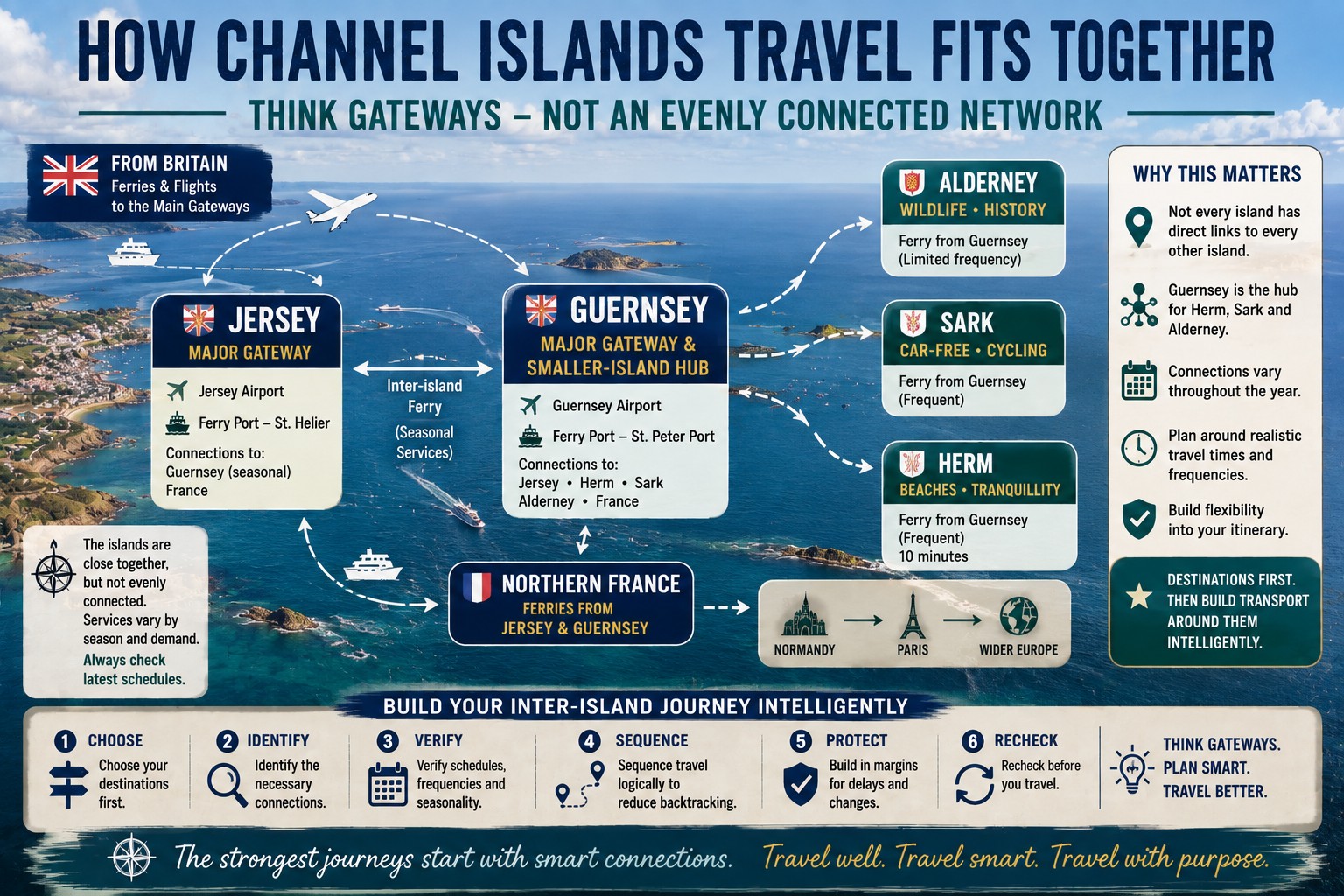
Jersey and Guernsey form the principal Channel Islands gateways, with Guernsey playing an especially important role for journeys involving Herm, Sark and Alderney
🚆 Continue into Normandy, Paris and Wider Europe
Once the Channel Islands are combined with Northern France, the journey can naturally continue—but possible does not automatically mean worthwhile. Every additional destination should earn its place by contributing something genuinely different.
Normandy can provide that contrast exceptionally well. Coastal landscapes, historic towns, countryside and extraordinary layers of European history can transform Northern France into a substantial part of the holiday rather than simply a transit stage between the islands and Paris.
Paris changes the character again. Island communities and coastal journeys give way to one of Europe’s great cities, while extensive onward rail connections create opportunities to continue much farther across the continent.
A logical progression might become:
Channel Islands → Northern France → Normandy → Paris → Europe by Rail → Wider Europe
The same discipline used when planning inter-island connections remains valuable here. Check the important transport stages before building dependent accommodation around them, avoid unnecessary backtracking and allow destinations enough time to justify the effort involved in reaching them.
Paris may provide a natural conclusion. Alternatively, travellers with more time can use it as a gateway towards other parts of France, Belgium, the Netherlands, Switzerland, Italy or a broader multi-country European journey.
The important principle is restraint.
Do not turn a well-designed Channel Islands holiday into an exhausting tour of Europe merely because another train, ferry or flight exists. Extend when the next destination improves the experience and when the available time allows you to enjoy it properly.
The Channel Islands can therefore fulfil two equally valuable roles: they can be the complete holiday, or the opening chapter of something much larger.
📅 Plan Your Journey Around the BVT Europe Events Calendar 2026–2027
Transport planning is usually approached through two questions: where are you going, and how will you get there? For a well-designed Channel Islands or wider European journey, a third question can be equally important: when should you travel?
Festivals, cultural occasions, sporting events, commemorations and seasonal celebrations can provide an additional reason to choose particular dates. They can also increase demand for transport and accommodation, so knowing what is happening during your intended visit can be valuable even when attending an event is not the principal purpose of the holiday.
The BVT Europe Events Calendar 2026–2027 should therefore be used early enough to influence the itinerary rather than consulted only after everything has been booked.
For a flexible trip, a useful sequence is:
Choose Dates → Check Events → Compare Transport → Secure Important Stages
If a particular event is the reason for travelling, reverse the process. Establish the confirmed event dates first, then construct transport and accommodation around them.
This becomes even more useful when the Channel Islands form the opening stage of a longer European journey. A significant event in Northern France, Normandy, Paris or farther across Europe might provide a worthwhile reason to extend the trip, alter its direction or spend longer in one destination.
Equally, identifying a major event that coincides with your existing plans can alert you to potentially greater demand before key transport or accommodation becomes difficult to secure.
A memorable event can become one of the defining experiences of a European holiday. The advantage comes from discovering it before your itinerary becomes fixed, allowing dates, transport and accommodation to support the opportunity naturally rather than forcing you to reconstruct an otherwise sensible journey later.
🌱 Sustainable Ways to Reach and Explore the Channel Islands
Sustainable Channel Islands travel is more nuanced than assuming one transport mode is automatically better than another. A responsible decision should consider the whole door-to-door journey, including how you reach your departure point, what you bring with you, how frequently you move between islands and how you travel after arriving.
Comparing only one flight or ferry crossing can therefore create a false picture. A longer drive to reach a particular departure point, repeated vehicle movements or several unnecessary inter-island transfers may matter to the wider journey just as much as the headline transport choice.
Once on the islands, public transport can reduce unnecessary car use where it works effectively for your plans, while walking and cycling can become rewarding parts of the experience rather than simply ways to reach the next attraction.
Itinerary design matters too. Adding another island merely to increase the number visited can create extra movement without producing a better holiday. Choosing fewer destinations and experiencing them more meaningfully can reduce unnecessary transfers while leaving more time—and visitor spending—within individual island communities.
Bringing a car may still be entirely sensible for some journeys, particularly when travelling with family equipment or when extensive exploration makes it genuinely useful. For other visitors, local transport, walking, cycling and appropriate shared services may provide a better solution.
The same thinking applies when continuing into France and wider Europe. Connect stages efficiently, consider rail and shared transport where they suit the itinerary, and avoid unnecessary backtracking.
Supporting locally owned accommodation, restaurants, shops and experiences can also help more of tourism’s economic value remain within the communities being visited.
The most responsible transport choice depends on the whole journey, not one isolated leg.
Travel with purpose. Explore with care.
❓ How to Get to the Channel Islands FAQs
✈️ Can You Fly Directly to the Channel Islands?
Yes. Jersey and Guernsey are the principal air gateways, with direct services available from a range of departure points depending on current schedules and season. Alderney also has air connections that can make flying an important part of some multi-island itineraries.
Because routes can change, check services for your actual travel dates rather than assuming a connection operates year-round.
⛴️ Can You Get a Ferry to the Channel Islands?
Yes. Ferry travel is an important way to reach the Channel Islands and can be particularly useful when bringing a vehicle, carrying additional luggage or equipment, or incorporating the islands into a journey involving France.
When comparing Channel Islands ferries, consider departure location, check-in, onward transport and your wider itinerary—not just the advertised crossing time.
🚗 Can You Take a Car to the Channel Islands?
Vehicle ferry services can allow travellers to bring their own car to the larger islands on appropriate routes, subject to the transport provider’s current arrangements.
Whether you should take one is a different question. Consider where the car will genuinely improve the holiday and whether it remains useful once you begin travelling between islands.
⚖️ Is It Better to Fly or Take a Ferry to Jersey?
Neither option is automatically better.
Flying can be particularly attractive for shorter breaks or travellers with convenient airport access. Ferry travel may become preferable when bringing a vehicle, carrying more luggage or building Jersey into a wider sea-based itinerary.
Compare the complete journey from your starting point rather than choosing solely by scheduled travel time.
🇬🇬 Is It Better to Fly or Take a Ferry to Guernsey?
The answer again depends on your circumstances. Flying may maximise usable destination time, while travelling by sea can provide practical advantages involving vehicles, luggage and wider itineraries.
If Herm, Sark or Alderney also forms part of your plans, look beyond the initial arrival. The best way to reach Guernsey should ideally support the next stage of the holiday as well as the first.
🏖️ How Do You Get to Herm?
Herm is naturally reached by boat from Guernsey, making it particularly well suited to a Guernsey-centred itinerary. Always verify current sailing arrangements before travelling.
🚲 How Do You Get to Sark?
Sark fits naturally into a journey through Guernsey, with sea travel providing the principal visitor route. Arrival also marks a genuine change in travel style: Sark’s car-free character means walking and cycling become central to exploring the island rather than alternatives to conventional vehicle travel.
For a day visit, verify both outward and return connections before building other arrangements around them. If staying overnight, consider how the additional accommodation move fits into the wider itinerary and whether the extra time on Sark justifies carrying your main luggage between islands.
🐦 How Do You Get to Alderney?
Alderney can be reached using air connections and, where suitable services operate, by sea. Guernsey can also play an important role as a connecting gateway.
Because Alderney’s available transport can vary according to route, season and travel date, it rewards more deliberate planning than simply assuming a particular connection will fit your itinerary. Establish the transport first, then build dependent accommodation and activities around a route that actually works.
🔄 Can You Travel Between Jersey and Guernsey?
Yes, when suitable inter-island services operate for your dates. Jersey and Guernsey can form the backbone of an excellent two-island holiday, but the connection should be verified before committing to accommodation on both islands.
If your preferred sequence produces an awkward transfer or fragile onward booking, test the itinerary in reverse. Changing the order can be considerably better than forcing an inconvenient original plan.
🇫🇷 Can You Travel Between France and the Channel Islands?
Yes. Sea connections can make France and the Channel Islands natural partners within a wider itinerary, subject to the routes operating for your dates.
Once France is included, remember that you are travelling beyond the Common Travel Area. Check current documentation requirements and consider how the international stage affects accommodation, luggage and onward transport.
🪪 Do You Need a Passport for the Channel Islands?
It depends on where you are travelling from, your nationality and your transport provider’s requirements.
The Channel Islands sit within the Common Travel Area arrangements, but carriers can still require acceptable identification. International stages involving France or another destination outside the Common Travel Area introduce additional considerations.
Always verify current official government and carrier requirements before travelling rather than relying on a general travel guide for an individual documentation decision.
🌅 Final Thoughts: Make Transport Part of the Journey
Knowing how to get to the Channel Islands is ultimately about much more than choosing between a ferry and a flight. The strongest transport plan is the one that fits the holiday you genuinely want to experience.
For a short Jersey or Guernsey break, that may mean using a convenient direct air connection and travelling relatively light. For another visitor, bringing a vehicle by ferry may make the complete door-to-door journey considerably easier. If Herm, Sark or Alderney is high on your wish list, looking beyond the first arrival becomes essential because your gateway should work intelligently with the connections that follow.
The same principle becomes even more important when Northern France enters the itinerary. What begins as an island holiday can evolve into an international journey involving several destinations, accommodation changes and onward travel.
The answer is not to make transport complicated.
It is to understand the important connections before they become complicated.
Choose destinations because they deserve your time. Identify any constrained transport stage early, sequence the itinerary around connections that genuinely work and retain enough flexibility to enjoy the places you travelled to see.
Choose the destinations that matter first. Understand the connections that make them possible. Then build a journey in which transport supports the experience rather than controlling it.
The Channel Islands can be your complete holiday, a carefully connected collection of contrasting island experiences or the opening chapter of a wider European adventure. Whichever approach suits you, getting there intelligently gives the rest of the journey a much stronger foundation.