


Loch Ness Travel Guide: Cruises, Legends, Inverness and Highland Adventures
3rd September 2026
🐉 Loch Ness Travel Guide: Cruises, Legends, Inverness and Highland Adventures

Discover Loch Ness beyond the legend, from cruises across its famous waters and historic Urquhart Castle to the Great Glen and wider Scottish Highlands
Few places in Scotland are as instantly recognisable by name as Loch Ness. Stretching for roughly 23 miles (37 kilometres) through the Great Glen, this deep, dark loch is famous around the world for the mystery of the Loch Ness Monster. Yet arrive expecting only Nessie and you may discover that the legend is merely the beginning.
Loch Ness is part of a much bigger Highland story. Historic Urquhart Castle rises above its western shoreline, boats cross waters framed by mountains and forest, and the Great Glen reveals a landscape shaped by geology, history and centuries of human movement. Inverness provides the principal practical gateway for many visitors, while Fort Augustus offers a very different experience where the Caledonian Canal meets the southern end of the loch.
This Loch Ness travel guide will help you decide where to explore, whether to take a cruise, where to stay, how long to spend and how best to combine Loch Ness with Inverness, Skye and a wider journey through the Scottish Highlands.
The most important decision comes before any itinerary is built: do you simply want to see Loch Ness, or do you want to experience it?
Come for the legend. Look beyond it, and Loch Ness becomes one of the great landscapes of the Scottish Highlands.
The most practical gateway for many visitors, with accommodation, restaurants and transport connections for Loch Ness and the wider Highlands.
A cruise reveals the scale of the loch and its relationship with the surrounding Highland landscape in a way that cannot be experienced entirely from the shoreline.
Combine Highland history with one of the classic views across Loch Ness. For many first-time visitors, castle and water together create a particularly strong introduction.
A useful western-shore stop, particularly for visitors interested in the modern Nessie story and convenient access to nearby Urquhart Castle.
A slower Highland setting where Loch Ness meets the Caledonian Canal and the wider geography of the Great Glen becomes easier to understand.
Isle of Skye
for mountains, dramatic coastlines and a contrasting island landscape.
🗺️ Where Is Loch Ness? Understand the Geography First
Loch Ness lies within the Scottish Highlands and forms a major part of the Great Glen, the natural corridor running across the Highlands between the Inverness area and Fort William. Its long, narrow geography matters because the places and experiences associated with Loch Ness are distributed along the landscape rather than concentrated around a single visitor centre or viewpoint.
Inverness is commonly described as the gateway to Loch Ness, but the city itself does not sit directly on the loch. Travel south-west from Inverness and you gradually enter the Loch Ness landscape. Drumnadrochit and nearby Urquhart Castle provide important focal points along the western shore, while Fort Augustus introduces another character entirely at the southern end, where Loch Ness meets the waterways of the Caledonian Canal.
Understanding that geography before you travel prevents one of the most common planning mistakes: treating “visiting Loch Ness” as driving to one pin on a map, taking a photograph and leaving.
🧭 Understanding Loch Ness by Area
| Area What You Will Find Best For Role in Your Journey | |||
|---|---|---|---|
| Inverness | City accommodation, restaurants and transport connections | Arriving, staying and wider Highland exploration | Main gateway |
| Northern Loch Ness approach | Waterways, changing scenery and access to cruise experiences | First views and time on the water | Entry into the Loch Ness landscape |
| Drumnadrochit | Visitor facilities and Loch Ness Monster interpretation | Nessie stories and practical stops | Western Loch Ness base |
| Urquhart Castle | Historic ruins overlooking the loch | History, scenery and classic Loch Ness views | Major first-time experience |
| Fort Augustus | Canal locks, village atmosphere and southern Loch Ness | Slower exploration and Great Glen journeys | Southern hub |
BVT Planning Principle: Loch Ness is not one viewpoint. It is a long Highland landscape offering several different ways to experience its water, history, communities and scenery.
Before deciding where to stop, decide what you want Loch Ness to contribute to your Scotland journey. For many first-time visitors, that decision begins with one of the most distinctive possibilities of all: leaving the shoreline behind and seeing the loch from the water.
History & Nessie? Drumnadrochit & Urquhart Castle
Canal & slower exploration? Fort Augustus
Deeper Highland journey? Follow the Great Glen
Decide what you want the loch to contribute to your wider
Scotland journey,
then choose the part of Loch Ness that best supports it.
🚢 Loch Ness Cruises: Should You See the Loch from the Water?
Standing beside Loch Ness gives you a sense of its atmosphere. Travelling across the water reveals something different: its scale. The shoreline stretches away, the surrounding Highland landscape becomes more prominent, and places that can feel disconnected when travelling by road begin to make geographical sense.
For many first-time visitors, this makes a Loch Ness cruise one of the most rewarding ways to experience the loch. It is not simply about searching the water for Nessie. A cruise places you within the landscape, changes your perspective on the Great Glen and provides views that cannot be replicated from a roadside stop.
Depending on the experience chosen, a cruise might concentrate on scenery, explore a longer section of the loch or be combined with time at Urquhart Castle. Some visitors will be perfectly satisfied making a cruise the centrepiece of a shorter Loch Ness visit. Others, particularly those with a full day available, may find that combining time on the water with exploration on land creates a much more complete experience.
🌊 Short Cruise or Longer Loch Ness Experience?
The right choice depends largely on the role Loch Ness plays in your itinerary.
A short scenic cruise can work well when time is limited or when Loch Ness forms one part of a wider Highland day. You still gain the valuable water-level perspective without allowing the experience to consume most of your available sightseeing time.
A longer cruise experience gives you more time to absorb the scale and changing character of the loch. This can be particularly worthwhile when Loch Ness itself is one of the principal destinations of your Highland visit rather than simply a stop along the route.
For many first-time visitors, one of the strongest combinations is Loch Ness from the water together with Urquhart Castle on land. The two experiences complement one another: the cruise reveals the geography and scale of the loch, while the castle introduces centuries of human history within that landscape.
Highland weather should also form part of your decision. Conditions on the water can feel cooler and more exposed than they do on land, even when Inverness or the surrounding countryside feels relatively mild. Layers and a waterproof outer layer are sensible choices in any season.
A cruise is not automatically the “best” way to visit Loch Ness, nor does it replace everything worth experiencing ashore. Its greatest value is perspective. If your itinerary allows it, seeing Loch Ness from both water and land provides a far richer understanding than simply stopping beside it.
Loch Ness is a major priority? Consider a longer cruise.
First visit with a full day? Combine a cruise with Urquhart Castle.
Touring the Highlands? Make the cruise one part of the wider journey.
Loch Ness can feel cooler and more exposed than the surrounding countryside. Adaptable layers and a waterproof outer layer are sensible in any season.
🏰 Urquhart Castle: Where Loch Ness and Highland History Meet
Few places demonstrate that relationship between land and water more powerfully than Urquhart Castle. Its ruins occupy a commanding position on the western shore, creating one of the most recognisable historic landscapes around Loch Ness.
The location was strategically important. The Great Glen has long provided a natural route through the Highlands, and controlling key positions within it mattered during centuries of political rivalry and conflict. Urquhart Castle developed during the medieval period and experienced a turbulent history before eventually being deliberately destroyed in 1692 to prevent its use by Jacobite forces.
Today, the surviving towers, walls and ruins open onto expansive views across Loch Ness. The setting helps visitors understand why this particular piece of shoreline mattered long before Nessie made the loch internationally famous.
BVT Expert Insight: Urquhart Castle is rewarding not simply because it is a castle beside Loch Ness. Its position helps explain the historical importance of the landscape around it.
For first-time visitors with sufficient time, exploring Urquhart Castle on land and seeing its dramatic setting from the water can create one of the most complete introductions to Loch Ness. It also provides an important counterbalance to the story that dominates almost every visitor’s imagination before they arrive: the enduring mystery of Nessie.
you appreciate the scale of Loch Ness, the surrounding landscape and the dramatic position of the castle on the western shoreline.
you step into the human history of the Great Glen and experience the loch from one of its most important historic locations.
The cruise explains the landscape. The castle explains the history. Together, they provide a more complete introduction to Loch Ness than either experience can offer alone.
🐉 Nessie: Legend, Sightings and the Loch Ness Monster
No Loch Ness travel guide would be complete without Nessie. The Loch Ness Monster has transformed an already remarkable Highland landscape into one of the world’s most famous places of mystery, attracting generations of visitors who arrive wondering—however optimistically—whether something unexplained might appear on the water.
The story becomes more interesting, not less, when folklore, historical tradition and modern evidence are kept distinct. Tales of strange creatures and supernatural beings have existed within Scottish and wider Celtic traditions for centuries. An often-repeated account associated with St Columba describes an encounter with a dangerous water creature near the River Ness in the sixth century. It is an intriguing part of the region’s legendary inheritance, but it should not be treated as proof that the modern Loch Ness Monster tradition already existed in its present form.
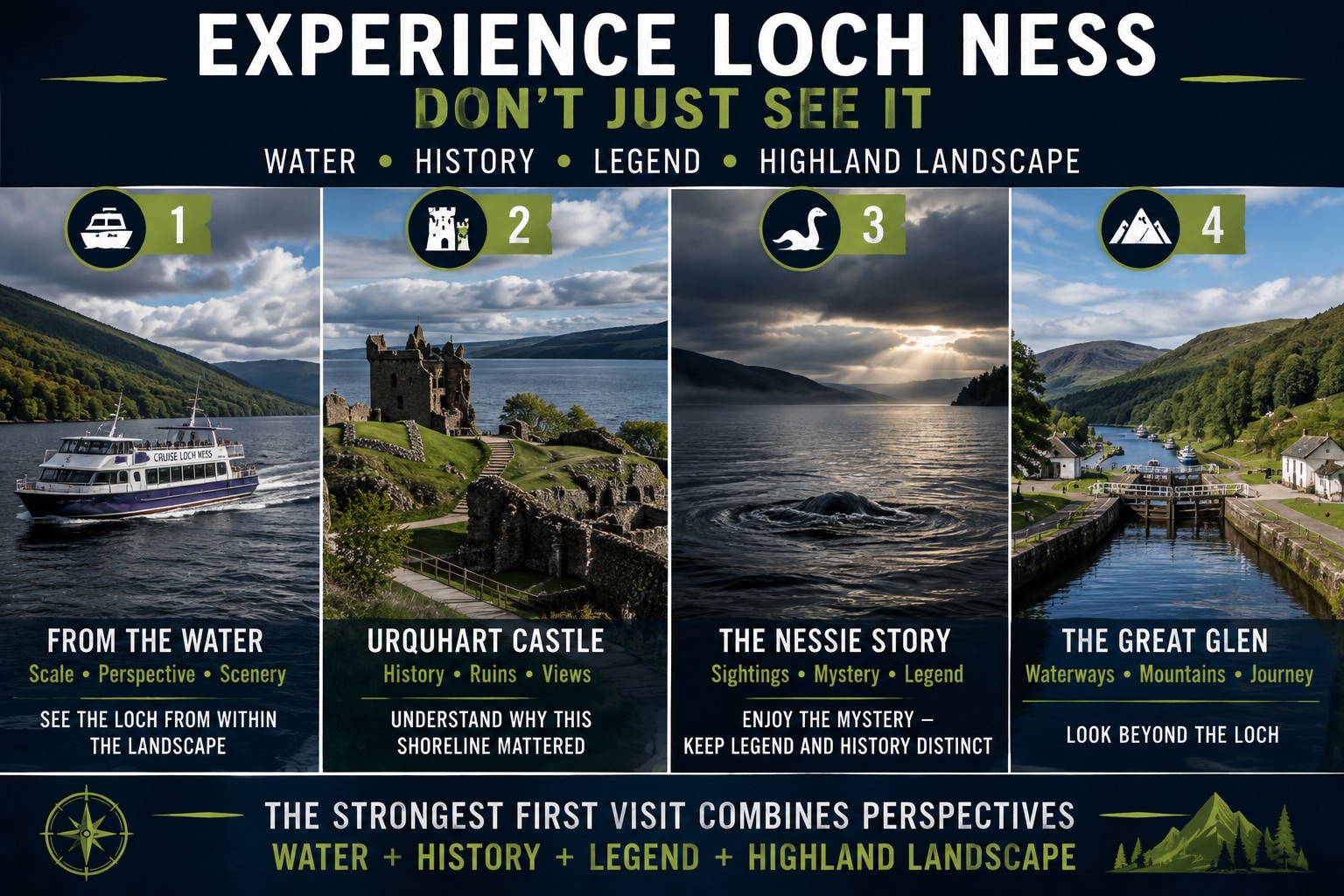
Experience Loch Ness from different perspectives, combining time on the water with Urquhart Castle, the famous Nessie story and the wider landscape of the Great Glen
The wider Highlands contain their own traditions of magic, ancient landscapes and legendary figures. Exploring those stories can add another dimension to a Loch Ness journey without confusing folklore with documented history.
Merlin
and discover how Loch Ness became connected with a much broader world of Scottish myth, magical landscapes and legendary tradition.
📜 How Did the Modern Loch Ness Monster Story Begin?
The modern Nessie phenomenon developed much later. It attracted widespread attention during the 1930s, when reports of unusual creatures or shapes in and around Loch Ness began receiving extensive newspaper coverage. Eyewitness accounts, photographs and organised searches followed, transforming a Highland mystery into an international cultural phenomenon.
Some famous pieces of supposed evidence have subsequently been exposed as hoaxes or challenged, while other sightings remain unexplained observations rather than proof of an unknown animal. Over the decades, investigators have used increasingly sophisticated methods, including sonar surveys, underwater exploration and scientific sampling, in attempts to understand what might—or might not—live beneath the surface.
🔬 What Does the Evidence Tell Us?
Despite decades of fascination and investigation, there is no conclusive scientific evidence demonstrating the existence of a large unknown monster in Loch Ness.
Scientific research has nevertheless added another fascinating layer to the story. Modern environmental DNA studies have examined genetic material present in Loch Ness to understand the organisms living within its waters. Such research has not established evidence for a giant unknown creature, although it has inevitably generated new discussion about possible explanations for reported sightings.
The distinction matters. An unexplained sighting is not automatically evidence of a monster, but neither does explaining the science remove the cultural importance—or enjoyment—of the legend.
Perhaps Nessie has endured because the story fits the landscape so well. Loch Ness is exceptionally deep, its peat-darkened water limits underwater visibility, and changing Highland weather can alter the appearance of the surface within minutes. Waves, wakes, floating material, wildlife and shifting light can all create fleeting shapes. When you are looking across a loch already famous for a monster, imagination inevitably becomes part of the experience.
The absence of proof has done remarkably little to diminish the legend.
Travellers interested in Scotland’s legendary landscapes can also explore wider Highland traditions associated with magic, folklore and figures such as Merlin without allowing those stories to replace the documented history of Loch Ness itself.
Stand at the southern end of the loch and you gain a different perspective from the western shoreline, with the water opening northwards through the Highland landscape.
Spend time around the locks and watch boats move through the village. The canal makes the connection between natural lochs and engineered waterways unusually easy to see.
Look beyond Fort Augustus itself and the wider geography becomes clearer: Loch Ness is one major part of a natural corridor continuing through the Highlands rather than an isolated visitor attraction.
Slow down, walk beside the canal, watch the locks in operation and use Fort Augustus to understand the journey — not simply to collect another photograph.
Loch Ness explains the water. The Caledonian Canal explains the connection. The Great Glen explains the wider Highland journey.
🏘️ Drumnadrochit: The Modern Home of the Nessie Story
On the western side of Loch Ness, Drumnadrochit has become one of the principal places for visitors interested in the monster phenomenon. Visitor attractions and interpretation here explore reported sightings, investigations and the extraordinary cultural story that has developed around Nessie.
The village is also useful geographically. It lies close to Urquhart Castle, making it straightforward to combine monster interpretation with one of Loch Ness’s most important historic sites.
For many first-time visitors, that is Drumnadrochit’s strongest role: a practical and interpretive stop rather than the complete Loch Ness experience. Urquhart Castle provides the stronger direct relationship with the water and historic landscape, while Drumnadrochit helps explain how Nessie became one of the world’s most enduring modern legends.
⚓ Fort Augustus: Where Loch Ness Meets the Caledonian Canal
At the southern end of Loch Ness, Fort Augustus offers a markedly different experience from the monster-focused attractions farther north. Here, attention shifts towards boats, waterways and the Great Glen itself, making the village an excellent place to understand how Loch Ness connects with the wider Highland landscape.
Fort Augustus is particularly known for the flight of locks carrying the Caledonian Canal through the centre of the village. Watching boats rise or descend through them provides a visible reminder that Loch Ness is not an isolated body of water. It forms part of a navigable route linking natural lochs and constructed sections of canal across the Great Glen.
The village also encourages a slower style of exploration. Walking beside the canal, watching boats pass through the locks, stopping for food or simply spending time near the southern end of Loch Ness can provide a welcome change of pace after driving between Highland sights.
For travellers considering an overnight stay, Fort Augustus offers another advantage: location. It can work particularly well when Loch Ness forms part of an onward journey through the Great Glen rather than a return trip from Inverness.
That relationship introduces one of the most important ideas in this guide. To understand Loch Ness properly, it helps to understand the landscape that contains it.
Stand at the southern end of the loch and you gain a different perspective from the western shoreline, with the water opening northwards through the Highland landscape.
Spend time around the locks and watch boats move through the village. The canal makes the connection between natural lochs and engineered waterways unusually easy to see.
Look beyond Fort Augustus itself and the wider geography becomes clearer: Loch Ness is one major part of a natural corridor continuing through the Highlands rather than an isolated visitor attraction.
Slow down, walk beside the canal, watch the locks in operation and use Fort Augustus to understand the journey — not simply to collect another photograph.
Loch Ness explains the water. The Caledonian Canal explains the connection. The Great Glen explains the wider Highland journey.
🏔️ The Great Glen: Understanding the Landscape Around Loch Ness
Loch Ness becomes much more interesting when you stop seeing it as an isolated attraction and start seeing it as part of the Great Glen.
This remarkable Highland corridor extends across Scotland from the Inverness area towards Fort William, creating a natural route through mountains, valleys and a chain of freshwater lochs. The glen follows a major geological fault zone, and its distinctive geography has influenced movement through the Highlands for centuries.
Loch Ness forms the largest and most famous body of water along this route. To its south, the Great Glen continues through other lochs and waterways towards Fort William and the mountains of the western Highlands.
The Caledonian Canal adds another layer to the story. Constructed in the early nineteenth century, it linked natural lochs with engineered canal sections to create a navigable waterway between Scotland’s east and west coasts. At Fort Augustus, where vessels move through the locks before entering or leaving Loch Ness, that relationship becomes particularly easy to see.
Understanding the Great Glen changes the meaning of several places already encountered in this guide. Urquhart Castle is no longer simply a picturesque ruin beside famous water; its strategic position becomes easier to appreciate. Fort Augustus is not merely a village at the opposite end of the loch; it occupies an important point on a much longer waterway. Inverness, meanwhile, becomes the northern gateway to a geographical corridor extending deep into the Highlands.
For visitors planning a wider Scotland itinerary, this distinction is especially valuable. Loch Ness does not have to be a destination you reach, photograph and then leave by the same route. It can become part of a natural progression through the Great Glen and deeper into the Highlands.
That makes the choice of where to base yourself particularly important—and for many travellers, the most practical answer lies just to the north in Inverness.
🏙️ Inverness: The Gateway to Loch Ness and the Northern Highlands
For many travellers, Inverness provides the most practical base for visiting Loch Ness. As the principal city of the Highlands, it offers a much wider choice of accommodation, restaurants, shops and transport connections than the smaller communities around the loch.
Its value is not simply proximity. Inverness works particularly well when Loch Ness forms part of a broader Highland journey rather than the sole purpose of your stay. From one base, visitors can explore the loch while retaining the flexibility to travel in other directions across the northern Highlands.
Inverness can be especially useful for travellers arriving without a car. Rail connections place the city within Scotland’s wider transport network, while organised excursions provide another way to reach Loch Ness and surrounding Highland destinations without managing unfamiliar roads or parking.
The city also deserves some time in its own right. The River Ness runs through its centre, and riverside walks offer a gentler contrast to a day spent travelling through the surrounding countryside. However, visitors whose principal objective is Loch Ness should remember an important geographical distinction: staying in Inverness means staying near Loch Ness, not directly beside it.
🛏️ Should You Stay in Inverness or Beside Loch Ness?
There is no universally correct base. The strongest choice depends on what you want to experience and, just as importantly, where your journey takes you next.
Choose Inverness if convenience is the priority. Its broader accommodation choice, restaurants and transport connections make it particularly effective for visitors spending several days exploring different parts of the Highlands.
Choose Drumnadrochit if you want to stay closer to the western shore, Urquhart Castle and the modern Nessie story. It places the Loch Ness experience more firmly at the centre of your stay.
Choose Fort Augustus if you prefer a smaller Highland settlement, the atmosphere of the Caledonian Canal and easy access to the southern end of the loch. It can be particularly attractive when continuing through the Great Glen rather than returning north.
Some travellers need not choose any of these as their principal base. If Loch Ness is one stage of a longer touring itinerary, an overnight stop elsewhere in the Highlands may fit the route more naturally.
touring itinerary,
choose accommodation that follows the natural direction of your journey.
Castle & Nessie? Drumnadrochit
Canal & onward Great Glen travel? Fort Augustus
Longer touring route? Let your wider Highland itinerary determine the base
⏳ How Long Should You Spend at Loch Ness?
It is possible to see Loch Ness in a few hours, but the amount of time you allow fundamentally changes the experience. A brief visit can deliver a cruise, castle or famous view. A full day allows several elements to work together. Staying overnight begins to turn Loch Ness from a sightseeing stop into part of a genuine Highland journey.
⏱️ Half a Day at Loch Ness
With half a day, prioritisation matters. Choose one principal experience rather than attempting to cover the length of the loch. A cruise, Urquhart Castle or a focused visit around Drumnadrochit and the western shore can each work well.
Half a day is most realistic when Loch Ness forms part of a tightly planned itinerary or when you are travelling from nearby Inverness.
🌄 One Full Day at Loch Ness
For most first-time visitors, one full day offers the strongest balance. It provides enough time to combine experiences—for example, seeing Loch Ness from the water, exploring Urquhart Castle and allowing some unhurried time within the wider landscape.
A full day also creates useful flexibility. Highland weather, road journeys and individual attractions can all take longer than expected, and an itinerary with some breathing room is usually more enjoyable than one dependent on perfect timings.
🛏️ Staying Overnight at Loch Ness
An overnight stay changes the pace of a Loch Ness visit. Instead of trying to fit every experience between arrival and departure, you gain flexibility for a cruise, Urquhart Castle and exploration around different parts of the loch.
Staying locally also allows you to experience the landscape outside the busiest part of the sightseeing day. Evening light, quieter roads and an unhurried morning can reveal a different side of Loch Ness from the one experienced during a tightly scheduled visit.
An overnight stay is particularly worthwhile if Loch Ness is one of the principal reasons for your Highland journey rather than simply a stop between larger destinations.
🏔️ Two Days or More
Loch Ness alone does not necessarily require several days for most first-time visitors. Two days or more becomes valuable when the loch is used as an anchor for a wider Great Glen or Highland journey incorporating places such as Inverness, Fort William, Skye or other parts of the Highlands.
The additional time should therefore create greater geographical range or a slower experience, rather than simply adding more stops around the same stretch of shoreline.
| Time Available Realistic Experience Best Suited To | ||
|---|---|---|
| Half day | One principal experience or selected Loch Ness highlights | Tight itineraries |
| Full day | Cruise, castle and wider Loch Ness scenery | Most first-time visitors |
| Overnight | Broader exploration with a slower pace | Travellers prioritising Loch Ness |
| 2+ days | Loch Ness combined with the Great Glen and wider Highlands | Longer Scotland journeys |
Skye
as part of a longer Scotland itinerary.
First visit? Give Loch Ness a full day.
Want a slower experience? Stay overnight.
Exploring deeper into Scotland? Allow 2+ days and expand the journey.
🚗 Car, Tour or Cruise: How Should You Explore Loch Ness?
There is no single best way to explore Loch Ness because each travel method solves a different problem. A car provides independence, an organised tour removes the burden of driving, and a cruise provides the distinctive experience of being on the water. Public transport can also make a car-free visit possible, although it requires more careful planning.
One distinction is particularly important: a car or tour determines how you travel through the Loch Ness landscape; a cruise determines how you experience the loch itself. They are therefore not always competing choices.
Want the driving and logistics handled? Choose an organised tour.
Want the distinctive Loch Ness perspective? Add a cruise.
Travelling car-free? Use Inverness as your principal gateway.
Your road transport determines how you move through the Loch Ness landscape. A cruise determines how you experience the loch itself. They are not necessarily competing choices.
🚘 Exploring Loch Ness by Car
Driving offers the greatest flexibility for travellers who want to combine Loch Ness with Fort Augustus, the Great Glen or a wider Highland road journey. You can control your pace, choose where to stop and adjust the day according to weather and interest.
The trade-off is responsibility for navigation, parking and driving. Highland distances can also be deceptive: a route that appears manageable on a map can take considerably longer once scenic stops and sightseeing are included.
🚐 Visiting Loch Ness on an Organised Tour
An organised tour can be particularly effective for first-time visitors who want interpretation as well as transport. It removes much of the practical burden of navigation and parking and can make it easier to understand how Loch Ness fits within the wider Highlands.
The compromise is reduced independence. Stops, routes and timings are determined by the itinerary, so travellers who value spontaneous exploration may prefer driving themselves.
🚢 Exploring Loch Ness from the Water
A cruise offers something neither car nor coach can reproduce. From the water, the scale of the loch and its relationship with the surrounding Highland landscape become much clearer.
However, a cruise should usually be understood as an experience rather than a complete transport solution. For many first-time visitors, combining time on the water with exploration on land creates the strongest overall visit.
🚌 Can You Explore Loch Ness Without a Car?
Yes. Inverness provides the most practical gateway for many car-free visitors, with public transport and organised excursions offering alternatives to driving. Current routes, frequencies and seasonal arrangements should always be checked before travelling, particularly if you intend to combine several locations independently in one day.
Skye
as part of a longer Scotland itinerary.
First visit? Give Loch Ness a full day.
Want a slower experience? Stay overnight.
Exploring deeper into Scotland? Allow 2+ days and expand the journey.
🌦️ When Is the Best Time to Visit Loch Ness?
Loch Ness is a year-round destination, but the experience changes considerably with the seasons. Rather than searching for one universally “best” month, think about what matters most to you: long daylight hours, quieter roads, autumn colour, atmospheric winter landscapes or the greatest flexibility for cruises and visitor attractions.
Highland weather can change quickly in any season. A bright morning does not guarantee a dry afternoon, and conditions beside or on the loch can feel noticeably cooler than they do in sheltered areas. Flexible planning and appropriate clothing are therefore more valuable than trying to identify a supposedly perfect weather month.
🌱 Spring at Loch Ness
Spring can be an excellent time to visit Loch Ness. Increasing daylight allows more time for sightseeing, while the surrounding Highland landscape begins to emerge from winter. Visitor numbers can also be lower than during the busiest summer period.
Conditions remain changeable, particularly earlier in the season, so warm layers and waterproof clothing are sensible even when the forecast appears favourable.
☀️ Summer at Loch Ness
Summer offers long daylight hours and the greatest flexibility for exploring. That additional time is particularly valuable if you want to combine a Loch Ness cruise, Urquhart Castle and a longer journey through the Great Glen.
The trade-off is popularity. Major attractions, roads and accommodation can be busier, so advance planning becomes more important, especially when particular experiences or overnight locations matter to your itinerary.
🍂 Autumn at Loch Ness
Autumn can bring rich seasonal colour to the surrounding Highland landscape and a particularly atmospheric character to the water. Earlier in the season, useful daylight remains for longer touring days; later in autumn, shortening days begin to place greater limits on ambitious itineraries.
For travellers who value landscape and atmosphere more than maximum daylight, autumn can be especially rewarding.
❄️ Winter at Loch Ness
Winter reveals a quieter and often more dramatic side of Loch Ness. Low light, changing weather and fewer visitors can give the landscape a very different character from summer.
The principal constraint is daylight. Routes and sightseeing need to be planned more carefully, and some visitor experiences may operate reduced or different seasonal arrangements. Always check current opening information and cruise availability for your intended travel date rather than assuming summer schedules apply year-round.
Carry a reliable waterproof even when the day begins dry. Highland weather can change rapidly during a longer sightseeing day.
Several lighter layers are more useful than relying on one heavy garment, particularly when moving between sheltered areas, exposed viewpoints and boats.
Choose comfortable footwear suitable for uneven ground, historic sites, paths and potentially wet surfaces rather than dressing only for the journey by road.
A Loch Ness cruise can feel noticeably cooler and more exposed than conditions on land. Keep an additional layer accessible rather than packed away.
Long summer days allow considerably more flexibility than winter. In the darker months, build the itinerary around usable daylight rather than simply counting available hours.
Allow enough breathing room to adjust for changing weather, road conditions and the time you actually want to spend at each stop.
🗺️ Turn Loch Ness into a Highland Journey
Loch Ness works as a standalone destination, but its geographical position makes it even stronger as part of a wider Scotland itinerary. The objective is not to add destinations simply because they are famous. Build a journey in which each place contributes something different.
⛰️ Loch Ness and the Scottish Highlands
This is the most natural combination of all because Loch Ness is already embedded within the Highland landscape. Extending your journey can reveal mountains, glens, historic places and smaller communities that give the loch a richer geographical context.
Rather than treating Loch Ness as a diversion from a Highlands itinerary, make it one of the journey’s anchors.
Loch Ness introduces the Great Glen, inland waterways, castles, Highland history and the mystery surrounding Nessie. Skye shifts the journey westwards towards mountains, dramatic coastlines and island landscapes.
The temptation is to compress both into an excessively ambitious sightseeing day. That may put famous names on an itinerary, but it can also leave much of the experience dominated by driving. With sufficient time, Loch Ness and Skye become complementary chapters of the same Highland journey rather than competing photo stops.
BVT Expert Insight: If both Loch Ness and Skye matter to you, protect enough time for the journey between them to become part of the experience. In the Highlands, the route is often one of the reasons for travelling.
🏙️ Edinburgh, Inverness and Loch Ness
For visitors beginning elsewhere in Scotland, combining Edinburgh, Inverness and Loch Ness can create a satisfying progression from the capital into the Highlands.
Edinburgh provides the historic urban introduction; travelling north then reveals an increasingly different Scotland before Inverness becomes the practical gateway to Loch Ness and the northern Highlands. This structure works particularly well when each destination is given a clear role rather than Loch Ness being treated as a distant sightseeing excursion from Edinburgh.
Inverness is especially useful within this journey because it provides the transition between city-based travel and Highland exploration. Stay there, continue towards the loch or use it as a staging point for a longer route through the Great Glen.
🚆 London, Scotland and Loch Ness
Travellers beginning in London need to think at a larger geographical scale. Loch Ness is not a realistic extension to an ordinary London sightseeing day; it belongs within a properly planned multi-day Scotland journey.
Once sufficient time is available, rail travel, organised touring or a longer independent itinerary can connect London with Edinburgh, Inverness and the Highlands. The important principle is to allow Scotland enough time to become a destination in its own right rather than reducing it to a collection of distant stops.
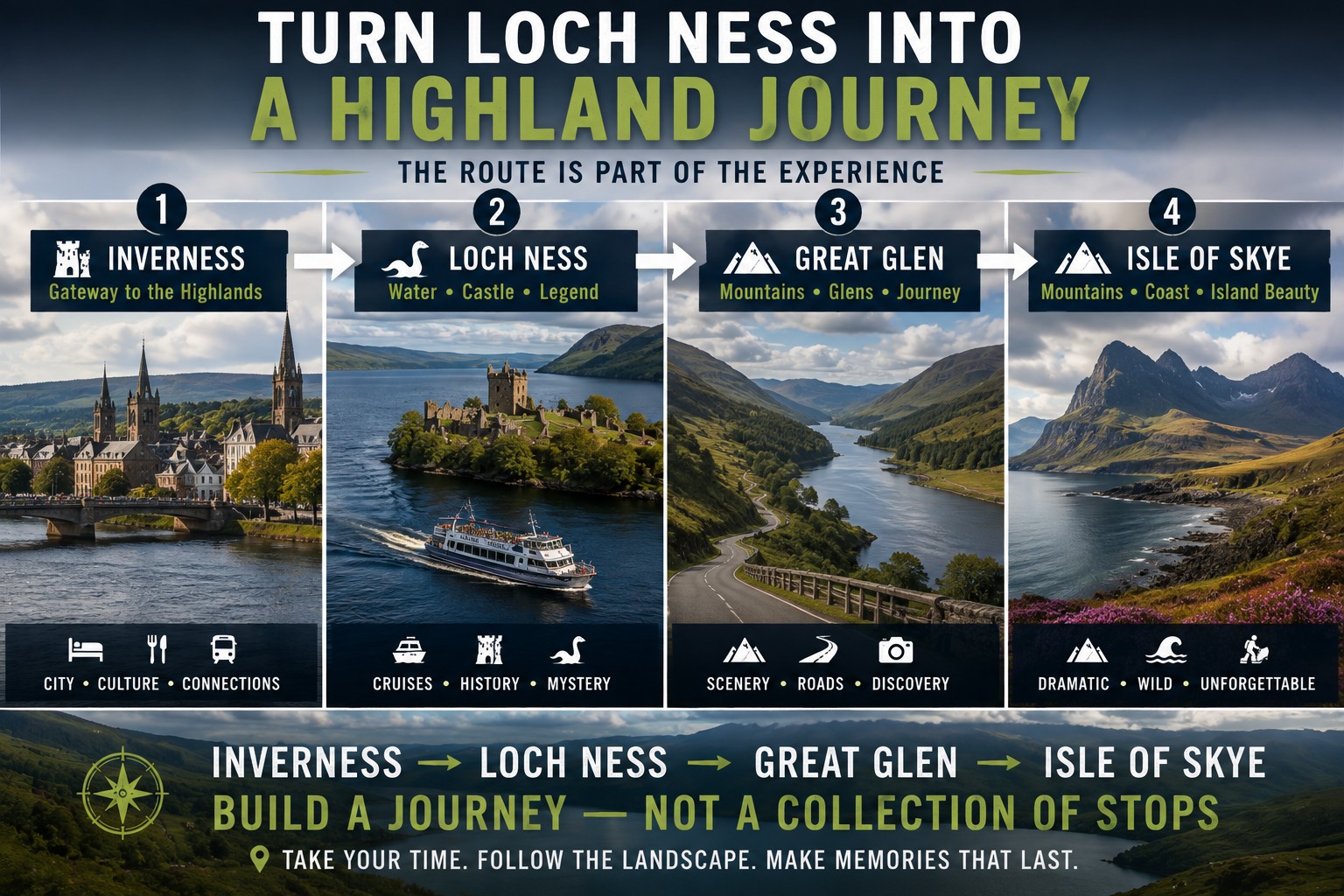
Turn Loch Ness into a wider Highland journey, travelling from Inverness through the loch and Great Glen before continuing west towards the dramatic landscapes of Skye
Scottish Highlands
Isle of Skye
London
Want inland and island landscapes? Loch Ness + Isle of Skye
First broader Scotland journey? Edinburgh + Inverness + Loch Ness
Starting in London? Build a genuine multi-day Scotland journey
📅 What’s Happening During Your Highland Journey?
A Loch Ness visit is often planned around landscapes and historic places, but Scotland’s events calendar can add another dimension to the journey. Highland Games, traditional music, cultural events, seasonal celebrations and community gatherings take place across the country throughout the year.
This becomes particularly relevant when Loch Ness forms part of a longer journey through Inverness and the Highlands. An event elsewhere on your route may be worth incorporating into the itinerary and could influence where you stay, how long you spend in an area or which direction you travel.
Major events can also increase demand for accommodation and transport. Checking what is happening before finalising your route therefore serves two purposes: it can reveal experiences you might otherwise miss and help you anticipate dates when advance planning becomes especially important.
Highland Games and traditional gatherings can bring music, competition and local culture into a journey that might otherwise focus primarily on landscapes and historic sites.
Major Scottish festivals and seasonal celebrations may be worth incorporating when your route also includes Edinburgh, Inverness or other destinations beyond Loch Ness.
Check what is happening before finalising accommodation and transport. A well-timed event can enrich the journey, while major gatherings can also affect availability and how you organise the day.
🌱 Exploring Loch Ness Responsibly
The landscapes around Loch Ness can feel vast, but visitors are travelling through living Highland communities as well as natural environments. Responsible travel here therefore means considering roads, parking, paths, waterways, wildlife and the people who live and work around the loch.
Use designated parking and avoid blocking entrances or creating informal stopping places simply because a view looks appealing. Follow local access guidance, respect private property and use appropriate paths where repeated footfall could otherwise contribute to erosion or damage vegetation.
The same principle applies around the water. Wildlife should be observed without disturbance, and litter should always leave with you.
There is also a human dimension to sustainable Highland travel. Using local accommodation, cafés, shops and visitor businesses can help tourism contribute more directly to the communities through which you travel. Slowing the journey can help too: an overnight stay around Loch Ness or Inverness may reduce the pressure to race between distant attractions while creating more opportunities to spend locally.
Where practical, rail, coach, organised touring and shared transport can form part of a lower-impact Scotland itinerary, particularly when Loch Ness is incorporated into a longer journey rather than approached as an isolated car trip.
Responsible travel around Loch Ness is as much about respecting Highland communities and access as reducing environmental impact.
Rail, shared transport, organised touring and carefully planned multi-stop journeys can reduce unnecessary mileage while still allowing you to experience more of Scotland.
Use established paths where appropriate, take litter away with you and treat shorelines, historic sites and fragile Highland environments as places to experience rather than simply consume.
Local accommodation, food, attractions and independent businesses can help ensure that visitor spending contributes directly to the communities through which you travel.
Giving destinations more time can reduce rushed journeys, improve the visitor experience and encourage deeper engagement with the landscape instead of treating Scotland as a sequence of brief stops.
🏴 Planning specifically for Scotland?
For more detailed guidance on responsible touring, rail journeys and lower-impact travel choices across the country,
explore Sustainable Travel in Scotland.
❓ Loch Ness Travel Guide FAQs
🐉 Is the Loch Ness Monster Real?
There is no conclusive scientific evidence demonstrating that a large unknown monster lives in Loch Ness. Decades of searches, photographs, sonar investigations and more recent scientific research have not established proof of such a creature.
That does not make Nessie irrelevant. The Loch Ness Monster remains one of Scotland’s most enduring modern legends, shaped by reported sightings, folklore, media attention and popular culture. For many visitors, enjoying that mystery is part of experiencing Loch Ness—you do not need to believe in the monster to appreciate the story.
🚢 Is a Loch Ness Cruise Worth Doing?
For many first-time visitors, yes. A cruise provides a perspective that cannot be gained entirely from the road or shoreline, helping you appreciate the length, scale and surrounding Highland landscape of Loch Ness.
It is particularly worthwhile when combined with time ashore. If your itinerary allows, experiencing the loch from the water and then exploring a historic site such as Urquhart Castle creates a stronger introduction than relying on either experience alone.
🏰 Can You Visit Urquhart Castle and Cruise Loch Ness on the Same Day?
Yes. For many visitors, this is one of the strongest ways to structure a day at Loch Ness.
The cruise provides the water-level perspective, while Urquhart Castle adds history and direct exploration on land. Some visitor itineraries may make it possible to combine the two particularly efficiently, but current cruise schedules, castle opening arrangements and any relevant booking requirements should always be checked for your travel date.
⏳ How Long Do You Need at Loch Ness?
A half day is enough for one principal experience, such as a cruise or Urquhart Castle, but it leaves relatively little room for broader exploration.
For most first-time visitors who want to experience Loch Ness properly, a full day is the stronger choice. Staying overnight becomes worthwhile when you want a slower pace, greater flexibility or when Loch Ness forms part of a longer Great Glen and Highland journey.
🏙️ Is Inverness the Best Place to Stay for Loch Ness?
Inverness is often the most practical base, particularly if you value transport connections, restaurants, a wider choice of accommodation and the ability to explore other parts of the Highlands.
It is not automatically the best choice for everyone. Drumnadrochit places you closer to Urquhart Castle and western Loch Ness, while Fort Augustus offers a smaller Highland setting beside the southern end of the loch and the Caledonian Canal.
Choose your base according to the wider journey you are planning, not simply the distance from Loch Ness.
🚗 Do You Need a Car to Visit Loch Ness?
No. A car provides valuable flexibility, especially if you want to explore several areas around Loch Ness or continue through the Great Glen, but it is not essential.
Visitors without a car can use Inverness as a practical gateway and combine available public transport with organised excursions or cruises. If travelling independently, always check current transport arrangements before departure because frequency and seasonal services can affect what is realistically achievable in a day.
🚌 Can You Visit Loch Ness from Inverness Without a Car?
Yes. Inverness is one of the most practical starting points for a car-free Loch Ness visit.
Depending on the experience you want, organised tours, public transport and cruise-related options can provide alternatives to driving. The main consideration is flexibility: independent public transport requires greater attention to schedules, while an organised experience can simplify the journey when you want to combine several highlights within limited time.
🏝️ Can You Combine Loch Ness and the Isle of Skye?
Yes, and the two destinations complement each other particularly well within a wider Highland itinerary.
Loch Ness introduces the Great Glen, inland waterways, castles, Highland history and the enduring mystery of Nessie. The Isle of Skye offers a different landscape of mountains, dramatic coastlines and island scenery. Together, they can reveal two distinct sides of the Scottish Highlands.
The important consideration is time. Trying to reduce both destinations to a rapid sequence of famous viewpoints can turn an exceptional Highland journey into a long day dominated by driving. If both Loch Ness and Skye are priorities, allow enough time for the route between them to become part of the experience rather than something to be rushed through.
🌦️ What Is the Best Month to Visit Loch Ness?
There is no single best month for every visitor.
Late spring and summer provide long daylight hours and greater flexibility for sightseeing. Autumn can bring striking colours and atmospheric Highland landscapes, while winter offers a quieter experience but considerably less daylight and potentially fewer seasonal visitor services.
The better question is therefore what kind of Loch Ness experience you want. Choose the season that best matches your priorities, then prepare for changeable Highland weather regardless of the month.
👨👩👧 Is Loch Ness Good for Families?
Yes. Loch Ness can work particularly well for families because the destination combines several very different experiences: boats, castles, Highland scenery and, of course, the possibility of Nessie.
The key is pace. A day containing a cruise, time exploring a castle and opportunities to enjoy the landscape will often work better than an itinerary dominated by repeated long drives and brief photo stops.
The legend can provide the initial excitement for younger visitors, but Loch Ness has enough variety to make the wider destination interesting even after the monster hunt is over.
🌄 Come for the Legend. Discover the Highlands.
For generations of travellers, the name Loch Ness has created an immediate image: dark Highland water and the possibility that somewhere beneath the surface, Nessie might still be hiding.
That mystery remains part of the pleasure of visiting. But one of the greatest surprises of Loch Ness is how quickly the monster becomes only one part of the story.
From the water, the scale of the loch becomes apparent. At Urquhart Castle, the landscape becomes entwined with centuries of Highland history. In Fort Augustus, the Caledonian Canal reveals how Loch Ness belongs to the wider Great Glen. Inverness, meanwhile, opens the route towards an even broader exploration of northern Scotland.
That is the difference between seeing Loch Ness and experiencing Loch Ness.
Allow enough time, choose the right base and resist the temptation to treat the loch as a single roadside viewpoint. Whether you arrive for a cruise, a castle, a family adventure, Highland scenery or simply the possibility of spotting something unexplained on the water, look beyond the attraction that first brought you here.
Come for the legend. Look beyond it, and Loch Ness becomes one of the great landscapes of the Scottish Highlands.
📚 Continue Your Scotland Journey
Loch Ness makes most sense when it is placed within the wider geography of Scotland. Continue your planning through the Highlands, west towards the islands or deeper into the legends that have shaped how travellers imagine these landscapes.