


Stonehenge Inner Circle Availability Patterns: What We’ve Learned So Far (2026 Guide)
22nd July 2026
🗿 Stonehenge Inner Circle Availability Patterns: What We’ve Learned So Far (2026 Guide)

Understanding recurring availability patterns can help you make more informed planning decisions. Rather than trying to predict individual dates, experienced travellers look for wider seasonal trends and remain flexible where possible
If you’ve checked the Stonehenge Inner Circle calendar more than once and wondered why availability seems to change so unpredictably, you’re certainly not alone.
One week your preferred sunrise visit appears to be available. A few days later it has disappeared. Another date unexpectedly opens up, while a different month seems to fill much faster than you expected. It’s easy to conclude that availability is simply random.
In reality, it rarely is.
Although nobody can accurately predict which individual dates will be available in the future, the way availability behaves often follows recognisable patterns. Visitor demand rises and falls throughout the year, different types of travellers book in different ways, and seasonal tourism creates rhythms that repeat remarkably consistently.
Understanding those patterns won’t guarantee your ideal date.
It will, however, help you make better planning decisions, avoid common mistakes and approach your visit with realistic expectations rather than unnecessary frustration.
Rather than trying to predict the future, this guide looks at something far more valuable—what we’ve learned by observing how Stonehenge Inner Circle availability has behaved throughout the 2026 booking season.
Instead of relying on assumptions, we’ll examine recurring trends, explain why they happen and, most importantly, show how you can use those observations to improve your own planning.
Throughout this guide we’ll use a simple planning framework that reflects how experienced travellers naturally approach Stonehenge Inner Circle access:
🔍 Observe → 💭 Interpret → 🧭 Plan
First, recognise the patterns.
Next, understand what those patterns actually mean.
Finally, use that knowledge to make more confident travel decisions.
It’s a straightforward approach, but one that can completely change the way you plan your Stonehenge experience.
🌟 Quick Answer
Stonehenge Inner Circle availability isn’t random—but it isn’t predictable either.
Throughout the 2026 booking season we’ve consistently observed recurring patterns influenced by seasonal tourism, weekends, holidays and visitor behaviour. Travellers who understand these patterns, plan early and remain reasonably flexible generally enjoy more options than those relying on a single preferred date.
The calendar doesn’t reward luck nearly as often as it rewards good planning.
🤔 Why Availability Often Feels Random
Almost everyone planning a Stonehenge Inner Circle visit experiences the same moment.
You open the calendar.
You find what looks like the perfect date.
You return a few days later—and everything has changed.
It’s understandable why many visitors conclude that availability behaves unpredictably.
The reality is rather different.
What often appears to be random is actually the result of several predictable influences interacting at the same time.
Some are driven by visitors.
Others are driven by how a limited-capacity visitor experience naturally operates.
Understanding the difference between those two influences is one of the biggest steps towards planning more confidently.
👥 Behavioural Patterns
These are the choices made by visitors themselves.
People naturally prefer:
- school holidays
- bank holidays
- weekends
- warmer weather
- longer daylight hours
- dates that fit wider UK holidays
- sunrise or sunset depending on personal interests
When thousands of people independently make similar decisions, recognisable demand patterns begin to emerge.
⚙️ Operational Patterns
Alongside visitor behaviour, availability also reflects normal operational management.
Stonehenge Inner Circle access remains intentionally limited.
Schedules evolve.
Visitor allocations change.
Occasionally availability may increase or decrease as planning develops.
None of this should be viewed as unusual—it is simply how a carefully managed heritage experience operates throughout the year.
The important point is that these operational changes do not make the calendar random.
They simply add another layer of movement to an already dynamic booking environment.
Understanding both influences gives a much clearer picture of why availability changes throughout the year.
🔍 Observation
Availability changes continually.
💭 Interpretation
Most changes are driven by recurring visitor behaviour together with the practical management of a limited-capacity experience.
🧭 What This Means for You
Rather than trying to predict one perfect date, focus on recognising broader patterns and planning accordingly.
🔬 How We’ve Reached These Observations
One of the biggest responsibilities when writing about Stonehenge Inner Circle access is recognising the difference between observation and prediction.
No independent guide can truthfully promise which future dates will remain available.
Nor should it.
Availability is ultimately determined by operational decisions, visitor demand and factors that naturally evolve throughout every booking season.
Instead of attempting to predict future availability, this guide has taken a different approach.
It analyses what has already happened.
Throughout the 2026 season we have carefully monitored:
- changes across the availability calendar
- seasonal booking behaviour
- sunrise versus sunset demand
- visitor planning trends
- recurring travel questions
- the relationship between tourism seasons and booking interest
Viewed individually, none of these observations tells the complete story.
Viewed together, however, they reveal remarkably consistent patterns.
Some periods repeatedly attract stronger demand.
Certain visitor behaviours occur again and again.
Planning flexibility consistently increases opportunity.
Waiting for a single “perfect” date often reduces choice.
These are not predictions.
They are recurring observations.
That distinction matters because good planning should always be based on evidence rather than assumptions.
Instead of asking:
“What will happen next month?”
A better question is:
“What does the evidence suggest usually happens under similar circumstances?”
That mindset transforms travel planning from guesswork into informed decision-making.
📅 Pattern One: Seasonal Demand Follows a Predictable Rhythm
Perhaps the clearest observation throughout the booking season is that visitor demand doesn’t remain constant.
Instead, it follows a rhythm that broadly reflects how people naturally travel.
As spring approaches, confidence grows.
Warmer weather encourages day trips.
International tourism begins increasing.
Families start planning school holiday travel.
Photographers anticipate changing seasonal light.
By early summer these individual decisions combine to create noticeably stronger demand.
This isn’t because Stonehenge suddenly becomes more attractive.
It is because millions of people naturally begin travelling at the same time.
As summer progresses, those influences strengthen further.
Longer daylight hours, overseas visitors, family holidays and Britain’s wider tourism season combine to create one of the busiest periods for many attractions—including Stonehenge.
Autumn then introduces a different rhythm.
Visitor numbers often become more evenly distributed.
Many experienced travellers deliberately choose this period because it combines comfortable weather with a calmer atmosphere.
Winter brings another change altogether.
Although visitor numbers often reduce compared with summer, festive travel, shorter days and changing tourism patterns continue to influence availability in different ways.
The important lesson isn’t that one season is always better than another.
It’s that every season creates its own characteristic pattern of demand.
Recognising that rhythm makes availability appear considerably less mysterious.
✈️ Planning Scenario
Imagine two visitors.
A family restricted to school holidays may naturally find fewer options because demand is concentrated during those periods.
A retired couple visiting in late September, however, might enjoy greater flexibility while experiencing equally memorable conditions.
Neither approach is right or wrong.
They simply interact differently with seasonal demand.
🔍 Observation
Demand gradually builds, peaks and eases throughout the travel year.
💭 Interpretation
The calendar reflects wider tourism behaviour rather than isolated booking events.
🧭 What This Means for You
Choose the season that best matches your priorities—but understand how that season is likely to influence demand before finalising your plans.
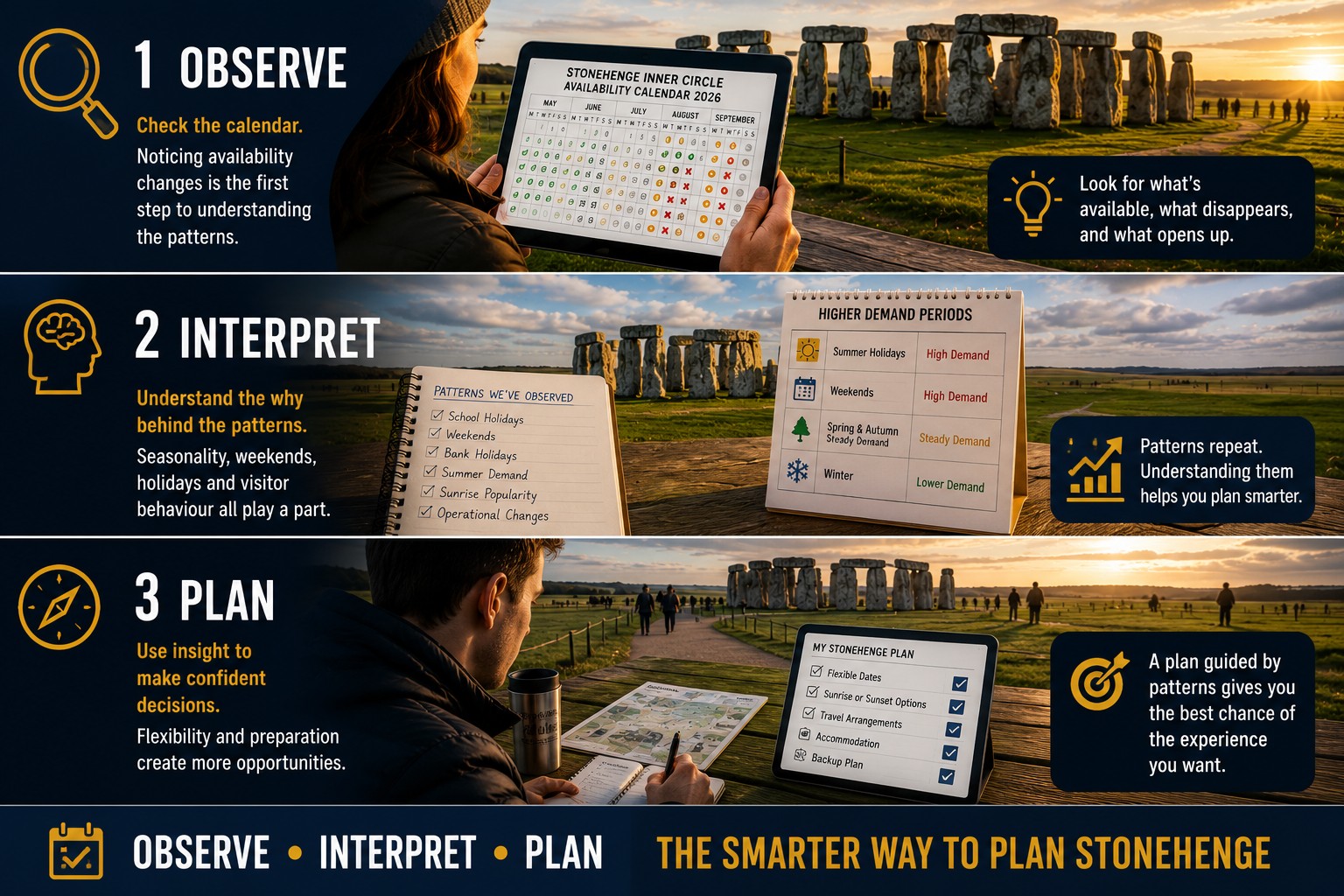
Successful Stonehenge Inner Circle planning begins by recognising availability patterns, understanding why they occur, and using those insights to make confident travel decisions rather than relying on guesswork
🌸 Why Spring Marks the Beginning of Increased Demand
As winter gradually gives way to spring, Stonehenge enters one of the most significant phases of the visitor calendar.
Longer days, improving weather and the arrival of the main tourism season encourage people to start planning outdoor experiences once again. Domestic travellers begin organising weekend breaks, while overseas visitors often finalise UK itineraries months before they travel.
Although summer is commonly viewed as the busiest season, the foundations for that demand are often laid much earlier.
Planning activity increases steadily during spring, meaning that popular dates can attract interest well before the traditional peak holiday period begins.
This is an important observation because many visitors mistakenly assume that they only need to think ahead once summer arrives.
In reality, experienced travellers frequently begin making decisions long before then.
The calendar often reflects this gradual build-up rather than a sudden surge.
🔍 Observation
Interest starts increasing well before the busiest months actually arrive.
💭 Interpretation
Traveller confidence grows alongside improving weather, longer daylight hours and the beginning of the wider tourism season.
🧭 What This Means for You
If you’re hoping to visit during late spring or early summer, don’t assume that planning can wait until the weather improves. Starting your research earlier often provides greater choice and reduces unnecessary pressure.
☀️ Why Summer Naturally Creates the Greatest Competition
Summer consistently attracts the broadest range of visitors.
Families travel during school holidays.
International tourism reaches one of its highest points of the year.
Long daylight hours encourage sightseeing, while many visitors are making once-in-a-lifetime trips around Britain that naturally include Stonehenge.
These individual decisions combine to produce one of the strongest periods of demand.
Importantly, this doesn’t mean that every summer date immediately becomes difficult to secure.
Demand isn’t evenly distributed.
Some weekdays may remain available longer than expected, while weekends and dates that align with wider travel itineraries often attract stronger interest.
This illustrates an important principle.
Availability is influenced by concentrated demand, not simply by the time of year.
Understanding that distinction helps explain why some summer dates behave very differently from others.
📸 Planning Scenario
Imagine two visitors arriving in July.
The first can only travel on a Saturday because of family commitments.
The second is happy to visit on either a Tuesday or Wednesday.
Although both are travelling during the same month, their experience of availability may be completely different simply because one has greater flexibility within the same season.
🔍 Observation
Summer usually experiences the highest concentration of visitor demand.
💭 Interpretation
Long holidays, international tourism and favourable weather encourage many travellers to plan similar trips at the same time.
🧭 What This Means for You
If summer is your preferred season, begin planning early and, where possible, remain flexible about individual dates rather than focusing on a single ideal option.
🍂 Autumn Often Offers One of the Best Balances
Autumn is frequently overlooked, yet many experienced visitors regard it as one of the most rewarding times to experience Stonehenge.
As the busiest holiday period begins to ease, the atmosphere often becomes calmer while temperatures remain comfortable for exploring. The changing light across Salisbury Plain also creates a distinctive setting that many photographers particularly appreciate.
From a planning perspective, autumn often provides an attractive balance.
Demand remains healthy, especially around weekends and school breaks, but there is often a wider spread of opportunities compared with the busiest weeks of summer.
This doesn’t mean autumn is always quieter.
Rather, it demonstrates that visitor demand becomes more evenly distributed once the peak tourism season begins to subside.
For many travellers, that combination of comfortable conditions, excellent photography opportunities and slightly greater flexibility makes autumn an especially appealing choice.
👥 Planning Scenario
A retired couple visiting in October may enjoy a peaceful experience without needing to compete with the intense holiday demand often associated with midsummer.
Meanwhile, a keen landscape photographer might deliberately choose autumn for its softer light and seasonal colours rather than simply focusing on availability.
Different priorities naturally lead to different planning decisions.
🔍 Observation
Autumn frequently combines favourable visiting conditions with more evenly distributed demand.
💭 Interpretation
As peak summer tourism eases, visitor behaviour becomes less concentrated while the quality of the experience often remains exceptionally high.
🧭 What This Means for You
Don’t overlook autumn simply because it falls outside the traditional peak season. It may offer exactly the balance of atmosphere, flexibility and visitor experience you’re looking for.
🌅 Pattern Two: Sunrise and Sunset Appeal to Different Types of Visitors
One of the most interesting observations throughout the 2026 season has been the way sunrise and sunset experiences attract different audiences.
Many first-time visitors assume one must always be more popular than the other.
The evidence suggests something more interesting.
Rather than competing directly, sunrise and sunset often appeal to visitors with different motivations.
Some travellers dream of witnessing the first rays of sunlight gradually illuminate the ancient stones—an unforgettable experience that has inspired photographers and historians alike.
Others are drawn to the softer colours, calmer atmosphere and dramatic silhouettes created as daylight fades across Salisbury Plain.
Neither choice is inherently better.
They’re simply different experiences.
This distinction is important because demand is often shaped more by visitor preference than by one experience consistently being easier to secure.
| 🌅 Sunrise Experience | 🌇 Sunset Experience |
|---|---|
| Appeals strongly to early risers and landscape photographers | Popular with visitors seeking a more relaxed evening experience |
| Often chosen by returning enthusiasts | Frequently selected by first-time visitors |
| Requires an earlier start to the day | Integrates more easily into many travel itineraries |
| Offers dramatic dawn light and changing colours | Creates striking silhouettes and warm evening tones |
| Planning priority: commit early if sunrise is your goal | Planning priority: remain flexible with dates if possible |
The lesson isn’t to choose whichever appears easier.
It’s to choose the experience that genuinely matches your own interests.
Visitors who plan around the experience they actually want almost always leave more satisfied than those trying to second-guess demand.
🔍 Observation
Sunrise and sunset attract different audiences rather than one consistently replacing the other.
💭 Interpretation
Personal priorities—including photography, travel schedules and the type of experience visitors hope to enjoy—play a major role in shaping demand.
🧭 What This Means for You
Decide whether sunrise or sunset best suits your visit first. Then begin comparing dates, rather than allowing assumptions about availability to dictate the experience you ultimately choose.
🔄 Transition
Understanding seasonal demand explains when visitor interest tends to increase.
The next pattern explores something equally important—how individual planning decisions can dramatically influence the opportunities available to you.
🤸 Pattern Three: Flexibility Consistently Creates More Opportunities
If one lesson has emerged more clearly than almost any other throughout the 2026 booking season, it is this:
Flexibility is one of the biggest advantages any visitor can have.
Many people understandably begin planning with a single ideal outcome in mind.
Perhaps it’s a particular sunrise in June.
A Saturday visit during a family holiday.
Or one carefully chosen date that fits perfectly into a wider UK itinerary.
Having an ideal plan is sensible.
The challenge comes when that ideal becomes the only acceptable option.
Stonehenge Inner Circle access is intentionally limited. When thousands of visitors are hoping for the same handful of dates, concentrating your entire trip around one specific opportunity naturally reduces your chances of success.
By contrast, visitors who approach the calendar with several acceptable possibilities often enjoy a far smoother planning experience.
This doesn’t mean lowering your expectations.
It means increasing your opportunities.
A willingness to consider a weekday instead of a weekend, sunrise instead of sunset—or even travelling a week earlier or later—can dramatically expand the number of viable options without reducing the quality of the overall experience.
Ironically, many experienced visitors don’t set out to find the “perfect” date.
Instead, they focus on securing the best available experience for their circumstances.
That subtle change in mindset often produces better results than waiting indefinitely for one ideal opportunity.
📊 Flexibility Exists on a Spectrum
Not everyone has complete freedom to alter travel plans.
Fortunately, flexibility isn’t an all-or-nothing concept.
Even relatively small adjustments can make a meaningful difference.
| Level of Flexibility | Typical Example | Potential Benefit |
|---|---|---|
| 🟢 High | Open to several months, weekdays and either sunrise or sunset | Maximum choice and planning opportunities |
| 🟡 Moderate | Fixed month but flexible within that period | Good balance between convenience and availability |
| 🔴 Limited | One specific date or weekend only | Fewer options, making early planning especially important |
Most visitors fall somewhere in the middle.
The key is recognising where your own flexibility exists and using it wisely.
🌍 Planning Scenario
Imagine an overseas visitor travelling from Australia.
Their flights and accommodation may already be fixed, leaving little flexibility around travel dates.
However, they may still be able to choose between sunrise and sunset, or adjust the order of attractions within their itinerary.
Those relatively small decisions can still create additional opportunities.
Now compare that with a local visitor planning a weekend away.
Their travel distance is shorter, making it easier to choose a different weekend or even a weekday visit.
Neither traveller has complete freedom.
But both can improve their chances by recognising where flexibility already exists.
🔍 Observation
Visitors with multiple acceptable options consistently experience a smoother planning process.
💭 Interpretation
Flexibility reduces dependence on any single date, allowing you to respond more confidently as availability evolves.
🧭 What This Means for You
Don’t ask yourself, “What’s my only possible date?”
Instead ask:
“What are my three best options?”
That one question often transforms the entire planning process.
🔄 Pattern Four: Availability Evolves Rather Than Changing Randomly
One of the most common misconceptions surrounding Stonehenge Inner Circle access is that availability changes without any logic.
After observing the calendar throughout the year, that isn’t the conclusion we’ve reached.
A better description is that availability evolves.
👥 Behavioural Evolution
Visitor behaviour changes naturally throughout the year.
School holidays begin.
International tourism increases.
Photography seasons change.
People book around work commitments, public holidays and family travel.
These recurring behaviours steadily influence demand.
⚙️ Operational Evolution
Alongside visitor behaviour, availability also changes because the calendar itself is dynamic.
Schedules are managed.
Visitor allocations develop.
Operational adjustments may occasionally occur as the season progresses.
Importantly, these changes should not be interpreted as unusual or unexpected.
They’re a normal feature of managing a carefully controlled visitor experience.
When behavioural and operational influences combine, availability appears to shift continually.
From a distance, those movements may look random.
Viewed more closely, they usually reflect understandable processes unfolding over time.
This distinction matters because it encourages much better planning.
Visitors who assume everything is random often postpone decisions, hoping conditions will somehow improve dramatically.
Those who recognise that availability evolves tend to make informed choices while suitable opportunities still exist.
Good planning isn’t about predicting tomorrow’s calendar.
It’s about understanding the direction in which availability is naturally moving.
⚠️ A Common Mistake
One of the biggest planning mistakes is assuming that unavailable dates will inevitably become available again if you simply wait long enough.
While availability can occasionally change, successful planning is generally based on responding to the opportunities that exist—not postponing decisions in the hope that a preferred option will reappear.
🔍 Observation
Availability changes continuously throughout the booking season.
💭 Interpretation
Those changes usually reflect evolving visitor demand together with the practical operation of a limited-capacity experience.
🧭 What This Means for You
View the calendar as a living planning tool rather than something that should remain static. Monitor it sensibly, make informed decisions and avoid relying on speculation.
🧠 Pattern Five: The Most Successful Visitors Share Similar Planning Habits
Perhaps the most encouraging observation isn’t about the calendar itself.
It’s about the people who consistently enjoy successful planning experiences.
Throughout the season we’ve noticed that visitors who secure satisfying Inner Circle visits rarely rely on luck.
Instead, they tend to follow remarkably similar habits.
They understand what matters most to them before checking availability.
They identify several suitable options instead of one.
They appreciate how demand behaves throughout the year.
Most importantly, they make confident decisions when appropriate opportunities appear.
Interestingly, they don’t usually spend weeks searching for a mythical “perfect” date.
They recognise that Stonehenge offers extraordinary experiences across many different seasons and that flexibility often leads to unexpectedly rewarding visits.
That mindset reduces stress while improving decision-making.
It’s also a useful reminder that successful travel planning isn’t about removing every uncertainty.
It’s about making good decisions despite uncertainty.
👨👩👧 Planning Scenario
Consider two visitors.
The first checks the calendar repeatedly for one specific Saturday in August.
The second identifies six possible dates spread across late August and early September.
Both begin with the same goal.
The second traveller simply gives themselves far more opportunities to achieve it.
🔍 Observation
Successful visitors display remarkably similar planning behaviours.
💭 Interpretation
Preparation, realistic expectations and sensible flexibility consistently outperform guesswork.
🧭 What This Means for You
Treat availability planning as a decision-making exercise rather than a search for certainty. The more informed your approach, the more confident your final choice is likely to be.
📋 What These Patterns Mean for Your Own Planning
Taken individually, each observation provides useful insight.
Taken together, they create a practical framework for making better decisions.
Rather than focusing on every individual date, begin by asking yourself:
- Which season genuinely suits my trip?
- Would I be equally happy with sunrise or sunset?
- Where do I have flexibility?
- Am I planning early enough?
- What matters most about this experience?
Answering these questions usually proves far more valuable than repeatedly searching for one elusive “perfect” date.
Good planning isn’t about controlling every outcome.
It’s about putting yourself in the strongest possible position before making your decision.
📊 Availability Patterns at a Glance
By stepping back and looking at the booking season as a whole, several recurring themes become clear. While no guide can promise future availability, recognising these broad patterns allows visitors to plan with greater confidence instead of relying on guesswork.
| Availability Pattern | Why It Happens | What We’ve Learned | What You Should Do |
|---|---|---|---|
| 📅 Seasonal demand follows a recognisable rhythm | Tourism naturally increases and decreases throughout the year | Spring builds momentum, summer concentrates demand, autumn often offers greater balance | Match your preferred season with realistic expectations |
| 🌅 Sunrise and sunset attract different visitors | Personal priorities shape demand differently | Neither experience is consistently “easier” to secure | Choose the experience you genuinely want before comparing dates |
| 👨👩👧 Weekends and holidays attract stronger demand | Work patterns, school breaks and public holidays influence travel | Convenience often drives booking behaviour | Consider weekday visits where practical |
| 🤸 Flexibility creates more opportunities | More acceptable options reduce dependence on one date | Small adjustments can significantly increase choice | Keep alternative dates or visit times in mind |
| 🔄 Availability evolves continuously | Visitor behaviour and operational management both influence the calendar | Change is normal rather than unusual | Review the calendar sensibly and make informed decisions |
| 🧠 Successful visitors plan differently | Preparation consistently outperforms guesswork | Early research and realistic expectations improve outcomes | Focus on informed planning rather than chasing perfection |
Rather than trying to predict individual dates, use these patterns as a framework for making better travel decisions.
💡 The Biggest Lesson We’ve Learned
If we had to summarise everything we’ve observed throughout the 2026 booking season in one sentence, it would be this:
Stonehenge Inner Circle availability rewards informed planning far more often than good fortune.
Many visitors begin their research hoping to uncover a hidden secret. Perhaps there’s a particular month that’s always easier. Maybe sunrise is consistently less popular. Or perhaps waiting a little longer will eventually reveal the perfect opportunity. After following the availability calendar throughout the season, we haven’t found evidence to support those assumptions. Instead, we’ve found something considerably more valuable.
We’ve found patterns.
Patterns in how people travel. Patterns in how demand develops. Patterns in how flexibility creates opportunity. Patterns in how confident planning almost always produces better outcomes than last-minute decision-making. The important point is that these patterns don’t remove uncertainty. Rather, they help you understand it.
Instead of asking:
“Will my perfect date definitely become available?”
A far more useful question is:
“How can I put myself in the strongest possible position to enjoy an unforgettable Stonehenge experience?”
That subtle shift changes everything. Planning becomes calmer. Decisions become easier. Expectations become more realistic. And the overall experience becomes significantly more enjoyable.
Knowledge doesn’t eliminate uncertainty.
It replaces unnecessary uncertainty with informed confidence.
🧭 The Observe → Interpret → Plan Framework
Throughout this guide we’ve used a simple three-stage approach.
It is equally useful when you’re ready to plan your own visit.
🔍 Observe
Look beyond individual dates.
Identify the wider patterns developing throughout the travel season.
💭 Interpret
Ask why those patterns exist.
Consider visitor behaviour, holidays, tourism trends and your own priorities.
🧭 Plan
Use that understanding to choose the experience that best matches your circumstances instead of chasing one specific date.
This simple framework encourages thoughtful planning rather than reactive decision-making—and that’s exactly how experienced travellers tend to approach Stonehenge Inner Circle access.
🌿 Sustainable Planning Benefits Everyone
Careful planning doesn’t just improve your own visit.
It also contributes to more sustainable tourism.
Visitors who understand how availability typically behaves are less likely to make unnecessary last-minute itinerary changes, duplicate journeys or rearrange entire holidays because of unrealistic expectations.
Planning ahead encourages more efficient travel, better use of accommodation, reduced unnecessary transport and a more balanced distribution of visitors throughout the year.
It also highlights an important truth.
Outstanding Stonehenge experiences aren’t limited to a handful of dates.
Every season offers something distinctive, whether that’s spring’s sense of renewal, summer’s long daylight hours, autumn’s rich colours or winter’s unique atmosphere.
By approaching your visit thoughtfully, remaining flexible where practical and making informed decisions based on evidence rather than assumption, you’ll not only improve your own experience—you’ll also support a more sustainable future for one of Britain’s most treasured prehistoric landscapes.
Thoughtful Planning Supports More Sustainable Travel
One of the simplest ways to travel more sustainably begins long before you arrive at Stonehenge. Taking time to understand seasonal demand, considering flexible travel options where practical and planning your visit carefully can help reduce unnecessary journeys, minimise last-minute itinerary changes and support a smoother visitor experience throughout the year.
Responsible travel isn’t about avoiding popular places—it’s about making informed decisions that benefit both visitors and the destinations they enjoy. By approaching your Stonehenge visit with realistic expectations and thoughtful planning, you contribute to a more balanced and sustainable future for one of Britain’s most remarkable prehistoric landscapes.
Good planning doesn’t just improve your own experience—it also helps reduce unnecessary travel, supports better visitor management and encourages more responsible tourism throughout the year.
❓ Frequently Asked Questions
❓ Are some months consistently easier to book than others?
Every season follows its own demand pattern, but no month can be described as universally easy or difficult. Spring and summer often attract stronger visitor numbers, while autumn may provide a broader spread of opportunities. Regardless of when you plan to visit, early preparation is always beneficial.
❓ Does availability sometimes return after dates appear to be unavailable?
Availability can evolve throughout the booking season as circumstances change. However, visitors should avoid assuming that unavailable dates will automatically become available again. It is generally wiser to consider suitable alternatives rather than relying on future changes.
❓ Are weekends always the busiest?
Weekends frequently attract greater demand because they are convenient for many travellers. That said, holidays, international tourism and seasonal travel patterns also influence availability, so weekends should be viewed as a general trend rather than an absolute rule.
❓ Should I wait if my preferred date isn’t available?
That depends on how flexible your travel plans are. If alternative dates would provide an equally rewarding experience, remaining open to those options often leads to a smoother planning process than waiting indefinitely for one particular date.
❓ How often should I check the Stonehenge Inner Circle availability calendar?
It’s sensible to review the calendar regularly while planning your trip, particularly if you’re still deciding between several possible dates. Repeatedly checking in the hope of dramatic changes is usually less productive than combining regular reviews with a flexible travel plan.
❓ Will these availability patterns always stay the same?
No.
The observations in this guide are based on recurring trends seen during the 2026 booking season. Visitor behaviour, tourism trends and operational considerations can all evolve over time. These patterns should therefore be viewed as informed planning guidance rather than guarantees of future availability.
🏛️ Conclusion
Stonehenge has inspired curiosity for more than four thousand years.
Today, an Inner Circle visit offers one of the rarest opportunities to experience this extraordinary monument from within the stone circle itself—a privilege that naturally attracts visitors from around the world.
While availability may sometimes appear unpredictable, stepping back reveals something far more reassuring.
It isn’t governed by chance.
It reflects the way people travel.
Seasonal demand, visitor priorities, holidays, photography opportunities and practical planning decisions all combine to create recognisable patterns throughout the year.
Understanding those patterns won’t guarantee your first-choice date.
What it will do is help you make better decisions, avoid common misconceptions and approach your planning with far greater confidence.
Ultimately, the visitors who enjoy the smoothest planning experiences aren’t usually the luckiest.
They’re the ones who take the time to understand how availability behaves, remain flexible where they can and make informed decisions when good opportunities arise.
That approach transforms planning from a frustrating guessing game into an enjoyable part of the journey itself.
And when the day finally comes to step inside the ancient stones, you’ll know your visit wasn’t simply the result of good fortune.