


What to Do Before and After Your Stonehenge Inner Circle Tour (2026 Guide)
24th July 2026
🏛️ What to Do Before and After Your Stonehenge Inner Circle Tour (2026 Guide)

A little preparation before your Stonehenge Inner Circle tour can make the entire experience more relaxed and enjoyable. Confirm your meeting arrangements, dress for the conditions, prepare your camera and allow extra travel time so you can focus on the monument rather than last-minute logistics
A Stonehenge Inner Circle tour is not simply another sightseeing stop. It is a carefully timed visit to one of Britain’s most important prehistoric monuments, often taking place at sunrise or sunset and requiring a little more preparation than an ordinary daytime visit.
Most travellers naturally focus on the moment they will finally stand among the stones. Yet the quality of the day is shaped just as much by what happens before that moment and by how the visit is allowed to unfold afterwards. A rushed departure, an unclear meeting point, unsuitable clothing or an overpacked itinerary can all distract from an experience that deserves your full attention.
The most rewarding approach is simple: arrive ready, remain present and leave the rest of the day unhurried. That means preparing the practical details in advance, giving yourself permission to slow down during the tour and resisting the temptation to rush immediately towards the next attraction.
This guide explains what to do before and after your Stonehenge Inner Circle tour, how to make the most of the time among the stones and how to build a complete day around the visit without making it feel over planned.
💬 What Should You Do Before and After a Stonehenge Inner Circle Tour?
Before your Stonehenge Inner Circle tour, confirm your collection point or local meeting arrangements, check the required arrival time, review the weather, dress in suitable layers, charge your phone or camera and leave a generous travel buffer. Your booking confirmation and the instructions issued by your tour operator should always be treated as the definitive source for timings, permitted items and any session-specific guidance.
During the visit, avoid spending every minute behind a screen. Take the photographs that matter to you, but leave enough time to listen, observe the landscape and appreciate the scale and atmosphere of the stones from close range.
Afterwards, do not feel pressured to move immediately to another fixed activity. A relaxed breakfast after sunrise, dinner after sunset, time in Salisbury or a carefully paced onward journey can help the day feel complete rather than abruptly finished.
🌅 Why the Experience Begins Before You Reach the Stones
The emotional beginning of an Inner Circle visit often arrives before Stonehenge itself comes into view. There is a particular sense of anticipation in knowing that you are about to enter the monument under restricted-access conditions, outside the rhythm of a normal public visit and at a time of day when the landscape may feel very different.
That anticipation deserves space. Whether you are approaching across Salisbury Plain independently, joining a coach departure from London or meeting a guide locally, an unhurried journey helps create the right tone. By contrast, arriving distracted by traffic, uncertain directions or a last-minute search for booking information can make the opening of the visit feel unnecessarily tense.
Good preparation removes that noise. When your clothing is ready, your devices are charged, your meeting point is confirmed and your travel time includes a sensible margin, your attention is free to shift towards the monument itself.
The difference is not merely practical. Visitors who arrive calmly are usually better placed to notice the smaller details that make the day distinctive: the changing light over Wiltshire, the atmosphere within the group and the gradual transition from an ordinary journey to a rare encounter with the stones.
INSERT WHY THIS MATTERS PANEL
🎒 What to Do Before Your Stonehenge Inner Circle Tour
Preparation does not need to be complicated. The aim is not to plan every minute or carry equipment for every possible situation. It is to remove the predictable distractions that could otherwise compete for your attention.
The most important guidance will always come from your own booking confirmation. Inner Circle tours can operate in different ways, including London departures, local meeting points, private arrangements and combination itineraries, so generic advice should never replace the instructions supplied by the operator responsible for your visit.
📍 Confirm Your Meeting Point, Collection Time and Check-In Instructions
Do not assume that the time shown on your booking is the time you should arrive. It may be the departure time, the tour start time or the required meeting time, depending on the arrangement.
Check the exact location the day before, including the entrance, street, hotel lobby or local collection point specified in your confirmation. Keep the operator’s contact details accessible and note any instructions about when you are expected to check in.
This matters because restricted-access visits are carefully timed. If a coach or guide must depart at a fixed time, a late arrival may be difficult or impossible to recover. Leaving a sensible buffer is therefore not just a matter of comfort; it protects the visit you have planned.
For London departures, allow for early-morning transport disruption, roadworks or difficulty locating the correct pickup point. For local arrangements, check parking, access directions and whether you are meeting at Stonehenge itself or elsewhere nearby.
🧥 Dress for the Conditions, Not Just the Forecast
Stonehenge stands within an open and exposed landscape. Even when the forecast looks mild, wind, damp ground and rapidly changing conditions can make sunrise and sunset sessions feel cooler than expected.
Layers are usually the most practical choice because they can be adjusted as the temperature changes. Comfortable closed footwear is also important, particularly after rain or during colder months when the ground may be damp or uneven.
A lightweight waterproof is often more useful than relying on an umbrella, especially in windy conditions or where space within a group is limited. During warmer months, sun protection remains important even for an early or late session, so consider sunscreen, sunglasses and a hat where appropriate.
Clothing should support the visit rather than become part of the problem. If you are cold, wet or uncomfortable, it becomes much harder to concentrate on the atmosphere and interpretation around you.
📷 Prepare Your Phone or Camera in Advance
Sunrise and sunset can produce beautiful light, but they can also present challenging photographic conditions. Preparing your equipment before departure saves valuable time once the session begins.
Charge your devices fully, check that you have enough storage space and carry a compact power bank if it is practical to do so. If you use a dedicated camera, review your low-light settings in advance rather than trying to learn them while standing among the stones.
It is also worth disabling unnecessary sounds and alerts, particularly during quieter moments. Photography should never obstruct another visitor’s view or draw your attention away from instructions given by the guide.
A simple approach works well: take a few photographs early, capture any particular angle or moment that matters to you, then put the device away for part of the session. The technology should support the visit, not dominate it.
🪨 During Your Inner Circle Tour: Make Every Moment Count
Once the session begins, the preparation is finished. This is the point at which practical concerns should fall away and your attention can move fully towards Stonehenge itself.
Inner Circle access is restricted, but it should not be mistaken for a private visit. You may be sharing the experience with other guests, moving within defined areas and following instructions from a guide or site team. Respecting those arrangements helps protect the monument while also ensuring that everyone in the group has the opportunity to enjoy the visit properly.
Begin by listening. Important guidance is often given at the start of the session, and it may cover where you can stand, how the group will move and what conservation rules apply. Avoid rushing immediately towards a particular photographic position before you understand how the visit will unfold.
As you move closer to the stones, take time to notice details that are difficult to appreciate from the standard visitor path. The scale of individual stones, the texture of their surfaces, the gaps between them and the changing relationship between light and shadow can all alter your perception of the monument.
Photography is part of the experience for many visitors, but it should not become the entire experience. Take the images that matter to you, remain aware of other guests and avoid blocking views for longer than necessary. A few well-chosen photographs will usually mean more than dozens taken without looking up.
Most importantly, follow all conservation instructions. Do not touch, lean against or interfere with the stones unless you are explicitly told that a particular action is permitted. Stonehenge is both an ancient monument and a highly sensitive archaeological site, so respectful behaviour is essential.
Inner Circle access rewards attention far more than speed. The more calmly you observe, the more likely you are to notice the qualities that make the visit different from an ordinary daytime stop.
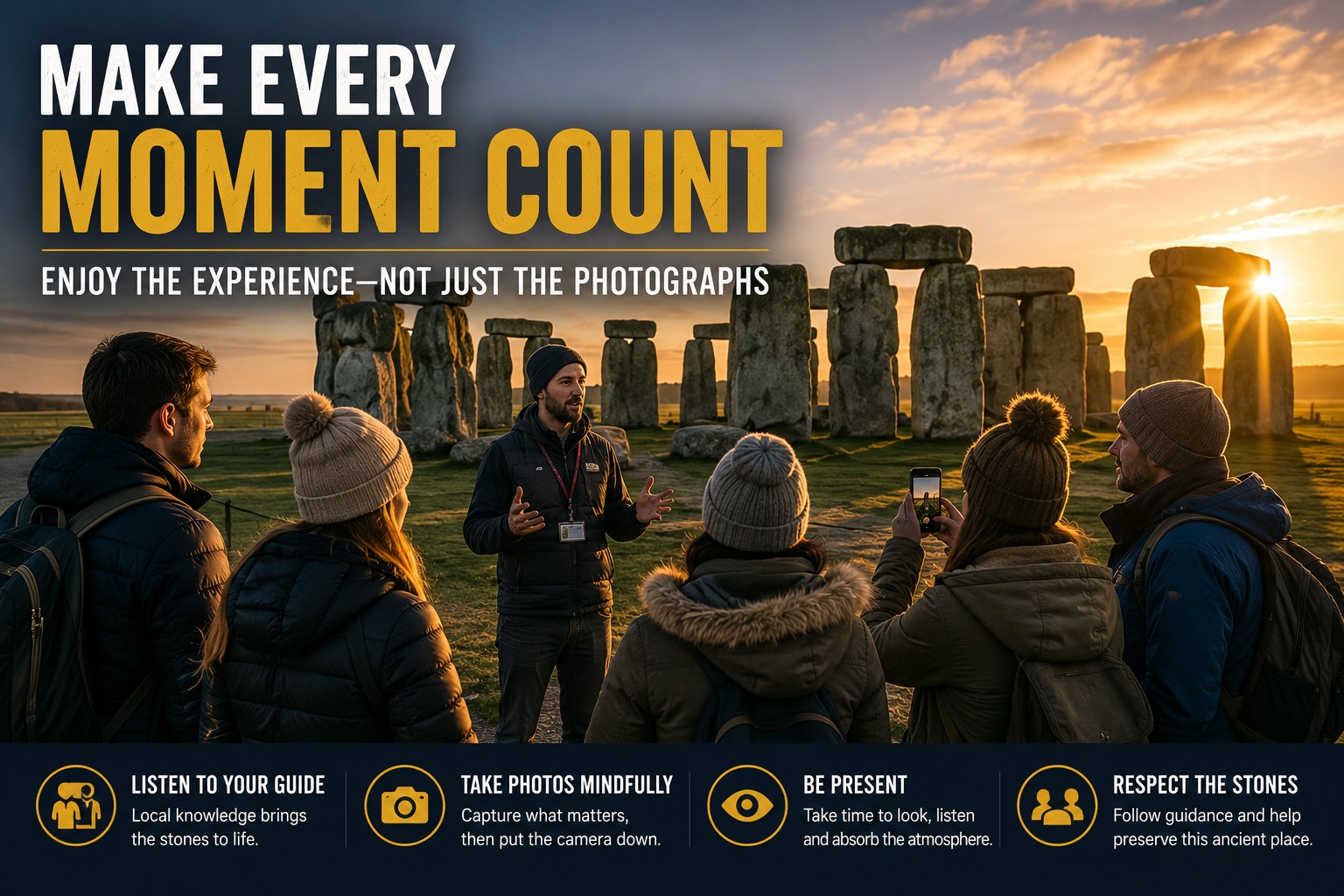
A Stonehenge Inner Circle visit is about more than photographs. Listening to your guide, respecting the monument and taking time to appreciate the atmosphere creates a richer and more memorable experience
🌄 What to Do After Your Stonehenge Inner Circle Tour
The final moments inside the stone circle do not need to mark an abrupt end to the day. In many cases, the period immediately afterwards is when the significance of the visit begins to settle.
A tightly scheduled onward journey can make that transition feel rushed. Where possible, avoid placing an inflexible booking immediately after the session, particularly if your day already involves an early departure, a long drive or uncertain traffic conditions.
The best next step depends partly on whether you have visited at sunrise or sunset.
🌅 After a Sunrise Inner Circle Tour
A sunrise session often leaves most of the day still ahead of you, but that does not mean you need to fill every remaining hour. The early start alone can make a slower pace more sensible.
Breakfast is usually the most natural first stop. A relaxed meal gives you time to warm up, compare impressions and allow the morning to feel complete before deciding what comes next.
Where opening hours, ticket arrangements and your itinerary allow, the Stonehenge Visitor Centre can add useful archaeological context. Seeing reconstructed Neolithic houses, exhibitions and interpretation after standing among the stones often helps connect the physical monument with the people who built and used it.
Salisbury is another natural continuation. Its cathedral, historic centre and independent cafés offer a different but complementary experience, especially for visitors who want to keep the day culturally focused without moving too quickly.
If you are continuing towards Bath, the South West or another destination, leave a realistic buffer. An early Inner Circle visit can be the highlight of the day without needing to become the first item in an exhausting sequence.
🌇 After a Sunset Inner Circle Tour
A sunset session calls for a different rhythm. By the time the visit ends, daylight may be fading, temperatures may have dropped and the practical priority may be dinner, accommodation or a comfortable return journey.
Consider eating nearby rather than beginning a long drive immediately if that would make the evening feel pressured. A quiet meal can provide a natural conclusion to the day and gives the group time to talk about what stood out.
Staying locally may also be worthwhile, particularly if you have travelled a significant distance or prefer not to drive late. This can make the visit feel less compressed and may allow you to explore Salisbury or the wider Wiltshire landscape the following morning.
Do not feel obliged to review every photograph as soon as the session ends. Low-light images can be assessed later, while the immediate memory of the atmosphere is still fresh and unfiltered.
☁️ Allow for Timing Changes
Restricted-access visits depend on carefully managed operations, and exact timings can occasionally be affected by traffic, weather or site requirements. Keeping the next part of the day flexible reduces pressure if the schedule changes slightly.
Your operator should provide the relevant guidance, so continue monitoring messages and follow any instructions issued during the tour. Flexibility is particularly valuable when the visit forms part of a longer itinerary with several moving parts.
Keeping the next part of the day flexible reduces stress if arrangements change and often leads to a more enjoyable overall experience.
🗺️ Where to Go After Visiting Stonehenge
The best onward plan is not necessarily the one with the longest list of attractions. It is the one that fits the timing, energy and tone of the visit you have just completed.
Some travellers will want to continue exploring, while others will benefit more from a meal, a quiet journey or a less structured afternoon. The table below offers a simple way to match the next step to the type of Inner Circle session.
| Your Inner Circle Session | A Natural Next Step |
|---|---|
| Early sunrise access | Breakfast, the Visitor Centre where available, or Salisbury |
| Morning restricted access | A carefully paced Wiltshire itinerary or onward journey |
| Evening sunset access | Dinner nearby, local accommodation or a relaxed return |
| Combination tour from London | Follow the planned itinerary while preserving rest where possible |
| Private or local meeting arrangement | Choose one nearby activity rather than several rushed stops |
| Tight onward schedule | Protect a time buffer and avoid another inflexible booking |
⛪ Continue the Story in Salisbury
Salisbury works particularly well because it offers historical depth without feeling like an unrelated addition. The cathedral, medieval streets and riverside setting provide a natural change of pace after the openness of Salisbury Plain.
It is also a practical place for breakfast, coffee, lunch or dinner, depending on the timing of your tour. Rather than treating the city as another item to tick off, allow enough time to enjoy it properly.
Salisbury often provides the ideal balance between extending the day and keeping the pace relaxed.
🏺 Add Context at the Visitor Centre
The Visitor Centre can deepen your understanding of the monument, but availability depends on opening hours, ticket conditions and the structure of your tour. Check before assuming that it will be accessible immediately after every session.
When it fits the itinerary, the exhibitions help explain the construction of Stonehenge, the wider ritual landscape and the communities connected with the site. This context can make details seen during the Inner Circle visit more meaningful.
🌿 Explore More of Wiltshire
Visitors staying locally may wish to explore the wider county at a slower pace. Rural landscapes, historic villages and archaeological sites can complement Stonehenge, but the key is to choose selectively.
A well-paced day with one or two meaningful stops will usually feel more rewarding than an itinerary built around constant driving. Avoid unnecessary backtracking and group nearby places logically.
☕ Choose to Do Less
There is equal value in doing very little. A quiet breakfast, a slow coffee or an unhurried return journey may be exactly what the day needs.
The aim is not to fill every hour, but to allow the day to unfold at a pace that suits the significance of the visit.
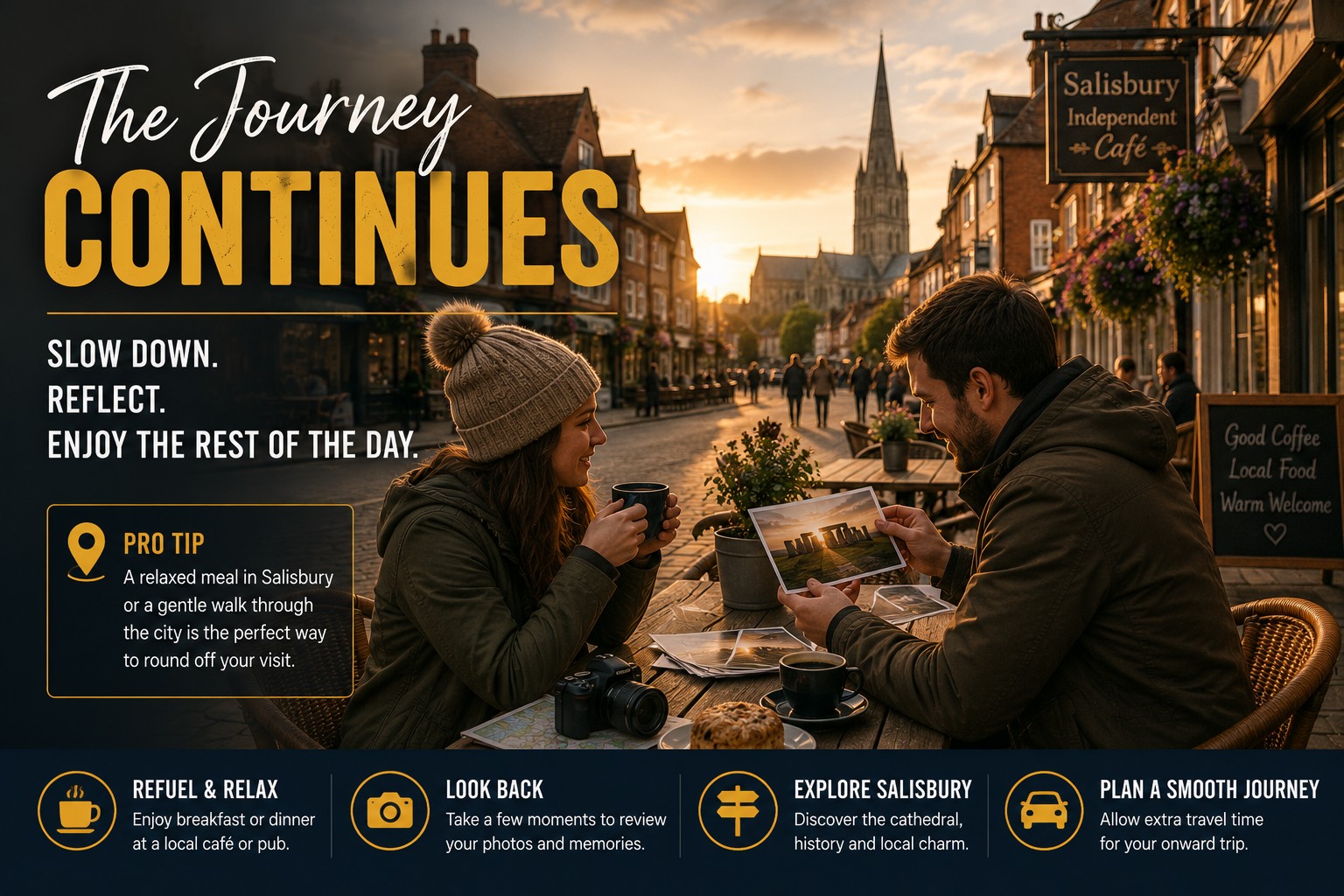
A Stonehenge Inner Circle experience doesn’t have to end when you leave the stones. Taking time to relax over a meal, explore Salisbury or simply reflect on the day often creates the most lasting memories
❤️ Turn the Visit Into a Lasting Memory
The immediate aftermath of the tour is about slowing down. The longer-term memory is shaped by what you choose to notice, retain and revisit afterwards.
Consider writing down one or two details that surprised you. It might be the scale of a particular stone, the sound of the wind across the landscape, the colour of the sky or a historical explanation that changed how you understood the monument.
If you travelled with others, ask what each person noticed. Different members of the same group often remember entirely different moments, and those conversations can become part of the day’s story.
There is no need to publish every photograph immediately. Select a few later, once you have had time to process the visit, and allow the memory to exist before reducing it to a camera roll or social post.
You may also find that the history becomes more interesting after the visit than it was before. Reading about archaeology, landscape alignments or recent discoveries can feel more relevant once you have stood among the stones and seen their scale first-hand.
A Stonehenge Inner Circle tour may be measured in minutes, but the memories created around it can continue developing long after the day itself.
INSERT DID YOU KNOW PANEL
🌱 How to Make Your Stonehenge Visit More Sustainable
Thoughtful travel often creates a better visitor experience as well as a lighter environmental impact. Planning the day carefully can reduce unnecessary journeys, support the local economy and encourage a slower, more respectful relationship with the landscape.
Where practical, consider staying locally before a very early session. This can reduce long pre-dawn driving and make the start of the day calmer. Shared transport or an organised tour may also reduce the number of individual vehicles travelling to the site.
Avoid building an itinerary that sends you repeatedly across the same area. Combining nearby stops logically reduces unnecessary mileage and usually produces a more coherent day.
Support local cafés, restaurants, accommodation providers and independent businesses where they fit naturally into your plans. Spending time in Salisbury or nearby communities can spread the benefits of tourism beyond the monument itself.
Carry reusable essentials where permitted, dispose of waste responsibly and follow all guidance relating to paths, access and protected archaeological areas. Stonehenge and its surrounding landscape require careful conservation, responsible access and continued visitor respect.
Slower travel is not only more sustainable. It is often more memorable because it gives each place enough time to make an impression.
INSERT SUSTAINABILITY PANEL
❓ Stonehenge Inner Circle Tour FAQs
❓ How early should I arrive for a Stonehenge Inner Circle tour?
Always follow the arrival or check-in time provided by your tour operator, as arrangements vary depending on whether you are departing from London, meeting locally or joining a private itinerary. Building extra travel time into your plans helps protect against traffic, transport delays or difficulty finding the meeting point, allowing you to begin the visit calmly rather than under pressure.
❓ What should I wear for Stonehenge Inner Circle access?
Layered clothing and comfortable closed footwear are usually the best choice. Stonehenge stands within an exposed landscape where temperatures can feel cooler than expected, particularly during sunrise and sunset sessions. A lightweight waterproof is often useful if rain is forecast, while sunscreen, sunglasses and a hat can make summer visits more comfortable.
❓ What should I bring on a Stonehenge Inner Circle tour?
Most visitors need very little. Your booking confirmation, a fully charged phone or camera, water where appropriate, suitable clothing and any essential personal items are usually all that is required. Travelling light makes it easier to move comfortably with the group and keeps your attention on the experience rather than on managing unnecessary belongings.
❓ Can you take photographs inside the Stonehenge Inner Circle?
Photography is normally an important part of the visit, but you should always follow the current guidance provided by your guide and the site team. Take time to enjoy the monument as well as photograph it, remain aware of other visitors and avoid blocking views while capturing images.
❓ Should I eat before a sunrise or sunset Inner Circle tour?
Yes. Because these sessions often take place outside normal meal times, it helps to plan ahead. A light breakfast before a sunrise departure or dinner after a sunset visit can make the entire experience more comfortable. Carrying water is also sensible where permitted and practical.
❓ Is the Stonehenge Visitor Centre worth visiting after an Inner Circle tour?
Where your itinerary, ticket arrangements and opening hours allow, the Visitor Centre provides valuable archaeological background that complements the experience of standing among the stones. The exhibitions, reconstructed Neolithic houses and interpretation displays help place Stonehenge within its wider prehistoric landscape.
❓ What should I do after visiting Stonehenge?
There is no single right answer. Some visitors continue to Salisbury, others enjoy breakfast or dinner nearby, while many simply take time to reflect before continuing their journey. The key is to avoid rushing immediately into another tightly scheduled activity if your itinerary allows flexibility.
❓ What happens if the weather is poor?
Stonehenge can be atmospheric in almost any weather, and changing conditions are part of visiting an exposed historic landscape. Do not assume that poor weather automatically means your tour will be cancelled or altered. Always monitor communications from your tour operator and follow any official instructions you receive before travelling.
❓ Should I stay near Stonehenge the night before?
If you have booked a very early sunrise session or are travelling a considerable distance, staying locally can make the start of the day significantly more relaxed. It reduces early-morning driving, gives you more flexibility if conditions change and allows you to arrive feeling refreshed rather than hurried.
❓ How much time should I allow for the whole experience?
Although your time inside the Inner Circle itself is relatively short, the overall commitment is much longer. Travel, meeting arrangements, the visit itself and time afterwards to relax or explore nearby attractions all contribute to the day. Whenever possible, avoid planning another fixed commitment immediately afterwards so you can enjoy the experience at a comfortable pace.
🏁 Conclusion
A Stonehenge Inner Circle tour is one of Britain’s most distinctive travel experiences, not simply because it allows you to stand among the ancient stones, but because it offers the opportunity to experience one of the world’s most famous prehistoric monuments in a calmer and more intimate setting than most visitors ever enjoy.
Making the most of that opportunity begins long before you arrive. Confirming your travel arrangements, dressing for the conditions, preparing your equipment and allowing extra time all help ensure that practical concerns never distract from the visit itself. Once you are inside the stone circle, slowing down, listening carefully and taking time simply to observe often proves just as rewarding as taking photographs.
The experience does not end when you leave the monument. Whether you continue to Salisbury, enjoy breakfast after sunrise, dinner after sunset or simply pause before travelling on, giving yourself space to reflect allows the significance of the visit to settle naturally.
The most successful Stonehenge days are rarely the busiest ones. They are the days that balance thoughtful preparation with unhurried exploration, allowing the monument to become the genuine centrepiece of the journey rather than just another stop along the way.
Your Stonehenge Inner Circle session may only last a short time, but the day you build around it is what gives those moments their lasting meaning.
INSERT FINAL CALENDAR CTA PANEL