


Best 3 Day Scotland Tours: Highlands, Lochs, Castles and Islands
30th October 2026
🏔️Best 3 Day Scotland Tours: Highlands, Lochs, Castles and Islands
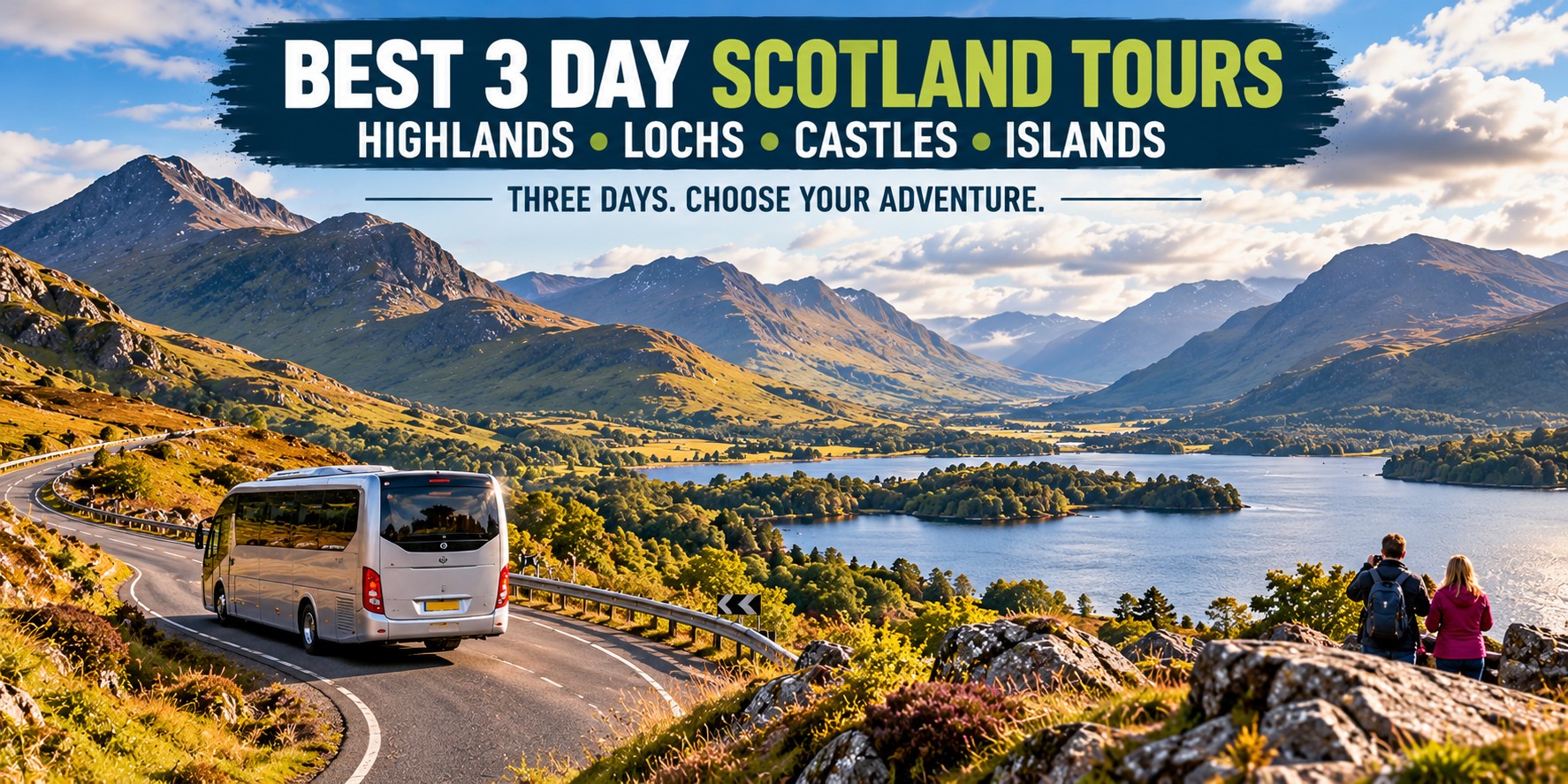
Discover Scotland’s spectacular Highlands on a three-day adventure, travelling through mountain landscapes, scenic glens and beautiful lochside countryside. Choose a route that gives you time to enjoy the places that matter most
Scotland has a remarkable ability to make even a short journey feel like an adventure. Within three days, you could travel through dramatic Highland valleys, gaze across the waters of Loch Ness, discover historic castles or experience the rugged beauty of the Isle of Skye.
But choosing the best three-day Scotland tour is not simply about finding the itinerary with the longest list of destinations.
Scotland’s celebrated landscapes are spread across a country of considerable geographical variety. A journey concentrating on Glencoe and the western Highlands offers a different experience from one exploring Loch Ness or travelling towards Skye.
The key is understanding what three days can realistically deliver, where your journey begins and how much time you will actually spend enjoying each destination.
This guide compares the principal three-day touring styles, their advantages and compromises, helping you choose a Scottish journey that matches your interests, available time and preferred pace.
🧭 What Can You Realistically See on a 3 Day Scotland Tour?
Three days can provide an excellent introduction to Scotland’s landscapes, history and Highland character. However, the experience depends enormously on the geographical area you choose to explore.
A carefully planned itinerary might combine mountain scenery, famous lochs, historic landmarks and traditional Highland settlements. Another might concentrate on reaching the Isle of Skye, where the island’s distinctive landscapes become the main attraction.
Both can be rewarding, but they involve different priorities.
The most important distinction is between covering geographical distance and having meaningful time at your destinations.
🗺️ Understanding Scotland’s Geography in Just Three Days
Scotland’s most popular touring regions are spread across an extensive and varied landscape.
Edinburgh and Glasgow lie within Scotland’s Central Belt, providing practical starting points for journeys north and west.
Beyond them, the scenery changes considerably.
Loch Lomond and the Trossachs introduce wooded hills, freshwater lochs and landscapes that form a natural transition towards the Highlands.
Farther north and west, Glencoe offers a different experience: steep mountain slopes, a dramatic glen and scenery shaped by geological forces and centuries of human history.
Loch Ness lies much farther north, southwest of Inverness. Its long expanse of water and surrounding Highland scenery make it a destination in its own right, rather than simply somewhere to stop for a photograph.
The Isle of Skye presents another geographical commitment. Situated off Scotland’s western mainland and connected by road via the Skye Bridge, it contains extensive coastal landscapes, mountain ranges and attractions spread across different parts of the island.
These destinations can sometimes feature within the same multi-day journey, but that does not mean visitors will have sufficient time to explore each one thoroughly.
A useful principle: The more distant regions a three-day itinerary attempts to combine, the more carefully you should examine its daily travelling commitments.
For some visitors, the journey through changing Highland scenery is itself a major part of the attraction. Others will prefer fewer destinations and longer opportunities to explore on foot, visit historic sites or enjoy the atmosphere of a particular location.
Neither approach is inherently better. The right choice depends on what you want from Scotland.
⏳ Three Days of Touring or Three Days Including Travel?
Before comparing destinations, establish exactly what the advertised three days represent.
A tour beginning in Edinburgh or Glasgow may spend much of its available time travelling through Scotland’s countryside and Highland regions.
A journey beginning in Inverness could concentrate more closely on northern destinations, although reaching Inverness beforehand may require additional arrangements.
Travelling from London introduces a different consideration.
If your three-day holiday includes the journey from London to Scotland and the return south, a substantial portion of the available time may be devoted to reaching and leaving your touring region.
Alternatively, you might travel to Edinburgh or Glasgow independently, stay overnight and join a three-day Scottish tour the following morning.
That arrangement provides a clearer distinction between travel-to-tour time and actual touring time.
It is therefore worth checking the advertised starting point, finishing location and whether the first and final days contain substantial sightseeing or primarily transport.
A three-day itinerary should ultimately be judged by the experience it provides during those three days, not simply by the number of places appearing in its description.
🏔️ The Best Types of 3 Day Scotland Tours: Which Route Suits You?
The best three-day Scotland tour depends on the experiences you most want to enjoy.
Some itineraries prioritise dramatic mountain landscapes, while others concentrate on famous lochs, island scenery or Scotland’s historic castles and communities.
Understanding these differences helps you choose a route that feels rewarding rather than unnecessarily rushed.
The following four touring styles represent distinct ways to experience Scotland. They are illustrative itinerary types, not guarantees that every destination or activity will be included in a particular tour.
🌄 Western Highlands and Glencoe: Dramatic Mountain Scenery
Best for: Travellers who love dramatic landscapes, mountain scenery and scenic journeys.
The western Highlands offer some of Scotland’s most striking scenery, making them an appealing choice for a short multi-day journey.
Glencoe is a particular highlight. Its steep mountain slopes, broad valley and atmospheric landscapes create a powerful sense of place.
The glen is also associated with the Massacre of Glencoe in 1692, an important episode in Scottish history that adds a deeper historical dimension to the landscape.
Depending on the route, a western Highland journey may also include lochs, mountain passes and small Highland settlements.
Some itineraries approach the region through Loch Lomond and the Trossachs, while others follow different routes through western or central Scotland.
For landscape enthusiasts, the attraction lies partly in the changing scenery between destinations.
A scenic viewpoint, a walk beside a loch or time spent appreciating Glencoe’s mountains may be more satisfying than visiting numerous indoor attractions.
Main consideration: Check how much time the itinerary allows outside the vehicle. A journey through beautiful scenery can be memorable, but brief photography stops are different from extended opportunities to explore.
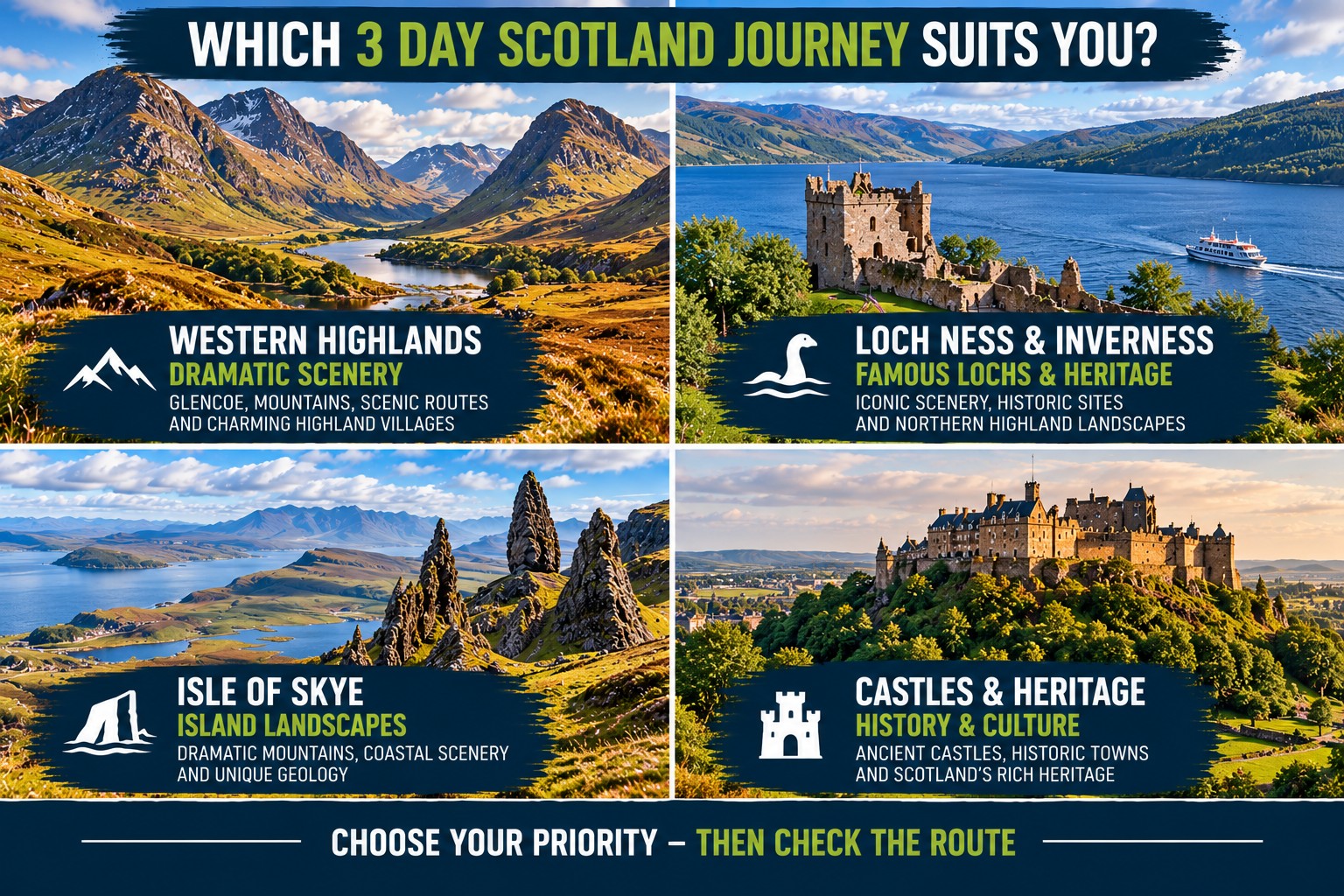
Discover four different ways to experience Scotland in three days, from the dramatic mountains of the Western Highlands and the historic shores of Loch Ness to the rugged landscapes of Skye and Scotland’s magnificent castles. Choose your priority, then check the route
🌊 Loch Ness and Inverness: Northern Highland Adventures
Best for: Travellers interested in Scotland’s famous lochs, Highland heritage and northern landscapes.
Loch Ness is one of Scotland’s best-known natural landmarks, extending southwest from the Inverness area through the Great Glen.
Its appeal goes well beyond the familiar legend of the Loch Ness Monster.
The loch’s expansive waters, wooded shores and surrounding hills create an atmospheric Highland setting, while nearby historic sites provide opportunities to explore the region’s past.
Urquhart Castle, overlooking Loch Ness, is a particularly notable example. Its ruined fortifications occupy a dramatic position beside the water, although an itinerary mentioning the castle does not necessarily include admission or an extended visit.
Inverness serves as an important gateway to the northern Highlands, with its own riverside setting and regional heritage.
A three-day route concentrating on this area may offer a mixture of loch viewpoints, historic landmarks and Highland scenery.
However, the distance involved in reaching northern Scotland matters, particularly when the journey begins in Edinburgh or Glasgow.
Main consideration: Decide whether Loch Ness is your principal destination or simply one stop within a wider Highland journey. That distinction can substantially affect the time available to enjoy it.
🏝️ Isle of Skye and the Western Highlands: An Island-Focused Journey
Best for: Travellers whose main ambition is to experience Skye’s distinctive island landscapes.
The Isle of Skye is celebrated for its dramatic mountains, rugged coastline and strong Gaelic cultural heritage.
Its landscapes are notably varied.
The Cuillin mountains create a striking skyline, while the Trotternish Peninsula is associated with distinctive rock formations and sweeping coastal views.
Skye is connected to the Scottish mainland by the Skye Bridge, so a ferry crossing is not essential for reaching the island by road. Alternative ferry approaches also exist, subject to their operating arrangements.
For a three-day journey, the main consideration is how much time remains for exploring Skye after travelling to and from the island.
One example is the 3 Day Highlands, Loch Ness & Isle of Skye Tour, which travels from Edinburgh to Skye, devotes its middle day to exploring the island and returns through Highland scenery and the Loch Ness area. It illustrates why checking the daily itinerary matters: three days can combine several celebrated regions, but the time spent at individual attractions will depend on the route and conditions.
Simply reaching Skye is not the same as experiencing its different landscapes.
Attractions are spread across a substantial area, and a route attempting to include numerous island viewpoints alongside mainland destinations can involve considerable travelling.
A more focused itinerary may provide a better opportunity to appreciate the island’s scenery and character.
Main consideration: If Skye is your priority, examine the actual time allocated to the island rather than choosing an itinerary simply because its description includes the name.
🏰 Castles, Lochs and Highland Villages: A Heritage-Focused Route
Best for: History enthusiasts and travellers who enjoy combining cultural discoveries with scenic surroundings.
Not every three-day Scotland tour needs to concentrate on reaching the most remote landscapes.
A heritage-focused journey may combine historic castles, traditional settlements, lochside scenery and places associated with Scotland’s cultural past.
Stirling Castle, for example, offers an important connection with Scottish royal history, while Urquhart Castle provides a very different historical setting beside Loch Ness.
These sites belong to different geographical areas and should not be assumed to appear together on every itinerary.
Some travellers will particularly enjoy guided historical interpretation, opportunities to explore castle interiors or time in Highland communities.
Others may prefer a journey that balances shorter heritage visits with scenic countryside.
The important distinction is between seeing a historic landmark and having sufficient time to understand its significance.
Main consideration: Check whether historic attractions are included as full visits, optional experiences or exterior sightseeing stops.
⚖️ Comparing 3 Day Scotland Tour Routes: What Will You Actually Experience?
Choosing between Scotland’s different three-day touring routes becomes easier when you consider the experience each one offers, rather than simply counting the destinations mentioned.
A journey through the western Highlands might deliver spectacular mountain scenery, while a Loch Ness itinerary places greater emphasis on northern landscapes and Highland heritage.
Skye offers a distinctive island experience, whereas a castle-focused journey may provide more opportunities to explore Scotland’s history.
The key is identifying which experiences matter most to you and understanding the compromises involved in reaching them.
🏔️ Which Three-Day Scotland Journey Suits You?
Three days can reveal very different sides of Scotland. Start with the experience that matters most to you, then look for an itinerary that gives it sufficient time.
🌄 Western Highlands
Mountain scenery, Glencoe and memorable journeys through Highland landscapes.
Choose this if: Scenic drives, dramatic glens and mountain viewpoints are your priorities.
🌊 Loch Ness
Famous lochs, Highland heritage and the atmospheric landscapes of northern Scotland.
Choose this if: Loch Ness and the surrounding Highland region are central to your plans.
🏝️ Isle of Skye
Distinctive island scenery, rugged coastlines and dramatic mountain landscapes.
Choose this if: Exploring Skye is your main ambition and you accept the travelling involved.
🏰 Historic Scotland
Castles, Highland settlements and cultural discoveries surrounded by scenic countryside.
Choose this if: History, heritage and meaningful attraction visits matter more than covering distance.
Remember: These are touring styles, not guaranteed itineraries. Check each tour’s actual route, departure point and sightseeing time before deciding.
Ready to explore the different ways to discover Scotland?
🎯 Choosing Between Highland Scenery, Loch Ness, Skye and Historic Scotland
There is no single three-day Scotland itinerary that will suit every traveller.
Someone who enjoys landscape photography may find Glencoe particularly rewarding. A visitor fascinated by Scottish history might prefer a journey incorporating historic castles and settlements.
For others, reaching Loch Ness or experiencing Skye will be the main ambition.
The following comparison highlights the principal differences between four itinerary styles. These are general touring approaches rather than confirmed individual departures.
| Three-day route emphasis | Principal experience | Best suited to | Main planning compromise |
|---|---|---|---|
| Western Highlands and Glencoe | Mountain scenery, glens and lochs | Landscape lovers and scenic travellers | Sightseeing time depends on route and departure point |
| Loch Ness and northern Highlands | Famous loch, Highland heritage and Inverness area | Travellers interested in lochs and northern Scotland | Additional travel into the northern Highlands |
| Isle of Skye and western Highlands | Island landscapes, coastal scenery and Gaelic cultural context | Travellers prioritising Skye | Dispersed attractions and substantial journey commitments |
| Castles, lochs and historic settlements | Heritage, historic landmarks and varied scenery | History enthusiasts and mixed-interest travellers | Interior visits and admission arrangements vary |
A useful way to approach this decision is to identify your principal priority first, then examine which additional experiences fit naturally into the route.
Trying to include every famous destination can sometimes reduce the time available to appreciate the places that attracted you to Scotland in the first place.
🚐 Scenic Driving Versus Meaningful Sightseeing Time
One of the most important considerations when comparing three-day tours is the balance between travelling and sightseeing.
Scotland’s Highland roads can pass through extraordinary landscapes. The journey itself may be a highlight, particularly where mountain scenery, lochs and changing countryside are central to the experience.
However, travelling through a destination is not the same as spending time there.
A short viewpoint stop might allow photographs and a brief appreciation of the surroundings. An extended visit could provide opportunities to walk, explore a historic attraction or enjoy a village at a more relaxed pace.
Neither approach is necessarily wrong, but they create different experiences.
When reviewing an itinerary, look beyond its destination list. Consider the daily route, planned stops, overnight locations and whether time is allocated for activities rather than simply passing through.
The strongest three-day itinerary is often the one that makes the best use of its available time, not the one that covers the greatest distance.
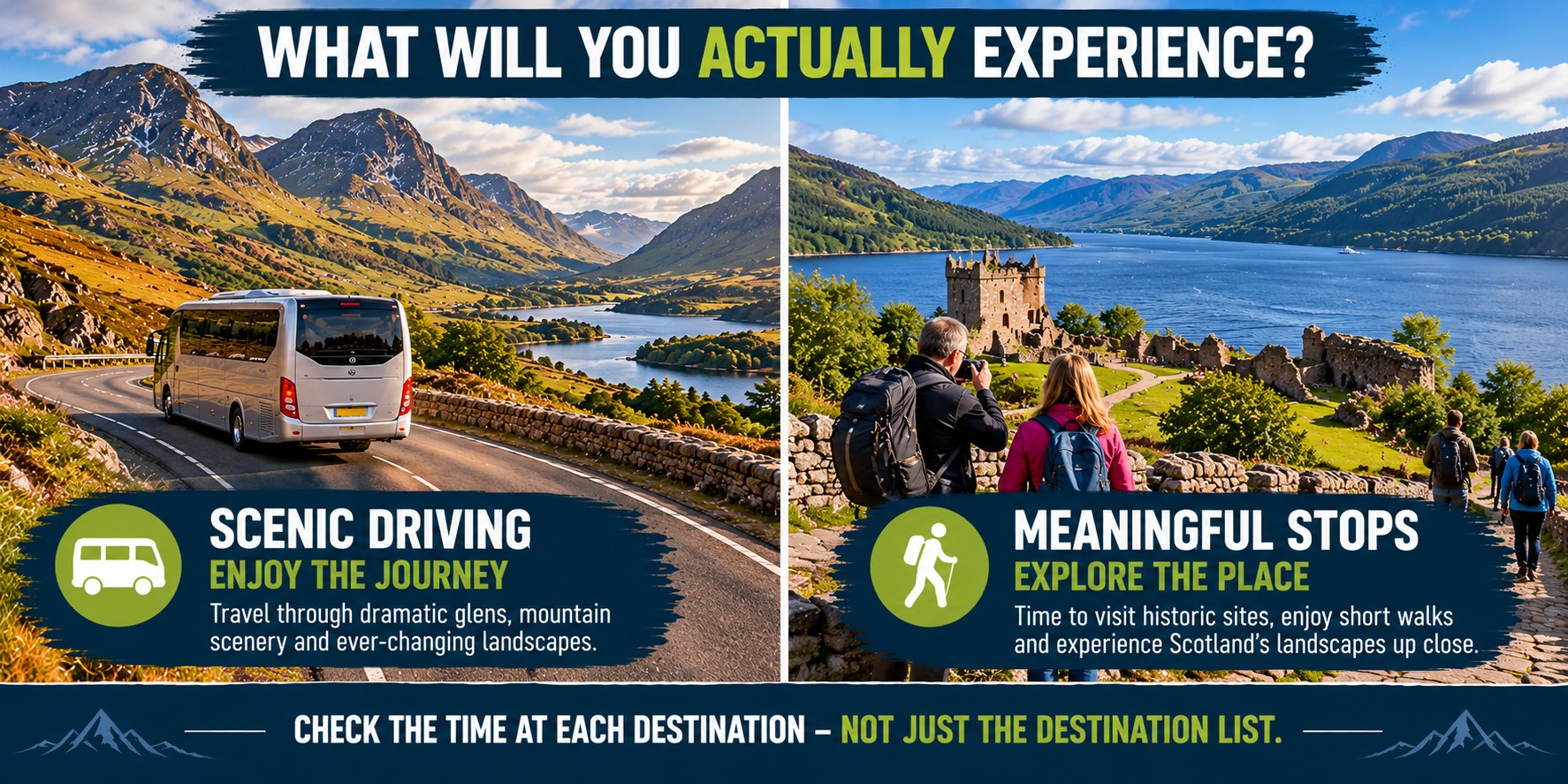
A memorable three-day Scotland tour is about more than travelling through beautiful landscapes. Compare scenic driving with opportunities to explore historic castles, enjoy Highland viewpoints and spend meaningful time at the places you visit
🚆 Where Should Your 3 Day Scotland Tour Begin?
Your departure point can significantly influence what is realistic within three days.
Starting from Edinburgh, Glasgow or a Highland town creates different geographical opportunities, particularly when your preferred destinations lie farther north or west.
It is therefore worth considering the starting location before deciding which route appeals most.
🏙️ Starting from Edinburgh or Glasgow
Edinburgh and Glasgow are practical starting points for many visitors because they are established Scottish transport centres with connections to other parts of Britain and beyond.
Both provide access to routes heading towards the Highlands, although the direction and destinations of individual tours vary.
An Edinburgh departure may suit travellers already exploring Scotland’s capital, while Glasgow can be convenient for those staying in the west of the Central Belt.
However, neither city should be assumed to offer every itinerary type.
If you are travelling to Scotland specifically to join a tour, consider arriving before the departure day rather than relying on a tight same-day connection.
This can provide greater flexibility if your incoming journey is delayed.
🧭 Starting from Inverness or Another Highland Base
Beginning a journey farther north can be advantageous when Loch Ness, Inverness or the surrounding northern Highlands are your principal interests.
A northern departure may reduce the need to travel from central Scotland before reaching those destinations.
However, you must also account for the journey required to reach your starting location.
For some travellers, additional pre-tour travel will be worthwhile because it allows a more focused Highland experience.
For others, joining a tour from Edinburgh or Glasgow may be more convenient overall.
Inverness is not automatically the best departure point for every Highland itinerary, particularly when the western Highlands or Skye are the main priority.
The right starting point depends on the chosen route, existing travel arrangements and where the journey finishes.
🚄 Travelling from London Before Your Scotland Tour
If you are beginning your holiday in London, it is important to distinguish the journey to Scotland from the three-day touring experience itself.
Rail and air travel can provide ways of reaching Scottish departure cities, although services, connections and journey arrangements vary.
Travelling to Edinburgh or Glasgow before joining a tour may allow you to devote the full three days to exploring Scotland rather than using part of that time to reach the starting point.
Where practical, arriving the previous day also provides an opportunity to settle into your accommodation and reduces dependence on a tight connection immediately before the tour begins.
The same consideration applies at the end of the journey. Check where and when the tour finishes before arranging onward transport.
If your total holiday allowance is only three calendar days, including travel from London, your time exploring the Highlands may be considerably reduced.
Practical priority: Count the days available for exploring Scotland separately from those needed to travel to and from your departure point.
🚌 Organised 3 Day Scotland Tours or Independent Travel?
Once you have identified your preferred destinations, the next decision is how you want to explore them.
An organised multi-day tour can simplify the practical arrangements, while independent travel provides greater freedom over routes, stops and accommodation.
Both approaches have advantages, but their suitability depends on your confidence with travel planning and the experience you want.
🧳 What an Organised Multi-Day Tour Can Make Easier
An organised tour can remove much of the responsibility for planning a journey through unfamiliar regions.
Rather than arranging each day’s route and transport independently, you follow an established itinerary with scheduled destinations and overnight arrangements.
Where provided, a knowledgeable guide can also add valuable context to Highland landscapes, historic sites and local traditions.
For travellers unfamiliar with Scotland’s geography, this combination of transport coordination and interpretation can be particularly appealing.
However, organised touring involves compromises.
Departure times, sightseeing stops and the overall pace are generally determined by the itinerary. You may have limited freedom to extend a visit or explore somewhere not included in the schedule.
Accommodation, meals and attraction admissions also vary between arrangements, so these should be checked rather than assumed.
Best suited to: Travellers who value convenience, structured sightseeing and the opportunity to concentrate on the experience rather than daily logistics.
🚗 Self-Driving Scotland in Three Days: Freedom and Responsibilities
Driving independently provides greater control over how you spend your time.
You can choose where to stop, adjust your route according to your interests and select accommodation that suits your plans.
For photographers, walkers and travellers who enjoy discovering quieter places, this flexibility may be especially attractive.
However, driving through the Highlands requires preparation.
Some rural roads are narrow or winding, and single-track sections require an understanding of passing places and consideration for other road users.
Parking arrangements, changing weather and the demands of navigating unfamiliar routes can also influence the experience.
A journey that appears straightforward on a map may feel more demanding when sightseeing stops and the responsibilities of driving are included.
Self-driving is therefore not automatically quicker, cheaper or more relaxing than joining an organised tour.
Best suited to: Confident drivers who enjoy independent planning and are comfortable balancing sightseeing with the practical demands of the journey.
🚉 Can You Explore the Highlands by Train and Public Transport?
Rail and bus travel can provide an appealing alternative for visitors who prefer not to drive.
Scotland has rail connections serving selected Highland towns and scenic corridors, while bus services provide additional connections in various regions.
For some journeys, travelling by train can become part of the experience, allowing passengers to enjoy the passing scenery without concentrating on the road.
However, public transport works differently from a dedicated touring vehicle.
Reaching a Highland town does not necessarily mean that nearby castles, remote viewpoints or countryside attractions are easily accessible without further transport.
Services may also be less frequent in rural areas, and connections require careful planning.
For a three-day visit, this can limit the number of destinations that are practical to combine.
Public transport is often most suitable when you concentrate on places with workable connections rather than attempting to reproduce a road-based sightseeing itinerary.
Before choosing this approach, examine the current transport arrangements for the particular destinations you want to visit.
The most suitable travel style is ultimately the one that supports your chosen destinations without making the practical arrangements more demanding than the experience itself.
🏰 What Should You Check Before Choosing a 3 Day Scotland Tour?
Two three-day Scotland tours can appear remarkably similar at first glance. Both might mention Highland scenery, famous lochs and historic castles, yet the experiences they provide could be quite different.
The distinction often lies in the details: how each day is organised, where you stay overnight, which attractions you actually visit and what is included in the arrangements.
Before choosing an itinerary, it is worth examining these practical elements rather than relying solely on the headline destinations.
🗺️ Daily Routes, Overnight Stops and Time at Attractions
Start by looking at the itinerary day by day.
Consider where the journey begins each morning, which regions it crosses and where the group stays overnight. A route that progresses naturally through neighbouring destinations may allow more time for sightseeing than one involving substantial backtracking.
Pay particular attention to the difference between a scheduled visit and a scenic stop.
An itinerary might mention Glencoe, Loch Ness and several castles, but the amount of time spent at each location can vary considerably.
Check whether there are opportunities to leave the vehicle, explore independently or enjoy a guided visit.
Overnight locations can also affect the experience. Staying within or near the principal touring region may provide opportunities to appreciate the surroundings beyond the main sightseeing schedule.
Early departures and lengthy driving periods deserve attention too, particularly when several consecutive days involve substantial travel.
Check how many overnight stays are included and the scheduled departure time on the first day and finishing time on the final day. These details help establish how much of the advertised three-day period is available for touring and clarify the accommodation arrangements.
Practical priority: Choose an itinerary whose daily pace matches your expectations, rather than assuming a longer destination list represents better value.
🎟️ Castle Entry, Loch Cruises and Optional Experiences
Scotland’s castles, lochs and historic attractions can add considerable depth to a three-day journey, but advertised destinations do not always indicate what activities are included.
A visit to Loch Ness, for example, might involve enjoying shoreline views, stopping near Urquhart Castle or taking an optional cruise.
Similarly, a castle appearing in an itinerary might be viewed from outside rather than explored through its interior rooms and exhibitions.
These distinctions matter when comparing experiences.
Before making a decision, establish whether attraction admissions are included, available as optional extras or left for travellers to arrange independently.
Some activities may depend on opening arrangements, capacity or weather conditions.
If a particular castle visit or cruise is central to your plans, check its status rather than assuming it will be possible simply because the destination appears on the route.
✅ Check the Details Before Booking Your Three-Day Tour
Two tours may advertise similar Highland destinations but offer quite different experiences. Use these five checks to understand what you are actually booking.
01
Departure and Finishing Arrangements
Confirm the exact departure city, meeting point, first-day departure time and final-day finishing location and time. Allow sufficient time for any separate travel connections.
02
Overnight Stays and Accommodation Costs
Check how many overnight stays are provided, where they are located and whether accommodation is included in the advertised price or paid separately. Review room options and single-room supplements where applicable.
03
Attraction Admissions and Optional Experiences
Establish whether castle admissions, loch cruises and other activities are included, optional or simply mentioned as possible sightseeing stops. Check any additional charges.
04
Daily Travelling and Sightseeing Time
Review each day’s route, expected travelling commitments and scheduled stops. Distinguish short photographic opportunities from longer visits with time to explore.
05
Meals, Luggage and Additional Charges
Confirm which meals are provided, the luggage allowance and any extra costs that may affect the overall price, including supplements or independently arranged services.
Before you commit: Compare these details with the specific tour operator’s current itinerary, inclusions, accommodation arrangements and booking conditions. Do not assume that all three-day Scotland tours provide the same services.
🛏️ Accommodation, Meals, Luggage and Overall Value
Accommodation is another important consideration when comparing multi-day itineraries.
Some arrangements include accommodation within the advertised price, while others may involve separate accommodation payments or choices between different room categories.
Check what type of accommodation is provided, whether breakfast or other meals are included and whether any single-room supplement applies.
If you are travelling with someone else, establish whether the quoted arrangement assumes a shared room and whether your preferred room configuration is available.
Luggage allowances and handling arrangements are also worth confirming, especially when travelling in smaller vehicles or changing accommodation between nights.
The lowest advertised price does not necessarily represent the best overall value.
A more useful comparison considers the accommodation arrangements, transport, sightseeing opportunities, included admissions and any additional expenses likely to arise.
The objective is to understand what the complete three-day experience involves, not simply what appears in the initial price.
♿ Group Size, Comfort, Accessibility and Mobility
Comfort can make a substantial difference during a journey involving several days of Highland travel.
Vehicle size, seating arrangements, time spent travelling and the number of scheduled stops all influence the experience.
Smaller groups may offer a different atmosphere from larger coach journeys, although group size alone does not determine comfort or quality.
Travellers with mobility requirements should consider the physical nature of the destinations as well as the transport.
Historic castles may involve steps and uneven surfaces. Highland viewpoints can have rough paths, while exposed locations may be difficult in poor weather.
Vehicle boarding, luggage assistance and access to accommodation also deserve attention.
Accessibility arrangements vary between individual tours and attractions, so specific requirements should be checked before committing to a journey.
A suitable three-day itinerary should be enjoyable throughout, not merely achievable.
🌦️ When Is the Best Time for a 3 Day Scotland Tour?
Scotland’s landscapes change considerably throughout the year, and the season can influence both the atmosphere of a journey and the practical opportunities available.
For a three-day tour, daylight, weather and visitor demand are particularly important because there is relatively little time to adjust plans.
The best season therefore depends on the experience you want, the destinations you hope to visit and how comfortable you are with changing conditions.
☀️ Spring and Summer: Longer Daylight and Popular Routes
Spring brings changing colours to Highland landscapes, while the longer days of late spring and summer provide more daylight for scenic journeys and outdoor sightseeing.
This can be especially valuable when visiting mountain viewpoints, lochs and coastal destinations.
Longer daylight may also provide greater flexibility for photography, short walks and enjoying the surroundings during scheduled stops.
Summer is a popular period for exploring the Highlands and Skye, so well-known locations may be busier and accommodation availability more limited.
However, longer daylight does not guarantee sunshine.
Rain, wind and changing conditions remain possible throughout the warmer months, particularly in mountainous and coastal areas.
Tour availability also varies, so a route advertised for one season should not automatically be assumed to operate throughout the year.
Best suited to: Travellers who prioritise longer daylight, outdoor sightseeing and opportunities to enjoy Highland landscapes during extended summer evenings.
📅 Choose Your Scotland Touring Dates with Confidence
When you have just three days to explore Scotland, your travel dates can make a real difference. Consider these practical factors before choosing your departure.
☀️ Daylight and Sightseeing Time
Longer spring and summer days can provide more daylight for Highland viewpoints, lochs and coastal scenery. Shorter winter days make the timing of individual stops especially important.
🌦️ Weather and Route Flexibility
Highland and island conditions can change quickly. Choose an itinerary with realistic travelling commitments and be prepared for adjustments to outdoor stops or activities.
🛏️ Popular Dates and Accommodation
Popular travel periods can increase demand for tours and overnight accommodation. Check availability early, particularly when your plans involve specific departure dates or room arrangements.
🎪 Festivals, Highland Games and Local Events
Scottish cultural celebrations may offer an enjoyable addition to your wider holiday. Consider whether an event fits naturally before or after your three-day tour rather than assuming it can be included within the scheduled itinerary.
📆 Explore Scotland’s Events Calendar
Discover Scottish events and celebrations that may help shape your travel dates or inspire additional time in a particular region.
🍂 Still Deciding Which Season Suits You?
Explore the differences between spring, summer, autumn and winter before settling on your Scottish travel dates.
Planning reminder: Event dates, programmes, admission arrangements and availability can change. Confirm details directly with event organisers and check tour departure availability separately before making travel commitments.
🍂 Autumn and Winter: Atmosphere, Daylight and Route Limitations
Autumn can bring beautiful colours to Highland woodland, glens and lochside landscapes.
The changing scenery offers a different atmosphere from summer, although daylight gradually becomes more limited.
For travellers interested in photography and quieter-feeling landscapes, autumn may be particularly appealing, depending on the destination and timing.
Winter introduces further considerations.
Shorter days reduce the time available for outdoor sightseeing, while snow, ice, heavy rain or strong winds can affect particular roads and exposed locations.
Some attractions and visitor services may operate reduced seasonal hours or close for part of the year.
This makes the details of a winter itinerary especially important. A route that works comfortably during long summer days may require different sightseeing arrangements when daylight is limited.
A winter journey can still be rewarding, but it requires realistic expectations and confirmation that the intended itinerary operates during the chosen period.
Snow-covered scenery should never be regarded as guaranteed.
Best suited to: Travellers who appreciate atmospheric seasonal landscapes and are comfortable with shorter sightseeing days and potentially greater itinerary flexibility.
🌬️ Highland Weather, Island Conditions and Itinerary Flexibility
Weather can change quickly in Scotland’s mountainous and coastal regions.
Conditions experienced in a sheltered settlement may differ considerably from those on an exposed Highland road or coastal viewpoint.
Skye and the western Highlands are particularly associated with landscapes where wind, rain and visibility can influence outdoor experiences.
A viewpoint that offers expansive mountain or coastal scenery in clear conditions may provide a very different experience when cloud descends or heavy rain arrives.
Occasionally, adverse conditions may require changes to routes, stops or activities.
For travellers, the best approach is to prepare for variable weather, carry suitable clothing and retain some flexibility about individual sightseeing opportunities.
Waterproof outer layers, practical footwear and clothing that can be adjusted to changing temperatures are sensible considerations, even during summer.
It is also worth checking how an organised tour handles weather-related alterations, particularly if a specific outdoor activity is central to your plans.
A successful three-day journey is not dependent on perfect conditions at every destination. It depends on choosing an appropriate itinerary and being prepared to enjoy Scotland’s changing landscapes responsibly.
⏳ Is Three Days Enough, or Should You Choose a Longer Scotland Tour?
Three days can be enough to experience some of Scotland’s most memorable scenery, but whether that feels satisfying depends on your expectations.
The important question is not whether Scotland can be explored in three days. It is whether your chosen destinations can be enjoyed properly within that time.
A focused itinerary can provide a wonderful introduction to the Highlands, while a journey attempting to combine too many distant regions may leave you wishing you had stayed longer.
✅ When Three Days Is the Right Choice
A three-day tour is particularly appealing when you have limited time but want to experience more than a single-day excursion can comfortably provide.
For first-time visitors, a carefully chosen route through the western Highlands might offer an enjoyable combination of mountain scenery, lochs and historic locations.
Alternatively, concentrating on Loch Ness and its surrounding landscapes can provide a more focused introduction to northern Scotland.
Three days can also suit travellers who already know which experience matters most to them.
If your principal ambition is to see Glencoe, discover Loch Ness or enjoy a scenic Highland journey, there may be little benefit in adding distant destinations simply to make the itinerary appear more extensive.
Three days works best when the route has a clear geographical focus and the sightseeing pace matches your interests.
🧭 When Four, Five or More Days Make a Meaningful Difference
Additional days become valuable when you want to explore several regions or spend longer at individual destinations.
This is particularly relevant to the Isle of Skye, where the journey from central Scotland and the distances between attractions can consume a significant proportion of a short itinerary.
A longer visit may allow more opportunities to explore different parts of the island rather than concentrating on a limited selection of viewpoints.
Extra time can also make it easier to combine Loch Ness, the western Highlands and historic attractions without placing excessive pressure on each day’s schedule.
For travellers interested in walking, photography, cultural experiences or visiting castle interiors, a less hurried itinerary may be especially rewarding.
A longer journey is not automatically better. However, when several distant destinations are essential to your plans, additional time can improve the balance between travelling and actually experiencing Scotland.
🌱 Sustainable and Responsible Travel on a Short Scotland Tour
Scotland’s Highland and island landscapes are among the country’s greatest attractions, but many of these places are also working environments and home to established communities.
Responsible travel begins with recognising that the places visitors enjoy are not simply scenic backdrops.
In rural Highland areas, narrow roads, limited parking and small community facilities can come under pressure during busy periods.
Visitors travelling independently should use designated parking areas, avoid obstructing access roads and respect passing places on single-track routes.
When exploring landscapes on foot, follow relevant access guidance, respect wildlife and habitats and take litter away where appropriate. Scotland’s outdoor access rights are accompanied by responsibilities, particularly around farming activities, livestock and sensitive environments.
On Skye and in other island communities, supporting local cafés, shops and accommodation providers can contribute to the places that make a journey memorable.
Cultural respect matters too. Gaelic heritage, historic sites and Highland traditions deserve thoughtful appreciation rather than assumptions based on romanticised images of Scotland.
Route planning can also play a part.
Choosing a coherent journey with fewer unnecessary detours may reduce avoidable travel, while allowing more time to appreciate individual destinations.
Public transport or shared touring arrangements may be appropriate for some travellers, but their environmental impact depends on the actual journey and circumstances. Neither should automatically be described as the most sustainable option.
Responsible Scotland travel means enjoying remarkable places while respecting the landscapes, wildlife and communities that give them their character.
❓ Frequently Asked Questions About 3 Day Scotland Tours
❓ Can You Visit the Scottish Highlands in Three Days?
Yes. Three days can provide a rewarding introduction to a selected part of the Scottish Highlands, particularly when the itinerary concentrates on a coherent geographical route.
You might explore the western Highlands around Glencoe or focus on Loch Ness and the surrounding northern landscapes.
However, the Highlands cover an extensive area, so three days is not enough to explore the entire region. The most satisfying approach is usually to prioritise a manageable number of destinations rather than attempting to cover everything.
❓ Can You See Loch Ness and the Isle of Skye on the Same 3 Day Tour?
It can be geographically possible to include both Loch Ness and Skye within a three-day journey, depending on the departure point and route.
However, combining them involves considerable travelling, and the time available at individual destinations may be limited.
If both places are priorities, examine the daily itinerary carefully, particularly the time allocated to exploring Skye rather than simply reaching the island.
❓ Are Three-Day Scotland Tours Suitable for First-Time Visitors?
Yes. A well-planned three-day tour can provide an excellent introduction to Scotland’s scenery, heritage and Highland character.
For first-time visitors, an organised journey may also simplify transport arrangements and provide useful interpretation along the route.
The most suitable itinerary will depend on whether you prefer dramatic landscapes, historic attractions, famous lochs or island scenery.
❓ Do Three-Day Scotland Tours Include Accommodation?
Accommodation arrangements vary between individual tours.
Some include overnight stays within the advertised price, while others may require separate accommodation payments or offer different room options.
Check the number of overnight stays, accommodation type, meal arrangements and any single-room supplements before booking.
❓ What Is the Best Three-Day Scotland Tour for Scenic Landscapes?
Travellers who prioritise mountain scenery may particularly enjoy a route through Glencoe and the western Highlands.
The Isle of Skye is another attractive choice for its distinctive mountains, rugged coastline and varied island landscapes.
However, the best route depends on your starting point, preferred pace and how much time the itinerary provides for sightseeing rather than travelling.
❓ Can You Take a 3 Day Scotland Tour from London?
Yes, you can travel from London to Scotland and join a three-day tour, but it is important to distinguish the journey north from the actual touring period.
Some travellers arrange their own transport to Edinburgh, Glasgow or another Scottish departure point before joining an organised itinerary.
If you have only three calendar days available, including travel from London, your time exploring the Highlands may be considerably reduced.
Check where the tour begins and finishes, then allow sufficient time for the necessary connections.
❓ Is a 3 Day Scotland Tour Worth It Compared with Day Trips?
A three-day tour can be particularly worthwhile when you want to explore Highland destinations that are difficult to experience comfortably on separate day trips from a distant city.
Staying overnight along the route may reduce repeated journeys back to the same base and allow more time in the regions you have travelled to see.
However, multi-day touring also involves accommodation arrangements, fixed schedules and potentially longer travelling periods.
If you prefer to remain in Edinburgh or Glasgow and explore nearby attractions, individual day trips may suit you better.
The right choice depends on how far you want to travel and whether you value a continuous Highland journey over the convenience of returning to one base.
🏁 Conclusion: Choosing the Best 3 Day Scotland Tour for You
The best three-day Scotland tour is not necessarily the journey that promises the greatest number of famous landmarks. It is the one that provides the most rewarding balance of scenery, experiences and time.
For some travellers, that means discovering Glencoe and the western Highlands. Others will prefer the landscapes of Loch Ness, the distinctive character of Skye or a journey combining historic castles and Highland settlements.
Your starting point, daily travelling commitments, overnight locations and time at attractions all deserve consideration.
If three days is all you have, choose a route that concentrates on what matters most. If several distant regions are essential to your plans, allowing additional days may create a more satisfying experience.
Scotland rewards curiosity, but it also rewards taking time to appreciate where you are. A thoughtfully chosen three-day journey can leave lasting memories without attempting to see everything at once.