


Burns Night in Scotland: Traditions, Celebrations & Visitor Guide
26th November 2026
Burns Night in Scotland: Traditions, Celebrations & Visitor Guide
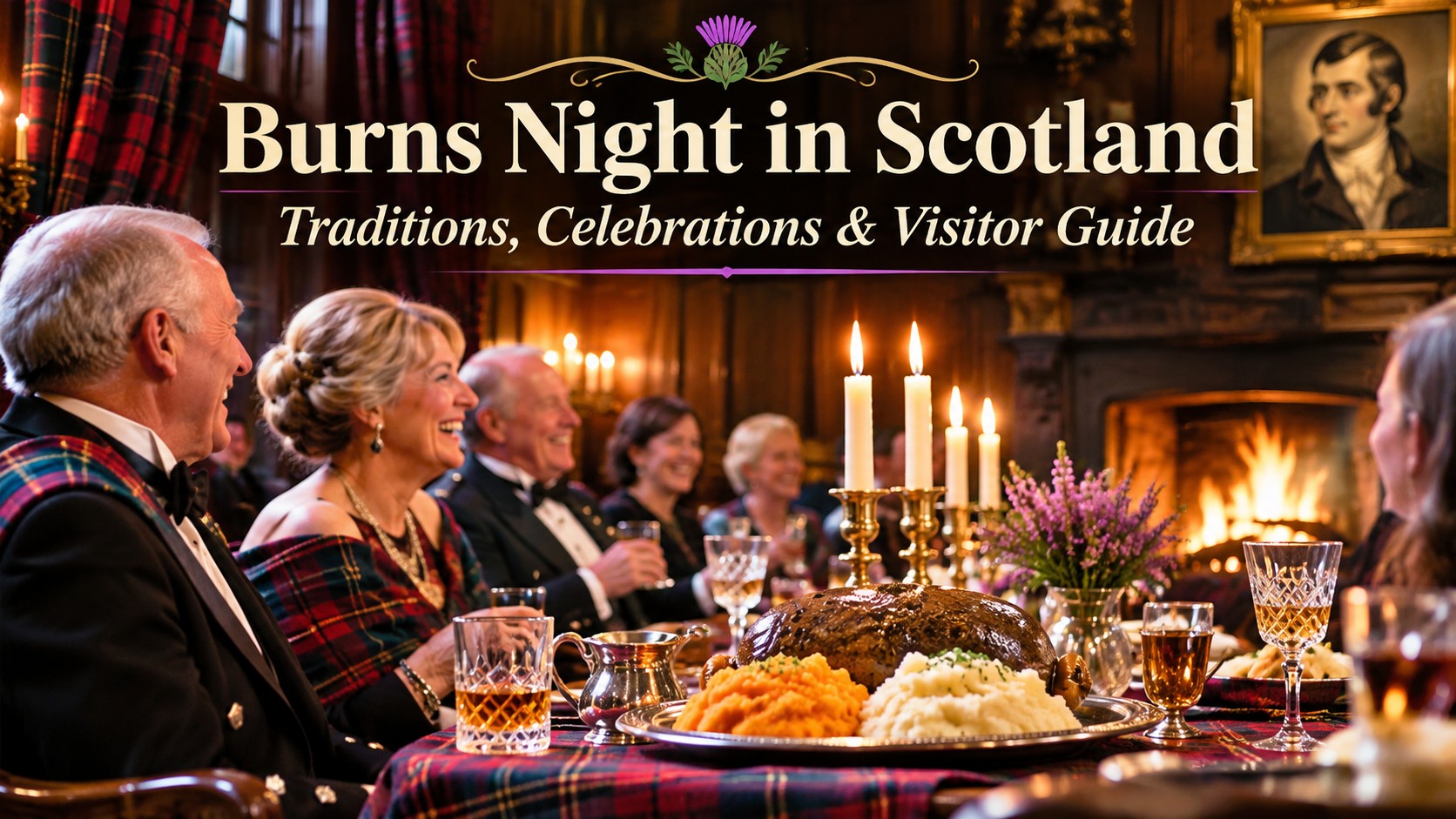
A traditional Burns Night supper celebrates Scotland’s cultural heritage through food, poetry and fellowship.
A winter evening in Scotland can offer something quite different from sightseeing among castles and dramatic landscapes. Burns Night brings people together through food, storytelling, poetry and music, celebrating a literary figure whose work continues to connect generations. For visitors, the attraction is not simply watching a tradition unfold but sharing in an occasion with a distinctive Scottish character.
Whether you would enjoy a ceremonial dinner, a relaxed gathering or exploring the places associated with Robert Burns, there are several ways to approach the celebration. This guide explains the customs, helps you choose an experience and considers the practicalities of travelling in January.
📜 What Is Burns Night and Why Is It Celebrated?
Who Was Robert Burns?
Born in Alloway, Ayrshire, in 1759, Robert Burns grew up in a farming family and became Scotland’s national poet. His writing explored subjects that extended far beyond the rural world in which he was raised, from love and friendship to injustice and human dignity.
His use of Scots alongside English gives much of his work a distinctive voice. Although visitors may recognise Auld Lang Syne from New Year celebrations, Burns’s contribution to Scottish literature and song is considerably wider.
Understanding that breadth helps explain why a supper in his honour can move from affectionate humour to serious reflection within the same evening. The occasion offers a way into Scottish culture through the experiences and emotions expressed in his work.
When Is Burns Night and How Did the Tradition Begin?
Burns Night is traditionally observed on 25 January, the anniversary of the poet’s birth. Its origins, however, lie in a gathering held during summer rather than winter.
On 21 July 1801, five years after Burns’s death, a group of his friends met at his birthplace to remember him over dinner. Their first commemorative supper established the combination of conversation, food and literary remembrance that remains central to the occasion. Later gatherings shifted towards his birthday, with the correct January date adopted by 1803.
Modern celebrations need not fall on the anniversary itself. Organisers may choose a nearby weekend or another convenient evening. If attending a supper is the principal reason for your visit, establish the date of your preferred event before committing to travel. The traditional anniversary is a starting point for planning, not a universal event timetable.
📅 Explore Britain’s Seasonal Celebrations
Burns Night is traditionally celebrated on 25 January, although individual events may take place on other dates. Explore Britain’s wider seasonal calendar for inspiration when planning your winter visit.
Confirm individual event dates, admission and availability with the organiser.
🥃 What Happens at a Traditional Burns Supper?
Piping, Haggis and the Traditional Burns Supper
The meal is often a performance in its own right. A traditional opening may include the Selkirk Grace, a short expression of gratitude before eating. At a more ceremonial supper, the arrival of the haggis can become the focus of the room, announced by bagpipes and accompanied by a procession.
A recital of Address to a Haggis turns an apparently ordinary dish into an occasion for theatrical humour. The poem celebrates the haggis with mock grandeur, and its presentation can be as entertaining as the meal itself.
Traditional haggis combines seasoned meat with oatmeal and onions. It is served with neeps (turnip or swede) and tatties (potatoes). Whisky is a customary accompaniment, but drinking alcohol is not essential to joining the celebration.
Not every venue follows the same sequence or employs a piper. The organiser’s description will give a better indication of the experience than the label Burns Supper alone.
Poetry, Toasts, Music and the Closing Traditions
Beyond the dining table, the celebration is an opportunity to encounter Burns through spoken and sung words. The Immortal Memory is a tribute to the poet, often combining reflections on his character, achievements and continuing relevance.
Other customary speeches include a toast to the lassies and a reply, traditionally delivered with humour. Their style and inclusion can vary, and contemporary hosts may adapt the format to suit their gathering.
Recitations can range from lively storytelling to much quieter moments. Listening to Scots spoken aloud can reveal the rhythm and character of a poem in ways that reading silently may not. Some gatherings also feature Scottish music or dancing, although a ceilidh is not an essential part of every supper.
Auld Lang Syne is a familiar closing song. Here its themes of friendship and remembrance have a particular resonance: the evening ends not merely with entertainment but with a shared expression of fellowship.
Dress, Etiquette and Joining In for the First Time
A kilt is not a universal admission requirement. A formal dinner may have specific dress expectations, while a relaxed supper may welcome ordinary smart clothing. Ask the host rather than purchasing traditional clothing solely for the occasion.
If you are unsure when to stand, join a toast or sing, take your lead from the host and other guests. You need not assume that every invitation involves delivering a speech. Solo visitors may also find it helpful to ask about seating arrangements before booking, particularly if they would prefer a shared table to dining alone.
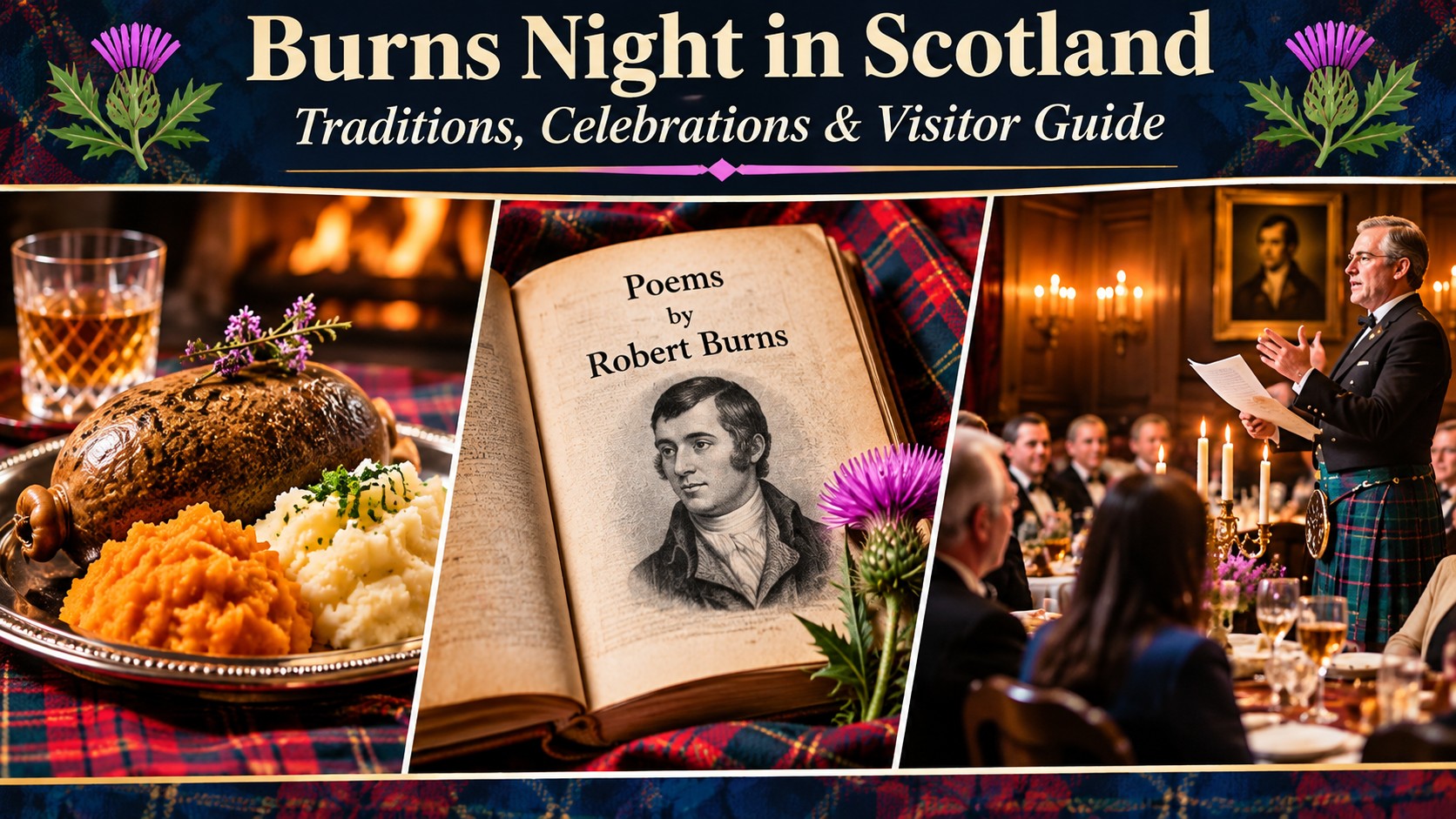
Traditional Scottish food, poetry and recitations are central to many Burns Night celebrations.
🎭 Choosing the Right Burns Night Experience
Formal Suppers, Informal Gatherings and Cultural Performances
Consider whether you want the ceremony, the social atmosphere or the literary heritage to be the main feature of your visit. A full evening around a dining table is a different commitment from a concert or a daytime museum visit. The following comparison describes possible formats rather than guaranteed programmes.
| Experience | Atmosphere and format | Participation | Suitable interests | Access and checks |
|---|---|---|---|---|
| Formal Burns Supper | Structured dinner with ceremonial elements | Listening, toasts and possible shared singing | Traditional customs and dining | Confirm tickets, dress and duration |
| Informal Burns celebration | Relaxed social gathering | Conversation and optional joining in | Sociable, less formal experiences | Check public welcome and meal arrangements |
| Poetry, music or cultural performance | Performance-focused programme | Mainly listening or watching | Literature and music | Confirm programme, seating and admission |
| Burns-related heritage visit | Museum or historic setting | Exploring exhibits and places | History and independent discovery | Check opening, accessibility and ordinary admission |
Public Celebrations, Private Gatherings and Admission Requirements
A public celebration and a private club supper have different admission arrangements. An advertised celebration may require advance tickets, while another gathering may be intended solely for members or invited guests. Do not assume that a restaurant serving a Burns-themed meal necessarily provides the full ceremony.
Check whether admission includes food, entertainment and a reserved seat. Ordinary heritage admission does not automatically include an evening function; assume separate booking unless the organiser confirms otherwise.
📍 Where to Experience Burns Night in Scotland
Alloway and Ayrshire: Exploring Burns’s Early Life
For visitors interested in the relationship between the poet and his surroundings, Alloway offers a particularly meaningful starting point. The Robert Burns Birthplace Museum brings together the cottage where he was born and collections that illuminate his writing and life. The nearby historic landscape includes the Auld Kirk and Brig o’ Doon, settings associated with his poem Tam o’ Shanter.
Exploring these places before a celebration can give the evening a richer context. Allow time for moving between the different parts of the heritage site rather than treating it as a single indoor attraction. Historic surfaces and steps may affect accessibility, so consult the museum’s visitor guidance and check winter opening arrangements before setting out.
Dumfries: Discovering Burns’s Later Life and Legacy
Dumfries offers a different perspective on the poet. Burns farmed at nearby Ellisland before moving into the town, where he spent the final years of his life. Robert Burns House, his final home, offers insight into the poet’s family life. Its entrance steps and narrow staircase warrant an accessibility check before visiting.
Rather than attempting to cover both regions in one short winter day, consider which aspect of his life interests you most. A heritage-focused stay could include an evening celebration. Check winter opening at each historic site, particularly Ellisland, where ordinary visits may be suspended for the season.

Explore Robert Burns’s literary heritage through his birthplace in Alloway and his later home in Dumfries.
Edinburgh, Glasgow and Scotland’s Local Celebrations
For a city break centred on Burns Night, Edinburgh or Glasgow may be practical places to investigate. Look for supper or performance programmes that fit comfortably alongside your other plans, and compare the location of the venue with your accommodation.
A smaller community gathering may appeal if you prefer a more intimate occasion. However, the cultural atmosphere of a local event is no reason to presume that it welcomes uninvited visitors. Confirm admission and consider how easily you can return afterwards, especially outside the larger towns.
Choose your base around the celebration and its logistics.
🏴 Discover More of Scotland During Your Visit
Combine your interest in Scottish culture with wider exploration of Scotland’s landscapes, history and heritage.
Scotland Multi-Day Tours
Consider a longer journey through Scotland’s varied regions.
Check individual itineraries, operating dates and inclusions. Burns Night celebrations are not necessarily included.
❄️ Planning a Burns Night Visit in January
Choosing Dates, Booking Events and Checking Visitor Requirements
Read the programme before booking travel, paying particular attention to the expected finishing time as well as the advertised start.
If you have particular dining or accessibility needs, speak to the organiser before committing. A venue described as accessible may not meet every individual requirement: the route to your table, accessible toilets, seating during performances and the level of background noise may all matter.
For an overnight visit, arrange accommodation around the event schedule. Leave room between daytime activities and the supper so that a delay does not compromise your evening.
Winter Weather, Daylight and Evening Travel
January days are short in Scotland, even as daylight gradually increases. Cold, wet or frosty conditions are typical, and snow or ice may complicate journeys. Check the local forecast rather than expecting a snowy landscape.
If visiting historic places during the day, put outdoor elements earlier in your itinerary and allow time for warming up indoors. Waterproof footwear and layers can be useful even when most of your evening is spent inside.
Evening transport deserves particular attention. Check the last feasible train or bus after your event finishes, allowing time to reach the departure point. An outward service does not establish that a convenient return exists. Staying within a manageable distance of the venue can simplify the evening considerably. Check travel updates close to departure and have an alternative if weather or disruption affects your original arrangements.
Your Burns Night Visitor Planning Checklist
- Date and programme: Confirm the actual celebration date, start, finish and format.
- Admission: Establish whether visitors are welcome, what booking is required and what the ticket includes.
- Dining: Ask about food ingredients, allergies and suitable alternatives.
- Accessibility: Confirm entrances, seating, toilets and any individual assistance requirements.
- Participation: Check dress expectations, age suitability and whether guests are expected to perform or contribute.
- Travel: Arrange accommodation and confirm the return journey after the celebration.
- Contingency: Review the weather forecast, transport updates and cancellation arrangements before departure.
Keep the organiser’s contact details available in case your plans change. If a particular celebration is central to your trip, consider the flexibility of your other bookings before committing to them.
🌙 Plan Your Return Before the Celebration Begins
Will your return transport still be available when the celebration finishes?
01 — Return journey confirmed
Allow sufficient time to reach your departure point after the event.
02 — Return journey uncertain
Confirm alternative transport or consider accommodation closer to the venue.
03 — No reliable return option
Consider a different celebration, venue or daytime cultural experience.
An enjoyable evening begins with a dependable journey home.
🌿 Sustainability and Responsible Cultural Travel
Respecting Scottish Traditions and Local Communities
Burns Night is a living celebration rather than a performance staged solely for tourists. Approach it with curiosity, respect the nature of the gathering and be attentive to the people sharing the occasion with you.
Ask before photographing speakers or other guests, particularly at smaller gatherings. Listen during recitations and follow the host’s guidance when joining in. Visitors can appreciate the humour and warmth of an evening without treating every local custom as a spectacle or expecting each celebration to conform to a prescribed script.
Supporting Local Heritage and Travelling Responsibly
A stay centred on one area can provide time to explore its heritage without unnecessary journeys between distant destinations. Consider locally based accommodation and visits to institutions that care for the places and objects associated with Burns.
Where practical, travel by public transport or share journeys. Winter conditions and late finishing times may limit these choices, so prioritise a reliable and safe return over an impractical transport plan. A thoughtfully arranged visit should benefit from a slower pace without placing unnecessary demands on local services.
❓ Frequently Asked Questions About Burns Night in Scotland
Can Visitors Attend Burns Night Without Knowing Burns’s Poetry?
Yes, provided the gathering welcomes visitors. Prior literary knowledge need not be a barrier. Reading a short poem beforehand, such as To a Mouse, can give you a useful introduction to Burns’s voice, but listening to experienced reciters may be an equally rewarding discovery.
Are Vegetarian and Alcohol-Free Burns Suppers Available?
Yes, vegetarian haggis and non-alcoholic drinks are possible alternatives at Burns Suppers, but confirm availability with the organiser. If you prefer an entirely alcohol-free gathering, check that separately. Anyone with allergies should confirm ingredients and food preparation arrangements directly.
Can Families With Children Attend Burns Night Celebrations?
Family suitability depends on the individual event. Ask about minimum ages, meal options, the length of the programme and how late it finishes. A shorter daytime cultural activity may suit younger children better than a lengthy ceremonial evening with speeches and formal dining.
What Can I Do if I Cannot Attend a Burns Supper?
Build a visit around Burns’s literary heritage instead. Explore a museum, read his work in the landscape that inspired it or look for a suitable music or poetry programme on your dates. Keep an indoor alternative in mind if weather affects your plans.
🌟 Conclusion: Experience Scotland Through Burns Night
Burns Night offers a compelling reason to discover Scotland in January through its literature, hospitality and living traditions. The right experience may be a full ceremonial supper, a smaller gathering or a journey into the places that shaped the poet’s life.
Choose the format that suits your interests, confirm the practical arrangements and allow time to enjoy the occasion. Exploring Scotland’s wider seasonal celebrations can help you discover complementary experiences and shape a rewarding winter visit beyond a single evening.
🧭 Continue Exploring Scotland’s Seasons and Celebrations
Discover more reasons to visit Scotland, from seasonal celebrations and winter experiences to planning a journey at another time of year.
Scotland’s Events Calendar
Explore festivals, cultural celebrations and seasonal events across Scotland.
Winter in Scotland
Discover Hogmanay, winter events and other seasonal experiences.
Scotland Throughout the Year
Compare the seasons and find a time of year that suits your travel interests.