


Scotland Events in Winter: Hogmanay, Christmas Markets and Snowy Highland Escapes
20th August 2026
❄️ Scotland Events in Winter: Hogmanay, Christmas Markets and Snowy Highland Escapes
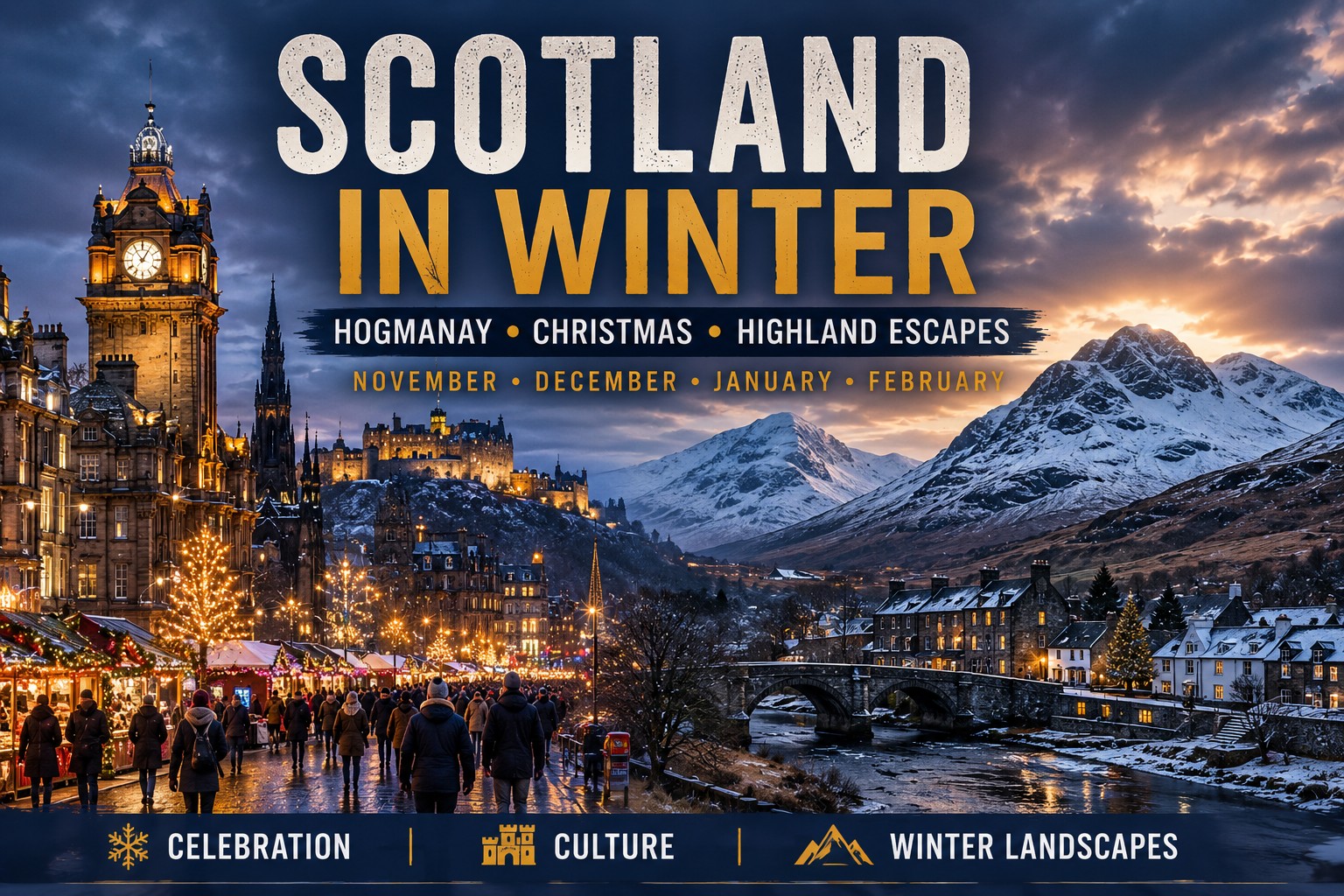
Scotland in winter combines the festive atmosphere of its historic cities with Hogmanay celebrations, Highland scenery and the distinctive landscapes of the colder months
Scotland events in winter bring together some of the country’s most distinctive seasonal experiences: Hogmanay celebrations, festive city streets, Christmas markets, whisky, historic attractions and Highland landscapes transformed by frost, low winter light and, sometimes, snow. It is a Scotland with a character fundamentally different from the long days and fast-moving itineraries of summer.
A winter journey works best when planned for the season rather than against it. Short daylight, variable weather and changing transport or attraction schedules affect what realistically fits into a day, yet those same conditions create much of winter’s appeal. Edinburgh illuminated after dark, the anticipation of Hogmanay, a quiet Highland road beneath snow-dusted mountains or an evening of Scottish food and whisky all feel particularly at home at this time of year.
Snow should be treated as a possibility, never a promise. Higher ground may be white while glens, cities and loch shores remain green, wet or frosty; snow may also fall at lower levels without settling for long. The strongest trip therefore begins by choosing the winter experience that matters most—festive celebration, city culture, Highland scenery or a combination—and building intelligently around it.
| Late November | Festive transition + city culture |
| December | Christmas atmosphere + Hogmanay build-up |
| January | Deep winter + Highlands + whisky + heritage |
| February | Winter landscapes + gradually increasing daylight |
Culture + markets and events + evening atmosphere
Fixed-date celebration + high planning dependency
Winter landscapes + slower touring
Weather-resilient depth + culture and history
🗓️ When Is Winter in Scotland—and Which Month Should You Visit?
Scottish winter is not one uniform travel period. Late November brings the transition into the festive season, December becomes increasingly Christmas-led before building towards Hogmanay, and January and February shift the emphasis towards landscapes, heritage and deeper winter travel.
Choosing the month is therefore one of the most important decisions you can make before choosing the route.
🎄 Late November and December
Late November marks the transition into festive Scotland. Seasonal lights, cultural programmes and Christmas markets may begin appearing in some destinations, while increasingly short days encourage a useful rhythm: prioritise outdoor sightseeing during daylight, then move towards museums, shopping, food and festive experiences as evening arrives.
December intensifies that character. Early and mid-month are predominantly Christmas-led, while the final days shift rapidly towards New Year and Hogmanay. This can be one of Scotland’s most exciting periods, but major celebrations can affect accommodation availability, transport and visitor demand even for travellers who are not attending the headline events.
❄️ January and February
January feels markedly different once Hogmanay has passed. Scotland moves into deep winter, with Highland landscapes, whisky, heritage and city culture taking greater prominence. Daylight remains limited, and some attractions or services may operate differently after the festive period, making current-date checks particularly important.
February remains genuinely wintry, but gradually increasing daylight can provide more scope for scenic travel. Higher ground may retain strong winter character while lower-level snow remains unpredictable.
| Period | Winter character | Particularly good for | Main planning consideration |
|---|---|---|---|
| Late November | Festive season emerging | City breaks, early markets and culture | Shortening daylight |
| December | Christmas + Hogmanay build-up | Festive cities, events and celebrations | Demand around key dates |
| January | Deep winter | Highlands, whisky and heritage | Weather and limited daylight |
| February | Late winter | Scenic escapes and longer touring days | Winter conditions remain variable |
→
🎆 Hogmanay Scotland
→
❄️ Deep Winter Scotland
→
🌤️ Late Winter Scotland
🎆 Hogmanay in Scotland: More Than New Year’s Eve
Hogmanay is one of Scotland’s defining winter traditions, but it extends beyond any single city-centre celebration. Public gatherings, music, midnight festivities and customs such as first-footing can all form part of Scottish New Year, with traditions and participation varying between communities and households.
🎇 Edinburgh Hogmanay
Edinburgh is Scotland’s most internationally recognised large-scale Hogmanay destination. Organised celebrations, live entertainment and the atmosphere of New Year in the historic capital can make it an extraordinary place to welcome the year, but the programme should never be treated as identical from one December to the next.
Ticketing, event locations, access arrangements and transport can change annually. If Edinburgh Hogmanay is the non-negotiable centrepiece of your trip, secure suitable accommodation before constructing the wider itinerary around it. Check the current programme, book essential ticketed experiences where required and consider how you will return to your accommodation after late-night celebrations.
This is a particularly useful Scotland ↔ London bridge. The anchor is completely natural, and the destination introduces the London-to-Edinburgh rail journey without forcing London into the prose. The exact record is present in the supplied master material.
🥂 Hogmanay Beyond Edinburgh
Hogmanay belongs to Scotland rather than to one city. Elsewhere, New Year can involve organised public celebrations, live music, community gatherings and traditions shared among families and friends.
This gives travellers an important choice. Edinburgh offers large-scale spectacle and energy, while another destination may provide a different, more local-scale New Year experience. Neither is inherently more authentic; the right choice depends on how you want to celebrate.
Not every town stages a public visitor event, so current arrangements must be verified rather than assumed.
There is another decision worth making early: is Hogmanay itself the holiday, or the beginning of a longer Scotland journey? Edinburgh can lead naturally into several days exploring the Highlands, while travellers already based farther north may prefer to celebrate locally instead of crossing Scotland solely for New Year’s Eve.
|
🎆 Is Hogmanay the Holiday?
→ Concentrate around the celebration
Give the destination, programme and surrounding festive experience enough time rather than adding unnecessary long-distance travel to a short New Year break.
|
🏔️ Is Hogmanay the Beginning of the Holiday?
→ Protect the fixed event first
Secure the essential Hogmanay arrangements, then build the Highlands, whisky country, heritage or wider Scotland journey around those fixed commitments.
|
🎄 Christmas Markets and Scotland’s Festive Cities
Christmas markets can add considerable atmosphere to a Scottish winter break, but they should rarely be the only reason for choosing a destination. Dates, locations, operators and programmes can change, whereas Scotland’s historic streets, museums, architecture, food and cultural life provide enduring reasons to visit.
The strongest approach is therefore simple: choose a city worth visiting in its own right, then allow its current festive programme to enrich the trip.
🏰 Christmas in Edinburgh
Edinburgh is particularly well suited to this approach. Its Old Town, New Town, castle skyline and historic streets already create a compelling winter city break; festive lights, seasonal entertainment and Christmas markets where operating add another layer rather than carrying the entire experience.
Short daylight can actually help shape the day. Use the brighter hours for Edinburgh Castle, historic streets or other outdoor priorities, then move towards museums, galleries, shopping and cafés as afternoon develops. After dark, festive illuminations, seasonal events, restaurants and the atmosphere of the city itself can take over.
This creates a natural winter rhythm rather than attempting to squeeze a summer sightseeing schedule into December.
Use the brighter part of the day for castles, historic streets, architecture, viewpoints and other outdoor priorities.
As daylight fades, shift naturally towards indoor culture, browsing, food and experiences that do not depend on perfect weather.
Use early darkness to enjoy lights, seasonal programmes and the changing atmosphere of the city.
Let the evening become part of the destination rather than treating it simply as time after sightseeing has finished.
Winter evenings can become a positive part of the itinerary through city lights, performances, music and the character of historic streets after dark.
→
Indoor Culture
→
Festive Evening
→
Dinner
→
City After Dark
✨ Christmas in Glasgow and Beyond
Glasgow offers a different festive character. Its architecture, museums and galleries, shopping, restaurants and renowned music culture provide substantial reasons to visit before any Christmas programme is considered. Seasonal events, lights and markets where operating can then complement an already worthwhile city break.
Elsewhere in Scotland, towns and cities may host Christmas markets, concerts, light displays and community celebrations. These are annually changing opportunities rather than permanent attractions, so check current programmes before building travel around a particular event.
That principle also makes a winter city break more resilient. If weather changes or an individual event is altered, there is still a worthwhile destination to explore.
🏔️ Snowy Highland Escapes: What Winter Scotland Really Looks Like
Leave the festive cities behind and winter takes on an entirely different character. Bare woodland, frost, waterfalls, mountain silhouettes and low seasonal sunlight can give the Highlands remarkable atmosphere even when there is no snow beside the road.
❄️ Will There Be Snow in the Scottish Highlands?
Possibly—but never plan as though it is guaranteed.
Elevation matters enormously. Mountain summits and higher ground can be white while nearby glens remain green, brown or wet. Snow may fall at lower elevations without producing persistent cover, and conditions can change rapidly.
Choose the Highlands because they are extraordinary in winter—not because your holiday depends on every glen being white.

Treat Hogmanay as the fixed point of a Scotland winter trip: choose the destination, verify the current programme, secure accommodation and tickets, arrange transport, then build the wider journey around it
Higher elevations are more likely to retain snow, frost and genuinely wintry conditions when lower landscapes do not.
A valley can remain green, brown or wet while the surrounding mountains look fully wintry.
Snow can fall at lower elevations and disappear quickly, leaving frost, rain or simply cold winter conditions behind.
|
🌨️ Snowfall
≠
A guarantee that snow will settle or remain.
|
🏔️ Higher-Ground Conditions
≠
Conditions in the glen, beside the road or in the nearest town.
|
🏞️ Where Winter Landscapes Can Be Spectacular
Different parts of the Highlands offer different versions of winter. The Cairngorms can deliver a particularly strong sense of high-elevation winter, with mountains forming a dramatic backdrop to carefully planned days. Conditions can vary substantially with altitude, however, so comfortable sightseeing in a valley should never be taken as evidence of equally benign conditions higher up.
Glen Coe and the West Highlands offer another kind of drama. Deep glens, mountain walls, waterfalls and low winter sunlight can make the journey itself memorable. Snow can transform the scenery when it arrives, but clear skies, frost, mist and rapidly changing light can be equally characteristic.
Around Inverness and Loch Ness, travellers can combine Highland landscapes with heritage and a practical regional base. This can work particularly well when you want memorable scenery without making every day dependent on remote roads or extensive outdoor activity.
| Winter experience | Region to consider | Why it works |
|---|---|---|
| Mountain winter landscapes | Cairngorms | Elevation and dramatic winter scenery |
| Scenic Highland journey | Glen Coe / West Highlands | Mountains, glens and low seasonal light |
| Highlands + heritage | Inverness / Loch Ness | Scenic and cultural combination |
| Festive city + Highlands | Edinburgh + selected Highland route | Strong contrast within one trip |
🌌 Short Days, Winter Light and Scotland After Dark
Winter daylight fundamentally changes how Scotland should be explored. A route that appears modest by mileage can become ambitious once viewpoints, meals, photographs and unexpected discoveries consume a limited number of daylight hours.
The compensation is atmosphere. Low-angle winter sunlight can produce remarkable landscapes, while early darkness gives historic streets, festive illuminations, restaurants, whisky experiences and cultural events a larger role in the day’s rhythm.
Away from major light pollution, long nights can also provide excellent dark-sky conditions. The Northern Lights are occasionally visible from Scotland when solar activity, darkness, clear skies and viewing conditions align, but cloud and inherently unpredictable auroral activity mean they should be treated as an exceptional bonus rather than an itinerary promise.
🥃 Whisky, Castles and Weather-Resilient Winter Days
What happens when Scottish winter changes the day’s plan? The strongest itineraries already have an answer.
A winter journey should not depend on ideal outdoor conditions from morning until evening. Scotland’s whisky, heritage and cultural experiences can give each day a second dimension, allowing plans to adapt without making poor weather feel like lost time.
Whisky fits naturally into this balance. A distillery visit can complement time in the Highlands or provide an indoor anchor within a broader touring day, while the stories, production methods and landscapes associated with Scotch whisky add interest beyond the tasting itself. Visitor opening, tour availability and booking requirements vary between distilleries, particularly in winter, so check priority visits in advance.
Castles, museums, galleries and other heritage attractions can perform a similar role. Some remain accessible throughout winter while others reduce opening days or close seasonally. In Edinburgh and Glasgow, major cultural attractions provide additional flexibility when weather changes unexpectedly; elsewhere, verify what is genuinely available before relying on an indoor alternative.
The objective is not to retreat indoors whenever conditions become imperfect. Instead, consider giving each day one priority outdoor experience and one weather-resilient alternative. A scenic morning might lead into a heritage afternoon, while poor visibility in the Highlands could allow a planned distillery, historic site or other indoor experience to become the day’s focus.
|
🌄 Priority Outdoor Experience
✓ Highland scenery
✓ Historic streets
✓ Loch or glen
✓ Outdoor heritage
|
🏛️ Weather-Resilient Alternative
✓ Distillery
✓ Castle where operating
✓ Museum
✓ Gallery
✓ Cultural attraction
|
→
Use the outdoor priority while daylight and visibility support it.
→
Activate the worthwhile alternative rather than forcing the original plan.
🧭 Which Scotland Winter Experience Is Right for You?
The best winter trip depends on what you want the season itself to contribute.
A festive city break suits travellers prioritising Christmas atmosphere, culture, food and straightforward logistics. A Hogmanay journey places New Year at the centre of the holiday. A Highland winter escape prioritises landscapes and slower touring, while a city-and-Highlands combination can deliver the strongest contrast when sufficient time is available.
Trying to maximise all of them within a short break usually creates more travel rather than more Scotland.
Unlike the earlier inspirational Highlands passages, the reader is now explicitly deciding what form their Scotland winter trip should take. That makes the commercial route useful rather than intrusive.
| 2–3 Days | Concentrate Choose one principal winter experience and avoid turning a short break into a long-distance circuit. |
| 4–5 Days | City + One Region Create contrast without forcing excessive movement between distant destinations. |
| 7+ Days | Build a Deeper Combination Add another region only where geography, daylight, weather resilience and transport make the journey realistic. |
| If you want… | Consider… |
|---|---|
| Christmas atmosphere | Edinburgh or Glasgow |
| Hogmanay | Edinburgh or another verified celebration destination |
| Highland winter scenery | Cairngorms, Glen Coe or an Inverness-based journey |
| Festive + scenic contrast | City + Highlands |
| Minimal winter driving | City base + organised excursion or rail where suitable |
+
Geography
+
Weather
+
Seasonal Opening
+
Contingency
=
Realistic Winter Journey
🚆 How to Build a Winter Scotland Itinerary
A good Scotland winter itinerary rewards fewer bases, shorter daily distances and deliberate contingency. Extra destinations are not automatically extra value when daylight is limited and conditions can alter the pace of travel.
🧳 2–3 Days
For two or three days, stay predominantly city-led. Edinburgh or Glasgow provides heritage, culture, food and evening activity regardless of the weather, with scope for one carefully chosen excursion when conditions and daylight suit it.
A short winter break should usually not attempt a broad Highlands circuit. Hours spent travelling between distant destinations consume a disproportionate amount of the usable day.
This exact commercial destination is supplied in the protected master. The placement is particularly natural because the reader has reached an actionable planning decision: remain city-based and use a selected excursion rather than attempting an over-ambitious multi-day circuit.
🚐 4–5 Days
Four or five days create two strong models: one city plus one selected Highland region, or a dedicated Highland stay.
A festive Edinburgh experience followed by several nights farther north can create an excellent contrast. Alternatively, basing yourself around Inverness, the Cairngorms or another carefully chosen region reduces unnecessary movement and provides more flexibility when conditions change.
🗺️ 7 Days or More
A week or longer allows festive or cultural Scotland and the Highlands to complement rather than compete with one another. Edinburgh or Glasgow might begin the journey before several days devoted to Highland scenery, heritage and whisky.
More time should not automatically mean more destinations. Islands, remote regions and long cross-country transfers should earn their place through genuine traveller priorities rather than being added simply because another day is available.
Build some weather flexibility into the longer journey instead of allocating every day to a different destination. If conditions are excellent, that spare capacity creates opportunities; if they deteriorate, one disrupted journey is less likely to unravel the entire itinerary.
📅 Find Hogmanay, Christmas and Winter Events with the BVT Scotland Events Calendar
Winter travel in Scotland is often more date-led than travel during the other seasons. Christmas and Hogmanay create specific windows, while concerts, cultural programmes, seasonal celebrations and other winter events can provide an additional reason to choose one destination over another.
The BVT Scotland Events Calendar can therefore become an early part of the planning process. Start with the dates you can travel, explore what may be happening across Scotland, and then decide whether an event should become the centrepiece of the trip or complement a destination you already want to experience.
A useful winter planning sequence is:
Choose dates → discover events → choose destination → reserve priority experiences → build the surrounding journey
This approach is especially valuable around Christmas and New Year. Major celebrations can affect accommodation availability and transport even when you do not intend to attend the headline event, so understanding what is happening locally can help avoid surprises as well as reveal opportunities.
Always verify final dates, locations, admission arrangements and programmes with the relevant organiser before travelling.
| 🎆 Hogmanay | 🎄 Christmas Events |
| ✨ Festive Programmes | 🎶 Concerts & Cultural Events |
| ❄️ Seasonal Celebrations | 🏘️ Community Events |
→
Discover Events
→
Choose Destination
→
Secure Critical Bookings
→
Build the Wider Journey
⚠️ Practical Winter Travel in Scotland
Winter requires more contingency than any other Scottish season. Short daylight, rapidly changing weather and seasonal operating arrangements can all influence a journey, particularly beyond the major cities.
Check sunrise and sunset for your actual dates and destination before fixing daily routes. In the Highlands, plan around usable daylight rather than mileage alone, allowing time for viewpoints, meals and slower progress when conditions require it.
Weather should influence plans rather than become something an itinerary attempts to defeat. Snow and ice are possible, but conditions can differ considerably between cities, glens, roads and higher ground. Road-based sightseeing is also fundamentally different from winter mountain activity and should be planned accordingly.
Check live conditions close to travel rather than relying on assumptions made when the itinerary was booked. Rail, bus and ferry services should likewise be checked for your actual dates, while Christmas and New Year can bring altered schedules or closures.
The same principle applies to castles, distilleries and other attractions: verify winter opening rather than assuming year-round access.
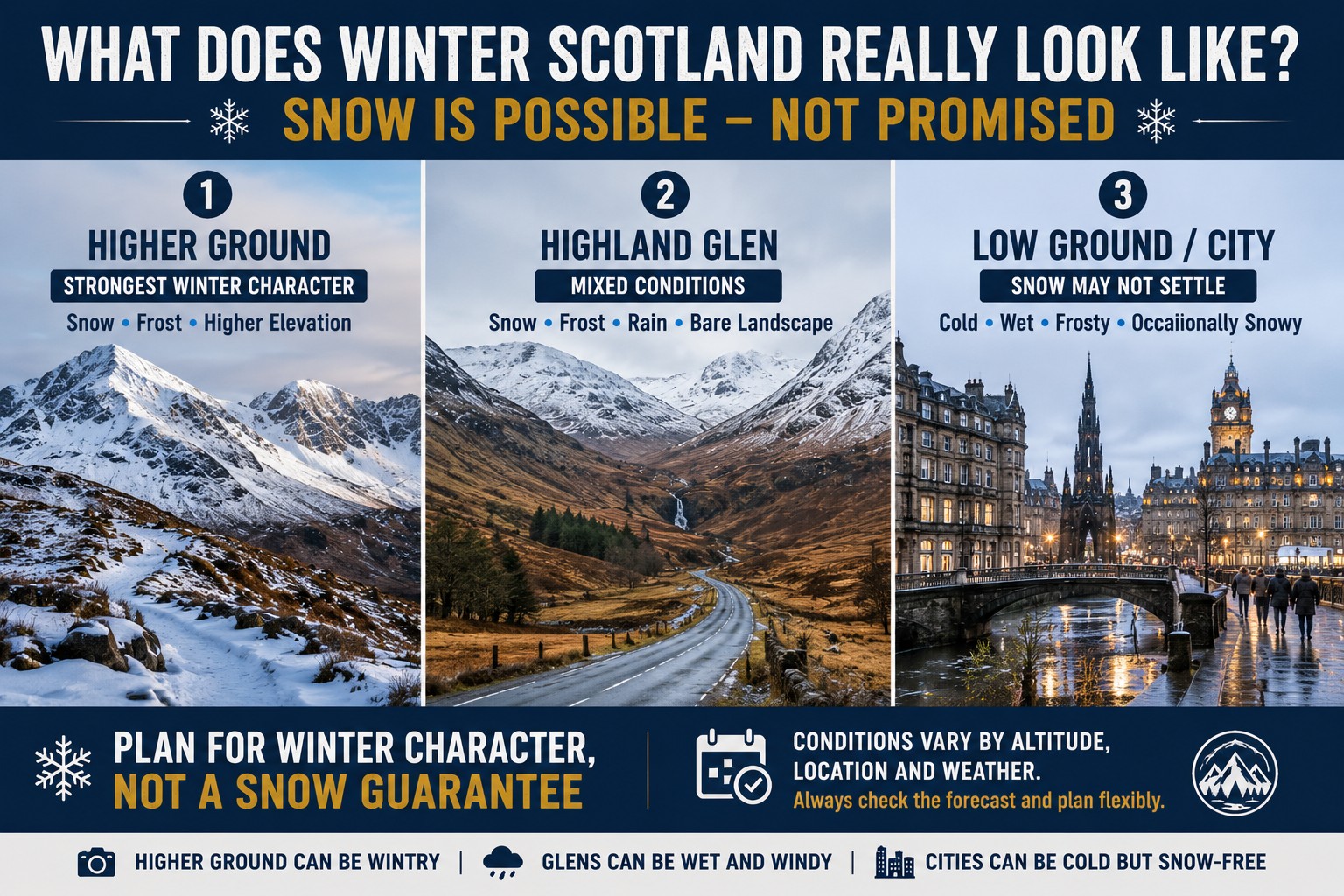
Winter conditions vary dramatically across Scotland, with higher ground often showing stronger snow and frost while Highland glens and cities can remain wet, bare or largely snow-free
→
Weather
→
Roads
→
Transport
→
Opening
→
Plan B
🌱 Responsible Winter Travel in Scotland
Winter travel can support accommodation, restaurants, shops and visitor attractions outside the main summer period, but responsible travel means recognising that not every destination operates with the same capacity throughout the year.
Spending longer in fewer places can reduce unnecessary movement while giving you more time to engage with local businesses and communities. Rail, public transport, organised touring or shared transport may also be useful where practical for the particular journey, especially when they reduce the need for unfamiliar driving in difficult conditions.
Respect the landscape when frost or snow creates tempting photographic opportunities. Do not leave appropriate paths, roads or safe areas simply to reach a photograph, and always give wildlife sufficient space. If weather, road or ground conditions deteriorate, adapting the day’s plans is responsible travel rather than a failed itinerary.
Winter tourism can benefit local businesses, but visitors should never assume that every remote community, attraction or transport service is operating at summer capacity. Check what is genuinely available and plan accordingly.
Slower travel is particularly well suited to this season. Fewer bases, realistic distances and greater flexibility can create a richer journey while reducing unnecessary travel.
Travel with purpose. Explore with care.
Spending locally outside peak summer can help visitor businesses and communities across a quieter part of the year.
Choose the transport combination that suits the real journey rather than assuming every winter route should be driven independently.
Frost, ice or snow can make tempting photographs, but never leave suitable paths, roads or safe areas simply to reach a viewpoint.
Observe without pursuit and avoid adding pressure to wildlife during difficult seasonal conditions.
Concentrating on fewer places reduces unnecessary movement and gives winter conditions more room to shape the day.
→
Less dependence on perfect conditions
→
More opportunity for local benefit
→
A safer and more resilient winter journey
OR
Multi-Day Winter Journey
|
🚌 Scotland Day Tours
Keeping Edinburgh or another gateway as your winter base?
Add one focused Scotland excursion without committing a short winter break to a broad circuit or extensive unfamiliar driving.
Strong fit when you want:
✓ One carefully selected excursion
✓ A city base with culture and evening options
✓ Less pressure to manage a wider winter route yourself
✓ A concentrated experience within limited daylight
|
🏔️ Scotland Multi-Day Tours
DEEPER WINTER JOURNEY
Want several days among Scotland’s landscapes?
Overnight touring can create greater geographical depth across Highlands, lochs, castles and regional Scotland while allowing more time for weather, daylight and seasonal conditions.
Strong fit when you want:
✓ Several days beyond the city
✓ Highland and regional depth
✓ Overnight touring rather than one compressed day
✓ More time to absorb winter scenery at a measured pace
|
→ Keep the reliable base and add one carefully chosen excursion.
→ Give the journey several days rather than trying to compress regional Scotland into one winter outing.
❓ Scotland in Winter FAQs
❓ When is the best time to visit Scotland in winter?
It depends on the trip you want. December is particularly suited to Christmas atmosphere and Hogmanay, while January and February can work better for a more landscape-led winter journey involving the Highlands, whisky and heritage. February also brings gradually increasing daylight.
❓ Does it snow in Scotland in December?
It can, but persistent snow at lower elevations is never guaranteed. Mountain summits and higher ground may be white while cities, glens and loch shores remain green, wet or frosty. Snow can also fall without settling for long, so do not make continuous snow cover essential to the trip.
❓ Is Edinburgh worth visiting in winter?
Yes. Edinburgh’s historic streets, castle, museums, galleries, restaurants and cultural attractions make it particularly well suited to winter, while Christmas and Hogmanay can add exceptional seasonal atmosphere. Short daylight and increased demand around major festive dates should simply become part of the planning.
❓ What is Hogmanay in Scotland?
Hogmanay is associated with Scotland’s New Year celebrations and traditions, ranging from major public festivities and music to gatherings among families and friends. Customs vary between communities, while organised programmes can change annually, so visitors should check current arrangements for their destination.
❓ Are Scotland’s Christmas markets open every year?
Festive markets and programmes can change from year to year, including dates, locations and operating arrangements. Choose a destination for its wider appeal rather than depending entirely on one market, and verify current information before booking a trip around a specific event.
❓ Can You Tour the Scottish Highlands in Winter?
Yes, but winter touring requires realistic distances, flexibility and careful attention to daylight, weather and current road or transport conditions. Concentrating on one region is often more rewarding than attempting an ambitious circuit, particularly during the shortest days of December and January.
❓ What Should You Pack for Scotland in Winter?
Pack adaptable layers, waterproof and wind-resistant outerwear, suitable footwear and cold-weather accessories such as a hat and gloves. Conditions can vary considerably between locations and during a single day, so flexibility is more useful than packing for one predicted version of Scottish winter.
❄️ Let Winter Reveal a Different Scotland
Scotland in winter is not simply the summer landscape experienced in a warmer coat. Hogmanay brings celebration, festive cities glow after early darkness, Highland landscapes gain drama from low winter light, and whisky, heritage and culture become natural companions to time outdoors.
Choose the experience that matters most, reduce unnecessary distance and leave enough flexibility for Scotland’s conditions to influence the journey. Snow may arrive or it may not—but winter has far more to offer than a white landscape alone.
Travel intelligently, and Scotland’s shortest days can reveal experiences no other season can offer.