


Britain’s Seasonal Traditions: A Year of Festivals, Celebrations & Cultural Events
25th November 2026
🎭 Britain’s Seasonal Traditions: A Year of Festivals, Celebrations & Cultural Events
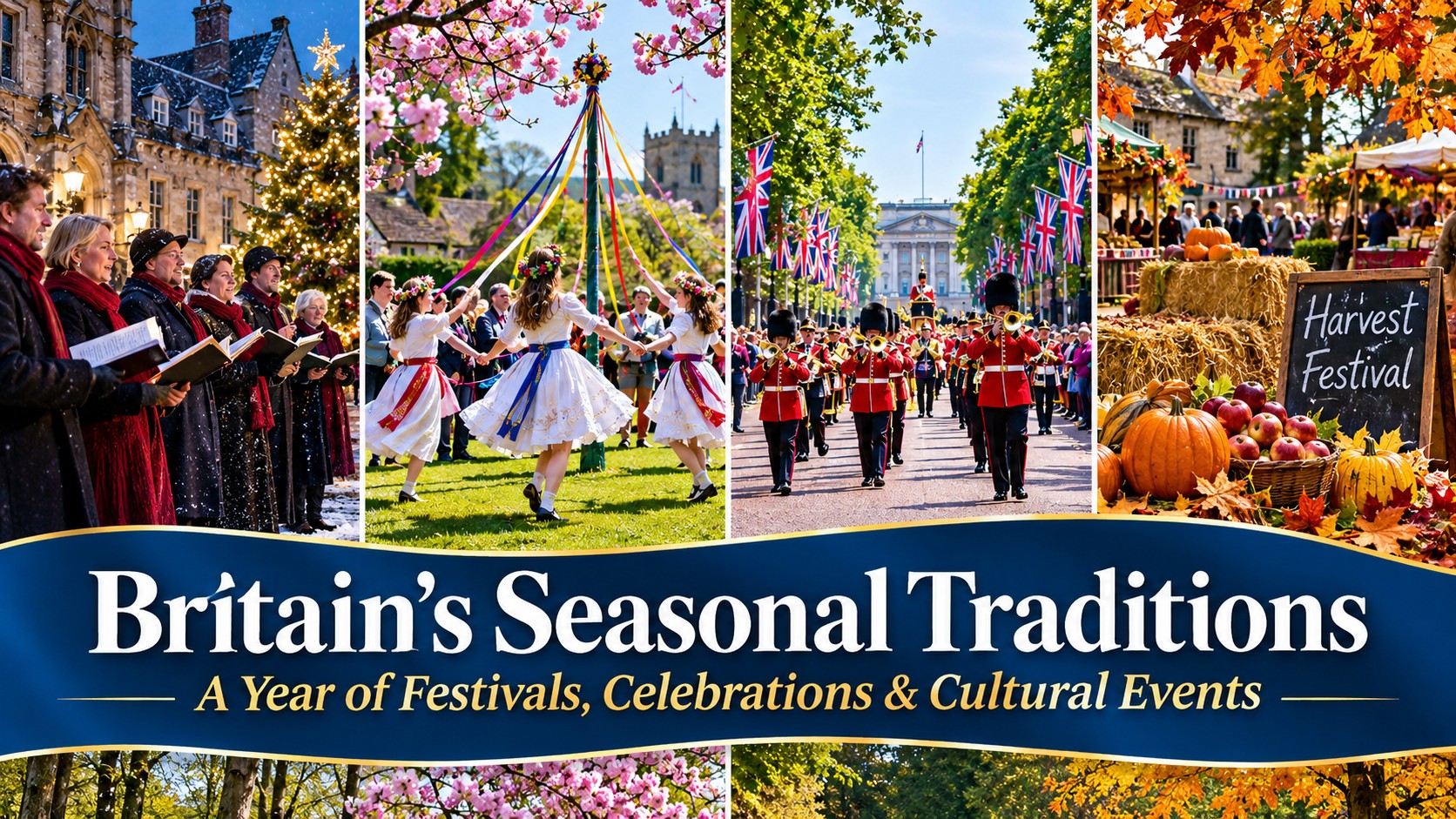
From winter carol singing and spring maypole dancing to summer pageantry and autumn harvest celebrations, Britain’s cultural traditions reflect the changing seasons
Britain’s cultural calendar is more than a succession of holidays. It is a changing landscape of shared meals, music, processions, seasonal rituals and local gatherings, from winter celebrations in Scotland to spring customs in Welsh communities and summer ceremonies at historic places. Some traditions are easy to encounter while exploring a town; others are private, ticketed or subject to special access arrangements.
The most rewarding visit begins by choosing the kind of experience you want, not simply circling a familiar date. Would you rather watch a public spectacle, join a community celebration, learn about a centuries-old custom or attend a contemporary arts festival? This guide follows the cultural year through England, Scotland and Wales, then explains how to check what is actually happening and plan a visit respectfully.
🗓️ Understanding Britain’s Cultural Year
🎉 Traditions, Festivals and Public Celebrations: What’s the Difference?
A tradition is a practice passed on, adapted or revived over time. It might involve food, song, dress or a particular way of marking the seasons. A festival is generally an organised programme of performances or activities, while a public celebration may be a procession, civic occasion or community gathering. These categories overlap, but they are not interchangeable.
Consider a Burns supper: the custom centres on poetry, food and remembrance, yet individual suppers may be private gatherings, community events or ticketed evenings. Likewise, a historic ceremony may be visible from a public space without offering access to its participants or restricted areas. A familiar tradition does not automatically mean there is an event that visitors can attend.
🧭 How Traditions Differ Across England, Scotland and Wales
Great Britain comprises England, Scotland and Wales; the wider United Kingdom also includes Northern Ireland. This guide concentrates on Great Britain rather than attempting to cover every tradition across the UK.
Shared occasions such as Christmas and Easter take on different local expressions. Scotland has particularly prominent Hogmanay and Burns Night traditions. Wales celebrates St David’s Day through cultural symbols, music and community activity. Within England, too, neighbouring towns may have quite different May Day or autumn customs. Local history, language, faith and community preferences all matter. Even where a date is nationally recognised, the visitor experience is usually organised locally.
❄️ Winter Traditions: Firelight, Festivities and New Beginnings
Winter is a season of gathering, storytelling and renewal, but it is important to distinguish the customs people practise from the events destinations advertise. December festivities, New Year celebrations and January commemorations offer quite different experiences.
🎄 Christmas Customs and Community Celebrations
Carols, decorated streets, seasonal services and community performances can make December atmospheric even without a major festival. Some towns arrange light switch-ons or public singing; others emphasise local markets, church events or neighbourhood gatherings. These are examples of recurring festive activity, not confirmation of a programme in any particular year.
Visitors seeking an informal experience might enjoy exploring a decorated town centre and attending a clearly advertised public concert. Those interested in religious services should check the venue’s welcome guidance and behave as guests at an act of worship, not spectators at a performance. Christmas Eve and Christmas Day can also bring closures and altered transport, so a lively Advent visit should not be assumed to resemble a visit on the holiday itself.
🎆 Hogmanay, New Year and Burns Night
In Scotland, Hogmanay refers to New Year celebrations, with traditions including first-footing: visiting a household after midnight, traditionally with symbolic gifts. That is a social custom, not an invitation to enter a stranger’s home. Organised street celebrations or torchlit events, where offered, have their own ticketing, safety and crowd arrangements.
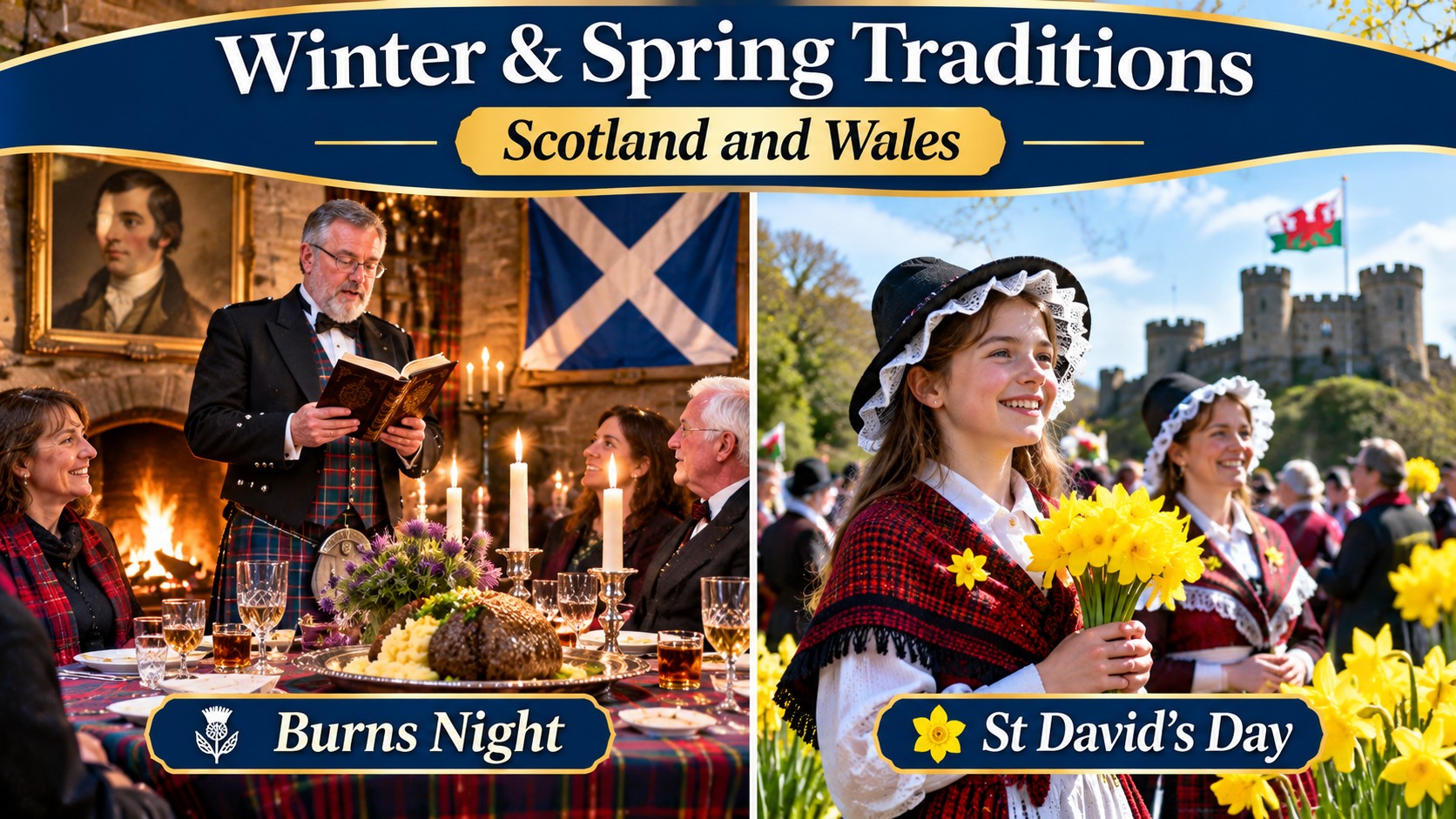
Burns Night, traditionally marked on 25 January, honours poet Robert Burns. Suppers commonly feature haggis, recitations, speeches and music. A public Burns supper may suit someone who enjoys literature and convivial dining more than a crowded outdoor New Year event. Check whether the occasion welcomes visitors and whether advance reservations are required; a tradition’s annual date does not guarantee an accessible local event.
🌱 Spring Traditions: Renewal, Community and Celebration
Spring brings customs associated with preparation, religious observance, flowers and renewed outdoor community life. Some dates move from year to year, while others remain fixed even though the public events surrounding them may change.
🥞 Pancake Day, Easter and Movable Dates
Pancake Day, also called Shrove Tuesday, falls before the Christian season of Lent. Pancake races and community activities are associated with the occasion in some places, but they are not staged in every town. Easter itself is a movable festival, so the dates of Good Friday and Easter-related events change between years.
A visitor might choose a public Easter trail at a heritage property, a community activity or a religious service, but each offers a different type of participation. Check the organiser rather than assuming an attraction’s normal admission includes a special event. Public holidays can also affect opening hours and transport, and the official holiday calendars are not identical across Britain.
🌼 St David’s Day and May Day Customs
St David’s Day, on 1 March, celebrates Wales’s patron saint. Daffodils, leeks, Welsh music and cultural dress are familiar symbols, while individual schools, communities and venues choose how to mark the occasion. Travellers interested in Welsh culture may find a public performance or museum activity more informative than simply searching for a parade.
May Day has a varied history of seasonal celebration. Maypole dancing, flower garlands and May Queens are among the customs recorded in Britain, with different histories and local revivals. In Wales, traditions associated with Calan Mai also mark the arrival of the warmer season. Some present-day gatherings are longstanding community events; others are modern interpretations. Neither their antiquity nor their availability should be assumed without checking local evidence.
Stonehenge’s ancient heritage provides a distinctive connection to Britain’s summer solstice traditions
☀️ Summer Traditions: Ceremonies, Solstice and Festival Culture
Longer days make outdoor gathering appealing, but summer occasions range from contemplative heritage observances to highly organised arts programmes. Their atmosphere, access arrangements and practical demands differ substantially.
🌅 Summer Solstice and Heritage Observances
The summer solstice is an astronomical turning point, associated with the longest period of daylight in the Northern Hemisphere. At Stonehenge, the monument’s relationship with the solstitial sun is a significant part of its interpretation, and modern gatherings give the occasion contemporary spiritual and cultural meaning. That does not mean every claim about ancient ceremonies at the site is established historical fact.
Crucially, ordinary Stonehenge admission, a managed solstice gathering and separately arranged special-access experiences are different arrangements. English Heritage publishes event-specific conditions covering access, transport, parking and protection of the monument. Its summer solstice guidance for 2026, for example, set out free event access alongside pre-booked parking restrictions. That is a historical example, not a promise of identical arrangements in future years. Visitors should consult the current official notice before making plans.
🎺 Civic Pageantry and Summer Arts Festivals
Ceremonial processions, military pageantry and civic occasions can offer memorable public spectacle, but viewing areas, security restrictions and the dates of individual ceremonies depend on the organiser. Seeing a procession from an authorised public area is not the same as admission to a ceremony or reserved seating.
Summer arts festivals provide another route into British culture through theatre, music, storytelling and performance. Some offer free outdoor activities alongside paid productions; others require tickets for almost everything. For a visitor choosing between pageantry and a festival, the key question is whether they want to watch a scheduled ceremony or choose from a programme of performances. The latter may offer greater flexibility, provided the actual programme and accessibility information suit the trip.
🍂 Autumn Traditions: Harvest, Halloween and Bonfire Night
Autumn traditions move from gratitude for the harvest to storytelling, costume and firelit gatherings. Their roots are diverse, and present-day celebrations may differ considerably from the practices that inspired them.
🌾 Harvest Customs and Local Celebrations
Harvest festivals are associated with thanksgiving, seasonal produce and community generosity. Churches, schools and local groups may organise displays, collections or shared events. In rural areas, agricultural shows and food celebrations can provide another perspective on the season, although they are not necessarily harvest festivals in the traditional sense.
For visitors, the most meaningful experience may be a modest local occasion rather than a large attraction. Check whether a gathering is public, whether contributions are expected and whether photographs are welcome. A community’s harvest celebration should not be treated as an open tourist performance simply because it is culturally interesting.
🎃 Halloween and Bonfire Night
Halloween, on 31 October, now encompasses costumes, decorated homes, family activities and themed events. Its customs have evolved through different cultural influences; modern entertainment should not be presented as a direct, unchanged survival of ancient ritual. In Wales, Nos Calan Gaeaf is associated with the turning towards winter, with older folklore describing supernatural encounters and seasonal gatherings; these beliefs should not be confused with confirmed modern visitor events.
Bonfire Night, associated with 5 November and the Gunpowder Plot of 1605, is often marked by organised fireworks or bonfire displays. Actual events may take place on nearby dates, require tickets or impose restrictions for safety and crowd management. Choose an authorised public display rather than assuming any open space permits fireworks or fires. Outdoor autumn evenings may be cold, wet and busy, making weather preparation and a safe journey home particularly important.

Harvest celebrations, Halloween customs and Bonfire Night bring distinctive colour and atmosphere to Britain’s autumn cultural calendar
🧭 Choosing a Tradition to Experience
A good choice balances cultural interest with the kind of day or evening you will actually enjoy. The comparison below describes typical possibilities, not a confirmed programme of events.
📊 Compare the Seasons by Celebration and Visitor Experience
| Season | Representative traditions (qualified) | Cultural/visitor experience | Public access type to check | Main planning consideration |
|---|---|---|---|---|
| Winter | Christmas customs, Hogmanay, Burns Night | Carols, festive streets, communal suppers or New Year spectacle | Public gathering, worship service, private supper or ticketed event | Holiday closures, late-night travel and winter conditions |
| Spring | Pancake Day, Easter, St David’s Day, May Day | Community races, cultural performances, seasonal ceremonies | Public activity, heritage admission, religious service or local celebration | Movable dates, local participation and holiday timetables |
| Summer | Solstice observances, civic ceremonies, arts festivals | Heritage gathering, spectator pageantry or performance | Managed special event, restricted viewing, free programme or paid ticket | Access rules, crowds, outdoor exposure and programme dates |
| Autumn | Harvest customs, Halloween, Bonfire Night | Community gathering, folklore activity or organised display | Local invitation, public event, venue admission or ticket | Weather, event safety and evening transport |
The access column describes possibilities, not confirmed entry rights.
👨👩👧 Match the Experience to Your Travel Style
For families, a daytime museum activity or clearly advertised community celebration may be easier to manage than a late-night crowd. Travellers who enjoy history may prefer a heritage interpretation event, while music lovers might choose a festival with several performances. Those looking for atmosphere without a tightly scheduled itinerary may enjoy seasonal streets and public displays where these are genuinely open.
Accessibility needs deserve more than a generic “accessible” label. Ask about step-free routes, seating, toilets, viewing positions, uneven ground, noise, lighting and the distance between transport stops and entrances. A busy outdoor ceremony can be quite different from an indoor performance even when both relate to the same tradition. Choose the experience first, then verify its actual conditions.
🚆 Planning a Visit Around a British Celebration
The strongest itinerary is built around a confirmed event, with enough flexibility to enjoy the destination even if conditions change. Avoid making a non-refundable journey depend on an event that has not yet been announced.
📅 Confirm Dates, Tickets and Public Access
Use this seven-step checklist before committing to travel:
- Identify the organiser and exact location. A tradition’s name alone may not identify a public event.
- Check the current-year date and programme. Distinguish a fixed observance from a festival scheduled for particular days.
- Establish the access category. Is it open to the public, ticketed, invitation-only, restricted, ordinary admission or a separately booked experience?
- Read accessibility and site rules. Confirm suitable routes, facilities, photography rules and any prohibited items.
- Check transport and connections. Use the relevant operators’ current timetables, including holiday and late-evening services.
- Assess weather, crowds and accommodation. Build in realistic arrival time and an alternative plan.
- Recheck shortly before departure. Organisers and operators may amend arrangements, particularly for outdoor events.
A seasonal events calendar can help identify promising occasions; use the official organiser to confirm the programme and admission rules.
🧳 Allow for Regional Travel and Seasonal Conditions
A cultural weekend usually works better when centred on one town or region than when it attempts several distant celebrations. Consider arrival and departure times, the last practical train or bus, and whether the event finishes after local services become limited. For an evening display or a sunrise gathering, an overnight stay may be more realistic than a same-day return.
Weather preparation also changes with the occasion. Winter streets and autumn fireworks call for warm layers and a dry-weather fallback; summer gatherings may involve long periods standing outdoors, limited shade or uneven ground. Check the Met Office forecast near departure rather than relying on seasonal averages. For heritage sites, confirm the route from the entrance or transport drop-off to the actual event area, not just the attraction’s general address.
🗓️ Discover Britain’s Seasonal Celebrations
From traditional community gatherings and cultural festivals to heritage ceremonies and seasonal celebrations, Britain’s cultural calendar offers many different ways to experience the country throughout the year.
Explore our Seasonal Events Calendar for inspiration, then confirm current dates, locations, public access and ticket requirements directly with the relevant organisers before making your travel arrangements.
🌿 Sustainability and Respectful Cultural Travel
🤝 Respect Local Customs, Communities and Event Rules
Celebrations belong first to the people who sustain them. Follow an organiser’s instructions, respect religious or private gatherings and ask before photographing participants, especially children. A local custom is not automatically a performance staged for visitors.
At heritage locations, remain within authorised areas and do not touch protected structures or leave offerings, decorations or litter. At fire-based events, obey barriers and steward directions. Respectful attendance helps communities continue traditions without unnecessary disruption or damage.
🚉 Reduce Unnecessary Travel and Waste
Where practical, use public transport and explore several nearby cultural places on the same visit rather than making repeated long journeys. Check that the last service is genuinely usable before choosing rail or bus for a late event; a theoretically available route is not always a workable one.
Carry reusable essentials where permitted, dispose of waste responsibly and support local businesses without assuming every gathering welcomes commercial activity. At crowded or fragile locations, travelling at a less pressured time may provide a better experience for both visitors and residents. The goal is thoughtful participation, not an unsupported claim that any particular journey is automatically sustainable.
❓ Frequently Asked Questions About Britain’s Seasonal Traditions
Which British Traditions Can Visitors Experience Without a Ticket?
Some public parades, community activities and seasonal displays may be free to watch, while suppers, performances and managed heritage events can require booking or have restricted entry. The individual event’s admission conditions determine whether visitors can attend without a ticket.
Are Britain’s Festival Dates the Same Every Year?
No. Certain observances have fixed calendar dates, including St David’s Day and Burns Night, while Easter and Shrove Tuesday move. Organisers may also schedule celebrations on a convenient weekend rather than the traditional date. Always check the current programme.
Do England, Scotland and Wales Celebrate the Same Traditions?
Some occasions are widely shared, but regional identities and local histories shape how they are observed. Hogmanay is particularly associated with Scotland and St David’s Day with Wales; individual towns may also maintain customs not found elsewhere. Local programmes vary.
How Far Ahead Should I Check an Event Before Travelling?
Check before booking any essential transport or accommodation, then revisit the organiser’s information as departure approaches. Ticket releases, access conditions and transport details may be announced at different times. There is no reliable universal booking window for all British celebrations.
🌟 Conclusion: Find Your Place in Britain’s Cultural Year
Britain’s traditions offer many ways to connect with a place: hearing poetry at a winter supper, watching spring customs return to a village, encountering a summer ceremony or sharing the atmosphere of an autumn celebration. The best experience is not necessarily the largest or most famous. It is the one that matches your interests, respects its hosts and can actually be visited on your chosen dates.
Start with the season and cultural experience that appeal to you, compare the practical options, then confirm the organiser’s current arrangements before travelling. That simple sequence turns a fascinating tradition into a confident, considerate visit.
🧭 Continue Exploring Britain’s Cultural Year
Once you have discovered the traditions and celebrations that interest you, explore Britain’s seasonal events, compare travel months, understand changing visitor conditions or discover one of the country’s most significant seasonal heritage destinations.
🎭 Discover Britain’s Seasonal Events
Explore festivals, celebrations and seasonal experiences throughout Britain’s cultural year.
📅 Choose Your Travel Month
Compare Britain’s weather, daylight, events and visitor experiences month by month to help choose the right time for your trip.
🍂 Understand Britain’s Changing Seasons
Discover how seasonal weather, daylight and visitor crowds can influence your travel plans and the experiences you choose.
🌅 Discover Stonehenge Through the Seasons
Explore Stonehenge’s changing seasonal atmosphere, heritage significance and practical considerations when choosing a time to visit.