


Autumn in Scotland: Highlands, Colours, Events & Visitor Guide
25th November 2026
Autumn in Scotland: Highlands, Colours, Events & Visitor Guide

Autumn colours transform Scotland’s Highland landscapes, with golden woodland, dramatic hills and tranquil lochs
Autumn in Scotland can mean golden woodland beside a quiet loch, cloud drifting across a Highland glen or an evening spent enjoying local food and culture after a day outdoors. But these experiences do not arrive everywhere at once. A wooded valley in Perthshire, an exposed mountain landscape and a city-based break can feel very different during the same week.
The best Scottish autumn trip starts with three decisions: when to go, which landscape matters most and how much flexibility you need. This guide compares September, October and November, explores suitable regions and explains how to plan around changing weather, daylight, events and transport. Rather than promising perfect foliage or an uninterrupted itinerary, it helps you choose a trip that suits your interests and circumstances.
🍂 What Autumn in Scotland Really Looks Like
🌳 Woodland Colour, Highland Scenery and Regional Differences
Scotland’s autumn appeal is not limited to trees turning red and gold. Deciduous woodland can bring striking colour to sheltered glens, loch shores and forest walks, while evergreen conifers provide a darker backdrop. In open Highland country, the spectacle may be the shape of the mountains, changing light, russet vegetation and reflections on water rather than a continuous canopy of colourful leaves.
This distinction matters when choosing where to stay. If your priority is a woodland walk surrounded by autumn leaves, focus on places with accessible deciduous woodland. If you prefer wide horizons, lochs and dramatic mountain views, the Highlands can reward a visit even when trees are sparse or their leaves have fallen. Coastal landscapes and historic towns offer further alternatives when woodland conditions disappoint.
Colour varies by tree species, location and the weather experienced during the season. A photograph taken in one forest during a previous October is inspiration, not a promise for the dates of your visit.
🌦️ Weather, Daylight and Changing Conditions
Scottish autumn weather can shift quickly, particularly in upland and exposed areas. Rain, wind, low cloud and wet paths may affect what you can see or comfortably do. Conditions can also differ between sheltered towns, coastal glens and exposed mountain routes. Consult the forecast for your actual destinations and activities: long-term climate averages cannot predict the conditions on an individual holiday.
Daylight becomes progressively shorter from September towards November. That makes the timing of walks, scenic drives and return journeys increasingly important. Plan the most exposed or demanding activity for a suitable daylight window, carry appropriate layers and be willing to change plans when forecasts or local advice warrant it.
🗓️ September, October or November: Choosing Your Travel Window
🌤️ September: Earlier Autumn and Longer Outdoor Days
September can suit travellers who want a mixture of late-summer greenery and the first signs of autumn. Compared with later months, it generally offers more daylight for sightseeing, walking and longer journeys. Some woodland may still look predominantly green, however, especially early in the month or where colour develops later.
Choose September if you value time outdoors more than the prospect of widespread autumn leaves. It can work particularly well for a flexible road trip or a base with several excursion options. Check the forecast and local conditions rather than assuming that an earlier autumn visit guarantees settled weather.
🍁 October: Woodland Colour and Seasonal Atmosphere
October is often the month visitors associate most strongly with Scottish autumn colour. Woodland areas around Highland Perthshire, for example, are well known for their seasonal appeal. Yet the timing and intensity of colour depend on local conditions, so no single week can be recommended with certainty across the country.
For a colour-focused break, select a woodland-rich area and leave room to adjust your walks or viewpoints. Combine forests with lochs, villages or indoor attractions so the holiday remains worthwhile if heavy rain, wind or an early leaf fall changes the scene. October is a sensible starting point for planning, not a guaranteed peak-colour appointment.
🌫️ November: Quieter Landscapes and Shorter Days
November offers a different kind of visit: subdued woodland, atmospheric skies, waterside views and the possibility of spending more time in towns, galleries or welcoming indoor venues. Some areas may feel quieter than during popular holiday periods, although crowds depend on location and events.
By November, shorter days and potentially more demanding weather make ambitious outdoor itineraries less forgiving. A scenic drive or low-level walk may still be enjoyable, but the plan should have realistic timings and alternatives. Do not assume that every seasonal attraction remains open, that mountain paths are suitable or that snow will be present.
📊 Autumn Month-by-Month Decision Table
| Travel window | Potential highlights | Main trade-offs | Best suited to | Check before booking |
|---|---|---|---|---|
| September | Longer outdoor windows; early seasonal change | Many woods may still be green | Walkers and flexible explorers | Forecast, route conditions and local events |
| October | Potential woodland colour; lochside atmosphere | Peak colour varies; wet or windy days possible | Foliage-focused visitors | Current woodland reports and access |
| November | Moody scenery; cultural and city breaks | Shorter days; some seasonal restrictions | Travellers comfortable with flexible plans | Daylight, venue hours and transport |
The best month depends on what you would regret missing. For extended outdoor days, September may have the edge. For woodland colour, October is a useful focus. For a quieter-feeling, culture-led break, November may be appealing. None removes the need for local checks.
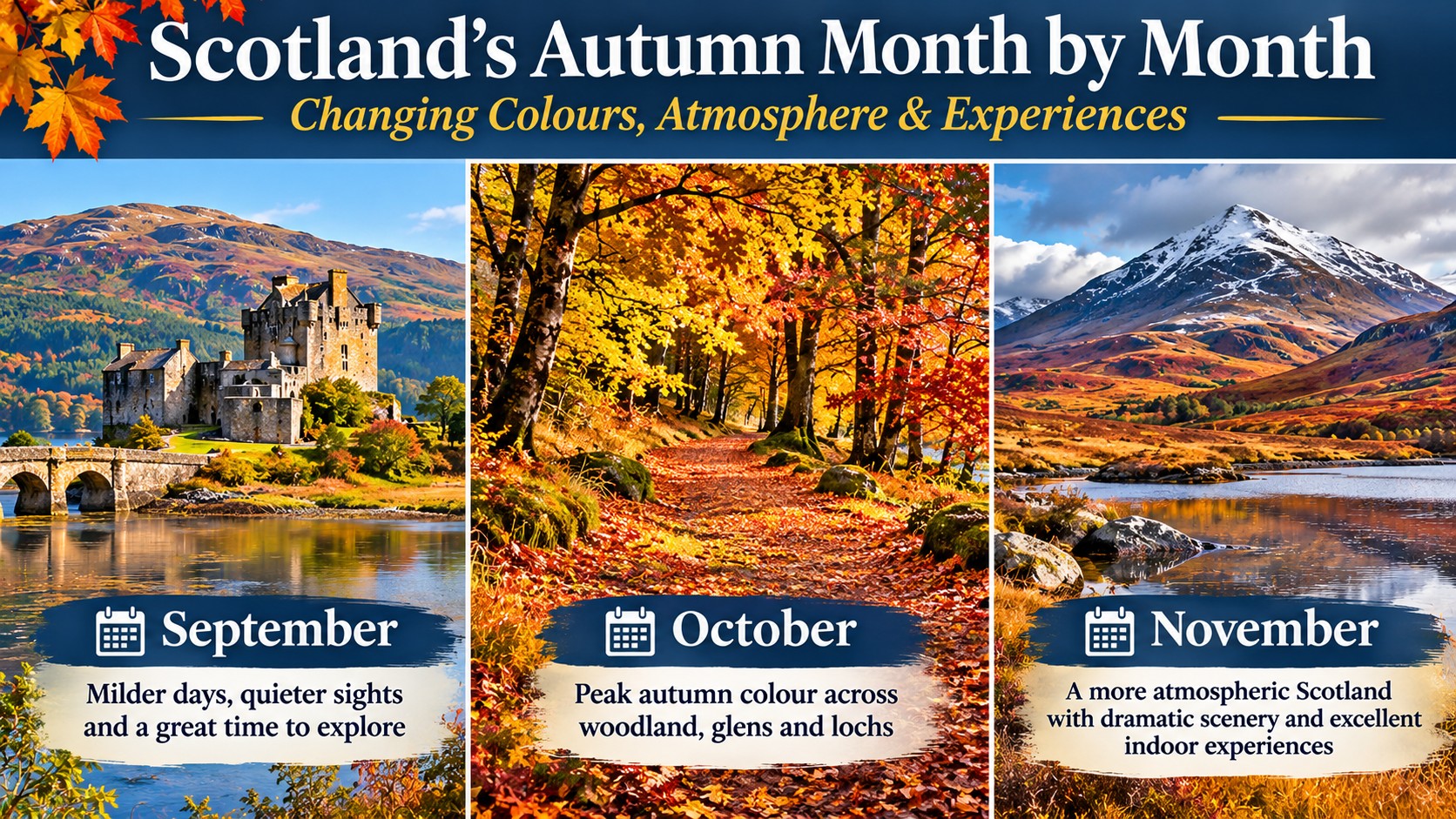
From September’s early autumn landscapes to October’s woodland colours and November’s atmospheric Highland scenery, Scotland offers varied seasonal experiences
🏞️ Where to Experience Scotland’s Autumn Landscapes
⛰️ The Highlands: Lochs, Glens and Open Mountain Scenery
The Highlands are a strong choice for visitors drawn to scale and atmosphere. Lochs, steep-sided glens, mountain silhouettes and shifting cloud can be memorable without a carpet of autumn leaves. Where woodland lines a glen or loch, seasonal colour may add contrast to the surrounding hills.
A Highland trip works best when you accept that conditions can limit visibility and access. Build an itinerary around a manageable area rather than trying to cover widely separated locations in a short daylight window. Roads can be slower or more demanding than a map suggests, while remote viewpoints may have limited facilities. Mountain walking requires separate preparation and current route-specific advice; an attractive viewpoint photograph does not establish that a route is easy or safe.
Choose the Highlands for dramatic landscapes and a willingness to adapt. Choose a more woodland-focused region if seeing leaves at close quarters is the overriding aim.
🌲 Perthshire and the Cairngorms: Woodland and Forest Settings
Perthshire offers a particularly persuasive autumn combination of deciduous trees, riverside paths and loch scenery. Around places such as Dunkeld and Pitlochry, visitors can seek woodland experiences without making a demanding mountain outing the centre of every day. Forestry and Land Scotland highlights Scottish woods for autumn colour, while VisitScotland identifies Highland Perthshire as a notable autumn destination.
The Cairngorms add a different mix of pinewoods, broad glens and mountain scenery. Not every forest is deciduous, so a walk through native pinewood may feel very different from a leafy riverside route. Choose individual walks for their actual setting, distance, gradients and facilities rather than assuming that all forests offer the same colour or accessibility.
These areas can suit travellers who want woodland as the main attraction but still appreciate varied scenery. Check path notices and forestry operations before setting out, especially after strong winds.
🌊 Loch Lomond and the Trossachs: Lochside and Woodland Choices
Loch Lomond and the Trossachs offer a practical contrast between waterside scenery, wooded slopes and more open hill country. For a visitor who wants scenic stops without committing to a long mountain walk, a carefully chosen lochside base can provide several types of outing within one region.
The important distinction is between a place being scenic and a particular route being suitable. Some viewpoints involve uneven surfaces, steep approaches or limited parking, while other locations may offer shorter paths or facilities. Consult current national park and site information for the exact walk, visitor centre or access point you intend to use.
This region can be attractive when you want a balance of woodland, water and adaptable day plans. Allow for weather changes rather than treating a single panoramic viewpoint as the sole purpose of the trip.
🚉 City Bases and Countryside Excursions
A Scottish city break can also include autumn scenery. Edinburgh, Glasgow, Stirling or Perth may provide a base for museums, restaurants and transport-connected outings, depending on your chosen destination and current services. The advantage is flexibility: if a countryside excursion becomes impractical, there may be appealing indoor alternatives close to your accommodation.
The limitation is the final leg of the journey. A train reaching a town does not necessarily take you to a forest trail, viewpoint or accessible path. Check onward buses, walking distances, return connections and whether the attraction operates on your intended day. A car-free itinerary is often possible, but it must be built around actual connections rather than broad assumptions about regional coverage.
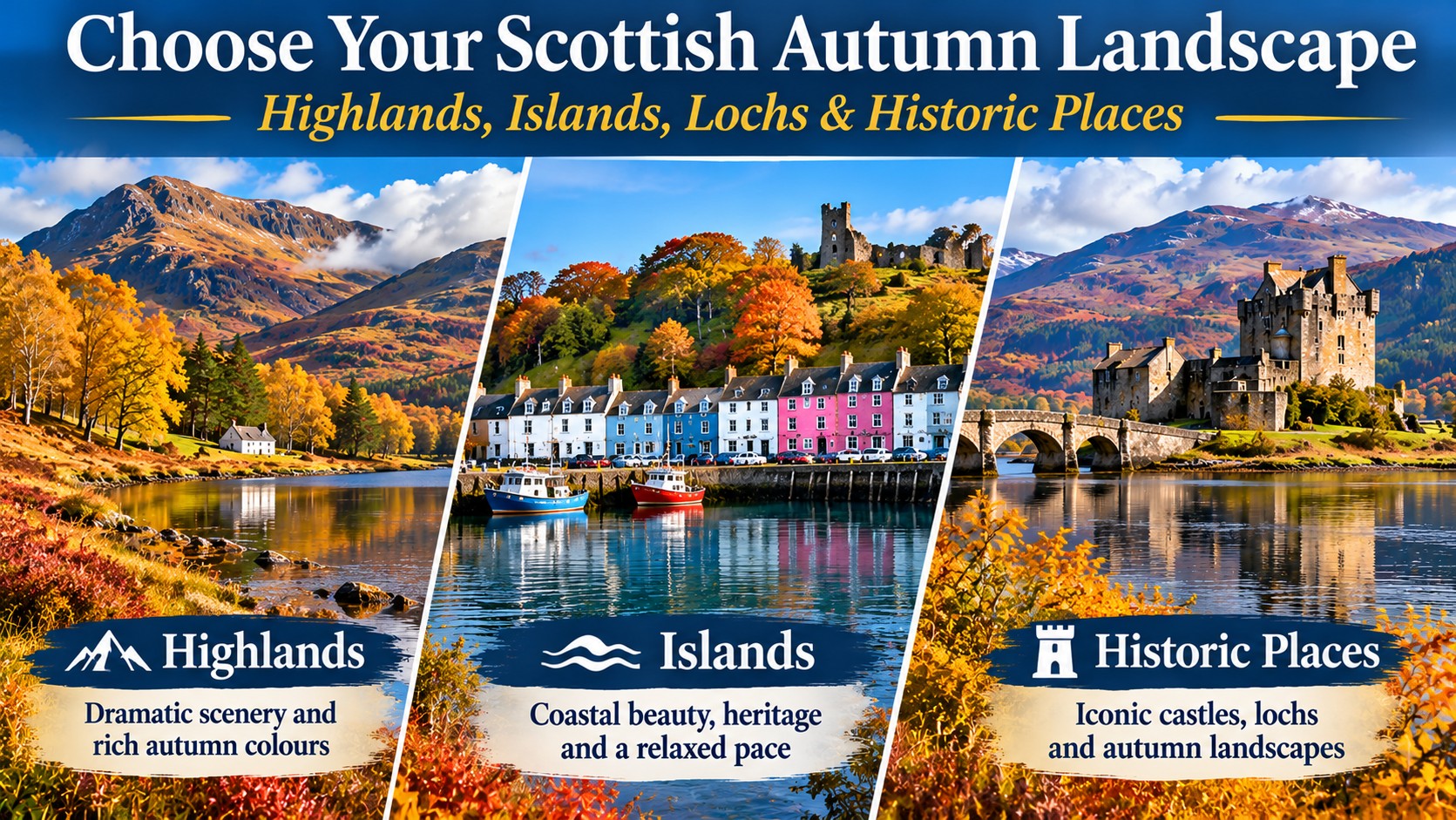
Explore Scotland’s varied autumn landscapes, from colourful Highland woodland and mountain glens to tranquil lochs and historic settings
🧭 Regional Experience Comparison
| Area/landscape | Main autumn appeal | Travel style | Key limitation/check |
|---|---|---|---|
| Highlands | Lochs, glens and expansive mountain scenery | Flexible touring or carefully chosen base | Exposure, travel time and changing conditions |
| Perthshire and Cairngorms | Woodland walks, forests and mixed upland scenery | Woodland-focused stay with selected excursions | Tree mix, trail condition and access notices |
| Loch Lomond and the Trossachs | Lochside views and wooded hills | Scenic base with adaptable outings | Route-specific gradients and facilities |
| City bases and countryside excursions | Culture plus reachable outdoor experiences | Rail-based or mixed city-and-country break | Final-mile links and return timetables |
For the strongest woodland emphasis, investigate individual Perthshire walks or suitable wooded areas of the Trossachs. For open landscapes, give the Highlands more weight. For a trip without a car or with uncertain weather, start by identifying a base with dependable alternatives.
🎉 Autumn Events, Culture and Seasonal Experiences
🥃 Festivals, Food, Whisky and Local Traditions
Autumn travel in Scotland need not revolve around scenery alone. Depending on the place and year, visitors may find food celebrations, book or arts events, music, whisky-related experiences and local seasonal traditions. A distillery visit, for example, may provide an indoor alternative to a wet afternoon, but tours, accessibility and admission arrangements depend on the individual venue.
Events are most valuable when they fit your interests and geography. A festival several hours from your chosen Highland base can complicate an otherwise relaxed trip. Decide whether a particular event is the main reason for travelling or simply a welcome possibility if dates align. This keeps the itinerary useful even when a programme changes.
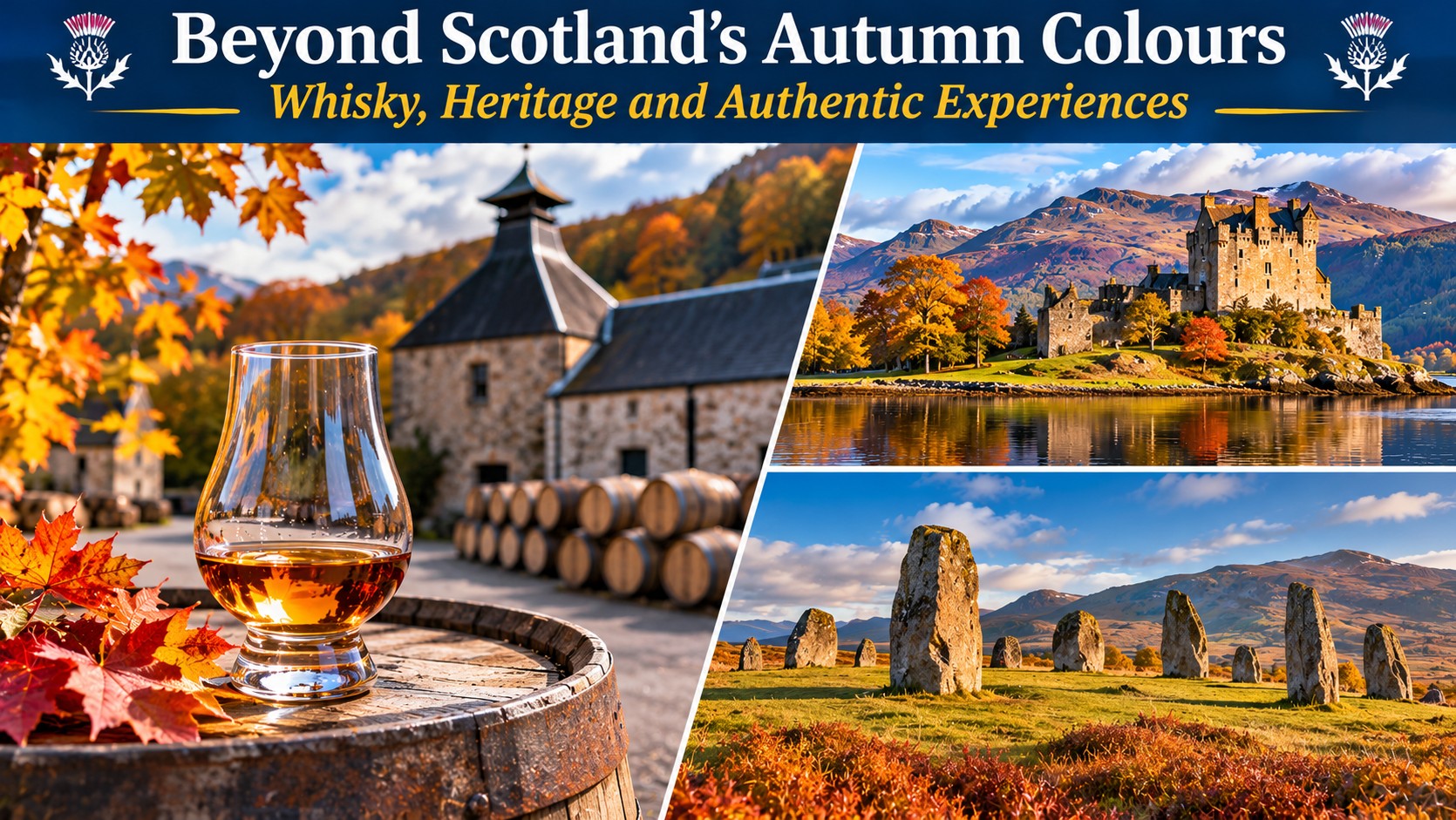
Discover Scotland beyond its autumn colours through whisky heritage, historic castles and scenic railway experiences
📅 Planning Around Confirmed Event Dates
Recurring festivals and annual traditions are not the same as confirmed performances or ticket availability. Check the organiser’s current programme, exact venue, admission rules and any changes before making non-refundable plans. Some events may require advance tickets; others may be accessible without booking, but neither arrangement should be assumed.
A seasonal events calendar can help identify what to investigate across the travel period. Use it as a planning starting point, then confirm details directly with organisers. If your trip is primarily about autumn landscapes, leave sufficient time for weather-dependent outdoor choices rather than filling every day with fixed appointments.
🗓️ Plan Your Scottish Autumn Visit Around Seasonal Events
From food and whisky experiences to cultural celebrations and local traditions, seasonal events can help shape the dates and destinations you choose for your Scottish autumn break.
Explore our Seasonal Events Calendar for inspiration, then confirm current dates, venues, admission arrangements and ticket requirements directly with the relevant organisers before finalising your plans.
🧳 Planning a Confident Scottish Autumn Visit
🚗 Driving, Rail and Other Transport Choices
A car can make it easier to combine rural viewpoints and smaller villages, especially where public transport is limited. The trade-off is responsibility for unfamiliar roads, parking, changing visibility and potentially difficult conditions. Avoid planning long drives after an ambitious walk when daylight is limited.
Rail can work well for journeys between major towns and selected scenic destinations, but it does not solve every rural connection. ScotRail timetables, local buses and any relevant ferry services should be checked for the precise travel date. Allow realistic time for transfers and an alternative if a connection is disrupted. Traffic Scotland and the relevant operator are useful checks for road conditions and service notices, rather than sources of guaranteed journey times.
For a short visit, one well-chosen base may offer more enjoyment than frequent hotel changes. If a particular walk or attraction is essential, work backwards from its access arrangements before selecting accommodation.
🥾 Walks, Viewpoints, Accessibility and Weather Alternatives
Choose outdoor activities by their actual route characteristics. A short distance on a map can still involve steps, slippery stones, steep gradients or exposed ground. Visitors with mobility needs should look for current site-specific accessibility information, including surface type, toilets, parking and any assistance available. Do not assume that a national park or scenic area has uniformly accessible facilities.
For hill walks, consult appropriate mountain forecasts, route guidance and safety advice, and be prepared to abandon a plan. Lower-level woodland paths are not automatically risk-free after heavy rain or strong winds. Carry suitable footwear and waterproof layers, tell someone your intended route when appropriate and plan to finish within daylight.
Keep a practical alternative for each outdoor day: a town visit, museum, gallery or confirmed indoor experience. This is not a consolation prize; it is how a changeable-season itinerary stays enjoyable.
✅ Essential Pre-Travel Checklist
- Check the regional forecast close to departure and again before exposed outdoor activities.
- Confirm daylight hours and clock changes for the exact date, especially when planning a late return.
- Review path, hill and forestry conditions, including any safety notices or temporary restrictions.
- Verify road, rail, bus or ferry operations for the routes you will actually use.
- Check attraction opening hours and booking requirements rather than relying on summer arrangements.
- Confirm event dates, venues and ticket conditions with the current organiser.
- Check route and venue accessibility against the needs of everyone travelling.
- Keep a suitable bad-weather alternative and allow flexibility in the daily schedule.
These checks are particularly important when an itinerary combines remote scenery, fixed accommodation and a time-sensitive event. Make the plan resilient before you travel, not only when a disruption occurs.
♻️ Responsible Autumn Travel in Scotland
Scotland’s landscapes are living environments as well as visitor attractions. The Scottish Outdoor Access Code asks people enjoying access rights to respect others, care for the environment and take responsibility for their actions. Those rights apply to much land and inland water when exercised responsibly; they are not permission to drive onto land, enter every building or ignore site-specific restrictions.
Stay clear of forestry work and follow reasonable local safety advice. Avoid damaging young trees or sensitive ground, leave gates as you find them and take litter home. Keep dogs under proper control, particularly near livestock or wildlife. After muddy woodland visits, cleaning footwear and equipment can help reduce the spread of tree pests and diseases.
Where a practical rail, bus or shared journey suits the itinerary, consider it. More importantly, choose realistic routes and support local communities without placing unnecessary pressure on fragile paths or working landscapes.
❓ Frequently Asked Questions
🍁 When Is the Best Time to See Autumn Colours in Scotland?
October is a useful month to investigate for woodland colour, especially in areas known for deciduous trees, but there is no guaranteed national peak. Species, altitude, local weather and the particular year all matter. Choose a suitable woodland region, consult current local updates and include other experiences in case the colour is earlier or later than expected.
⛰️ Are the Scottish Highlands Worth Visiting in November?
They can be, particularly if you enjoy atmospheric lochs, glens and a slower-paced landscape break. November is less suitable for travellers who need long daylight hours or predictable mountain conditions. Choose a manageable base, check roads and weather, and favour flexible low-level activities unless you have the experience and current information for more demanding routes.
🚆 Can You Enjoy Scotland in Autumn Without a Car?
Yes, provided the trip is designed around places with suitable rail or bus connections and realistic onward access. A city or transport-connected town can be a practical base for selected excursions. Check the final journey to each trail or attraction, the return timetable and any accessibility requirements. Remote Highland stops may be much harder to combine without a car.
🎟️ Do Scottish Autumn Events Need Advance Booking?
It depends on the event and organiser. Ticketed performances, specialist tours and popular experiences may require reservations, while other activities may not. Check the current programme, admission arrangements, cancellation terms and transport before committing. A recurring event name alone does not confirm that a particular year’s programme or tickets are available.
🌄 Conclusion: Choose the Autumn Scotland Trip That Suits You
A rewarding Scottish autumn visit is not about finding one supposedly perfect week. It is about matching your priorities to the season: September for longer outdoor opportunities, October as a starting point for woodland colour or November for atmospheric scenery and a more culture-led break. The Highlands, Perthshire, the Cairngorms and the Trossachs each offer different combinations of landscapes and practical demands.
Choose your month and region together, then test the itinerary against transport, daylight, weather, accessibility and any confirmed events. With a flexible plan and realistic expectations, Scotland’s autumn can be memorable whether the trees are glowing, the hills are misty or the afternoon is best spent exploring somewhere indoors.
🧭 Continue Exploring Scotland
Once you have chosen the autumn experiences that appeal to you, explore Scotland’s destinations, compare other travel seasons, discover local events or consider organised touring options.
🏞️ Discover More of Scotland
Explore Scotland’s Highlands, islands, historic cities and varied landscapes as you develop your wider travel itinerary.
🍂 Compare Scotland Through the Seasons
Discover how Scotland’s landscapes, weather and visitor experiences change throughout the year to help you choose the right travel window.
📅 Discover Scottish Events
Explore Scotland’s regional events calendar for further inspiration, then confirm dates and arrangements directly with the relevant organisers.
🚌 Explore Organised Scottish Touring
If you prefer to explore Scotland through an organised itinerary, discover multi-day touring options featuring its Highlands, islands, lochs and castles.