


Hidden London: Lesser-Known Places Worth Visiting
25th October 2026
🏛️Hidden London: Lesser-Known Places Worth Visiting
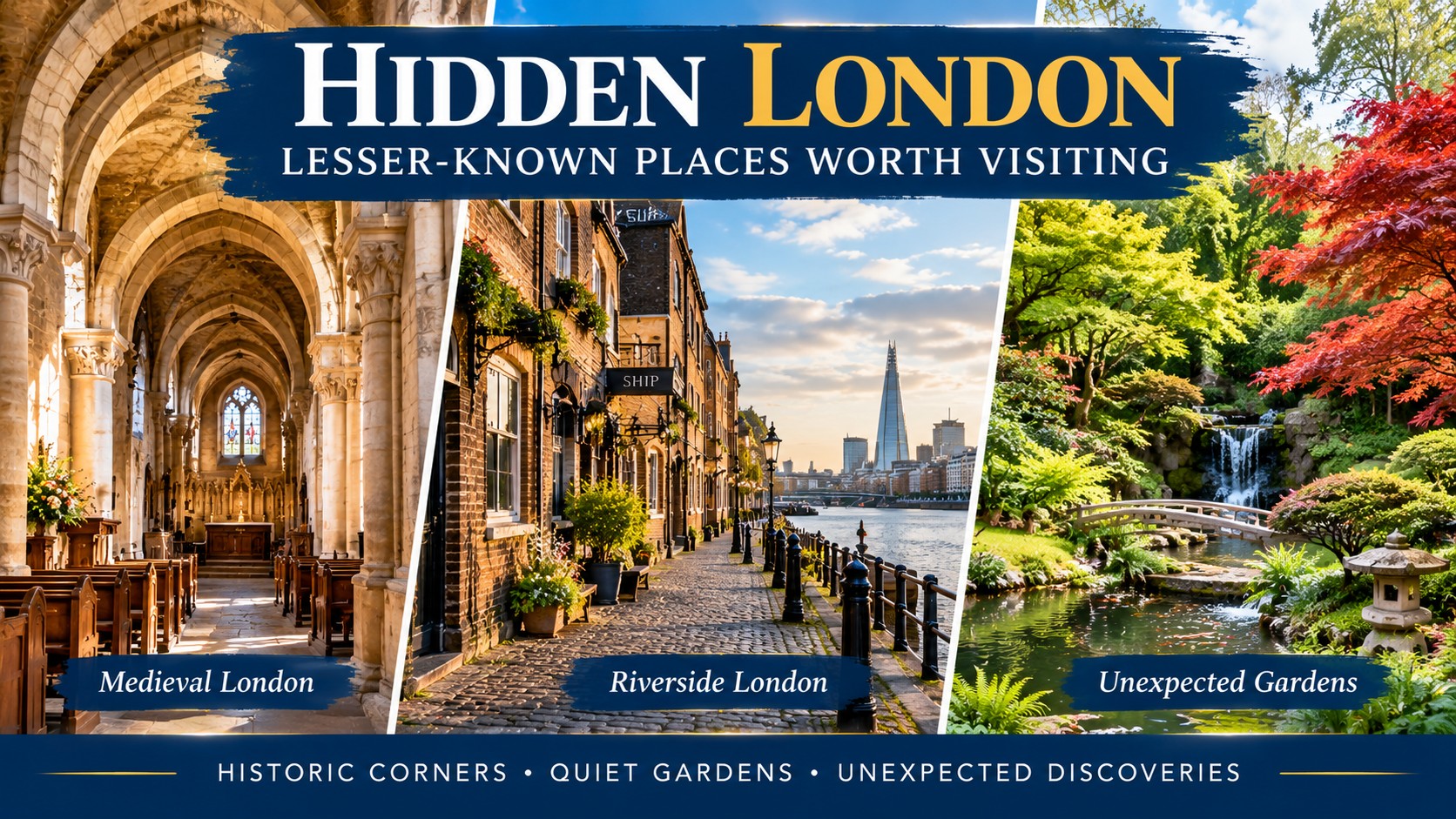
Discover another side of London, from atmospheric medieval churches and historic Thames-side streets to unexpected gardens and peaceful green spaces beyond the capital’s famous landmarks
London’s most famous landmarks tell only part of the city’s story. Beyond Buckingham Palace, the Tower of London and Westminster lies another London: medieval churches tucked between modern buildings, remarkable historic houses, atmospheric riverside streets and unexpected gardens.
Some of these places are easy to overlook. Others are familiar to Londoners but rarely feature prominently in a first-time visitor’s itinerary. What connects them is not secrecy, but the opportunity to experience something distinctive.
Yet discovering lesser-known London requires a little judgement. An unusual historic house might justify planning an afternoon around it, while a beautiful garden or intriguing memorial may be most rewarding when exploring the surrounding neighbourhood.
London is also a vast city. Travelling between scattered attractions can consume valuable sightseeing time, particularly when smaller venues have restricted visiting arrangements.
This guide introduces ten lesser-known places worth considering, explains what makes each special and helps you choose the discoveries that best suit your interests, available time and wider London plans.
🧭 What Makes a Lesser-Known London Place Worth Visiting?
London has countless intriguing corners, but not every unfamiliar street, garden or building deserves a special journey. The most rewarding discoveries offer something beyond novelty: a compelling story, an unusual setting, architectural significance or an experience that reveals another dimension of the capital.
🔎 Hidden, Overlooked or Simply Less Visited?
The term hidden London can be misleading. Some supposedly secret locations are established attractions with dedicated visitor programmes. Others are public spaces that attract plenty of local residents but receive relatively little attention in conventional tourist itineraries.
A place does not need to be deserted to feel like a discovery.
Sir John Soane’s Museum, for example, is well known among architecture enthusiasts, yet visitors concentrating on London’s major museums may overlook it. Similarly, Wapping’s historic riverside streets are hardly unknown, but they offer a different experience from the capital’s familiar sightseeing routes.
The more useful question is not whether somewhere is truly hidden, but whether visiting it will add something memorable to your understanding of London.
⭐ How to Judge Whether a Discovery Is Worth Your Time
Four considerations can help distinguish a worthwhile discovery from an unnecessary detour.
Distinctive character comes first. Does the place offer an atmosphere, setting or experience you would struggle to find elsewhere?
Historical or cultural substance adds depth. An atmospheric building becomes more rewarding when you understand the people, events or traditions behind it.
Personal interest matters just as much. Someone fascinated by medieval architecture may find a historic church more compelling than a landscaped garden, while another visitor might feel precisely the opposite.
Finally, consider the effort involved. A remarkable location across London may justify a dedicated visit, but a smaller discovery is often best enjoyed while exploring somewhere nearby.
The following ten places offer different rewards. Rather than attempting to see them all, consider which would make your particular London visit more interesting.
🏛️ Hidden Historic London: Remarkable Places Beyond the Famous Landmarks
London’s history is not confined to palaces and nationally famous monuments. Some of its most evocative places are smaller buildings where centuries of architecture, everyday life and human experience remain unusually tangible.
🏺 Sir John Soane’s Museum — An Extraordinary House of Art and Architecture
In Lincoln’s Inn Fields, Sir John Soane’s Museum offers an experience quite unlike that of a conventional art gallery.
The museum occupies the former home of Sir John Soane, the influential architect whose collection includes antiquities, architectural fragments, paintings and objects gathered throughout his life.
Rather than being displayed in spacious modern galleries, many of these treasures inhabit a remarkable arrangement of rooms, passages and carefully controlled light.
The building itself is central to the experience. Mirrors, unexpected viewpoints and ingenious use of limited space reveal Soane’s architectural imagination. The interiors reward close observation, with details that can be easy to miss when moving too quickly.
For visitors interested in design, historic interiors or unusual collections, this is one of London’s most rewarding smaller museums.
It deserves more than a hurried glance, particularly if you enjoy understanding how architecture shapes the experience of a space. However, the historic building also presents practical considerations, so check current visitor arrangements and accessibility information before travelling.
⛪ St Bartholomew the Great — Medieval London Still Standing
Near Smithfield, the Priory Church of St Bartholomew the Great offers a striking encounter with medieval London.
Founded in the twelfth century, the church preserves remarkable Norman architectural features, including substantial stone arches that evoke a city far older than the streets surrounding it.
Its atmosphere is particularly compelling because the building remains a place of worship rather than simply a preserved historic attraction. Visitors can appreciate its architecture while recognising that religious life continues within its walls.
For anyone interested in medieval history, the church offers a perspective on London quite different from the grandeur of Westminster Abbey or St Paul’s Cathedral.
It works particularly well as part of a wider exploration of Smithfield, where surviving historic features and modern city life sit closely together.
As an active church, visiting arrangements may be affected by services or other activities. Check current access information and any admission requirements before making a special journey.
🏘️ Dennis Severs’ House — An Immersive Journey into London’s Past
In Spitalfields, Dennis Severs’ House offers one of London’s most unusual encounters with history. Rather than presenting the past through conventional museum displays, the house creates the impression that its inhabitants have only just stepped out of the room.
The experience unfolds through carefully arranged interiors, furnishings, lighting and everyday objects. Each room contributes to an imagined story of domestic life, inviting visitors to notice details and interpret the atmosphere for themselves.
What makes the house distinctive is its emphasis on imagination. It is not a straightforward reconstruction of one documented family’s life, but an artistic interpretation that evokes different periods of London’s past.
The surrounding Spitalfields neighbourhood adds another dimension. Its streets retain connections with London’s history of migration, trade and craftsmanship, making the house particularly interesting within its wider setting.
Visitors who enjoy storytelling, historic interiors and unconventional cultural experiences may find Dennis Severs’ House especially memorable. Those expecting explanatory panels and a traditional museum format should approach it differently.
This is best treated as a planned experience rather than a casual stop. Visit formats and booking arrangements can vary, so check the current programme before travelling.
🧱 Postman’s Park — A Small Place with a Powerful Human Story
A short distance from St Paul’s Cathedral, Postman’s Park offers something quieter and more personal than London’s monumental landmarks.
Its most remarkable feature is the Memorial to Heroic Self-Sacrifice, conceived by artist George Frederic Watts. The memorial commemorates ordinary people who lost their lives while attempting to save others, with individual ceramic tablets recording their names and acts of courage.
These brief accounts transform an otherwise modest City park into a moving place of reflection. They offer a perspective on London’s history that focuses not on monarchs, politicians or celebrated figures, but on everyday people and extraordinary acts.
Postman’s Park is particularly worthwhile for visitors interested in social history or those seeking a thoughtful pause while exploring the City of London.
It is not somewhere most travellers need to dedicate an entire afternoon. Its strength lies in the meaning concentrated within a relatively small space, making it a rewarding addition to nearby sightseeing.

Discover two extraordinary historic houses in London. Sir John Soane’s Museum reveals architectural imagination and remarkable collections, while Dennis Severs’ House offers an atmospheric journey into London’s domestic past
🌿 Quieter London: Gardens, Green Spaces and Unexpected Retreats
London’s green spaces extend far beyond its famous Royal Parks. Smaller gardens and unusual landscaped settings can reveal surprising contrasts between nature, architecture and the surrounding city.
These three discoveries offer different experiences, from a Japanese-inspired garden to an atmospheric pergola and a contemporary roof garden.
🌸 Kyoto Garden in Holland Park — A Peaceful Landscape Within the City
Within Holland Park in west London, Kyoto Garden provides an elegant contrast to the surrounding urban environment.
Created as a Japanese-style landscape, the garden features carefully arranged planting, water and stone, with a waterfall and pond contributing to its distinctive atmosphere.
Its appeal lies in the sense of design and balance rather than its size. Visitors interested in gardens, photography or simply enjoying a slower pace may appreciate the opportunity to observe its details.
However, Kyoto Garden is neither a secret nor guaranteed to be quiet. Its beauty attracts visitors, particularly during pleasant weather and popular visiting periods.
The most satisfying approach is often to explore it as part of a wider visit to Holland Park rather than travel across London expecting an isolated sanctuary.
🌳 Hampstead Pergola and Hill Garden — An Atmospheric Garden Escape
Hampstead Pergola and Hill Garden offer a very different kind of green-space experience.
The pergola’s raised walkways, architectural features and surrounding planting create an atmosphere that can feel surprisingly removed from central London’s busy streets.
Originally associated with the ambitious garden landscape of a wealthy Edwardian residence, the setting combines formal design with a romantic, sometimes weathered appearance.
For photographers, garden enthusiasts and visitors interested in unusual architecture, it can be particularly rewarding. Seasonal changes also affect its character, making the experience different throughout the year.
Its location in north London means it generally requires more deliberate planning than a quick stop near Westminster or the City.
Visitors should check current access arrangements and consider the physical characteristics of the site, including steps and changes in level, before travelling.
🌱 Crossrail Place Roof Garden — Greenery Above Canary Wharf
In Canary Wharf, Crossrail Place Roof Garden demonstrates how contemporary London can incorporate greenery into a densely developed business district.
The garden occupies a distinctive structure above the Elizabeth line station complex, bringing planting and sheltered public space into an area better known for towers, offices and modern architecture.
Its appeal comes partly from the contrast. Rather than escaping the city entirely, visitors experience a designed garden surrounded by evidence of London’s commercial and architectural transformation.
This is particularly interesting for travellers who enjoy contemporary architecture, urban regeneration and the changing character of Docklands.
However, it is unlikely to justify a long cross-city journey for every visitor. Its greatest value often comes when combined with wider exploration of Canary Wharf.
Check current public access arrangements before visiting, as operational restrictions can affect individual spaces.
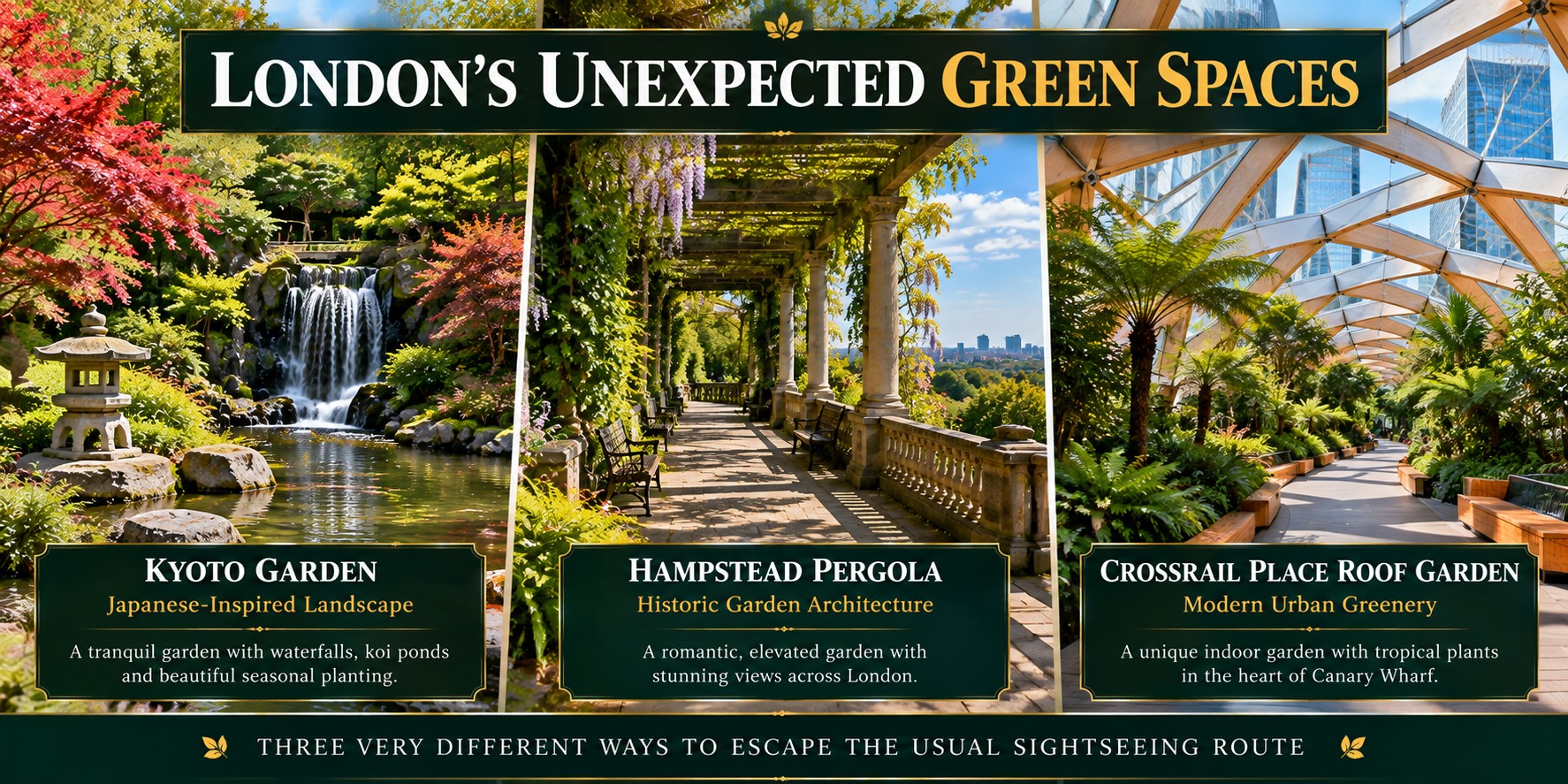
Discover three unexpected green spaces in London, from the Japanese-inspired beauty of Kyoto Garden and the romantic architecture of Hampstead Pergola to the contemporary urban greenery of Crossrail Place Roof Garden
🏙️ Discover London’s Character Through Its Lesser-Known Streets and Neighbourhoods
Some of London’s most rewarding discoveries are not individual attractions at all. They are neighbourhoods where waterways, architecture and everyday life reveal how the capital has developed.
These places reward curiosity and unhurried exploration rather than a tightly scheduled sightseeing checklist.
🏡 Little Venice — Waterside London Beyond the Thames
Near Paddington, Little Venice offers a gentler perspective on London through its canals, narrowboats and attractive waterside surroundings.
The meeting of waterways around the area creates a distinctive setting, particularly for visitors more familiar with the Thames and central London’s monumental architecture.
Part of its appeal is simply walking beside the water, observing the boats and appreciating how the canal network forms another layer of the city’s transport and industrial heritage.
Little Venice is not particularly secret, and its most attractive stretches can be busy. Nevertheless, it offers a worthwhile change of atmosphere for visitors who enjoy relaxed neighbourhood exploration.
Rather than treating it as a major attraction requiring several hours, consider incorporating it into a broader visit around Paddington or the nearby canal paths.
🎨 Leake Street Arches — London’s Changing Street-Art Landscape
Close to Waterloo station, Leake Street provides a striking contrast to London’s historic churches, gardens and conventional galleries.
The railway tunnel is particularly associated with graffiti and street art, with colourful work covering much of the surrounding surfaces. Its appearance changes as artists add new pieces and existing work is painted over.
This constantly evolving character is central to the experience. Visitors encounter a living urban art environment rather than a permanent collection with fixed exhibits.
It is especially appealing to those interested in contemporary culture, photography and London’s alternative creative spaces.
Leake Street is best approached as a relatively brief discovery while exploring Waterloo and the South Bank. The tunnel is an active urban environment, so visitors should expect its atmosphere and artwork to vary rather than anticipate a quiet gallery experience.
⚓ Wapping — Historic Riverside London Without the Landmark Crowds
East of the Tower of London, Wapping offers a different perspective on the Thames and the capital’s maritime past.
Its historic associations with docks, warehouses, riverside trade and working London remain visible in parts of the streetscape, even as former industrial buildings have acquired new uses.
The appeal here is less about reaching one famous monument and more about noticing the relationship between the river, older buildings and the neighbourhood’s changing identity.
For visitors interested in maritime history and atmospheric urban exploration, Wapping can provide a rewarding alternative to London’s more heavily visited central waterfront.
It is best explored without rushing, allowing time to appreciate the streets and publicly accessible riverside viewpoints.
Remember that many attractive historic buildings are now private residences or commercial premises. Respect entrances, courtyards and residential spaces rather than assuming that every interesting doorway or waterfront passage is open to visitors.
📊 Which Hidden London Places Are Best for You?
The best discovery depends on what interests you and how much effort you want to devote to reaching it.
Some places offer substantial experiences in their own right. Others are most rewarding when incorporated into a nearby walk or a day already planned around that part of London.
| Place | Main appeal | London area | Best suited to | Planning judgement |
|---|---|---|---|---|
| Sir John Soane’s Museum | Remarkable historic interiors | Holborn | Art and architecture enthusiasts | Check visitor arrangements |
| St Bartholomew the Great | Medieval architecture | Smithfield | History lovers | Combine with nearby historic sights |
| Dennis Severs’ House | Immersive historical atmosphere | Spitalfields | Unusual cultural experiences | Plan around available visits |
| Postman’s Park | Memorial and human stories | City of London | Reflective short visits | Excellent nearby addition |
| Kyoto Garden | Japanese-inspired landscape | Holland Park | Garden enthusiasts | Explore the wider park |
| Hampstead Pergola | Atmospheric garden architecture | Hampstead | Photography and gardens | Worth a deliberate outing |
| Crossrail Place Roof Garden | Modern urban greenery | Canary Wharf | Architecture and contemporary London | Best when already nearby |
| Little Venice | Canal-side neighbourhood | Paddington area | Relaxed exploration | Allow time to wander |
| Leake Street Arches | Changing street art | Waterloo | Contemporary urban culture | Short discovery |
| Wapping | Maritime streets and riverside character | East London | Urban history enthusiasts | Explore the wider neighbourhood |
If historic interiors appeal most, Sir John Soane’s Museum and Dennis Severs’ House offer contrasting experiences. For outdoor exploration, Hampstead Pergola and Kyoto Garden provide different forms of landscaped beauty.
Visitors interested in London’s changing identity may prefer the contrast between Wapping’s maritime heritage and Canary Wharf’s contemporary architecture.
The most important consideration is not how many places you can visit, but whether the discoveries complement one another. Two carefully selected locations may produce a far more satisfying day than an ambitious attempt to cross London repeatedly.
🚶 How to Explore Hidden London Without Wasting Time
Discovering London’s overlooked places can be immensely rewarding, but geography matters. The capital is spread across a considerable area, and attractions that appear close together on a simplified tourist map may require more travelling than expected.
A successful hidden London experience is therefore less about collecting destinations and more about choosing places that work together.
🗺️ Choose a Neighbourhood Rather Than Crossing London Repeatedly
One of the simplest ways to improve your day is to concentrate on a particular area.
For example, St Bartholomew the Great and Postman’s Park can form part of a rewarding exploration around Smithfield and the City of London. Both offer historical interest, but their appeal is different: one reveals medieval architecture, while the other tells moving stories of individual courage.
Spitalfields provides another opportunity for focused exploration. A planned visit to Dennis Severs’ House can be complemented by time discovering the surrounding streets, rather than immediately travelling to another distant attraction.
Similarly, Little Venice works naturally within a Paddington-area visit, while Crossrail Place Roof Garden makes more sense when exploring Canary Wharf.
This approach allows time for unexpected discoveries and reduces the pressure of travelling between unrelated locations.
⏳ Decide Which Places Deserve a Dedicated Visit
Not every hidden London attraction requires the same commitment.
An experience such as Dennis Severs’ House may need advance arrangements and sufficient time to appreciate its distinctive presentation. Sir John Soane’s Museum also rewards visitors who want to explore its unusual interiors carefully.
By contrast, Postman’s Park or Leake Street can be enjoyable shorter stops when nearby.
Hampstead Pergola presents another consideration. Its appeal may justify travelling specifically to north London, particularly for garden enthusiasts or photographers, but it is less convenient as a spontaneous addition to a tightly scheduled central London day.
Ask yourself whether a place is the main reason for visiting an area or an interesting addition to something already planned.
That distinction can prevent a rewarding discovery from becoming an exhausting detour.
🎟️ Check Access Before Travelling
Lesser-known does not necessarily mean easier to visit.
Some historic houses operate scheduled experiences or have limited capacity. Churches may restrict sightseeing during worship, while gardens and other public spaces can be affected by maintenance, events or temporary closures.
Historic buildings may also have stairs, narrow passages or other physical limitations that affect accessibility.
Before making a special journey, check the individual venue’s current visitor information, including admission arrangements, opening conditions and accessibility guidance.
This is particularly important when travelling with children, visiting with limited mobility or building a day around a particular experience.
🎒 Should You Explore Hidden London or Concentrate on the Famous Sights?
The answer depends largely on whether this is your first visit to London and what you most want to experience.
👀 If This Is Your First London Visit
There is no reason to abandon London’s celebrated attractions simply because lesser-known places offer something different.
For many first-time visitors, seeing Westminster, Buckingham Palace or the Tower of London remains an important part of the experience.
The most satisfying approach may be to incorporate one or two distinctive discoveries alongside those priorities.
Postman’s Park, for instance, can add a reflective historical dimension to time spent in the City, while Leake Street introduces contemporary urban culture near the familiar South Bank sightseeing area.
Choose places that enrich your plans rather than compete unnecessarily with the landmarks you have travelled to see.
🔍 If You Have Already Seen London’s Highlights
Returning visitors often have greater freedom to explore neighbourhoods and specialist interests.
A historic house, unusual garden or maritime district may provide a fresh perspective on a city that initially seemed defined by its major monuments.
Many of these discoveries are enjoyable independently, particularly outdoor spaces and neighbourhoods. Others benefit from interpretation or carefully arranged visits that help explain their historical significance.
The best choice is the experience that deepens your understanding of London, rather than simply adding another attraction to your list.
🌍 Responsible Travel: Exploring Hidden London with Care
Exploring London’s lesser-known places offers opportunities to support local neighbourhoods and appreciate parts of the city beyond its busiest visitor routes. It also brings responsibilities, particularly where attractions sit alongside homes, working communities and sensitive historic environments.
When visiting residential areas such as Wapping or the streets around Little Venice, respect private property, avoid blocking entrances and keep noise to a considerate level.
Historic churches, memorials and small museums deserve particular care. Follow photography guidance, avoid touching fragile interiors and remember that places such as St Bartholomew the Great remain active community and religious spaces.
In gardens and parks, stay on permitted paths, protect planting and wildlife, and take litter away or use appropriate bins.
London’s public transport network makes it possible to explore many of these locations without relying on private vehicles. Grouping discoveries geographically and walking manageable distances can also reduce unnecessary journeys.
Where practical, support independent cafés, shops and local businesses as part of your visit.
The most rewarding discoveries should remain enjoyable for the people who live and work around them.
Travel with purpose. Explore with care.
❓ Hidden London FAQs
❓ Are London’s lesser-known attractions usually free?
Many outdoor locations, including public parks, gardens and streets, can be explored without a standard admission charge. However, some historic houses, churches and specialist experiences charge admission or have particular visitor arrangements. Always check current information before travelling rather than assuming that lesser-known means free.
❓ Can you visit hidden London places on a Sunday?
Some locations are accessible on Sundays, but arrangements vary considerably. Churches may prioritise worship, museums and historic houses may operate different schedules, and certain gardens can have restricted access. Check the individual destination’s Sunday arrangements, particularly if it is the main purpose of your journey.
❓ Are lesser-known London attractions suitable for children?
Many can be, depending on children’s ages and interests. Gardens, canals and visually interesting neighbourhoods may appeal to families, while some historic interiors and immersive experiences require greater patience or have specific visitor guidance. Consider walking distances, facilities and any age-related admission conditions before deciding.
❓ Is hidden London suitable for visitors with limited mobility?
Some discoveries are easier to access than others. Modern public spaces may offer more straightforward routes, while historic houses, older churches, gardens and riverside streets can involve steps, uneven surfaces or restricted access. Check official accessibility information for each location and consider the entire journey, including nearby stations and walking routes.
❓ Are hidden London locations safe to explore independently?
Many of the places in this guide are established public attractions or neighbourhoods that visitors can explore independently. Nevertheless, use normal city precautions, remain aware of your surroundings and take particular care in quieter streets or unfamiliar areas after dark. For a more comfortable experience, plan your route and check whether the places you intend to visit are publicly accessible.
❓ Do you need to book lesser-known London experiences in advance?
It depends on the destination. Some museums and historic houses offer scheduled or capacity-controlled visits, making advance planning important. Public gardens, memorials and neighbourhood walks generally require less preparation, although access restrictions can still apply. Check official visitor information before travelling, especially when your plans depend on a particular attraction.
🧭 Discover a Different Side of London
London rewards visitors who look beyond its most recognisable landmarks, but discovering the capital’s quieter and more unusual places does not require abandoning its famous sights.
The most memorable experiences often come from thoughtful contrasts: a medieval church amid modern streets, an intimate historic house rather than a vast museum, or a peaceful garden surrounded by contemporary architecture.
Choose discoveries that genuinely interest you, consider how they fit into your wider plans and allow enough time to appreciate what makes them distinctive.
For a first-time visitor, that might mean adding one unexpected stop to a day of major sightseeing. For someone returning to London, it could mean devoting an afternoon to a neighbourhood or historic place previously overlooked.
Whether this is your first London holiday or a return to a city you already know, exploring beyond the obvious can reveal a richer, more personal understanding of the capital.