


London’s Must-See Attractions in One Day
4th October 2026
🏛️ London’s Must-See Attractions in One Day

One day in London works best when you prioritise the experiences that matter, group nearby sights intelligently and avoid trying to fit every famous attraction into the same itinerary
London rewards time, but many visitors simply do not have much of it. Perhaps you are passing through the capital on a wider journey, adding a single sightseeing day to a business trip, or trying to make the most of a short first visit. Whatever the reason, one day creates an unavoidable challenge: London has far more must-see attractions than you can meaningfully experience in a single day.
The solution is not to race through the longest possible checklist.
A memorable day comes from deciding which parts of London matter most to you, grouping major sights intelligently and understanding the difference between seeing a landmark and properly visiting an attraction. Standing beneath Big Ben may require relatively little of your day; exploring a major historic site can become one of its defining experiences.
That distinction changes everything.
A useful way to plan is:
PRIORITISE → GROUP → DECIDE WHAT TO ENTER → PROTECT TIME → ADD EXTRAS ONLY IF THEY FIT
With that approach, one day can still provide an excellent introduction to London: Westminster’s great landmarks, royal London around Buckingham Palace, some of the atmosphere of the West End and the historic Thames landscape around the Tower of London and Tower Bridge.
The objective is not to finish London in a day. It is to make your one day feel unmistakably like London.
🎯 What Counts as “Must-See” When You Have Only One Day?
Search for London’s must-see attractions and you will quickly find lists long enough to fill a week.
For a one-day visitor, that is not especially helpful.
A genuine must-see should earn its place in your limited schedule. Before adding an attraction, ask five questions:
- How important is it to my first experience of London?
- How strongly does it match my own interests?
- Does it fit geographically with my other priorities?
- How much of the day will it consume?
- What will I have to sacrifice in order to include it?
That final question is particularly important.
Every attraction has an opportunity cost. Spending meaningful time inside one historic building may be exactly the right decision, but that time cannot also be spent exploring several other parts of London.
This is why “must-see” should never mean “compulsory”.
For one traveller, entering Westminster Abbey may be the highlight of the entire visit. Another may prefer to see the Abbey from outside and use that time to experience a broader sweep of the city. A history enthusiast may happily build much of the afternoon around the Tower of London; someone seeking iconic views and atmosphere may prefer to keep moving.
Protect your personal priorities first. Then build the rest of London around them.
👀 The Crucial Choice: See It or Go Inside?
One of the easiest ways to overload a one-day itinerary is to treat every famous London landmark as though it requires the same kind of visit.
It does not.
Some sights provide considerable value as part of an exterior sightseeing route. Big Ben and the Houses of Parliament are obvious examples: experiencing them within the Westminster streetscape is itself a major London moment.
Other attractions reward a much deeper commitment. Westminster Abbey and the Tower of London are not simply buildings to photograph before moving on. If you choose to enter and explore them properly, they become substantial experiences in their own right.
Think of your options in three broad categories:
SEE — experience the landmark primarily from outside.
STOP — spend meaningful time in the area without making it a major interior visit.
ENTER — make the attraction one of the day’s principal experiences.
For a one-day visitor, the mistake is not choosing to enter somewhere. The mistake is making several substantial visits without recognising what those choices do to the rest of the day.
Decide early whether you want breadth or depth. That single choice will make everything that follows considerably easier.
🗺️ The Core London Sights That Work Best in a One-Day Plan
The most useful way to think about London’s major sights is not as an isolated top-ten list, but as groups of experiences that make geographic and practical sense together.
That allows you to spend more of your limited day experiencing London and less of it repeatedly travelling between disconnected attractions.
👑 Westminster — The Strongest Starting Point for Iconic London For many first-time visitors, Westminster provides the greatest concentration of immediately recognisable London.
The Houses of Parliament and Big Ben create one of the capital’s defining views, while Westminster Abbey brings centuries of royal, religious and national history into the same compact part of the city. Whitehall and the wider Westminster landscape extend that sense of being at the ceremonial and political heart of Britain.
That concentration makes Westminster particularly valuable when time is scarce.
But this is also where your first important trade-off appears. You can experience much of Westminster as a concentrated landmark area, seeing its famous architecture and absorbing the setting before continuing through central London. Alternatively, if Westminster Abbey is personally important, you can make it one of the day’s major interior experiences.
Both are legitimate choices. They simply produce different days.
The important thing is to decide deliberately rather than planning an extensive Abbey visit while still expecting to complete an unchanged sightseeing checklist afterwards.
🏰 Buckingham Palace and Royal London
From Westminster, royal London provides a natural continuation rather than a separate sightseeing expedition.
Buckingham Palace is one of the capital’s most recognisable landmarks and, for many first-time visitors, seeing it is an important part of feeling that they have actually arrived in London. Yet it is also a good example of why one-day sightseeing benefits from separating seeing a famous place from making it a major visit.
If your priority is an overview of London, the palace can form part of a broader royal landscape. The surrounding avenues, memorials and St James’s Park help connect the ceremonial city with Westminster, allowing the journey itself to become part of the experience. You are not simply travelling between two pins on a map.
If royal history is a major reason for your visit, you may naturally want to give this area greater weight. But avoid allowing every possible royal or ceremonial experience to enter the plan. With only one day, the objective is to experience royal London sufficiently well for your interests, then continue while the day still has room for other sides of the capital.
That principle applies throughout London: a place can be important without needing to consume hours.
🎭 Trafalgar Square and the West End/Covent Garden Direction
As you move away from Westminster and royal London, it is worth allowing the character of the day to change.
Trafalgar Square offers another unmistakably London setting, but its value in a one-day plan is not simply that it is another landmark to photograph. It also provides a useful transition towards the West End and the more animated, street-level experience of central London.
This matters because a day spent moving exclusively between monumental buildings can miss something essential about the city itself.
Depending on your priorities and available time, the Covent Garden and West End direction can provide space for wandering, eating, watching the city and enjoying London without every moment being attached to an admission or scheduled attraction. For some travellers, that atmosphere will be more memorable than squeezing another formal sight into the itinerary.
The danger is that these areas are easy to expand. An intended short exploration can become a substantial part of the day, particularly once shops, restaurants, performers and surrounding streets begin competing for attention.
Treat this part of London as flexible experiential time. If experiencing the city matters strongly to you, protect some of it. If your priority is reaching the historic eastern sights with enough time to enjoy them, know when to continue.
🌉 The Thames and the Tower of London Area
The eastern part of the sightseeing day introduces another concentration of London icons, but also one of its most important time decisions.
The Tower of London is fundamentally different from a landmark that can be appreciated during a brief exterior stop. Its significance lies in the depth of the place: fortress, royal residence, prison and setting for centuries of British history. For a traveller fascinated by history, giving it a substantial part of the day can be an excellent choice.
But it is a choice.
Trying to experience the Tower properly while retaining every other attraction from an ambitious one-day itinerary is precisely how a rewarding day can turn into a race.
If you choose depth, accept the trade-off. Reduce something elsewhere and enjoy the experience you deliberately selected.
Tower Bridge provides a different kind of opportunity. Its architecture and Thames setting make it one of London’s defining visual landmarks even if you do not turn it into another substantial attraction visit. Together, the Tower, bridge and river create a powerful eastern conclusion to the core sightseeing geography.
The Thames itself also deserves more than being treated as empty space between landmarks. It helps explain London’s shape and history, while its bridges and river views reveal relationships between sights that can be less obvious when travelling underground.
By this stage, the logic of a strong one-day plan should be becoming clear: London works better when you experience connected areas rather than chase isolated attractions.📊 One-Day London Priority Planner
The following comparison is not a timetable. It is a way to judge what each major sight asks from your limited day before you commit to it.
| Sight / Area | Why It Matters | See or Enter? | Time Commitment | Priority When Time Is Tight |
|---|---|---|---|---|
| Westminster / Big Ben | One of the strongest concentrations of iconic London | Primarily see | Low–moderate | Very high |
| Westminster Abbey | Exceptional historic and royal significance | See or enter | Moderate–high if entering | High |
| Buckingham Palace | Defining royal London landmark | Primarily see | Moderate | High |
| Trafalgar Square | Historic central landmark and useful transition point | See | Low | Medium–high |
| Covent Garden / West End | Atmosphere, streets and contemporary city experience | Explore | Flexible | Medium |
| Tower of London | One of London’s major historic experiences | Best given meaningful time if entering | High | High if history is a priority |
| Tower Bridge | Iconic Thames landmark and strong visual experience | See or explore | Low–moderate | High |
The table reveals why simply counting attractions is misleading. Westminster Abbey and the Tower of London might each occupy one line on a checklist, but choosing a substantial visit can have far greater consequences for your available time than seeing several exterior landmarks.
The right question is therefore not “How many attractions can I fit in?”
It is “Which experiences are worth spending my one day on?”
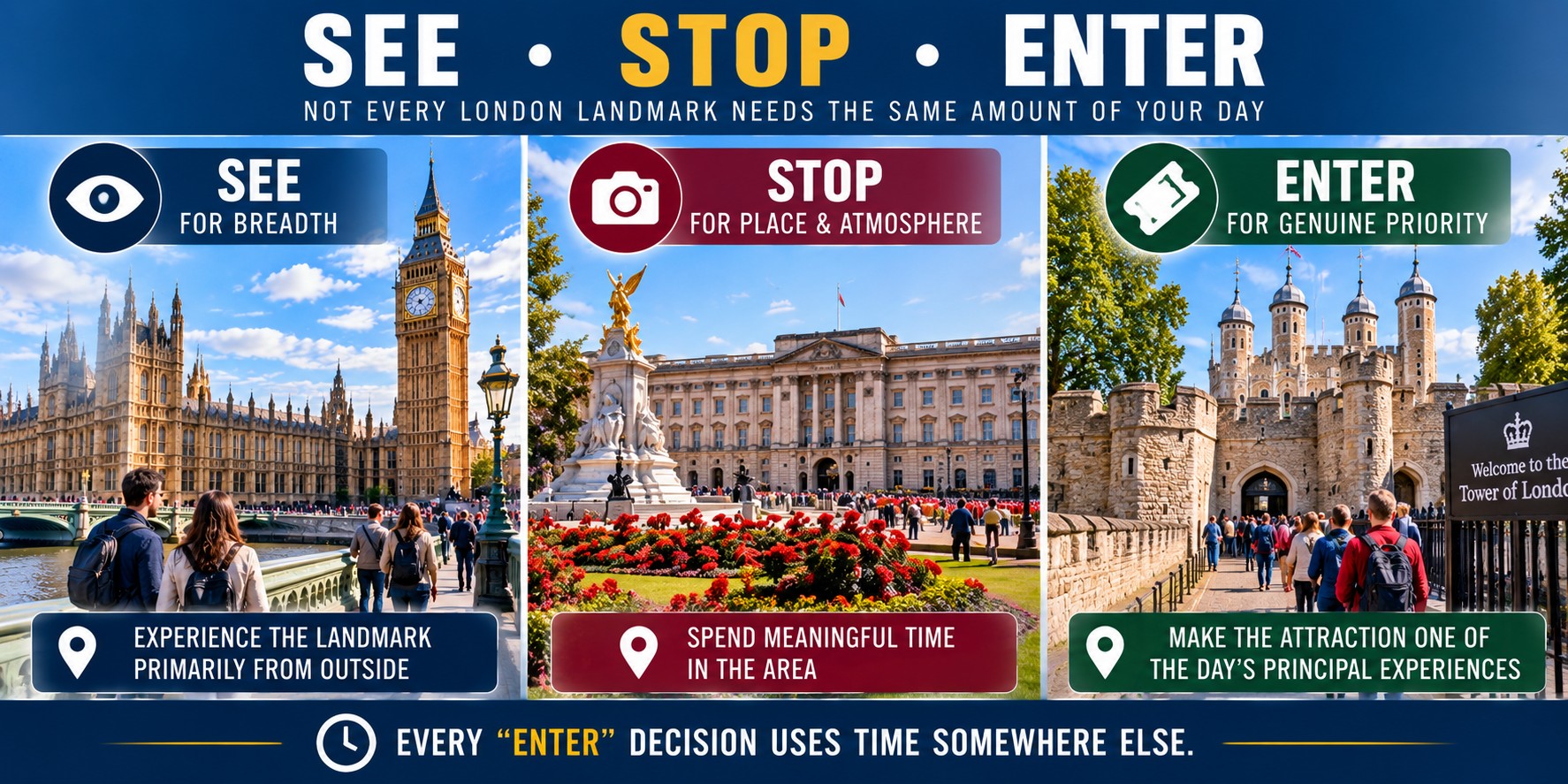
Not every London landmark needs the same amount of your day. See some for breadth, stop where the setting matters and enter the attractions that are genuine priorities
⏱️ How to Turn the Must-Sees Into a Realistic Day Knowing which attractions matter is only half the job. The next challenge is turning those choices into a day that works on the ground.
The biggest advantage comes from protecting priorities and maintaining geographic momentum. London is large enough that poor sequencing can consume surprising amounts of time. A realistic plan therefore moves through connected parts of the city rather than repeatedly crossing it to collect individual sights.
🌅 Morning — Use Your Freshest Hours for a Major Priority
Your morning deserves one of the day’s strongest experiences.
For many first-time visitors, Westminster and royal London make a logical opening because several important landmarks can be experienced within a relatively concentrated area. It also means beginning with unmistakable London rather than spending the first part of a precious day travelling towards a minor attraction.
This is also the point to accommodate a major interior visit if one is central to your plans.
If Westminster Abbey is your priority, for example, build the morning around that decision rather than treating the visit as something to squeeze between several other sights. If you prefer breadth, use the same period to experience more of Westminster and royal London externally before continuing.
Either approach works. What causes problems is attempting both at full scale.
🚶 Midday — Connect Rather Than Constantly Restart
As the day develops, resist the temptation to treat every new attraction as a separate journey.
Some of the pleasure of central London comes from the spaces between the headline sights: historic streets, parks, squares, architecture and the gradual change in character as you move from ceremonial Westminster towards the West End and other parts of the centre.
Walking appropriate sections can therefore do two jobs at once. It moves you towards the next priority while allowing you to experience the city rather than repeatedly disappearing into transport.
That does not mean walking everywhere. London is too extensive for that to be an efficient rule. The better principle is to walk when the journey itself adds value and use transport when distance would otherwise consume time needed for something more important.
🌉 Afternoon — Commit to Your Eastern London Priority
By the afternoon, the breadth-versus-depth decision becomes particularly important.
If the Tower of London is one of the experiences you most want from your visit, this is not the moment to discover that six other attractions have already consumed the time you intended to give it. A substantial historic attraction deserves protected space in the plan.
Alternatively, travellers seeking a broader overview may prefer to experience the Tower and Tower Bridge as part of the Thames landscape without committing the same amount of time to an interior visit.
Neither traveller has planned the day incorrectly. They have simply chosen different priorities.
The key is to make the choice before your schedule makes it for you.🌆 Late Afternoon / Evening — Add, Don’t Rescue
The final part of the day should contain flexibility.
If you are ahead of expectations and still have energy, this is the opportunity to linger somewhere you enjoyed, explore an atmospheric area, enjoy Thames views or add an optional experience.
If you are behind schedule, do not try to rescue an unrealistic itinerary by racing through everything that remains.
Drop an extra.
A relaxed final hour in London will usually contribute more to the memory of the day than arriving breathlessly at another landmark simply to say you saw it.
⚖️ The One-Day Decision That Changes Everything: Breadth or Depth?
Most one-day London plans ultimately fall somewhere between two approaches.
Understanding which one suits you prevents many of the compromises that otherwise appear unexpectedly during the day.
📸 Choose Breadth If You Want the Iconic London Overview
Breadth works particularly well for a first-time visitor whose priority is to gain a strong visual and geographic impression of the capital.
You may see Westminster, royal London, important central squares and the Thames landmarks while limiting the number of substantial admissions. You experience more changes of scenery, encounter more of London’s streets and gain a better sense of how its major areas relate to one another.
The price is depth. You will inevitably pass places that could occupy hours—or much longer—on another visit.
That is not a failure. It is the deliberate trade-off that makes breadth possible.
🏛️ Choose Depth If One Major Attraction Really Matters
If you have wanted for years to explore Westminster Abbey or the Tower of London, sacrificing that experience simply to increase your attraction count makes little sense.
Choose the major visit and give it sufficient attention.
A depth-led day will contain fewer headline sights, but the experiences you retain may be substantially richer. This approach often suits travellers with a strong interest in history, architecture or a particular part of London’s story.
The essential discipline is accepting the consequences. Once you choose a substantial visit, remove lower priorities rather than compressing everything else.
🧭 The Best Day May Be a Hybrid
You do not have to choose between spending the entire day outside and disappearing into attractions for hours at a time.
For many visitors, an effective compromise is one meaningful interior experience combined with a carefully grouped selection of exterior landmarks and neighbourhood atmosphere.
This preserves depth without surrendering the broader sense of having experienced London.
It is not a universal formula. Someone who dislikes formal attractions may prefer an entirely different balance, while a passionate history visitor may happily devote much more of the day to one site.
The principle matters more than the formula: decide where depth genuinely improves your day and use breadth everywhere else.
🧠 Build the Day Around Your Personal London Priority The phrase “must-see” can make visitors feel as though London comes with a compulsory syllabus. It does not.
Your strongest day begins by identifying what you would most regret missing.
👑 If Royal London Matters Most
Give Westminster and Buckingham Palace greater weight and allow yourself time to appreciate the ceremonial landscape connecting them. Do not dilute that priority simply because another famous attraction appears on every generic checklist.
🏰 If History Matters Most
Decide whether a substantial historic experience deserves to anchor the day.
Westminster Abbey and the Tower of London offer very different encounters with London’s past, and trying to give both maximum attention while retaining a broad sightseeing programme can place considerable pressure on a one-day visit.
If one matters significantly more to you, make the choice deliberately and allow the rest of the day to become simpler.
📸 If Iconic Landmarks Matter Most
If your main goal is to come away with a strong visual impression of London, favour breadth.
Westminster, Big Ben, Buckingham Palace, the Thames, the Tower of London and Tower Bridge provide very different but immediately recognisable faces of the capital. The key is to connect them sensibly rather than turning the day into a sequence of hurried arrivals and departures.
Exterior sightseeing becomes especially valuable here. You can appreciate architecture, settings and famous views without committing substantial portions of the day to every interior.
Keep photography in perspective too. Allow enough time to actually look at the city rather than experiencing every landmark through a screen.🌆 If Experiencing London Matters More Than Completing a Checklist
Some visitors will remember the unexpected street, the walk through a park or the atmosphere beside the Thames more vividly than the tenth famous building they photographed.
If that sounds like you, deliberately create breathing room.
Spend longer walking through an area that interests you. Stop when a view deserves it. Allow Covent Garden or another central area to be an experience rather than merely a waypoint. Leave enough flexibility for lunch or a coffee without feeling that the schedule has failed.
The same decision framework still applies:
PERSONAL PRIORITY → ONE MAJOR COMMITMENT → CORE LANDMARKS → OPTIONAL EXTRAS
The difference is that your personal priority may be the experience of London itself.
🚌 Should You Sightsee Independently or Use a Structured Experience?
Once you know what you want from the day, another decision becomes easier: whether to organise the sightseeing yourself or use a more structured experience.
Independent sightseeing offers maximum control. You decide when to start, which attractions deserve your time, whether to enter them and when to change the plan. If you unexpectedly love an area, you can stay. If something disappoints you, you can move on.
That freedom is particularly useful when your priorities are highly personal.
The trade-off is responsibility. You need to understand the geography, make transport decisions and keep an eye on whether the day is still realistic.
A structured sightseeing experience approaches the problem differently. Organisation and orientation can reduce some of the planning burden, which may appeal to a first-time visitor who would rather concentrate on experiencing London than continually deciding how to navigate it.
The compromise is reduced control over the shape and pace of the day.
Neither approach is automatically better. Ask a more useful question:
Which format gives me the best chance of experiencing my own priorities within the time available?
If flexibility is essential, independence may suit you. If ease, orientation and structure matter more, an organised format may be attractive. The important thing is to choose the format after deciding what you want from London, rather than allowing the format to determine your priorities.

Grouping London’s major sights into connected areas helps reduce unnecessary travel, protect priority experiences and make better use of a limited sightseeing day
🚫 What Not to Do With One Day in London
A successful one-day visit depends as much on what you leave out as what you include.
Do not try to enter every famous attraction. Major historic sites deserve meaningful attention. Treating several of them as quick stops usually produces frustration rather than depth.
Do not build the day from somebody else’s top-ten list. Popularity tells you that a place matters to many visitors; it does not tell you whether it deserves your limited time.
Do not zigzag across London for minor additions. A geographically coherent day generally gives you more useful sightseeing time and a better understanding of the city.
Do not measure success by attraction count. Six well-chosen experiences can produce a much stronger day than twelve rushed ones.
Do not schedule away every margin. London is a living city, not a controlled itinerary. Movement, queues, security procedures, weather and simple human needs can all affect your plans.
Do not sacrifice a genuine priority to protect an optional stop. If something has to disappear, remove the experience you cared about least.
And do not assume that choosing a faster-looking form of transport can rescue a fundamentally overloaded itinerary. Efficient movement helps, but it cannot create unlimited sightseeing time.
🌦️ Build Flexibility Into the Day
The most robust one-day plan has layers rather than a single chain of supposedly essential attractions.
Use three:
CORE MUST-SEES → ONE MAJOR EXPERIENCE → FLEXIBLE EXTRAS
Your core must-sees are the landmarks or areas you would genuinely regret missing. Your major experience is the part of the day you are willing to protect even if it means seeing less elsewhere. It could be a substantial historic attraction, or simply a longer period exploring the part of London that matters most to you.
Your flexible extras are deliberately expendable. They improve the day if circumstances allow, but losing one does not make the visit a failure.
That hierarchy gives you a simple response when reality interferes with the plan: remove an extra rather than rushing everything else.
Operational conditions can change. Attraction admission arrangements, opening information, security requirements, transport conditions and other practical details should therefore be checked from appropriate current sources when they materially affect your plans.
A good one-day strategy should remain useful even when individual details change. That is another reason to build around priorities and geography rather than an inflexible minute-by-minute schedule.
🌱 Responsible One-Day Sightseeing — Experience More by Rushing Less
Responsible sightseeing does not have to mean adding another task to an already busy day.
In London, some of the most sensible choices are also the ones that improve the visitor experience.
Grouping nearby sights reduces unnecessary journeys. Walking appropriate sections can reveal streets, architecture, parks and river views that disappear when every movement is treated purely as transport. Spending meaningful time at fewer places can also encourage greater appreciation of historic environments rather than turning them into items to collect.
Respect the places you visit, follow local and site guidance, give other people space and remember that central London is both a major visitor destination and a city in which people live and work.
Most importantly, resist the idea that travel becomes more valuable simply because more attractions have been consumed.
Travel with purpose. Explore with care.
❓ FAQs — One Day in London
❓ Can You Really See London’s Main Attractions in One Day?
You can see an excellent selection of London’s major attractions in one day, but you cannot comprehensively visit all of them.
That distinction matters. A well-planned day can include Westminster’s principal landmarks, royal London, some central London atmosphere and the historic Thames landscape around the Tower of London and Tower Bridge. What it cannot realistically include is an in-depth visit to every major attraction along the way.
Think of one day as a high-quality introduction to London, not a compressed substitute for several days in the city.
❓ How Many Major Attractions Should I Enter in One Day?
There is no number that works for every traveller because different attractions demand different amounts of time.
The more useful rule is to identify the interior experience that matters most to you and protect sufficient time for it. Every additional substantial admission should then be judged against what it removes from the rest of the day.
If your priority is broad sightseeing, limiting major interior visits leaves considerably more room for landmarks and neighbourhoods. If one attraction is the main reason you came to London, allowing it to dominate part of the day can be entirely worthwhile.
❓ Is the Tower of London Worth Visiting If I Only Have One Day?
It can be—particularly if British history is one of your strongest interests.
The important question is not whether the Tower of London is significant enough to visit. It clearly represents a substantial historic experience. The question is whether you value that depth enough to give it a significant share of your only sightseeing day.
If you do, make it a priority and reduce the rest of the itinerary accordingly. If your aim is to see the widest possible range of London landmarks, experiencing the Tower area and Tower Bridge without building the afternoon around a substantial interior visit may suit you better.
❓ Should I Visit Westminster Abbey or the Tower of London?
Choose according to your interests rather than trying to identify a universal winner.
Westminster Abbey places you at the heart of royal, religious and national history within the concentrated Westminster sightseeing area. The Tower of London offers a very different historic experience within the eastern Thames landscape.
With only one day, making one of them your principal interior experience can produce a more balanced itinerary than trying to explore both deeply while also maintaining a broad sightseeing programme.
If neither is a personal priority, you are not obliged to enter either simply because they are famous.
❓ Is London Walkable Enough for One-Day Sightseeing?
Important parts of central London are very rewarding to explore on foot, and walking can be one of the best ways to understand how nearby landmarks relate to each other.
But “London is walkable” should not be interpreted as meaning that every major attraction belongs on one continuous walking route. The city is extensive, and insisting on walking long connections can consume time and energy that would be better spent at your priorities. Walk where the route itself contributes to the experience. Use appropriate transport when it does.❓ Should I Book London Attractions in Advance?
If entering a particular attraction is important enough to shape your one-day plan, check its current admission arrangements before you travel.
Do not build the entire day around an assumed entry opportunity and only investigate the practical details when you arrive. Equally, avoid filling the day with so many fixed commitments that you lose all flexibility.
Treat your most important admission as an anchor and keep less important elements adaptable.
❓ Is a Sightseeing Tour Better Than Exploring London Independently?
Neither is inherently better.
Independent sightseeing gives you greater control over priorities, pace and changes of plan. A structured sightseeing experience can reduce the organisational burden and provide useful orientation, particularly when London is unfamiliar.
Choose according to what you need most from your limited time: flexibility and personal control, or structure and easier orientation.
🌇 One Day in London: Make the Important Experiences Count
A single day will never reveal everything London has to offer. It does not need to.
The mistake is approaching the city as though every famous attraction carries equal importance and every omission represents a missed opportunity. Once you accept that choices are unavoidable, planning becomes considerably easier.
Start with what matters most to you. Decide whether you want breadth, depth or a mixture of both. Protect one major experience if there is somewhere you genuinely want to explore properly. Group the remaining landmarks intelligently and keep lower-priority additions flexible.
In practical terms:
CHOOSE YOUR PERSONAL PRIORITY → PROTECT ONE MAJOR EXPERIENCE → GROUP THE ICONIC SIGHTS → DECIDE WHAT TO SEE OR ENTER → KEEP OPTIONAL STOPS FLEXIBLE
That approach can give you the monumental London of Westminster, the royal landscape around Buckingham Palace, the atmosphere of the centre and the historic Thames setting around the Tower of London and Tower Bridge without pretending that every place must receive the same amount of attention.
And if something has to be left for another visit, let it be left.
A successful day in London is not the one with the highest attraction count. It is the one that gives enough time to the London experiences you most wanted to have.