


Scotland Events in Spring: Festivals, Wildlife, Castles and Highland Landscapes
13th August 2026
🌱 Scotland Events in Spring: Festivals, Wildlife, Castles and Highland Landscapes
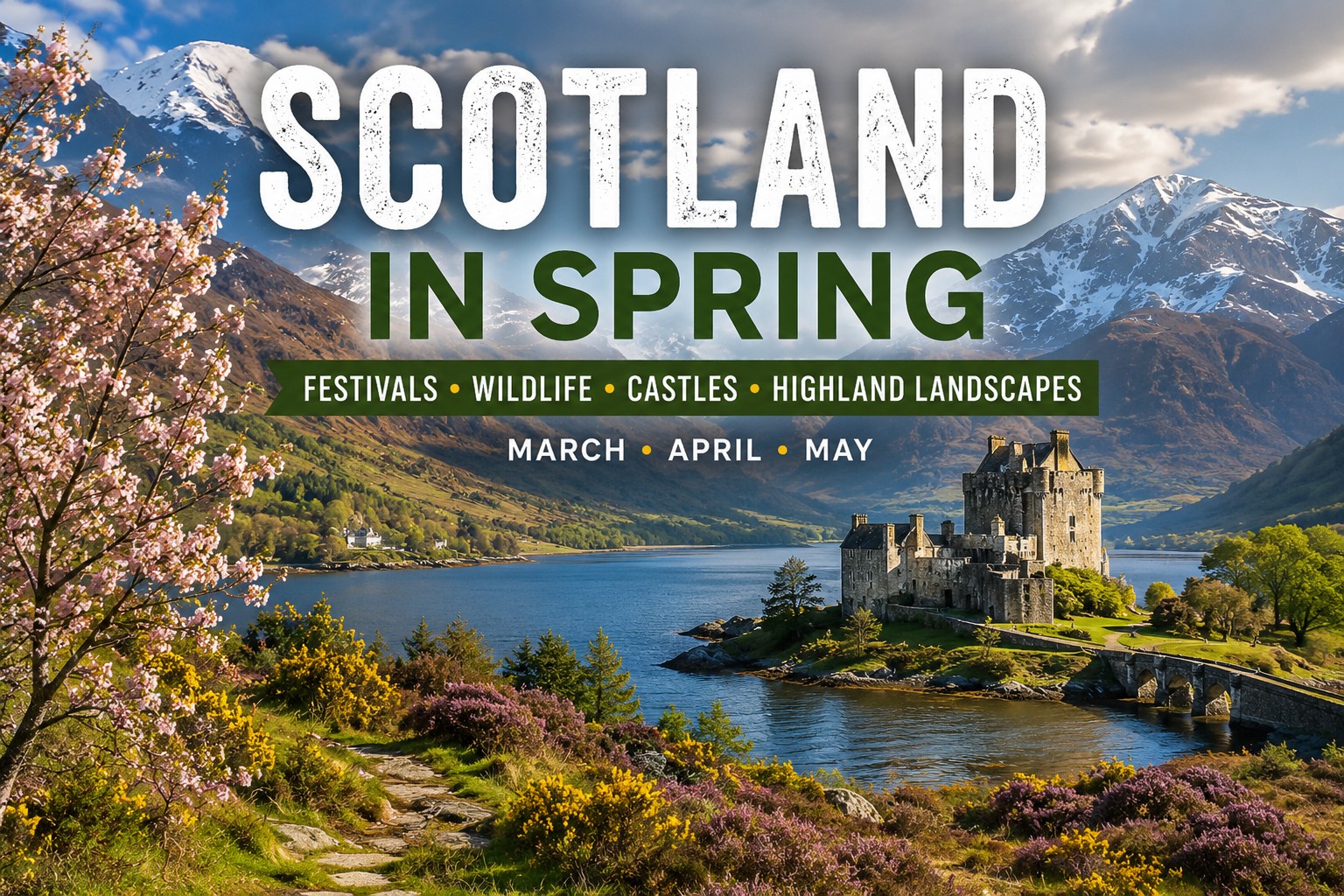
Scotland in spring brings together lingering mountain snow, increasingly colourful landscapes, historic castles and longer days for exploring from March through May
Scotland in spring is a country in transition. In March, snow can still define the higher Highland mountains while lower ground begins showing the first signs of seasonal change. By May, evenings stretch dramatically longer, glens and woodland are increasingly green, wildlife activity is more visible and Scotland’s programme of festivals, cultural events and outdoor experiences is gathering momentum.
That transformation is precisely what makes spring interesting. Rather than offering one predictable version of Scotland, the season changes noticeably from week to week and from the Lowlands to the Highlands, islands and coasts. For travellers who enjoy watching a destination change around them, this can be one of Scotland’s most rewarding times of year.
A spring journey might combine Edinburgh’s historic streets and cultural life with castles and gardens, coastal wildlife and Highland landscapes where winter has not entirely disappeared. Choosing between March, April and May can therefore make a significant difference to the experience.
This guide explores Scotland in spring through its festivals and events, wildlife, castles and Highland scenery, alongside the practical realities that can shape a successful journey.
Spring in Scotland is not one experience—it is a season in motion.
🌱 Spring Scotland at a Glance
Spring in Scotland is not one season. It is a progression from winter towards summer.
March, April and May can produce noticeably different journeys. Start with the stage of spring you want to experience, then consider where in Scotland you are travelling and what you want to do.
Month → Region → Experience → Conditions
🌦️ Spring Changes Month by Month
🌱 March — Transition
Atmospheric landscapes, increasing daylight and lingering winter character, particularly across higher ground.
🌷 April — Spring Developing
Increasing colour, longer days and growing seasonal activity make mixed city, heritage and countryside itineraries increasingly rewarding.
🌿 May — Spring Expanding
Long evenings, greener landscapes and greater daylight create more flexibility for wider scenic journeys.
🗺️ Geography Changes the Experience Too
| 🏙️ Cities | Culture, heritage and useful flexibility when spring weather changes. |
| 🏔️ Highlands | Some of Scotland’s strongest seasonal contrasts, from greener glens to lingering mountain snow. |
| 🌊 Islands & Coasts | Wildlife and coastal landscapes, with greater attention required for weather, ferries and other logistics. |
| 🏰 Castles & Countryside | Historic landscapes become increasingly rewarding as daylight, foliage and spring colour develop. |
🌱 Choose the stage of spring you want to experience—not simply the month called “spring”.
🌼 Why Visit Scotland in Spring?
Spring occupies an intriguing position in Scotland’s travel year. The shortest days of winter are retreating, yet the height of the summer visitor season is still ahead. Increasing daylight creates more time for scenic journeys, castle visits and countryside stops, while the changing spring light can give familiar landscapes a completely different character.
The appeal is not that spring guarantees empty attractions, low prices or perfect weather. Easter holidays, major events and popular destinations can still generate significant demand, while opening arrangements at some seasonal attractions vary.
Its real advantage is the opportunity to experience Scotland changing rather than simply waiting for summer.
📅 Scotland in March, April and May: What Really Changes?
Treating March, April and May as interchangeable can create unrealistic expectations. Daylight increases substantially across the season, vegetation develops at different speeds and wildlife activity changes, while Scotland’s latitude, altitude, islands and coastlines create considerable regional variation.
🌦️ March — Scotland in Transition
March often retains one foot in winter. Higher Highland landscapes can remain snowy, with genuinely wintry conditions possible at elevation, while Edinburgh, the Central Belt and lower-level countryside may already be showing early signs of spring.
For visitors comfortable with unpredictability, this can be an atmospheric month. City breaks, castles and lower-level scenic touring can work particularly well, while the increasing daylight provides noticeably greater freedom than during midwinter.
March is therefore less about guaranteed spring weather and more about witnessing the transition begin.
🌷 April — Spring Becomes More Visible
By April, the transformation is usually easier to see. Woodland and gardens begin developing more colour, days continue lengthening and increasing wildlife activity adds another dimension to countryside and coastal journeys.
April can be particularly effective for mixed itineraries. A traveller might combine Edinburgh or another historic centre with castles, gardens and rural landscapes without the shorter sightseeing window associated with winter.
Easter can also introduce additional events, family activities and visitor demand when it falls within the travel period, so popular accommodation and transport should not automatically be assumed to be quiet.
🌿 May — Long Days and Mature Spring Landscapes
May brings the greatest touring flexibility of the three spring months. Long evenings create more room for scenic stops and historic attractions, while many lower landscapes are increasingly green and spring wildlife activity is well established.
For road journeys through the Highlands, islands and rural Scotland, those longer days can be particularly valuable.
The important distinction is therefore not simply colder versus warmer. March, April and May reveal different stages of Scotland’s journey from winter towards summer.
| Month | Typical Seasonal Character | Landscapes | Wildlife & Events | Particularly Good For |
|---|---|---|---|---|
| March | Winter-to-spring transition | Snow possible on higher ground; early change below | Early seasonal activity | Atmospheric journeys and city breaks |
| April | Increasingly spring-like | Developing greenery, gardens and woodland colour | Growing wildlife activity and Easter-period events | Mixed city and countryside trips |
| May | Established late spring | Green glens and long evenings | Increasing wildlife activity and expanding events programme | Wider touring and road journeys |
These are useful seasonal patterns rather than guarantees. Conditions can differ substantially between Edinburgh, the west coast, the Northern Isles and the Highlands—and even between a Highland glen and the mountains rising above it.
🌦️ Which Spring Month Suits Your Scotland Journey?
March, April and May are all spring months, but they can create very different Scotland experiences. Instead of asking which month is universally best, decide which stage of the season best matches the journey you want.
🌱 Want the Greatest Sense of Seasonal Transition?
→ Choose March
Best for travellers attracted to atmospheric landscapes, lengthening days and the visible transition between winter and spring.
Consider: March retains the greatest winter influence, particularly across the Highlands and higher ground.
🌷 Want Emerging Spring with a Balanced City and Countryside Journey?
→ Choose April
A strong middle ground for combining cities, castles, countryside and developing spring landscapes as daylight continues to increase.
Consider: Easter dates and school holidays can affect accommodation demand, attractions and transport.
🌿 Want the Longest Spring Days and Maximum Touring Flexibility?
→ Choose May
Long evenings, greener landscapes and greater daylight make May particularly attractive for wider Highland, countryside and scenic journeys.
Consider: Stronger touring conditions do not guarantee settled weather or consistently low visitor demand.
🧭 The Spring Progression
March = Transition
→
April = Emergence
→
May = Expansion
Don’t search for the “best” spring month. Choose the stage of spring that best supports your Scotland journey.
🎪 Spring Festivals and Events in Scotland
Spring changes Scotland culturally as well as naturally. Arts and music festivals, food and drink events, exhibitions, community celebrations and seasonal programmes can provide reasons to build a journey around more than scenery alone.
The most rewarding event does not necessarily have to be the largest. A local festival or cultural gathering can introduce visitors to a town, island or region they might otherwise have passed through.
🎭 Let an Event Shape the Journey
There are two ways to plan an events-led trip. Travellers can choose their destinations and then discover what is happening nearby—or find an appealing event first and allow it to influence the route.
That second approach can be particularly rewarding in spring, when an event may provide the reason to stay another night, explore beyond a familiar destination or combine a cultural experience with surrounding castles and landscapes.
Individual dates and programmes can change from year to year. For that reason, this guide focuses on the character of spring events rather than presenting a fixed annual list that may quickly become outdated.
🎪 Let a Spring Event Shape Your Scotland Journey
There are two equally valid ways to build an events-led spring trip. You can begin with the route and discover what is happening nearby, or begin with an event and allow it to influence where you travel.
|
🗺️ Option A — Route First Choose Your Scotland Route This works particularly well when your main priorities are already fixed—perhaps Edinburgh, the Highlands, castles or a specific region—and you want an event to enrich the journey without controlling it. |
🎭 Option B — Event First Discover an Appealing Event This can be especially rewarding when a festival, cultural gathering or traditional event gives you a reason to stay longer, explore a different town or change the direction of the trip. |
🧭 Why This Works
A well-chosen event can turn an overnight stop into a highlight, introduce you to a region you might otherwise have passed through, or give a wider Scotland itinerary a memorable focal point.
An event doesn’t have to interrupt the itinerary. It can create the itinerary.
🎪 BVT Event Planning Principle: If an event becomes central to the journey, treat its confirmed date and location as a fixed point. Then build accommodation, transport and the surrounding Scotland route around it.
🥁 Towards the Highland Games Season
As spring progresses, Scotland begins moving towards the broader outdoor gathering and Highland Games season. These traditional events can combine sporting competition, music, dancing and community identity within settings that range from towns and villages to dramatic Highland landscapes.
Visitors should not assume that Games are taking place everywhere throughout March and April. The season develops progressively, with individual gatherings following their own schedules. Anyone hoping to make a Highland Games experience central to a trip should therefore check current dates before fixing the surrounding itinerary.
🐣 Easter and Spring Breaks
Easter can bring another dimension to spring travel, with family activities and seasonal programmes appearing at attractions and destinations across Scotland. It can also create concentrated demand for accommodation and transport.
The opportunity and the practical consequence belong together: an Easter event may enrich the trip, but a popular weekend can require earlier booking.
🦅 Spring Wildlife in Scotland
Spring brings a different rhythm to Scotland’s natural landscapes. Birdlife becomes increasingly active, seabirds return to breeding areas and the coasts, islands, woodland and glens can all provide rewarding opportunities for patient wildlife watching.
🌊 Coasts and Islands
Scotland’s sea cliffs, islands and coastal habitats can be particularly compelling as the breeding season develops. Returning seabirds can transform some coastal locations, while marine environments add the possibility of encounters that no itinerary can guarantee.
This exact destination record is verified in the current Scotland master.
That uncertainty is part of genuine wildlife watching. Rather than treating particular species as items on a checklist, allow time to watch a coastline, listen from an appropriate distance or choose responsible wildlife experiences that prioritise the animals and their habitats.
🦌 Highlands, Forests and Glens
Inland, woodland, loch shores and Highland glens offer a different spring experience. Wildlife may reveal itself gradually rather than dramatically, rewarding visitors who slow down and pay attention to the wider habitat.
Rural Scotland is also a working landscape. Spring lambing makes responsible behaviour around livestock particularly important, including following local guidance and keeping dogs under appropriate control.
The best spring wildlife experience is one that leaves the wildlife behaving as though you were never there.
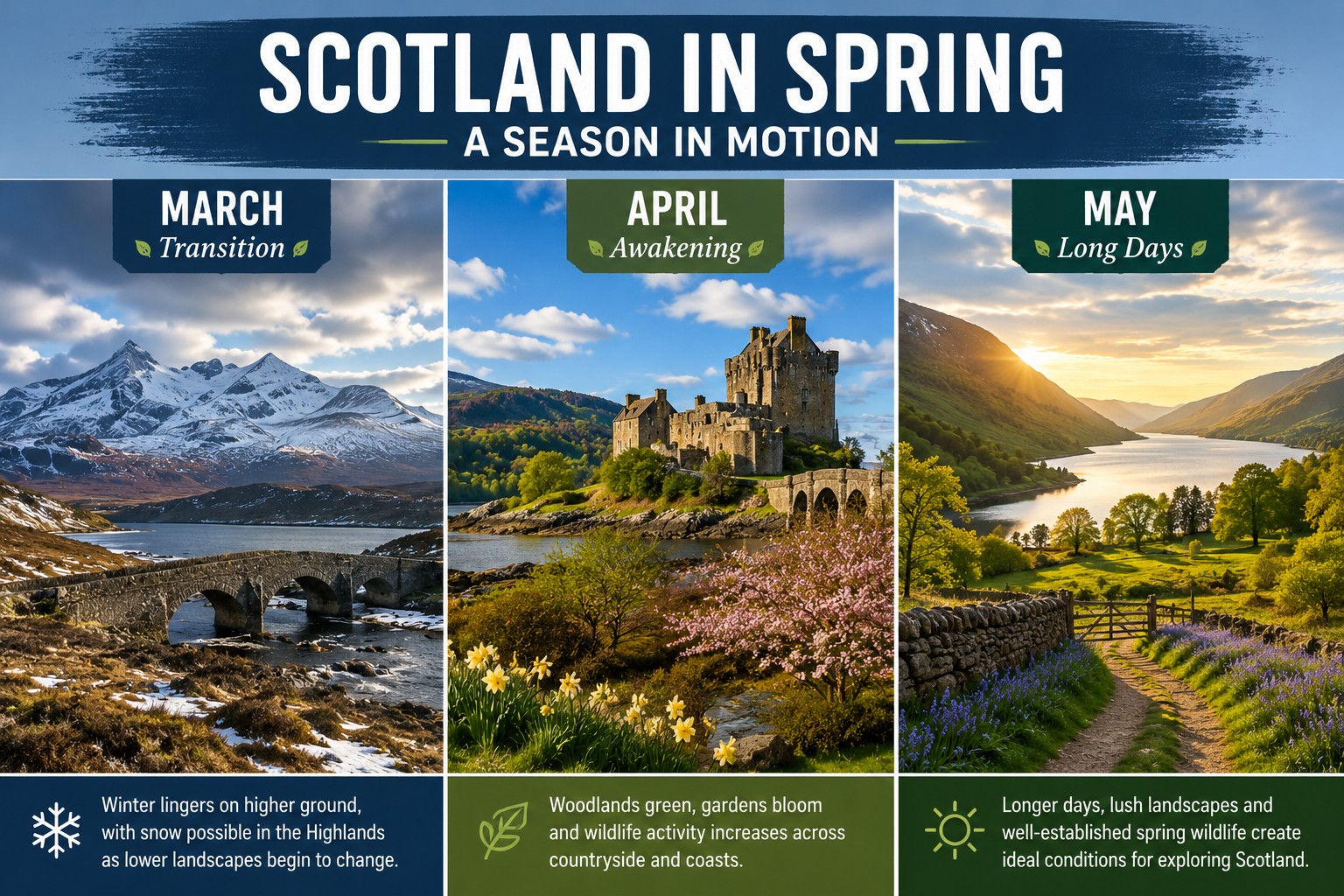
Scotland changes rapidly through spring, from lingering Highland snow in March to developing greenery in April and the long, increasingly lush days of May
🦅 BVT Expert Tip — Experience Spring Wildlife Responsibly
The best wildlife encounter is the one that does not change the animal’s behaviour.
Spring is a particularly sensitive time in Scotland. Breeding, nesting and lambing can all coincide with increasing visitor activity, so patience and distance should be part of the experience.
✓ Watch from an appropriate distance
✓ Never approach nests or breeding areas
✓ Avoid pursuing wildlife for photographs
✓ Keep dogs appropriately controlled around livestock and wildlife
✓ Follow local seasonal access guidance
✓ Allow time rather than forcing an encounter
✓ Treat sightings as possibilities, never guarantees
👀 Observe → 🚫 Don’t Pursue → 🌿 Leave Undisturbed
🌱 Spring Wildlife Principle: Give wildlife the space to behave naturally. A distant encounter that leaves an animal undisturbed is more responsible than a closer photograph achieved by approaching, following or disturbing it.
🏰 Castles and Historic Scotland in Spring
Spring works particularly well for travellers who want to experience Scotland’s history as part of the landscape rather than treating castles and countryside as separate attractions. Lengthening days create greater scope to explore a historic site and still continue through lochs, glens or coastal scenery without every stop competing for limited winter daylight.
In Edinburgh and other cities, major historic attractions can anchor a spring cultural break and provide useful flexibility when the weather changes. Elsewhere, Highland and coastal castles often become part of the journey itself, with their approaches, surrounding estates and wider settings adding as much atmosphere as the architecture.
Gardens and castle grounds can also become increasingly rewarding as spring advances. March may retain a relatively stark character, while April and May bring developing foliage, blossom and colour to many historic landscapes.
Opening arrangements are not identical everywhere. Major attractions may operate extensively through the year, while smaller, seasonal or more remote properties can follow different timetables. Check current access before designing a day’s route around one particular castle.
Spring’s advantage is therefore not simply the opportunity to visit castles. It is the chance to place Scotland’s historic architecture within landscapes visibly changing around it.
🏰 BVT Expert Tip — Make the Castle Part of the Journey
Don’t treat the castle as the whole day.
Spring creates an opportunity to experience Scotland’s historic sites as part of their wider setting. Instead of arriving, visiting the building and immediately moving on, consider how the grounds, landscape and surrounding area can become part of the same journey.
🏰 Historic Site
↓
🌷 Castle Grounds & Gardens
↓
🌄 Surrounding Landscape
↓
🌊 Loch • Glen • Coast • Nearby Town
🌱 Let the Month Change the Experience
| 🌱 March | Architecture + Atmosphere Earlier spring can place greater emphasis on the historic building itself, dramatic skies and the character of the surrounding landscape. |
| 🌷 April | Developing Grounds + Foliage As spring advances, gardens, woodland and surrounding countryside can begin contributing more strongly to the visit. |
| 🌿 May | Longer Days + Wider Landscape Longer daylight can create greater scope to combine the castle with a scenic drive, countryside stop, loch, glen, coastline or nearby town. |
🧭 Journey Principle: Choose historic sites not only for what lies inside their walls, but for how naturally they fit the wider route. A castle that belongs geographically within the day’s journey can create a richer experience than an isolated famous site requiring unnecessary backtracking.
In spring, the setting can become part of the attraction.
🏔️ Highland Landscapes in Spring
Few places reveal the transition as dramatically as the Scottish Highlands. Spring can place several seasons within the same view: fresh growth across lower glens, dark lochs beneath shifting skies and snow still marking the highest mountains.
As daylight expands, scenic touring becomes easier to enjoy at a less compressed pace. Routes through glens and around lochs offer more time for spontaneous viewpoints, short walks and historic stops, while long May evenings can transform landscapes that looked entirely different beneath the morning weather.
Rivers, burns and waterfalls can add further drama when rainfall and snowmelt increase their flow, while woodland progressively develops colour. Conditions vary considerably, however, and western and eastern Highland landscapes can experience very different weather.
That unpredictability is not separate from the Highland spring experience. It is part of it.
❄️ Spring Below Does Not Mean Spring on the Mountain
A mild afternoon beside a loch or in a Highland village tells visitors relatively little about conditions at elevation. Snow and ice can remain on higher mountains well into spring, while strong winds, poor visibility and rapidly changing weather can create genuinely wintry conditions above landscapes that appear green from the road.
That distinction matters. Scenic sightseeing through the Highlands and higher-level mountain walking are very different activities. Anyone heading onto the mountains should assess conditions specifically for the route and elevation they intend to tackle rather than relying on a general Scotland forecast.
For sightseeing travellers, this geographical variation is less a problem than something to understand. A journey can pass through sunshine, rain and dramatic cloud before finishing beneath bright evening skies without anything particularly unusual having happened.
❄️ Spring Below Does Not Mean Spring on the Mountain
One of the most important principles for spring travel in the Scottish Highlands is that conditions can change dramatically with elevation.
A mild day at road level does not tell you what conditions will be like higher in the landscape. Think about where you are going and what you intend to do, rather than relying on a general forecast for “the Highlands”.
🏘️ Highland Village / Roadside
→ Milder spring conditions may already be present
Lower-level landscapes can feel increasingly springlike as daylight expands and the season develops.
🥾 Glen / Lower Trail
→ Conditions can remain wet, cold and changeable
Moving away from roads and settlements can quickly expose you to a different combination of ground conditions, temperature and weather.
🏔️ Higher Mountain
→ Conditions may remain genuinely wintry
Snow, ice, strong wind and poor visibility can persist at elevation even when lower Highland landscapes appear to have moved firmly into spring.
🌤️ Low-Level Weather ≠ 🏔️ Mountain Conditions
🧭 Two Very Different Highland Decisions
|
🚐 Scenic Highland Touring Road journeys, viewpoints, glens, lochs and lower-level sightseeing. |
🥾 Higher-Level Mountain Activity A different proposition where elevation and current mountain conditions become much more important. |
Scenic Highland Touring ≠ Higher-Level Mountain Activity
Assess conditions for the elevation and activity—not simply for “the Highlands”.
🗺️ Where to Experience Spring in Scotland
The best region depends less on finding Scotland’s universally “best” spring destination and more on deciding what you want the season to provide.
Edinburgh and Central Scotland combine culture, heritage and events with straightforward access to surrounding countryside. They work particularly well for shorter breaks where a mixture of indoor and outdoor experiences provides flexibility.
The Highlands offer the strongest sense of seasonal drama, combining mountains, lochs, castles and wildlife-rich environments. Perthshire and the Trossachs provide a more accessible combination of woodland, lochs and scenic countryside, while northeast Scotland brings together castle country, coastline and rural landscapes.
Scotland’s islands and west coast offer another experience entirely. Coastal scenery and wildlife can become central to the journey, but ferry schedules, seasonal services and weather deserve additional attention when planning more remote itineraries.
| Region | Spring Character | Strong For |
|---|---|---|
| Edinburgh & Central Scotland | Culture, heritage and accessible events | City breaks and first visits |
| Scottish Highlands | Dramatic seasonal transition | Landscapes, wildlife and scenic touring |
| Islands & West Coast | Coastal spring and expansive landscapes | Wildlife and longer journeys |
| Perthshire & Trossachs | Woodland, lochs and accessible countryside | Nature-led touring |
| Northeast Scotland | Castle country, coast and countryside | Heritage and landscape journeys |
🗺️ Which Spring Scotland Experience Suits You?
Start with the spring experience you want—not simply a list of places you hope to fit into the journey.
Scotland’s regions offer very different combinations of landscape, wildlife, history and culture during spring. Decide what matters most, then choose the region that naturally delivers it.
🏛️ Want Culture + Heritage + Events?
→ Edinburgh & Central Scotland
A strong choice for museums, historic sites, cultural programmes and events, with useful indoor alternatives when spring weather changes.
🏔️ Want Maximum Seasonal Landscape Drama?
→ Scottish Highlands
Experience some of Scotland’s strongest spring contrasts, from changing glens and lochs to mountain landscapes where winter conditions may linger at elevation.
🦅 Want Wildlife + Coast + Island Atmosphere?
→ Islands & West Coast
A rewarding spring combination of coastal landscapes, wildlife possibilities and island character, with additional attention required for ferries, weather and journey logistics.
🌲 Want Woodland + Lochs + Accessible Countryside?
→ Perthshire & Trossachs
A strong choice for woodland, lochs and countryside journeys where developing spring colour can be enjoyed without committing to Scotland’s most remote regions.
🏰 Want Castles + Coastline + Rural Landscapes?
→ Northeast Scotland
Combine historic sites with coastal scenery and rural landscapes, creating a spring journey where heritage belongs naturally within the wider setting.
⏳ Now Match the Experience to Your Time
|
🧳 Short Spring Break? → Favour geographically concentrated experiences. |
🗺️ Longer Scotland Journey? → Highlands and islands become increasingly viable. |
🧭 The Decision
Choose the Spring Experience → Choose the Region → Match It to the Time Available
Choose the spring experience first. Then choose the part of Scotland that delivers it.
🧭 Is Spring a Good Time to Visit Scotland?
For many travellers, yes. Spring can be an excellent time to visit Scotland, particularly for those attracted by lengthening days, seasonal scenery, wildlife, cultural events and the opportunity to combine historic places with increasingly accessible countryside.
The important question is not whether spring is universally the “best” season, but which version of spring best matches your trip.
March particularly suits travellers drawn to atmospheric transition and comfortable with colder, less predictable conditions. April provides a useful balance between developing spring landscapes and longer sightseeing days. May generally offers the greatest spring touring flexibility, with long evenings and a broader range of seasonal experiences.
There are trade-offs. Easter and major events can create concentrated demand, some smaller attractions and services may operate differently earlier in the season, and mountain conditions can remain wintry long after lower landscapes feel spring-like.
For island journeys, ferry schedules and weather deserve particular attention. Travellers with fixed dates should not assume that travelling outside peak summer means accommodation or transport will always be available at short notice.
Spring is therefore particularly rewarding for visitors who value variety and seasonal change more than predictable conditions.
🧭 Spring Scotland Journey Reality Check
Is spring a good time to visit Scotland? For many travellers, absolutely—but its greatest strengths come with a need for flexibility.
Use this quick reality check to decide whether the character of a Scottish spring matches the journey you want to make.
🌱 Spring Works Particularly Well If You Value…✓ Changing landscapes ✓ Longer days ✓ Wildlife activity ✓ Castles and countryside ✓ Events ✓ Variety |
⚠️ Spring Requires More Planning If…⚠ Your itinerary depends on mountain conditions ⚠ You have critical island ferries ⚠ You’re travelling during Easter ⚠ One particular event is essential ⚠ A seasonal attraction is essential ⚠ Your schedule has no weather flexibility |
🗺️ BVT Planning Principle: Spring works best when the important parts of the journey are secured, but enough flexibility remains to respond to weather, conditions and opportunities as they develop.
Spring rewards adaptability more than rigid scheduling.
🎒 Planning and Packing for Scotland in Spring
The most useful packing strategy is adaptability. Layers allow clothing to be adjusted throughout the day, while reliable waterproof outerwear and comfortable footwear appropriate to the planned activities are more useful than dressing for one expected temperature.
A small daypack is valuable for carrying spare layers, water and waterproofs. Sunglasses and sun protection also deserve space: cool Scottish spring days can still bring prolonged bright conditions, particularly when travellers are outdoors for longer periods.
Check forecasts locally as the journey progresses rather than assuming conditions in Edinburgh will resemble those in the Highlands or west coast.
For Easter travel or trips built around a particular event, secure important accommodation and transport sufficiently early. Island itineraries should retain sensible flexibility around ferries, while castles and other attractions should be checked for current seasonal opening arrangements.
Earlier spring generally presents fewer midge issues than warmer periods, although suitable conditions can increase activity as the season advances.
📆 Plan Your Trip with the BVT Scotland Events Calendar
Once your preferred month and regions begin taking shape, check what will actually be happening around your travel dates before the itinerary becomes fixed. A well-timed festival, Highland gathering or local celebration can transform an overnight stop into one of the most memorable parts of a Scottish journey.
The BVT Scotland Events Calendar provides a dedicated planning resource for discovering festivals, Highland Games, cultural events and seasonal celebrations that may coincide with your trip. It complements this spring guide rather than duplicating it: this article helps you decide why, when and where to experience Scotland in spring, while the calendar helps identify what may be happening once your dates are known.
An event can even reshape the itinerary. If something particularly appealing is taking place close to your proposed route, an additional night or small change of direction may introduce a part of Scotland you might otherwise have missed.
For any event that becomes essential to the journey, confirm current dates, programmes, admission arrangements and other important details with the organiser before committing accommodation or transport.
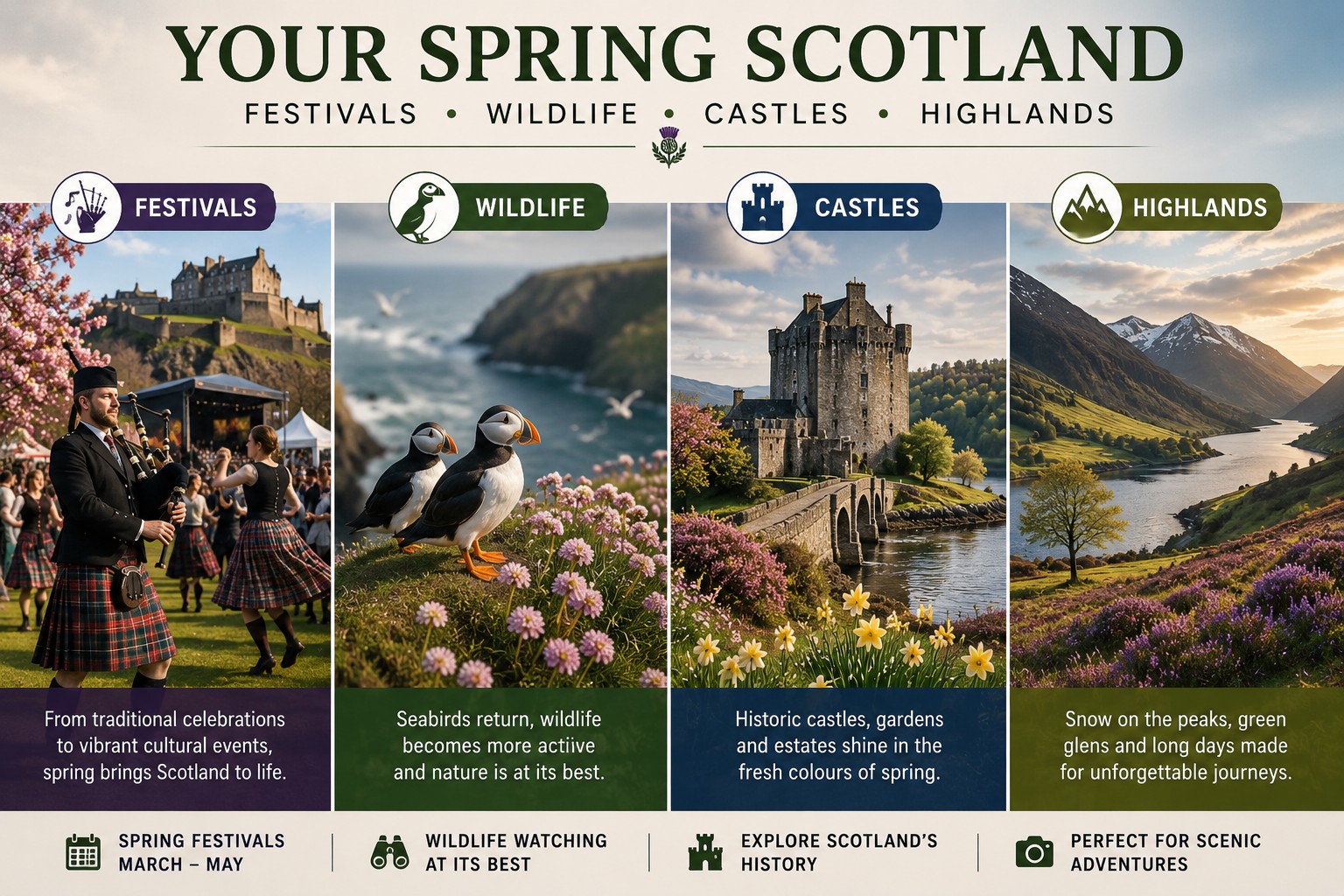
Spring in Scotland can combine cultural events, returning wildlife, historic castles and Highland landscapes where green glens contrast with snow remaining on the peaks
📅 Planning Scotland for March, April or May?
Once you have chosen your preferred spring month and region, check what will actually be happening around your travel dates before fixing the itinerary.
Spring events can do more than fill an afternoon. A festival, Highland gathering, Easter activity or local celebration can influence where you stay, how long you remain in a region and whether a small change of route creates a much stronger Scotland journey.
🌼 What to Look For in Spring
🎪 Festivals
Arts, music, food and regional festivals can add a cultural focal point to a wider spring journey.
🏆 Highland Games & Traditional Gatherings
As spring develops, selected gatherings can provide opportunities to experience sporting, musical and community traditions.
🐣 Easter Activities
Seasonal programmes and family events can add another dimension to April travel while also creating periods of stronger visitor demand.
🎭 Cultural Programmes
Exhibitions, performances and local cultural events can work particularly well alongside city, castle and heritage itineraries.
🌷 Seasonal Celebrations
Spring programmes can provide an additional reason to visit a particular town, island or region.
🛏️ Accommodation & Transport Demand
Popular weekends and major events may increase demand, so important arrangements can be easier to secure once you know which dates matter.
🧭 Build the Spring Journey in the Right Order
Choose Month
→
Choose Region
→
Check Events
→
Fix the Itinerary
📅 BVT Spring Planning Tip: If an event becomes one of the reasons for travelling, confirm its current date, programme and admission arrangements before committing the surrounding accommodation or transport. Then let that fixed point help shape the rest of the route.
A well-timed event can turn a good spring itinerary into a memorable one.
🌱 Sustainable Spring Travel in Scotland
Spring landscapes can appear robust, but this is also a sensitive period for wildlife, livestock and the countryside.
Give nesting and breeding wildlife sufficient space and avoid changing an animal’s behaviour simply to obtain a photograph. In farming and crofting areas, respect livestock, gates and local instructions concerning dogs, particularly during lambing.
Wet spring weather can also leave paths and surrounding ground vulnerable to erosion. Follow established routes where requested rather than widening paths to avoid mud, take litter away and leave natural and historic places as you found them.
Responsible travel also has a human dimension. Using rail or public transport where practical and supporting local accommodation, cafés, guides, shops and other independent businesses can help sustain the communities visitors travel through.
Travel with purpose. Explore with care.
🌱 Travel Scotland Responsibly This Spring
Spring is a season of renewal, but it is also a sensitive time for wildlife, livestock, paths and rural communities.
Travelling responsibly does not mean seeing less. It means planning journeys that respect the landscapes and communities you have come to experience.
🦅 Protect Breeding Wildlife
→ Give animals and nesting areas space
Observe from an appropriate distance, avoid disturbing breeding areas and never pursue wildlife simply to obtain a closer photograph.
🐑 Respect Lambing and Working Landscapes
→ Follow local guidance and control dogs appropriately
Farms, crofts and rural routes are working environments as well as visitor landscapes. Respect livestock, gates and local access instructions.
🥾 Protect Wet Ground
→ Use established routes rather than widening paths
Spring rain and thaw can leave paths and surrounding ground vulnerable to erosion. Follow established routes where requested and avoid creating new tracks simply to bypass mud.
🚆 Travel Efficiently
→ Use rail or public transport where practical and reduce unnecessary backtracking
Build geographically coherent routes so more of the journey is spent experiencing Scotland rather than repeatedly covering the same ground.
🏡 Support Local Communities
→ Use accommodation, cafés, guides, shops and independent businesses
Spring travel can contribute directly to the communities visitors pass through, particularly when journeys include smaller towns, islands and rural regions.
🌿 Leave Places Unchanged
→ Take litter away and respect natural and historic environments
Leave landscapes, wildlife habitats and historic places as you found them so that the next visitor—and the local community—can experience them in the same condition.
Protect Wildlife → Respect Working Landscapes → Travel Efficiently → Support Communities
Travel with purpose. Explore with care.
❓ Scotland in Spring FAQs
❓ Is Spring a Good Time to Visit Scotland?
Yes. Scotland in spring can be particularly rewarding for travellers interested in lengthening days, changing scenery, wildlife, historic attractions and seasonal events.
The key is flexibility. March retains more of winter’s character, April sits firmly within the transition, and May generally provides the greatest spring touring freedom. Visitors who accept that conditions can change quickly are well placed to enjoy what makes the season distinctive.
❓ Is March, April or May Best for Scotland?
There is no universal winner.
Choose March for atmosphere and the strongest sense of winter giving way to spring. Choose April for a balance of longer days, developing greenery and increasing seasonal activity. Choose May for long evenings, mature spring landscapes and greater flexibility for wider touring.
The best month is ultimately the one that matches the experience you want.
❓ What Events Happen in Scotland During Spring?
Scotland’s spring events can include arts and music festivals, food and drink events, cultural programmes, community celebrations and seasonal activities. Later spring also begins moving towards the broader outdoor gathering and Highland Games season.
Programmes and dates vary between years. Travellers planning around a particular event should therefore check current information rather than relying on previous annual dates.
❓ What Wildlife Can You See in Scotland in Spring?
Scotland’s coasts, islands, forests and glens can provide excellent spring wildlife opportunities as birdlife and breeding activity increase through the season. Coastal locations can become particularly interesting as seabirds return to breeding areas.
Specific encounters are never guaranteed. Habitat, location, weather, timing and chance all influence what visitors see, while responsible observation should always take priority over approaching wildlife more closely.
❓ Are Scottish Castles Open in Spring?
Many major castles and historic attractions can be visited during spring and some operate extensively throughout the year. Smaller, seasonal or more remote properties may follow different opening arrangements, particularly earlier in the season.
Always check the individual property’s current information before making it an essential part of the day’s itinerary.
❓ Can It Still Snow in Scotland During Spring?
Yes. Snow can still fall during spring, particularly in northern Scotland and at higher elevations. Mountain snow may also persist long after towns, valleys and lower-level countryside have developed noticeably milder, greener conditions.
This is why a pleasant forecast for Edinburgh or a Highland village should never be treated as evidence of conditions on higher ground. Visitors planning mountain activities should assess weather, snow and route conditions specifically for the elevation and activity involved.
For sightseeing travellers, snow remaining on distant mountains can simply become another striking feature of Scotland’s spring landscape.
❓ Are Midges a Problem in Scotland in Spring?
Midges are generally less troublesome during earlier spring than during the warmer part of the Scottish year, which can be an advantage for travellers exploring the Highlands, islands and west coast.
There is no reliable calendar date on which midge activity suddenly begins. Temperature, location, weather and local conditions all influence their emergence, and activity can increase where conditions become suitable later in spring.
Being prepared is therefore more sensible than assuming March, April or May will be completely midge-free.
❓ What Should I Pack for Scotland in Spring?
Pack for adaptability. Layers, waterproof outerwear and comfortable footwear appropriate to your planned activities provide the best foundation, with a small daypack useful for carrying additional clothing as conditions change.
Include sunglasses and sun protection as well as rainwear. Long spring days can produce extended periods outdoors even when temperatures remain relatively cool.
🎒 Spring Scotland Packing and Flexibility Checklist
Pack for Scotland’s changeability rather than trying to predict one type of spring weather for the entire journey.
A practical spring packing system starts with adaptable essentials, then changes according to your region, elevation and planned activities.
🧳 Spring Packing Foundations
✓ Adaptable layers — add or remove clothing as temperatures and conditions change.
✓ Reliable waterproof outerwear — useful when showers and exposed conditions arrive unexpectedly.
✓ Comfortable, activity-appropriate footwear — match footwear to sightseeing, countryside walking or more demanding outdoor plans.
✓ Small daypack — keep spare layers and everyday essentials accessible.
✓ Water — particularly when spending longer periods outdoors.
✓ Sunglasses — useful as spring daylight strengthens.
✓ Sun protection — don’t assume cool temperatures remove the need for it.
✓ Offline confirmations where appropriate — useful for remote journeys and important travel arrangements.
✓ Locally updated forecasts — check conditions for where you are actually travelling rather than relying on one Scotland-wide forecast.
✓ Midge preparation as conditions become suitable — particularly as spring advances and according to location and conditions.
🌅 Before Leaving Each Morning
| 📍 Where am I going? | City, coast, island, glen and mountain environments can require different preparation. |
| 🏔️ What elevation? | Conditions at road level may be very different from those encountered higher in the landscape. |
| 🌦️ What does the local forecast say? | Use current information relevant to the area you will actually be visiting. |
| 🥾 What is my outdoor activity? | A scenic drive, castle visit, countryside walk and higher-level activity do not require identical preparation. |
🎒 BVT Spring Packing Principle: Don’t pack once for a generic idea of Scottish spring. Reassess what you carry as the journey moves between different regions, elevations and activities.
Pack for change, then adjust for geography.
🌄 Final Thoughts: Scotland in a Season of Change
March can still carry the character of winter. April reveals the transformation more clearly. By May, long evenings, greener glens, returning wildlife and a growing programme of events can make wider journeys particularly rewarding.
A single spring trip might combine a cultural festival with a castle, coastal wildlife with Highland scenery, or bright lower-level landscapes with snow still visible across the mountains.
That variety gives the season its identity.
Spring is not Scotland waiting for summer. It is Scotland changing—and that change is the experience.
🌼 Explore Scotland in Spring
Spring can be an excellent time to explore Scotland—whether you want one focused day beyond your base or a longer journey through the Highlands, lochs, islands and historic landscapes.
Choose the touring style that fits the amount of Scotland you want to experience and the time available.
|
🚐 Scotland Day Tours Ideal for a focused spring experience from a Scottish gateway. If you are using Edinburgh or another convenient base, a day tour can add Scotland’s landscapes, history and countryside to a wider city-based spring break without requiring a complete change of itinerary. Consider a day tour if you want: ✓ A focused excursion ✓ A city or gateway as your main base ✓ Scottish scenery and history within a shorter stay ✓ Less responsibility for planning the day’s route |
🏔️ Scotland Multi-Day Tours Ideal when you want spring to become a wider Scotland journey. As daylight expands through April and May, overnight touring creates greater scope for the Highlands, Loch Ness, islands and more distant landscapes without trying to compress Scotland into a single long day. Consider a multi-day tour if you want: ✓ Highlands and lochs ✓ Islands and more distant regions ✓ Overnight stays within the journey ✓ More time to experience Scotland between destinations |
🌼 BVT Spring Touring Tip: Match the tour to the geography rather than trying to maximise the number of destinations. A focused day journey can be ideal for a shorter spring break, while several days allow Scotland’s expanding daylight and changing landscapes to become part of the journey itself.
One Day or Several Days — Give Scotland the Time Your Journey Needs.
🌼 Explore Scotland in Spring
Spring can be an excellent time to explore Scotland—whether you want one focused day beyond your base or a longer journey through the Highlands, lochs, islands and historic landscapes.
Choose the touring style that fits the amount of Scotland you want to experience and the time available.
|
🚐 Scotland Day Tours Ideal for a focused spring experience from a Scottish gateway. If you are using Edinburgh or another convenient base, a day tour can add Scotland’s landscapes, history and countryside to a wider city-based spring break without requiring a complete change of itinerary. Consider a day tour if you want: ✓ A focused excursion ✓ A city or gateway as your main base ✓ Scottish scenery and history within a shorter stay ✓ Less responsibility for planning the day’s route |
🏔️ Scotland Multi-Day Tours Ideal when you want spring to become a wider Scotland journey. As daylight expands through April and May, overnight touring creates greater scope for the Highlands, Loch Ness, islands and more distant landscapes without trying to compress Scotland into a single long day. Consider a multi-day tour if you want: ✓ Highlands and lochs ✓ Islands and more distant regions ✓ Overnight stays within the journey ✓ More time to experience Scotland between destinations |
🌼 BVT Spring Touring Tip: Match the tour to the geography rather than trying to maximise the number of destinations. A focused day journey can be ideal for a shorter spring break, while several days allow Scotland’s expanding daylight and changing landscapes to become part of the journey itself.
One Day or Several Days — Give Scotland the Time Your Journey Needs.
🧭 Continue Exploring Scotland in Spring
You have decided what Scotland can offer in spring. Now take the next planning step.
Compare spring with the rest of the year, explore the Highlands or islands in greater depth, find events for your dates, or plan a more responsible journey through Scotland.
🌦️ Compare Spring with Scotland’s Other Seasons
See how spring compares with summer, autumn and winter for daylight, landscapes, touring possibilities and the overall character of a Scotland journey.
📅 Find Festivals, Highland Games and Events
Discover festivals, Highland Games, seasonal celebrations and travel inspiration that may help determine where and when to travel.
🏔️ Plan a Spring Highland Journey
Go deeper into Scotland’s mountains, lochs, castles and scenic routes while choosing the Highland experience that best fits your available time.
🏝️ Take Spring to Scotland’s Islands
Explore Skye, Orkney, the Hebrides and Scotland’s remote coastal landscapes while planning realistically around access, ferries and journey time.
🌱 Travel Through Scotland Responsibly
Plan a journey that considers transport choices, local communities, wildlife, landscapes and the practical benefits of travelling more thoughtfully.
🧭 Your Next Spring Planning Decision
Compare the season → Choose the region → Check events → Plan the journey → Travel responsibly
Spring is not Scotland waiting for summer. Continue exploring the season on its own terms.