


Sustainable Travel in Scotland: Eco-Friendly Tours, Rail Journeys and Responsible Tourism
15th August 2026
🌱 Sustainable Travel in Scotland: Eco-Friendly Tours, Rail Journeys and Responsible Tourism
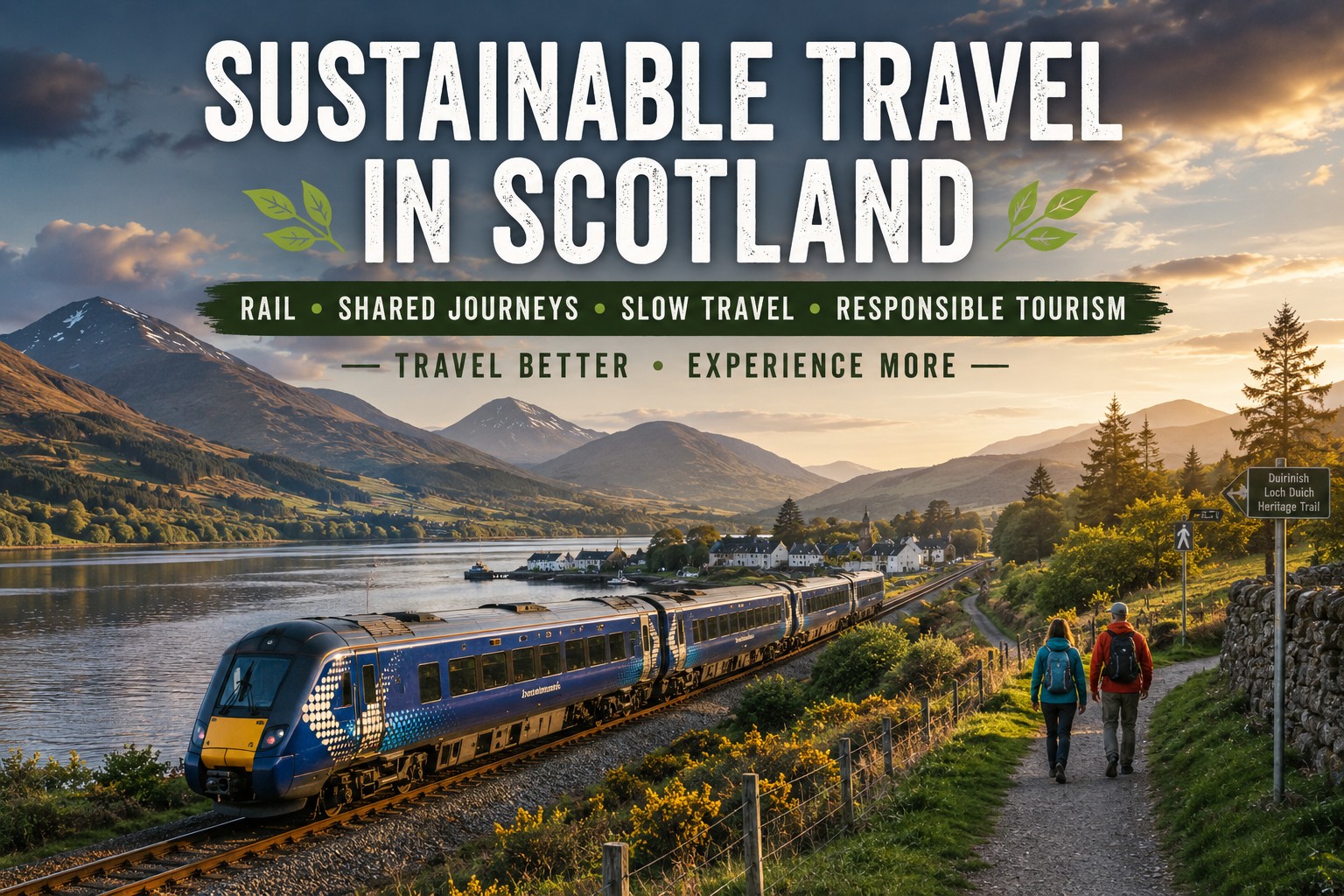
Thoughtful journeys through Scotland can combine rail, shared transport and slower local exploration while making the journey itself part of the experience
Sustainable travel in Scotland begins long before you reach a Highland glen, board an island ferry or step onto a train for Edinburgh. It starts with the shape of the journey itself: how you move between destinations, how much ground you try to cover, where your money is spent and how you behave once you arrive.
Tourism brings enormous value to Scotland’s cities, rural economies and visitor services, but concentrated demand can also place pressure on roads, paths, wildlife, historic places and communities. Responsible tourism is therefore about more than choosing an apparently greener form of transport. It means making thoughtful decisions throughout the trip.
This exact destination record is verified in the current supplied master.
The encouraging part is that those decisions do not have to diminish the experience. Using rail for suitable journeys, sharing transport, choosing fewer bases and spending meaningful time within each region can create a calmer, richer holiday as well as reducing unnecessary movement.
Travelling sustainably in Scotland does not mean seeing less. Often, it means travelling more thoughtfully and experiencing places more deeply.
Use rail, shared transport and efficient route design where they work practically for your journey.
Choose fewer bases, reduce unnecessary transfers and give each region enough time to become part of the experience.
Support accommodation, cafés, guides, attractions, shops, producers and other businesses rooted in the places you visit.
Respect wildlife, landscapes, communities and historic places so that your visit does not diminish what makes them special.
Better Transport + Slower Itinerary + Local Benefit + Responsible Behaviour
More Thoughtful Travel
🌍 What Does Sustainable Travel in Scotland Really Mean?
Sustainability is sometimes reduced to carbon emissions, but responsible tourism in Scotland has environmental, economic, social and cultural dimensions.
🚆 How You Travel
Rail, buses, coaches, ferries, organised tours, walking and cycling can all form part of a lower-impact journey. A car can remain valuable where Scotland’s geography makes other options impractical. The objective is not to declare one transport method universally good or bad, but to use each intelligently.
🏘️ Where Your Money Goes
Accommodation, cafés, restaurants, guides, attractions, shops and local producers determine how much visitor spending remains within the places being explored.
🦅 How You Treat the Destination
Giving wildlife space, respecting residents and livestock, protecting paths and archaeological sites, parking considerately and taking litter away are equally important.
🕰️ How Fast You Travel
Pace matters too. Fewer bases can mean fewer transfers, less unnecessary mileage and more time actually experiencing each destination.
Sustainable travel is a collection of better decisions—not a badge attached to one transport mode.
🚆 Scotland by Train: When Rail Becomes Part of the Journey
Rail can be one of the most satisfying ways to incorporate shared, potentially lower-impact transport into a Scottish itinerary because the journey itself can become part of the experience.
For visitors travelling north from England, trains provide direct connections into Edinburgh and Glasgow, avoiding the need for an airport transfer or immediate car hire. Within Scotland, the network connects the major cities and continues towards destinations including Aberdeen and Inverness, making rail particularly effective for substantial intercity legs.
There is also an experiential advantage. From the carriage window, travellers can watch urban Scotland give way to farmland, rivers, woodland and increasingly dramatic northern scenery. Instead of losing several hours simply moving between destinations, the transfer becomes part of discovering the country.
🏔️ Why Rail Works Particularly Well for Some Scottish Journeys
Rail is strongest when both ends of the journey are conveniently connected. City-centre-to-city-centre travel can remove the complications of traffic and parking while allowing passengers to read, talk or enjoy the landscape rather than concentrate on the road.
It can also provide the backbone of a mixed-transport holiday. A traveller might complete a long-distance journey by train before continuing into more rural Scotland by bus, ferry or organised tour.
For travellers whose mobility or accessibility requirements affect transport choices, the optimum combination may be different. Responsible travel should never mean forcing an impractical transport method simply because it appears preferable in theory.
🚉 Where Rail Stops Being the Complete Answer
Scotland’s railway network does not conveniently reach every glen, castle, coastline or island. Scenic quality and network coverage are also different questions: an excellent rail journey may still require careful onward planning.
The useful principle is therefore not rail everywhere. It is rail where it genuinely works, connected intelligently with other transport where it does not.
That might mean:
train → local bus → ferry, or train → shared tour → walking.
A well-designed Scotland-by-train itinerary succeeds because the connections have been considered together, not because every mile has been forced onto the railway.
Rail can be an excellent foundation for a Scotland journey, but responsible travel is about choosing the right combination—not forcing every journey onto one transport mode.
Can rail handle the main journey?
↓
What remains after the station?
↓
Which connection solves that stage most effectively?
🚌 Can Small-Group Tours Be a More Sustainable Choice?
Sometimes. A well-planned shared tour can provide a practical way to reach several Scottish attractions without every traveller independently driving the same route. One vehicle may also reduce parking pressure at popular locations while allowing visitors who are uncomfortable with unfamiliar rural roads to experience places that public transport does not conveniently reach.
The important distinction is between shared transport and an automatically “eco-friendly” tour. Vehicle type, occupancy, distance, routing and operator practices all influence the journey’s impact, as does the realistic alternative. A small-group tour should therefore be considered a potentially more efficient shared option—not given a sustainability label without evidence.
For some visitors, the strongest itinerary will combine rail between major destinations with organised touring for rural sightseeing. This can preserve access and convenience without requiring a rental car for the entire holiday.
🚗 Do You Need a Car in Scotland?
Not everywhere—but sometimes a car genuinely improves the journey.
Edinburgh, Glasgow and many major intercity routes can work extremely well without one. Remote Highland areas, dispersed rural attractions and some island itineraries are different. In those circumstances, selective car hire may provide greater flexibility and can avoid convoluted connections or repeated private transfers.
🌿 Making a Scottish Road Trip More Responsible
Start with route design. Group nearby attractions together, avoid unnecessary backtracking and spend several nights within a region rather than building each day around another major drive.
Share vehicles where practical, use public transport instead of driving into busy city centres, and park only where doing so is permitted and considerate. Rural verge parking can damage ground, obstruct access and create problems for residents.
Electric vehicles may suit some itineraries, but charging should be investigated against the actual route rather than assumed to be either universally convenient or impractical.
The same principle applies whatever powers the vehicle. An overloaded itinerary does not become thoughtful simply because the technology changes.
Slow the itinerary before trying to optimise the vehicle.
|
✓ Shared Touring Can Be a Good Fit For
🏔️ Highlands
Reaching scenic and rural areas beyond the main rail network. 📍 Multi-Stop Sightseeing
Connecting several attractions within one planned regional route. 🚐 Unfamiliar Rural Roads
Useful for travellers who would rather not drive themselves. 🎒 Travellers Without a Car
Extending a rail-based or city-based Scotland journey into more rural landscapes. |
🔍 Still Evaluate the Individual Tour
Vehicle
What type of vehicle is being used? Occupancy
How effectively is that vehicle being shared? Routing
Is the itinerary geographically coherent? Distance
How much travel does the itinerary actually require? Operator Practices
What evidence supports any sustainability claims being made? |
📊 Choosing How to Travel Around Scotland
There is no single responsible transport choice for every Scottish journey. Geography, accessibility, time and the destinations involved all matter, and the strongest itinerary may combine several methods rather than forcing the entire holiday around one rule.
| Travel Method | Particularly Useful For | Role in a Responsible Journey | Practical Limitation |
|---|---|---|---|
| Rail | Cities and major intercity journeys | Shared transport; journey can become part of the experience | Does not reach everywhere |
| Bus/Coach | Cities, towns and selected regional routes | Shared transport and useful local connections | Frequency and coverage vary |
| Small-Group Tour | Highlands and multi-stop sightseeing | Shared vehicle and efficient planned routing | Less itinerary flexibility |
| Car | Remote and rural exploration | Flexible access when used selectively | Mileage, parking and congestion |
| Ferry | Island journeys | Essential connection for visitors and communities | Timetables, capacity and weather |
| Walking/Cycling | Local exploration | Low-impact movement and slower discovery | Distance, terrain, weather and accessibility |
For many travellers, the answer is therefore combination rather than compromise: rail for a substantial journey, shared touring for rural sightseeing, a ferry for an island connection and walking once the destination is reached.
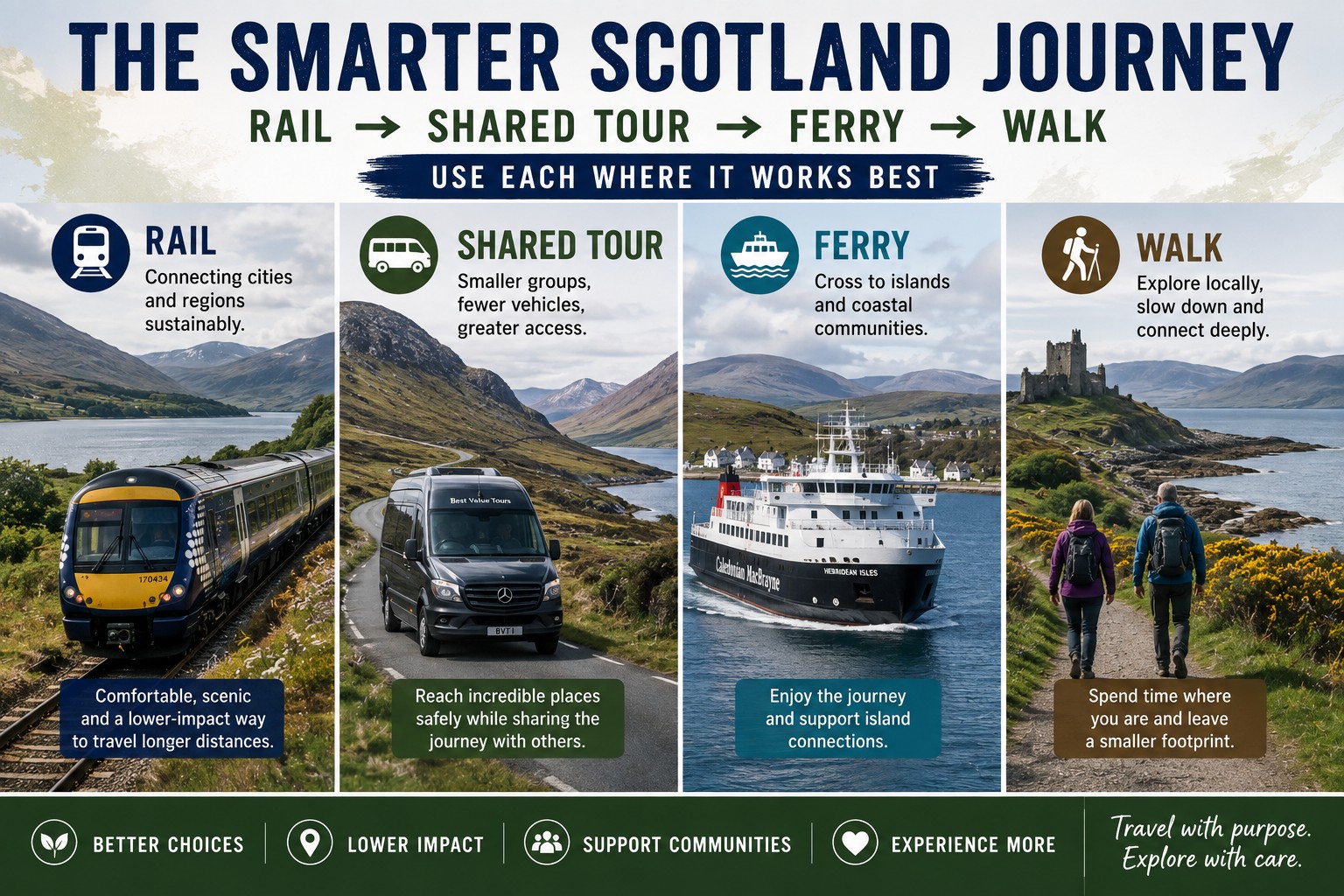
A thoughtful Scotland itinerary can combine rail, shared touring, ferries and walking, using each form of transport where it works best
🏔️ Responsible Travel in the Scottish Highlands and Islands
Scotland’s Highlands and islands are among the places visitors most want to experience—and among those where thoughtful travel can matter most. Distance, sensitive environments, limited infrastructure and small communities can make concentrated visitor pressure particularly visible.
🏝️ Slow Down on Scotland’s Islands
A ferry is not simply part of a sightseeing itinerary. Scotland’s ferry routes are lifeline connections used by residents, workers and businesses as well as visitors, while vehicle capacity and local infrastructure are not unlimited.
Once ashore, staying longer can create a better relationship with the destination. Travellers gain more time for local accommodation, cafés, shops, guides and less-famous places instead of racing between headline viewpoints.
Plan accommodation and transport rather than assuming a small community can absorb unlimited spontaneous demand. Respect parking restrictions, keep roads and access points clear, and remember that villages, harbours and cottages are part of everyday island life.
An island is not simply an attraction reached by ferry. It is somebody’s home.
⛰️ Protect Highland Landscapes
The Highlands can appear vast and resilient, but popular viewpoints, walking routes and roadside locations can experience concentrated pressure. Wet ground is vulnerable to erosion, while careless parking, litter and unnecessary disturbance can leave an impact disproportionate to a single visit.
Use established routes where requested, avoid widening paths simply to escape mud and follow local access guidance. Gates, livestock, farms, crofts and estates are parts of working landscapes and should be treated accordingly. Outdoor access brings remarkable opportunities to experience Scotland, but those opportunities depend upon responsible behaviour.
Access brings responsibility.
|
🏝️ On Scotland’s Islands
✓ Remember that ferries are community lifelines
They carry residents, workers, supplies and essential services as well as visitors. ✓ Secure important transport and accommodation
Limited capacity can make critical arrangements particularly important on island journeys. ✓ Stay longer rather than racing between islands
Fewer transfers can create a deeper experience while reducing unnecessary movement. ✓ Keep roads and access points clear
Park considerately and never obstruct passing places, gateways or essential local access. ✓ Support island businesses
Accommodation, cafés, shops, guides and local producers can help visitor spending remain within the community. ✓ Remember that villages and harbours are living communities
Enjoy them as places where people live and work—not simply as visitor attractions. |
⛰️ In the Scottish Highlands
✓ Use established routes where requested
Following recognised paths can help protect surrounding vegetation and vulnerable ground. ✓ Don’t widen paths simply to avoid mud
Walking around wet sections can gradually increase erosion and damage beside established routes. ✓ Park considerately
Avoid blocking roads, gateways, passing places or access required by residents and land managers. ✓ Respect gates, livestock and working land
Highland landscapes can be both spectacular visitor environments and active working countryside. ✓ Avoid concentrating pressure at roadside viewpoints
If a location is crowded or parking is unsuitable, be prepared to continue rather than adding to the pressure. ✓ Give the landscape enough time
Slower regional travel can reduce rushed driving while creating more opportunity to experience the Highlands beyond famous stops. |
🦅 Wildlife, Nature and Scotland’s Fragile Places
Wildlife encounters can become highlights of a Scottish journey, particularly around islands, coastlines, forests and quieter Highland landscapes. The quality of an encounter should never depend upon getting unnecessarily close.
Give animals sufficient space, especially around nesting and breeding areas. Never feed or pursue wildlife for photographs, and do not pressure guides or wildlife operators to approach more closely simply to produce a better picture. Dogs require particular care around livestock and sensitive wildlife.
Responsible tourism also extends to Scotland’s cultural landscape. Standing stones, prehistoric remains and archaeological sites may have survived for thousands of years, but that does not make them indestructible. Follow site guidance and avoid climbing on, moving or damaging historic remains.
A memorable encounter should never require wildlife—or the landscape—to pay for it.
🏘️ Support the Communities Behind the Landscapes
Environmental impact is only one part of sustainable tourism. Where visitor spending goes matters too.
Choosing locally based accommodation, independent cafés and restaurants, guides, attractions, shops, craftspeople and producers can help more of the economic value of tourism remain within the destination.
Staying longer strengthens that opportunity. It creates time to eat locally, use nearby services and discover places beyond the headline attractions rather than simply arriving for a photograph and leaving.
Responsible tourism also means recognising the distinction between a destination and a community. Homes are not visitor attractions, narrow roads remain essential local access, and everyday services have resident users.
Scotland’s Highlands and islands are communities first and visitor destinations second.
Give wildlife enough space that your presence does not alter its behaviour.
A closer image is not worth causing stress or forcing wildlife to move away.
Feeding can change natural behaviour and create unhealthy dependence on visitors.
Respect seasonal restrictions, local guidance and any protected areas or access measures.
Follow local instructions and keep dogs under suitable control for the environment you are visiting.
Follow site guidance, avoid climbing or moving historic material, and treat prehistoric remains with the same care as natural landscapes.
🗺️ Build a More Sustainable Scotland Itinerary
Some of the most effective responsible-travel decisions happen before the journey begins. Rather than designing an overloaded itinerary and then trying to make each individual transfer marginally greener, start by reducing unnecessary movement.
1️⃣ Choose Fewer Bases
Staying several nights in each location means fewer transfers, less packing and more time for genuine exploration. It can also create more opportunities to spend with businesses within the region.
2️⃣ Use Rail Where It Works
Consider rail for well-connected intercity and longer-distance journeys instead of automatically hiring a car from arrival to departure.
3️⃣ Connect with Shared or Local Transport
Buses, ferries and organised tours can extend a rail-based journey into areas the railway does not reach. Walking or cycling may work particularly well for local exploration where distance, terrain, weather and individual accessibility allow.
4️⃣ Add a Car Where It Genuinely Improves Access
Selective car hire can be entirely reasonable when rural destinations would otherwise require impractical connections. Responsible itinerary design should accommodate different mobility requirements rather than demanding one supposedly ideal solution from every traveller.
5️⃣ Stay Longer
Allow regions time to reveal themselves. An additional day can create space for local walks, independent businesses, nearby attractions and unexpected discoveries without requiring another long-distance transfer.
6️⃣ Spend Locally and Leave Carefully
Support the communities making the journey worthwhile, then leave landscapes, wildlife sites and historic places ready for those who come after you.
The relationship is straightforward:
fewer bases → fewer long transfers → more time locally → greater opportunity for local benefit.
A slower itinerary can therefore improve more than its environmental footprint. It can reduce travel fatigue, create greater flexibility and replace a succession of brief stops with experiences that actually have time to become memorable.
More destinations do not automatically create a better Scotland journey. Sometimes the strongest improvement is simply to give fewer places more time.
|
⚠️ Overloaded Itinerary
🧳 Many Bases
↓
🎒 Repeated Packing
↓
🚗 Long Transfers
↓
↩️ Backtracking
↓
⏱️ Brief Encounters
More of the journey can become movement between places rather than time spent experiencing them.
|
🌱 Thoughtful Itinerary
🏡 Fewer Bases
↓
🗺️ Geographical Grouping
↓
🚶 Shorter Local Journeys
↓
🕰️ More Time Locally
↓
❤️ Deeper Experience
More time can be spent walking, eating, exploring and experiencing the places already included in the journey.
|
→
Fewer Long Transfers
→
More Time Locally
→
Greater Opportunity for Local Benefit
💷 Does Sustainable Travel in Scotland Cost More?
Not necessarily. Some responsible choices carry a premium, while others may reduce costs.
The useful comparison is not the price of one train ticket, hotel or rental car in isolation. It is the overall value and cost of the complete itinerary.
Rail can sometimes offer good value when booked ahead, while using public transport or walking in cities may avoid car-hire, fuel and parking costs. Choosing fewer bases can also remove repeated transfers that add expense without necessarily adding much to the experience.
Equally, specialist experiences, particular responsible operators and accommodation in remote areas may cost more. Sustainable travel should therefore not be sold as automatically cheaper—or treated as a luxury available only to travellers with large budgets.
The better question is: which choices deliver the strongest combination of experience, practicality, value and responsibility for this particular journey?
|
✓ Responsible Choices May Save Money
✓ Fewer Transfers
A slower itinerary can reduce the number of separate journeys you need to make. ✓ Less Car Hire
Rail, shared transport or selective car use may remove the need for a vehicle throughout the entire trip. ✓ Less Fuel and Parking
Reducing unnecessary driving can also reduce associated journey costs. ✓ Walking and Public Transport in Cities
Compact urban itineraries can make a car unnecessary for parts of the journey. ✓ Advance Rail Planning
Investigating longer rail journeys early can reveal options that fit both the itinerary and the budget. |
⚠️ Responsible Choices May Sometimes Cost More
⚠️ Remote Accommodation
Staying within smaller or more isolated communities can sometimes carry different costs from major destinations. ⚠️ Specialist Experiences
Local guides and specialist activities may cost more than simply passing through independently. ⚠️ Particular Responsible Operators
Some businesses investing in stronger environmental or community practices may not be the cheapest available option. ⚠️ Accessibility and Practical Requirements
The most suitable journey must work for the traveller’s genuine mobility, accessibility and logistical needs. ⚠️ The Cheapest Option Isn’t Always the Most Suitable
Price alone cannot measure convenience, time, accessibility, experience or wider impact. |
+
Practicality
+
Value
+
Responsibility
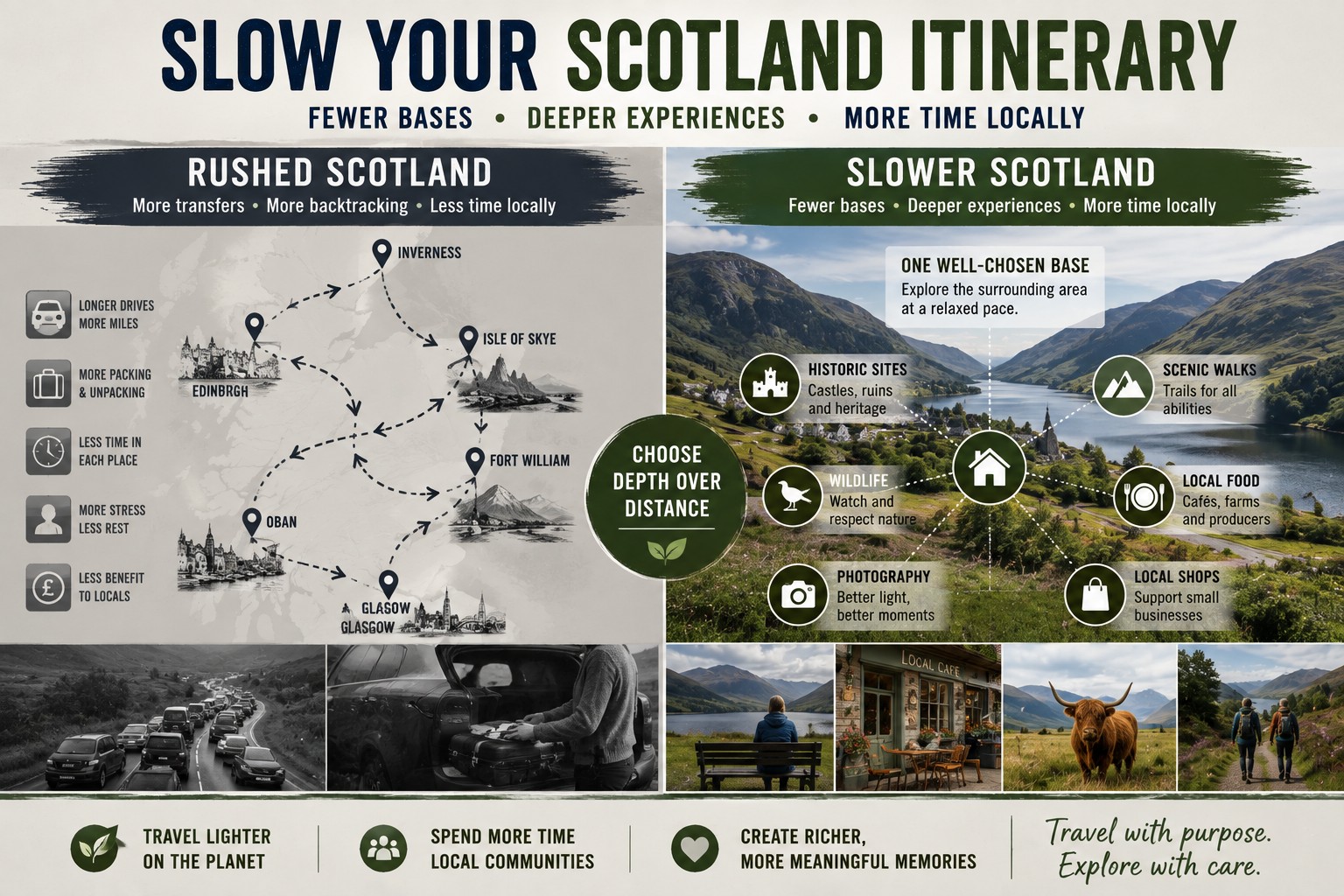
Choosing fewer bases can reduce unnecessary transfers while creating more time for local landscapes, historic places, wildlife, businesses and communities
📆 Use the BVT Scotland Events Calendar to Plan Smarter Journeys
Events can influence a responsible itinerary before transport is even booked. Highland Games, festivals and cultural celebrations may provide excellent reasons to spend longer within one region rather than travelling a substantial distance simply to attend for a few hours.
The BVT Scotland Events Calendar can help identify events that coincide with proposed travel dates while the route is still flexible:
Once an event becomes part of the plan, investigate rail, bus or shared transport and consider staying in or near the host community. If travelling without a car, check the return journey as carefully as the outward one—particularly when an event finishes later in the evening.
Nearby attractions can then turn the event into part of a wider regional stay. Instead of crossing Scotland for one engagement and immediately leaving, travellers may discover another reason to remain for an additional night.
Always confirm current dates, admission arrangements and transport information before making an event essential to the itinerary.
Used intelligently, an events calendar is therefore more than a collection of things to do.
It can help determine where to slow down and spend more time.
Festivals •
Cultural Events •
Traditional Gatherings •
Seasonal Celebrations
🌱 Sustainable Scotland: The Responsible Traveller’s Checklist
Responsible tourism becomes easier to put into practice when it is treated as a series of thoughtful decisions rather than a demand for perfection. Scotland’s geography is varied, public transport does not serve every remote destination equally, and travellers have different mobility requirements, budgets and amounts of time available.
What matters is making better choices where they genuinely work.
Use rail and shared transport where they suit the route, and use a car selectively when it provides meaningful access. Avoid unnecessary mileage, allow enough time within each region and resist measuring the success of a Scottish holiday by how many destinations can be collected.
Support local accommodation, guides, cafés, restaurants, shops and producers. Give wildlife enough space to remain wild, respect livestock and working landscapes, and treat archaeological and historic places with the care their survival deserves.
On paths and in the countryside, avoid contributing to erosion, take litter away and follow local guidance. Park responsibly and prepare properly for the terrain and weather you expect to encounter.
Above all, remember that responsible travel should remain practical and inclusive. A transport choice that works brilliantly for one visitor may be unsuitable for another. Sustainability is strengthened by informed decisions, not by making travellers feel they have failed because their circumstances require a different solution.
A slower journey can create more time for conversations, local food, unexpected viewpoints and places that never appeared on the original itinerary. Responsible travel at its best is therefore not simply about reducing impact.
It can improve how deeply Scotland is experienced.
Travel with purpose. Explore with care.
|
🚆 Plan the Journey
✓ Use rail or shared transport where practical
✓ Use a car selectively where it genuinely improves access
✓ Choose fewer bases
✓ Avoid unnecessary backtracking
✓ Stay longer within regions
✓ Support local businesses
|
🌿 Respect the Place
✓ Give wildlife space
✓ Respect livestock and working landscapes
✓ Protect paths and wet ground
✓ Treat archaeology carefully
✓ Park responsibly
✓ Take litter away
|
❓ Sustainable Travel in Scotland FAQs
❓ What Is Sustainable Tourism in Scotland?
Sustainable tourism considers the environmental, social, cultural and economic effects of a journey. Transport is important, but so are visitor behaviour, local spending, wildlife protection, cultural heritage and the pressure tourism places on communities and landscapes.
The objective is not perfect travel. It is to make thoughtful choices that allow tourism to benefit Scotland while reducing unnecessary negative impacts.
❓ Can You Travel Around Scotland Without a Car?
Yes. Many Scottish itineraries can be built around trains, buses, ferries, walking and organised tours, particularly when Edinburgh, Glasgow and other well-connected destinations form the backbone of the journey.
The limitations become greater in remote rural areas, where services may be less frequent or poorly aligned with individual attractions. A successful car-free journey is therefore usually designed around destinations that connect naturally rather than attempting to reproduce a road trip using public transport.
❓ Is Scotland Easy to Explore by Train?
Scotland by train can be both practical and highly enjoyable. Rail links the principal cities and reaches several important destinations farther north and west, allowing substantial parts of an itinerary to be completed without driving.
It is not a comprehensive sightseeing network. Many glens, islands, castles and rural communities require onward transport, so rail often works best as the backbone of a multimodal journey.
❓ Are Small-Group Tours a Sustainable Way to See Scotland?
They can provide a potentially more efficient shared option when several travellers would otherwise make the same journey independently.
However, small-group does not automatically mean sustainable. Vehicle type, occupancy, route, distance and operator practices all matter, so responsible claims should be considered on their individual merits.
❓ Do You Need a Car for the Scottish Highlands?
No—not for every Highland journey. Trains, buses and organised tours provide access to many destinations and can support excellent itineraries.
A car becomes more useful when visiting remote locations, dispersed attractions or routes with limited public transport. Selective car hire can therefore offer a practical middle ground between driving throughout the holiday and insisting on remaining entirely car-free.
❓ Can You Visit Scotland’s Islands Without a Car?
Yes, some Scottish islands can work very well without one, especially when accommodation and activities are chosen around local transport and realistic walking distances.
Conditions differ considerably between islands. Ferry connections, bus networks, seasonal services, accessibility requirements and accommodation location should therefore be researched for the specific journey rather than assuming one car-free strategy will work everywhere.
❓ How Can Tourists Protect Scotland’s Landscapes and Wildlife?
Give wildlife sufficient space, particularly around nesting and breeding areas, and never feed, pursue or deliberately disturb animals for a photograph. Respect seasonal restrictions, local signage and guidance from responsible wildlife operators, and keep dogs under appropriate control around livestock and sensitive habitats.
In the countryside, use established routes where requested, avoid worsening erosion around wet or heavily used ground, park considerately and take litter away. Historic and prehistoric places deserve the same care: do not climb on, move or damage archaeological remains to obtain a closer experience or photograph.
Responsible access means enjoying Scotland while leaving as little evidence of your visit as possible.
❓ Is Sustainable Travel in Scotland More Expensive?
Not inherently. Public transport, shared journeys, walking and choosing fewer bases can sometimes reduce costs, while advance planning may improve the value available on some rail journeys.
Other choices, including specialist experiences, remote accommodation or particular responsible operators, may cost more. Compare the cost and value of the complete itinerary rather than assuming sustainable travel is automatically either cheap or expensive.
🌄 Final Thoughts: Travel Better, Experience More
A more sustainable Scotland journey need not be defined by restriction. It can begin with a more rewarding idea: giving each destination enough time to matter.
Use rail where it works. Share transport when it provides a sensible solution. Add a car where it genuinely improves access. Support businesses rooted in the places you visit, respect communities, give wildlife space and leave Scotland’s natural and ancient landscapes ready for those who follow.
Responsible tourism cannot require every visitor to make identical choices. Scotland’s geography is too varied, and travellers themselves have different needs.
What matters is the direction of those choices—and whether the journey has been designed with consideration for the places and people that make it possible.
Scotland does not need visitors to travel perfectly. It needs visitors to travel thoughtfully.
Travel with purpose. Explore with care.
Choose the place → understand the journey → give the region enough time.
Scotland Travel Guide: Discover the Highlands, Islands, Cities and Legendary Landscapes →
Scottish Highlands Travel Guide: Mountains, Lochs, Castles and Scenic Journeys →
Scottish Islands Travel Guide: Skye, Orkney, Hebrides and Remote Coastal Adventures →
Scotland Multi-Day Tours: Highlands, Islands, Lochs and Castles →