


Stonehenge Autumn Equinox 2026: What Happens and Can You Visit?
17th August 2026
🍂 Stonehenge Autumn Equinox 2026: What Happens and Can You Visit?
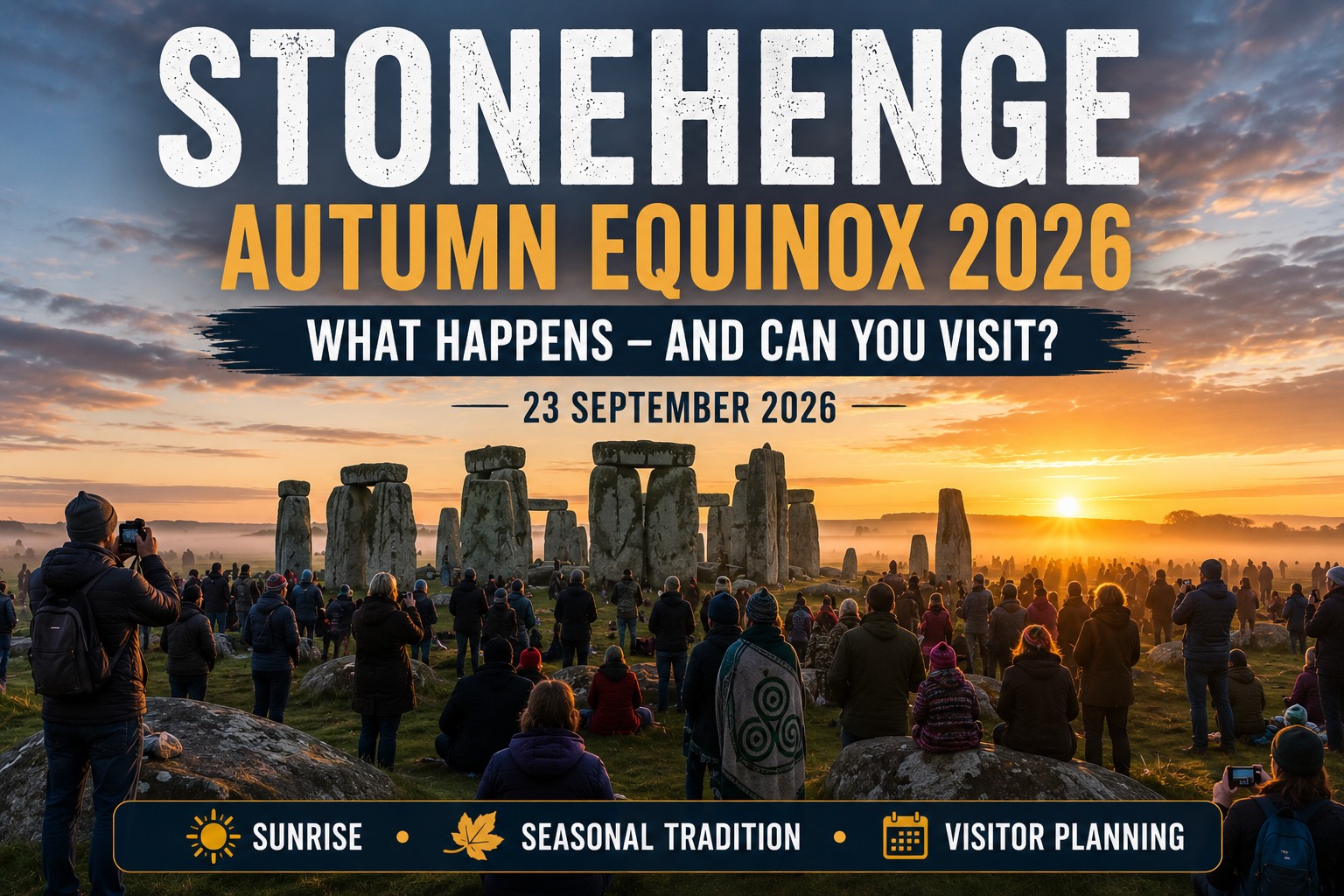
Stonehenge’s Autumn Equinox brings visitors together around sunrise and the changing season. The 2026 equinox falls on 23 September, while specific visitor and access arrangements should be confirmed before travelling
🍂 Can You Visit Stonehenge for the Autumn Equinox in 2026?
Yes, Stonehenge can be a remarkable place to experience the Autumn Equinox, but anyone planning a 2026 visit needs to distinguish carefully between what is already known and what still requires official confirmation.
The astronomical date is established: the 2026 autumnal equinox falls on 23 September. Stonehenge also has an established modern tradition of people gathering around the spring and autumn equinoxes to watch the sunrise. However, detailed visitor arrangements for a seasonal gathering—such as exact access times, parking, ticketing or Managed Open Access—should only be treated as confirmed when current 2026 information has been published by the relevant authorities.
That distinction matters because several different ideas are often blurred together when Stonehenge and the equinox are discussed.
Stonehenge has exceptionally strong archaeological associations with the solstices, particularly the relationship between its principal axis and the directions of midsummer sunrise and midwinter sunset.
Modern equinox observance is different. There is no established archaeological evidence that Stonehenge was constructed specifically to mark the spring or autumn equinoxes in the same way.
That does not make an equinox gathering less meaningful. Contemporary visitors may come for sunrise, seasonal reflection, photography, modern pagan or spiritual observance, historical curiosity or simply the unusual atmosphere of being at Stonehenge as summer gives way to autumn.
The most useful way to approach the 2026 Autumn Equinox is therefore to keep four categories separate throughout your planning:
Astronomically established: what the equinox itself is and when it occurs.
Archaeologically supported: what the evidence tells us about Stonehenge and the Sun.
Modern tradition: how people choose to mark the equinox at Stonehenge today.
2026 visitor arrangements: the practical access details that should be checked against current official information before travelling.
Understanding those distinctions allows you to appreciate both ancient Stonehenge and its continuing modern significance without confusing one with the other. It also gives you a clearer basis for deciding whether to plan specifically around the equinox or whether a conventional Stonehenge visit would better suit the experience you want.
🌍 When Is the Autumn Equinox in 2026?
The 2026 autumnal equinox occurs on 23 September, marking the beginning of astronomical autumn in the Northern Hemisphere.
An equinox is an astronomical moment when the Sun crosses the celestial equator. It happens twice each year, around March and September, as Earth continues its annual journey around the Sun.
You will often hear the equinox described as the point when day and night are exactly equal. That is a useful shorthand, but the reality is slightly more complicated. Daylight and darkness are approximately equal rather than precisely twelve hours each everywhere, partly because of atmospheric refraction and the way sunrise and sunset are measured.
For anyone planning to visit Stonehenge, there is another useful distinction: the astronomical equinox is a particular moment, whereas an equinox gathering is a human event organised around the seasonal occasion. The exact astronomical time does not therefore determine every practical detail of a Stonehenge visit.
Sunrise nevertheless has particular symbolic power. Watching the landscape gradually emerge from darkness provides a natural focus for people marking the transition between seasons, especially at a monument so strongly associated with the changing position of the Sun.
That explains part of Stonehenge’s modern equinox appeal—but it does not tell us that its prehistoric builders were celebrating the same event.
☀️ Why Do People Gather at Stonehenge for the Equinox?
Stonehenge has become one of Britain’s most recognisable places for marking seasonal change.
Modern visitors may gather around the equinox for very different reasons. Some come for contemporary pagan, Druid or other spiritual observances. Others want to photograph sunrise, experience Stonehenge in an unusual atmosphere, acknowledge the changing season or simply witness a tradition they have never encountered before.
There is no single type of equinox visitor, and there is no need to assume that everyone present shares the same beliefs.
That diversity is part of the modern story of Stonehenge. For prospective visitors, it also helps set expectations correctly: the attraction is not a conventional organised performance, but the opportunity to share an important seasonal moment with people who may have very different reasons for being there.
Stonehenge naturally lends itself to seasonal gatherings because the monument has such a powerful relationship with the Sun and the changing year. Standing in the prehistoric landscape around sunrise can feel significant whether your interest is spiritual, archaeological, photographic or simply experiential.
But one distinction is essential:
A modern tradition does not need to be Neolithic to be meaningful.
Contemporary equinox gatherings can have genuine cultural and spiritual importance without being presented as an unbroken continuation of ceremonies performed by Stonehenge’s prehistoric builders. Recognising that difference allows modern traditions to stand on their own terms while protecting the integrity of the archaeological story.
🏺 Was Stonehenge Built for the Autumn Equinox?
This is where archaeology and modern tradition need to be separated particularly carefully.
Stonehenge has a well-established architectural relationship with the solstices. Its principal axis is aligned approximately towards the direction of midsummer sunrise and, when viewed in the opposite direction, midwinter sunset. These relationships provide some of the strongest evidence that the changing solar year mattered to the people who created and used the monument.
The equinox is different.
There is no established archaeological evidence demonstrating that Stonehenge’s builders deliberately designed the monument to mark the spring and autumn equinoxes in the same way. Nor can today’s equinox gatherings be used as evidence that equivalent ceremonies took place there during the Neolithic or Bronze Age.
That distinction is worth preserving because Stonehenge becomes more interesting, not less, when evidence and interpretation are kept separate.
Myth: Stonehenge was definitely designed to mark every major event in the solar year.
Evidence: Its strongest established architectural solar relationship concerns the solstices. Modern equinox observance belongs principally to contemporary seasonal tradition rather than proven prehistoric equinox ritual.
You can therefore experience an Autumn Equinox sunrise as part of Stonehenge’s continuing cultural life while recognising that its meaning today is not necessarily the meaning it held thousands of years ago.
For visitors particularly interested in Stonehenge’s ancient relationship with the Sun, understanding this distinction can also help determine whether an equinox gathering, a solstice experience or a conventional archaeology-focused visit best matches what they actually want from the monument.
🌅 What Actually Happens at Stonehenge at the Autumn Equinox?
An Autumn Equinox morning at Stonehenge is better imagined as a seasonal sunrise gathering than as a large conventional festival.
Visitors typically arrive very early, before the landscape is fully light, with the gathering building as sunrise approaches. People may watch the eastern horizon, take photographs, meet fellow visitors or participate in contemporary spiritual and seasonal observances. Others simply come to experience Stonehenge at an unusual hour and witness the atmosphere surrounding the changing season.
The mood can therefore be quite varied. One part of the gathering may feel reflective, while elsewhere people may be talking, celebrating or sharing the experience with friends. Visitors should not expect a single organised ceremony in which everyone participates, nor assume that everyone present has come for religious or spiritual reasons.
Weather also plays a substantial role.
A clear horizon may produce a memorable sunrise, but September on Salisbury Plain can just as easily bring cloud, mist, wind or rain. Sunrise itself is never guaranteed to be visually dramatic. In some conditions, however, the changing light, weather and ancient landscape can create an atmosphere every bit as memorable as a clear sky.
Recent Autumn Equinox gatherings provide useful evidence of how the occasion has operated, including early-morning access under special managed arrangements. They should be treated as precedent rather than a promise of identical conditions in 2026. Exact access times, parking arrangements, restrictions and the form of any Managed Open Access should be checked against current official information before travelling.
This is one of the principal differences between planning an equinox morning and booking an ordinary Stonehenge visit: the experience can be distinctive precisely because it falls outside the monument’s conventional daytime rhythm, but that also makes careful advance planning more important.
If the unusual access and seasonal atmosphere are central to why you want to visit, that additional planning may be entirely worthwhile. If your priorities are predictable logistics, detailed interpretation and a conventional sightseeing experience, a normal Stonehenge visit may ultimately suit you better.
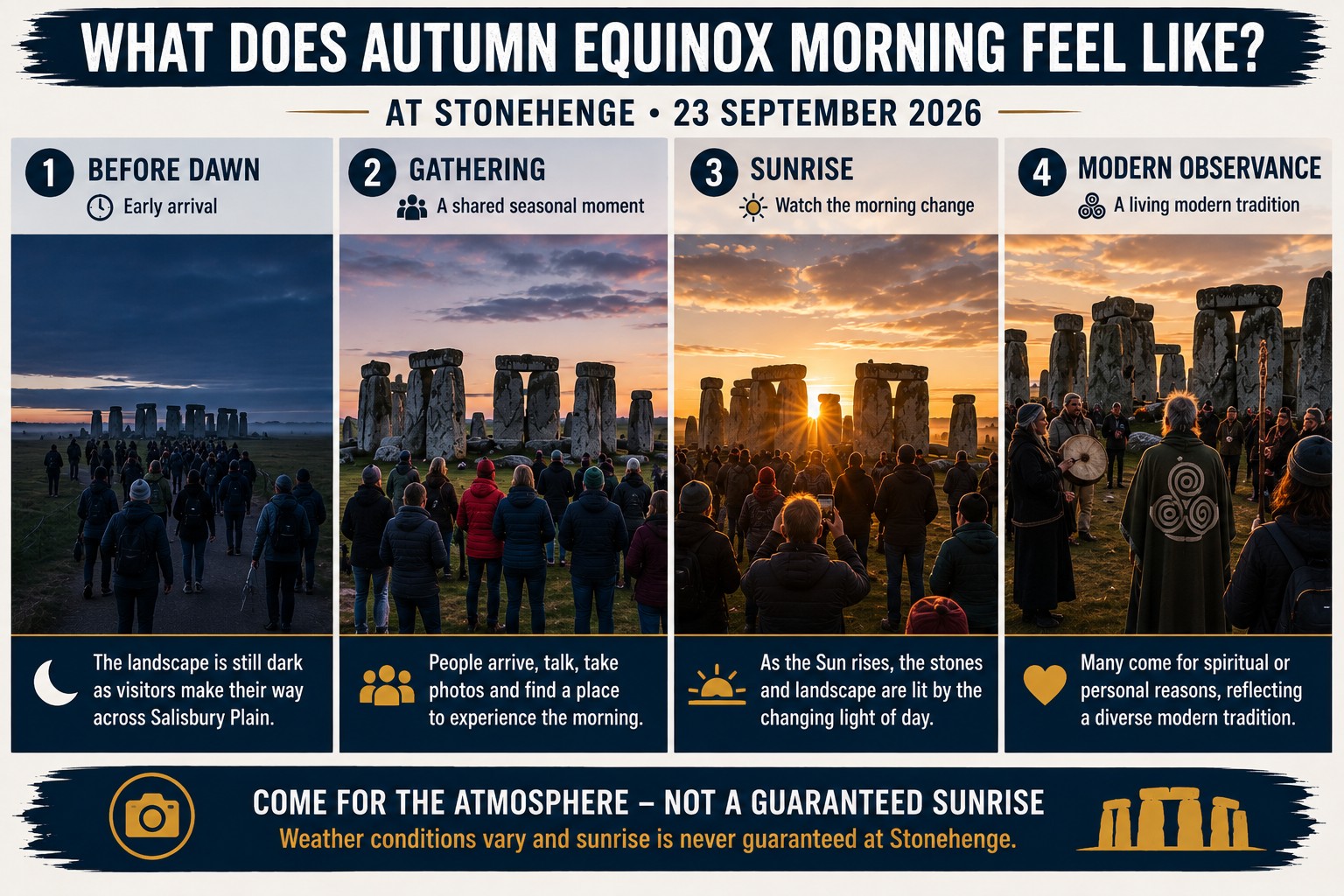
An Autumn Equinox morning at Stonehenge develops from a pre-dawn arrival into a shared seasonal gathering, changing morning light and diverse modern observance. Weather and sunrise conditions are never guaranteed
📊 Autumn Equinox vs Summer Solstice vs a Normal Stonehenge Visit
Although all three experiences take place at the same monument, they can produce very different Stonehenge visits.
| Decision Factor | Autumn Equinox | Summer Solstice | Normal Stonehenge Visit |
|---|---|---|---|
| Main character | Smaller seasonal gathering | Major communal celebration | Heritage sightseeing |
| Historical relationship | Modern equinox observance; no equivalent proven alignment | Strong solstitial association | Not event-dependent |
| Atmosphere | Reflective, early morning | Large-scale and energetic | Conventional visitor experience |
| Crowd scale | Generally much smaller | Very large | Variable |
| Timing | Early morning | Overnight/early morning | Normal opening hours |
| Practical predictability | Special arrangements may apply | Major event management | Most straightforward |
| Best for | Seasonal atmosphere and sunrise interest | Major cultural experience | Interpretation and convenience |
The most important difference is not simply the number of people attending.
Summer Solstice has a direct relationship with Stonehenge’s solar architecture and has developed into a major contemporary gathering. It can attract very large crowds and has a celebratory atmosphere that is fundamentally different from an ordinary heritage visit.
The Autumn Equinox generally offers a smaller-scale seasonal experience. Its appeal lies more in sunrise, atmosphere and contemporary observance than in an equivalent prehistoric architectural relationship with the equinox itself.
A normal daytime visit provides something different again. It offers more predictable operating arrangements and is generally better suited to travellers who want to explore Stonehenge’s interpretation, exhibition and wider prehistoric story at a conventional sightseeing pace.
None of these experiences should automatically be ranked above the others.
A visitor fascinated by archaeology may gain more from a normal daytime visit than from attending before sunrise. Someone interested in seasonal tradition may find the Autumn Equinox considerably more memorable. A traveller seeking the scale and communal character of Stonehenge’s most famous annual gathering may prefer Summer Solstice.
The useful question is therefore not “Which is the best way to visit Stonehenge?”
It is “Which version of Stonehenge best matches the experience I actually want?”
Making that decision first gives you a much stronger basis for choosing the appropriate date, access arrangement and wider Stonehenge itinerary rather than treating every special occasion as automatically superior to a normal visit.
🎟️ Can You Visit Stonehenge During the Autumn Equinox 2026?
The practical answer requires an important distinction between what is already established and what still needs official confirmation for 2026.
✅ What Is Confirmed for 2026
The Autumn Equinox falls on 23 September 2026, so travellers can confidently use that date when considering where the equinox might fit within a wider September itinerary.
Stonehenge also has an established modern tradition of people gathering around the equinoxes to watch the sunrise. The existence of that contemporary tradition is not in question.
What should not be assumed, however, is that every operational arrangement used for a previous gathering will automatically be repeated.
⏳ What Is Still Awaiting Confirmation
Until specific 2026 arrangements are officially published, travellers should avoid treating previous details concerning Managed Open Access, parking, opening times, monument-field access, charges or restrictions as confirmed for this year.
Previous arrangements are useful for understanding the general character of the event, but they are not a substitute for current visitor information.
This distinction becomes particularly important if special access is the main reason for your journey.
🔎 What Should Visitors Check Before Travelling?
Before committing to the trip—and again shortly before departure—check the latest official information covering access times, parking, transport arrangements, prohibited items, accessibility and any instructions applying specifically to the gathering.
Overseas visitors and anyone travelling a substantial distance should be especially cautious about making non-refundable arrangements solely on the assumption that a previous year’s access arrangements will be repeated unchanged.
If the equinox is one element of a wider Britain itinerary, keeping the surrounding plans reasonably flexible until the operational details are confirmed can reduce the risk of one unconfirmed event arrangement disrupting flights, accommodation or other important experiences.
The equinox itself is predictable.
The visitor arrangements surrounding it are operational decisions, and those should always be verified for the year you intend to attend.
🥾 Practical Planning for an Early-Morning Equinox Visit
Even before final 2026 operational details are confirmed, some practical realities of an equinox sunrise visit are easy to anticipate.
Expect an early start, with at least part of your journey potentially taking place in darkness. September mornings on Salisbury Plain can be cool, windy and wet, so warm layers and waterproof clothing are sensible even when the forecast looks relatively favourable. Weather can change quickly in an exposed landscape.
Footwear matters too. Previous equinox arrangements have involved walking across the Stonehenge landscape and negotiating uneven ground, so comfortable shoes with suitable grip are preferable to footwear intended only for city sightseeing. Any specific 2026 walking route or access arrangements should nevertheless be checked once current guidance is available.
A small torch or headlamp can be useful when approaching before daylight, where permitted and appropriate. Keep anything you carry practical and compact, and check event-specific restrictions before leaving home or your accommodation.
Transport requires particularly careful planning. Public transport that works perfectly well for a normal daytime Stonehenge visit may not operate early enough for a sunrise gathering. Drivers should likewise avoid assuming that normal parking arrangements, opening times or routes will apply during special access.
If you are staying elsewhere in southern England, consider the complete journey rather than simply the distance to Stonehenge. Your accommodation location, departure time, transport method and return or onward plans all affect whether an equinox morning will fit comfortably into the wider trip.
Visitors with mobility or accessibility requirements should confirm the current arrangements rather than relying on previous events. The combination of darkness, uneven terrain, weather and altered access procedures can make an early-morning gathering quite different from an ordinary visit.
Finally, allow contingency time. Traffic, parking procedures and the walk towards the monument can all take longer than expected.
Arriving prepared means you can spend less time worrying about logistics and more time experiencing the changing light, landscape and atmosphere that brought you to Stonehenge in the first place.
👤 Who Will Enjoy the Stonehenge Autumn Equinox Most?
The Autumn Equinox is likely to appeal most strongly to travellers who value atmosphere and experience as much as conventional sightseeing. The early start and less predictable conditions are part of its character rather than inconveniences added to an otherwise normal Stonehenge visit.
🌅 Sunrise and Atmosphere Seekers
If getting up before dawn feels like part of the adventure, an equinox morning may suit you particularly well. There is something distinctive about watching Salisbury Plain emerge from darkness while people gather around one of the world’s most recognisable prehistoric monuments.
The experience is about being present at a seasonal turning point rather than simply arriving at Stonehenge at an unusual hour.
📸 Photographers
Early light, changing weather and the relationship between people, monument and landscape can create fascinating photographic opportunities.
There are no guarantees. Heavy cloud may obscure the sunrise completely, while rain or mist may transform the scene in another direction. Photographers who embrace those changing conditions rather than expecting one predetermined image are likely to get the most from the morning.
🧠 History-Curious Travellers
The equinox can be especially rewarding if you enjoy understanding how the meaning of historic places evolves.
Here, an ancient monument with demonstrable solstitial relationships provides the setting for a modern equinox tradition. Appreciating both stories—and recognising that they are not the same story—adds considerable depth to the experience.
🌿 Spiritual and Seasonal Visitors
For people who already mark seasonal transitions, Stonehenge can provide a particularly resonant setting.
Modern Druid, pagan and other spiritual observances form part of the monument’s continuing cultural life. They deserve respect on their own terms without needing to be presented as an unchanged continuation of prehistoric ritual.
The common thread is simple: the Autumn Equinox works best for visitors who care about the occasion itself, rather than those seeking only a different route to ordinary Stonehenge sightseeing.
If your reasons for visiting fall outside these priorities, that is useful information rather than a reason to force the equinox into your plans. Stonehenge offers several very different visitor experiences, and identifying what you actually want from the monument is the strongest starting point for choosing between them.
🚫 Who May Prefer a Normal Stonehenge Visit Instead?
The Autumn Equinox is a different Stonehenge experience, not automatically a better one.
A normal daytime visit may suit you better if you prioritise straightforward transport, conventional opening hours, visitor facilities and plenty of time to explore the exhibition and wider interpretation. For a first encounter with Stonehenge, these advantages can matter considerably.
Families with younger children may find ordinary visiting hours easier than travelling before dawn. Visitors with mobility requirements may also value the greater predictability of standard arrangements, particularly if accessibility details for the equinox gathering have not yet been confirmed.
A conventional visit can also be the stronger choice if your principal goal is to understand Stonehenge properly. The monument is only one part of an extraordinary prehistoric landscape, and the visitor experience provides context that can be difficult to absorb during the unusual conditions and atmosphere of a seasonal gathering.
You do not need to attend an equinox, solstice or special-access event to have an authentic Stonehenge experience.
For many travellers, seeing the monument in daylight, learning about the people who built it and exploring its archaeological story at a comfortable pace will be more rewarding than an early-morning gathering.
If this better describes what you want from Stonehenge, a conventional visit or organised Stonehenge tour may provide a more natural foundation for the wider day, particularly when the monument forms part of a broader southern England itinerary.
🍁 Why September Can Be a Beautiful Time to Visit Stonehenge Anyway
Missing the exact Autumn Equinox does not mean missing autumn at Stonehenge.
September brings a gradual change to the Wiltshire landscape as summer gives way to shorter days, cooler mornings and softer seasonal light. Cloud, low sun, mist and rapidly changing weather can alter the appearance of the stones throughout a single visit.
That atmosphere makes September worthwhile even if you have no interest in attending the equinox gathering itself.
The wider setting also deserves time. Stonehenge sits within a remarkable prehistoric landscape rather than existing as an isolated stone circle, and autumn conditions can make the surrounding downland particularly atmospheric. Travellers who have flexibility may find that allowing time for the wider site creates a richer experience than concentrating everything on a single sunrise.
September also lends itself naturally to exploring more of Wiltshire. Salisbury can add another dimension to the journey, while visitors with additional time can use Stonehenge as part of a broader exploration of southern England rather than treating it as a standalone stop.
The important point is that the equinox is one moment within a much broader autumn season.
If the gathering does not suit your dates, if the final arrangements are inconvenient, or if an early start simply does not appeal, there is no reason to regard your trip as second best. Stonehenge can be exceptionally atmospheric throughout this period.
For travellers building a wider British journey, this flexibility can be valuable. Rather than forcing the itinerary around one seasonal morning, Stonehenge can remain an important part of a route that also gives appropriate time to Wiltshire, Salisbury and other destinations that genuinely matter to you.
📅 What About Stonehenge Inner Circle Access?
Autumn Equinox access and a scheduled Stonehenge Inner Circle experience are not the same thing.
The equinox concerns a seasonal gathering and whatever managed-access arrangements are confirmed for that particular occasion. Inner Circle visits are separate special-access experiences with their own dates, availability and operating arrangements.
This distinction matters if your main objective is proximity to the stones rather than experiencing the equinox itself.
If getting closer to Stonehenge is your priority, the BVT Stonehenge Inner Circle Access Calendar 2026–2027 provides a more appropriate way to investigate suitable dates. An Inner Circle opportunity on another morning or evening may fit your itinerary and your reasons for visiting considerably better than planning around the Autumn Equinox.
Do not assume that attending an equinox gathering automatically provides the same experience as a dedicated Inner Circle visit, or that booking an Inner Circle experience is necessary simply because you want to mark the equinox at Stonehenge.
They are distinct visitor experiences and should be planned as such.
🧩 Should You Plan Your Trip Around the Autumn Equinox?
By this point, the decision becomes less about whether the Autumn Equinox is objectively “worth it” and more about whether the experience matches the way you want to encounter Stonehenge.
🌅 Plan Specifically for the Equinox If…
Plan around the equinox if the seasonal occasion itself genuinely matters to you. Sunrise, changing light, contemporary observance and the atmosphere of gathering at Stonehenge at a turning point in the year should be part of the attraction.
You should also be comfortable with an early start, variable September weather and the possibility that practical arrangements may differ from previous years. Some flexibility is valuable, particularly while final 2026 access details remain subject to official confirmation.
For the right visitor, those elements are not disadvantages. They are part of what makes the morning distinctive.
If the equinox is important enough to shape a wider UK journey, build flexibility around it rather than allowing one still-unconfirmed operational detail to make the rest of the trip unnecessarily vulnerable.
🎟️ Visit Stonehenge Normally If…
Choose a conventional visit if your priorities are easier transport, predictable facilities, heritage interpretation and sufficient time to understand the monument and surrounding landscape.
This can be particularly sensible for families, travellers following a tightly structured itinerary and first-time visitors primarily interested in Stonehenge’s archaeology.
A normal visit is not a compromise. For many people, it is the better Stonehenge experience.
⏳ Stay Flexible If…
Flexibility is especially important if your journey depends on a particular form of 2026 access that has not yet been officially confirmed.
That applies particularly to overseas visitors arranging flights and accommodation, anyone travelling a substantial distance specifically for the gathering, and travellers considering non-refundable bookings.
If the final equinox arrangements do not suit your journey, retaining a conventional Stonehenge visit, another September date or a suitable special-access experience as an alternative can protect the wider trip without losing Stonehenge altogether.
The governing principle is straightforward:
Build your trip around the Autumn Equinox only if the equinox itself matters—not simply because it sounds like a more exclusive way to see Stonehenge.
That distinction turns an interesting idea into a much better-informed travel decision.
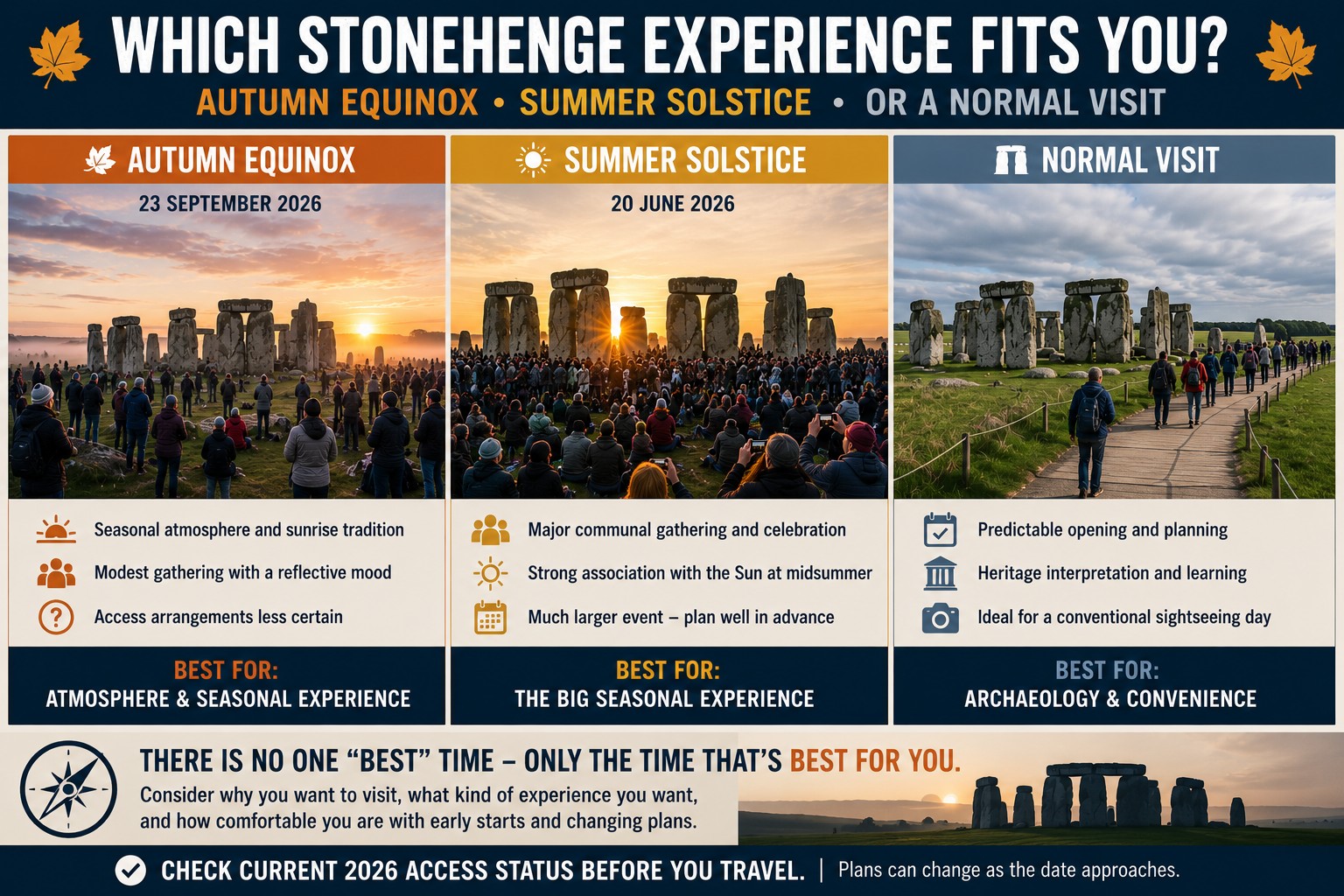
Autumn Equinox, Summer Solstice and a normal Stonehenge visit offer very different experiences. The best choice depends on whether you prioritise seasonal atmosphere, a major communal gathering, or archaeology and straightforward sightseeing
🌱 Experiencing the Equinox Responsibly
A seasonal gathering at Stonehenge brings visitors into one of Britain’s most important archaeological landscapes. Any opportunity to experience the monument under unusual access arrangements should increase the sense of responsibility towards the site rather than reduce it.
Follow all current managed-access guidance, remain within permitted areas and treat both the stones and the surrounding archaeological landscape with care. Stonehenge is much more than the visible stone circle: earthworks, buried archaeology and the wider prehistoric landscape all contribute to its significance.
Respect the people around you as well. Modern spiritual observance is part of the contemporary equinox gathering, even if you are attending primarily as a traveller, photographer or history enthusiast. Give ceremonies and personal observances appropriate space, and avoid obstructing other visitors simply to secure a photograph.
Where practical, consider shared transport and follow any special traffic or parking instructions issued for the event. Take everything you bring away with you and leave no litter behind.
Stonehenge has survived for thousands of years. Experiencing it at a significant seasonal moment should strengthen our reasons for protecting it for those who come after us.
Travel with purpose. Explore with care.
❓ Frequently Asked Questions
❓ When Is the Stonehenge Autumn Equinox in 2026?
The astronomical Autumn Equinox occurs on 23 September 2026. It marks the beginning of astronomical autumn in the Northern Hemisphere.
Remember that the astronomical equinox itself is a precise moment, whereas any Stonehenge gathering or special visitor access is organised separately around the seasonal occasion. Check current visitor information for the final 2026 event timetable rather than assuming that the astronomical timing determines when access will take place.
❓ Can You Visit Stonehenge at Sunrise for the Autumn Equinox?
Stonehenge has an established modern tradition of visitors gathering around the equinox to watch sunrise, and previous Autumn Equinox events have operated under special managed arrangements.
However, exact arrangements can change. Confirm the 2026 access times, entry conditions, parking and other visitor instructions before making a journey specifically for sunrise.
This is especially important if attending the sunrise is the principal reason for your trip or if your accommodation, transport or wider itinerary depends upon the gathering operating in a particular way.
❓ Is Autumn Equinox Access Free?
Do not assume that arrangements from a previous year will automatically apply in 2026.
Previous Autumn Equinox gatherings at Stonehenge have included free Managed Open Access, but event arrangements can change. Check the current official information before travelling to confirm whether access is free, whether any booking procedure applies and whether there are separate parking or transport charges.
This is particularly important if free special access is one of the main reasons you are considering the journey. The overall cost of attending can also include early-morning transport, accommodation and parking, so consider the complete journey rather than access to the monument alone.
❓ Can You Go Inside the Stone Circle?
Any opportunity to enter the monument field or approach the stones during an Autumn Equinox gathering depends on the access conditions established for that particular event.
Equinox access should not be confused with a separately scheduled Stonehenge Inner Circle or special-access experience. The two operate for different purposes and under different arrangements.
If proximity to the stones is your main priority, investigate dedicated special-access opportunities rather than assuming that the equinox will provide the experience you want. This can also give you greater freedom to choose a date that fits naturally within the rest of your journey rather than organising the trip around the equinox itself.
❓ Do Druids Celebrate the Autumn Equinox at Stonehenge?
Yes, modern Druids and other pagan or spiritual practitioners may attend Stonehenge around the Autumn Equinox, alongside photographers, travellers, history enthusiasts and people simply interested in experiencing the sunrise.
Their observance forms part of Stonehenge’s continuing modern cultural story. However, contemporary practice should not be treated as evidence of an unchanged ritual tradition extending directly back to the monument’s prehistoric builders.
❓ Was Stonehenge Built for the Equinox?
There is no established archaeological evidence that Stonehenge was deliberately designed to mark the spring or autumn equinoxes in the same way that its architecture relates to the solstices.
The strongest demonstrated solar relationship concerns the midsummer sunrise and midwinter sunset.
That distinction does not diminish the modern Autumn Equinox gathering. It simply separates what archaeology can demonstrate about prehistoric Stonehenge from the meanings people give the monument today.
❓ Is Autumn Equinox as Busy as Summer Solstice?
Generally, no. The Autumn Equinox has traditionally been a much smaller gathering than Stonehenge’s Summer Solstice celebrations.
Summer Solstice can attract very large crowds and has developed into a major annual event with substantial transport, access and visitor-management requirements. The Autumn Equinox usually has a quieter, smaller-scale character, which can appeal to visitors who want to experience a seasonal gathering without the intensity of Stonehenge’s largest celebration.
That does not mean an equinox morning will feel empty. Attendance can vary, and visitors should expect to share the experience with other people who have made the early journey.
Rather than planning around an assumed crowd size, approach the Autumn Equinox as a shared seasonal experience whose atmosphere will depend partly on the people, weather and conditions on the morning itself.
If crowd scale is an important factor in your decision, remember that a normal Stonehenge visit offers a different kind of predictability again. The choice is not simply between two seasonal gatherings; conventional visiting remains a strong alternative for travellers who place greater value on interpretation and straightforward planning.
❓ Is the Autumn Equinox Worth Attending?
Yes—if sunrise, seasonal atmosphere and Stonehenge’s continuing modern cultural story genuinely interest you.
The experience is less compelling if your priorities are conventional sightseeing, predictable logistics, detailed heritage interpretation or simply seeing Stonehenge for the first time. In those circumstances, a normal daytime visit may provide considerably more value.
The strongest reason to attend is therefore not exclusivity. It is wanting to experience this particular seasonal moment at this particular place.
If that description genuinely matches your motivation, the additional planning, early start and uncertainty surrounding the weather may feel entirely proportionate to the experience. If it does not, choosing another Stonehenge experience is likely to strengthen rather than diminish your wider trip.
🎯 Final Verdict: Is Stonehenge Worth Visiting for the Autumn Equinox?
Stonehenge can be a remarkable place to experience the Autumn Equinox.
The combination of sunrise, Salisbury Plain and a monument whose history is deeply connected with the changing position of the Sun gives the morning a powerful atmosphere. Modern seasonal observance adds another layer to Stonehenge’s continuing cultural story.
But two distinctions matter.
The Autumn Equinox should not be presented as archaeologically equivalent to Stonehenge’s established solstitial alignments. The strongest evidence connects the monument’s architecture with the midsummer sunrise and midwinter sunset, while today’s equinox gatherings belong principally to Stonehenge’s continuing modern cultural life.
Travellers should also avoid building inflexible plans around specific 2026 event arrangements until those details have been officially confirmed. The date of the equinox can be predicted precisely; parking arrangements, Managed Open Access, access times and visitor restrictions are operational decisions that can change from year to year.
For some visitors, none of that uncertainty will diminish the appeal. If you value sunrise, seasonal atmosphere and the opportunity to witness how people continue to find new meaning in an ancient landscape, an Autumn Equinox morning could become one of the most memorable parts of your trip.
For others, a conventional September visit will provide more interpretation, easier logistics and a better overall experience. That is not a lesser way to see Stonehenge. Indeed, first-time visitors primarily interested in archaeology may gain considerably more from exploring the monument and its wider landscape during normal visiting hours.
And if your principal ambition is to experience Stonehenge from much closer to the stones, a dedicated Inner Circle opportunity may provide a better match than organising the journey around the equinox. Separating these different visitor experiences allows you to choose according to what genuinely matters rather than assuming that seasonal access is automatically the most rewarding option.
The best decision therefore comes back to why you want to be there.
If the Autumn Equinox itself is meaningful to you, the early start, unpredictable weather and unusual atmosphere can all become part of the experience. If your real objective is simply to see and understand Stonehenge, there is no need to organise your journey around one particular sunrise.
Both approaches are valid ways to encounter a monument that has witnessed changing seasons—and changing human interpretations of those seasons—for thousands of years.
Visit for the Autumn Equinox because the seasonal experience matters to you—not because you believe it is the only authentic way to experience Stonehenge.