


Stonehenge Inner Circle Sunrise or Sunset Tours: Which Should You Choose? (2027 Guide)
8th September 2026
🗿 Stonehenge Inner Circle Sunrise or Sunset Tours: Which Should You Choose? (2027 Guide)
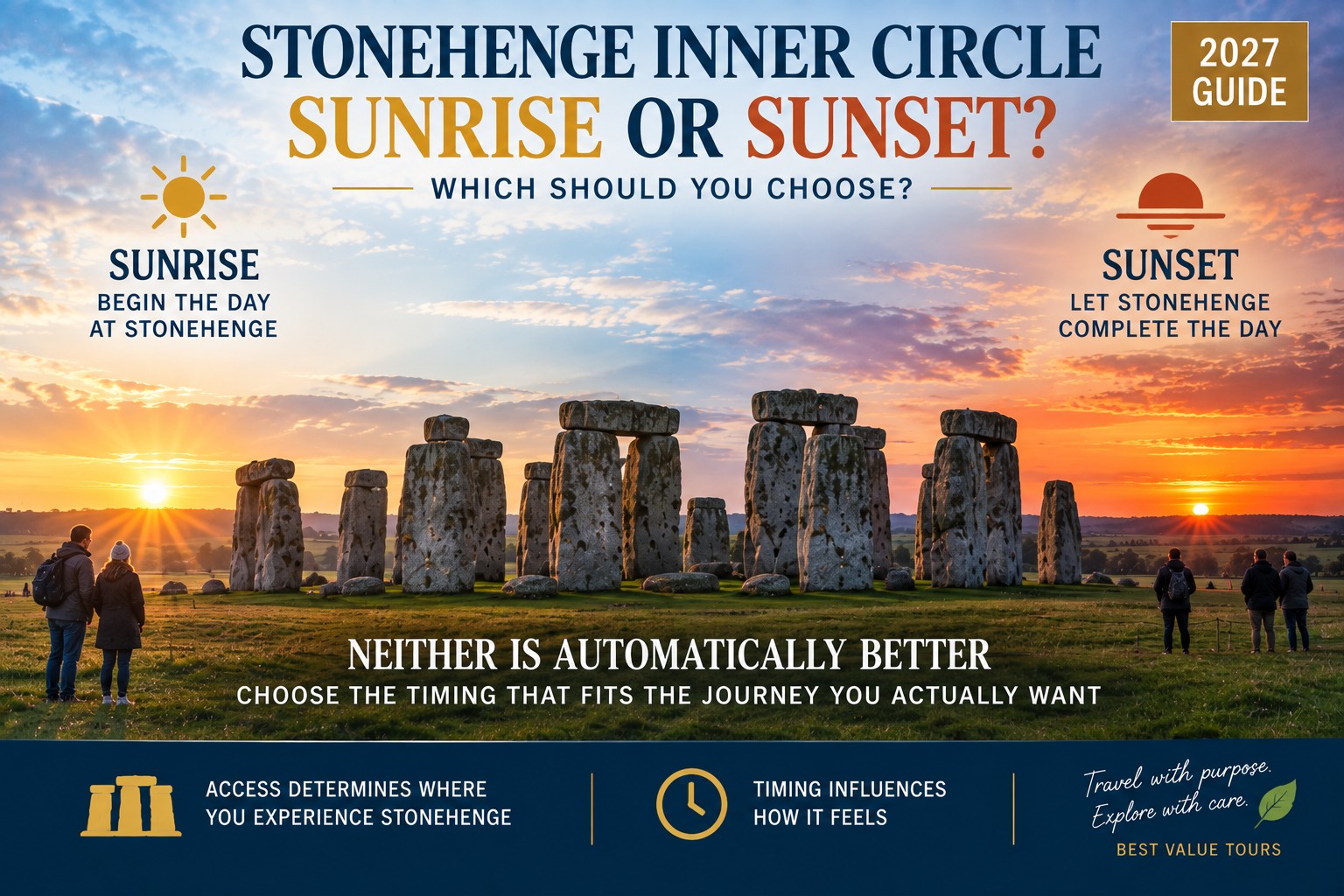
Sunrise can make Stonehenge the beginning of your day, while sunset can turn it into the culmination. Neither is automatically better—the strongest choice is the timing that fits the Inner Circle experience and wider journey you actually want
A Stonehenge Inner Circle visit can already feel very different from a standard daytime experience. Add sunrise or sunset into the decision, and the choice becomes even more distinctive—but also more complicated.
Sunrise has the appeal of beginning the day at one of Britain’s most extraordinary prehistoric monuments, potentially experiencing the landscape as morning light develops. Sunset creates a different rhythm: Stonehenge becomes the culmination of the day, with evening light and the gradual transition towards dusk shaping the atmosphere.
Neither is automatically better.
The right choice depends on far more than which photograph you imagine taking. You need to consider the time of year, how early or late you are comfortable travelling, where you are staying, who you are travelling with, how the experience fits into the rest of your itinerary and, importantly, which specialist-access opportunities are realistically available.
There is also one expectation worth establishing immediately: choosing a sunrise or sunset experience does not mean you can choose the weather. Cloud, rain, haze and changing conditions may affect the light you see, while the Inner Circle experience itself can still remain exceptional.
The most useful question is therefore not:
“Is sunrise or sunset better?”
It is:
“Which timing gives me the Stonehenge experience I want while still fitting comfortably into the journey I am actually taking?”
And if entering the Inner Circle matters significantly more to you than whether that happens around sunrise or sunset, availability may ultimately deserve to lead the decision.
🌅🌇 What Is the Real Difference Between Sunrise and Sunset Inner Circle Tours?
At first glance, the difference appears obvious: one takes place around the beginning of the day and the other towards its end. In practice, the choice can influence the atmosphere of your visit, the natural light, your energy levels, your departure or return arrangements and the entire shape of the day surrounding Stonehenge.
A sunrise experience can make Stonehenge feel like the opening chapter of the day’s journey. You may begin unusually early, experience the monument while the morning develops and still have a substantial part of the day available afterwards.
A sunset experience reverses that rhythm. You may spend the earlier part of the day sightseeing or travelling before Stonehenge becomes the final major experience, potentially followed by a later journey back to your accommodation.
Those differences matter because a time that sounds ideal in isolation may be much less attractive once the logistics are considered. A traveller who loves the idea of sunrise may discover that the required early start conflicts with hotel location, family routines or plans from the previous evening. Someone who dislikes early mornings may prefer sunset until they realise that a later seasonal finish affects dinner, transport or the following day’s plans.
🗿 Inner Circle Access and Time of Day Are Two Separate Decisions
The most important distinction is that Inner Circle access and sunrise or sunset timing are not the same decision.
Inner Circle access concerns the type of Stonehenge experience you are seeking. Sunrise and sunset concern the timing and atmosphere around that experience.
A useful principle is:
Access determines where you experience Stonehenge. Timing influences how that experience feels.
Keeping those two questions separate will make every later decision easier.
📊 Sunrise vs Sunset Inner Circle Tours: Quick Comparison
The easiest way to begin narrowing the choice is to compare the factors that can genuinely affect your experience. Neither sunrise nor sunset wins every category, because many of the apparent advantages depend on season, weather, your itinerary and personal preference.
| Decision Factor | Sunrise Inner Circle | Sunset Inner Circle | What Really Matters |
|---|---|---|---|
| Overall character | Stonehenge at the beginning of the day | Stonehenge towards the end of the day | The experience you prefer |
| Natural light | Developing morning light | Fading evening light | Weather and season |
| Travel timing | Earlier start | Later finish | Accommodation and itinerary |
| Photography | Distinctive photographic potential | Distinctive photographic potential | Conditions and photographic goals |
| Rest of the day | Much of the day may remain | Earlier part of the day may be available | Wider travel plans |
| Families | Early waking may be difficult | Later return may be difficult | Children’s routines and stamina |
| Couples | Memorable early experience | Atmospheric evening experience | Personal preference |
| Weather certainty | No guarantee | No guarantee | Realistic expectations |
| Availability | Depends on actual access opportunities | Depends on actual access opportunities | Your dates and flexibility |
The table highlights an important point: the best choice is rarely determined by one factor alone.
You may prefer the idea of sunset but discover that sunrise works considerably better with your accommodation and onward journey. Alternatively, you may normally dislike early starts but decide that the particular atmosphere you want from Stonehenge makes one exceptional morning worth the inconvenience.
The aim is not to accumulate more advantages in one column. It is to identify which differences actually matter to you.
🌅 What Does a Stonehenge Inner Circle Sunrise Experience Feel Like?
Sunrise has a particular psychological appeal because Stonehenge becomes the beginning of the day rather than simply one attraction within it.
There is anticipation in travelling towards the monument while most of the day’s activity still lies ahead. As natural light develops, the surrounding landscape can gradually reveal itself, changing the visual character of the stones and creating a strong sense of transition from night or early morning into day.
For photographers, those changing conditions can be part of the attraction. For other visitors, the appeal may have little to do with photography. Simply beginning a significant travel day within one of Britain’s best-known prehistoric landscapes can provide the sense of occasion they were hoping for.
But it is important not to build the experience around an imagined perfect sunrise. Cloud may obscure the sun completely. The light may be subdued rather than dramatic, and weather conditions can change quickly.
The stronger reason to choose sunrise is therefore that the early-morning character of the experience appeals to you even if the sky does not perform exactly as hoped.
⏰ The Practical Reality of Choosing Sunrise
The sunrise decision begins long before you reach Stonehenge.
You need to work backwards from the access arrangements and consider when you must arrive, how you will reach the relevant departure point, how long you need to prepare beforehand and therefore when your day actually begins.
If you are staying some distance away, the practical morning may start considerably earlier than the Stonehenge experience itself. This is especially important when your journey involves reaching a separate meeting or departure point before travelling onwards to the monument.
Season matters too. Sunrise does not occur at the same clock time throughout the year, so the practical demands of an early experience can change substantially between different periods.
Also consider the evening before. A very early morning can feel much less appealing after a late dinner, theatre visit, long flight or demanding previous sightseeing day.
Do not judge a sunrise tour only by the time you reach Stonehenge—judge the entire morning required to get there.
🌇 What Does a Stonehenge Inner Circle Sunset Experience Feel Like?
Sunset creates almost the reverse rhythm. Rather than Stonehenge opening the day, the monument can become its culmination—a significant experience towards which the rest of the day’s journey gradually builds.
As daylight begins to soften and fade, the stones and surrounding landscape can take on a different visual character. When conditions cooperate, changing evening light may produce striking contrasts, silhouettes or warmer tones. Yet the attraction of sunset does not depend entirely on photography. Some travellers simply prefer arriving at an important destination later in the day, when there is no pressure to wake extremely early and the visit feels like a memorable conclusion rather than a beginning.
This can be particularly appealing to couples and visitors celebrating a special occasion, but sunset should not automatically be described as the more romantic choice. A clear, crisp sunrise may feel every bit as memorable to one couple, while another may value the evening atmosphere more. The better experience remains personal.
As with sunrise, it is important to separate the experience you can choose from the conditions you cannot. A sunset visit may coincide with spectacular evening light, subdued cloud or something in between. The Inner Circle experience should therefore be the principal reason for choosing it, with a dramatic sunset regarded as a possible enhancement rather than a promise.
🌙 The Practical Reality of Choosing Sunset
Sunset avoids one obvious challenge associated with sunrise: the extremely early beginning to the day. But that does not mean it is automatically the easier option.
A later Stonehenge experience can push meals, accommodation arrangements and onward travel further into the evening. If you have already spent several hours sightseeing, the visit may also arrive when you are more tired than you expected.
Season again matters. Evening daylight lasts much longer during some parts of the year than others, so the practical meaning of a “sunset” experience changes as the seasons progress. Rather than assuming a comfortable evening schedule, consider the complete journey from your morning plans through Stonehenge and finally back to your accommodation.
This is particularly important if you have an early departure or substantial journey planned for the following morning.
Avoiding an early start does not remove a timing compromise—it may simply move it to the end of the day.
☁️ You Can Choose the Timing, But You Cannot Choose the Weather
Sunrise and sunset photographs are among the most powerful reasons travellers become interested in these experiences. They can also create unrealistic expectations.
British weather does not work to a sightseeing schedule. Cloud may conceal the sunrise completely, an anticipated sunset may disappear behind an overcast sky, and conditions can change between checking a forecast and arriving at Stonehenge.
That does not mean the experience has failed.
Inner Circle access gives the visit its fundamental character. Light and weather influence how that experience looks and feels on the day, but they should not determine its entire value.
You can choose the timing of your experience. You cannot book the weather.
🌦️ What If the Sunrise or Sunset Is Hidden?
A cloudy sky does not turn an Inner Circle visit into a wasted opportunity. Stonehenge can feel dramatically different under mist, broken cloud, rain or muted early light, and some visitors may find those conditions every bit as atmospheric as the clear sky they originally imagined.
The sensible approach is to separate the specialist access you are planning from the weather you hope to experience. If being within the Inner Circle is the principal attraction, the visit can still fulfil its purpose even when the sun itself remains hidden.
Be cautious about reorganising an entire itinerary around a distant weather forecast. Conditions can change, while suitable Inner Circle opportunities may be much less flexible than the forecast suggests.

Sunrise and sunset can both produce remarkable conditions at Stonehenge, but neither guarantees the sky you imagine. Choose the Inner Circle experience and timing that suit your journey, and treat exceptional light as a bonus rather than a booking promise
📸 Sunrise or Sunset: Which Is Better for Photography?
There is no universal photographic winner. Sunrise and sunset can both produce exceptional images, but the better choice depends on what you want to photograph, the season and the conditions you encounter.
Morning light can gradually reveal the monument and surrounding landscape, potentially giving photographers changing conditions within a relatively short period. Evening light offers its own possibilities as brightness falls and the relationship between the stones and sky changes towards dusk. Cloud cover, haze and weather can transform either situation.
It is therefore more useful to decide what matters photographically. Are you hoping for silhouettes, visible detail in the stones, a wider landscape composition, changing skies or photographs that capture people experiencing Stonehenge? Those objectives may influence your preference more intelligently than simply assuming that one end of the day always provides “better light”.
Photography should also remain secondary to any access instructions in force during your visit. The opportunity to take memorable photographs does not override the need to respect the monument, guides, site staff or other visitors sharing the experience.
📱 If Photography Is Not Your Main Priority
Most visitors are not travelling to Stonehenge to produce a professional photographic portfolio. If you mainly want a few memorable photographs on your phone or camera, there is little reason to let theoretical differences in light dominate the decision.
You may gain considerably more from choosing the timing that leaves you rested, relaxed and able to appreciate where you are. A technically less dramatic sky experienced comfortably can produce a better travel memory than ideal light reached after an exhausting schedule.
🎒 Practical Photography Considerations
Prepare whatever camera or phone you intend to use before the experience begins. Check batteries and available storage, protect equipment appropriately if the weather is poor, and remember that colder conditions can affect battery performance.
Most importantly, avoid experiencing the entire visit through a screen. Take the photographs you value, then give yourself time simply to look at the stones and surrounding landscape. For many visitors, the moments when the camera is lowered become as memorable as the photographs themselves.
📅 How Season Changes the Sunrise-vs-Sunset Decision
A sunrise preference in one month can create a very different travel day from the same preference in another. Daylight times change significantly through the year, altering both when you may need to start and how much usable daylight remains afterwards.
The same applies to sunset. Longer summer evenings can push the end of the experience later, while shorter winter days change how much sightseeing can realistically fit before it.
Season also affects temperature, clothing, weather exposure and traveller comfort. The question is therefore not simply “Do I prefer sunrise or sunset?” but “What does that preference mean at the time of year I am actually visiting?”
🌱 Spring and Autumn
Spring and autumn can offer a useful middle ground between the daylight extremes of summer and winter, but conditions remain variable. Sunrise and sunset occur at progressively changing times, so travellers should check what their preferred timing actually means for their specific travel period rather than relying on a general impression of the season.
Temperatures can also vary considerably. Layers, weather protection and sensible footwear may matter more to the enjoyment of an early or late experience than trying to predict precisely what the sky will look like.
☀️ Summer
Summer creates some of the most significant timing considerations. Longer daylight means sunrise can occur particularly early, while sunset can fall much later in the evening. That can make either option appealing while also making the surrounding travel schedule more demanding.
There is an important distinction here: a conventional Inner Circle sunrise experience should not be confused with Stonehenge’s summer solstice sunrise celebrations. The summer solstice is a distinct event with its own access arrangements, visitor context and atmosphere. Travellers specifically interested in the solstice should plan for that experience separately rather than treating it as another sunrise Inner Circle tour.
❄️ Winter
Shorter winter days change the equation again. Sunrise occurs later and sunset earlier than during summer, potentially reducing some of the extreme timing associated with either choice.
The trade-off is that colder temperatures, shorter daylight and potentially difficult weather can influence comfort and the amount of sightseeing you can realistically build around Stonehenge. A later sunrise may be convenient, for example, but the shorter day may leave less time for an ambitious onward itinerary.
🧭 How Sunrise or Sunset Shapes the Rest of Your Day
One of the easiest planning mistakes is to treat the Stonehenge visit as an isolated appointment. In reality, choosing sunrise or sunset can determine the architecture of almost the entire day.
Ask what else you genuinely want to achieve. If Stonehenge is the day’s unquestioned priority, arranging other activities around it may be straightforward. If it forms part of a more ambitious southern England itinerary, however, the timing can influence everything from meals and transport to how long you can comfortably spend at another destination.
Choose the whole travel day, not merely the moment at Stonehenge.
🌅 If Stonehenge Comes First
A sunrise experience may leave a substantial part of the day available afterwards. Depending on your wider arrangements, that could mean returning towards London, continuing elsewhere in southern England or simply enjoying a slower afternoon after an unusually early start.
Do not assume that finishing Stonehenge early means you should fill every remaining hour. An early start can catch up with you later, particularly after a busy previous day. Building some flexibility into the afternoon can make the overall journey more enjoyable.
If you do want to continue sightseeing, think in terms of a coherent route rather than the maximum possible number of stops. A well-paced day with enough time to appreciate each place is usually more rewarding than an itinerary that looks impressive on paper but feels rushed in practice.
🌇 If Stonehenge Comes Last
Sunset allows the opposite structure. Other sightseeing can potentially take place earlier, with Stonehenge becoming the principal experience towards the end of the day.
This can create an excellent sense of progression, but pacing matters. Filling every available hour before Stonehenge may leave you tired precisely when you reach the experience you valued most.
Allow sensible margins for travel and avoid making the day dependent on an unrealistically tight sequence of activities. If Stonehenge is meant to be the highlight, protect enough time and energy for the reason you planned the day in the first place.
🏨 Does Where You Stay Change the Best Choice?
Where you spend the night before or after your visit can materially change whether sunrise or sunset feels convenient.
A traveller based in London may face a very different morning from someone already staying closer to Stonehenge. Likewise, someone travelling through southern England on a multi-day journey may have considerably more freedom to organise accommodation around the experience rather than making Stonehenge fit around a fixed city base.
For sunrise, work backwards from where you need to be at the required time. Consider the journey from your accommodation, any separate meeting or departure point and the preparation time you need before leaving. A sunrise experience that looks attractive on paper can become less appealing if reaching it requires an impractically early start.
Sunset raises the reverse questions. Think about where you will stay afterwards, how you will get there and whether a later finish creates difficulties with meals, transport or check-in arrangements.
This does not mean you necessarily need to stay near Stonehenge. It means accommodation should be treated as part of the decision rather than something to arrange independently afterwards.
👤 Which Travellers Are Most Likely to Prefer Sunrise?
Sunrise is particularly worth considering if you naturally enjoy early mornings and like the idea of Stonehenge setting the tone for the rest of your day.
It can also suit travellers who want substantial time available afterwards, those whose accommodation or departure arrangements make an early journey straightforward, and photographers specifically interested in morning conditions. If you would rather accept one unusually early start than finish your sightseeing late in the evening, sunrise may also fit your natural travel rhythm better.
You may be less suited to sunrise if early starts noticeably reduce your enjoyment, if the previous evening is already important, or if travelling companions would find the schedule difficult.
The key is not whether you can wake up early. It is whether doing so will enhance or diminish an experience you have travelled specifically to enjoy.
👤 Which Travellers Are Most Likely to Prefer Sunset?
Sunset may suit travellers who strongly dislike very early mornings or who prefer to build towards Stonehenge as the major experience of the day.
It can work well when the earlier hours have a clear purpose but are not so demanding that you arrive exhausted. Travellers interested in evening photography may also prefer it, while couples or those marking a special occasion may simply find the end-of-day atmosphere personally appealing.
A sunset experience becomes less attractive when a later return causes difficulties with accommodation, transport, dinner or an important early commitment the following morning.
Again, the objective is not to identify a stereotypical “sunset traveller”. It is to recognise whether the rhythm fits you.
⭐ Editor’s Recommended Tour: Stonehenge Inner Circle at Sunset
If the evening timing itself is an important part of the experience you want, the Stonehenge Inner Circle Tour at Sunset provides the most direct match to that priority.
It is particularly appropriate for travellers who prefer Stonehenge to become the culmination of the day and who are comfortable with the later travel arrangements that can accompany an evening experience.
Choose it because the sunset format genuinely suits your travel rhythm—not because clear skies or dramatic evening colour can ever be guaranteed.
Stonehenge Inner Circle Tour at Sunset:
https://www.bestvaluetours.co.uk/tours/day-tours/stonehenge-tours/inner-circle-tours/stonehenge-inner-circle-sunset-tour/
👨👩👧 How the Choice Changes for Different Travellers
Two people travelling on exactly the same date can reasonably reach opposite conclusions. Personal circumstances matter because sunrise and sunset place different demands on the hours surrounding the experience.
🌍 First-Time and Overseas Visitors
First-time visitors can place considerable pressure on themselves to create the “perfect” Stonehenge experience. Overseas travellers may add jet lag, unfamiliar transport and a tightly scheduled UK itinerary to that pressure.
Try not to make the wider trip unnecessarily difficult for an idealised sunrise or sunset. A comfortable, realistic Inner Circle experience is likely to be more rewarding than theoretically perfect timing surrounded by exhausting logistics.
❤️ Couples and Special Occasions
Couples may be drawn instinctively towards sunset because evening light and the conclusion of the day can sound romantic. That can be a perfectly valid preference, but it should not become an automatic rule.
For some couples, sharing an unusually early start and experiencing Stonehenge at the beginning of the day may feel more distinctive. The better choice is the one that suits the occasion, your normal travel rhythm and what you want to remember about the experience—not somebody else’s idea of what should feel romantic.
👨👩👧 Families
For families, practical timing may deserve more weight than subtle differences in atmosphere. A very early start can be difficult for children who need a normal night’s sleep, while a late finish can become equally challenging after a full day of sightseeing.
Think about your children’s ages, usual routines, meal times and tolerance for long travel days. If one timing allows everyone to arrive rested and interested rather than tired and irritable, that may be the stronger choice regardless of the theoretical photographic advantages of the alternative.
🧍 Solo Travellers
Solo travellers often have greater freedom to organise unusual timings around their own preferences. There is no need to negotiate different sleep schedules or competing priorities, which can make either sunrise or sunset easier to accommodate.
Even so, practical arrangements still matter. Consider how you will reach the departure point, what happens at the end of the experience and whether you are comfortable with the early or late travel involved. Independence is useful only when the itinerary remains straightforward and enjoyable.
⭐ Editor’s Recommended Tour: Inner Circle Access in a Small Group
For travellers who value specialist Stonehenge access but also prefer travelling with fewer people, the Stonehenge Inner Circle Tour with Small Group offers a distinct alternative to choosing purely by time of day.
This can be particularly attractive to solo travellers, first-time visitors and anyone who values a smaller shared touring environment around the wider Stonehenge journey.
The important distinction remains the same as elsewhere in this guide: choose the tour because both the access arrangement and the touring format suit you. Small-group travel should not automatically outweigh itinerary, timing or practical convenience.
Stonehenge Inner Circle Tour with Small Group:
https://www.bestvaluetours.co.uk/tours/day-tours/stonehenge-tours/inner-circle-tours/stonehenge-inner-circle-special-access-tour-from-london/
📸 Serious Photographers
If photography is one of the principal reasons for your visit, sunrise versus sunset may legitimately carry more weight. Your preferred style, the season, potential light and the compositions you hope to create can all influence the decision.
Weather remains the major uncertainty. A photographer who chooses one timing should be comfortable with the possibility that conditions will produce something entirely different from the image originally envisaged. If photography is genuinely central to the trip, flexibility may ultimately be more valuable than declaring either sunrise or sunset universally superior.
📅 Availability Can Be More Important Than Preference
By this stage, you may have developed a clear preference. Before reorganising your itinerary around it, decide how important that preference really is.
A useful approach is to place yourself in one of three categories:
Essential: You specifically want sunrise or sunset, and that timing is a major reason for choosing the experience.
Strong preference: You would choose one over the other if both were realistically available, but you would still value the alternative.
Flexible: Entering the Inner Circle matters considerably more than whether the experience takes place around sunrise or sunset.
This distinction becomes important because specialist access opportunities and your travel dates may not align perfectly. If you are flexible, rejecting a suitable Inner Circle opportunity merely because it occurs at your second-choice time could mean sacrificing the part of the experience you actually value most.
If your preference is essential, however, recognise the consequences before committing the rest of your trip. You may need greater date flexibility, different accommodation arrangements or a willingness to reorganise other sightseeing. That can be worthwhile when the timing itself is fundamental to why you are travelling—but it should be a conscious decision rather than an assumption.
Do not lose the experience you most value while chasing the timing you merely prefer.
📅 BVT Stonehenge Inner Circle Access Calendar (2026–2027)
Once you understand your preferred experience, the next stage is to establish what is realistically possible.
The BVT Stonehenge Inner Circle Access Calendar (2026–2027) is designed to help visitors understand specialist-access opportunities and plan around the dates relevant to their journey.
Use the calendar as part of a simple planning sequence:
- Decide what experience you prefer. Sunrise, sunset or simply Inner Circle access?
- Check which opportunities are realistic for your travel period.
- Test those possibilities against your accommodation, transport and wider itinerary.
- Build the rest of the journey around the strongest feasible option rather than an imagined ideal that may not be available.
The calendar should be treated as a planning resource rather than a guarantee. Availability can change, and individual tour arrangements may differ, so always confirm the specific experience and current booking conditions before committing the rest of your itinerary.
This approach is especially useful for 2027 planning because it separates preference from feasibility. You can begin with the experience you would most like, then make an informed decision once you understand the opportunities around your actual dates.
🔄 What If Your Preferred Sunrise or Sunset Tour Is Not Available?
Do not assume the entire plan has failed.
Return to the distinction between timing and access.
If your original preference was sunset, ask whether the evening atmosphere was essential or simply desirable. If it was only a preference, an available sunrise Inner Circle experience may still provide the specialist access you valued most.
The same applies in reverse. A traveller who initially imagined sunrise may discover that a sunset opportunity fits the wider trip considerably better.
If the exact timing is genuinely essential, explore whether your travel dates have enough flexibility to accommodate another opportunity. But avoid destabilising an otherwise excellent itinerary unless the benefit is genuinely important to you.
Sometimes the best decision is to preserve the wider journey and accept your second-choice timing. Sometimes the Stonehenge experience is important enough to justify moving other plans.
There is no universal answer. The objective is to know which compromise you are making and why.
⚖️ What Matters Most: Sunrise, Sunset or Inner Circle Access Itself?
This is the decision that can simplify everything else.
Imagine that only one realistic Inner Circle opportunity remains during your trip, and it is at the opposite time from the one you originally preferred.
Would you take it?
If the answer is immediately yes, Inner Circle access probably matters more to you than exact timing.
If you would rather miss the Inner Circle than give up your preferred sunrise or sunset experience, timing is clearly central to what you are trying to achieve.
Neither answer is wrong.
Ask yourself:
Which opportunity would you regret missing more?
Your answer reveals the true priority more effectively than comparing another list of sunrise and sunset advantages.
Once you know whether exact timing or Inner Circle access is the priority, the next question is what kind of wider journey you want to build around that experience.
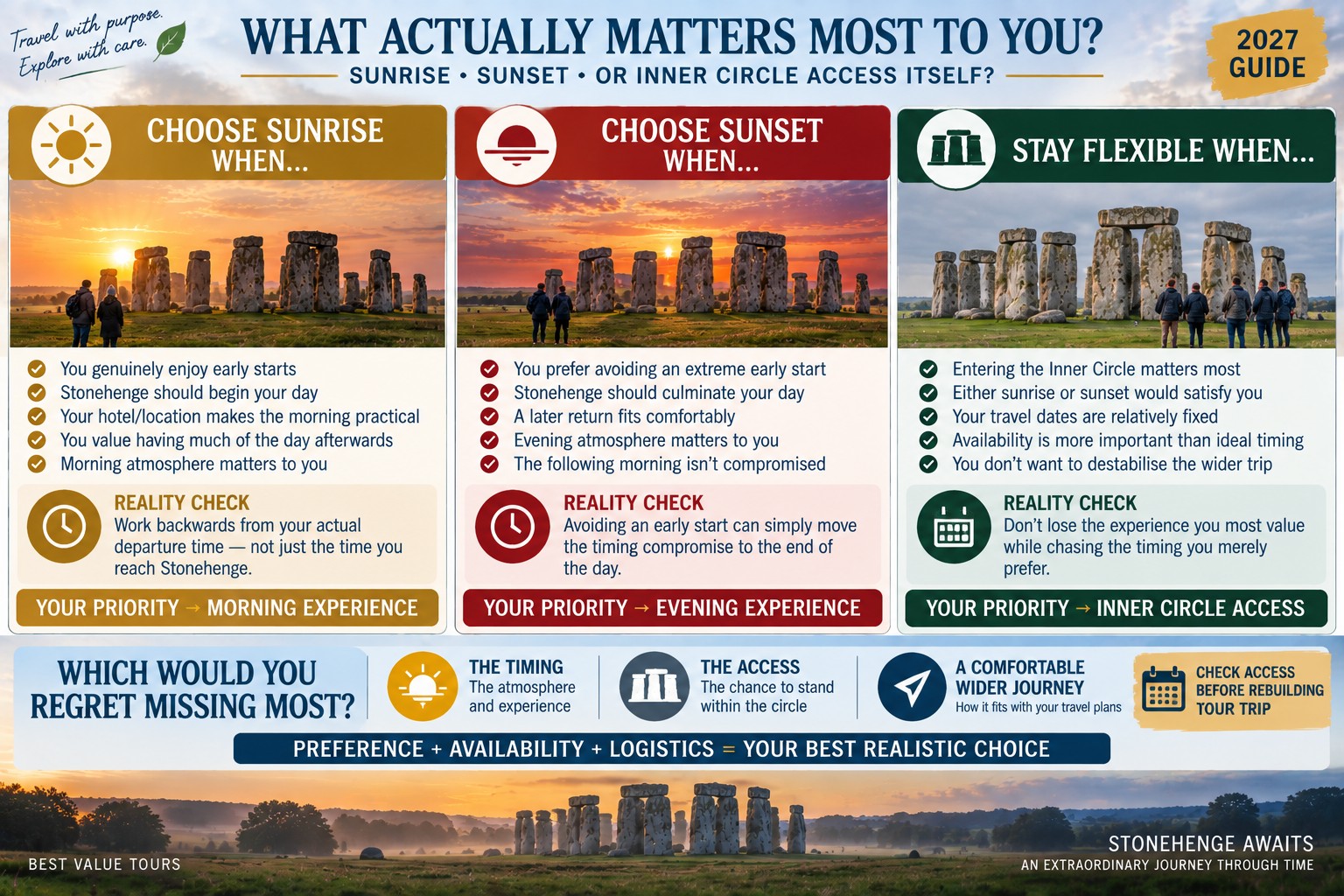
Choose sunrise when beginning the day at Stonehenge genuinely suits you, sunset when an evening culmination fits your journey, or stay flexible when securing Inner Circle access matters more than exact timing. The best realistic choice balances preference, availability and logistics
⭐ Editor’s Recommended Tours: Choose the Journey Around Your Inner Circle Experience
Once you have established that Inner Circle access matters more than pursuing one exact time of day, the next decision is what kind of wider journey you want Stonehenge to form part of.
For travellers who want major historic destinations alongside Stonehenge, Stonehenge Inner Circle Tour with Bath & Lacock combines the specialist-access experience with Bath and the historic village of Lacock.
If Windsor is one of your priorities, Stonehenge Inner Circle Tour with Windsor provides a different classic-English itinerary, making it particularly relevant to visitors who want another internationally recognised landmark within the same journey.
Travellers whose interests lie more strongly in prehistoric landscapes and ancient Britain may instead prefer Stonehenge Inner Circle Tour with Avebury & West Avebury, where the wider archaeological character of the day becomes part of the reason for choosing the itinerary.
None is automatically the stronger tour. Once Inner Circle access has been established as your priority, choose according to the additional places you genuinely want to experience, rather than simply selecting the itinerary containing the greatest number of stops.
Stonehenge Inner Circle Tour with Bath & Lacock:
https://www.bestvaluetours.co.uk/tours/day-tours/stonehenge-tours/inner-circle-tours/stonehenge-inner-circle-lacock-and-bath-evening-tour/
Stonehenge Inner Circle Tour with Windsor:
https://www.bestvaluetours.co.uk/tours/day-tours/stonehenge-tours/inner-circle-tours/afternoon-stonehenge-inner-circle-tour-with-windsor/
Stonehenge Inner Circle Tour with Avebury & West Avebury:
https://www.bestvaluetours.co.uk/tours/day-tours/stonehenge-tours/inner-circle-tours/stonehenge-evening-inner-circle-tour-avebury/
✅ Five-Minute Decision Framework: Which Should You Choose?
If you are still undecided, work through these questions in order. They are designed to identify the factors that genuinely affect your experience rather than simply reinforce the timing you initially imagined.
- Would you rather begin or end an important sightseeing day at Stonehenge?
- How comfortable are you with a genuinely early start?
- How comfortable are you with a later finish and return journey?
- How important is photography to your decision?
- What does sunrise or sunset actually mean during the season you are visiting?
- Where will you be staying before and after the experience?
- Will children, older relatives or other travelling companions find one timing easier?
- How flexible are your travel dates?
- Is Inner Circle access more important than the exact timing?
- Which option fits the whole journey better rather than merely sounding better in isolation?
🧭 Quick Decision Summary
Choose sunrise when the early-morning character genuinely appeals to you, the required start is practical and you like having much of the day available afterwards.
Choose sunset when you prefer Stonehenge as the culmination of the day, a later finish fits comfortably and the evening character matters to you.
Remain flexible when entering the Inner Circle is the real priority and either timing would still provide the experience you most want.
If two options still appear equally attractive, choose the one that creates the calmer, more coherent travel day.
🌱 Responsible Inner Circle Travel
Stonehenge is not simply a sightseeing backdrop. It is a protected prehistoric landscape of exceptional cultural and archaeological importance.
Inner Circle access carries an additional responsibility because the experience brings visitors into a more sensitive relationship with the monument than standard viewing arrangements.
Follow all instructions provided by guides and site staff. Respect any restrictions concerning where you may stand, walk or photograph, and never touch, climb or interfere with the stones unless explicitly permitted under the conditions of the visit.
Allow other visitors space to experience the monument as well. Specialist access can feel highly personal, but it remains a shared privilege rather than a private photographic session.
Practical preparation also contributes to responsible travel. Bring suitable clothing for the weather, wear appropriate footwear and arrive prepared so that avoidable delays do not affect the experience for others.
Where possible, consider the wider environmental impact of your journey too. Efficient shared transport, sensible itinerary planning and combining destinations coherently can reduce unnecessary travel while often creating a better visitor experience at the same time.
Travel with purpose. Explore with care.
❓ Frequently Asked Questions
Is sunrise or sunset better for a Stonehenge Inner Circle tour?
Neither is universally better. Sunrise suits travellers who enjoy early starts and like beginning the day at Stonehenge, while sunset can suit those who prefer an evening experience and a later finish. The stronger choice depends on season, logistics, accommodation, companions and personal preference.
Does a sunrise Inner Circle tour guarantee that I will see the sunrise?
No. You can choose an experience scheduled around the relevant part of the day, but weather and cloud conditions cannot be guaranteed. The sun may be obscured even when the timing is correct.
Does a sunset Inner Circle tour guarantee a dramatic sunset?
No. Evening conditions depend on the weather. A sunset-timed experience may coincide with spectacular light, subdued cloud or an overcast sky. Inner Circle access should remain the principal reason for choosing the experience.
Which is better for Stonehenge photography: sunrise or sunset?
Both can offer excellent photographic opportunities. The better option depends on your preferred photographic style, season, weather and the conditions on the day. Neither consistently guarantees superior light.
Is sunrise too early for a Stonehenge Inner Circle tour?
That depends on the season, your accommodation and the wider arrangements required to reach the experience. Judge the complete morning—including travel to any departure or meeting point—rather than looking only at the time you expect to reach Stonehenge.
Is sunset better for first-time visitors?
Not automatically. First-time visitors should prioritise the experience that best fits their itinerary and allows them to arrive rested and prepared. Inner Circle access itself may matter more than choosing sunrise or sunset.
Is sunset better for couples or special occasions?
It can be, particularly if you value the atmosphere of an evening experience, but sunset is not automatically more romantic. Some couples may prefer the shared experience of an unusually early start and sunrise. Choose according to what feels meaningful to you rather than a general assumption about romance.
Which timing is better for families?
The timing that best fits children’s sleep, meal and energy patterns is usually the stronger choice. Very early starts and late finishes can both create difficulties, so practical family comfort may deserve more weight than differences in light or atmosphere.
Does the season affect whether I should choose sunrise or sunset?
Yes. Sunrise and sunset times change substantially through the year, altering how early you may need to begin or how late you may finish. Weather, temperature and available daylight for the rest of your itinerary also vary by season.
What should I do if my preferred sunrise or sunset option is unavailable?
Decide whether the timing itself is essential or whether Inner Circle access matters more. If access is the priority, an available experience at your second-choice time may be the better decision. If timing is fundamental, consider whether your travel dates can reasonably be adjusted.
Is Inner Circle access more important than choosing sunrise or sunset?
For many travellers, yes. Inner Circle access determines the fundamental type of Stonehenge experience, while sunrise or sunset influences its timing and atmosphere. If you would happily accept either timing to secure the access you want, availability should probably lead your decision.
How far ahead should I plan a Stonehenge Inner Circle tour for 2027?
Begin planning as early as practical if Inner Circle access is an important part of your trip, particularly if your travel dates are fixed or you strongly prefer sunrise or sunset. Use current availability information when making decisions rather than assuming a particular timing will remain available.
🏁 Conclusion: Choose the Experience That Fits Your Journey
Sunrise and sunset can both create exceptional Stonehenge Inner Circle experiences, but neither deserves to be treated as the automatic winner.
Sunrise can provide the distinctive feeling of beginning your day within one of Britain’s most remarkable prehistoric landscapes. Sunset can turn Stonehenge into the culmination of the day’s journey, with evening light and the transition towards dusk shaping the atmosphere.
But the strongest choice is not necessarily the one that sounds most dramatic.
Consider the season, your accommodation, the complete travel schedule, your companions, your tolerance for early starts or late finishes, your photographic priorities and the effect the timing will have on the rest of your trip.
Then separate that preference from the more fundamental question of Inner Circle access itself.
If sunrise is essential to the experience you have imagined, plan around it deliberately. If sunset is genuinely what you value most, make the later schedule work comfortably. But if entering the Inner Circle matters more than either timing, remain flexible enough to recognise an excellent opportunity when it appears.
The best Stonehenge experience is not the one that wins a theoretical comparison. It is the one that allows you to arrive prepared, appreciate the monument properly and leave feeling that the journey worked as well as the moment itself.
Choose sunrise or sunset because the timing genuinely improves the Stonehenge experience you want. But if Inner Circle access itself matters more, let the best realistic opportunity win.